After nearly 900 years, the Trappist monks may be leaving the Abbey of Our Lady of La Trappe in Normandy, France, one of the most iconic symbols of the Cistercian tradition founded in the 12th century.
The monks, who belong to the Cistercian Order of the Strict Observance — also known as the Trappist order, which follows the Rule of St. Benedict — reported that they were considering leaving the monastery around 2028 due to “the shortage of vocations and the increasing burden of owning the land.”
For the approximately 20 brothers who make up the community located in Soligny-la-Trappe in northwestern France, this decision would signify the end of an era, although they emphasized that the abbey will not close its doors nor is it for sale at the moment.
“Discussions are underway with other communities to find more suitable solutions, more economically and spiritually relevant. The situation has been difficult for several decades now, and many other abbeys have already changed hands,” they stated on March 6.
They added that “the departure of the brothers is very trying and is painful; it will undoubtedly be a profound loss for all those connected, sometimes for generations, to the community.”
Faithful to the tradition of the Rule of St. Benedict, the monks have a guesthouse where they receive the faithful “as if they were Christ himself” and welcome them so they can experience a moment of solitude and reflection in an atmosphere of prayer and peace, as stated on their website.
They also maintain a shop where they sell books, religious articles, and regional products handcrafted at the abbey.
‘An ideological secularism that is rotting the soul of the West’
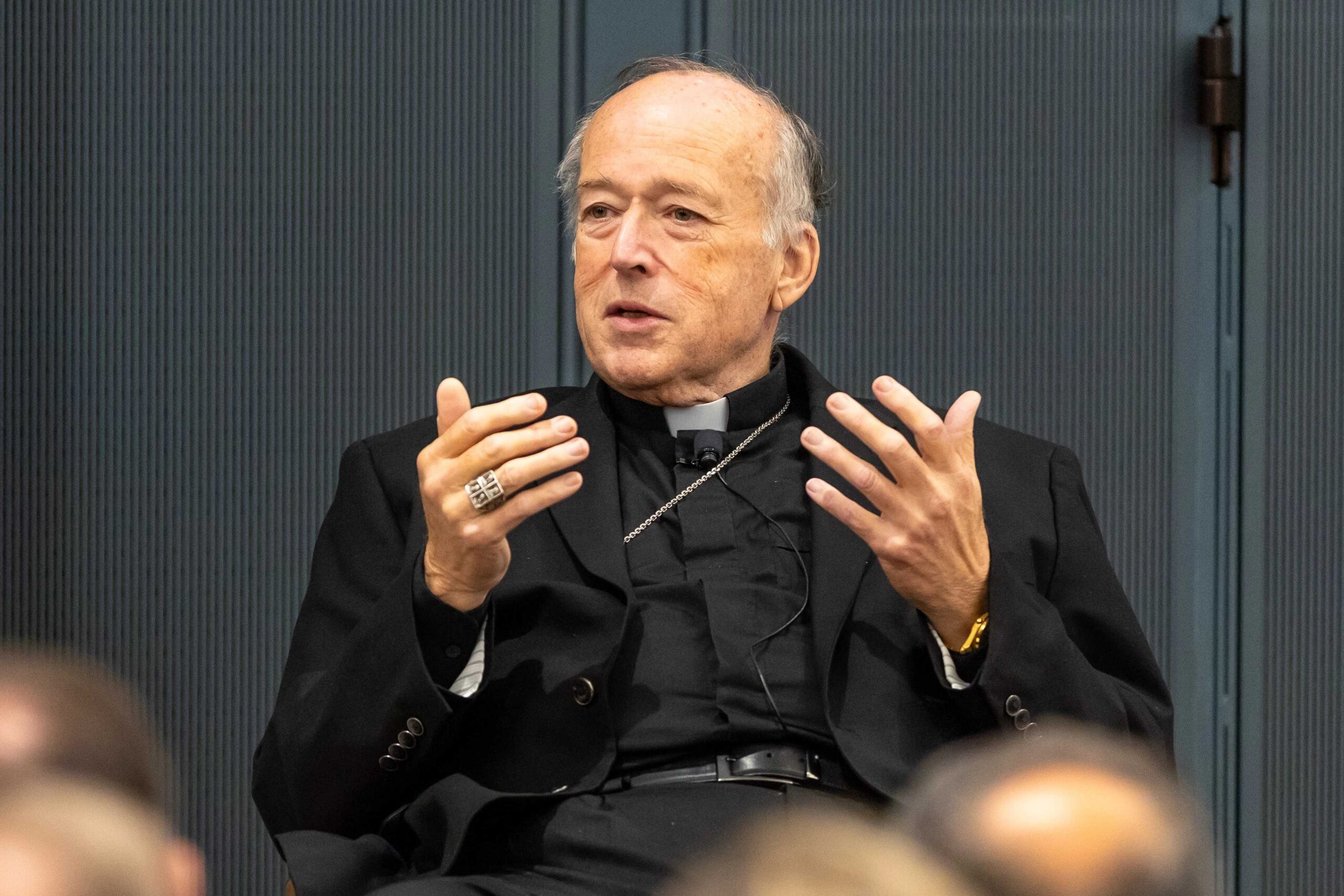
Bishop Robert Barron of the Diocese of Winona-Rochester, Minnesota, expressed his sadness at the possibility that the monks might leave the historic monastery.
The prelate noted that it is the “motherhouse of the Trappist order,” a reform of the Cistercian movement and a “particularly intense form of Benedictine life, famous for its austerity and silence.”
Barron explained that he came to know the abbey through the Trappist monk Thomas Merton, an American theologian and writer, and emphasized that the La Trappe abbey “has survived the Black Death, the Hundred Years’ War, the Protestant Reformation, the French Revolution, and the world wars of the 20th century.”
“That this venerable monastery cannot find enough vocations to keep it alive is, in my judgment, a sign of the spiritual disaster that has befallen Europe in the last hundred years: an ideological secularism that is rotting the soul of the West,” he lamented.
Given this situation, the bishop asked for renewed prayers so that the monks “might find a way to preserve their great abbey. It is needed especially now.”
This story was first published by ACI Prensa, the Spanish-language sister service of EWTN News. It has been translated and adapted by EWTN News English.
In recent days, Christian villages in southern Lebanon have garnered widespread attention across media and social networks, praised for their resilience and peaceful resistance as many residents chose to remain in their homes despite the dangers of ongoing hostilities.
But on Monday, that resilience took a tragic turn. What had become a symbol of persistence turned into a scene of martyrdom, when a Catholic parish priest was killed in an Israeli strike that hit the border village of Qlayaa in southern Lebanon.
According to local media reports, Hezbollah militants infiltrated the Christian town, turning it into a target for Israeli airstrikes. Residents alerted Rahi, who reportedly went to confront them and ask them to leave the village. The strike that killed him occurred around that time.
In one of his last television interviews before the strike, Rahi said: “We will remain here until death.”
It was not the first time he had expressed such determination. During a previous round of the war in 2024, speaking from the same village of Qlayaa, he said: “We will not leave. We are projects of martyrdom, and we will not abandon our land.”
His death sparked strong reactions among Lebanon’s Christian community, particularly from political and religious leaders. Fingers were pointed at both Israel and Hezbollah. In a statement, Lebanese Forces leader Samir Geagea confirmed that Hezbollah fighters had infiltrated the village of Qlayaa, triggering Israeli strikes that led to Rahi’s death.
Father Dani Dergham, known for his political activism, wrote on X that during both the current war and previous rounds of fighting, Rahi had repeatedly warned about the presence of armed men among the peaceful residents of his town.
Meanwhile, a video also circulated online showing Father Hanna Khoury, another priest from Qlayaa, saying that anyone whose presence or activities in the village are unknown should be considered a threat to the community, reflecting fears among residents about the infiltration of Hezbollah militants into the town.
Rahi was not the only victim of the strikes. Several residents were injured, and earlier, community pages from Christian villages in southern Lebanon also announced the death of a Christian farmer, Sami Youssef Al-Ghafri — from the nearby town of Alma Al-Shaab — who was killed in the shelling.
Christian residents of southern Lebanon have also been calling for the deployment of the Lebanese Army in their towns.
They say they wish to remain on their land, fearing that if they evacuate, Hezbollah could use their villages to launch rockets, exposing them to destruction. Some also express concern that if Israel launches a ground operation, displacement could lead to the loss of their land.
The bishop of San Ignacio de Velasco in Bolivia, Robert Flock, reviewed the different types of intelligence and encouraged the development of “spiritual intelligence,” which allows one to move from a mere understanding of things to true wisdom.
Recalling his youth, the prelate noted that intelligence was measured according to mathematical and verbal abilities. Later, at the university, he became aware of the existence of emotional intelligence, “through which one can perceive, understand, and manage one’s own emotions and those of others,” he recalled.
However, citing psychologist Howard Gardner, he referred to “multiple intelligences,” different forms that include: linguistic-verbal, logical-mathematical, visual-spatial, musical-auditory, bodily-kinesthetic, interpersonal, intrapersonal, naturalist, emotional, existential, creative, and collaborative.
“Naturally, this list does not include artificial intelligence, which is not a human capacity but a computer tool that is beginning to dominate information searches,” the prelate clarified.
However, Flock emphasized a type of intelligence that he considers “the most important”: spiritual intelligence.
“At first glance, it sounds like existential intelligence, No. 10, which is defined as ‘meditation on existence, including the meaning of life and death,’ but this would be a superficial understanding, ironically lacking in intelligence, because spiritual intelligence is being attuned to God,” he explained.
“Spiritual intelligence allows us to move from a mere understanding of things to true wisdom. It is the only one that can unite and harmonize all the others and ensure that they are used wisely,” he added.
“All the phrases in the Lord’s Prayer emanate from the spiritual intelligence of Jesus Christ, as do his parables and other teachings, his miracles, and his final sacrifice.”
Jesus, the prelate noted, “embodied all forms of intelligence, except for artificial intelligence, which he did not need.”
“The risen Jesus opened the intellectof his disciples so they could ‘understand the Scriptures’; that is, he gave them the gift of spiritual understanding so that they could not only understand the Bible but also converse with God at all times,” he emphasized.
“This is not the opiate of the masses,as someone lacking spiritual understanding has said. It is life in abundance. This is what Lent is for!” he explained.
This story was first published by ACI Prensa, the Spanish-language sister service of EWTN News. It has been translated and adapted by EWTN News English.
Southern Lebanon’s Christian communities rejected Israeli evacuation orders, saying they fear permanent displacement amid hostilities, according to a Beirut migrant shelter leader.
“We know for a fact that many of the Christians, in particular the poorest and some of the older Christians, made the decision to not leave southern Lebanon,” Jesuit Father Daniel Corrou told “EWTN News Nightly” in a March 10 interview. Corrou oversees a public shelter for migrant workers in the southern suburbs of Beirut and is the regional director of Jesuit Refugee Service (JRS) in the Middle East and North Africa.
“Their fear was that if they did leave, that they would never be able to get their land back again, that it would be occupied by some group — whether it was Israeli, or whether it was other local groups here,” he said.
“The Israelis have asked for a mass evacuation from all of southern Lebanon, south of the Litani River,” Corrou said. “They did the same for Dahieh, a neighborhood in southern Beirut — there were 700,000 people in the area where they forced a mass evacuation. Hundreds and hundreds of thousands of people have been displaced as a result.”
Corrou described hearing drone strikes overhead “all day long,” saying: “This is our reality.”
The priest said while many Lebanese Christians in the south have refused to abandon their homes, “in order to maintain the Christian presence along the border with Israel,” many refugees and migrant workers and refugees from countries including Sudan, Yemen, and Sri Lanka, have sought safety at his shelter.
He emphasized the vulnerability of this demographic, noting that they lack the support system most Lebanese people have through their families, communities, or political organizations.
“The one thing that they have is their faith community,” he said.
“For 40 years, the Christians here have known this church to be a safe haven,” Corrou said. “When things go bad, they have for 40 or 50 years shown up on our doorstep. As they’ve done before, they brought their Hindu, Buddhist, and Muslim brothers and sisters with them.”
“That’s what happened on early Monday morning when the war began again,” he said. “As it had happened in 2024, they showed up on our doorstep, and unfortunately, we were ready and happy to welcome them, but it’s a terrible circumstance.”
The Spanish Bishops’ Conference (CEE, by its Spanish acronym) have stated that “abortion can never constitute a right, since there is no right to eliminate a human life,” in response to the governmentʼs attempts to include it in the Spanish constitution.
”In anticipation of the Day for Life to be held March 25, the feast of the Annunciation, the Bishops’ Subcommittee for the Family and the Defense of Life released a message titled “Life, an Inviolable Gift” in order to “reaffirm our faith in the God of life, creator of all that is visible and invisible, who confers upon each human being an infinite and inalienable dignity from beginning to end.”
The prelates argued that beyond the truth that proceeds from faith, the defense of human life is also “a requirement of right reason and science,” supported by disciplines such as biology, embryology, and genetics, and techniques such as ultrasound.
They noted that “biology unanimously maintains that, from the moment of fertilization, there exists a living and independent human organism with its own genetic heritage and an autonomous, ordered, and coordinated embryonic development.”
Embryology, for its part, affirms that the zygote “is a real individual of the human species and possesses an ‘ontological self’ from its conception,” the bishops emphasized.
‘Abortion is objectively immoral’
“The embryo is a person distinct from its parents, with a unity organized by its own genetic program. Even thinkers who defend abortion must recognize, for the sake of intellectual honesty, that from the first moments of its existence, the embryo is a human being,” the bishops point out.
That is why, the prelates declare, “abortion is objectively immoral, since it involves ending the life of an individual of our species, denying the radical equality of rights that must underpin any true humanism.”
A grave ‘bio-political paradox’
The bishops also expressed concern about “the tendency to elevate abortion to the status of a ‘right,’ even with constitutional status or in charters of fundamental rights.”
“Abortion can never be a right, since there is no right to eliminate a human life,” the prelates emphasized, adding that “we live in a society suffering from a serious ‘bio-political paradox’” which was pointed out by the president of the CEE, Archbishop Luis Argüello, in his opening address at the bishops’ last plenary assembly.
On that occasion, the archbishop of Valladolid described how, in a hospital, some doctors might be deciding how to save an unborn baby, while another group of healthcare workers “is deliberately killing a baby of the same age in the next room.”
The CEE subcommittee also highlighted the fact that destroying an eagleʼs egg carries a 15,000 euro fine (about $17,480) and up to two years in prison, while the law grants “the right to kill a child with Down syndrome until the end of the pregnancy. [up to birth]”
“This moral inconsistency is a symptom of the weakening of our democracy, which seems incapable of protecting the most vulnerable of all beings: the unborn,” the prelates pointed out.
‘The poorest of the poor’
In accordance with the papal magisterium, the Spanish prelates reminded citizens that “the unborn are the poorest of the poor, for they cannot defend themselves, nor even cry out, against the aggression” against them.
At the same time, the bishops pointed out that the Church’s perspective on abortion does not stop at the unborn child, but also “at mothers and fathers who face difficulties when confronting a pregnancy,” and they decried that many women “see their motherhood thwarted by ‘structural barriers’ that seem absolutely insurmountable: job insecurity, difficulty accessing housing, and the weakness of public policies supporting families.”
The Spanish bishops therefore proposed “a social alliance for hope in favor of natality, which will serve, on the one hand, to build together the necessary conditions so that our young people can consider forming a family open to life and, on the other hand, so that no woman has to resort to abortion because she feels alone or without resources.”
Finally, the prelates expressed their gratitude for “the many initiatives, carried out by non-governmental organizations and individuals, that welcome, support, and provide comprehensive assistance to pregnant women facing difficulties.”
“Abortion is not a victory, but a personal and social failure. We dream of the day when future generations will look back and find it hard to believe that millions of lives were sacrificed in the name of freedom,” they stated.
This story was first published by ACI Prensa, the Spanish-language sister service of EWTN News. It has been translated and adapted by EWTN News English.
Pope Leo XIV has bestowed the designation of “chaplain to His Holiness” upon Father Michael J.K. Fuller who serves as the general secretary of the United States Conference of Catholic Bishops (USCCB).
The pontifical honor comes with the title of “monsignor” following Fuller’s work serving the U.S. bishops for the past decade in a variety of roles. Fuller was ordained a priest in 1997 in the Diocese of Rockford, Illinois.
“In his work, Father Fuller has demonstrated a pastoral heart, a theologian’s mind, and a worthy steward’s deft guiding hand,” said Archbishop Paul S. Coakley, president of the USCCB, when he announced the news at the bishop’s Administrative Committee meeting.
“Last fall my predecessor, Archbishop Timothy Broglio, along with Father Fuller’s ordinary, Bishop David Malloy of Rockford, desired to bring an awareness of the exemplary priesthood and work of Father Fuller to the Holy Father,” Coakley said. “Together it was proposed that Father Fuller be duly recognized for his priestly life and his service to the broader Church as a seminary formator, a theologian, and as General Secretary.”
In 2016, Fuller began his work with the USCCB serving as the head of the Secretariat for Doctrine and Canonical Affairs. He later joined the offices of the General Secretariat in 2021.
In his position as general secretary, Fuller has supported the work of the USCCB by coordinating administrative matters through the Office of the General Secretary. The office closely follows the work of the bishops’ committees and is responsible for the coordination of activities and staff.
With Fullerʼs leadership, the General Secretariat is also responsible for the preparation and arrangements of meetings for the Administrative Committee and Plenary Assemblies and for the maintenance of the USCCB’s files and archives.
Monsignor Fuller
Prior to entering seminary formation, Fuller spent two years in Swaziland, Africa, as a Peace Corps volunteer.
Fuller holds a doctorate in sacred theology, a master of divinity, a licentiate of sacred theology, and a bachelor of sacred theology from the University of St. Mary of the Lake/Mundelein Seminary, where he has since served as an instructor, assistant professor, and chair of the Department of Christian Life.
Prior to his service with the USCCB, Fuller served as spiritual director and instructor for the Diaconate Formation Program of the Diocese of Rockford, and as instructor for the Diaconate Formation Program of the Archdiocese of Chicago.
He also taught at the Institute for Priestly Formation at Creighton University in Omaha, Nebraska and at St. Anthony School of Nursing, in Rockford.
Fuller was the editor of the Chicago Studies Theological Journal, and has a number of scholarly publications in other journals. He is the author of two books, “Daily Prayer 2008” and “The Virgin Martyrs: A Hagiographical and Mystagogical Interpretation.”
Several members of the Catholic hierarchy are expressing grave concerns about the American and Israeli military conflict with Iran, and at least one cardinal said the U.S. decision to launch the initial attacks fails to meet the criteria of a “just war” based on Catholic criteria.
President Donald Trump and Israeli Prime Minister Benjamin Netanyahu ordered joint strikes on Iran on Feb. 28 amid inconclusive U.S.-Iranian negotiations related to uranium enrichment. In response, Iran launched strikes on U.S. bases and forces, Israel, and the Gulf states.
“At this present moment, the U.S. decision to go to war against Iran fails to meet the just war threshold for a morally legitimate war in at least three requirements,” Cardinal Robert McElroy, archbishop of Washington, D.C., said in an interview with the archdiocesan Catholic Standard.
McElroy noted that the Church recognizes six conditions for a war to be just. The war must be waged by a proper authority, it must have a just cause, it must have the right intention, it must have a reasonable chance of success, it must be a last resort, and the damage caused by the war must not be more harmful than the evil it is meant to destroy.
“The criterion of just cause is not met because our country was not responding to an existing or imminent and objectively verifiable attack by Iran,” McElroy said.
Cardinal Robert McElroy of the Archdiocese of Washington, D.C. speaks at the University of Notre Dame Forum event on ‘Healing Our National Dialogue and Political Life’ on Oct. 17, 2025. | Credit: Courtesy of Michael Caterina / University of Notre Dame
Just prior to the attack, Omanʼs Foreign Minister Badr al-Busaidi, a key mediator in the negotiations between the two countries, told CBS News that Iran was prepared to make major concessions, including a lower level of enrichment, a reduction of its enriched uranium stockpile, and inspections. On March 3, three days after the attack, Trump said “it was my opinion [Iran was] going to attack first.”
McElroy said the “right intention” criterion is also not met: “One of the most worrying elements of these first days of the war in Iran is that our goals and intentions are absolutely unclear, ranging from the destruction of Iran’s conventional and nuclear weapons potential to the overthrow of its regime to the establishment of a democratic government to unconditional surrender.”
At times, Trump has said he would potentially work with new Iranian leaders but has also urged the Iranian people to overthrow the government at other times. The previous supreme leader, Ali Khamenei, was killed in a strike and has been replaced by his son, Mojtaba Khamenei. Iran has not shown any interest in returning to negotiations or making more concessions since the war began.
McElroy also said “it is far from clear that the benefits of this war will outweigh the harm which will be done.” He called the Middle East “the most unstable region in the world, and the most unpredictable.”
“Already the war has had unintended consequences,” McElroy said. “Iran’s morally despicable decision to target its neighbors in the region has spread the expanse of destruction. Lebanon may fall into civil war. The world’s oil supply is under great strain. The potential disintegration of Iran could well produce new and dangerous realities. And the possibility of immense casualties on all sides is immense.”
Parolin told Vatican News that “this erosion of international law is truly worrying: justice has given way to force; the force of law has been replaced by the law of force.”
He said people in the Middle East, including Christians, have been “plunged into the horror of war, which brutally shatters human lives, brings destruction, and drags entire nations into spirals of violence with uncertain outcomes.”
“The Holy See prefers to recall the need to use all the instruments offered by diplomacy in order to resolve disputes among states,” Parolin said. “History has already taught us that only politics — through the hard work of negotiation and attention to balancing interests — can increase trust among peoples, promote development, and preserve peace.”
Cardinal Blase Cupich, archbishop of Chicago, criticized the administration’s characterization of the war, especially an X post from the White House that showed videos of American strikes with the caption “JUSTICE THE AMERICAN WAY” in all capitalized letters.
In a statement, Cupich said “more than 1,000 Iranian men, women and children lay dead after days of bombardment,” and added: “A real war with real death and real suffering being treated like it’s a video game — it’s sickening.”
Cardinal Blase Cupich of Chicago speaks at a Georgetown University forum Oct. 30, 2025. | Credit: Madalaine Elhabbal/CNA
“Hundreds of people are dead, mothers and fathers, daughters and sons, including scores of children who made the fatal mistake of going to school that day,” he added. “Six U.S. soldiers have been killed. They are also dishonored by that social media post. Hundreds of thousands displaced, and many millions more are terrified across the Middle East.”
Following the publication of the statement, a seventh member of the U.S. armed forces was confirmed dead.
Cupich accused the government of “treating the suffering of the Iranian people as a backdrop for our own entertainment, as if it’s just another piece of content to be swiped through while we’re waiting in line at the grocery store.” He warned that “in the end, we lose our humanity when we are thrilled by the destructive power of our military.”
Cardinal Pablo Virgilio David, vice president of the Federation of Asian Bishops’ Conferences (FABC), raised similar concerns as Cupich, and commented on how technology changes how war is conducted.
“From distant command centers, military operators stare at screens where maps, radar signals, and algorithm-generated targets move like icons in a computer game,” he told Vatican News. “A cursor moves. A coordinate is selected. A click is made. And a missile is launched."
When asked about who benefits from the war and who does not, David said “industries that manufacture weapons” benefit financially from the conflict.
“Certainly not the families who bury their dead,” David said. “Certainly not the workers who suddenly find themselves trapped in a war zone far from home. Certainly not the poor nations that will absorb the economic shock.”
“I write to you from this trembling land,” he wrote. “It trembles under the footsteps of the poor, under the crying of children, under the silence of the innocent, under the fierce noise of the weapons you have built, sold, blessed by your cynicism.”
Battaglia asked those perpetuating the war to “stop,” to “convert,” and to listen to the words of Jesus Christ, as expressed in the Beatitudes.
“Blessed are the peacemakers, for they will be called children of God,” Christ said in Matthew 5:9.
Lebanon is asking the Vatican to stand with Christian villages in the southern part of the country. In recent days, these communities were widely praised across Lebanese and international media after residents chose to remain in their homes despite the dangers around them. Caught between Hezbollah infiltrations and Israeli strikes, villagers insisted on staying in their ancestral lands.
Lebanon’s Foreign Minister, Youssef Raggi, said on Tuesday he had contacted the Holy See to raise concerns about the situation. In a phone call with Archbishop Paul Gallagher, the Vatican’s Secretary for Relations with States, Raggi discussed the latest developments in Lebanon and the difficult conditions facing border villages in the south.
He also asked the Holy See to intervene and mediate in order to help preserve the Christian presence in those villages, whose residents, he noted, have consistently supported the Lebanese state and its official military institutions.
Gallagher, for his part, affirmed that the Holy See is making the necessary diplomatic contacts to help halt the escalation in Lebanon and prevent the displacement of citizens from their lands. He also assured that Lebanon remains in the prayers of Pope Leo.
A worsening crisis for southern Lebanon’s Christian villages
The foreign ministerʼs appeal comes as the situation for Christian border villages grows increasingly dire.
On Monday, Father Pierre Rahi was killed in an Israeli strike on the Christian village of Qlayaa. According to local reports, Hezbollah militants had infiltrated the town, turning it into a potential target. Residents alerted Father Rahi, who reportedly went to confront the armed men and asked them to leave the village. The strike that followed killed him.
His death shocked Lebanon and drew attention across the Catholic world, where many saw in him as a hero and shepherd who chose to remain with his community despite the dangers.
It was not the first such tragedy. The day before, Youssef Al-Ghafri, a Christian farmer, was killed in the town of Alma al-Shaab in similar circumstances.
On Tuesday, United Nations peacekeepers from UNIFIL escorted residents of Alma al-Shaab out of the village as they evacuated their homes. The residents had hoped to remain and had appealed for the Lebanese army to deploy and protect the town, but the protection did not materialize, forcing families to leave.
There are now growing fears that other Christian towns along the border could face the same fate. The mayor of Rmeish, for example, said he received a warning call from an Israeli officer stating that the town itself is not considered a target, but that it would become one if Hezbollah militants entered it.
The problem, residents say, is that these villages lack the presence of the Lebanese army needed to prevent such infiltrations, making it extremely difficult for local communities to control the situation.
Caught between Israeli strikes and Hezbollah’s military adventures, Christian villagers fear they are paying the price of a conflict they oppose — at risk of becoming not only collateral damage, but also pawns in a wider regional confrontation.
According to reports from An-Nahar, the Apostolic Nuncio to Lebanon, Archbishop Paolo Borgia, has scheduled a visit to the Christian border villages next Friday in a gesture of solidarity with their residents and in rejection of any plans that could lead to the displacement of those who remain. The visit aims to encourage villagers to remain in their homes and on their land despite the growing dangers.
In addition, according to MTV Lebanon, the United States has intervened, in coordination with Israel, to help protect Christian villages in southern Lebanon. However, the sources said the main challenge remains the absence of the Lebanese army in these areas, which has made it difficult to prevent Hezbollah militants from entering the villages and turning them into potential targets.
Amid the ongoing conflict between the United States and Israel on one side, and Iran on the other, Archbishop of Tehran-Isfahan Cardinal Dominique Mathieu was evacuated from his residence in the Iranian capital. He arrived in Rome last weekend after witnessing the first days of military clashes.
The 62-year-old Belgian cardinal, a member of the Order of Friars Minor Conventuals, became archbishop of Iran in 2021 and was named a cardinal by Pope Francis in 2024.
After traveling to Rome last January to participate in the consistory convened by Pope Leo XIV at the Vatican, Mathieu returned to Tehran, wishing not to abandon his flock despite the ongoing anti-government protests at the time, U.S. and Israeli threats against the regime, and his own recovery from serious health issues.
Mathieu is the only priest in his diocese. The Roman Catholic Church in Iran has about 2,000 members, most of whom are non-Iranians, out of a population of roughly 90 million, predominantly Shia Muslims. The Latin faithful belong to four parish churches: three in Tehran and one in Isfahan.
Closure of the Italian embassy forces departure
The cardinal’s residence is on the grounds of the Italian Embassy in Tehran, which also hosts the diocesan cathedral. Following Italy’s decision to close the embassy and relocate staff to Azerbaijan, the archbishop had no choice but to leave with the diplomatic representation. He then took a flight from Azerbaijan to Rome.
The Italian embassy in Iran is about 1.2 miles from where the country’s Supreme Leader Ali Khamenei was targeted in an Israeli airstrike on the first day of the war, Saturday, Feb. 26, which killed him along with dozens of others.
Italian Foreign Minister Antonio Tajani revealed last week that the embassy in Tehran would temporarily close for “security reasons,” with staff relocating to Baku, Azerbaijan, according to Italian news agency ANSA. Tajani clarified that Italy is not cutting diplomatic ties with Tehran.
Mathieu’s regret at leaving Iran
Mathieu told the Belgian Catholic news site Cathobel that he left Iran with sorrow and pain for the sake of his brothers and sisters there. He hopes to return and asks for prayers for hearts to find inner peace.
In an interview with EWTN News, Cardinal Claudio Gugerotti, prefect for the Dicastery for the Eastern Churches, addressed Mathieu’s departure from Iran. He explained that all embassies are urging foreigners to leave the country due to the unpredictability of the situation. Gugerotti said, “Bombing certain specific areas is something, but from what we hear they are bombing also the most important cities in Iran.”
As of March 10, the war has entered its 11th day, with military actions continuing across the Middle East and threats exchanged between the parties involved.
ACI MENA, the Arabic-language sister service of EWTN News, learned that many Catholic faithful in Iran — diplomats, employees, and students — left the country at the outbreak of the war. Currently, four religious sisters from the Daughters of Charity remain: three in Tehran in a senior home with about 20 residents, and one in Isfahan who previously worked at a leprosy shelter.
A dozen alleged abuse victims suffered a defeat at a Georgia appeals court this week when their lawsuit against the Archdiocese of Atlanta was dismissed on the grounds that the alleged abuse did not fall under an extended statute of limitations.
The case turned on whether or not the archdiocese had covered up the alleged clergy sexual abuse, which if true could have “tolled” the time limit for filing abuse claims.
“Tolling” occurs when a statute of limitations is extended beyond a normal window, allowing alleged victims to file abuse claims years after they normally would have been barred from doing so.
In the Atlanta case, a dozen alleged victims had filed numerous suits against the Archdiocese of Atlanta and numerous churches, claiming that Fathers John Edwards and Jorge Cristancho had abused them over multiple decades from the 1960s to the early 2000s.
A lower court had dismissed the cases. The Georgia Court of Appeals on March 9 upheld the dismissal, arguing that the statute of limitations for the filings had expired and that the archdiocese had not committed any malfeasance that could have extended the filing window.
The plaintiffs “failed to point to any evidence that the [the archdioceseʼs] actions concealed the Plaintiffs’ claims and prevented or hindered them from filing their lawsuits,” the ruling held.
The alleged victims failed to prove that they “ever requested information from the [archdiocese] about their knowledge and involvement in the abuse, or that the [archdiocese] refused” to provide it.
The three-judge panel acknowledged that it was “certainly mindful of the grievous circumstances involving heinous conduct which led to the filing of these cases.”
Edwards and Cristancho are both listed by the archdiocese as “credibly accused” of sexual abuse. Edwards died in 1997; Cristancho was laicized in 2003.
Statutes of limitations have been a key component of disputes in the U.S. Church for years, with lawmakers in recent years advocating and often passing bills retroactively extending the window for filing abuse claims.
In 2023 Maryland passed the state Child Victims Act, which abolished a 20-year statute of limitations for civil child abuse suits. The Maryland Supreme Court ruled in 2025 that the law did not violate the state constitution.
Numerous states such as New York, North Carolina, New Jersey, Colorado and others have enacted similar laws allowing for abuse victims to seek restitution for alleged incidents that occurred in decades past.
Such legal arrangements are not limited to the United States. In January the Spanish Bishops’ Conference and the national government agreed to a compensation plan for abuse victims that will allow victims to file for restitution even if the alleged abuse falls outside of the standard statute of limitations.