The Catholic Church in Europe has firmly stated that abortion “is gravely contrary to the moral law” and maintained that women “should never feel compelled to abort due to social or economic pressure.”
The strong statement from the Commission of the Bishops’ Conferences of the European Union comes after the European Commission of the European Union rejected the “My Voice, My Choice” initiative, which proposed creating a mechanism to promote abortion financed by European taxpayers.
In a statement, the presidency of this body — which brings together the bishops delegated by the episcopal conferences of the European Union countries — expressed its satisfaction with the decision not to submit this proposal to the EU Parliament and the EU Council.
Church’s consistent teaching on abortion
In the bishops’ view, “this decision clearly recognizes the need to respect the limits of EU competences and to uphold the principle of subsidiarity.”
Abortion laws vary across the European Union from very permissive to more restrictive.
In this context, the European bishops recalled the “constant teaching of the Catholic Church” regarding abortion, emphasizing that scientific research “increasingly confirms that from fertilization a new human being comes into existence, endowed with inherent dignity and deserving of the fundamental protection owed to every human life.”
While supporting this decision, they warned against other initiatives from the European Union that attack pro-life values. Specifically, they expressed their “serious concern” that the EU Commission explicitly states that European funds, initially intended to prevent families from falling into poverty, could be “used to provide cross-border ‘access to legally available, safe, and affordable abortion services.’”
The bishops declared that this measure would deviate from its original purpose and risk “creating political friction rather than strengthening cohesion.”
For the European bishops, this approach does not constitute genuine support for women in vulnerable situations, since what they truly need is “effective social, economic, and health care assistance enabling them to carry their pregnancy to term without suffering negative social or economic consequences for themselves or for their child,” they pointed out.
‘Women must be truly supported’
In their March 4 statement, the bishops emphasized that what Europe truly needs, “if it is to remain faithful to its foundational values of human dignity, solidarity, and equality,” is concrete and sustained support for women in vulnerable situations.
“Women must be genuinely helped to welcome motherhood and should never feel compelled to abort due to social or economic pressure,” the bishops emphasized.
They also urged the development of policies that strengthen the protection of motherhood, support for families, and social inclusion.
Finally, they insisted that issues affecting the intrinsic dignity of the human person, the fundamental right to life, and the protection of the most vulnerable “must never be instrumentalized in political debate or exploited for ideological purposes.”
This story was first published by ACI Prensa, the Spanish-language sister service of EWTN News. It has been translated and adapted by EWTN News English.
A Pew Research Center study found Americans are more likely than people in other countries to question the morality of their fellow citizens.
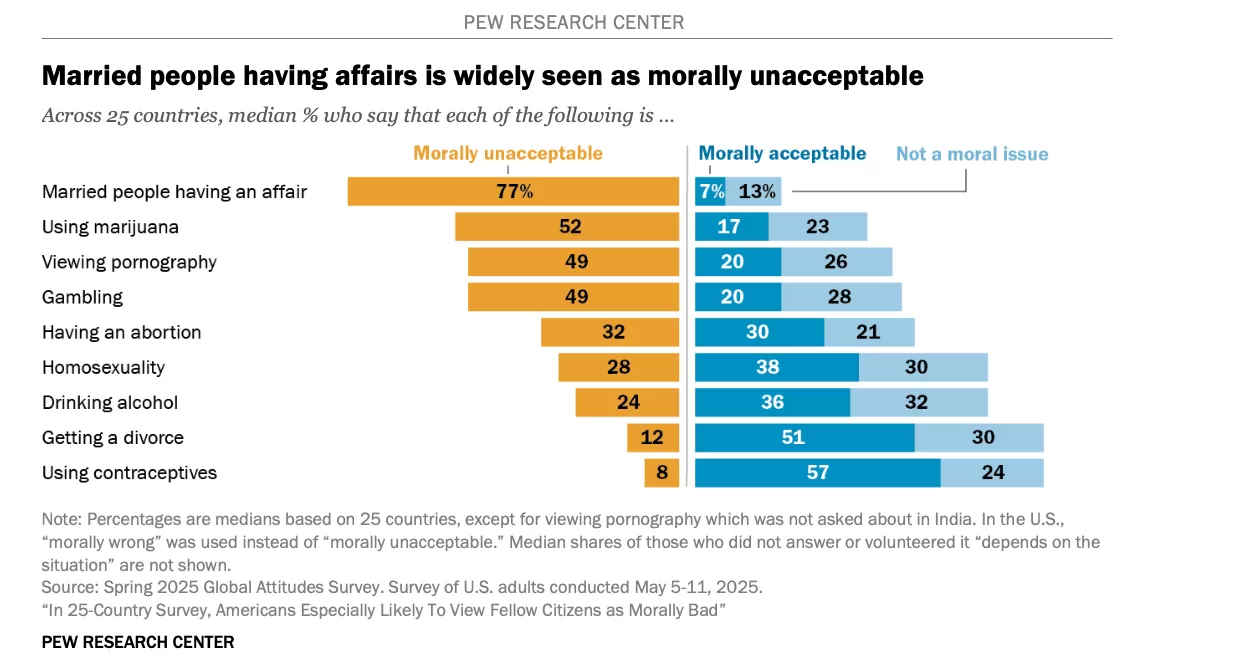
The report, “In 25-Country Survey, Americans Especially Likely To View Fellow Citizens as Morally Bad,” explores how adults in 25 countries rate the morality of others in their nation. It also examines if people consider different behaviors to be morally wrong including drinking alcohol, gambling, having extramarital affairs, using marijuana, viewing pornography, having abortions, homosexuality, getting divorces, and using contraceptives.
The research was based on data from participants in Argentina, Australia, Brazil, Canada, France, Germany, Greece, Hungary, India, Indonesia, Israel, Italy, Japan, Kenya, Mexico, Netherlands, Nigeria, Poland, South Africa, South Korea, Spain, Sweden, Turkey, the United Kingdom, and the United States.
Surveys conducted outside the U.S. were based on nationally representative surveys of 28,333 adults conducted from Jan. 8 to April 26, 2025. In the U.S., Pew surveyed 3,605 adults who are members of the Center’s American Trends Panel (ATP) from March 24–30, 2025.
A March 2026 Pew report, “In 25-Country Survey, Americans Especially Likely To View Fellow Citizens as Morally Bad,” explores if adults in 25 countries consider nine behaviors to be morally unacceptable or acceptable. | Credit: Courtesy of Pew Research Center
The report also includes some findings from a separate ATP survey of 8,937 U.S. adults conducted from May 5–11, 2025. The margin of sampling error for the full sample of 3,605 respondents is plus or minus 1.9 percentage points.
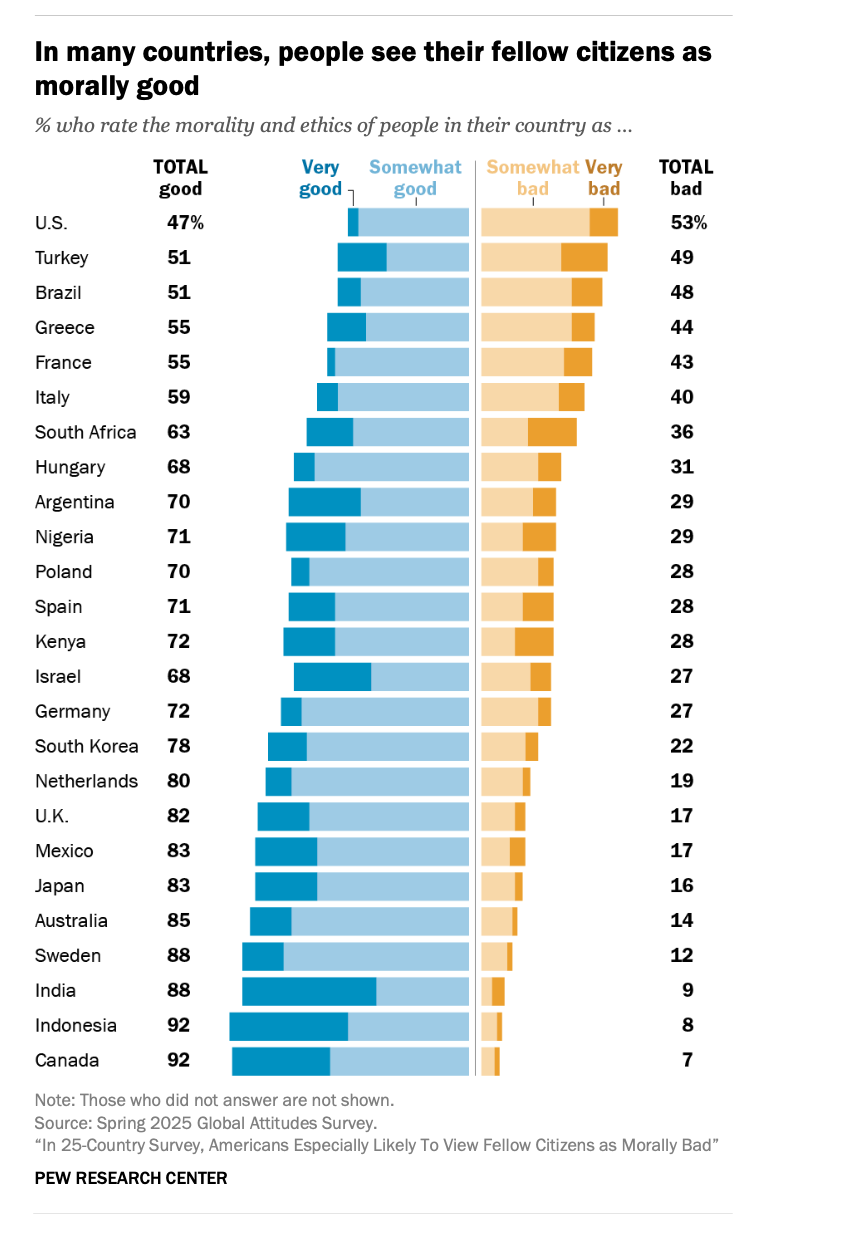
According to the research, 47% of U.S. adults reported Americans have “very good” or “somewhat good” morals and ethics, which was the lowest of all countries. The majority of adults in Canada and Indonesia (92%) said the same of the people in their countries.
Most and least accepted behaviors across the globe
Getting a divorce and the use of contraception were found to be the most widely accepted of the nine behaviors.
Only 12% of adults overall said getting a divorce is morally wrong, and 8% said using contraceptives is. The only countries with a slight majority that believe getting a divorce is morally unacceptable are India with 65% holding this view and Nigeria with 55%.
Of the nine behaviors Pew asked participants about, married people having affairs had the strongest overall disapproval. Across the 25 countries, a median of 77% of adults said married people having affairs is morally unacceptable, with at least half of adults in every country holding this view.
U.S. adults were among those to be most likely to condemn extramarital affairs as immoral. Nine in 10 Americans said having an affair is morally wrong, similar to the share of people in Indonesia and in Turkey (92%) who believe the same.
A March 2026 Pew report, “In 25-Country Survey, Americans Especially Likely To View Fellow Citizens as Morally Bad,” explores how adults in 25 countries rate the morality of others in their country. | Credit: Courtesy of Pew Research Center
Adults in Germany (55%) and France (53%) are among the least likely to believe having an affair is morally unacceptable.
Behaviors with least international consensus
The report found that for most behaviors asked about, there is not an international consensus if they are morally acceptable or not.
In the Latin American and African countries surveyed, half or more of adults said they believe abortions are morally unacceptable, but in most European countries, the vast majority of adults view abortions as either morally acceptable or not a moral issue at all. In the U.S., the group was fairly split with 47% reporting it is morally unacceptable to have an abortion.
In the U.S., adults are the most accepting of using marijuana and gambling. Only 23% of Americans said using marijuana is morally unacceptable, and 29% said the same in regard to gambling. In most other countries surveyed, more than 40% of adults said they consider gambling and marijuana use to be morally wrong.
In 10 countries, a majority said gambling is morally wrong, including 89% in Indonesia and 71% in Italy. In Australia, 25% said gambling is morally acceptable, and 43% do not see gambling as a moral issue.
In the U.S., 39% of adults reported homosexuality is morally wrong, which was found to be much more than those who hold the same belief in Germany (5%) or Sweden (5%). In other nations including Indonesia (93%) and Nigeria (96%), the majority reported it is morally wrong.
In regard to drinking alcohol, the majority of adults in Indonesia (83%) reported it is a morally unacceptable act. In contrast, only 7% of adults in Australia and Sweden reported the same. In the U.S., a small share of 16% said it is morally unacceptable.
What factors affect views of behaviors?
According to the report, a number of factors seem to affect how adults view the morality of behaviors including political party, religion, and gender.
Democrats and independents who lean toward the Democratic Party are more likely than Republicans and Republican leaners to rate fellow Americans as morally and ethically bad (60% vs. 46%).
Pew examined citizens’ stances based on religious belief and found those who said religion is very important in their lives were more likely to view the behaviors as morally wrong.
In 13 of the 25 countries surveyed, the research looked specifically at the differences between Protestants and Catholics. The report detailed that Protestants are typically more likely than Catholics in the same country to believe homosexuality is wrong. In the U.S., 59% of Protestants reported homosexuality is morally wrong, while 34% of Catholics did.
There is a large variation between Christians in different countries. The majority of Christians surveyed in Africa, Latin America, and the U.S. said having an abortion is morally wrong, but across Europe, the share of Christians who hold this view ranges from 40% in Spain to 7% in Sweden.
Gender is also a factor in how people view moral behaviors. Women tend to be more likely than men to believe some behaviors are morally unacceptable. In nearly every country surveyed, women were more likely than men to say that viewing pornography is wrong. In contrast, men were more likely than women to report homosexuality is morally unacceptable.
Overall, older adults were more likely than younger adults to report the behaviors are morally unacceptable. This is the case with using marijuana in 19 of the 25 surveyed countries. In Germany, adults ages 40 and older are twice as likely as younger adults to believe marijuana use is morally wrong, with 30% of older adults holding this belief and 15% of younger adults.
An apartment complex built by the Knights of Columbus in Ankawa, Iraq, a suburb of Erbil, has been struck in a drone attack.
“Fortunately, the building had been largely evacuated several days earlier due to its proximity to the Erbil International Airport,” the archdiocese said in a statement. The building had housed workers for the archdiocese as well as young families displaced by earlier violence in the region, which is roughly 60 to 90 miles west of the Iranian border. No casualties were reported.
ACI MENA, the Arabic-language sister service of EWTN News, posted video of the attack on social media, saying a “a missile and a drone fell in two separate instances” throughout the evening.
The attack took place around 8 p.m. local time, March 4, the archdiocese said. Named after Blessed Michael McGivney, founder of the Knights of Columbus, the apartment complex was funded entirely by the Knights to house Christian refugees displaced during the war in 2014–2018.
A nearby convent belonging to the Chaldean Daughters of Mary Immaculate also was damaged during the attack.
‘Remember and pray’
“We are now in a time once again where we pray for the solidarity and support from our brothers and sisters around the world, that these times of violence and war will come to an end, and that our suffering people may yet have a chance to return to lives of peace and dignity,” Archbishop Bashar Warda of Erbil said in a statement.
The archdiocese encouraged Christians around the world “to remember and pray for the many marginalized people in Iraq, including the small and still threatened Christian minority struggling to remain in their native land.”
Patrick Kelly, Knights of Columbus supreme knight, said in a statement, “We rejoice that no lives were lost, and we will continue to stand with the families who called McGivney House their home. We join with our Holy Father, Pope Leo XIV, who has encouraged us all to ‘pray for peace, work for peace.’”
This story was updated on Wednesday, March 4, 2026 at 5 p.m. ET to include a statement from the Knights of Columbus.
Cuban exiles in Miami, led by Rosa María Payá, founder of “Cuba Decides” and daughter of the late opposition leader Oswaldo Payá, signed on March 2 what they call an “Accord for Liberation” of Cuba, a 10-step roadmap to restore “democracy and the rule of law” on the island.
The document, signed in the Father Varela Hall of the National Shrine of Our Lady of Charity of El Cobre (the patroness of Cuba) in Miami, bears the signatures of the Cuban Resistance Assembly and Steps for Change coalitions, led respectively by Orlando Gutiérrez-Boronat and Rosa María Payá, along with various opposition organizations inside and outside Cuba.
The text states that it was signed “with faith in God, inspired by the founding ideals and values of the Cuban nation and the Accord for Democracy,” a document published on Feb. 20, 1998, that also establishes 10 points for a peaceful transition to democracy.
The Accord for Liberation outlines four phases for the transition: liberation, stabilization, reconstruction, and democratization of the country as well as the “dismantling of the criminal enterprise that is the Communist Party of Cuba, as well as the dismantling of all its repressive mechanisms and organizations.”
It also prioritizes the release of political prisoners and emphasizes the need to end “the humanitarian catastrophe and immediately address basic needs, beginning a limited transition period leading to free elections, during which the country will be administered by a provisional government.”
“Once the provisional government’s term has ended, general elections will be held: the first free, fair, and multiparty elections of Cuba’s new republican era,” the text emphasizes, encouraging all Cubans to join in this effort.
Payá: ‘The only way out of the crisis is the end of dictatorship’
During the presentation of the Accord for Liberation in Miami, Payá said: “Today we are promoting the democratic alternative to the barbarity that governs our country. Today we know that the only way out of the crisis is the end of the dictatorship.”
“And it’s urgent because the human suffering of our family, the human suffering of our people on the island right now is brutal. The blackouts last for days, there’s no medicine in the hospitals, there is no food in the stores,” she stated.
Payá pointed out that from 2021 to 2024, Cuba’s population decreased by 1.6 million, including Cubans who have died due to the crisis caused by the Cuban regime.
“Cubans are demanding freedom, and protests continue daily on the island. The network of opposition organizations across the island is growing, despite operating under extreme conditions,” she said.
According to the Global Affairs section of the University of Navarra, more than 1 million people have left Cuba since 2021 due to the economic crisis and the intensified repression of citizen protests that year; and according to Cuba’s National Office of Statistics and Information, some 480,000 people died on the island from 2021 to 2024.
The role of the United States
A few days ago, U.S. President Donald Trump said his administration was in talks with Cuba. “Maybe we’ll have a friendly takeover of Cuba,” the president told reporters.
“Cuba is, to put it mildly, a failed nation. Right now, it really is a country with serious problems, and they want our help,” he added. Trump made these statements after he had ordered a blockade of oil shipments to the island on Jan. 29, which has triggered a severe fuel shortage.
Meanwhile, the head of the U.S. diplomatic mission in Havana, Mike Hammer, stated in an interview with “EWTN Noticias,” the Spanish-language broadcast edition of EWTN News, in late February that Cuba is at a pivotal moment and that the country will soon achieve “the freedom it hasn’t had in 67 years.”
Hammer said that “there are exchanges with people within the Cuban regime at a high level” as well as “conversations to see what can be done to take the country in a new direction” that would allow for a transition to democracy.
ACI Prensa, the Spanish-language sister service of EWTN News, contacted the office of the Archdiocese of Miami, headed by Archbishop Thomas Wenski, for comment on the next steps regarding Cuba but has not yet received a response.
This story was first published by ACI Prensa, the Spanish-language sister service of EWTN News. It has been translated and adapted by EWTN News English.
Lou Holtz, whose lengthy football coaching career included an undefeated championship season at the University of Notre Dame and who spoke regularly about his Catholic faith, died on March 4at age 89.
Holtz’s death was announced by his family through a statement via the athletics department at Notre Dame. The retired coach had entered hospice shortly before his death.
The coach “is remembered for his enduring values of faith, family, service, and an unwavering belief in the potential of others,” his family said.
Holtz was preceded in death by his wife, Beth, who passed away in 2020. The two had been married for 59 years at the time of her death. Both are survived by four children.
A fixture in college sports for decades, Holtz began his head coaching career in 1969 at the College of William and Mary in Williamsburg, Virginia. He subsequently served as coach at North Carolina State and the University of Arkansas as well as a stint at the University of Minnesota; he also coached the New York Jets briefly in 1976.
His most memorable coaching appointment came at the University of Notre Dame, which he joined in 1986. He would go on to lead the team to an undefeated national championship in 1989, beating the West Virginia Mountaineers 34-21 at that year’s Fiesta Bowl in Tempe, Arizona.
After a brief retirement and a stint as a commentator for CBS Sports, Holtz took up the head coach position at the University of South Carolina in 1999, where he had previously served as an assistant coach in 1966.
He retired from that final role in 2004; his final game was marked by the infamous Clemson-South Carolina football brawl, with Holtz describing it as a “heck of a note” that his last match would be remembered for the fight.
In his later years he appeared in various commentary roles on a variety of ESPN programs. One of his four children is Skip Holtz, who has served as head coach at numerous collegiate football teams.
On Dec. 3, 2020, Holtz was awarded the Presidential Medal of Freedom by U.S. President Donald Trump. The White House at the time described Holtz as “one of the greatest football coaches of all time” as well as “a philanthropist, author, and true American patriot.”
Trump himself while awarding the medal described Holtz as a “great gentleman” and a “great man.” The president said he was amazed at learning about Holtz’s coaching record ahead of the ceremony.
“When we were researching this out, I knew he was supposed to be a good coach, but I didn’t know how good he was, because these stats are very amazing,” the president admitted.
Known in part for his conservative politics, Holtz at that ceremony described Trump as “the greatest president during my lifetime.”
“I get this award; I accept it humbly,” he said. “And you don’t go in life saying ‘I want to win this award.’ You just wake up one day and it happens.”
A lifelong Catholic, Holtz was educated by the Sisters of Notre Dame at St. Aloysius Grade School in East Liverpool, Ohio. In 2012 he told the National Catholic Register, the sister news partner of EWTN News, that the nuns “influenced my life tremendously.”
“This was due to the fact that they encouraged you always to make sure that God is the focus of your life, and they didn’t allow you to do anything except to the very best of your ability,” he said.
Holtz told the Register that he had prayed to God to be made a great athlete, only to have been made a coach instead.
“God does answer your prayers, but it’s not always in the way you expect,” he said. “God knows what’s best for us, though, so there’s no need to worry when things don’t go how we originally wanted them to go.”
He professed that the Catholic Church is “infallible” on religious principles regarding faith and morals. He said he “[tried] to follow the Catholic teachings [as that’s] what brings meaning and lasting happiness to life.” He said, however, that Church leaders should be “[held] accountable for their choices.”
In multiple cases he stressed fidelity to Christ above all, such as during an interview with Southwest Michigan Catholic when he said: “I don’t go to church to honor the pope; I don’t go to church to honor the priest who might have made some mistakes; I go to church to honor Jesus Christ.”
He told the publication he and his family attended Mass “every Sunday,” regardless if football was in season or not.
After Pope Leo XIV’s election in 2025, Holtz called on Catholics to “pray for [Leo], respect him and support him.”
“Pope Leo, I’ll be praying for you. God bless,” he said at the time.
In November 2025, meanwhile, he delivered what he said was his “final public speech,” speaking at the America First Policy Institute, where he served as chair of the 1776 initiative.
“[M]y commitment to the American dream has never wavered and never will,” he said at the time. “We must protect what makes America exceptional.”
“We cannot let God down; we must always do what’s right,” he said.
The Middle East has once again surged to the top of global headlines as renewed fighting spreads across multiple fronts, placing several countries at risk of continued strikes and retaliation, with no clear end in sight.
Airstrikes on the Iranian capital, Tehran, and other major cities have raised serious concerns about the country’s Christian communities.
Iran has already been grappling with instability following months of popular protests driven largely by economic hardship. Those demonstrations evolved into broader anti-government protests, during which many lives were lost.
In a previous report, Open Doors described Christians in Iran as consistently vulnerable, particularly converts to Christianity. The Islamic Republic officially recognizes only the Armenian Church (both Catholic and Orthodox branches) and the Assyrian and Chaldean Churches as recognized Christian communities with parliamentary representation.
Aside from remarks given to ACI MENA, the Arabic-language sister service of EWTN News, by Cardinal Dominique Mathieu, the Latin archbishop of Tehran, no official statements have been issued by churches inside Iran regarding the war and its repercussions.
This silence comes amid near-total internet blackouts and widespread mobile network disruptions across the country.
Iraq feels the heat of war
Several areas across Iraq have come under attack from different directions, despite assurances from the Ministerial Council for National Security that Iraq remains committed to preventing escalation and to ensuring that its territory is not used for external or internal conflicts. The stated goal is to safeguard the country’s stability and its citizens.
Erbil has faced a series of repeated attacks. The Christian-majority town of Ankawa, adjacent to Erbil International Airport, has encountered growing challenges as the U.S. coalition base located at the airport, situated within Ankawa’s municipal boundaries, has been targeted. The new U.S. consulate building nearby has also raised security concerns in the area.
Residents reported intercepts of rockets and drones in Ankawa’s skies, with falling debris causing limited damage to buildings and property. In the Nineveh Plain, a “drone of unknown origin” struck a building affiliated with the Popular Mobilization Forces in the Syriac town of Bartella.
In response to the escalating violence, Chaldean Patriarch Cardinal Louis Raphael Sako called on all Chaldean churches to pray for peace “amid the rising war in our region and its repercussions for neighboring countries.” The Patriarchate of the Assyrian Church of the East likewise issued a statement urging all parties to exercise maximum restraint to protect innocent civilians and asked Christians worldwide to pray for peace.
Syria and Lebanon
In Syria, Israeli air defenses intercepted an Iranian missile, which subsequently fell in Sweida, causing casualties. Additional scattered incidents of missile and drone debris were reported in several southern provinces.
As Israel intensifies troop deployments along its borders with Syria and Lebanon, Lebanon faces a dangerous escalation. Israeli airstrikes targeted Beirut’s southern suburbs, as well as areas in southern Lebanon and the Bekaa Valley, following a rocket attack launched by Hezbollah toward northern Israel. Hezbollah described the attack as retaliation “for the blood of Imam Khamenei and in defense of Lebanon and its people.”
Meanwhile, Lebanon’s presidency and government rejected the rocket launches, reiterating that the country must not be dragged into war.
Waves of displacement
Fearing further escalation, residents fled Beirut’s southern suburbs and parts of southern Lebanon, regions that include several Christian towns and villages. The scenes of displacement have repeated themselves as the government works to provide shelter and humanitarian assistance.
Bechara Boutros al-Rahi, the Maronite patriarch, emphasized that a nation cannot be healed by slogans or noise alone but through genuine faith. In his Sunday homily, he called for prayer “for our country, that the Lord may touch it with his healing hand and plant in the hearts of its people a living faith that leads to real healing and sincere renewal.”
The Holy Land and Jordan
The Holy Land is also feeling the strain of war. Several cities have faced repeated rocket and drone attacks, resulting in 12 deaths and nearly 500 injuries in Israel to date. In Jordan, a senior military source confirmed that the armed forces continue to fulfill their national duty to protect the kingdom’s airspace and sovereignty. Citizens were urged not to circulate rumors and to rely on official sources for information, as multiple areas witnessed falling debris from intercepted missiles.
Gulf states under fire
The Gulf countries, long regarded as among the region’s safest, have experienced what officials described as unprecedented and reckless Iranian attacks. The strikes were strongly condemned by the United Arab Emirates, Qatar, Saudi Arabia, Bahrain, Jordan, Kuwait, and the United States.
The attacks have damaged infrastructure and private property, and resulted in casualties. Since Feb. 28, five people have been killed in the Gulf, “all foreign nationals: one in Kuwait, three in the UAE [United Arab Emirates], and one in Bahrain,” according to Bishop Eugene Nugent, the apostolic nuncio to Kuwait, Bahrain, and Qatar.
Nugent described the situation as grave and deteriorating by the day as air raid sirens, once unthinkable in the Arabian Peninsula, have become an alarming reality in countries long considered safe havens.
The Apostolic Vicariates of Northern Arabia and Southern Arabia both called on the faithful to remain steadfast in faith, calm, united in prayer, and attentive to civil safety instructions. Other churches across the Gulf echoed these appeals.
In his Angelus address March 1 in St. Peter’s Square, Pope Leo XIV expressed deep concern over the unfolding events in the Middle East and Iran during these tense hours.
He stressed that stability and peace cannot be built on mutual threats or on weapons that sow destruction, pain, and death but rather through rational, sincere, and responsible dialogue.
This storywas first published by ACI MENA, the Arabic-language sister service of EWTN News. It has been translated and adapted by EWTN News English.
Archbishop Ronald Hicks of New York is hosting a program called “All Good Things with Archbishop Hicks” for SiriusXM’s Catholic Channel.
About a month after Hicks was installed as New York’s 11th archbishop at St. Patrick’s Cathedral on Feb. 6, SiriusXM announced he is hosting the show. The program takes over the time slot previously held by former archbishop of New York Cardinal Timothy Dolan, who hosted “Conversations with Cardinal Dolan.”
Hicks will host the weekly program alongside Father Dave Dwyer, host of the daily call-in show “The Busted Halo Show” and executive director of Busted Halo Ministries. Dwyer also co-hosted the radio show with Dolan.
Hicks and Dwyer will discuss real-world issues, current events, and everyday life through a Catholic lens, according to a statement. The show will offer conversation rooted in Church teachings and lived pastoral experience. The program will highlight works of those fostering personal conversion and the transformation of society through evangelization, the statement said.
The show joins a number of other Catholic faith-based shows on the channel including “The Katie McGrady Show,” “Catholic Guy with Lino Rulli,” and “Frontiers of Faith.”
The show is set to air at 2 p.m. ET Tuesdays on channel 129 and will be available on demand on the SiriusXM app. An inaugural episode aired March 3, according to the Archdiocese of New York.
Archbishop Hicks
Hicks was named archbishop of New York by Pope Leo XIV on Dec. 18, 2025, and brings a perspective from decades of service and ministry. He graduated from Loyola University Chicago in 1989 with a philosophy degree and went on to receive master of divinity and doctor of ministry degrees from the University of St. Mary of the Lake in Mundelein, Illinois.
He was ordained to the priesthood for the Archdiocese of Chicago on May 21, 1994. Prior to his appointment in New York, Hicks was appointed by Pope Francis on July 17, 2020, as bishop of Joliet, Illinois.
He has a history of ministerial experience in Latin America serving in El Salvador as the regional director of Nuestros Pequeños Hermanos, a charity that serves orphans in Latin America. He previously served as vicar general of the Archdiocese of Chicago and auxiliary bishop of Chicago.
Hicks also serves on the U.S. Conference of Catholic Bishops’ (USCCB) Committee on Clergy, Consecrated Life, and Vocations and as the USCCB liaison to the Association of Ongoing Formation of Priests and the National Association of Diaconate Directors.
Mexican priest José Dolores Aguayo González, known as Father Lolo, has received criticism from the archbishop of Guadalajara, Cardinal Francisco Robles Ortega, about letters Aguayo sent to a U.S. court on behalf of two convicted drug traffickers.
The letters concerning Jessica Johanna and Rubén Oseguera, adult children of drug trafficker Nemesio Rubén Oseguera, known as “El Mencho,” were written at the request of the judge and the detainees’ family as part of the priest’s work providing spiritual ministry to people in prison.
The elder Oseguera was the founder and leader of the powerful Jalisco New Generation drug cartel who was killed in a shoot-out with the Mexican military on Feb. 22.
In an interview with ACI Prensa, the Spanish-language sister service of EWTN News, the priest defended his actions, stating that “the Church cannot turn its back on those who seek reconciliation with God, even if they are public figures.”
“Imagine if the Church slams the door on them, and I think the issue here is, if it had been any anonymous prisoner in Puente Grande [penitentiary], there wouldn’t have been a problem. The problem is that the Church tried to fulfill its mission with these individuals,” the priest stated.
Both letters, revealed last week by journalist Laura Sánchez Ley, were addressed to Judge Beryl A. Howell in Washington, D.C. The first, sent in March 2021, describes Jessica Johanna Oseguera as “a very kind person, an excellent mother, a very philanthropic woman.”
Aguayo explained that he met the cartel leader’s daughter because she actively participated in parish activities, years before she pleaded guilty in U.S. court to drug trafficking charges.
“When I wrote about this man’s daughter, the judge was the one who asked for my personal opinion of her, how although she had already pleaded guilty to certain crimes, had taken responsibility, what was my personal assessment [of her],” the priest told ACI Prensa.
He sent the second letter to the same judge in January 2025, this time speaking favorably of Rubén Oseguera, known as “El Menchito” (Little Mencho), who was extradited to the U.S. in 2020 and sentenced to life imprisonment for drug trafficking two months after the priest’s letter.
In that letter, Aguayo said that he was Rubén Oseguera’s “spiritual director” and that “he comes from a very devout Catholic family, has reflected a great deal on his future, and has read the holy Scriptures,” adding that “despite any mistakes he may have made, he is a man who has been touched by God’s mercy.”
The priest clarified that he did not know “El Menchito” personally but rather maintained correspondence through letters and phone conversations with family members during Oseguera’s imprisonment.
“His wife asked me to accompany them spiritually through letters … what did we talk about? Biblical themes, faith, personal growth, change — nothing out of the ordinary that could be discussed with a priest,” he recounted.
“Having gotten to know this young man through the letters … all I can say is that human beings make mistakes, they can change. I’m not saying he shouldn’t be punished by human justice, because we will also be punished by divine justice for our sins, but there is an opportunity to remake ourselves. In the Church, we believe in remaking ourselves; in conversion, and that is the great calling we have as priests: the sacrament of reconciliation,” he added.
Though visibly concerned about the public judgment of his actions, the priest said he has nothing to hide. He maintained that he has conducted his ministry in accordance with the precepts of the Church and that, to date, no authority in Mexico or the U.S. has contacted him regarding this matter.
The Archdiocese of Guadalajara on Feb. 28 issued a statement on the case, describing a lack of “prudence and good judgment on the part of this priest in addressing this matter … given the nature of this relationship.”
The archbishop said at a March 1 press conference that “the issue is much more complex and much broader than the issue of the imprudence or inexperience of a priest who wanted to act in good faith, but, as we say in slang, messed up.”
Robles added that Aguayo continues to fulfill his pastoral duties as a parish priest and that the Church is committed to providing spiritual support to everyone, including criminals and their families.
“For example, if a family member of someone who was killed or cut down [in a confrontation with law enforcement] and whose involvement in criminal activity has been proven,requests, for instance, a Mass, they cannot be refused. If they request to take the body to the church, they cannot be refused,” the cardinal stated.
This story was first published by ACI Prensa, the Spanish-language sister service of EWTN News. It has been translated and adapted by EWTN News English.
English professor Leanna Brunner devotes much of her time to educating prisoners — work that she says is “some of the most rewarding work of my entire career.”
“The students are some of the most devoted, conscientious, and hardworking I have had,” Brunner told EWTN News. “Every week that I go in the prison to teach, I come out feeling even more insightful than when I entered. I learn as much from the students about life as they do from me.”
Brunner, an assistant professor at University of St. Mary, a Catholic liberal arts university in Leavenworth, Kansas, is involved in the university’s prison education program.
About 100 students are enrolled across federal, state, and military correctional facilities in the university’s program. Though the university has worked in prisons for decades, the program recently received full accreditation, according to a Feb. 26 announcement.
“This is not an auxiliary initiative but a central expression of our Catholic identity,” program director Michelle Workman said.
“We approach prison education as authentic higher education rooted in rigor, dignity, and long-term formation,” Workman told EWTN News. “Our faculty teach the same curriculum, and our students meet the same expectations, as those enrolled on campus.”
Michelle Workman, director of the prison education program at University of St. Mary in Kansas, said the initiative is “a central expression of our Catholic identity.” | Credit: Photo courtesy of Michelle Workman
As the university is sponsored by the Sisters of Charity of Leavenworth, Workman said that “our mission calls us to educate the whole person and to serve those on the margins.”
“Catholic social teaching affirms the inherent dignity of every human person and calls us to solidarity and the pursuit of the common good,” Workman said. “Incarcerated individuals are not defined solely by their past actions; they remain persons created in the image of God, capable of intellectual growth, moral reflection, and meaningful contribution.”
Another professor involved in the program, Michael Hill, told EWTN News: “We are called to serve the least of these; to care for the imprisoned.”
“When I look at many of my students, I know that, with only a few different choices or a few different contingencies, I might well be one of them,” said Hill, assistant professor of history and theology at the university.
“I had several great professors in my life who radically altered my trajectory, not by being great, but by simply being present,” he continued. “If I can help some of these men, in however small a way, then my life has been for something.”
When asked about the challenges of the work he does, Hill said they are “beyond count.”
“On a personal level, many of our students come from backgrounds that don’t celebrate academic success. Many wonder if they truly belong in college. All carry the scars of life that ultimately placed them in prison,” he said. “I’m not only a teacher to many of our students, I’m also an adviser, mentor, and counselor. Wearing so many hats is an ongoing challenge. But those challenges make the successes so much sweeter.”
Sometimes, unexpected challenges arise that are “more to do with the nature of prison itself,” Brunner added.
“Flexibility is the name of the game because we never know what to expect on any given day,” Brunner said. “We constantly have to pivot, whether it be because of lockdowns, rules that arise because of prison culture, or any other unexpected event.”
But the in-person element of education “adds a layer of humanity to the program that other modes of learning cannot,” Brunner observed.
“Sitting in a classroom with these men again allows them to feel human,” she said. “Being there in person with them shows the men that I believe in their ability to change and that I am not going to judge them for the mistakes they have made in the past.”
“Sadly, their time in my class is one of the few times in their lives when they can feel like ordinary humans — a time when they can forget their bad decisions and focus on making a better life for themselves, both in prison and out,” Brunner said.
Classes give students a reprieve from the daily life of prison, what Hill described as “a space to be men, not just inmates or [a] number.”
“Giving our students a time and place to simply be — away from the violence and politics — matters,” Hill said. “Giving them face-to-face responsibility and accountability, not in a hierarchical relationship of authority with the state or its representatives, matters.”
Workman said higher education improves outcomes after prison, including reducing the likelihood of re-offending.
“Education inside correctional facilities strengthens families, reduces the social and financial costs of re-incarceration, and contributes to safer communities,” Workman said.
“Research consistently demonstrates that participation in higher education during incarceration is associated with significantly lower recidivism rates and stronger post-release employment outcomes,” she continued.
“Education builds cognitive skills, strengthens decision-making capacity, and supports the development of pro-social identity,” Workman said.
Brunner often sees the men “realize that they have the ability to learn, grow, and make better decisions.”
“Watching this kind of transformation is life-changing for me as well,” Brunner said. “I often tell my students that just because they are imprisoned physically, they do not have to be imprisoned mentally or spiritually. That is a choice, and there is no better feeling than to see them choose freedom.”
“At its core, however, this work is about hope — about restoring the possibility that a person can grow intellectually, rebuild identity, and reenter society with purpose,” Workman said.
An Iraqi Catholic archbishop said his flock is frightened and communication with Tehran’s archbishop has been impossible as the Iranian conflict escalates.
Archbishop Bashar Matti Warda of Erbil, the Kurdistan region of northern Iraq, told “EWTN News Nightly” that the situation is “quite frightening” because the Christian community is once more asking: “Will it reach us? Will we have to really leave again? Will our children have a future?”
Warda said the situation is particularly sensitive for Iraq’s Christian population, which has seen “almost 50 years of continuous violence,” including eight years of war with Iran, followed by the first and second Gulf wars, as well as sectarian violence.
“All of these memories,” he said, are “still there.”
Warda said schools and universities in the region have been closed for nearly a week, and “the economy is collapsing.” All the while, he said, there is fear that “around every three, four hours, Erbil would be hit by either rockets or drones.”
“The fear is there,” he said. “And the scope of violence is just getting bigger, because following the news, we see new countries being attacked and new places being attacked.”
“Erbil [has been] targeted a few times so far,” he said, “and we know the largest Iraqi Christian gathering is in Erbil, and this might be another reason for the Christians to say, ‘There is no future.’”
Warda said his “biggest fear” is that Christian families who were previously committed to remaining in Iraq will decide to flee the region due to ongoing instability. “These types of wars and conflicts will shake everything,” he said, regardless of what has been done to “really build something for the Christian community to stay.”
Regarding efforts to get in contact with Archbishop Dominique Joseph Mathieu of Tehran, Iran, Warda said: “We have tried several times. But there is no communication whatsoever.”
Warda said he asked one of the Chaldean religious sisters currently working in his diocese about her family, who live in Iran, but she has not been able to reach them.
“Sadly enough, there is no communication whatsoever with that part of the world,” he said, noting loss of power and communication lines in Iran.
“We are praying for the community there,” he said.
Amid the conflict, Warda said attendance at morning Mass and evening prayer in the community has been “really great.” The community has canceled its weekly catechism classes, however, as well as its annual Ankawa Youth Gathering, the largest gathering of young people in Iraq.