KAMPALA, Uganda — A Catholic priest previously suspended in Uganda has been sentenced to 31 years in prison after pleading guilty to the murder of a Uganda Revenue Authority (URA) official and the attempted murder of a man who tried to help, bringing to a close a criminal case that has drawn widespread attention in the East African nation.
Justice Flavia Nabakooza of the High Court in Entebbe handed down the sentences on July 23 after Father Dominic Alinga admitted to the murder of John Bosco Ngorok and the attempted murder of Moses Abigaba, who was riding a boda boda (a bicycle or motorcycle used as a taxi to carry passengers or goods) and tried to intervene.
The court sentenced Alinga to 21 years in prison for murder and 10 years for attempted murder. The sentences are to run concurrently. The court also ordered that compensation be paid to Abigaba, who survived the attack.
“The conviction demonstrates that criminal responsibility applies equally to all persons regardless of their social or religious status,” the ODPP said following the judgment.
Alinga is a priest of the Diocese of Moroto in Ugandaʼs Karamoja region. He was ordained to the priesthood in July 2020 and served at Iriiri Catholic Parish in Napak District before his suspension from ministry.
He was suspended effective July 17, 2024, by Bishop Damiano Guzzetti of the Moroto Diocese, who prohibited Alinga from celebrating Mass, administering the sacraments, and exercising priestly ministry anywhere in the diocese or elsewhere in the Church.
While confirming the authenticity of the suspension decree, Guzzetti reportedly declined to disclose the reasons for the disciplinary measure, saying the matter was not public. Instead he urged the faithful to pray for the priest “so that he may deeply receive the grace of conversion and amendment of life.”
The suspension reportedly came about two weeks before the killing of Ngorok. According to prosecutors, Alinga believed the URA officer had shared information that contributed to his suspension from priestly ministry.
Court records indicate that on Aug. 2, 2024, Alinga arranged to meet Ngorok in Entebbe. While traveling together, he allegedly attacked the tax official with a knife, inflicting multiple stab wounds.
As Ngorok attempted to escape and seek help, Abigaba came to his assistance. Prosecutors said Alinga then drove his vehicle into both men before fleeing the scene.
Ngorok later succumbed to his injuries, while Abigaba survived.
Investigators said Alinga fled to eastern Uganda following the incident, where he reportedly sought out another Catholic priest and confessed to the killing before surrendering himself to police.
He was subsequently arrested and charged with murder and attempted murder. He remained in custody as investigations and court proceedings continued until he entered guilty pleas before the High Court in Entebbe.
Under the Churchʼs Code of Canon Law, the suspension imposed on Alinga prohibited him from exercising priestly ministry but did not remove him from the clerical state.
As of the time of his sentencing, there has been no public announcement that Alinga has been dismissed from the clerical state, a canonical penalty commonly referred to as laicization. Such a penalty requires a separate canonical process and, in many cases, the approval of the Holy See.
The Diocese of Moroto has not publicly commented on the High Courtʼs judgment.
This story was first published by ACI Africa, the sister service of EWTN News in Africa, and has been adapted by EWTN News.
The suspect in a double shooting in Rhode Island this month is apparently the same man whose unexpected recovery after a health crisis as a newborn was deemed a miracle by the Vatican in 2025.
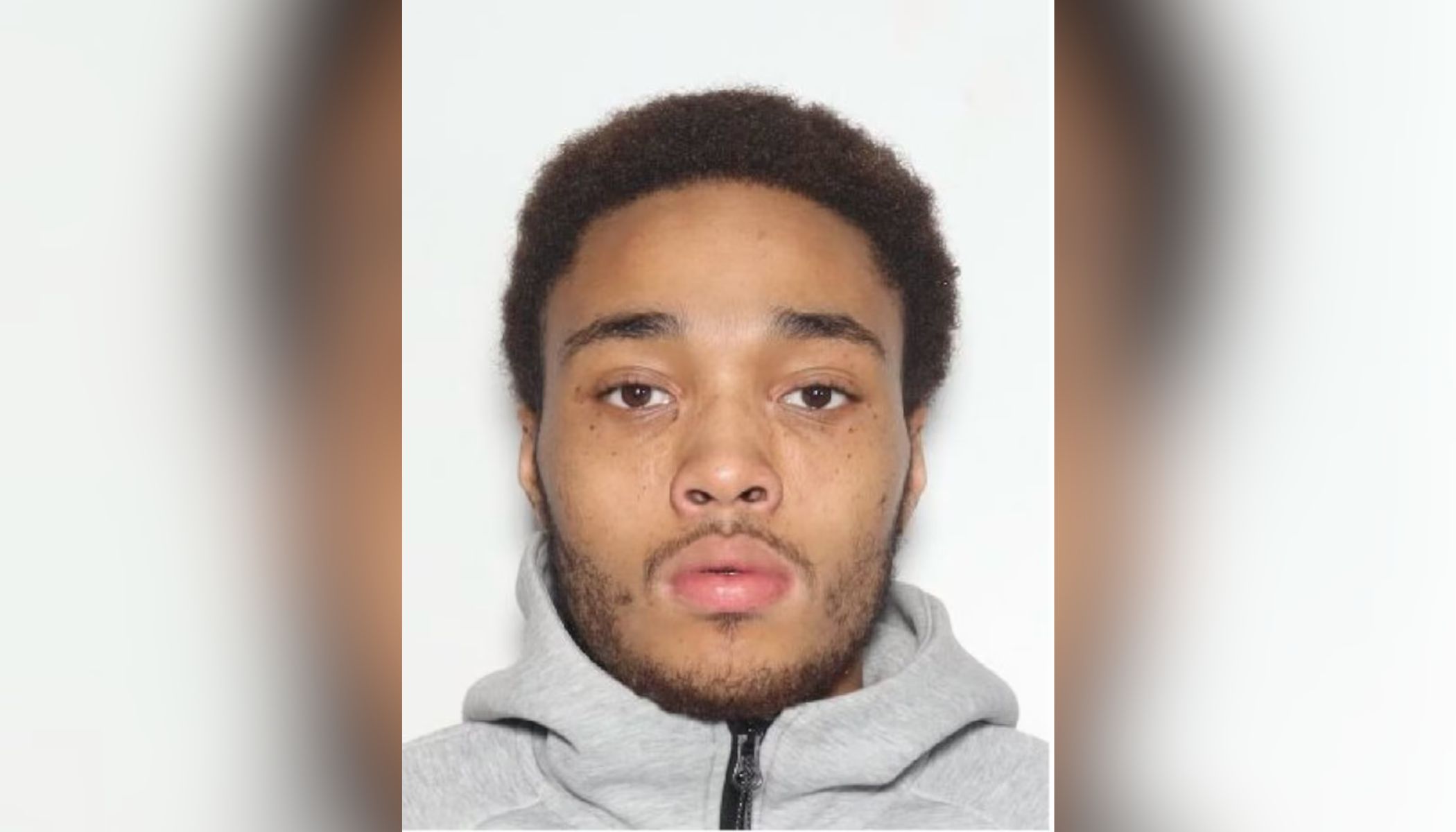
Police in Newport, Rhode Island, said in a July 24 press release that Tyquan Johnson was facing arrest for felony assault with a firearm in connection with a double shooting in Newport on July 19.
An undated photograph of Tyquan Johnson | Credit: Courtesy of Newport Police Department
The police dispatch, which said Johnson was considered “armed and dangerous,” identified the suspect’s birthday as Jan. 14, 2007. That date is the same birthday as the Rhode Island-born “Tyquan” noted by the Dicastery for the Causes of Saints in its information page on Blessed Salvador Valera Parra.
Valera was a 19th-century-born Spanish priest who carried out “many works of a spiritual and social nature,” particularly during cholera epidemics and earthquakes, according to the dicastery.
In considering his beatification, the dicastery said it reviewed the Rhode Island case, in which a pregnant mother was hospitalized after her amniotic sac ruptured. The baby was ultimately delivered via cesarean section, after which doctors “did not perceive any heartbeat.”
The attending physician at that point “invoked Salvador Valera Parra,” the dicastery said, after which the baby recovered his heartbeat without any external assistance and made a full recovery.
Pope Leo XIV approved the dicastery’s promulgation of the miracle on June 20, 2025. In a July 18, 2025, statement, Diocese of Providence Chancellor Father Timothy Reilly said the miracle was “a reminder of the power of prayer and the intercession of holy men and women.”
“God is indeed close to us. We are thrilled that this recognition will move the cause of beatification and canonization forward for Venerable Servant of God Salvador Valera Parra,” the priest said at the time. Reilly did not respond to requests for comment on the crime incident this month.
Rhode Island police said another individual was wanted in connection with the shooting, though it did not identify that suspect in its press release.
In the years following the miracle birth the Johnson family moved to Hampton, Virginia. Tyquan Johnson subsequently told local media that the promulgation of the miracle “changed my faith a lot because I’m destined to be in this world.”
“If God didn’t want me in this world, he would just let me die on that table. But he wanted to give me a second chance,” he said.
July 29 is the feast day of Sts. Martha, Mary, and Lazarus. It’s a relatively new feast day, implemented fewer than six years ago. The faithful might remember these siblings — especially since they are mentioned in all four Gospels — as friends and disciples of Jesus.
Individually, each of the three siblings has important lessons to teach. Martha, the oldest sibling, has a heart for service but is also anxious and worried about many things; Jesus encourages her to focus on the contemplation of Jesus himself, as her sister Mary has done. And Jesus’ raising of Lazarus from the dead provides a powerful witness to the eventual resurrection of the body. Together, the siblings display admirable qualities of unity and love.
For one Catholic parish, Sts. Martha, Mary, and Lazarus Parish on the South Side of Chicago, the patronage of Sts. Martha, Mary, and Lazarus serves as a symbol of the unity that has come about through the merging of three previously distinct parishes into one new and diverse community.
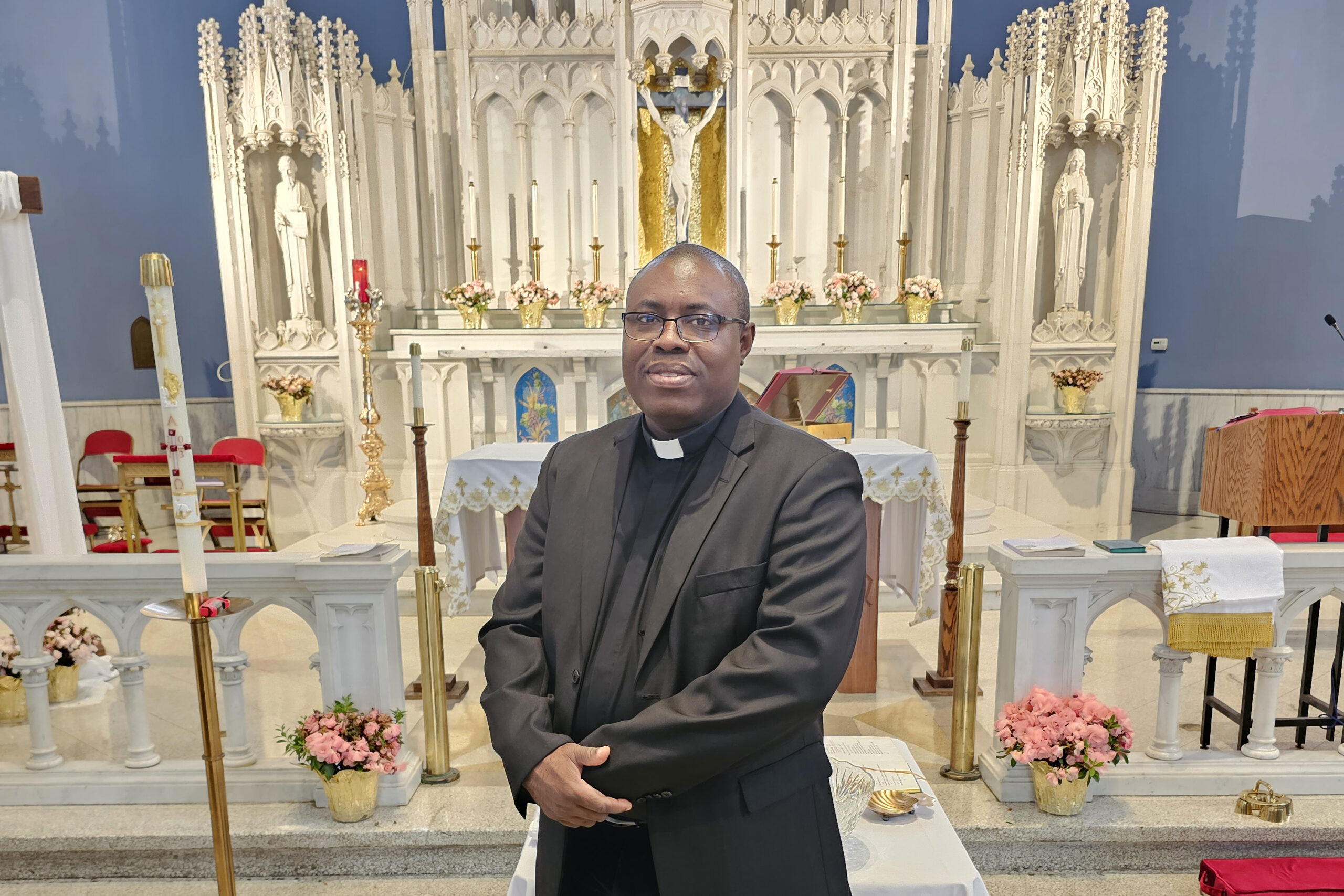
Father Mark Thomas Ameh, the pastor when the parishes merged and a native of Nigeria, arrived at the parish in July 2023 after previously ministering in Las Vegas. He told EWTN News at the time that the church was built originally as St. Margaret of Scotland Parish, but amid an ongoing archdiocese-wide consolidation process, “Renew My Church,” the parish was merged in 2022 with two others and renamed to reflect the new community.
Father Mark Thomas Ameh in front of the high altar of Sts. Martha, Mary, and Lazarus Parish in Chicago. | Credit: Photo courtesy of Father Mark Thomas Ameh
Ameh was not in Chicago when the renaming of the merged parish took place, but he said a person who was there told him the name was chosen to reflect the fact that the new parish was made of three former ones coming together.
Parish office manager Alfreda Rogers told EWTN News that it is the only parish in Illinois named for the sibling saints.
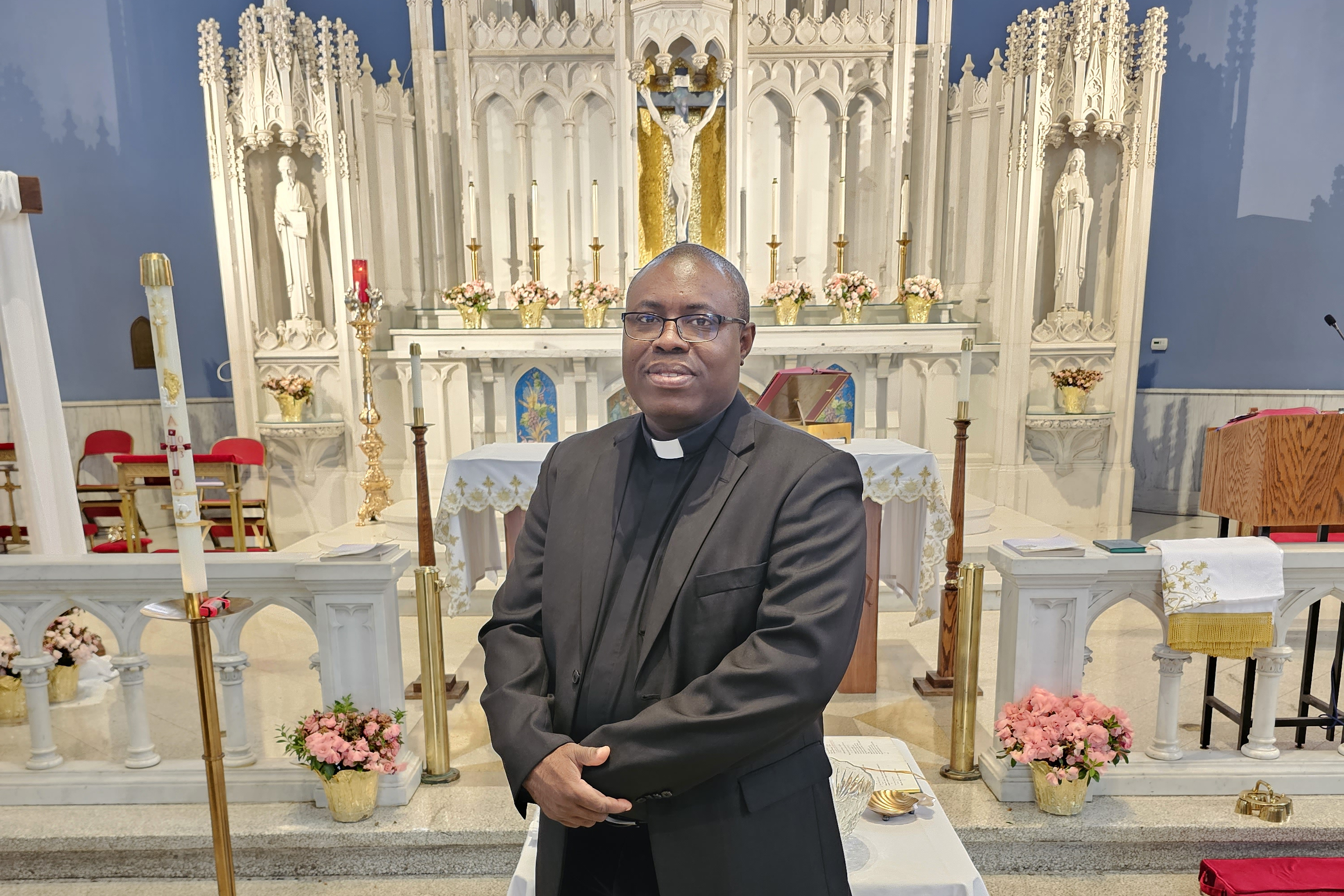
Despite its triple patronage, the church still has a statue of St. Margaret of Scotland on the high altar and is also known as “St. Margaret of Scotland Church.” In 2026, the church celebrates 150 years and the parish will hold a gala after a Mass on Aug. 2 to mark the occasion.
Abeh, a priest of the Missionary Society of St. Paul, described the parish as a “vibrant” church of about 500 registered parishioners when it began. Today, according Rogers, the parish serves about 200 families and offers two Masses on Sundays. There is also a Catholic school associated with the church.
Rogers said in a recent interview with Fox 32 Chicago that the parish is focused on bringing youth back to the Church and continuing to serve the community.
Father Donatus C. Mgbeajuo, also a priest of the Missionary Society of St. Paul, took over as pastor in July 2024, and Deacon Herbert D. Johnson just became parish pastoral director on July 1.
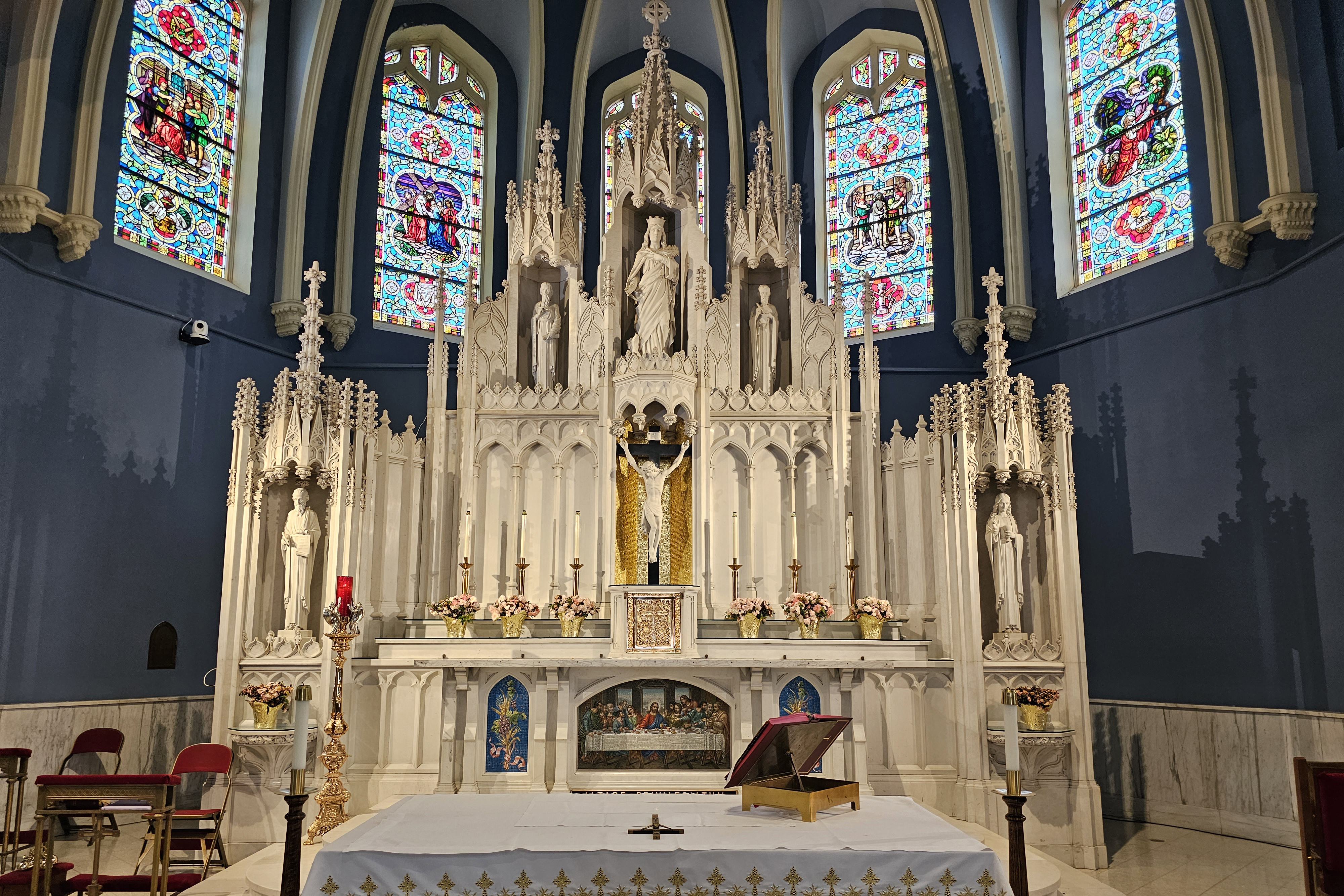
The high altar of Sts. Martha, Mary, and Lazarus Parish in Chicago. | Credit: Photo courtesy of Father Mark Thomas Ameh
Chicago’s South Side has a reputation for being dangerous but perhaps now is even more famous for being near the childhood home of Pope Leo XIV, the first American pope.
A 2021 decree from the Congregation for Divine Worship and the Discipline of the Sacraments said Pope Francis had included Martha, Mary, and Lazarus in the General Roman Calendar “considering the important evangelical witness they offered in welcoming the Lord Jesus into their home, in listening to him attentively, in believing that he is the resurrection and the life.”
The memorial of St. Martha was already included on July 29 in the General Roman Calendar before the Second Vatican Council, but St. Lazarus and St. Mary had been originally left off due to uncertainty about the identity of Mary Magdalene.
So, why change the memorial to all three siblings instead of Martha alone?
The decree explained that these uncertainties “have been resolved in recent studies and times” and pointed out that Mary and Lazarus are already commemorated on July 29 in the “Roman Martyrology,” the Church’s official catalog of martyrs and saints.
This story was first published on July 29, 2023, and has been updated.
The Archdiocese for the Military Services, USA, will launch its first conference for Catholic service members to explore how the ongoing conflict with Iran fits within the Church’s teachings on just war theory.
University of Notre Dame theology professor Joseph Capizzi will deliver the keynote address at the Nov. 9–11 event under the theme “Living and Serving Justly,” according to a July 28 archdiocese press release. The conference will be held at the Westfields Marriott in Chantilly, Virginia.
The U.S.-Iran conflict has entered its fifth month, and Catholic theologians have expressed concern over the impact of U.S. military force on civilian infrastructure in Iran.
“The position of the Church,” Capizzi said in the release, “is that the use of force, including lethal force, is bound by the moral law, and even when countries resort to the use of force in conflict, it’s not anything goes. In fact, both sides remain bound to the requirements of moral international law regarding the treatment of civilian populations, the treatment of prisoners of war and wounded soldiers, among others, and this has been spelled out for a long time in Western tradition.”
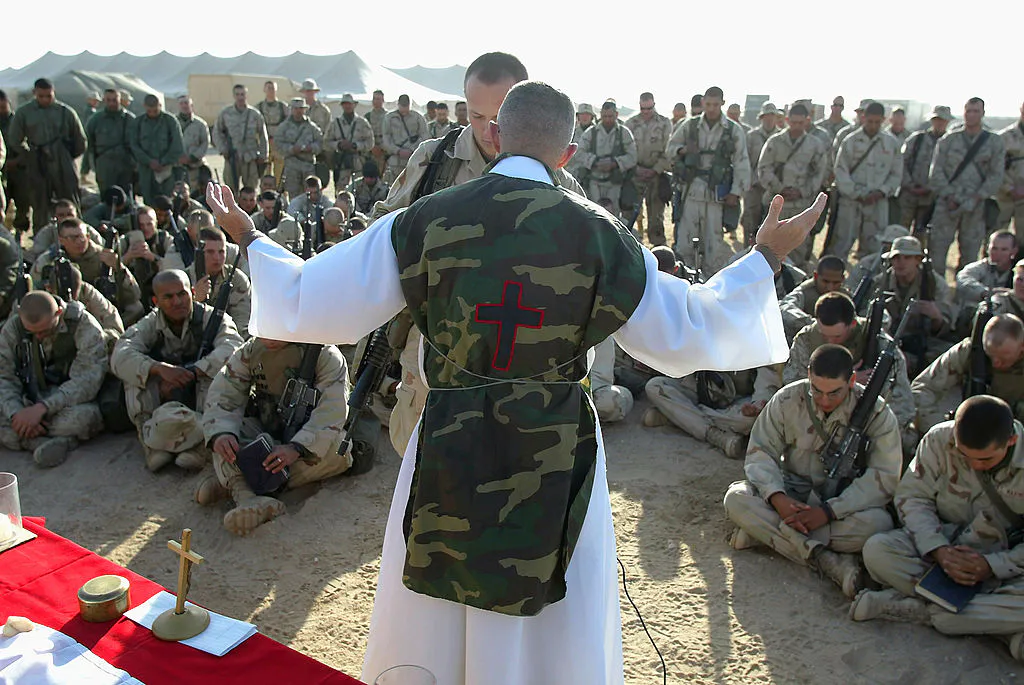
U.S. Marine Chaplain Father Bill Devine offers Mass for Marines from the 1st Marine Division Feb. 23, 2003, in Kuwait. | Credit: Robert Nickelsberg/Getty Images
Capizzi is the McGrath-Cavadini director of the McGrath Institute for Church Life at Notre Dame and is the author of “Politics, Justice, and War: Christian Governance and the Ethics of Warfare.” His remarks will include reflections on the teachings of St. Augustine and St. Thomas Aquinas and how they apply to modern warfare.
“Even when it’s resorted to, the use of force must be discriminatory or ‘distinct’ — the principle of distinction is what it’s called in international law, which means it has to distinguish between legitimate targets and illegitimate targets,” he said. “Civilian populations, civilian structures like schools, hospitals, desalinization plants and so on — they are not legitimately targeted. You must abide by this principle of distinction, and any uses of force must be proportional to the ends sought.”
Other speakers at the three-day event include Catholic radio host Katie McGrady, who will serve as emcee. The conference will feature additional keynote addresses and breakout sessions geared toward fostering “synodal” connections within the archdiocese, according to the release.
Cardinal Fernando Chomali, the archbishop of Santiago and primate of Chile, once again addressed the country’s pending “Listen to Their Heart” bill, which seeks to mandate within the abortion protocol (authorized in Chile under three specific grounds) an opportunity for the patient to listen to the babyʼs heartbeat.
Specifically, according to the bill’s legislative summary, the measure would modify the country’s health code “to establish the duty of the doctor to inform the woman about the embryonic or fetal heart activity and to offer her the opportunity to hear it prior to the interruption of the pregnancy.”
Speaking with the Chilean newspaper La Tercera, the cardinal sought to shift the focus of the discussion to the healthcare professionals involved. “It pains me that there are doctors who agree to perform an abortion,” he lamented.
Chomali also expressed regret over a tweet in which he stated that every mother should rejoice at hearing a heartbeat. “It pains me to have been a source of division in that regard,” he emphasized.
He explained that he is opposed to abortion under any circumstances. “I believe those three grounds should not exist,” he stated, drawing on his experience of accompanying women who are enduring a “horrific ordeal” such as rape, a fetus with serious medical issues, or whose life is at risk.
In such cases, he called for a “renewed recognition of what it means to care for another person,” noting that “when there is medical, psychological, spiritual, and financial support, women feel more supported and decide against [abortion].”
Regarding doctors who perform abortions, he remarked: “I find that terrible; I think that instead of showing the heartbeat to a woman facing a very difficult, complex situation, it would be very good for that heartbeat to be heard by a doctor who is committed to healing, curing, and caring for life.”
In this regard, he noted that doctors take an oath that entails “doing everything possible to heal and never to cause harm and here, objectively, someone is being harmed: a human being.”
He thus called for a review of current regulations: “It’s always the right time to examine all laws, because laws can be improved.”
“If you look at the bigger picture, a human life is being eliminated,” he summarized.
“Someone told me that with this attitude of mine, I mean, opposing the three grounds for abortion, I would turn half the world against me and end up all alone. I would rather stand alone than betray something as fundamental as the truth: that there is an innocent human being who deserves every possible care that could be given to it, and that’s that,” he declared.
I would rather stand alone than betray something as fundamental as the truth: that there is an innocent human being who deserves every possible care that could be given to it.”
Cardinal Fernando Chomali
Speaking to Radio Duna, the cardinal noted that this is simply “one bill among many” and expressed the view that “it must be addressed where it belongs: in the Legislature. They will have to decide whether or not they agree with it.”
Chomali added that “it is a matter that must be handled with great prudence, tact, and good judgment.” He expressed the view that “a woman could always have the option to hear the heartbeat,” but clarified: “Making it mandatory would be a matter for discussion.”
The archbishop further advised against confrontation: “What does not seem right to me is the use of language that serves only to polarize, when what matters is the truth,” he insisted.
This story was first published by ACI Prensa, the Spanish-language sister service of EWTN News. It has been translated and adapted by EWTN News English.
As the United States commemorates the 251st anniversary of the military chaplaincy, established on July 29, 1775, at George Washingtonʼs request, the story of Catholic priests in uniform reveals a long tradition of faith, courage, and sacrifice.
From the battlefields of the Civil War to the prison camps of Korea, generations of Catholic chaplains risked their lives to celebrate the sacraments, comfort the wounded, and strengthen the faith of those serving far from home.
Early Catholic chaplains in the Revolutionary era
Catholic priests were serving American troops long before the Civil War. During the Revolutionary War, Jesuit priest Father John Carroll — later the first Catholic bishop in the United States — accompanied American forces on the failed 1775 expedition to Canada, ministering to Catholic soldiers and seeking support from French Canadians.
In the decades that followed, as the nation’s Catholic population steadily grew, priests increasingly served military communities, laying the foundation for the larger and more organized Catholic chaplaincy that emerged during the Civil War.
Shepherds amid the carnage of the Civil War
The role of Catholic chaplains took a significant turn during the Civil War.
As Irish and German Catholic immigration dramatically increased the nation’s Catholic population, thousands of Catholic soldiers filled the ranks of both Union and Confederate armies. They needed priests who could celebrate Mass, hear confessions, administer the anointing of the sick, and offer hope in the midst of unimaginable suffering.
More than 100 Catholic priests served officially as military chaplains during the conflict, while many others ministered informally in hospitals and camps.
Among the best known was Father William Corby of the Congregation of Holy Cross, chaplain of the famed Irish Brigade.
Just before the Battle of Gettysburg on July 2, 1863, Corby climbed onto a large boulder overlooking the brigade and offered general absolution to thousands of Catholic soldiers preparing for battle. Knowing many would soon die, he urged them to entrust themselves to God’s mercy before raising his hand in blessing.
The Battle of Gettysburg was the bloodiest battle of the Civil War, with casualties exceeding 57,000. Corby’s absolution of the troops stayed deeply in the minds and hearts of the survivors, becoming one of the most enduring images of Catholic military history.
Col. St. Clair Mulholland later recalled the extraordinary silence that fell over the brigade.
“While there was profound silence in the ranks,” Mulholland wrote, “over to the left, the roar of the battle rose and swelled and reechoed through the woods … I do not think there was a man in the brigade who did not offer up a heartfelt prayer. For some it was their last; they knelt there in their grave-clothes.”
The witness of Corby established a model of Catholic chaplaincy that would be repeated in Americaʼs wars for generations.
Bringing Christ into the trenches of World War I
When the United States entered World War I in 1917, hundreds of Catholic priests once again offered their services. One Catholic chaplain, serving in New York’s famed 69th Infantry Regiment, came to embody the courage and compassion of those who ministered on the front lines: Father Francis P. Duffy.
Not long after the war began, Duffy’s regiment was redesignated as the 165th Infantry and sent to fight in France. It was there on the front lines that he gained his reputation as the “fighting chaplain.”
The trenches of France were places of constant shellfire, mud, disease, and uncertainty. Amid those harsh conditions, Duffy celebrated Mass wherever he could. He heard confessions from soldiers who faced certain death. He encouraged weary soldiers by reminding them that God does not abandon his children, even in the darkest moments of war.
Rather than remaining behind the lines, Duffy was regularly seen bringing the sacraments to the wounded and comforting the dying on the battlefield.
Over time, Duffy earned such widespread respect as a leader that he was considered a potential candidate for regimental commander. Because chaplains typically do not hold command authority, even being considered for such a position was unheard of.
By warʼs end, Duffy was widely respected by soldiers and civilians alike. He received numerous military decorations for his service and is remembered as one of the most decorated chaplains in U.S. Army history.
After the war, Duffy continued serving faithfully at Holy Cross Church until his passing in 1932. He was so beloved that his funeral Mass at St. Patrick’s Cathedral was attended by approximately 25,000 people.
Courage under fire in World War II
Millions of Americans served overseas during World War II, requiring the largest military chaplaincy in the nationʼs history.
Among the heroic men was Father Joseph T. O’Callahan, a Jesuit priest and Navy chaplain aboard the aircraft carrier USS Franklin.
On March 19, 1945, after the ship was devastated by Japanese air attacks, O’Callahan ignored exploding ammunition and raging fires to administer the sacraments, rescue wounded sailors, and encourage exhausted crew members.
For hours, OʼCallahan continued to organize firefighting and rescue efforts that ultimately saved the crippled carrier. Because of OʼCallahanʼs courage, leadership, and compassion, he became the first U.S. Navy chaplain to be awarded the Medal of Honor.
Another heroic chaplain of WWII was Father John P. Washington. Washington was an Army chaplain and one of the legendary Four Chaplains.
When the troop transport ship USS Dorchester was torpedoed and sank in the North Atlantic on Feb. 3, 1943, Washington and three other chaplains (representing Jewish, Methodist, and Reformed faiths) worked to calm the frightened, tend the wounded, and guide the disoriented toward safety.
When there were no lifejackets left, the chaplains removed theirs and gave them to four frightened young men. “It was the finest thing I have seen or hope to see this side of heaven,” said John Ladd, a survivor who saw the chaplains’ selfless act.
As the ship went down, survivors in nearby rafts could see the four chaplains — arms linked and braced against the slanting deck. Their voices could also be heard offering prayers.
Faith in captivity: Father Emil Kapaun
Another enduring witness came from Father Emil Kapaun, an Army chaplain who served during the Korean War.
Although ordained before World War II, Kapaun’s greatest witness came after volunteering for service in Korea. During fierce fighting, he repeatedly ran onto battlefields to rescue wounded soldiers, anointing the dying, carrying them to safety under enemy fire, and remaining behind to care for those unable to retreat.
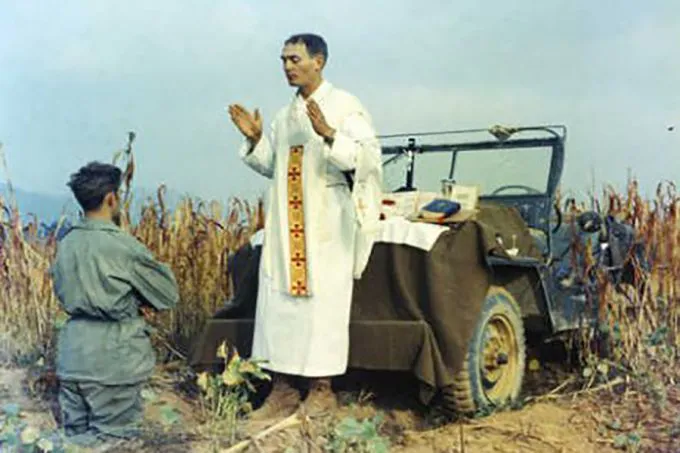
Father Emil Kapaun celebrates Mass using the hood of a jeep as his altar, Oct. 7, 1950. | Credit: Public domain
After the Battle of Unsan in November 1950, Kapaun was captured by Communist forces. Forced to march 60 to 100 miles to a prison camp at Pyoktong, he tirelessly encouraged fellow prisoners to carry the weak and wounded.
Once inside the dismal prison camp, Kapaun risked his life by sneaking through the camp after dark. He foraged for food, cared for the sick, and encouraged his fellow soldiers to hold fast to their faith and their humanity.
When the Chinese instituted a mandatory reeducation program, Kapaun patiently and politely rejected every theory put forth. One officer, Lt. Walter Mayo, later recalled the Communists taunting Kapaun. They argued that God must not exist since he was doing nothing to save them. Kapaun’s calm response: “God is as real as the air you breathe but cannot see; as the sounds you hear but cannot see; as the thoughts and ideas you have but cannot see or feel.”
Later, Kapaun openly flouted his captors by conducting a sunrise service on Easter morning, 1951.
Shortly after the service, Kapaun fell fatally ill. As he was being carried to the hospital, he asked Godʼs forgiveness for his captors, and to his fellow men he said, “I’m going where I always wanted to go, and when I get there, I’ll say a prayer for all of you.” He died in captivity on May 23, 1951, at the age of 35.
In 2013, Kapaun was posthumously awarded the Medal of Honor. He is also being considered for sainthood; in early 2025, Pope Francis officially declared him venerable.
Still serving those who serve
The work of Catholic military chaplains continues today. Priests celebrate Mass aboard ships, in hangars, at remote outposts, and in combat zones. They baptize children, prepare couples for marriage, hear confessions before deployments, and comfort grieving families when loved ones do not return home. Their mission remains what it has been since the Revolution: to bring Christʼs presence to those who serve.
Archbishop John Charles Wester of Santa Fe, New Mexico, voiced support for a Muslim group’s effort to construct a mosque in the suburbs of Albuquerque after the plan faced some community pushback.
The Albuquerque Islamic Center received approval for the new mosque in North Valley in a 5-1 vote by the Bernalillo County Planning Commission on July 1. The hearing was about five hours long with comments from the community, and the commission ultimately approved the mosque but not the proposed school, to keep the project smaller and the expected traffic lighter.
Wester issued a six-paragraph statement on July 27 in support of the project, saying Muslims have a right to access worship services and religious freedom extends beyond Christians.
In his statement, the archbishop said he has heard “concerns from residents” about the planned mosque and felt “compelled to speak clearly and pastorally” about the tension.
“Our Muslim neighbors have the same God-given and constitutionally protected right to worship freely as every other faith community, including our own,” he said and cited the Second Vatican Council’s declaration on religious freedom, Dignitatis Humanae.
Our Muslim neighbors have the same God-given and constitutionally protected right to worship freely as every other faith community, including our own.”
Archbishop John Charles Wester
Archdiocese of Santa Fe, New Mexico
“[The document] taught that every person ‘must be free from coercion’ in matters of faith,” he said. “This principle applies universally. It is not limited to Catholics or Christians; it extends fully to Muslims, Jews, and all people who seek to worship according to their conscience. Supporting the construction of a mosque is therefore entirely consistent with our own tradition and moral commitments.”
Wester encouraged “respect, dialogue, and peaceful coexistence” among people of different religious beliefs. He added: “We do not need to share the same beliefs to share the same neighborhood. What we do need is a willingness to listen, to learn, and to recognize the face of a neighbor rather than a stranger.”
The archbishop said interfaith relationships “enrich our civic life and strengthen the social fabric we all depend on” and criticized “anti-Muslim sentiment.”
“Any hostility toward Muslims — whether expressed through rhetoric, suspicion, or opposition to their places of worship — is incompatible with the Gospel of Jesus Christ, who commands us to love our neighbor without exception,” Wester said.
“Fear of the other is not a Christian virtue,” he added. “Hospitality is. Our Muslim brothers and sisters have faced discrimination and hostility in many parts of the country. When such prejudice arises, Catholics are called to stand beside them, not apart from them. Supporting their right to build a mosque is one concrete way to affirm their dignity and to reject the forces that seek to marginalize them.”
“We welcome Archbishop Wester’s principled statement defending religious freedom and thank him for speaking out,” Hooper said. “The freedom to worship is a fundamental and inalienable right of every American and every human being. As anti-Muslim bigotry rises throughout our nation, people of conscience and faith must stand together to encourage mutual respect.”
In Dublin, the Gaelic Athletic Association (GAA) All Ireland Football championship culminated this past weekend as County Mayo ended a 75-year “famine” by winning the Sam Maguire Cup, defeating the favored team to win, County Kerry, and putting to rest the supposed “curse” cast upon the Mayo by a priest in 1951.
Gaelic football is a traditional Irish team sport that blends elements of rugby, soccer, and basketball.
Legend has it that after winning their last All Ireland in 1951, the victorious Mayo team disrupted a funeral procession during their open-top lorry celebrations. In response, according to lore, a furious priest “cursed” the team, declaring that Mayo would not win another All Ireland title until every member of the 1951 squad had passed away. The last two members, Paddy Prendergast and Mick Loftus, passed away in 2021 and 2023, and this year is the first final the county has played — and won — since.
The historic win also took place on Reek Sunday, a traditional day of pilgrimage in County Mayo when thousands of Catholics climb Croagh Patrick holy mountain — a site forever associated with Ireland’s patron saint. To mark a marvelous day for the Mayo faithful, GAA President Jarlath Burns even mentioned Our Lady of Knock in his presentation speech to Mayo captain Jack Coyne in Croke Park.
The victory attracted acclaim from around the world. Former U.S. President Joe Biden’s family hails from County Mayo and he posted on social media: “Today, the dream becomes reality. Congratulations to my friends in Mayo. You earned this victory. Enjoy every minute. Sam is coming home.”
For the rest of the world the sporting focus this summer has been on the FIFA World Cup, but in Mayo fans agonized over whether this would finally be the year to end the 75-year losing streak.
Every July, the GAA Gaelic Football and Hurling championship finals take center stage, each attended by 82,000 fans in Croke Park Dublin. The finals are the showpiece occasion for the GAA, which is the largest amateur sports organization in the world.
Hurling continues to attract the attention and admiration of a growing international audience. It’s a nonstop, full-contact game played with sticks made from ash and a ball slightly smaller and lighter than a baseball. It traces its origins back to Celtic myth and legend.
Historic connection between the GAA and the Catholic Church
The Catholic connection to Ireland’s Gaelic sports is not coincidental. From its foundation in 1884, the GAA has had an almost symbiotic relationship with the Catholic Church. It is still present but no longer as evident.
There are GAA clubs globally wherever there is an Irish community, but in Ireland clubs are traditionally organized on a parish basis, relying on unpaid volunteers, with the best players selected to represent their county.
“Parish life revolved around the GAA and the Catholic faith — the two real pillars of life in Ireland,” Mickey Harte, who managed (County) Tyrone for three All-Ireland Senior football titles, told EWTN News. "The local priest would have been very heavily involved in the structure of the GAA club in the parish. Itʼs still a very strong connection, although thereʼs more of a secular outlook now.”
In Ireland, the GAA is more than a sporting organization, providing essential social fabric and support.
The GAA’s founding patron was the archbishop of Cashel and Emly, Thomas William Croke, after whom the famous stadium in Dublin is named. It was there that Pope Francis hosted the World Meeting of Families in 2018, and the GAA made Croke Park available for the World Eucharistic Congress in 1932. In years gone by, a bishop threw the ball in ceremonially on All Ireland final day.
Father Derek Ryan, a Redemptorist priest based in Drogheda and a GAA referee, said he sees a lessening of the link between the Catholic faith and the GAA, but “in times of tragedy, you can see how organized, compassionate, and supportive the GAA club can be to a community.”
Ryan pointed to the importance of the parish.
“The traditional loyalty to the parish is still the basis of the GAA. Itʼs about where youʼre living, where youʼre from, and parish boundary lines mark the border lines between local GAA clubs,” he said. “Club identity is woven into parish identity.”
Ryan highlighted the value of GAA clubs that provide a sense of community for the Irish diaspora.
“My own experience of living abroad in Africa and over in the United States is that these clubs become much more than sporting organizations, they become supportive centers,” he said. “If we didnʼt have these GAA clubs and communities throughout the world, we would be very much less well off.”
HARLINGEN, Texas — In the most recent development in an immigration case that has gained national attention, Sister Leticia Ugboaja, the Nigerian Catholic nun and nurse who was briefly detained by Immigration and Customs Enforcement (ICE) agents in south Texas in June, was informed today that third-country removal was not off the table, which her attorney called “very concerning.”
After a July 28 check-in with ICE officials in Harlingen, Texas, Carlos M. Garcia, Ugboaja’s lawyer, told reporters gathered outside the ICE field office that the possibility of third-country removal “is very concerning for us … That is obviously not what we want. And that’s why we are exploring all our legal alternatives.”
Garcia said he and his client have not yet decided on a specific legal path.
At a July 23 press conference, he said an immigration judge denied Ugboaja’s application for asylum in 2019 but did grant her protection from removal to Nigeria under the United Nations Convention Against Torture, finding it was likely she would be tortured if she returned there.
Garcia said this protection legally bars the U.S. government from deporting her to Nigeria, though she remains under a final order of removal and could be sent to a third country.
After Ugboaja’s July 28 check-in, her attorney expressed gratitude that the nun, who has lived in the United States for nearly two decades and has never missed an immigration appointment, was not detained and not required to wear an ankle monitor, possibilities he discussed last week. The nun has another check-in scheduled for Jan. 28, 2027.
“We’re happy that she’s continuing to be able to live her life the way she’s been living it, which is a life of service to the community and to her church family,” Garcia said.
“Today was just a check-in,” he said, and ICE officials “determined that [Ugboaja] was able to continue [living] based on the conditions that they had given her before, which is really released on her own word, her own recognizance.”
Ugboaja, a member of the Daughters of Mary Mother of Mercy and a registered nurse at South Texas Health System, was detained by two ICE agents on Sunday, June 28, as she walked to Mass at a church where she serves as a Eucharistic minister.
At a press conference last week, the only time she has spoken publicly, she described weeks of “stress, anxiety, and fear” since the detainment.
Though she has felt afraid and hurt, she said she has been trusting in God, quoting Jesus’ admonition to “not be afraid, because I am with you always.”
The nun declined to speak with reporters after her check-in July 28.
Sister Norma Pimentel, executive director of Catholic Charities of the Rio Grande Valley and a member of the Missionaries of Jesus in the Diocese of Brownsville, Texas, told EWTN News this process has been very difficult for Ugboaja.
“She’s such a joyful, happy, and beautiful personality,” Pimentel said. “She goes to daily Mass, and receiving the Eucharist is so much a part of her strength and her force within her, but this disruption has scared her tremendously.”
Though Ugboaja was released the same day she was detained, in part through the efforts of Rep. Henry Cuellar, D-Texas, Pimentel said “it was a tough time for her to be in detention … it felt like an eternity for her.”
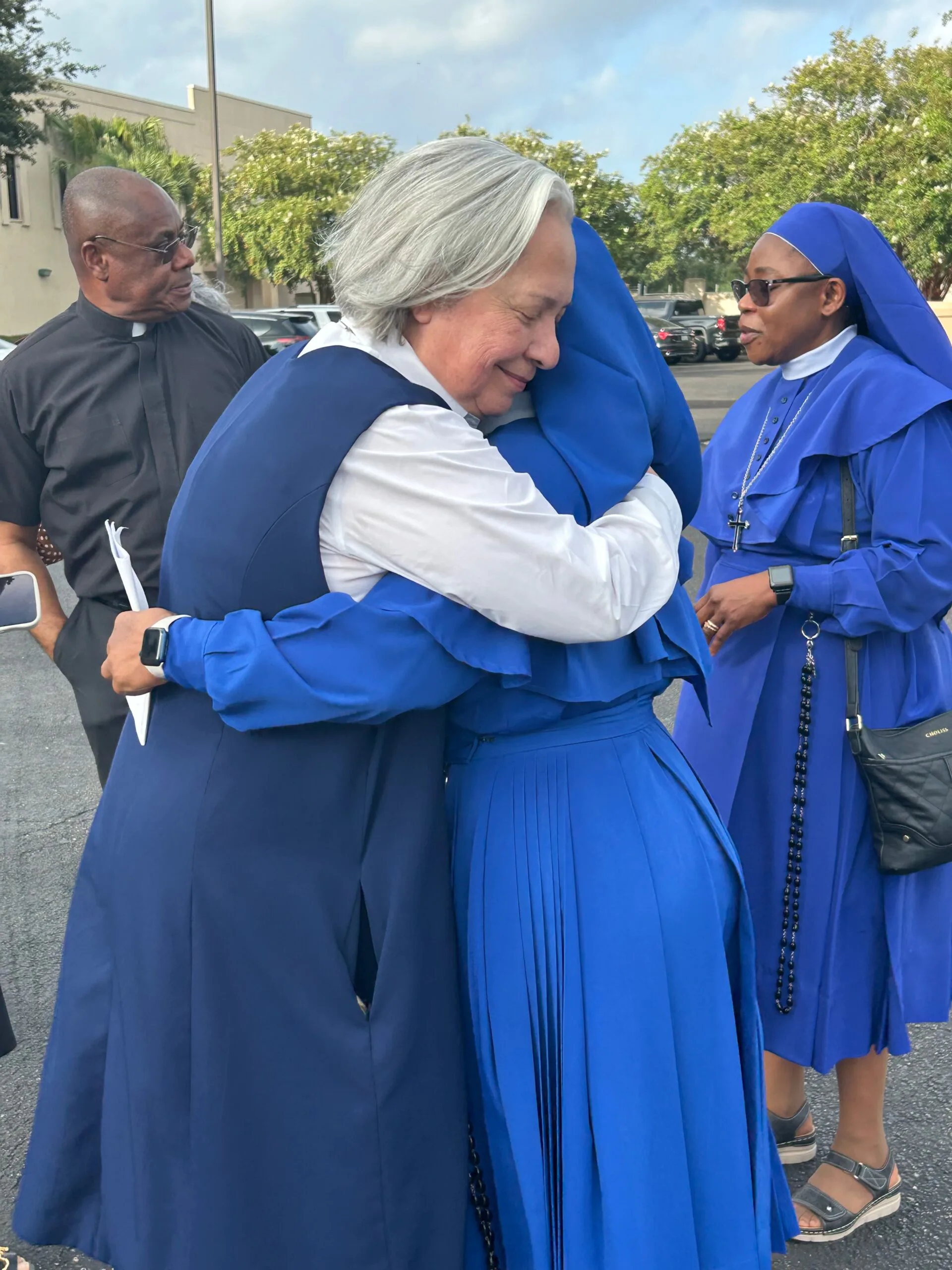
Sister Norma Pimentel hugs Sister Leticia Ugboaja outside the ICE field office in Harlingen, Texas, before Ugboaja’s July 28, 2026, immigration check-in. | Credit: Amira Abuzeid/EWTN News
Pimentel said the nun “just broke down into tears, uncontrollably” upon her release.
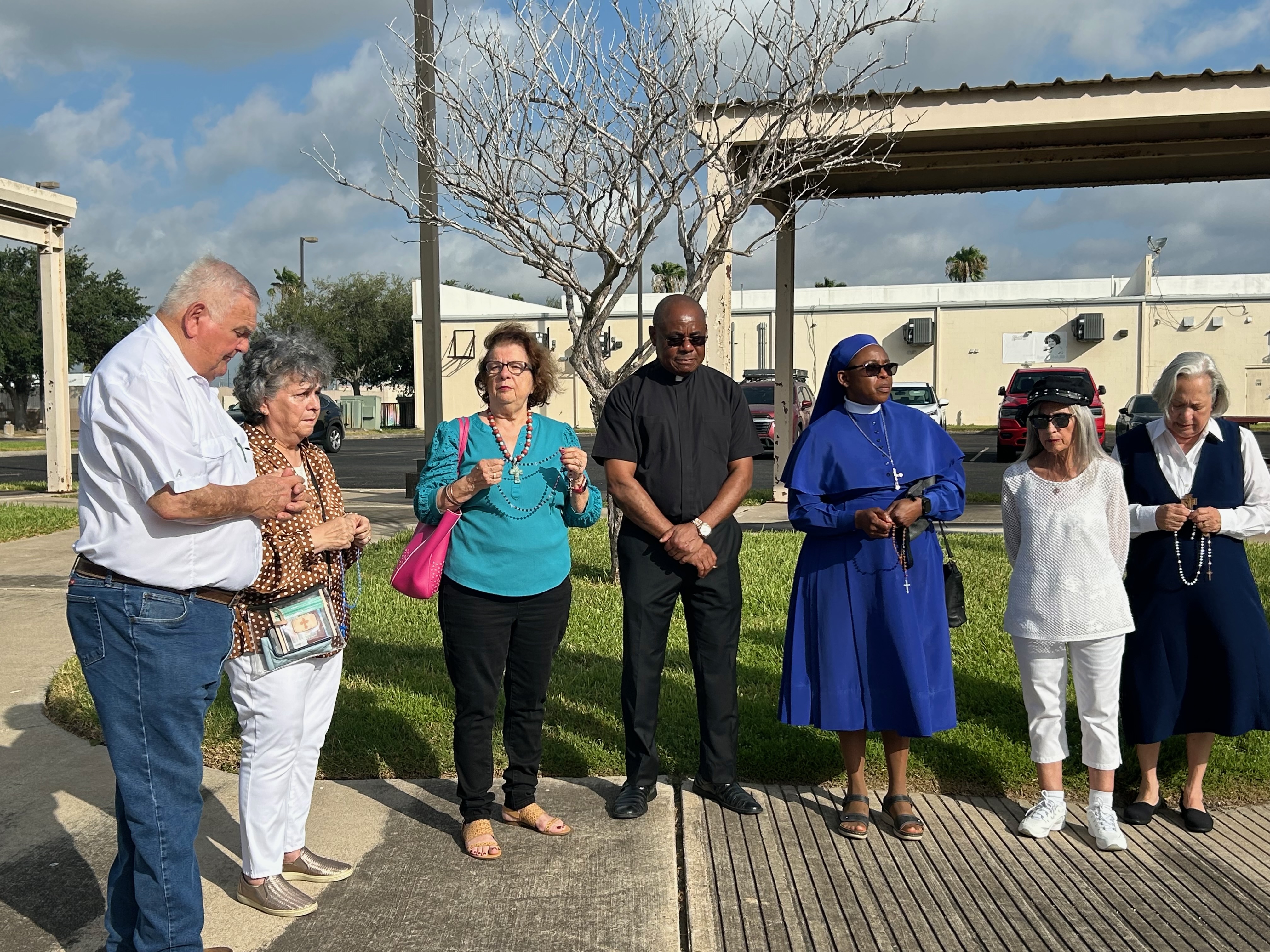
Since then, the community has poured out its support, Pimentel said. During this morningʼs check-in at the ICE field office, Father Isaac E. Erondu, a priest from Mission, Texas, led a group of people, including Ugboaja, in prayer before she entered the building with her lawyer.
Supporters then prayed the rosary together as they awaited news of Ugboaja’s fate.
Supporters of Sister Leticia Ugboaja, including Sister Norma Pimentel, right, pray the rosary outside an ICE field office in Harlingen, Texas, as they await news of Ugboaja’s immigration case, July 28, 2026. | Credit: Amira Abuzeid/EWTN News
“She’s trying to be strong,” Pimentel said. “She wants to continue just being herself … In seeing the support, the love, and so many people that are here for her, she knows she’s not alone.”
We want her to know “we are here with you, and you’ll be OK,” she said.
We were all thinking this was about picking up criminals, but there’s no criminal sense in all of this.”
Sister Norma Pimentel
In a message to Catholics and other supporters concerned with Ugboaja’s case, as well as the nature of ICE’s recent immigration enforcement measures, Pimentel, who has worked on behalf of immigrants on the U.S.-Mexico border for more than 20 years, said: “I think that we must stand together strong, supporting the defense of good people that are here in our community … and not only [Ugboaja], but everybody, so many families who are hurting.”
“We must speak up and ask for … a process that is more respectful to human life and to the goodness of people,” she continued. “So many people are here in the community and are really contributing in a positive, good way. This should not be happening.”
Of ICE’s enforcement measures, Pimentel said: “We were all thinking this was about picking up criminals, but there’s no criminal sense in all of this, you know? And so all of us must truly stand up and defend the right way of who we are as Americans here in the United States.”
Bishop José de Jesús González Hernández of the Diocese of Chilpancingo-Chilapa in the Mexican state of Guerrero called for a week of prayer for the victims of a fireworks explosion that occurred during the patronal festival for the municipality of Cocula.
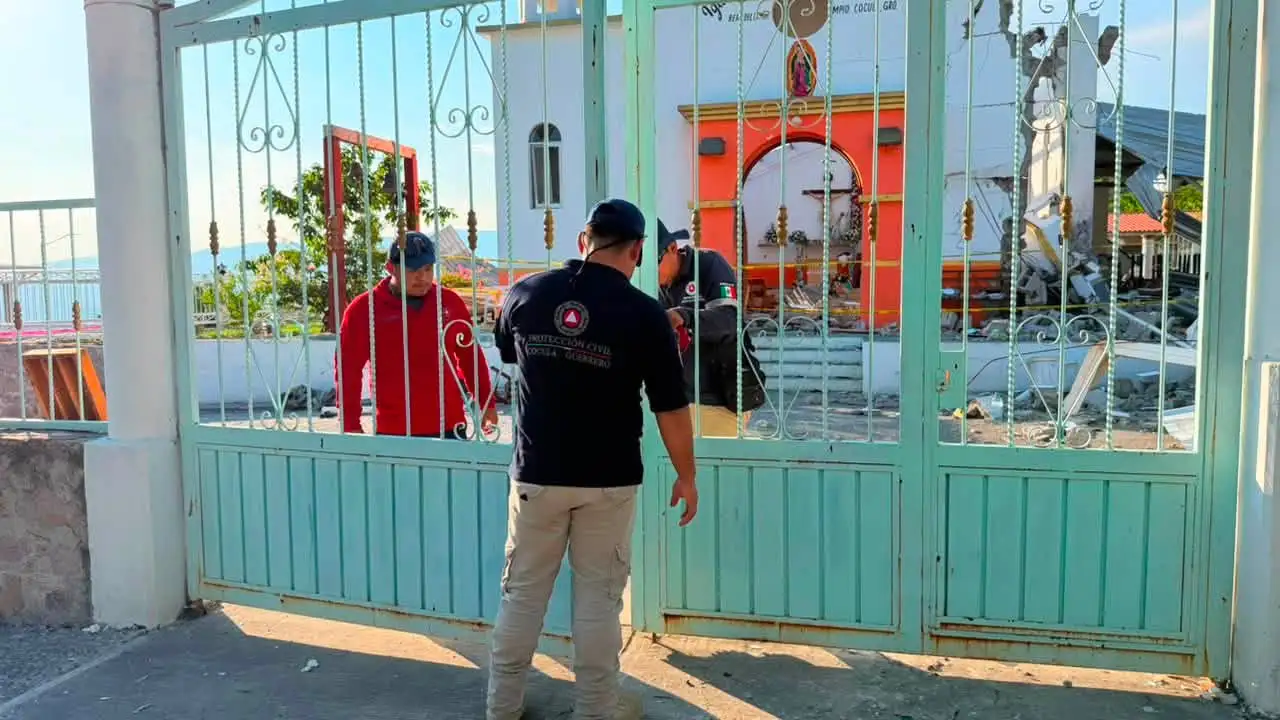
The accident took place on the night of July 25 while residents were celebrating the feast of St. James the Apostle in front of the Our Lady of Guadalupe parish church. A video circulating on social media shows the moment of the explosion.
According to the media outlet El Horizonte, the explosion killed three women, including a young woman who was eight months pregnant. Some victims suffered severe burns, including minors who required specialized care.
Speaking to the media on July 26, Francisco Rodríguez Cisneros, Guerrero state’s undersecretary for political and social development, explained that the incident occurred because those responsible for the fireworks display “failed to keep them at a safe distance from where they were being used.”
According to the official, a rocket was propelled toward the area where the fireworks were stored, triggering the explosion. Rodríguez reported that as of Sunday, July 26, there were 12 injuries and four fatalities.
Civil Protection personnel conduct inspections on July 26, 2026, at the Parish of Our Lady of Guadalupe in Cocula, Guerrero, Mexico, following a fireworks explosion. | Credit: Cocula Municipal Government
Prayers requested for the victims
In a July 26 statement, González expressed his “deep sorrow and dismay” regarding the incident.
“As a particular Church, we offer our prayers for the eternal rest of those who have been called to the Father’s House. We entrust their souls to the infinite mercy of God, with the firm hope of the Resurrection promised by Our Lord Jesus Christ,” he stated.
The prelate invited priests, deacons, men and women religious, and the lay faithful to offer special prayers during the week for the eternal rest of the deceased, the recovery of the injured, the consolation of their families, and for peace.
He particularly urged that, during the celebration of holy Mass and the recitation of the rosary, prayers be offered for the specific intention of all the victims of the tragedy.
Finally, he entrusted those affected to the intercession of Our Lady of Guadalupe and St. James the Apostle, asking God to pour out “upon them the balm of his love and peace.”
This story was first published by ACI Prensa, the Spanish-language sister service of EWTN News. It has been translated and adapted by EWTN News English.