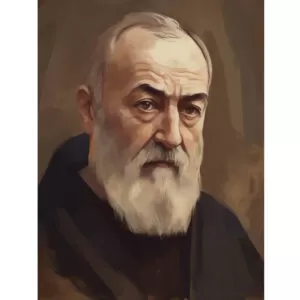
In late February, Pope Leo XIV thanked Father Bruno Kant of the Diocese of Fulda in Germany for his “many years of faithful and devoted priestly service.” Kant, the oldest priest in the world at 110 years of age, passed away on the night of Friday, May 29. He had been a priest since 1950.
In an article published on his dioceseʼs website, Bishop Michael Gerber of Fulda recalled that "just a few months ago" he had "the privilege of conveying Pope Leo XIVʼs blessing to Father Bruno Kant on the occasion of his 110th birthday."
"My encounter with him left a deep impression on me. Even at his advanced age, he radiated the humility, kindness, and spiritual depth that characterized his entire priestly life. The Diocese of Fulda remembers his work and service with great gratitude," he added.
Father Guido Pasanow of the parish in Eichenzell-Löschenrod, where Kant lived until his death, said that with the priest’s death, the parish “loses a person who was fundamental to it for many years.”
“Even after retiring from active ministry, he remained a confidant, pastor, and spiritual guide deeply cherished by many parishioners. We are grateful for all that he contributed to our community,” he added.
As reported by the Catholic news outlet katholisch in November 2025, Kant, born near Danzig in what is now Poland, had aspired to become a priest since the age of 9. He was able to begin his theological studies, but the Nazi regime thwarted his plans by conscripting him for forced labor and making him a soldier.
Kant spent four years as a prisoner of war in Russia before reuniting with his family, who had fled to the West.
He was finally ordained a priest in 1950. After decades of priestly service, he considerably curtailed his activities. He stopped driving at the age of 102, according to a report published on katholisch.de in November.
“Over the last few years, he has refrained from celebrating holy Mass with the congregation on Wednesday evenings. However, he continued visiting the sick for as long as he was able. Now, that is no longer possible for him.”
On that occasion, Kant said: “I expect to die every day. I am not far from it.” In his final years, he spent his days solving Sudokus, watching television, reading newspapers, and, of course, praying.
“Praying keeps me young,” he said.
This story was first published by CNA Deutsch, the German-language sister service of EWTN News. It has been translated and adapted by ACI Prensa/EWTN News English.
As head of the recently established ministry team for the Pastoral Care of Consolation and the Ministry of Exorcism (DEPAC, by its Spanish acronym) of the Mexican Bishops’ Conference, Bishop José Trinidad Zapata Ortiz highlighted the importance of a “mature faith” in the face of the proliferation of esoteric cults into which not a few Catholics have fallen.
“We are in need of a mature, committed, and convinced faith,” the bishop of Papantla shared with ACI Prensa, the Spanish-language sister service of EWTN News, lamenting that “unfortunately, many of our parishioners who are baptized do not live out their faith in an orthodox manner” and end up seeking a “solution to their difficulties in other areas.”
“Having the solution within their own Church in pastoral practice and by living out the sacraments, they go looking for solutions elsewhere,” falling “into spiritist practices or other types — satanic ones, or the so-called ‘Santa Muerte,’ [a Mexican folk saint and deity personifying death], etc.”
It is in this way that some people end up facing various spiritual difficulties, he explained.
This denotes a lack of faith, he pointed out, for “when there is total trust in the Lord, we know that there may be difficulties, that there may be problems, but that, ultimately, the Lord permits all of this to bring about a greater good and to guide us along the right path.”
“The Christian life is not a victorious life devoid of pain or problems; rather, one embraces this as a path, following the Lord,” he explained.
A new pastoral ministry to address spiritual suffering
The Mexican bishops established the new pastoral ministry during their general assembly in November 2025 and appointed Zapata as its head. The prelate explained to ACI Prensa that the decision is framed within the “growing need to address these situations of spiritual, moral, and physical suffering of some persons, which may have a malevolent origin.”
“Therefore, it was deemed appropriate to officially support the exorcists who were already undergoing training courses,” as well as to “accompany them” and foster “unity and cohesion regarding this entire issue at the national level.”
However, he emphasized that DEPAC “will not focus solely on ministering to exorcists” but rather aims at a comprehensive “pastoral ministry of consolation,” for “what people often need is consolation — to be listened to, to receive guidance, and to have prayers offered on their behalf — so that they may follow a path and a process in following the Lord.”
All priests, he underscored, as pastors of their parishioners, must “listen to their faithful to see what difficulties or sorrows they are enduring or suffering.”
For this reason, it is necessary to foster among priests a “serious and profound” formation in theology, spirituality, morality, and pastoral practice regarding these matters, in order to be able to attend to them.
The ordinary action of the devil
While the Mexican prelate emphasized that it is necessary to address problems related to the “extraordinary action” of the devil such as demonic possession, he noted that “it is through his ordinary action that the devil causes so much evil in the world.”
It is “through temptation that many of us fall.” It’s how the devil “produces the worst evils in the world and not [through] possession,” which happens once in a million cases.
Zapata also urged against exaggerating the power of the devil in our lives: “It should neither be denied nor seen everywhere,” for we must also “assume our own responsibility.”
“The devil can’t do what God doesn’t permit him to do, and what we don’t permit him to do,” he said. “Thus, if he wreaks havoc upon us, it is because we first allowed him to do so. We venture onto his paths and let him into our lives.”
The formation the Church seeks to promote in Mexico
With these challenges in mind, the recently established DEPAC aims to “form and guide all our priests so that they may recognize divine action, the action of the devil, and human action, and know how to discern,” while also ensuring they are equipped to “attend to special cases of extraordinary action” of the devil.
Along these lines, the new ministry team has already been conducting spiritual exercises and courses for priests, and has scheduled new training sessions for July of this year including lay experts in various disciplines who assist in this pastoral ministry, such as physicians and psychologists.
Outlining the qualities required of an exorcist priest, Zapata noted: “We simply need a priest grounded in doctrine, a good priest, generally speaking.”
“This is not a matter of having a charism; it’s a matter of a mandate issued by the bishop to a priest whom he sees has the qualities for this,” he pointed out; consequently, every prelate “must evaluate the qualities the priest has.”
However, he emphasized that it is considered important “that he be a Eucharistic priest, a Marian priest, a priest who enjoys caring for those in need, especially the sick.”
Thus “a priest who is, let us say, upright, transparent, and honest,” he summarized.
This story was first published by ACI Prensa, the Spanish-language sister service of EWTN News. It has been translated and adapted by EWTN News English.
YAOUNDE, Cameroon — The president of the National Episcopal Conference of Cameroon (NECC), Archbishop Andrew Fuanya Nkea, has renewed the Catholic Church’s call for peace and dialogue, urging both Church leaders and political authorities to address the root causes of conflict as the country continues to face security, political, and socio-economic challenges.
Speaking during the opening ceremony of the 51st Plenary Assembly of NECC members, the archbishop emphasized that peace must remain a national priority, particularly in Cameroon’s conflict-affected northwest, southwest, and far north regions.
“Peace is a fundamental human right, indispensable for the development of peoples, social cohesion, economic progress, and respect for human dignity,” Nkea said on Tuesday, June 2.
The leader of Cameroon’s Bamenda Archdiocese reflected on the April 15–18 apostolic journey of Pope Leo XIV to Cameroon, describing it as a historic moment for the local Church and a source of renewed hope for the nation.
“At a time when our Church and our country needed it most, he accepted, against all odds, even risking his own life, to come and comfort us and renew in us the hope that does not disappoint,” Nkea said.
He also highlighted the Holy Father’s appeal for reconciliation and an end to violence, recalling that Pope Leo XIV spoke of the suffering caused by the conflicts affecting parts of Cameroon, including the loss of lives, the displacement of families, disruptions to education, and growing uncertainty among young people.
The Cameroonian archbishop said the Church remains committed to promoting peace, dialogue, and hope while encouraging greater investment in the countryʼs youth as an essential part of building a stable future.
Quoting Pope Leo, Nkea noted that the tensions and violence affecting parts of Cameroon have caused profound suffering, including loss of life, displacement of families, disruption of education, and uncertainty among young people.
“Enough of war, with all the pain it causes through death, destruction, and exile,” the archbishop said, echoing the pope’s call.
He emphasized that peace cannot be achieved solely through political declarations but requires a sincere commitment to dialogue, conversion, justice, and national reconciliation.
“We will never achieve lasting peace without a firm decision to choose the path that leads to it, with all its demands of conversion, love for country, change of mentality, and dialogue,” he said.
As Cameroon prepares for future municipal elections, Nkea called for prayers and vigilance, noting that elections in the country are often accompanied by tensions and violence.
“The appeasement that we contributed to create after the presidential election was not a sign of weakness but a necessity for our society,” he said.
A significant portion of the archbishop’s address focused on the role of young people in building a peaceful and prosperous future.
Drawing from Pope Leoʼs remarks during his visit, the archbishop emphasized that youth remain the nation’s greatest hope.
“Young people represent the hope of the country and of the Church. Their energy and creativity are priceless treasures,” he said.
He warned that unemployment, social exclusion, and lack of opportunities continue to expose many young people to violence, migration, drug abuse, prostitution, and despair.
“Investing in education, training, and entrepreneurship for young people is therefore a strategic choice for peace,” Nkea said.
The NECC president also encouraged the Church in Cameroon to reflect on the popeʼs recent encyclical, Magnifica Humanitas, particularly its teaching on the ethical challenges posed by artificial intelligence (AI) and digital technologies.
“In times marked by the challenges posed by a certain use of digital technology and artificial intelligence, we must discern how to receive the Holy Father’s encyclical in our context,” he said.
Nkea also used the occasion to celebrate the 60th anniversary of NECC, describing the milestone as a testament to six decades of evangelization, ecclesial maturity, and faithful service to the people of God.
The 51st Ordinary Plenary Assembly of the NECC, running from May 31 to June 5, is bringing together Catholic bishops from across Cameroon to review pastoral priorities, discuss national concerns, evaluate Church projects, and strengthen their collective mission of evangelization.
Throughout the gathering, Nkea said, the bishops are to continue praying for peace in Cameroon and around the world while seeking ways to respond to the challenges facing the Church and society.
“We freely chose to come together and persevere in our journey toward eternity. May the Holy Spirit remain the principal protagonist of our communion and collegiality, so that our work may be for the glory of God and the salvation of all,” he said.
This story was first published by ACI Africa, the sister service of EWTN News in Africa, and has been adapted by EWTN News.
The canonization cause for Sister Blandina Segale, the "Fastest Nun in the West,” is moving forward after Vatican theologians unanimously voted to advance her sainthood cause.
It is a “very historical moment in the archdiocesan history, but also [for] the Sisters of Charity of Cincinnati and the whole Church,” Archbishop John Wester of Santa Fe, New Mexico, said at a press conference outside the Blandina Segale Convent in Albuquerque, New Mexico, on June 1.
“The Sisters of Charity are profoundly grateful for the life of Sister Blandina and her witness of faith, courage, and care for those most in need,” said Sister Monica Gundler, president of the Sisters of Charity of Cincinnati, in a press release.
“As her story continues to be shared with the world, we pray that her compassionate heart will inspire others to emulate her example of charity, justice, and service,” she said.
Her cause moving forward is “a national celebration,” said Allen Sanchez, the petitioner of Segale’s cause, at the event.
The theologians “came together with a very important lens to look at her life” and examined 14,000 pages of “the argument for her heroic virtue, the book she wrote, and books written about her,” Sanchez said.
After doing so, they confirmed that Segale used the gifts of the Holy Spirit and fulfilled the corporal works of mercy, Sanchez said.
“There was no debate” among them, but it was rather a “celebration,” Sanchez said.
“They have everything in place, but in the summer they get to vote and then itʼs up to them to recommend to the pope if sheʼs venerable,” he said. After an examination by cardinals and bishops who are members of the Dicastery for the Causes of Saints, the prefect of the dicastery presents findings to the pope who can consider approval.
If she becomes venerable it will then require one miracle to move forward again to her beatification, but “we have 58 of them,” he said.
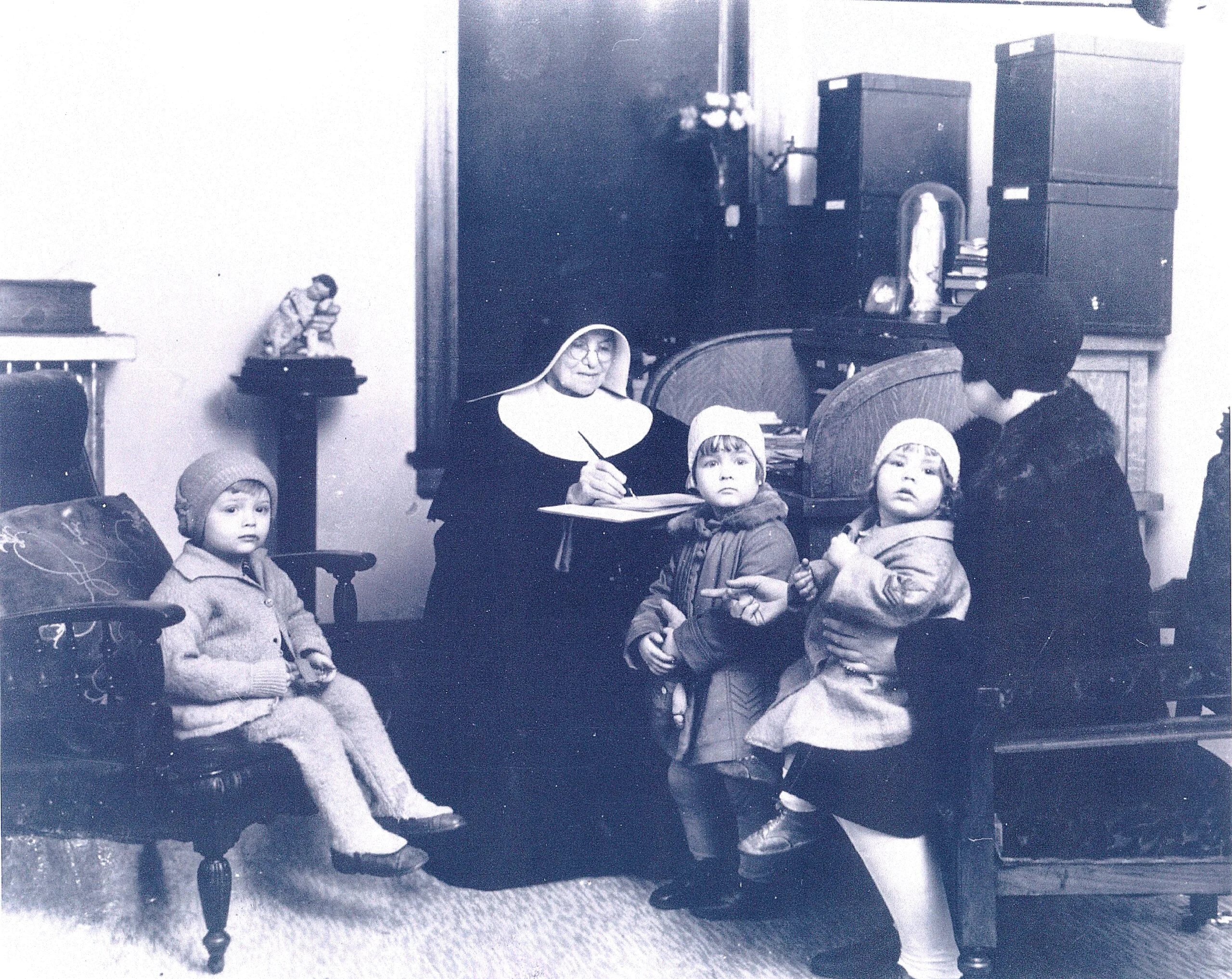
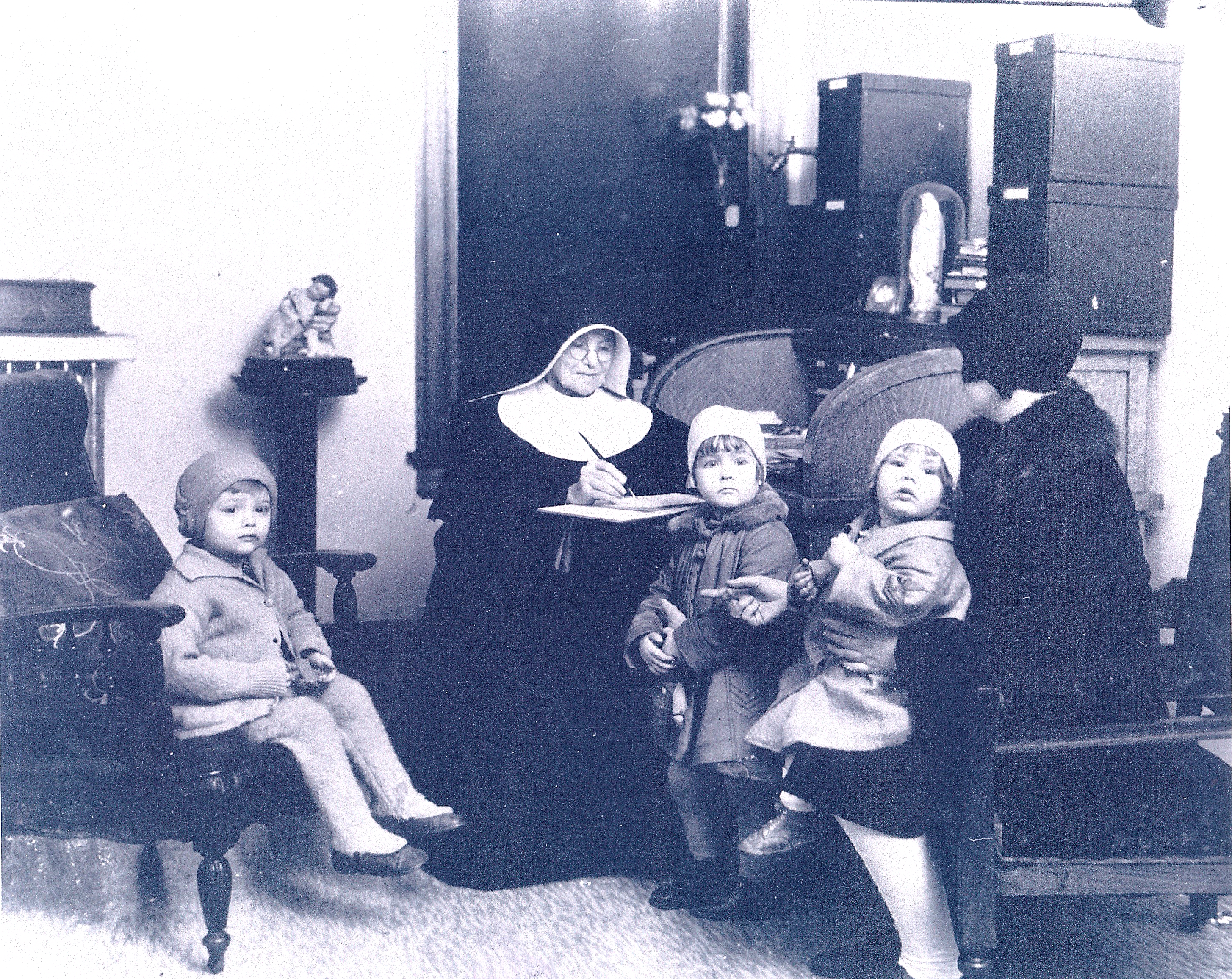
Sister Blandina and Sister Justina Segale founded Santa Maria Institute, today known as Santa Maria Community Services in Cincinnati, one of the first Catholic settlement houses in the United States. | Credit: Photo courtesy of Sisters of Charity of Cincinnati
Sister Blandina Segale
Segale was an Italian immigrant who came to the Wild West in the 1800s. She was born Maria Rosa Segale in the town of Cigana, Italy, on Jan. 23, 1850. At the age of 4, she and her parents moved to Cincinnati where she joined the Sisters of Charity at 16.
She spent over two decades serving in the American Southwest, primarily in Trinidad, Colorado, and in Santa Fe and Albuquerque, New Mexico.
She worked in schools, orphanages, and hospitals that the sisters operated. She worked to build a trade school for Native American women and a home for the elderly.
She offered direct relief to the poor and helped raise money for numerous efforts.
She “started the public schools and the Catholic schools in [New Mexico] and the healthcare system,” Sanchez said. “The healthcare system that she helped begin with other nuns is now the largest nonprofit healthcare provider in the nation.”
Amid her efforts to start schools and hospitals, she intervened against lynch mobs and outlaws.
She eventually formed a friendship with William Bonney, better known as “Billy the Kid” — an American criminal linked to numerous murders in the late 19th century.
According to legend, and Segale’s journal and letters, one of Billy the Kid’s gang members was shot, but doctors refused to treat him. Segale decided to take him in and nurse him back to health.
The criminal was still unhappy so he planned to return to scalp the four doctors in revenge. When he arrived, Segale intervened and convinced him to call it off on behalf of the man she had saved.
After the incident, Segale and Billy the Kid became friends. She visited him in jail, and he called off a stage-coach robbery as soon as he realized she was one of the passengers.
Gifts of the Holy Spirit
“Blandina had wisdom and she had understanding,” Wester said. “She saw the world through the eyes of God. She had the wisdom of the Scriptures, the wisdom of the Church, the wisdom of faith.”
She also had “courage and fortitude,” he said. “She was this little powerhouse” who “rode down here in the stagecoach by herself, and she came to New Mexico.”
“She trusted in Jesus, that the Lord Jesus was with her and calling her to this mission, and she never wavered in her courage.” She “confronted mobs, lynch mobs, Billy the Kid — all kinds of difficulties with courage."
“She had prudence" and “the gift of right judgment,” Wester said. “She conceived that we needed hospitals and schools and cemeteries and orphanages and all kinds of institutions to help people. And she started them.”
“She could make good decisions” with her “knowledge to know the will of God, that God was willing peace for his people,” he said.
“God wants us all to live together in peace, and Blandina knew that,” he said.
“I encourage all of us in New Mexico, Catholic and non-Catholic alive, to follow Blandinaʼs example, to care for people, to live in harmony with people, to see the good in people, to be able to affirm one another and build each other up, and to be able to live together in peace,” Wester said.
Washington archbishop Cardinal Robert McElroy on June 3 removed a prominent priest from his role as an archdiocesan exorcist after the priest made remarks linking UFOs to demonic activity.
Monsignor Stephen Rossetti was “removed … as an exorcist of the Archdiocese of Washington,” McElroy said in a statement posted to the archdioceseʼs website. Rossetti is a priest of the Diocese of Syracuse, New York, the statement noted.
In addition to Rossettiʼs removal, McElroy said the archdiocese had “ended all affiliation between the archdiocese and the St. Michael Center for Spiritual Renewal located in Washington, D.C.”
Led by Rossetti, the St. Michael Center is a Catholic nonprofit that “conducts spiritual education workshops and trains clergy, religious, and laity,” according to its website.
Rossetti had on May 29 posted a video to YouTube in which the exorcist had expressed his personal belief that “many, if not most, [UFO] sightings are, in fact, demons.” Such entities, he said in the video, “can do things that we canʼt do, such [as] the speed and all sorts of things that human beings canʼt do.”
McElroy in his statement said Rossettiʼs remarks “gravely undermine the Church’s very precise teaching on the devil, demons, and exorcism.” The cardinal also criticized the St. Michael Centerʼs “recent use of social media,” though the statement did not offer any specifics beyond that.
In a statement after the news broke, Rossetti said he was “saddened” by the archdioceseʼs decision.
“I ask forgiveness for any ways that I have not been faithful to the teachings of the Church’s magisterium, particularly in the cited video on ‘aliens and the demonic,’” he said.
“I believe it is of the utmost importance to be obedient to the Church and I will continue to endeavor to subject all that I do and the center to be thus obedient,” he continued, adding: “Also, I will continue to encourage all to do so as well.”
“I am grateful for 19 years of ministering in the Archdiocese of Washington as its exorcist and I thank the archdiocese for its support and blessing all these years,” the statement continued. “We will remember the cardinal and all in [the archdiocese] in our prayers for its important ministry.”
The St. Michael Center “plans to continue its ministry elsewhere,” Rossetti said.
As of June 3, the video that apparently resulted in Rossettiʼs dismissal had been marked private on YouTube.
U.S. bishops urged Congress to reauthorize the Religious Worker Visa Program, protect refugee services and unaccompanied children, and reject expanded enforcement and detention measures, warning that mass‑deportation policies would undermine due process and separate families.
The United States Conference of Catholic Bishops (USCCB) sent a list of immigration-related requests to lawmakers June 1 as they are set to vote on fiscal 2027 appropriations.
In a letter sent to leaders of the House and Senate Appropriations Committees, Bishop Brendan J. Cahill of Victoria, Texas, wrote on behalf of the USCCB asking the committee to consider “additional priorities” in connection “to human life and dignity.”
“The well-being of immigrants, refugees, unaccompanied noncitizen children, victims of trafficking, and other populations, as well as our immigration system in general, is of deep concern to the Catholic Church,” wrote Cahill, chair of the bishops' Committee on Migration.
“Our perspectives on these matters are grounded in Scripture and Catholic teaching, including our belief in the inherent and inviolable dignity of every person,” he said.
The letter was sent to Sen. Susan Collins, R-Maine; Sen. Patty Murray, D-Washington; Rep. Tom Cole, R-Oklahoma; and Rep. Rosa DeLauro, D-Connecticut.
The bishops urged that funding continue for the Refugee and Entrant Assistance (REA) programs administered through the Office of Refugee Resettlement, as the programs are needed to assist refugees, victims of human trafficking, and other migrant groups.
They asked for “robust” appropriations for the Wage and Hour Division and the U.S. Department of Justice’s Office of Justice Programs to support victims of trafficking, and funding for International Humanitarian Assistance and Emergency Refugee and Migration Assistance.
While acknowledging the governmentʼs right to enforce immigration laws, the bishops reiterated their opposition to expanded enforcement and detention measures, and asked for “more humane” alternatives.
The letter warned that mass deportation threatens due process, family unity, and discriminatory practice and asked Congress to ensure that people in detention facilities have access to religious and pastoral services.
Bishops' requests
The Department of Homeland Security (DHS) is operating without fully enacted fiscal 2026 funding, and instead has been funded through continuing resolutions after a 76-day shutdown that ended April 30. The Trump administration is asking Congress to approve $118.4 billion in fiscal 2027 DHS spending, which is a $6.6 billion increase over the continuing resolution levels.
The bishops asked the committee to consider permanently reauthorizing the Religious Worker Visa Program, “to avoid the uncertainty and disruption” that its expiration creates for religious organizations, their workers, and communities they serve.
The bishops also reiterated their request for Congress to take up and pass H.R. 2672/S. 1298, named by sponsors as “the Religious Workforce Protection Act.” The legislation would let DHS keep certain religious workers in the U.S. beyond the five-year limit on R‑1 visas while their green card or immigrant visa applications are still pending.
The bishops urged Congress to support agencies that help “promote trust” in the immigration system that “have been weakened” or “ceased operating entirely,” including the DHS Office of Inspector General and the Office of Immigration Detention Ombudsman.
Concerned about “nationality-based restrictions on legal immigration pathways,” the bishops asked that the State Department and DHS be required to report the status of all nationality-based restrictions.
Bishops urged lawmakers to fund the Legal Orientation Program, support the immigration court system, and oversee functions related to immigration enforcement in their consideration of the fiscal 2027 Commerce‑Justice‑Science (CJS) appropriations bill. U.S. House consideration is next for CJS appropriations; the House Appropriations Committee approved the legislation May 13.
The Washington, D.C.-based Institute on Religion and Democracy (IRD) launched its “Christians for Capitalism” project on June 2, seeking to bring together Christians of various traditions who support free-market capitalism.
“There was concern among a number of Christians in D.C. in the field of economics that there was no ongoing institutional voice in Washington, D.C., for pro-free market Christians, and there are obviously many Christians in D.C. who are pro-free market,” IRD President Mark Tooley told EWTN News.
“There was a vacuum here being filled by other voices and other perspectives that are critical of — if not hostile to — the free-market perspective,” he said.
Tooley, who is Methodist, said IRD is “not tied to any particular Christian tradition” and includes both Protestants and Catholics, noting “Catholics were among our founders.” He said IRD has been ecumenical from the start, with a focus on Christianity in the U.S., democracy, and human rights.
The IRD was founded in 1981, and most of its early board members were Protestant but also included one Catholic, the philosopher Michael Novak. Another early board member, Father Richard John Neuhaus, was Lutheran at the time but converted to Catholicism in 1990 and was ordained to the priesthood.
Tooley said the plan for the project is to hold events, publish articles, and host a semester-long fellowship for young people who align with their vision. He said he expects Novak’s writings to be prominently featured in the reading materials for the fellowship, which would likely meet twice per month this fall.
The launch event
The IRD kicked off the initiative with an early evening event on June 2 at its headquarters in downtown Washington, D.C., just a few blocks north of the White House. A few dozen people gathered for the occasion, which included drinks, hors dʼoeuvres, and an hourlong presentation by two Christian scholars discussing the intersection of Christianity and economic thought.
Erik Matson, a Gibbons fellow in economics at The Catholic University of America, and Jordan J. Ballor, executive director of The Center for Religion, Culture, and Democracy at the First Liberty Institute — both of whom are Protestant — delivered the presentation on their book: “A History of Christian Political Economy.”
The book delves into economic thought in the Bible, among the early Church fathers, from medieval theologians, in the writings of later Protestant reformers and Catholic thinkers, and from contemporary scholars.
Jordan said during the presentation that theological perspectives are “not in the mainstream of what is taught in economics” but said “we might be missing something” when we fail to include theological perspectives in economic discourse.
Although much of the older writings do not touch on the subject in the form of an economic treatise, Matson explained in his presentation that Christians were “wrestling with political and economic issues” of the time and commenting on questions about wealth, poverty, and access to resources.
Matson identified two “broad competing perspectives” among the thinkers. One, he called “a limited good perspective” and the other, “a mutual benefits perspective.”
He said the first views material wealth as essentially “fixed,” in the sense that any transaction is “zero sum,” or “the gain of one is the loss of another.” The second views wealth as something that can increase into the future, in the sense that “the good of one need not come at the cost of the good of many” and that transactions can be “wealth generative” rather than just being shifts in resources.
According to Matson, “you can find both of these perspectives” over the course of the last two millennia within all Christian faith traditions. He pointed to St. John Chrysostom as falling more into the “limited good perspective” of economic thought and St. Thomas Aquinas as being more closely aligned with the “mutual benefits perspective,” for example.
Matson told EWTN News after the presentation “there’s no real discernible difference across denominations,” saying the research found representatives of both perspectives in Catholic, Protestant, and Orthodox thought.
He said Pope Leo XIII, who authored Rerum Novarum in 1891 and set the foundation of Catholic social teaching, is more “in line with [the] mutual benefits” understanding of economics. He said the pontiff understood the importance of property but also saw “a role for the government [and] for voluntary associations [and] trade associations.”
The book also touches on more direct contributions Christian thinkers made to economics, such as the the School of Salamanca, which was a Catholic Scholastic movement that developed the quantity theory of money and dealt with questions such as pricing and usury.
Amid steadily rising incidents of anti-Christian violence in India, Christian and secular groups came together in a “Peopleʼs Tribunal,” titled “Caravan of Love,” that has urged the Indian government to end “impunity for non-state actors.”
“A recurring concern throughout the proceedings was the alleged role of state institutions. Participants described instances in which police officers failed to protect victims, registered cases against those who had been attacked, delayed investigations, or pressured communities into so-called compromise agreements,” the tribunal said in a statement released June 2.
More than 200 leaders and delegates of Christian networks and action groups, lawyers, researchers, and members of Hindu and Muslim groups took part in the June 1 tribunal in New Delhi.
The event also heard testimony from 20 survivors of anti-Christian violence, “documenting a disturbing escalation of violence and discrimination targeting Christians.”
“The Tribunal [proceedings] examined attacks on places of worship, pastors and priests, social and economic boycotts, denial of burial rights, expulsions from villages, the role of Hindutva (Hindu nationalist) organizations, and the conduct of political leaders, police and judicial institutions,” the statement said.
“The constitutional guarantees of freedom of conscience, religion and equal citizenship are increasingly under threat,” said John Dayal, a senior journalist and outspoken Catholic activist who organized and coordinated the tribunal.
“We want the state governments to obey Supreme Court directions in this regard to end the rampant impunity. Then only, the atrocities will go down,” Dayal told EWTN News June 3.
A sharp rise since 2014
Sporadic anti-Christian violence turned endemic after the Hindu nationalist Bharatiya Janata Party (BJP) came to power under Prime Minister Narendra Modi in 2014, with incidents of anti-Christian violence shooting up from 127 in 2014 to 834 by 2024.
In the run-up to the national tribunal, Dayal said, the investigative team visited troubled spots in Chhattisgarh state in central India in April and neighboring Odisha state in May, as these BJP-ruled states had reported a higher number of violent and oppressive incidents of late.
“There is systematic denial of burial rights — one of the gravest forms of humiliation inflicted upon Christian communities,” said Father Ajay Singh, former director of the Odisha Forum for Social Action of the Catholic Church.
Briefing the tribunal on the situation in Odisha, Singh recounted cases in which “funeral processions were obstructed, burial in village graveyards was denied, and even the bodies of deceased Christians were allegedly removed and buried against the wishes of families.”
“I was part of three fact-finding teams that visited troubled spots in Odisha this year. The situation has become so shocking that even [Christian] dead bodies are dug out” and subject to reconversion ceremonies, Singh told EWTN News.
‘A systematic campaign of exclusion’
A.C. Michael, a Catholic and coordinator of the United Christian Forum, which monitors atrocities against the community, told the tribunal about the “growing normalization of hostility towards Christian prayer meetings and places of worship.”
“Peaceful acts of worship are increasingly portrayed as threats to public order and national interest while there is no Christian representation in statutory minority institutions,” Michael pointed out.
Despite rising violence against Christians, the quota for a Christian member on the autonomous National Commission for Minorities has not been filled for six years under the BJP government.
“Accusations of conversion have become a recurring pretext for violence,” pointed out Vijayesh Lal, general secretary of the Evangelical Fellowship of India, who said that “recent violence has been justified through allegations of religious conversion.”
Siju Thomas, director of Alliance Defending Freedom India, lamented the “social and economic boycotts, expulsions and ostracization of Christians, especially of newly converted families and members of independent congregations.”
“Denial of access to community resources, social isolation, displacement and restrictions on burial rights have become instruments of coercion … [with] misuse of laws intended to protect Adivasi communities, to target Christian Adivasis and restrict their rights,” he said.
Harsh Mander, one of the eminent social activists, concluded the tribunal, deploring that widespread anti-Christian violence “could not be understood as isolated acts of prejudice or spontaneous expressions of hostility.”
“Rather, they revealed a systematic campaign of exclusion that threatened the constitutional promise of equal citizenship,” said Mander, who quit the elite Indian Administrative Service (IAS) to protest the 2002 carnage of Muslims in Gujarat state under Modi, who was then the stateʼs chief minister.
The findings of the Peopleʼs Tribunal, Dayal said, will be published in book form in two months. “What we have recorded are shocking and graphic, and these will run into around 300 pages,” he said.
A priest who formerly served in Louisiana and Texas has been handed nearly a century in prison after being convicted of several counts of sexual abuse.
Father Anthony Odiong received a 99-year sentence on June 2 for three counts of sexual assault after jurors in McLennan County, Texas, found him guilty on May 29, according to local news reports.
The priest reportedly served at Baylor Universityʼs St. Peterʼs Catholic Student Center in Waco, Texas, from 2007 to 2012 and later served in Luling, Louisiana, from 2015 to 2023. Prosecutors had said that Odiong used his position of authority as a priest to facilitate the sex crimes.
Odiong was arrested in July 2024 in Ave Maria, Florida. Authorities had been investigating an allegation of sexual assault committed by Odiong when they said they discovered child pornography in his possession. He was extradited to Texas after the arrest.
Upon arriving in Texas he was held on $2.5 million bond after authorities judged him a significant flight risk. Arrest warrants claimed that he had “access to immense amounts of money, contacts with money who follow him and provide heavily through financial means, and access to passports and multiple avenues to flee the country.”
Prosecutors also pointed to DNA evidence indicating that Odiong had fathered a child during one of his sexual assaults. The state described him as “a calculated predator who exploited vulnerable parishioners for decades while hiding behind a collar.”
In addition to the lengthy prison stretch, Odiong was also fined $10,000 for each charge as well.
GOPALGANJ, Bangladesh — Twenty-five years after a bomb attack during Sunday Mass killed 10 Catholics and injured more than 50 at Most Holy Redeemer Church in Baniarchar, southern Bangladesh, the parish priest says his community has all but given up hope of seeing anyone brought to justice.
“We donʼt expect any more justice, because we, the minority, will not get justice in this country,” Father David Gharami, parish priest of the church, told EWTN News. “We Catholics are a minority among the minorities. Thatʼs why no government pays attention to us.”
On June 3, 2001, at least 10 people were killed and more than 50 injured when a bomb exploded during Sunday Mass at Most Holy Redeemer Church in Baniarchar, in Gopalganj district. A quarter of a century later, police have yet to file a full charge sheet in the case.
Gharami said the parish has grown weary of seeking justice from the government. “For the past four to five years, no investigating officer has been looking into our case,” he said. He believes the attack was carried out by a religious extremist group or for political or social motives.
“On this day, we offer a Mass for the souls of those who died and pay floral tributes at their graves,” he said.
Nine of the 10 people killed in the bombing were between the ages of 20 and 25, and one was in his 40s, according to Premananda Halder, a local schoolteacher.
At the time of the attack, Sheikh Hasinaʼs Awami League was in power; Gopalganj is Hasinaʼs home district, and she visited the site after the bombing. The Bangladesh Nationalist Party won the parliamentary election held on Feb. 12 this year. Successive governments have come and gone, but no one has been brought to justice for the bombing.
Lalita Biswas, 46, a Catholic and mother of one, has sought justice for 25 years. Her husband, Satish Biswas, was among the 10 killed.
“I am tired of seeking justice, I donʼt want to seek justice anymore. If I get justice for my husbandʼs murder, I will be happy,” Biswas told EWTN News. “I will not get my husband back, or the son his father, but if we get justice, I will be able to see the punishment of those who killed him.”
Twenty-five years later, Bangladeshi police have yet to complete their investigation. Some 38 suspected militants have been arrested over the years, but none has confessed, and the investigating officer has been changed at least 22 times in 25 years.
The current investigating officer could not be reached. A former investigating officer, speaking on condition of anonymity, told EWTN News that police were still working on the case.
“The investigating officer has been changed repeatedly, and a lack of sufficient evidence is prolonging the inquiry. But I hope police will be able to submit a full report soon,” he said.