Prime Video and 5&2 Studios announced April 3 that the sixth season of “The Chosen” will be released in the U.S. and internationally exclusively on Prime Video on Nov. 15.
Season 6 of “The Chosen” will include six episodes, the first three of which will debut on Nov. 15, followed by the release of a weekly episode through Dec. 6.
The season finale will be a stand-alone theatrical release in spring 2027.
The highly anticipated sixth season will portray the 24 hours of Good Friday — culminating in Christ’s crucifixion.
“Everyone knows the basics of this part of the story, but not everyone knows the ‘why’ of the crucifixion and the extraordinary events of these 24 hours,” Dallas Jenkins, creator, writer, and director of “The Chosen,” said in a press release. “We realized this not only deserved a season of television but a stand-alone full-length theatrical event as well. We wrote and filmed all of it with this in mind.”
The show’s star, actor Jonathan Roumie, has spoken about his experience portraying Jesus’ passion and crucifixion.
“For the first few months afterwards going to Mass — and even thinking about it now — I just get weepy. I get emotional. It’s hard. It’s left an indelible impression on me — mentally and emotionally sharing even just a percentage, a micron of a percentage, of the Lord’s passion; playing it and reenacting it has left me absolutely humbled and moved,” he told EWTN News at ChosenCon on Feb. 20.
The show’s cast spent three weeks filming the crucifixion in Matera, Italy, in June 2025. In a press conference held at the Vatican at the end of that time, Jenkins called the three weeks “the most challenging and difficult we had in filming,” requiring him to surrender everything to Christ.
Abe Bueno-Jallad, the actor who portrays Big James, or James the Great, told EWTN News that during filming, he had “never seen the cast so focused.”
He added that the actors were “all there for each other … Everybody is carrying such a heavy burden this season as an actor.”
“There’s just been incredible stuff happening on set. I’ve come back to set on days that I don’t work just to watch and I’ve seen stuff that gives me goosebumps,” he shared.
In 2025, Amazon MGM Studios and 5&2 Studios signed a deal that made Prime Video the exclusive U.S. streaming partner for “The Chosen.” The deal also provides streaming rights to 5&2 Studios’ future projects including “The Chosen in the Wild with Bear Grylls,” “The Chosen Adventures,” and “Joseph of Egypt.”
Good Friday is considered for many one of the holiest days of the liturgical year. Part of the Triduum, Good Friday is the day the Church turns its attention to the cross on Calvary. It is the somber day Jesus Christ was crucified.
Catholic churches everywhere can be seen with a bare altar and with the door of the empty tabernacle open. As the Church mourns, Catholics are also called to solemnly observe this holy day.
Here are some ways you can solemnly celebrate Good Friday:
1. Attend the celebration of the Lord’s passion at your local parish
Mass is not celebrated on Good Friday. However, Catholic churches will offer a service celebrating the Lord’s passion with holy Communion and veneration of the cross. These services are normally held at 3 p.m. because that is the time Jesus died on the cross.
2. Participate in the Stations of the Cross
In addition to offering a service celebrating the Lord’s passion, many parishes will also have Stations of the Cross later in the evening. This is a wonderful opportunity to meditate on the events that took place on Good Friday, which led to Jesus’ passion and crucifixion.
3. Fast
Throughout Lent, Catholics are encouraged to fast on all Fridays. On Good Friday, strive to observe the obligatory full day of fasting by consuming no more than one full meal and two smaller meals that do not equal the one larger meal. In addition to fasting from food, you can also fast from social media, television, or radio in order to spend more time meditating on the significance of the day.
4. Read the Lord’s passion in the Bible
If you’re unable to attend a celebration of the Lord’s passion or Stations of the Cross, try to find time to spend in Scripture. Jesus’ crucifixion can be found in Mark 15, Luke 23, John 18, and Matthew 27.
5. Spend time in prayer
Spending time with the Lord in prayer is a great way to solemnly celebrate Good Friday. You can simply spend time speaking with Jesus or sit in silence as you allow yourself to be in his presence. Other prayers you can include are the Litany of the Passion and the Seven Sorrows of Mary. You can also pray the sorrowful mysteries of the rosary. Or, you can begin the Divine Mercy Novena, which starts today.
This story was first published on April 7, 2023, and has been updated.
COLOGNE, Germany — Cardinal Rainer Maria Woelki used his Holy Week homily to call priests back to the heart of their vocation: the daily celebration of the Eucharist.
Preaching at the chrism Mass at Cologne Cathedral on Monday evening — the annual liturgy at which priests renew their ordination promises before their bishop — the archbishop of Cologne urged the priests of his archdiocese to resist what he described as a troubling trend: the replacement of Sunday Mass with Communion services.
“I am concerned that Communion services — often with the distribution of holy Communion — are increasingly replacing the celebration of the Eucharist on Sundays,” Woelki said. “That, dear brothers, is no longer Catholic, and I urgently ask you to counteract this from the outset!”
The services in question are Liturgy of the Word celebrations in which previously consecrated hosts are distributed to the faithful but no Mass is celebrated.
A call to daily Mass
Woelki devoted much of his homily to the centrality of the Eucharist in the life of the priest. The celebration of the Mass is “ultimately irreplaceable and cannot be substituted,” he said, according to Cologne’s Domradio.
The daily Mass is not merely a devotional practice but is “constitutive of our priestly being and activity,” Woelki told the priests gathered in the cathedral, Domradio reported. He cautioned that if priests neglect the daily celebration, they risk further distancing the faithful from the opportunity to participate in the Eucharist.
“Even if only a few faithful or even no faithful at all should come to celebrate, its daily celebration is meaningful for us priests and spiritually essential for our very survival,” the cardinal said.
Woelki appealed for a conscious return to the central role of the Eucharist, pointing to the practice of the early Church in which the community gathered around a single Sunday celebration. Reviving that spirit, he said, could strengthen parish unity and set in motion a “spiritual and Eucharistic renewal.”
Cologne’s challenges
By the number of registered Catholics, the Archdiocese of Cologne is one of the largest dioceses in Germany. Yet only about 6% of its Catholics regularly attend Sunday Mass, below the German national average of 6.8%.
Sunday Communion services have been an option in the archdiocese only in recent years. Woelki himself proposed the step as early as April 2022, according to reports from June 2023. The services were introduced in 2024.
This story was first published by CNA Deutsch, the German-language sister service of EWTN News. It has been translated and adapted by EWTN News English.
NEW DELHI, India — The Catholic Church in India has described as “misleading” a Supreme Court ruling that reaffirmed Dalit Christians have no right to the constitutional protections and government benefits reserved for lower-caste Hindus, Sikhs, and Buddhists.
Dalit Christians account for more than two-thirds of India’s approximately 35 million Christians, and the ruling has generated widespread concern in the community.
“The Supreme Court’s judgment on Dalit Christians is very much misleading to the general public, because it is an individual case and doesn’t come on our ground,” the Commission for Scheduled Castes of the Catholic Bishops’ Conference of India (CBCI) said in a March 31 statement.
On March 24, a two-judge bench of the Supreme Court ruled in Chinthada Anand v. State of Andhra Pradesh that a person cannot simultaneously profess a religion other than Hinduism, Sikhism, or Buddhism and claim membership in a Scheduled Caste.
The case involved a Christian pastor born into the Madiga community, a Scheduled Caste in Andhra Pradesh, who sought protection under the Scheduled Castes/Scheduled Tribes (Prevention of Atrocities) Act after alleging he was assaulted with caste-based slurs. The court upheld a lower-court ruling quashing his complaint, finding that his conversion to Christianity resulted in the loss of his Scheduled Caste status.
Father Bijoy Kumar Nayak, secretary of the CBCI Commission for Dalits, told EWTN News that “this is not a verdict on our decades-old demand. The court made this observation while dismissing the appeal of a convert pastor who sought protection under the Atrocities Against Dalits.”
“We have been fighting for the last 75 years … for the constitutional rights that were denied by the presidential order of 1950. Our case is in the honorable Supreme Court … the appeal of the cause based on the constitutional rights,” the commission said.
Despite the ruling, the commission expressed confidence in an eventual resolution. “We have hope in God as well as in judiciary that the justice will be done to the Dalit Christians,” the commission’s statement said.
What is at stake
“Dalit,” literally meaning “trampled upon,” refers to communities at the bottom of India’s traditional caste hierarchy, historically treated as “untouchables” and relegated to menial jobs such as scavenging while living in segregation from upper castes.
In 1950, the Indian government issued a presidential order designating Hindu Dalits as “Scheduled Castes,” making them eligible for free education, a 15% quota in government jobs, and reserved seats in legislatures. Those protections were extended to Sikh Dalits in 1956 and Buddhist Dalits in 1990 but have been denied to Muslim and Christian Dalits.
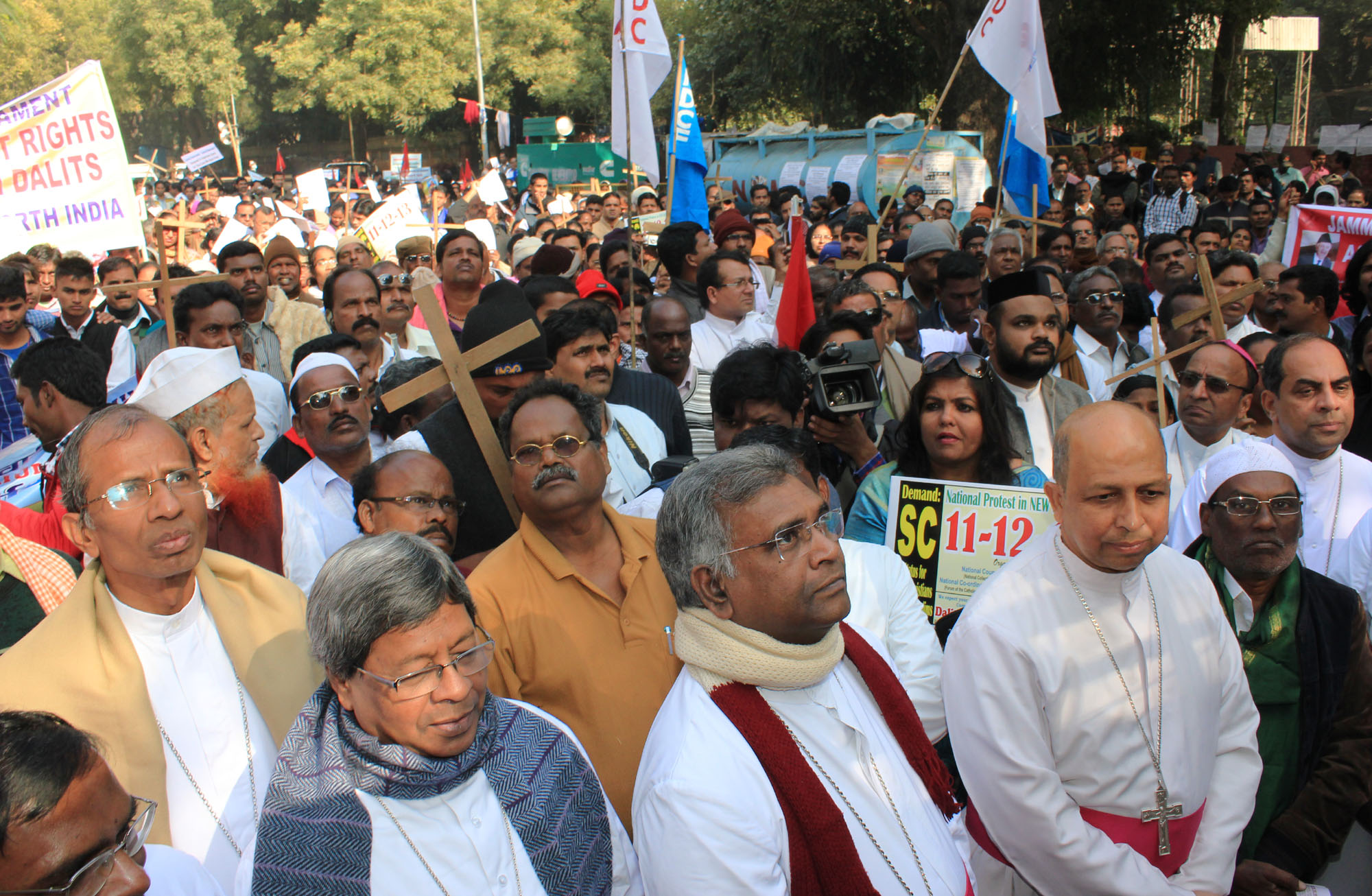
Catholic bishops and clergy join thousands of Dalit Christian demonstrators at a protest rally in New Delhi on Dec. 11, 2013. Placards demand Scheduled Caste status for Christian Dalits. | Credit: Anto Akkara
Christian and civil rights groups have challenged the constitutionality of this exclusion. A petition filed in the Supreme Court in 2004 demanding an end to discrimination against Dalit Christians remains pending before a three-judge bench.
Franklin Caesar Thomas, the Dalit Catholic lawyer who filed the 2004 petition, told EWTN News from southern Tamil Nadu state that the latest ruling has no bearing on the broader constitutional challenge.
“This order has created a lot of confusion and fear among the people. But it does not have any legal impact,” Caesar Thomas said.
He noted that past inquiry commissions, including the Justice Ranganath Misra Commission, “have clearly stated that conversion to Christianity does not end caste discrimination in society.”
Government commission still pending
However, the Hindu nationalist Bharatiya Janata Party government that came to power in 2014 demanded a fresh inquiry during the continued court hearing. A new commission under Justice K.G. Balakrishnan, a former chief justice of India, was established in October 2022 to study the social status of converts. The commission has yet to submit its report, with the latest deadline set for April 10.
The concern generated by the Supreme Court’s remarks was evident in Indian Currents, a Catholic sociopolitical weekly, which published several critical articles about the verdict.
“The recent judgment of the Supreme Court to continue the marginalization of those in the peripheries based on their religious identity is revelatory in itself,” the magazine’s editorial said.
A decades-long struggle
Since 1990, when Buddhists were included in the Scheduled Caste category, the Catholic Church in India has waged vigorous campaigns for the same recognition for Christian Dalits, with Aug. 10 observed annually as a “black day” with protests across the country. Thousands of demonstrators have been brought to New Delhi each year, led by bishops, to press the demand.
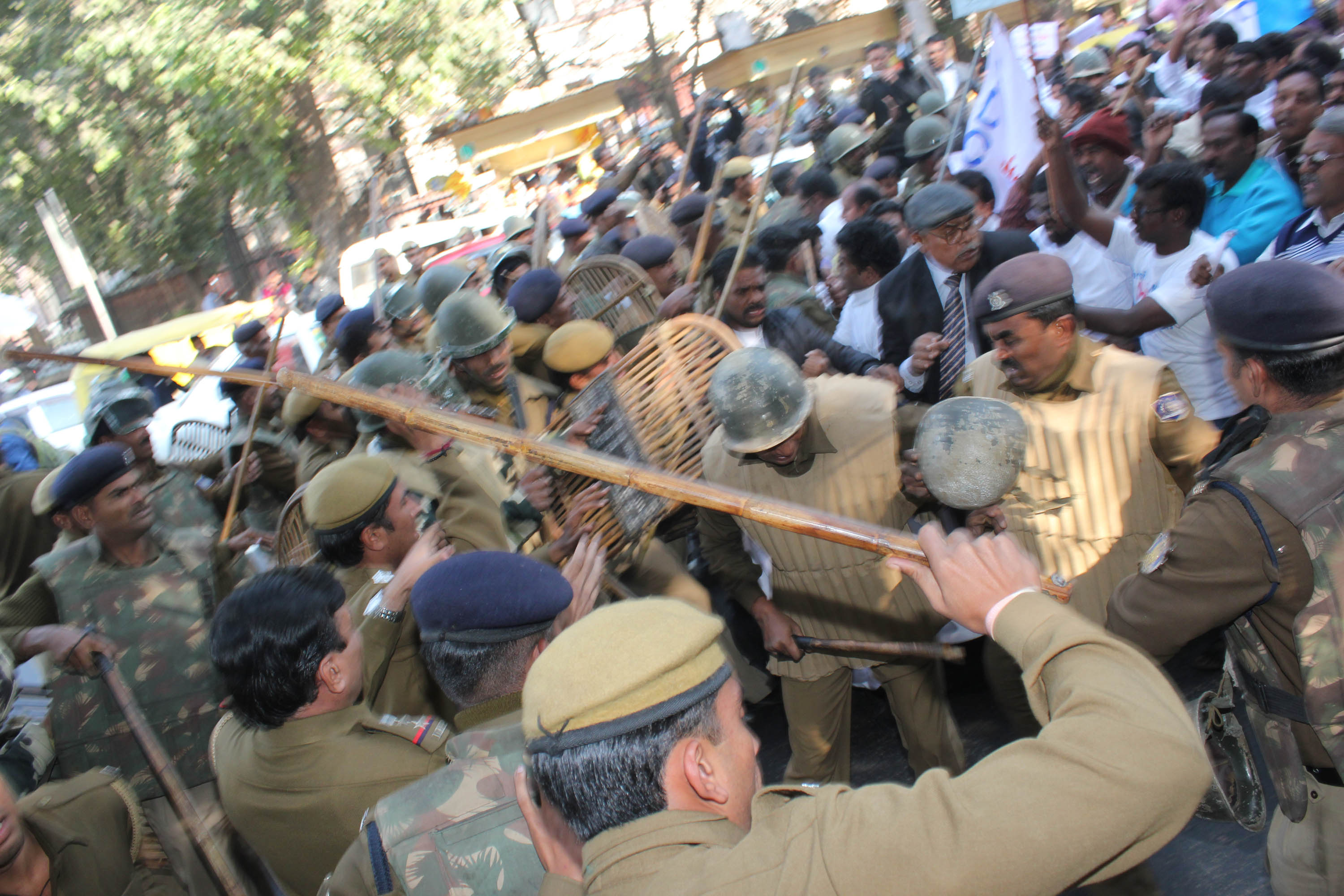
Police armed with bamboo batons and cane shields push back Dalit Christian protesters during a march in New Delhi on Dec. 11, 2013. | Credit: Anto Akkara
During a 2013 march to Parliament, police in New Delhi sprayed dirty water from water cannons on protesting priests in cassocks and other Dalit Christian demonstrators — images that Dalit Christian advocates say illustrate the institutional bias against their cause.
The CBCI’s biennial assembly in Bangalore in February 2026 reiterated the Church’s position.
“The denial of rights to Dalit Christians continues for decades as an indirect form of discrimination, despite numerous appeals for equality and justice. We express our concerns about the denial of rights to the minorities, as such acts weaken the democratic fabric of our society,” the assembly’s statement said.
Canada’s bishops told the Supreme Court of Canada that Quebec’s secularism legislation Bill 21 “denies the divine” going well beyond provincial jurisdiction by imposing an anti-religious ideology on the province.
The bishops were among more than 50 intervenors presenting arguments at a landmark Supreme Court of Canada hearing into the constitutionality of Quebec’s 2019 secularism law. The hearing, one of the longest in the court’s history, ran from March 23–26. The court reserved its decision, with a ruling expected later this year.
The secularism law, which lower courts have twice upheld, prohibits certain public employees — such as teachers and police officers — from wearing religious symbols while at work.
Toronto lawyer Phil Horgan, president and general counsel of the Catholic Civil Rights League (CCRL), argued on behalf of the Canadian Conference of Catholic Bishops (CCCB), summarizing a factum that argued the “purpose and effect” of Quebec’s legislation is to “amend Canada’s federal constitution by imposing an anti-religious, non-neutral ideology, which goes beyond Québec’s jurisdiction.”
Such a “drastic” change can only be made by the federal government using its authority over criminal law or its constitutional “peace, order, and good government” powers, according to the bishops’ argument.
Quebec preemptively invoked the notwithstanding clause of the Canadian Charter of Rights and Freedoms when it drafted Bill 21 to shield it from judicial review.
Federal and provincial governments can invoke the notwithstanding clause of the Constitution to temporarily prevent courts from invalidating legislation as unconstitutional.
The timing and impact of the use of Charter Section 33 became a significant issue during the four days of hearings and will likely be central in the court’s analysis, Horgan told The Catholic Register.
The appellants challenging Bill 21 include individual teachers directly affected by it as well as advocacy groups including the National Council of Canadian Muslims (NCCM), the Canadian Civil Liberties Association (CCLA), and the Legal Committee of the Coalition Inclusion Québec. They argue Bill 21 is “ultra vires,” beyond the powers of provincial jurisdiction.
In a five-minute oral argument, Horgan told the seven justices that “Canada’s existing federal constitution is pluralist and pro-religion.” Although “the doctrine of state neutrality is well established, Canada has never adopted laicity or an absolutist separation of church and state,” he said.
Justice Malcolm Rowe questioned Horgan on the point, asking: “Other than the reference to the supremacy of God in the preamble to the Charter, would you direct me to the provision in the Constitution which is pro-religion?”
Horgan cited Section 93 of the Constitution Act, 1867, which protects denominational school rights and privileges, and noted federal charity law recognizes religion as a public good.
Horgan said he wasn’t concerned by the pushback, noting judges often ask questions “not so much to get the answers from counsel but to help … persuade other members of the bench on some of the merits of the argument.”
In its factum, the CCCB said Bill 21 “turns the expression of religious belief, through the wearing of symbols, into something to be punished because such expression now conflicts with the dominant philosophical posture of laïcité.”
Just as religious symbols are an illustration of underlying personal faith, “the prohibition of religious symbols manifests an outlook from the provincial government that denies the divine,” the bishops said.
Quebec has argued the notwithstanding clause disqualifies courts from weighing in on matters deemed political debates. Isabelle Brunet, a lawyer for the Quebec government, told the justices: “It is not up to a court to answer a question that doesn’t concern the courts.”
Quebec received support from the attorneys general of Alberta, Ontario, and Saskatchewan, who maintain the courts should not interfere once the notwithstanding clause is invoked.
Alberta and Ontario take a contrary position, arguing there is nothing in the notwithstanding clause that precludes judicial scrutiny of legislation.
Guy J. Pratte, a lawyer for the attorney general of Canada, said Section 33 gives legislatures the power to override Charter rights but does not nullify the rights altogether or prevent judges from issuing an opinion if freedoms are violated.
‘Imposing an anti-religious, non-neutral ideology’
The following excerpts are from the factum submitted to the Supreme Court of Canada by the Canadian bishops:
“The purpose and effect of the act is unilaterally to amend Canada’s federal constitution by imposing an anti-religious, non-neutral ideology, which goes beyond Québec’s jurisdiction.”
“When a province makes itself laïc, it is adopting a non-neutral stance on religion. The provinces do not have that power.”
“Québec is attempting to impose an atheistic posture on religious believers.”
“Our constitution is founded on a political theory that sees fundamental rights and freedoms as God-given. To adopt an expressly anti-religious viewpoint, as the act purports to do, is an amendment of our existing federal constitution.”
“In the place of a genuinely neutral, pluralist, and pro-religious approach, the act substitutes an anti-religious constitutional settlement where symbols of religion worn by individuals are not permitted.”
“Just as religious symbols manifest an underlying personal faith, the prohibition of religious symbols manifests an outlook … that denies the divine.”
This story was first published by The B.C. Catholic and is reprinted here with permission.
California will pay $4.5 million to a Catholic legal advocacy firm after the U.S. Supreme Court ruled that the state could not continue to hide student transgender identities from parents.
In March the Supreme Court blocked California’s rules that forbid schools from informing parents if their children believed themselves to be the opposite sex.
The high court had held that parents enjoy “the right not to be shut out of participation in decisions regarding their children’s mental health.” The ruling upheld a similar order issued in December 2025 by U.S. District Judge Roger Benitez.
On March 31, the Thomas More Society — which had represented the plaintiffs in the class-action suit against the California rules — announced that Benitez had ordered California to pay $4.52 million in attorneys’ fees to the Catholic legal firm.
In his order, Benitez said he was “well familiar” with the yearslong lawsuit. He said California was guilty of “litigation intransigence” while fighting the lawsuit, such as “wasting scarce judicial resources” and “resisting at all junctures.”
The state has “continue[d] to fight” over the case even after the Supreme Court ruling, Benitez pointed out, including claiming that the Supreme Court-approved injunction is “flawed and needs to be modified.”
The $4.5 million fee was arrived at after applying a “multiplier” of 1.25 to a base fee of around $3.6 million. Multipliers are often applied in certain high-risk or otherwise notable legal disputes.
Peter Breen, litigation head at the Thomas More Society, said the massive award “sends an unmistakable message to state governments and school districts across the country: If you trample the constitutional rights of parents, you will pay for it — literally.”
“California threw everything it had at this case,” Breen said. “It lost at summary judgment, lost at the Supreme Court, and now Californians will foot the bill for their government officials’ refusal to respect the fundamental rights of families.”
In December 2025, Benitez had said the case concerned “a parent’s rights to information … against a public school’s policy of secrecy when it comes to a student’s gender identification.”
Teachers have historically informed parents of “physical injuries or questions about a student’s health and well-being,” the judge pointed out, yet lawmakers in California had enacted policies “prohibiting public school teachers from informing parents” when their child claimed to have an LGBT identity.
Teenagers and young adults are obtaining abortion pills through telehealth at high rates, a recent report found.
The report, published in the journal JAMA Health Forum, looked at telehealth abortion requests for an online provider across three age groups (ages 15–17, 18–24, and 25–49). The report found that young adults (ages 18–24) order abortion medication at much higher rates than older adults and that more teenagers order abortion pills in states with parental notification or consent laws around abortion.
The study found a “growing demand among adolescents and young adults in legally constrained environments.”
“Young people appear to increasingly rely on online telemedicine services for abortion care, with compounding legal restrictions driving higher demand,” the report read.
Michael New, senior associate scholar at Charlotte Lozier Institute and assistant professor at The Catholic University of America, told EWTN News that the report shows how abortion pills “undermine abortion bans and heartbeat laws” and “pro-life parental involvement laws that are in effect in over 30 states.”
For minor girls ages 15–17 requesting abortion pills, New pointed out that “the largest increase was seen in states that had both parental consent laws and parental notice laws.”
“Overall online requests for chemical abortion pills increased after the Dobbs decision,” New noted. “However, states that had some sort of parental involvement law had considerably larger increases than states with no parental involvement law.”
This can put women at risk, he said.
“There are serious public health concerns with giving minor girls access to chemical abortions by telehealth,” New said. “Minor girls who are seeking abortions via telehealth are often doing so to conceal their pregnancy or their sexual activity from their parents. As such, they might be less likely to seek medical attention if complications occur. This increases the health risks involved with obtaining an abortion.”
Multiple studies indicate high rates of hospitalizations for women taking the abortion pills. Chemical abortion has a complication rate four times that of surgical abortion, according to one study. Another report found that abortion pill complications are often underreported or misclassified.
“Overall, research has shown that chemical abortions pills taken under in-person medical supervision have a much higher complication rate than surgical abortions,” New said. “The fact that minor girls are obtaining chemical abortion pills online without in-person medical supervision only increases those risks.”
Tennessee telehealth abortion liability bill heads to governor
A Tennessee bill that would allow civil action against out-of-state abortion drug suppliers is heading to Gov. Bill Lee’s desk.
The bill, sponsored by Republican Rep. Gino Bulso of Brentwood, would make abortion pill suppliers liable in wrongful-death lawsuits. It would allow family members of an unborn baby, including the biological mother, to sue the abortion pill provider, allowing for statutory damages of at least $1 million for a wrongful-death lawsuit. It would also make it a Class E felony to knowingly mail abortion-inducing drugs to someone in Tennessee.
Though the state already has strong legal protections for unborn children, Bulso said that “mail-order abortions continue to kill thousands of innocent unborn children every year.” Bulso called the bill “a critical step in our efforts to promote life, protect women, and ensure morality defines our laws.”
Kansas lawmakers override governor’s veto of pregnancy center protections
Hours after Kansas Gov. Laura Kelly vetoed a bill to protect conscience rights for pregnancy centers, the state House and Senate voted to override the veto.
Based on model legislation, the CARE Act is designed to ensure that pregnancy centers are not targeted for their life-affirming beliefs. The bill prevents any government rule or division from targeting centers or forcing them to perform abortions. The bill affirms that “pregnancy centers serve women with integrity and compassion in this state and across the United States.”
United Kingdom lawmakers call for delay on abortion bill
In the U.K. Parliament, lawmakers called for a delay in an abortion clause that could effectively legalize abortion up to birth, according to the bill’s opponents.
A cross-party group of members of Parliament (MPs) and members of the House of Lords (peers) called on the government to delay the clause in an open letter to Home Secretary Shabana Mahmood and Health Minister Wes Streeting. In England and Wales, abortions after 24 weeks are a criminal offense. Though the bill does not directly remove the 24-week limit for abortion, it would remove any legal sanction on women aborting their children outside the legal time frame.
The letter, which had 79 signatories from different parties, said that Clause 246 (formerly Clause 208) would create ambiguities that need to be addressed. The letter warned that the new clause could lead to cases of infanticide going undetected and raises questions about cases like women being pressured into abortions.
“Since the advent of the abortion ‘pills by post’ scheme, disturbing cases of women inducing their own abortions outside the terms of the Abortion Act have already occurred,” the letter read. “As there would no longer be a legal deterrent against such cases, there is a real danger that such instances will increase with tragic consequences for women and viable unborn babies.”
The letter calls on the government to “hit pause” on the proposals and allow for “consultation, impact assessment, or meaningful scrutiny” and to draft guidance for police and health care professionals.
A few prominent Catholics are scheduled to speak at a May 17 event on the National Mall in Washington, D.C., where President Donald Trump will rededicate the United States to “one nation, under God.”
Speakers will include Diocese of Winona-Rochester, Minnesota, Bishop Robert Barron, founder of Word on Fire and member of the president’s Religious Liberty Commission, and Father Mike Schmitz, a Catholic media figure and host of “The Bible in a Year” podcast, according to an announcement by the White House.
Jonathan Roumie, the Catholic actor who plays Jesus Christ on the television series “The Chosen,” will also speak at the event. Cardinal Timothy Dolan will provide a video address for the event.
The programming for the event will include talks about Christianity in American history and the Christian faith of American historical figures along with prayers and Christian music.
Trump, Vice President JD Vance, and House Speaker Mike Johnson are scheduled to speak as well.
“Our mission is to gather the nation in prayer and worship, to have a moment reflecting on God’s providence in the birth and preservation of the United States, and this is really our opportunity to unite the country and rededicate our nation to God,” Justin Caporale, executive producer for major events and public appearances for the White House, said in a media call.
Some Protestant speakers expected include Pastor Jack Graham, Samuel Rodriguez, and Eric Metaxas. There will also be a video address by Franklin Graham. There will be musical performances by Chris Tomlin, Blessing Offor, and the U.S. Navy Band.
Trump announced the “Rededicate 250” event in February during the National Prayer Breakfast, which coincides with broader celebrations to honor the 250th anniversary of the Founding Fathers signing the Declaration of Independence on July 4, 1776. The Rededicate 250 event organizer, Freedom 250, is a nonprofit subsidiary of the National Park Foundation.
“When our founders proclaimed the immortal truths that echoed around the world and down all the way through time, they declared that all of us are made free and equal by the hand of our Creator,” Trump said at the Feb. 4 breakfast.
Last September, Trump also launched the “America Prays” initiative, which asks Americans to create groups to dedicate one hour of prayer every week for the United States and its people leading up to the Fourth of July anniversary.
The United States Conference of Catholic Bishops (USCCB) launched separate events to honor the 250th anniversary of the Declaration of Independence.
In February, the USCCB asked parishes to contribute to 250 collective hours of adoration and 250 collective works of mercy in the lead up to the Fourth of July. The bishops asked parishes to report participation in the initiative and inform them of the fruits of the prayers and actions.
On July 12, the bishops will also reconsecrate the United States to the Sacred Heart of Jesus as part of the solemnity. This will occur during Mass at the Basilica of the National Shrine of the Immaculate Conception in Washington, D.C.
The Visitation to Seven Churches is a Holy Thursday devotion primarily practiced in Latin America, Italy, Poland, and the Philippines — though it is also practiced in many other places.
The devotion involves traveling to seven local churches after the Mass of the Lord’s Supper on the evening of Holy Thursday. These visits recall the final seven places Jesus went from his arrest on Holy Thursday to his death on Good Friday.
In each church, the pilgrim kneels before the altar of repose, meditates on the appropriate Scripture, and offers prayers and adoration. In this way, pilgrims seek to spiritually accompany Christ as he enters his passion.
The first church recalls Jesus going from the Cenacle, where he celebrated the Last Supper with his disciples, to the Garden of Gethsemane, where he earnestly prayed and sweat blood in his agony over what was about to take place (see Luke 22:39-46).
In the second church, the pilgrim meditates on Jesus being taken from the Garden of Gethsemane by the armed crowd to the house of Annas, the father-in-law of Caiaphas the high priest, where he was interrogated and slapped in the face (see John 18:19-22).
In the third church, the prayer focuses on Jesus being brought to the house of Caiaphas, where he was beaten, spat upon, insulted, and endured a painful night in captivity (see Matthew 26:63-68).
The focus of the reflection for the fourth church is the first time Jesus was brought before Pilate, the Roman governor of the region. There Jesus was accused by the Jewish religious authorities of being a rival king to Caesar (see John 18:35-37).
In the fifth church, the pilgrim follows the Lord as he is taken to King Herod, who along with his guards mock him (see Luke 23:8-9; 11).
The sixth church recalls Jesus being taken from Herod and brought before Pilate for the second time and then scourged, crowned with thorns, mocked, and condemned to death (see Matthew 27:22-26).
The last church commemorates Christ carrying the cross on his shoulders from the Praetorium, where Pilate yielded to the crowd’s demand for his crucifixion, to Mount Calvary, where he suffered excruciating pain, died, and was laid to rest in a nearby tomb until his resurrection from the dead on Easter Sunday (see Matthew 27:27-31).
This story was first published on April 1, 2021, and has been updated.
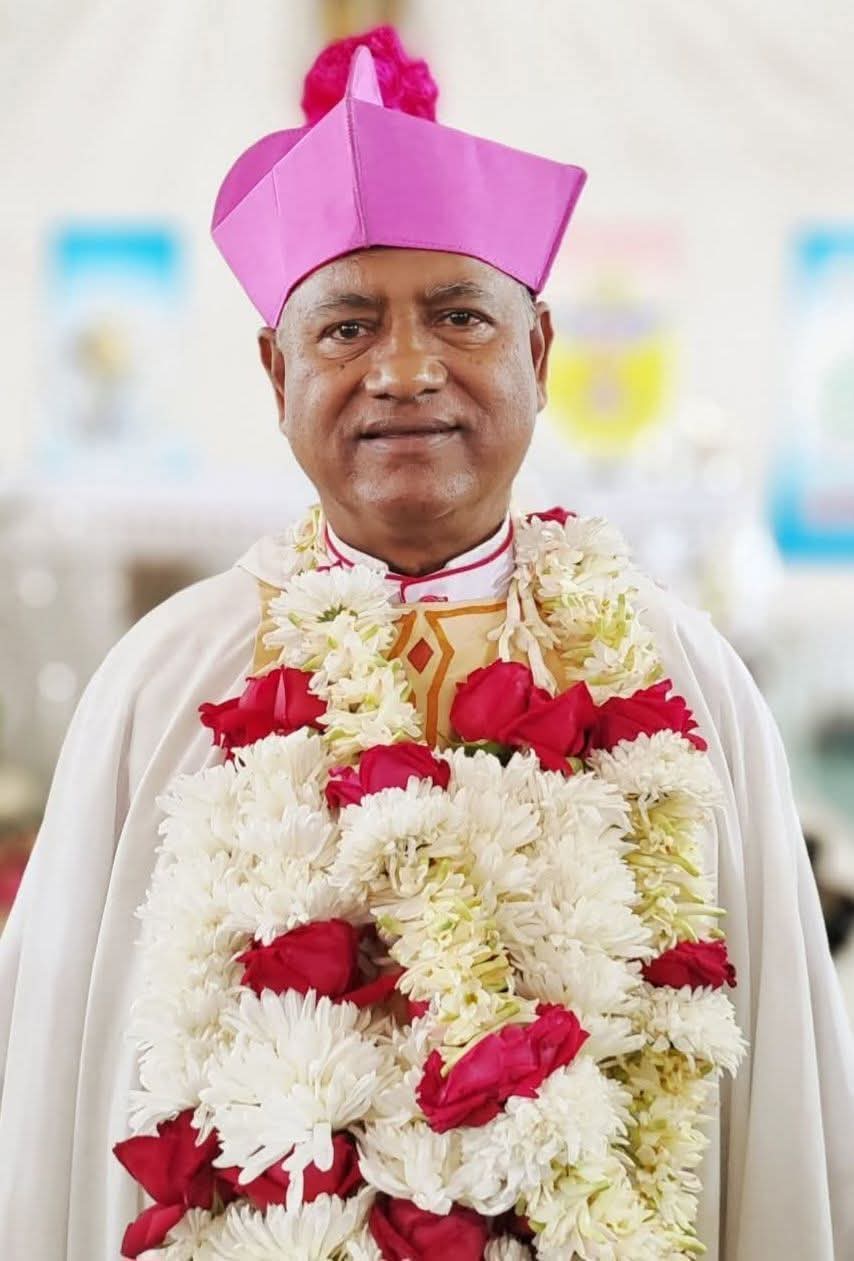
DHAKA, Bangladesh — As the Catholic Church marks Holy Thursday — known in some traditions as Maundy Thursday — a senior priest in Bangladesh says the day remains a deeply joyful and defining moment for priests, rooted in service, sacrifice, and renewal.
“Maundy Thursday is a very joyful day for our priests. It is the day of the priesthood and the day of the institution of the holy Eucharist,” said Monsignor Gabriel Corraya of the Archdiocese of Dhaka in an interview with EWTN News. “On this day, Jesus shared the Last Supper with his 12 disciples and entrusted them with his priestly life and ministry.”
Corraya, 69, said Holy Thursday holds special spiritual importance because it calls priests back to the origins of their vocation. The day, he explained, renews not only memories but also commitments.
“For us priests, Maundy Thursday is very important,” he said. “On this day, we renew our priestly promises before our bishop. It reminds us that we are participants in the great sacrifice of Jesus Christ.”
He said the ritual washing of the feet, a defining feature of Holy Thursday liturgies, reveals the heart of priestly service. Recalling Jesus kneeling before his disciples, Corraya said the act remains a lasting lesson in humility and action.
“Jesus came into the world to serve,” he said. “By washing the feet of his disciples, he showed that service must be proven not only through words but through actions. Though he was a teacher and master, he washed their feet. To me, no act of service is small. Washing feet is perhaps one of the most human things we can do.”
‘A blessed year’
This year marks a milestone in Corraya’s own priestly journey. On Jan. 24, he was elevated to the rank of monsignor, an honor conferred by Pope Leo XIV. He describes the title not as personal distinction but as an acknowledgment of service.
Monsignor Gabriel Corraya. | Credit: Photo courtesy of Monsignor Gabriel Corraya
Ordained a priest in Dhaka in 1986, he was among a group of deacons ordained during the pontificate of St. John Paul II. In 2026, he marks 40 years of priesthood.
“This is truly a blessed year in my life,” he said. “The greatest gift I have received is the priesthood itself. The monsignorship is simply a recognition of that service. As I wear this attire, I pray not for the garment, but that God may clothe my heart with humility, faith, and love.”
Forming bishops
For many years, Corraya served as rector of the major seminary in Dhaka, forming generations of priests in Bangladesh. Several of his former students have since become bishops, a source of gratitude rather than pride, he said.
“I always loved seeing one of my students ordained as a priest,” he said. “When one of my students, Sebastian Tudu, became bishop of the Diocese of Dinajpur, I was very happy. Even today, though he is a bishop, he treats me with great respect as his former rector.”
Corraya currently serves as vicar general of the Archdiocese of Dhaka. In that role, he sees both the wide reach of priestly ministry and its growing challenges in a rapidly changing society.
“There are many areas of service in this country, and priests are involved in many responsibilities,” he said. “One major challenge today is the identity of the priest. People’s way of thinking has changed. Often what we expect does not happen. Living our priesthood faithfully in the modern era can involve suffering.”
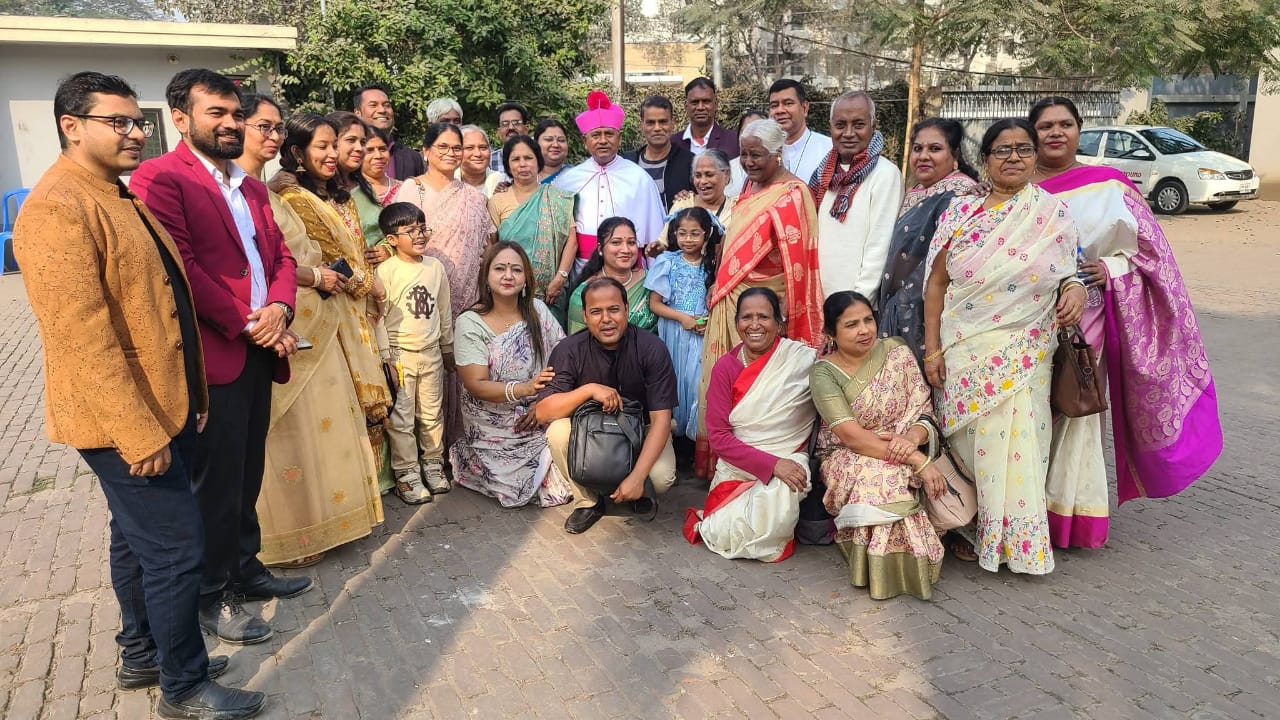
Monsignor Gabriel Corraya (center) poses with relatives after his elevation to the rank of monsignor at St. Mary’s Cathedral in Ramna, Dhaka, Bangladesh, on Jan. 24, 2026. | Credit: Photo courtesy of Monsignor Gabriel Corraya
He added that priests must also examine themselves honestly. “Many times, we priests are unable to give full witness to the ideal of Jesus,” he said. “Christians come to Jesus when they see that ideal lived. His service speaks louder than words.”
Social media, he said, has become both a challenge and an opportunity. “This is the era of social media,” he said. “If priests do not update themselves, it becomes difficult. Sometimes the distance between priests and the faithful grows, and this is a challenge we must address.”
To respond, senior priests gathered in Dhaka on March 25 to reflect on adapting to contemporary realities. “We discussed how we can update ourselves with the times, and that effort is ongoing,” he said.
A minority Church
Although Catholics remain a small minority in Bangladesh, Corraya said priests generally enjoy peaceful coexistence with members of other religions. “We have good relationships with people of other faiths,” he said. “Occasionally, isolated extremist incidents cause concern, but overall we share a bond of harmony.”
Bangladesh faces a modest shortage of priests, especially as new parishes open and missionary needs expand. “Fewer young people are entering seminaries,” he said. “We are addressing this by appointing vocation promoters to encourage young people to consider the priesthood.”
As the Church observes Holy Thursday — often called Priests’ Day — Corraya offered a message to clergy worldwide: “Priests are part of God’s great plan. Priesthood is a precious gift from God. My prayer is that all priests may remain healthy and walk closely with the faithful entrusted to them.”