The Mombasa Archdiocese announced the news on Saturday, Oct. 3, that pilgrims from St. Mathias Mulumba Mikindani Parish had died in a car crash in the small town of Salama, about a six-hour drive from the shrine.
The message from the office of the archbishop read: “We are saddened with lots of grief to announce the untimely passing on of [15] pilgrims from St. Mathias Mulumba, Mikindani, in an accident that occurred at Salama. The pilgrims were on their way to the National Shrine, Subukia, for the National Prayer Day.”
The statement from the office of Archbishop Martin Kivuva Musonde continued: “Let us pray for the repose of their souls as we pray for their families, St. Mathias Mulumba Parish and the Archdiocese as a whole, so that we may find solace and consolation in the Lord.”
In his opening address at the prayer event, the chairman of the Kenya Conference of Catholic Bishops (KCCB), Archbishop Maurice Muhatia Makumba, expressed the closeness of KCCB members with the Mombasa Archdiocese following the tragedy.
Muhatia also clarified that 15 people died, and not 17 as had earlier been reported by the archdiocese.
Welcoming participants to the event, the KCCB chairman said: “We remember in a special way other pilgrims from the Archdiocese of Mombasa who were headed here, but could not arrive due to a road accident. I express personal condolences and the solidarity of the Bishops’ Conference to Archbishop Martin Kivuva and Archbishop Dominic Kimengich for the loss of 15 pilgrims who were headed here.”
Muhatia added: “All of them were from one parish and all of them perished in the accident.”
The bishop of the Kisumu Archdiocese read out the names of the pilgrims who died and prayed for the repose of their souls.
The tragedy has been described as a major blow to the Kenyan archdiocese, which also lost a pilgrim during the 2025 National Prayer Day at the shrine. Marcella Mueni collapsed and died while she was getting ready for Mass. She was among more than 9,000 pilgrims who traveled from Mombasa for the annual spiritual gathering.
The 2026 National Prayer Day is being celebrated under the theme “Blessed Are the Peacemakers.” According to the KCCB, the theme is an invitation to the faithful to embrace their responsibility as agents of peace in their families, communities, and the country.
This story was first published by ACI Africa, the sister service of EWTN News in Africa, and has been adapted by EWTN News.
WASHINGTON — Archbishop Timothy Broglio of the Archdiocese for the Military Services, USA, underscored the importance of using the Holy Spirit’s guidance in public affairs at the annual Red Mass marking the opening of the Supreme Court term.
Seeking the Holy Spirit’s wisdom will help people reach their full potential in their work and responsibilities, Broglio said in the homily Oct. 4 at the Cathedral of St. Matthew the Apostle in Washington, D.C.
“We also pray that our understanding of Godʼs presence and his commandments will inspire integrity, devotion to meaning, and the promotion of harmony,” he said.
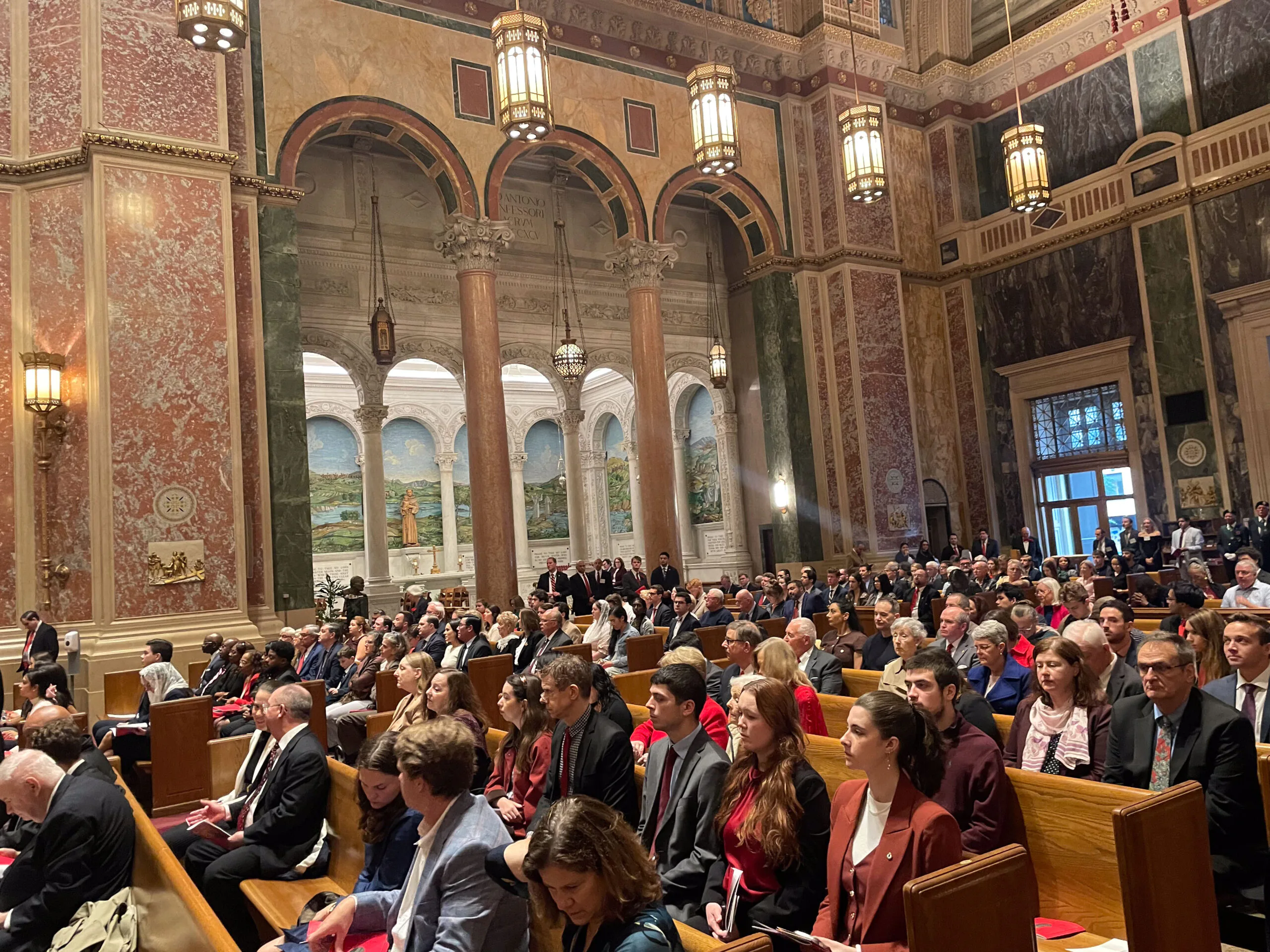
Hosted by The John Carroll Society, the Red Mass drew more than 1,000 people, including Supreme Court justices, public officials, and Vice President JD Vance, to mark the opening of the judiciary term and pray for judges, attorneys, diplomats, and government leaders.
The name derives from the red color of the archbishops’, cardinals’, and priests’ vestments. All Church officials who participated wore red to represent the tongues of fire symbolizing the presence of the Holy Spirit.
This year marked the 74th anniversary of the Red Mass in Washington, one of several such celebrations held worldwide, such as in Rome, Paris, and London, to invoke blessings on justice administrators.
Red Mass attendees sit in the pews at the Cathedral of St. Matthew the Apostle on Oct. 4, 2026, in Washington, D.C. | Credit: Emma R.C. Lyons/EWTN News
Mark Cummings, a member of the John Carroll Society, an adjunct professor at George Mason University, and a partner at Sher, Cummings, and Ellis, said attendance at the Mass would help students.
“Itʼs inspiring for them, and I think itʼs a very healthy thing to be able to mix with the Supreme Court justices, superior court judges and courts of appeals, as well as Vice President Vance,” Cummings said. “I donʼt know where else theyʼd have an opportunity to see so many people who have made it in the profession and are serving as Supreme Court justices.”
Broglio “talked about the importance of the Constitution, the importance of our laws, and that everybody, even the meekest and lowest of citizens, should have access to justice and how we should. Itʼs set up that way with our Constitution and Bill of Rights,” Cummings said.
Cummings said Broglio’s message was a call for those in the legal profession and public service to help ensure that everyone has equal access to justice.
Broglio also advised officials on how charity should guide all legal professions.
“Your service to order and the virtue of justice is deeply appreciated even by this canon lawyer,” said Broglio, who holds a doctorate in canon law.
Broglio said immigrants, past and present, have helped build the United States, and he urged legal professionals to be “architects of hope” to ensure that charity and fraternity shape the pursuit of justice.
“In his first encyclical, Pope Leo wrote that the way a society treats migrants, refugees, and those forced to move reveals whether its sense of justice is driven by fear or by the spirit of fraternity,” Broglio said.
“Perhaps if more of us directed our thoughts in the ways of peace, we would discover and develop a more civil society and and learn to live in harmony with our neighbors,” Broglio said.
With the aim of "living up to our heritage and fostering its growth,” next month’s Catholics and Public Life Congress in Madrid, Spain, aims to exalt the legacy of “Hispanidad,” a term for the faith-based civilization and union between Spain and the Americas that was first championed by Queen Isabella (1451–1504).
The theme for this year’s Nov. 13–15 congress is “The Americas and Spain: The Faith That Unites Us — A Round-Trip Journey,” and features a joint statement on the subject titled “Manifesto for Hispanidad.”
The text highlights the institutions that emerged from the Spanish enterprise in the Americas such as municipalities, universities, parishes, and hospitals, which “no international treaty has managed to replicate.”
“None of this is artificial. None of this needs to be invented. It simply needs to be recognized and put at the service of the future,” the manifesto proclaims.
“Isabella the Catholic Monarch did not set a mere promise in motion; she set a civilization in motion,” the manifesto continues. Isabella and her husband, King Ferdinand, were given the title “the Catholic Monarchs” by Pope Alexander VI through the papal bull Si Convenit for their defense of the Catholic faith.
From this transatlantic civilization emerged the Laws of the Indies governing the Spanish territories in the Americas through which Spain imposed limits on itself, along with the humanist thought of Francisco de Vitoria at the University of Salamanca, the cradle of international law and human rights.
This legacy, the manifesto continues, resulted in nonnegotiable principles such as “the dignity of the human person; the Greco-Latin heritage that gave us reason and the rule of law; the Christian tradition that shaped our concept of community; respect for the law as a limit on power; civil liberties as a condition for a decent life; and a legal framework capable of protecting property, contracts, and enterprise as engines of prosperity.”
More than 500 years after its inception, this civilization comprises a community of 600 million people who share a common language and presents “a demographic outlook that no other Western project can match.”
Furthermore, the manifesto notes that “Hispanidad is not limited to the political sphere or relations between governments and nations” but rather “demands a profound and, if necessary, radical change of attitude to defend, expand, and develop it” as well as a “cultural and moral dimension worthy of its history.”
Ultimately, the organizers of the Nov. 13–15 congress, the Catholic Association of Propagandists (who says its goal is to propagate or spread the Catholic faith), hold that “reclaiming Hispanidad does not mean looking to the past: It is acting with the confidence of those who start from a position of strength.” For this reason, it urges people to “stop treating as a minor legacy what is, in reality, our greatest competitive and moral advantage in the world to come.”
“Isabella the Catholic Monarch founded it. Vitoria conceived it. The Laws of the Indies codified it. Five hundred years of shared institutions have sustained it. It falls to us, quite simply, to live up to what we have inherited and to make it grow. Together, we are stronger. That is the starting point and also the conclusion,” the manifesto declares.
This story was first published by ACI Prensa, the Spanish-language sister service of EWTN News. It has been translated and adapted by EWTN News English.
The Villaregia Missionary Community has established a new presence in Ghinnir, in Ethiopia’s East Bale, seeking to reach communities where the Catholic Church has a limited presence.
Ethiopiaʼs East Bale region is in the Oromia region of the country and encompasses the eastern areas of Bale Mountains National Park.
According to a report on Sept. 29 by Agenzia Fides, the Villaregia Missionary Community has been visiting communities in East Bale where they have been raising awareness about femFRICA/ETHIOPIA, including the issues of female genital mutilation and early marriage.
Teresa Zullo, a missionary from the Community of Villaregia who has been in Ethiopia for seven years, following an invitation from Father Angelo Antolini, prefect of the Apostolic Prefecture of Robe, said that missionary work is not permanent. She said it is about taking the Gospel and pastoral services to places in most need.
“There are moments when mission asks us to stay, to put down roots, and build relationships, and there are others when it asks us to set out again and cross new horizons. The time has come for us to begin again,” Zullo said.
“We moved to Ghinnir, in the heart of East Bale. This decision was born from a journey of discernment and from the years of experience we gained in a territory that we have gradually come to know more closely.”
The missionary described the relocation as a new stage in the journey, saying they are “leaving what is familiar, entering a new reality and learning how to be present where there is not yet a Catholic community,” especially in Muslim-dominant areas where they are seeking to offer “a presence of relationship, listening, service, and fraternity.”
The missionaries establishing a new presence in Ghinnir hope their decision will enable them to extend some of their services to remote areas of East Bale, especially those near the Somali Region in Ethiopia.
“The move is therefore not simply a change of place. It is a new step: a new reality to discover, new people to meet, and new roads to travel. A home to inhabit, but a tent in our hearts: ready to stay, to meet others, and, when the time comes, to set out again,” Zullo said.
The move follows seven years of missionary service in Robe and Goba parishes, where the community has been involved in pastoral activities and gradually developed relationships with local communities.
“We began taking our first steps in this challenging context. The slow process of learning the language, our encounters with people, and the time spent traveling allowed us, little by little, to begin our pastoral activities and to become part of this new reality,” Zullo said.
The missionary said the community’s experience in other parts of Ethiopia has inspired them to move to East Bale, where many have fled due to extreme drought, and that this has encouraged them to support vulnerable communities there.
“Three years ago, a prolonged period of drought forced many people to leave the East Bale region and head towards Robe in search of opportunities. As we passed near the bus station in Robe, we noticed their presence. We approached them, asked some questions, and discovered that they came from East Bale. We thus found ourselves facing a vast territory that was almost completely neglected by the Church’s missionary activity. For us, this became an insistent call to our identity as missionaries ‘ad gentes,’” she said.
Zullo said the community sees its small numerical presence as an opportunity to build closer relationships with local people and spread the Gospel effectively.
“Being numerically insignificant can represent a great opportunity for the Gospel, a precious opportunity to draw close to others, not to frighten them, to recognize the positive forces within the local community and to build networks with them,” she said.
“Mobility, therefore, is not merely a practical matter; it is part of the way we understand mission. A Church that moves, a Church that goes out, a Church that draws near. This choice concerns not only our fraternity but is part of the journey of the Apostolic Prefecture of Robe, which is called to grow and continually broaden the scope of its evangelizing mission,” Zullo added.
Regarding the missionaries settling in Ghinnir, Zullo expressed hope that despite the challenges they are going to face, their focus will remain on their main agenda, which is to spread the Gospel and support the local communities in the region.
“We left Robe just a few days ago, and now here we are in Ghinnir, without knowing what awaits us. We would like to set out again with a home to live in, but with a tent in our hearts, ready to stay, to meet others, and, when the time comes, to set out again,” Zullo said.
The Villaregia Missionary Community is a Catholic community made up of consecrated men and women, clergy, married couples, and single people of different nationalities, united by the same spirituality and the same mission: to be a community for the “ad gentes” “to the nations” mission.
This story was first published by ACI Africa, the sister service of EWTN News in Africa, and has been adapted by EWTN News.
Noah McKay was always “at least slightly” more confident than not that God existed.
The philosophy doctoral student at Princeton University recently announced his conversion to Catholicism, but he told EWTN News that he struggled for years with what he saw as uncertainties related to faith, including the problem of evil and the “problem of divine hiddenness.”
McKay is the second Princeton philosophy scholar this year to convert to the Catholic faith; earlier in the summer Joe Schmid announced his own return to the faith after years of having run an agnostic-themed philosophy channel on YouTube.
“I was never an atheist, and I don’t think I was ever agnostic,” McKay told EWTN News. But he experienced profound uncertainties in high school and graduate school, some of which were also related to what he described as “difficulties with the reliability and interpretation of the Bible.”
While he never fully abandoned belief in God, “what firmly convinced me of theism were, first, design arguments based on the fine-tuning of physics for the emergence of life, and, second, the empirical evidence for contemporary Christian miracles,” he said.
“Arguments from consciousness, moral knowledge, and natural beauty also played a role,” he added.
It is perhaps unsurprising that a philosophy scholar would be drawn into the Church in part by scholarly inquiry. Schmid told EWTN News shortly after his conversion, for instance, that “contingency arguments” helped convince him of God’s existence.
McKay, meanwhile, cited “evidence for vindicatory Catholic miracles” as helping lead him to the Catholic Church specifically.
Those miracles “presuppose distinctive teachings of the Catholic Church,” he pointed out, and the evidence for them, he argued, is “as good or better than the evidence for the more generically Christian miracles” in which McKay himself already believed.
He told EWTN News that out of the necessity of consistency he felt he needed to either accept all of those Catholic miracles or reject all of them. “And the evidence was too strong for rejecting all of them to be reasonable!” he said.
The evidence for those miracles wasn’t the only thing that convinced him of the truth of the Catholic faith, he said, but “it did motivate me to look into the history and theology of the Church more carefully,” and the evidence he found for Catholicism was “very strong.”
He urged those considering Catholicism for the first time, or those who are considering returning to it, to start with researching those miracles.
Speaking to Catholic YouTube apologist Cameron Bertuzzi in a recent interview, McKay argued that “if you already accept that Christianity is true, the inference to Catholicism is irresistible.”
He admitted that his decision to join the Church caused his close friends and family “distress” given his Protestant background.
But “I think Catholicism — if you’re fully informed, if you’re really considering all of the evidence — I think Catholicism is basically going to be irresistible,” he said.
Speaking to EWTN News, he also urged potential converts and reverts: “Pray!”
“I found praying the rosary especially helpful when I was discerning Catholicism,” he said. “Just ask God to help you earnestly seek the truth and make the means of discovering it available. Those who seek Christ, earnestly and prayerfully, will find him.”
“I’m going to ask God to make himself known to everyone who reads this article!” he added.
The University of Notre Dame’s de Nicola Center for Ethics and Culture on Oct. 4 announced that its 2027 Evangelium Vitae Medal would be awarded to the Dominican Sisters of Hawthorne for what the center described as more than a century of “truth and love” serving poor and dying people.
The de Nicola Center said it would present the award to Mother Superior Marie Edward, O.P., during a special Mass and dinner at the university on April 24, 2027. This year’s is the 16th annual award the center has presented.
Founded in 1900 by Mother Mary Alphonsa — born Rose Hawthorne, the daughter of famed novelist Nathaniel Hawthorne — the congregation is headquartered in Hawthorne, New York. The sisters there are devoted to caring for impoverished men and women dying from cancer.
Notre Dame President Father Robert Dowd, CSC, said in a press release that the sisters in their work “radiate the very mercy of God.”
“Since their founding, they have proclaimed the Gospel of Life through direct service to God’s beloved poor, fulfilling Christʼs command to comfort the sick and give shelter to the homeless,” Dowd said.
The sisters’ ministry, he said, “highlights the inherent, God-given dignity of every human person, regardless of worldly success or social status.”
Jennifer Newsome Martin, director of the ethics center at the school, likewise described the sisters as “a shining example of Christian charity in action.”
The Evangelium Vitae medal is presented annually on Respect Life Sunday. It is named after Pope St. John Paul II’s famed 1995 encyclical that testifies in part to the inherent dignity of human life and the need to care for and protect the most vulnerable.
Mother Mary Alphonsa died in 1926 and is buried at Rosary Hill Home at the congregation’s headquarters. She was declared venerable by Pope Francis in 2024.
On Sept. 25, one day after the beatification of Archbishop Fulton Sheen, members of the media and entertainment world as well as the Church at large gathered in Peoria, Illinois — the hometown of now-Blessed Fulton Sheen — for the inaugural Sheen Awards.
Among the notable figures in attendance were Bishop Louis Tylka of the Diocese of Peoria; Bishop John Barres of the Diocese Rockville Centre, New York; Bishop Robert Barron of the Diocese of Winona-Rochester, Minnesota; Jonathan Roumie, who plays Jesus in “The Chosen”; David Henrie, host of EWTN’s travel series “Seeking Beauty”; and Siobhan Fallon Hogan, host of the EWTN podcast “Catholics and Cappuccinos.”
Seven awards were presented including the Radio and Podcast Impact Award, the Evangelization Impact Award, the Mission and Humanitarian Impact Award, the Innovation Impact Award, the Digital Creator Impact Award, the Television and Streaming Impact Award, and the Archbishop Fulton J. Sheen Lifetime Achievement Award.
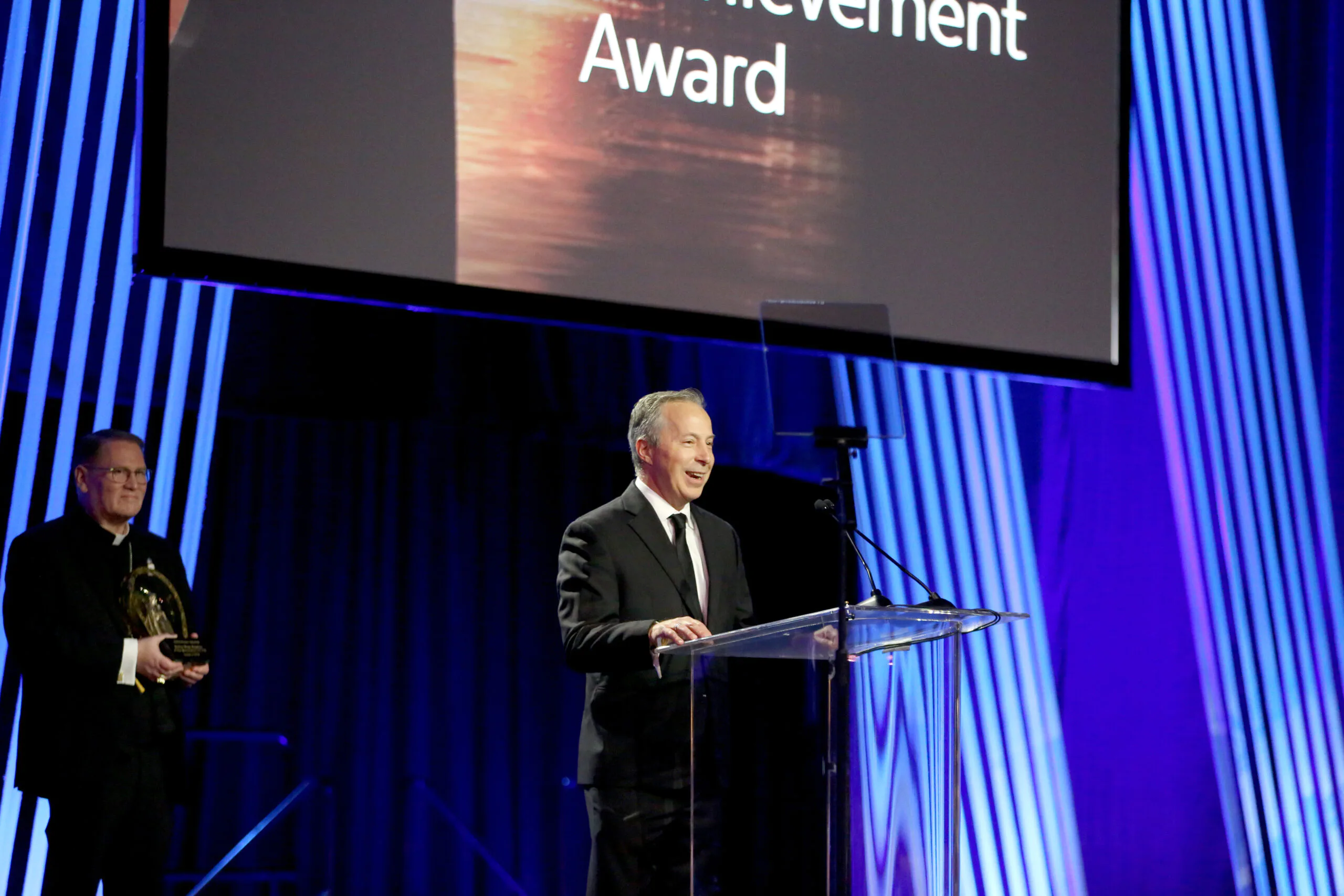
Mother Angelica, EWTN’s foundress, posthumously received the inaugural Lifetime Achievement Award. The award was bestowed on Mother Angelica in recognition of her lifetime of service to the Church and her pioneering use of television to proclaim the Gospel through the Eternal Word Television Network. EWTN Studios President Peter Gagnon accepted the award on her behalf.
“On behalf of Michael Warsaw, CEO, and myself, we want to thank Bishop Tylka and the Archbishop Sheen Foundation for honoring Mother Angelica with this award,” Gagnon said in his acceptance speech.
Gagnon worked with Mother Angelica for many years and pointed out that “one of her favorite expressions was to say, ‘This is awesome!’”
He said: “When there would be a papal event, she would say, ‘Wasnʼt that awesome?’ … I think tonight she would say, ‘This is awesome.’”
A little over one year after the death of Sheen — on Dec. 12, 1980 — EWTN was officially incorporated by Mother Angelica. Reflecting on this, Gagnon said: “I donʼt think itʼs a coincidence.”
“Mother Angelica took the torch from Archbishop Sheen because she saw the power of reaching people through the media, through television,” he said. “She, like Archbishop Sheen, could reach through that camera lens and talk to you. And when she was talking to you, she was talking to you directly.”
Gagnon added: “Also like him [Sheen], she had just an incredible love for the Church and a zeal for souls. I never knew anyone who loved Our Lord as much as Mother Angelica did. Her impact on many throughout the world is truly humbling and amazing.”
EWTN has aired “Life Is Worth Living,” Sheen’s popular television show, for over 20 years. Gagnon emphasized that the network is “proud to share his words and message throughout the world.”
In an additional statement commenting on the significance of the award, Michael Warsaw, chairman and CEO of EWTN Global Catholic Network, noted: “Among the great Catholic evangelists of the 20th century, Blessed Archbishop Fulton J. Sheen, and our own Mother Angelica, stand out for the extraordinary ways they embraced media to proclaim the Gospel, defend the dignity of the human person and speak the truth to a world desperately in need of Jesus Christ.”
“It is especially meaningful to see Mother Angelica honored in the name of Archbishop Sheen, whose pioneering use of radio and television demonstrated the power of media in service of the Gospel,” Warsaw pointed out. He said the recognition is “particularly poignant as we mark the 10th anniversary of Mother Angelica’s passing.”
EWTN Studios President Peter Gagnon accepts the Lifetime Achievement Award on behalf of Mother Angelica at the Sheen Awards on Sept. 25, 2026. | Credit: Nellie Gould, Archbishop Fulton J. Sheen Foundation
“She would have been deeply honored to be recognized at the inaugural Sheen Awards and counted among the innovators and communicators carrying forward Archbishop Sheen’s legacy,” Warsaw added.
Broaching the topic of Mother Angelica’s own potential cause for canonization, Warsaw indicated: “While I remain mindful of the Church’s careful discernment regarding any potential cause for sainthood, I can say personally that I pray and hope that one day Mother Angelica might be numbered among the saints of the Church she loved and served so faithfully.”
Warsaw concluded: “On behalf of the entire EWTN family, I am profoundly grateful for this recognition of Mother Angelica and, more importantly, for the opportunity to remember what animated both Mother Angelica and Blessed Fulton Sheen: the desire to bring souls to Jesus Christ. May their example inspire us all to use the gifts God has given us to proclaim the Gospel with courage, creativity and joy.”
Additional Sheen Award recipients included Katie McGrady, who received the Radio and Podcast Impact Award; Roumie, who received the Television and Streaming Impact Award; and Barron, who received the Evangelization Impact Award.
A Vatican Observatory scholar said modern astronomy suggests Earth may be far less ordinary than scientists once believed, saying decades of research have revealed a universe filled with diverse world rather than countless Earth-life planets capable of supporting intelligent life.
Christopher Graney, an adjunct scholar at the Vatican Observatory, told “EWTN News Nightly” anchor Veronica Dudo on Oct. 2: “From a modern astronomy perspective, Earth is not an ordinary place. Doesn’t mean that there’s no other planets like Earth elsewhere in the universe, but the universe is certainly not full of worlds like Earth.”
Graney asks readers to look at Earth in the context of the vast universe in his new book “A Universe of Earths: Our Planet and Other Worlds, Copernicus to NASA”(Oxford University Press, 2026).
For much of modern history, astronomers believed Earth was unremarkable and that many Earth-like worlds populated the universe, Graney said. However, Graney debunks this theory and argues for a more realistic approach to our solar system.
“Not long ago, at least in terms of Church history, astronomers thought Earth was very ordinary,” he said. “They thought that there were lots of places like Earth. You will find this in historical writings from the 19th century especially.”
For example, Jesuit Father Angelo Secchi, a pioneering Italian astronomer in the 19th century considered one of the founders of astrophysics, favored the idea that the universe contained many inhabited worlds. He wrote that stars were suns distributing “life and goodness” to “innumerable beings blessed by the hand of the Omnipotent,” reflecting a common 19th-century belief that life existed throughout the cosmos.
In modern astronomy, “we know that Mars is completely lifeless, or at least there’s so little life on there if it has any that we haven’t found it yet … we’ve observed planets orbiting other stars. The universe is so diverse. Those star systems, those planets seem very different from Earth,” he said.
At the Vatican Observatory, Graney focuses his research on the history of science by studying asteroids, galaxies, and cosmology.
When asked whether the Vatican was aware of any extraterrestrial sightings or signs elsewhere in the solar system, Graney dismissed theories that the Vatican is concealing evidence of alien life, saying such stories are “a lot more dull” in reality and that any life elsewhere in the universe is likely too far away to have reached Earth.
“It’s more boring, I guess, than the Vatican hiding space aliens. But that’s the way it is,” Graney said.
Two Christian women were killed early on Oct. 3 in an Israeli strike on a residential apartment in western Gaza City, according to Palestinian and Church sources. The women had recently moved into the apartment after spending a prolonged period sheltering at Holy Family Catholic Church during the ongoing war.
The victims were identified as Maysaa Khader Ibrahim Abu Dawoud and Mary Hafez Michel al-Najjar. They had been living in an apartment in the Institutions area of western Gaza City.
The Israeli military did not immediately comment on the strike.
In a statement to ACI MENA, the Arabic-language sister service of EWTN News, George Anton, the director of operations for the Latin Patriarchate in Gaza, said the two women had stayed at Holy Family Catholic Church throughout the war before recently moving into a rented apartment in an effort to resume a more stable life after months of displacement and sheltering at the church.
Anton said the apartment was struck early on Oct. 3, killing both women. He said their deaths had “left deep sorrow among Christian families in the Gaza Strip.”
In a statement of mourning issued by the Latin Patriarchate of Jerusalem, Cardinal Pierbattista Pizzaballa expressed his “profound sorrow and grief” over the deaths of the two women in the strike on Gaza City.
Pizzaballa in the statement offered his condolences to their families and to Gaza’s Christian community, praying that God would grant their loved ones consolation and strength during the painful time.
Holy Family Catholic Parish and the Greek Orthodox Church of St. Porphyrius in Gaza also mourned the two women and offered condolences to the Abu Dawoud, Ayyad, and al-Najjar families.
Anton pointed to figures recently cited by Pizzaballa showing a sharp decline in Gaza’s Christian population since the outbreak of the war, as members of the community have either died or left the Gaza Strip.
In September, Pizzaballa said the number of Christians remaining in Gaza — Catholics and Orthodox combined — had fallen to 541, down from 1,017 before the war.
Churches in Gaza have sheltered hundreds of displaced people during the conflict, Anton said, including people who lost their homes or were forced to flee them.
Holy Family Catholic Church and St. Porphyrius Greek Orthodox Church have provided shelter to Christian and non-Christian families, while some families later moved into alternative housing as the war and widespread destruction continued.
The deaths of the two women underscore the precarious situation facing Christians who have remained in the Gaza Strip. Like other Palestinians in Gaza, they continue to endure displacement, the loss of relatives and homes, and deteriorating humanitarian conditions while seeking to preserve their Christian presence and religious life under extremely difficult circumstances.
This story was first published by ACI MENA, the Arabic-language sister service of EWTN News. It has been translated and adapted by EWTN News English.
For many Catholic couples who were married civilly, the desire to fully participate in the sacramental life of the Church and receive the Eucharist remains a deep longing.
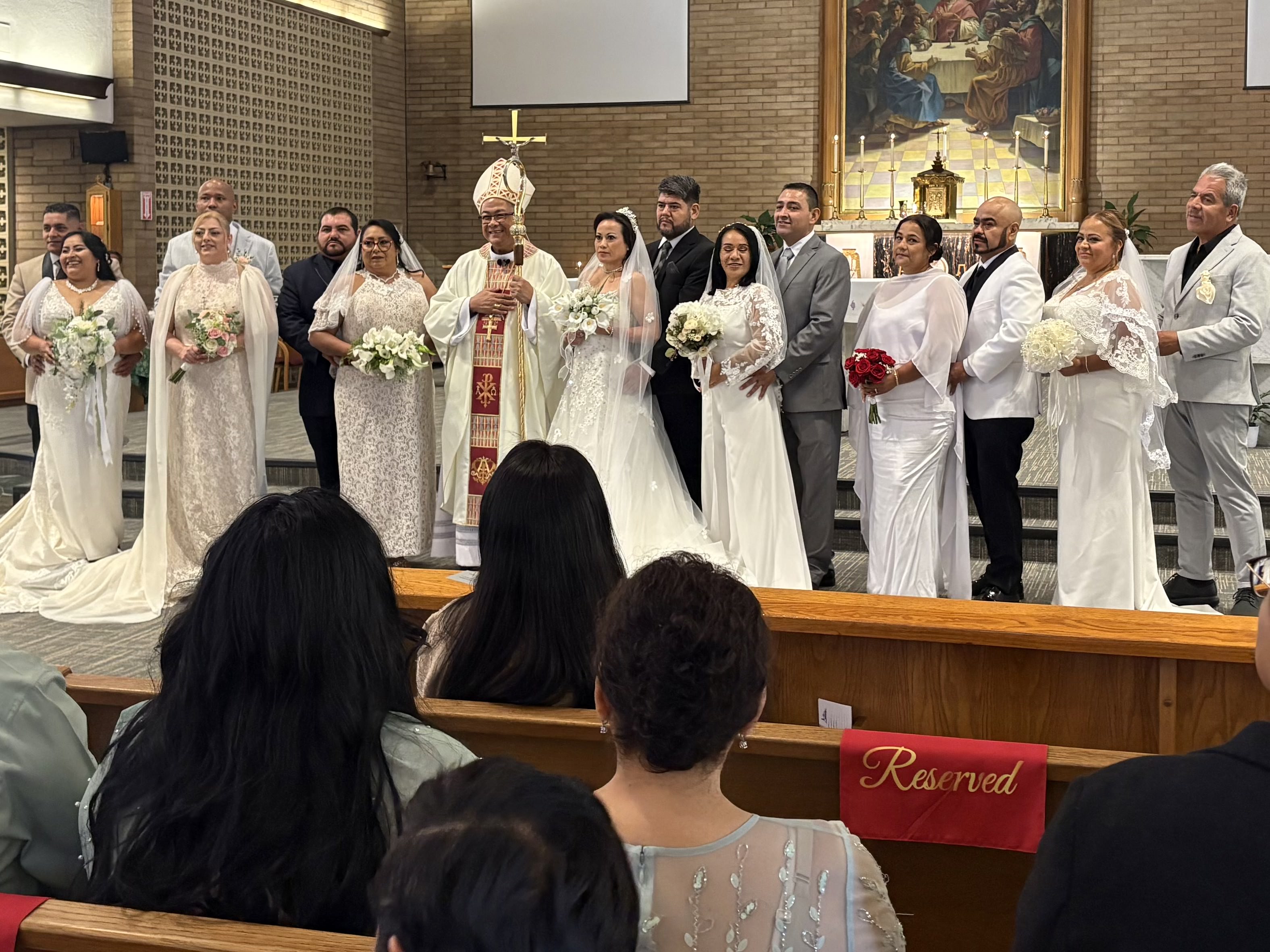
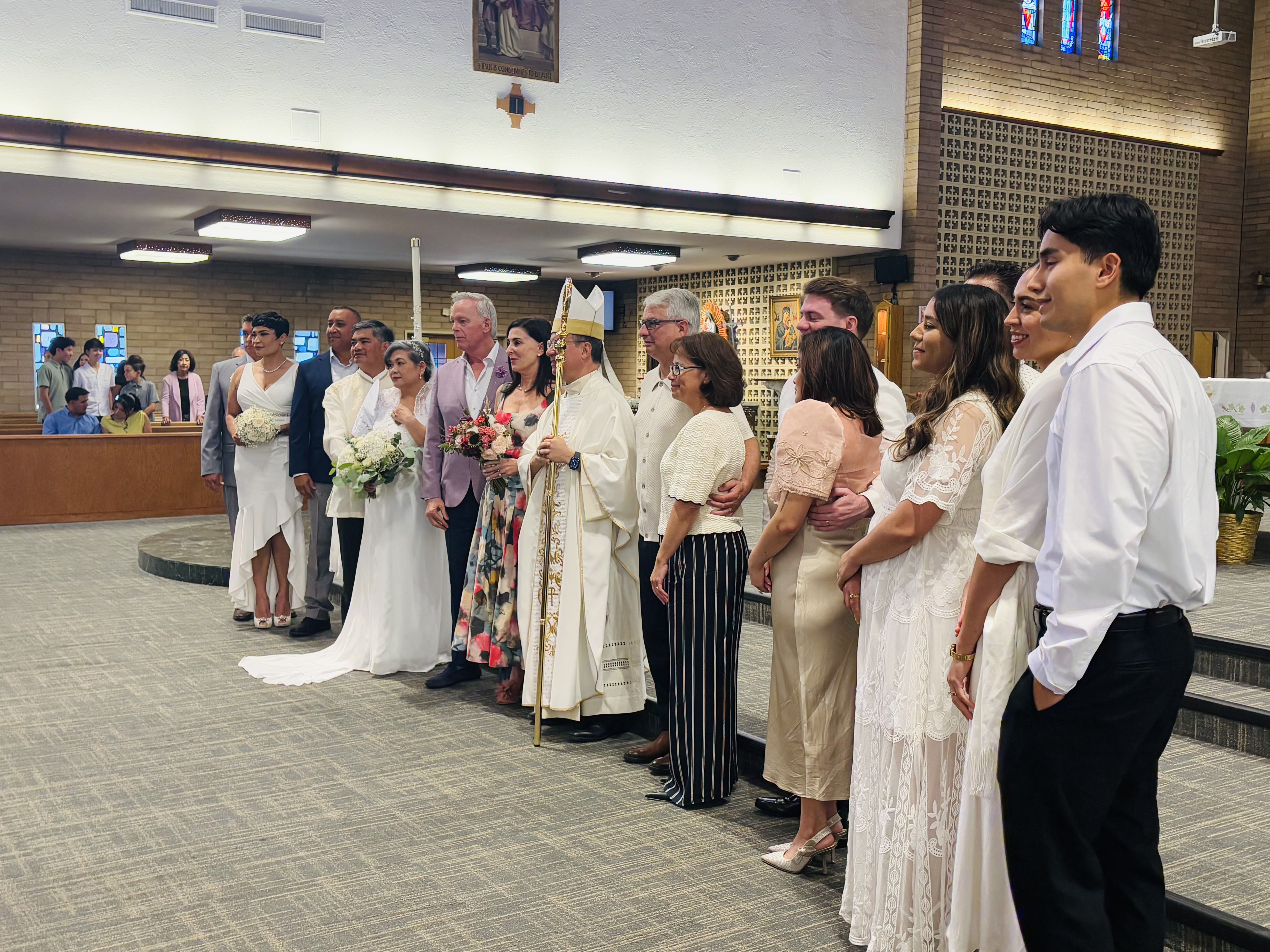
In response, the Diocese of San Jose, California, led by Bishop Oscar Cantú, has launched a landmark convalidation initiative under the California bishops’ “Radiate Love” campaign, witnessing dozens of couples enter into the sacrament of matrimony over the past few months.
Originally planned as a small pilot program, the initiative received a massive swell in interest from local families seeking to place Christ at the center of their marriages. Because of the high volume of registrants, celebrations took place across multiple communal Masses presided over by diocesan bishops on July 25, Aug. 1, and Sept. 26, alongside separate private ceremonies for couples who requested them.
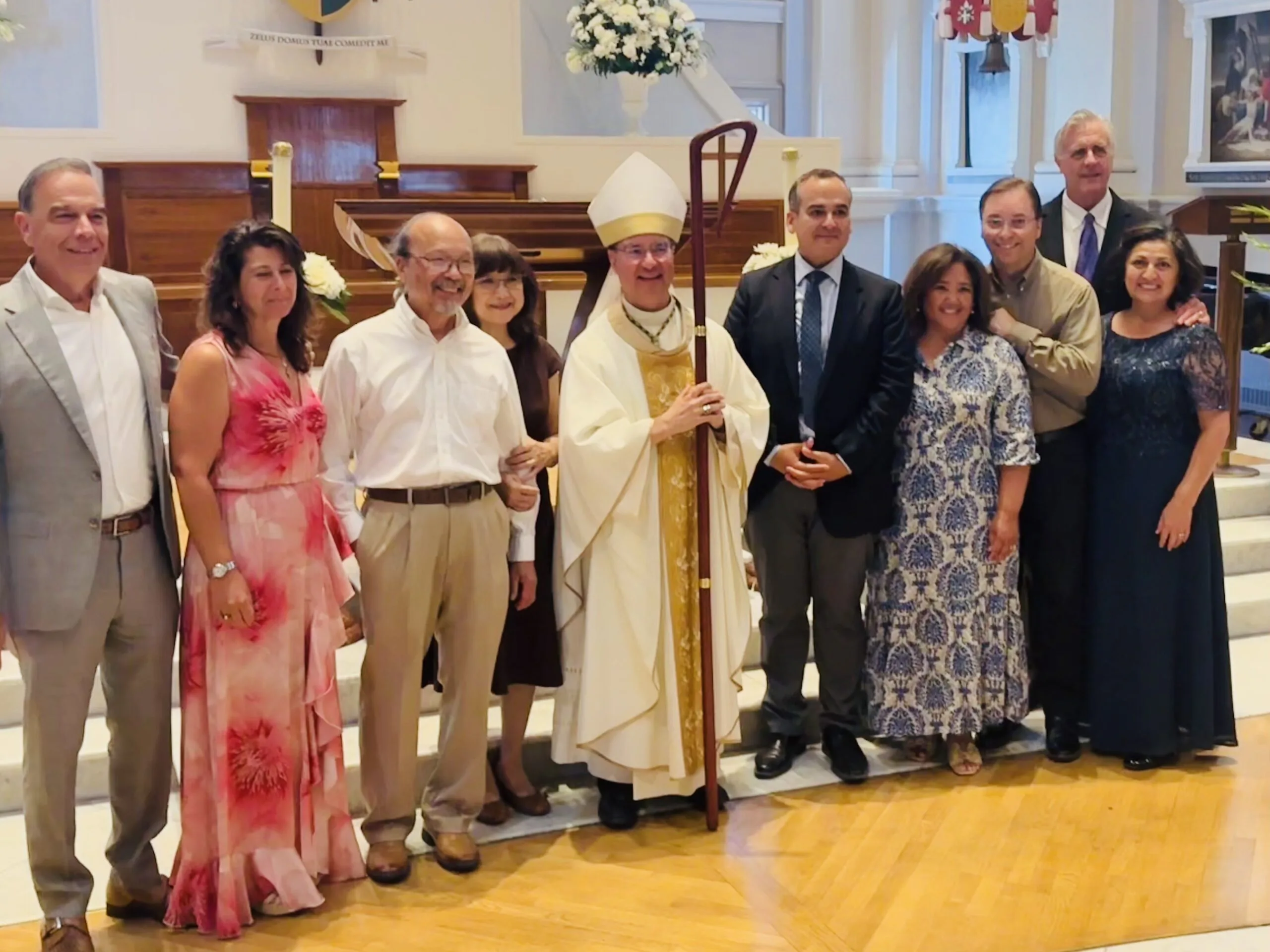
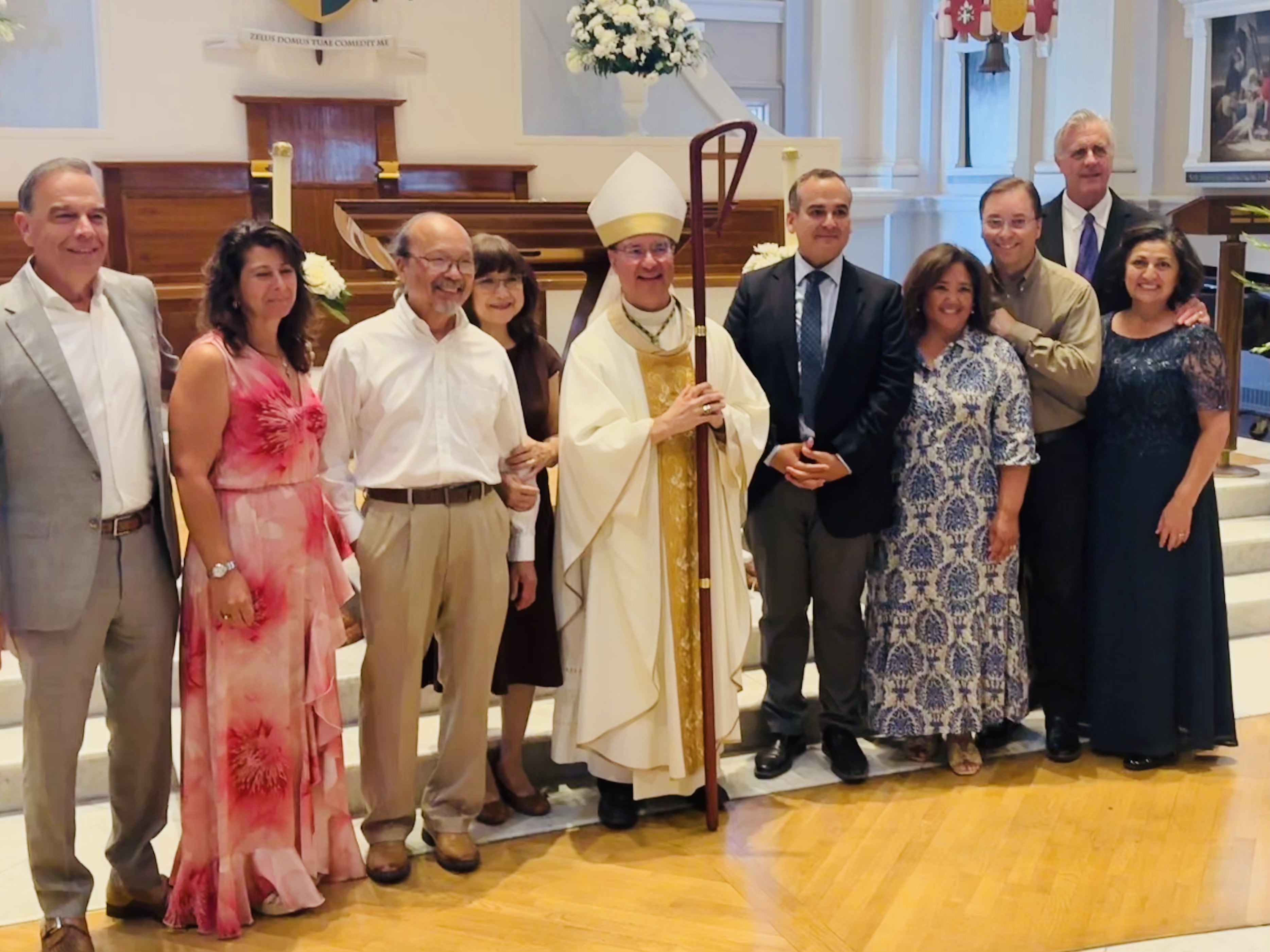
Members of the Radiate Love Task Force pose with Jose Soto, center-left, and Bishop Oscar Cantú, center, with task force mentors Richard and Veronica Wildanger pictured on the far right. | Credit: Oliver Tapia/Diocese of San Jose
The initiative began after the director for Adult Spirituality and Family Life for the Diocese of San Jose, Jose Soto, noticed how many couples attending weekly Mass with their children refrained from Communion due to their marital status.
“We adapted the title ‘Radiate Love’ because it was used by the California bishops as a way to promote marriage and family in 2024-2025,” Soto said. “So, as that initiative was drawing to a close, I created a Radiate Love task force, which was about four or five marriages that I put out an invitation to, and they were passionate about marriage and family, and they helped me put on events throughout the year. One of them said, ‘Jose, my heart breaks when I see couples … come to church, they bring their kids to Mass on Sunday, and they donʼt take Communion, and I wonder if thereʼs anything we can do to help those couples.’ And that’s how it started.”
While organizers initially planned for a small cohort of 12 to 15 couples to establish a framework, news of the program spread through parishes. After the time to sign up was over, there were a total of 102 couples ready to begin.
“We were just so excited and overwhelmed at the same time, but it was so joyful,” Soto said. “It just said to me that there’s a need out there, and that couples are willing to come forward when they are welcomed, and when they are, when they see that thereʼs an initiative from the Church to walk with them, to journey with them.”
Volunteer mentors Veronica and Richard Wildanger, who had their own civil marriage convalidated 22 years ago, joined the task force after being approached by Soto to support the “wonderfully successful” surge of applicants.
To ensure couples received thorough pastoral care, the diocese implemented the Witness to Love program for marriage preparation by pairing up civilly married couples with experienced mentor couples to walk them through the process. The Wildangers believed this was the next step in turning their marriage toward God.
“And the fact that the diocese offered it up, all of a sudden it was like someone stretching a hand out and saying, here, just hold my hand and we’ll guide you through every step,” Veronica said.
Participating couples pose for photos in the sanctuary during a Radiate Love communal convalidation liturgy presided over by San Jose Bishop Oscar Cantú and clergy. | Credit: Oliver Tapia/Diocese of San Jose
For candidates like Mireya Aristizábal and Juan David Díaz, who were married civilly three years after moving from Colombia, the program provided both spiritual clarity and personal connection as a couple.
“But in my heart, there was always that little itch,” Aristizábal said in Spanish. “Because I said, ‘Well, I want to be with my partner, but I want to be with him before God.’ That is, the sacrament of matrimony. It’s that, the desire to have and to live the sacrament to its fullest.”
Her husband saw the decision as a way to support his wife’s spiritual life while growing in his own faith.
“She was invited to the party, but they weren’t giving her dinner,” he said in Spanish. “So it’s very difficult … to block her from her beliefs. I said, ‘No, I also believe in God, I like the Catholic Church, so let’s go.’”
According to Aristizábal, the preparation process helped ground their relationship in shared spiritual formation, finding their community in their new home to join them for the celebration on Sept. 26.
“The impact has been drawing us closer to God, knowing that we are seeking him, and that we want to put him in first place in our lives,” Aristizábal said in Spanish.
Throughout the program, organizers and mentors emphasized the theology of sacramental marriage as an unbreakable covenant rather than a mere social agreement, Soto explained.
“When you bring God into it, this is now a covenantal marriage, not sort of a contractual marriage, but a sacramental marriage,” Wildanger told EWTN News. “Our Lord is now present, and you owe a responsibility to God to really try to help your spouse get to heaven. Itʼs not solely at this level; itʼs more of an also at this level. And God is now watching and present in you and can bring graces from that.”
Soto noted that elevating civil unions into sacramental covenants provides families with a deeper sense of purpose, stating that couples can “mirror that when they give themselves to each other in holy matrimony.”
Newly convalidated couples gather around San Jose Bishop OScar Cantú in the sanctuary, marking their entry into the sacrament of matrimony. | Credit: Oliver Tapia/Diocese of San Jose
For many couples, receiving the Eucharist after years of abstaining was an emotional milestone. Some even had exceeded 30 years of only civil marriage, causing many tears of joy, according to Veronica Wildanger.
Rather than detracting from the intimacy of the sacrament, participating in a group ceremony highlighted the universal nature of the Church.
“That makes me see that the Church is unity, and that sharing this sacrament with other people demonstrates that the Church is still very much alive, that it believes in marriage, and that it wants to keep fighting for it,” Aristizábal said.
For couples who did not reach the program in time, or were limited due to missing documentation, time constraints, or anxieties — all of which Soto claimed were obstacles experienced by couples during the last year, the message of encouragement is clear: Do not be afraid.
“I would just say that the Church welcomes you, and the Church is here with open arms, and that whenever you are ready, we are here to walk with you every step of the way,” Soto said. “So my advice would just be to, if you have it in your heart, if thereʼs been a tug in your heart that says, maybe I should get married in the Church, to listen to it, to respond to it.”