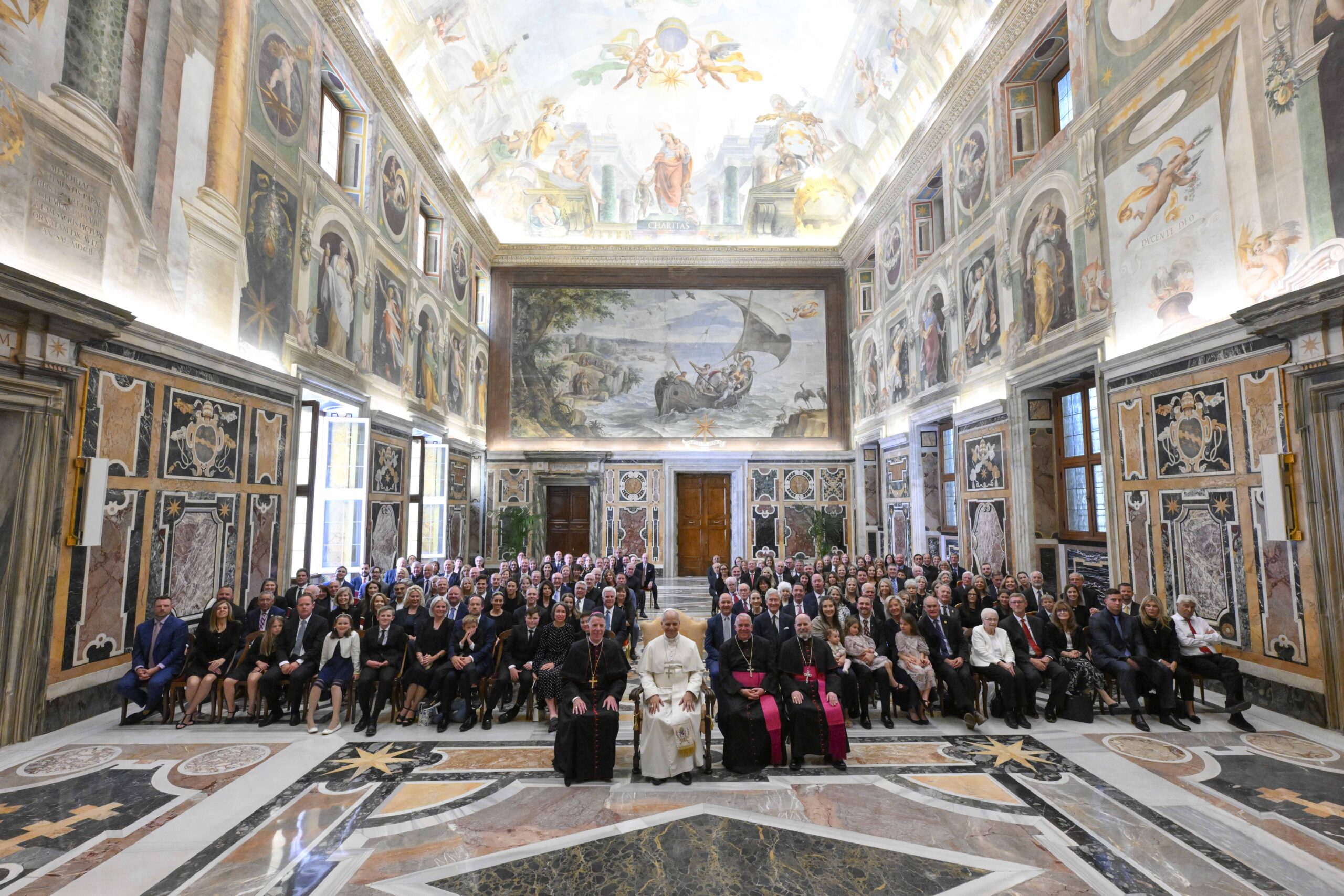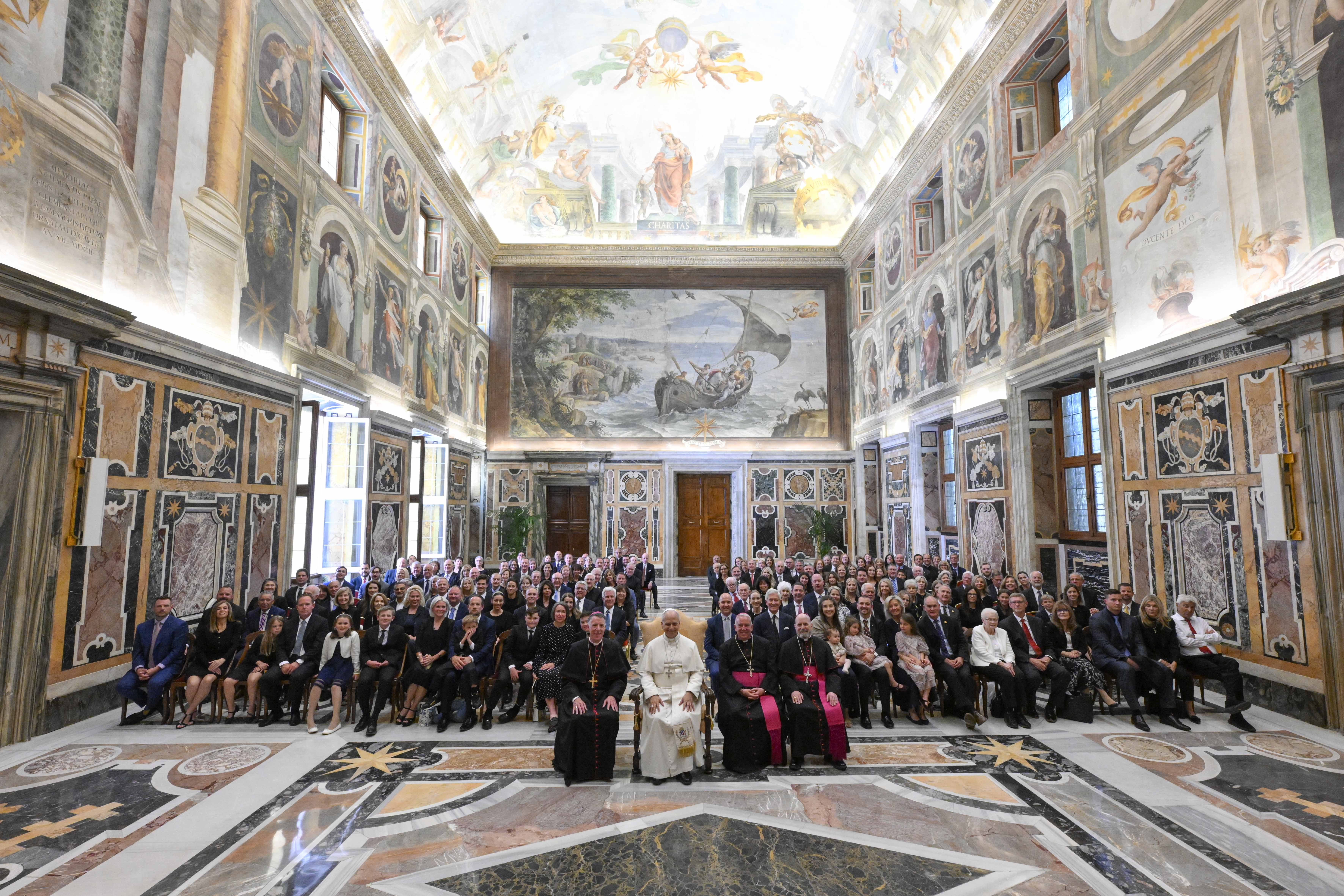
Pope Leo XIV on Sunday voiced dismay over ongoing conflicts around the world, saying the suffering of innocent victims “hurts all of humanity” and urging an end to hostilities grounded in dialogue and respect for human dignity.
“We cannot remain silent in the face of the suffering of so many defenseless people who are victims of these conflicts. What hurts them hurts all of humanity,” the pope said after praying the Angelus on March 22.
“The death and pain caused by these wars is a scandal for the entire human family and a cry that rises to God,” he continued. “I strongly renew my appeal to persevere in prayer, so that hostilities may cease and paths to peace may finally open up, based on sincere dialogue and respect for the dignity of every human person.”
Earlier, in his reflection before the Angelus, the pope focused on the Gospel account of the raising of Lazarus, describing it as a sign of Christ’s victory over death and the promise of eternal life received through baptism.
“The account of the resurrection of Lazarus, then, invites us to listen to this profound need and, with the power of the Holy Spirit, to free our hearts from habits, conditioning, and ways of thinking which, like boulders, shut us away in the tomb of selfishness, materialism, violence, and superficiality,” he said.
“In these places there is no life but only confusion, dissatisfaction, and loneliness.”
Quoting Jesus’ command in the Gospel — “Come out!” — the pope said Christ calls believers to emerge from such “cramped spaces,” renewed by his grace, and to “walk in the light of love, as new women and men, capable of hoping and loving, without calculation and without measure, according to the model of his infinite charity.”
He also warned that the world seems “to constantly search for novelty and change, even at the cost of sacrificing important things — time, energy, values, affections,” as though “fame, material goods, entertainment, and fleeting relationships could fill our hearts or make us immortal.”
“It is a symptom of a longing for the infinite that each of us carries within us, a need that cannot be satisfied by passing things,” he said. “Nothing finite can quench our inner thirst, for we are made for God, and we find no peace until we rest in him.”
The pope concluded by entrusting the faithful to the Virgin Mary, praying that the experience of encountering the risen Christ may be renewed in them each day.
This story was first published by ACI Stampa, the Italian-language sister service of EWTN News. It has been translated and adapted by EWTN News English.
On their first day at LifeCampUSA, middle-school-aged campers are taught how to use a map and a compass to learn how to find their way around. Then they’re given a Bible — for many, their first time having one — and shown how to find the different books of the Bible, after which there’s a discussion about how God’s word can serve as a map and compass in life.
For boys and girls who have lost their dads in military service, as first responders, or in law enforcement, LifeCampUSA and its Bible-based curriculum can be a life-changing summer experience where they forge new friendships and find a relationship with God.
Founded by married couple Mark and Jane Neumann, the camp — which, according to its website, is “a Christian ministry unassociated with a specific church or religious denomination” — first opened in the summer of 2021 after the Neumanns met a group of middle schoolers from military families and heard about the struggles they faced in the aftermath of losing their fathers. Having experience working with middle schoolers in youth ministry at their church, the Neumanns felt called to help these children and “become fathers to the fatherless.”
Despite neither one growing up in a typical military family, both Jane and Mark grew up with a “general sense of patriotism,” Jane told EWTN News in an interview.
The Neumanns emphasized that they start the week at camp with the map and compass lesson because they want the children to leave knowing that “just like with the compass you’re not going to get lost if you follow the Bible’s lessons and what this book has for you; it’s going to give you direction in life,” Mark said.
Middle-school-aged girls attend LifeCampUSA. | Credit: Photo courtesy of LifeCampUSA
LifeCampUSA offers their summer camp program in several different states across the United States including Colorado, Montana, South Dakota, Minnesota, and Wisconsin. Each camp has spaces for 10 boys and 10 girls. Each boy is assigned his own male mentor, while five couples serve as mentors for the girls’ camp.
“We have five couples for the girls so that the men can speak into the girls’ lives safely there and that the girls can see father figures [and] hear the things that a dad would want to tell their daughters, but also see the healthy marriages,” Mark explained.
Additionally, all expenses — including airfare — are completely covered by LifeCampUSA for the campers who attend. Also, all campers can take part in a 12-month program called LifeCare after their week at camp to continue their mentorship.
Mark and Jane also highlighted the way in which they’ve seen young boys in particular grow into young men during their time at camp. Jane shared that much of the feedback she receives from moms once their sons get back home is how much more respectful they are and how they begin to take more initiative in helping around the house.
One of Mark’s favorite stories was from a mom who shared with him that her son began leading his family in prayer before every meal after getting back home from camp.
“I mean there’s countless stories — it’s been such a blessing,” Mark said.
The Neumanns also pointed out the impact camp has on the many children who have lost their fathers due to suicide after serving the country. They shared that out of the 100 children who are signed up to attend camp this summer, 80% have lost their dads from suicide.
“Moms will tell us that they didn’t mean for this to happen, but they feel a sense of shame when their husbands have taken their own lives, and they didn’t even want necessarily that sense of shame, but it just naturally happens and they don’t mean to project that onto their kids, but it just has,” Jane explained.
She added that these children also face bullying in school after kids find out the manner in which they lost their fathers.
A group of campers and their mentors at LifeCampUSA. | Credit: Photo courtesy of LifeCampUSA
“Their dads are our nation’s heroes. [Yet] somebody finds out that that dad had an injury to their mind, they don’t understand that, but they have no problem bullying our kids, teasing them that their dads took their own lives. And so they don’t want anybody to know,” she shared. “… And now these kids — they’re almost suppressing their patriotism, putting shame into their lives. So our kids come to camp with that stigmatism.”
However, many of the mothers of these children have shared that after they attend camp they witness a “change in their hearts and their heads and it puts more confidence in them, it puts a pride in there for their dad, it puts pride back in for our nation,” Jane said.
Most importantly, the children are introduced to Jesus, which Mark and Jane believe is the greatest reason for the success seen during their summer camps.
“So, [when] you put the Creator in the heart and you know who your creator is, so many things get worked out. … We recognize the fact that Jesus is the one — when we can put Jesus into the program, we’re going to have the best success for these kiddos and families,” Jane said.
“We know that really we have the answer to the healing for these kids. That’s it. And so we want to tell them about Jesus because that’s the real solution,” Mark added.
Mark shared that their main hope for children who attend LifeCampUSA is to give them “hope, to be honest, because a lot of them are pretty hopeless,” and to “change the direction of their life.”
Christians in the West Bank continue to face an onslaught of aggressions by Israeli settlers, threatening their presence in the region, according to Auxiliary Bishop William Shomali of Jerusalem.
“The aggressions against Christians in the West Bank are multiplying,” Shomali said in a March 20 interview with “EWTN News Nightly.”
The situation for Palestinian Christians had been “calm” in the Bethlehem area, he said. “But now, there is more expansion of the settlements and more aggressions from the side of the settlers.”
Shomali said settlers have prevented Palestinian Christians from accessing their land through various threats, physical aggression, and property damage, including burning their cars.
“This happened mainly in the Christian village of Taybeh, and we communicated this news to all the world, even to the American ambassador in Tel Aviv, who came to visit the place, and he promised to do something, but not many things were done,” Shomali said.
In Birzeit, a Palestinian Christian town about six miles north of Ramallah in the West Bank, Shomali said settlers have been coming “almost every day to threaten people in their own homes or in their work.”
“This has become a real threat to Christian families,” he said, “because they lost their livelihood and their source of income.” The Church must intervene and provide aid for them to survive, the bishop said.
Shomali said Israeli settlers have also recently occupied land belonging to a convent of sisters in a village near Bethlehem called Urtas. The sisters “have a hill where they plant and grow olives and other things,” he said. “Settlers came to occupy this hill and to make it theirs, where they think of building a new settlement.”
He also noted a settlement to be built on the Shepherds’ Field of his own village, Beit Sahour, which he said is a piece of land that belongs to Christian families there.
“I heard just today, that a piece of land, one acre, was also entered by settlers who put an Israeli flag to mean that this land now is Israeli, while there is a deed of ownership to a Christian family that I know from Beit Sahour,” he said. “So slowly, slowly, the land of Palestine that Israels call now Judea and Samaria, the biblical name, is becoming less and less Palestinian and more and more settlers’ land.”
Sister Anna Maria of the Sacred Heart, an Italian nun, turned 106 on March 14 at her monastery near Milan, where she continues to serve her sick sisters and share reflections on the Gospel on YouTube.
Still lucid “in thought and word,” and with 36 years of life in cloister, the nun belongs to the Adorers of the Blessed Sacrament, the Italian newspaper Il Giorno reported. Despite her advanced age, she continues to participate daily in Eucharistic adoration even during the night and assists in the monastery’s infirmary, caring for elderly or ailing nuns.
Her birthday celebration took place with a Mass of Thanksgiving and a gathering with family members, experienced through the grilles of the cloister where Sister Anna Maria remains dedicated to prayer.
“I do this like so many other things, out of love for Jesus who continually asks me to love my neighbor,” the religious, whose name before entering the convent was Anna Perfumo, said in a video shared by her community.
“The years are many, but … with patience, God’s will shall be fulfilled. Pray for me, and I will always remember you on earth and in heaven,” she added.
According to Il Giorno, the nun’s life was marked by hardships from the very beginning. At 4 months old, she contracted bronchopneumonia — a condition that was practically fatal in 1920 — and at age 4 she came down with scurvy, a disease that was incurable at that time. “The doctor told my mother: ‘I won’t be coming back tomorrow, because the child will be dead.’ Yet I was miraculously healed,” she said.
Before entering the monastery, she worked for years as a governess and schoolteacher in addition to caring for elderly and infirm priests. Nevertheless, she always harbored in her heart the desire to consecrate herself to God in the contemplative life.
That longing was finally realized at the age of 70, following the death of her mother. After several attempts, she was admitted to the Adorers’ monastery in Genoa, from where she would be transferred years later to Seregno, where she currently lives.
In a video, Sister Anna Maria expressed her gratitude for the expressions of affection she had received and spoke about her late vocation: “It’s true; I had to wait quite a long time before fulfilling God’s will. But when it is God who desires something, it will always come to pass. That’s why one must have great confidence, great faith, great hope, and great patience.”
In her message, she also shared a reflection on the passage of time and on faithfulness: “My grandfather used to tell us that it’s faithfulness that keeps us young and that it’s necessary to keep our eyes and souls open to what is beautiful, good, and true; in this way, one will experience a serene old age. Love keeps the heart young.”
Finally, she extended a greeting for the Easter season: “Life is Christ — the Way, the Truth, and the Life. May the Lord grant you peace and joy… and also peace among peoples, for the sake of fraternity among nations.”
The Perpetual Adorers of the Blessed Sacrament are a contemplative, cloistered order of women whose life is centered on the continuous adoration of Jesus Christ in the Eucharist. Their mission is to intercede for the Church and the world from the silence of the monastery, offering their lives as a constant prayer.
The congregation was founded in 1807 in Rome by Blessed Maria Magdalena of the Incarnation (Caterina Sordini) with the charism of Eucharistic adoration.
This story was first published by ACI Prensa, the Spanish-language sister service of EWTN News. It has been translated and adapted by EWTN News English.
Christian ministers including a Jesuit priest won a victory at federal court on March 20 when a U.S. district judge said the Department of Homeland Security must allow them formal pastoral access to detainees at a federal facility in Minneapolis.
Judge Jerry Blackwell said in his ruling that the government “may not impose an access protocol … that bars clergy visits in all circumstances” at the Bishop Henry Whipple Federal Building on the outskirts of Minneapolis.
A group of Christian objectors, including Father Christopher Collins, SJ, had sued the government in late February, alleging that it was unlawfully “barring faith leaders from offering prayer, pastoral guidance, sacramental ministry, and spiritual comfort” to immigrants detained in the Whipple facility.
The government was unconstitutionally obstructing the plaintiffs' “sacred obligation to exercise their faith through ministry to community members in the greatest need of spiritual comfort,” the suit said.
In his ruling Blackwell said that his order allowing the ministers access to the facility would last “for the duration” of the lawsuit.
Erin Westbrook — an attorney with the law firm Saul Ewing which filed the suit on behalf of the ministers — said in a press release that the plaintiffs view their ministry work as “a core expression of their faith and a constitutionally protected exercise of religion.”
“It is vital that they be able to provide pastoral care at the Whipple building at a time when those detained are experiencing profound fear, uncertainty, and isolation,” she said.
Prior to the order the government had argued that heavy immigration enforcement in the area had already ended and that clergy had increasingly been allowed back into the building for ministry visits in recent weeks.
But Blackwellʼs order requires that officials develop a “written protocol” to ensure clergy access to the facility. The government must respond to requests for access “within a reasonable time,” the judge said, adding that such requests are subject to “reasonable” security measures.
The judge ordered the parties in the suit to file a joint status report by April 2 that includes proposed policies and disagreements from both sides.
In a fashion culture saturated with passing trends and corporate logos, a new Catholic menswear brand is making clothes that will stand the test of time and inspire its wearers to something deeper — a daily practice of identity, discipline, and faith.
Founded on the idea that what you wear can reflect what you live for, Shepherd’s offers an alternative vision of masculinity shaped not by excess but by purpose.
Launched in 2023 by Chris Cottrell, Nathan Price, Austin Wright, and football star Harrison Butker, the brand specializes in made-to-measure garments including jackets, outerwear, shirts, pants, suits, and tuxedos. For customers who cannot come to their Kansas City and Dallas stores, they offer video-based fittings and ship try-on garments.
Experiencing great success at their headquarters in Kansas City, the luxury brand recently opened a new store in Dallas on Feb. 28. Shepherd’s offers its customers advanced fitting methods that involve over 100 adjustments for a precise fit and uses premier fabrics from Europe, primarily Italy and the United Kingdom.
EWTN News spoke with Cottrell about the new brand and how it aims to play a role in the lives of Catholic men.
EWTN News: What inspired you to create Shepherd’s?
Chris Cottrell: I think a couple of us on the team had interest, generally, in menswear, but I think what we saw was an opportunity to build a brand that was elevating and refined and kind of inherently Catholic without being overtly Catholic. It’s not like we have a crucifix on the inside of our jacket or saints on our socks, but the values kind of just speak through it.
I’m a convert and I actually met my first nun like four years ago at a conference. I had never met a nun before and she just had this glow about her. It comes from the amount of prayer, it comes from so much time in adoration, and she really was glowing. And you can look at her from across the room — I was lucky enough to have dinner with her — and it was just obvious that she was so close to the Lord.
That’s the kind of brand we wanted to create, where you didn’t have to say anything, it just felt different. And there’s no other brand that’s in the premium luxury space that has that. Everything else is so worldly, it doesn’t have the same values underneath it. And we wanted to create something special. And I think we’ve done that so far with Shepherd’s.
Can you speak a bit more about how the brand portrays Catholicism?
I often think of St. Paul’s letter … In one of his letters he says, old men do all these things, old women do all these things, young women do all these things, young men, self-control. That’s the only advice that he gives the young men: Be self-controlled. And for us, dressing well is a form of self-control. It’s a habit toward virtue.
Of course, it’s easier to wear a T-shirt and sweatpants or something, but we’re trying to help ourselves and our customers be both comfortable in the clothing but also own stuff that they’re proud of, that’s truly made for them, and is unique that they want to wear and it makes it easier to practice virtue by dressing well.
And then of course, you have the effect of wearing the clothes. Like the self-discipline of going to prayer regularly forms you in discipline, but then also you have the effect of prayer. So for us, we have the discipline of getting dressed well and then you have the effect of being well dressed. And every girl knows this too in a different way, but every guy knows the feeling of putting on [something] they feel really confident in and they just stand up a little straighter, right? They feel more like there’s a gravitas and they take their life a little more seriously and they kind of live up to an expectation to be their best version of themselves.
Why do you think a brand like Shepherd’s is needed right now in our culture?
I mean other than the Church, of course, the last great institution that is under attack right now is the family. It’s the concepts of men and women and it’s the concept of the family.
And Harrison [Butker] has been a great exemplar of putting family first and speaking out about Christ and speaking out about our values, but we wanted to build a brand that was pro-men — masculine and associated with masculine beauty and built for men. That’s one of the reasons we don’t do women’s tailoring.
A look inside the Shepherd’s store in Dallas. | Credit: Carlos Lima/Shepherd’s
The manufacturers we work with, the mills that we work with, most of our competitors would offer women’s wear as a way to grow your customer base and grow revenue, but we don’t simply because the values we’re trying to build, we view them as masculine values. And men are under attack everywhere. And so if you look especially for young men, like where are they getting advice? It’s kind of either like Andrew Tate or YouTube and that’s not great.
It’s not a great place for young men, for our next generation … to be formed as men. So we want to, obviously, do the clothing, but also build a brand around that and an ethos around that that is built to encourage men in the life that we view as good, which is a life centered on faith, family, friends, and work that matters.
What is your main goal or hope with Shepherd’s?
When we started the business, we as a founding team, the four of us committed to kind of have a double bottom line. One being we want to build a great business. I think this is part of doing good work — doing our work as unto the Lord — is that we build a business that’s successful, that’s sustainable, that’s profitable, that we have the money to offer benefits, we have good pay … So we want to build a successful business.
The other part is we want to influence the culture. We want someone to come as a young man, maybe a recent graduate, come to Shepherd’s and get a couple garments from us and bit by bit … being around our community that we’re really building, have that influence their life … Three to four degrees of change in your early 20s can lead to a very different life, can lead to a very different outcome.
The thing we want to see is people who have somehow in their life been affected positively by the brand or brought closer to their faith or been more successful in their career or carried themselves differently and had a better marriage for that. So really that’s the dream goal.
For me personally, I would love to in 10 years overhear somebody saying, “Oh, I went to this cool brand, Shepherd’s, and I read this great piece of content they had, and I bought a jacket and I just love their stuff. It really made me want to try harder and so I got this new job and then I met this girl.” That’s the kind of business that we want to build.
BANGALORE, India — Church leaders in India have expressed frustration and concern over the Indian government’s rejection of the 2026 report of the U.S. Commission on International Religious Freedom (USCIRF) amid steadily increasing atrocities against minority Christians.
The 2026 USCIRF annual report about conditions related to religious freedom in 2025 urged the U.S. government to designate India as a “country of particular concern” for allegedly “engaging in and tolerating systematic, ongoing, and egregious religious freedom violations.”
The report also called for targeted sanctions on India’s external intelligence agency RAW (Research and Analysis Wing) and the Rashtriya Swayamsevak Sangh (RSS, translated “National Volunteer Corps”), known as the fountainhead of Hindu nationalism.
“We have taken note of the latest report… We categorically reject its motivated and biased characterization of India. For several years now, USCIRF has persisted in presenting a distorted and selective picture of India,” Randhir Jaiswal, spokesperson for India’s Ministry of External Affairs, said March 16.
“Instead of persisting with selective criticism of India, USCIRF would do well to reflect on the disturbing incidents of vandalism and attacks on Hindu temples in the United States, selective targeting of India, and growing intolerance and intimidation of members of the Indian diaspora in the United States, which merit serious attention,” Jaiswal said.
Jesuit Father Cedric Prakash, who is based in western Gujarat state, reacted to the government’s rejection of the USCIRF report, telling EWTN News on March 17: “The Indian government is in its normal denial mode. Politicians of the ruling regime and their caged parrot bureaucrats have mainstreamed the art of lying.”
He pointed out: “What USCIRF has stated and has been doing so all these years are incontrovertible facts. There is sufficient documented evidence to prove their charges.”
Despite the government denial, the ecumenical United Christian Forum (UCF), which has been documenting atrocities against Christians, has recorded a steady increase in the number of atrocities against Christians since the Hindu nationalist Bharatiya Janata Party (BJP) came into power in 2014, recording 834 in 2024 compared with fewer than 140 in 2014.
“It is not hidden that the splinter groups of RSS are involved in creating an atmosphere of hatred against religious minorities, especially Muslims and Christians,” A.C. Michael, a Catholic and UCF coordinator, told EWTN News.
Following widespread violence against Christians, the UCF wrote to Prime Minister Narendra Modi in early 2026. “In 2024, the UCF recorded a total of 834 incidents of violence against Christians, revealing a disturbing trend in religious persecution. As of November 2025, a staggering 706 incidents targeting Christians …. have been recorded by the UCF,” the letter said.
Archbishop Anil Couto of Delhi, India, secretary-general of the Catholic Bishops’ Conference of India, addresses the National Christian Convention against atrocities on Nov. 29, 2025, in New Delhi. | Credit: Anto Akkara
As incidents of anti-Christmas violence started pouring in, Archbishop Andrews Thazhath, president of the Catholic Bishops’ Conference of India (CBCI), sent a video appeal on Christmas Eve to Modi and chief ministers across the country “to ensure strict enforcement of the law and provide proactive protection to Christian communities.”
“Today, it is with deep pain and concern that I speak over the disturbing rise in attacks on Christians in several parts of our country. During this holy Christmas season, we are pained to hear about it,” Thazhath said in his video message.
The Feb. 3–10 biennial assembly of over 200 bishops in India at Bangalore also reiterated this concern in its final statement: “As many innocent individuals are incarcerated based on unfounded allegations of forceful religious conversions, we strongly demand the repealing of legislations which are inconsistent with religious freedom and right to privacy.”
“All persons are equally entitled to freedom of conscience and the right to freely profess, practice, and propagate religion,” the CBCI asserted, quoting Article 25 of the constitution.
However, hundreds have been arrested, including nuns and priests, under the draconian anti-conversion laws.
On March 16, the Supreme Court of India quashed a conversion case against a youth for praying inside his house with his friend. The young man was imprisoned for days in 2023 in northern Uttar Pradesh state, according to Alliance Defending Freedom (ADF India). Later, the man’s father was also charged with conversion, and the family petitioned various courts for three years, eventually ending up at the Supreme Court, where the case was dropped.
“The so-called Freedom of Religion Acts popularly known as ‘anti-conversion laws’ adopted in most of BJP-ruled states are being implemented under pressure from RSS in the name of forceful conversions. Till today there has not been a single conviction in any court of law in India,” Michael said.
According to Michael, the “call for a ban on the activities of RSS is nothing new” — India’s first home minister, Sardar Patel, as well as Prime Ministers Indira Gandhi and Narasimha Rao all banned RSS “citing dangerous activities and acts of violence, including arson, robbery, and murder.”
Prakash, who has spoken up consistently for victims of the 2002 attack on Muslims following the torching of a train carrying Hindu pilgrims, said: “On every global parameter, India has reached an abysmal low. The government is so rankled that it even tries to defend the likes of the RSS speaks volumes.”
“The least the government should do is in all humility and honesty to accept the truth and take corrective measures immediately,” he urged.
Winona-Rochester Bishop Robert Barron on March 20 criticized what he described as “absurd” claims from Carrie Prejean Boller that she was booted from the Presidential Commission on Religious Liberty because of her Catholic beliefs.
Boller, an outspoken Catholic and a former Miss California USA contestant, was removed from the commission in February after repeatedly criticizing “Zionism” at a commission hearing on Feb. 9.
The hearing focused on combatting anti-semitism in the U.S., though Boller during the hearing regularly brought up the subject of Zionism, the movement supporting Jewish self‑determination in a homeland in Israel.
“I’m a Catholic, and Catholics do not embrace Zionism, just so you know," Boller said at one point. Elsewhere she asked witnesses if they were willing to "condemn what Israel has done in Gaza."
In announcing Bollerʼs removal, Texas Lt. Gov. Dan Patrick — the chairman of the commission — argued that “no member of the commission has the right to hijack a hearing for their own personal and political agenda on any issue.”
“This is clearly, without question, what happened … in our hearing on antisemitism in America," he said at the time.
‘Simply preposterous’ discrimination claims
Boller has spoken out publicly about the controversy in the weeks since her removal, alleging that she was booted from the commission because of her Catholic faith. In a March 20 post on X, she suggested that the religious liberty commission “does not truly care about religious liberty” and suggested that she was removed “for faithfully articulating the Church’s teaching.”
In that post she suggested that Bishop Barron — who himself serves on the commission — was not sufficiently defending the Catholic faith by refusing to speak up about the alleged discrimination.
“If my religious freedom is not protected, then no one’s is,” she wrote to Barron. “Please speak up. Please stand up for Catholics.”
In a blistering response, Barron bluntly dismissed Bollerʼs allegations as “absurd.”
“Mrs. Prejean Boller was not dismissed for her religious convictions but rather for her behavior at a gathering of the Commission last month: browbeating witnesses, aggressively asserting her point of view, [and] hijacking the meeting for her own political purposes,” the bishop said.
Barron noted that he “fully subscribes” to the Catholic position on Zionism, which includes unequivocal opposition to antisemitism along with an acknowledgment that Israel has a right to exist but does not “stand beyond criticism.”
“If Mrs. Prejean Boller were dismissed for holding these beliefs, it is difficult to understand why I am still a member of the Commission,” Barron wrote.
“To paint herself as a victim of anti-Catholic prejudice or to claim that her religious liberty has been denied is simply preposterous,” he argued.
The commission met most recently on March 16 to discuss religious freedom in health care. Barron said during the hearing that Catholics are increasingly being pushed out of health care and social services.
“We’ve got to come forward in the public space, articulate what is the human good. I think we’ve become more reticent, and we’ve succumbed to the pressures from the secular ideology,” he said.
Alongside Barron, other prominent Catholics on the commission include Ethics and Public Policy Center President Ryan Anderson and Cardinal Timothy Dolan.
The commissionʼs advisory board also features San Francisco Archbishop Salvatore Cordileone, Springfield Bishop Thomas Paprocki and Fort Wayne-South Bend Bishop Kevin Rhoades.
For decades, Special Olympics has provided sports training and athletic competition to help children and adults with intellectual disabilities develop physical fitness, demonstrate courage, and foster a sense of community among individuals both with and without disabilities.
March 21 marks World Down Syndrome Day, a global awareness day to advocate for the legal rights of people with Down syndrome and promote greater inclusion for people with the genetic condition, which can cause intellectual disabilities, developmental delays, distinct physical characteristics, and increased risks of certain health problems.
The day helps to draw attention to the nearly half a million Americans with Down syndrome and the 3,000 to 5,000 children who are born with the chromosome disorder every year.
To promote community among people with Down syndrome and other challenges, Special Olympics works to create opportunities to develop physical fitness, demonstrate courage, and experience joy.
Here are five facts you may not know about the global organization:
It has programs operating across the globe every day and holds the Special Olympics World Games every two years alternating between summer and winter. Anyone over the age of 8 with intellectual disabilities is eligible to compete.
Programs and training are present in all 50 U.S. states, the District of Columbia, and Puerto Rico. As of 2024, it was active in 177 countries spanning each continent.
From weight lifting to speed skating, the programs and games offer a diverse range of athletics with more more than 30 Olympic-style sports available. Soccer, basketball, and bocce are some of the most popular.
In 2022 alone, there were 46,000 Special Olympics sports competitions, averaging to 126 per day. About 16,000 of the competitions were Unified, meaning people with and without intellectual disabilities competed on the same teams.
2. The organization operates in tens of thousands of schools.
Special Olympics Unified Champion Schools program is active in nearly 11,000 schools in the U.S. It has trained youth leaders and educators to create more inclusive education systems by including students in all aspects of school life.
The program is aimed at promoting social inclusion through implemented activities in K–12 schools and across college campuses. Through the programming, young people with and without disabilities come together on sports teams, create student clubs, and foster youth leadership. As many as 19.5 million young people are taking part in the experiences.
3. The movement all started in a backyard.
The Special Olympics movement began in 1962 when its founder, Eunice Kennedy Shriver, hosted a summer camp in her backyard for kids with disabilities at her Maryland farm.
“Camp Shriver” was motivated by the unfair treatment of children with disabilities including Shriver’s sister, Rosemary Kennedy, who had an intellectual disability and loved sports.
Shriver reached out to schools and clinics in her area to find special-needs children who might be interested in her camp. She then recruited high school and college students to act as counselors, ending up with 34 children and 26 counselors.
The children swam, played soccer, shot baskets, and rode horses. Not only did the camp prove the kids could play sports, but it also helped the young counselors see the participants in another light — as children who merely wanted to have fun and compete, just like any other kid.
Shriver passed away in 2009, but her son Timothy Shriver has carried on her legacy and led Special Olympics for three decades. For his work as an outspoken advocate for people with disabilities, he received the University of Notre Dame’s 2026 Laetare Medal.
4. Multiple Special Olympics athletes have set world records.
Special Olympics is not only creating unity and confidence but also has built up record-breaking athletes.
Chris Nikic set a Guinness World Record by becoming the first person with Down syndrome to complete a full IRONMAN in November 2020. The Special Olympics Florida athlete has also competed in golf, track and field, swimming, basketball, and triathlons.
In 2024, Lloyd Martin, an athlete with Down syndrome, ran the TCS London Marathon in a little under seven hours at the age of 19. He set a new Guinness World Record for the youngest known person with Down syndrome to complete a marathon.
Other athletes including cyclists Tom Kelsall and Hannah Kemp have set Guinness World Records titles for their accomplishments completing in the Ford RideLondon-Essex100, a 100-mile race in the U.K.
5. The organization goes beyond sports.
While athletics is at the forefront of Special Olympics, it also provides other opportunities and care. The organization offers year-round health support and advocates for better access to social services and health care for people with disabilities.
Since 1997, Special Olympics athletes have had access to free health screenings through the Special Olympics Healthy Athletes program, which works to close the gap in health care access between those with disabilities and the rest of the population.
Special Olympics Healthy Athletes has conducted more than 2 million screenings and has also trained 300,000 health care professionals.
Organization representatives also make an annual visit to Capitol Hill to meet with members of Congress to advocate for the needs of Americans with intellectual disabilities.
Chaplains are often the first responders in a crisis — when people are struggling with grief or trauma they often reach out to their priests and deacons. The nature of the work means clergy often face emotional stress. So who shepherds the shepherds?
The solution, for Deacon Ernie Martinez, starts with brother priests and deacons.
Martinez, director of deacons for the Archdiocese of Denver, has spent 40 years working with the Denver Police Department. Taking inspiration from its long-standing police support program, he helped launch the Clergy Outreach and Resilience (COR), which teaches clergy how to recognize signs of stress and burnout in one another.
“I have seen in both policing and ministry that without support, even the strongest men can find themselves battling darkness, including thoughts of hopelessness, or worse,” Martinez told EWTN News.
“Priests and deacons walk daily with people through death, trauma, addiction, broken families, and profound suffering,” Martinez said. “They absorb that pain. They carry it, often without peer support training or awareness, and too often, they carry it alone.”
The program launched in January with a four-day certification program led by clinical psychologist John Nicoletti. About 40 clergy members attended, mostly deacons.
“We are forming clergy who are trained to recognize distress, to step in early, to walk with a brother in crisis, and, when necessary, to help him get the care he needs: spiritually, emotionally, and clinically,” Martinez said. “It is about creating a culture where asking for help is not seen as weakness but as wisdom.”
The weight of service
“This program was born at the intersection of two worlds I have lived deeply — law enforcement and ordained ministry,” Martinez said.
“After 40 years with the Denver Police Department, I witnessed firsthand the weight men and women carry in silence,” Martinez said. “I saw what happens when that weight has nowhere to go.”
“In law enforcement, we learned that peer support, one trusted brother or sister walking with you in the darkness, can mean the difference between life and death,” Martinez continued.
Deacon Ernie Martinez, the Archdiocese of Denver’s director of deacons, helped launch the Clergy Outreach and Resilience (COR) program. | Credit: Photo courtesy of Deacon Ernie Martinez
“When I stepped more fully into my role serving the Church, I recognized that our clergy carry a similar, and in many ways even heavier, burden,” Martinez said.
Clergy “absorb that pain” that the people they walk with carry, according to Martinez.
“Scripture reminds us clearly: ‘Bear one another’s burdens and so fulfill the law of Christ’ (Gal 6:2),” Martinez said. “The challenge is that many of our clergy have been doing the bearing, but without someone helping to carry their burden.”
“And the reality is this: When that weight builds over time, it can lead to deep isolation, burnout, and even moments of despair,” Martinez said.
“My hope for the Archdiocese of Denver and the Diocese of Colorado Springs is simple but urgent: that no priest or deacon ever feels alone in his suffering again,” he said.
‘True fraternity’
The Clergy Outreach and Resilience program “is about building what the Church has always called us to be: true fraternity,” Martinez said.
“As the Holy Father has emphasized, authentic bonds are essential to our humanity; without them, we risk isolation and interior collapse,” Martinez said.
Martinez co-founded the program with Father Brad Noonan as well as with the support of both Archbishop Emeritus Samuel Aquila and Archbishop-designate James Golka of Denver and others.
Noonan spent more than 26 years as a fire department chaplain and 14 years as a police chaplain. Currently the pastor at Our Lady of the Pines Catholic Church in Colorado Springs, Noonan said he likes how the program “provides a one-on-one support program for priests and deacons.”
“I have seen one-on-one trained peer support help firefighters and law enforcement, including the International Association of Fire Fighters,” Noonan told EWTN News.
“When I first started in the fire service there were some elements to help firefighters deal with the emotional demands of the job,” he recalled.
Support didn’t always begin with formal meetings with a counselor. It often involved “dining-table talk after a bad call” or talking on the way back in the fire engine, Noonan explained.
“There are a lot of mental and emotional stressors that priests and deacons encounter everyday,” Noonan explained. “It is our hope that this program develops well and expands throughout the United States and across the world.”
About 40 clergy members, mostly deacons, attend the January 2026 launch event for the new Clergy Outreach and Resilience (COR) program, a joint effort between the Archdiocese of Denver and the Diocese of Colorado Springs in Colorado. | Credit: Photo courtesy of Deacon Ernie Martinez
“What makes this program unique is that it integrates proven peer-support practices from high-stress professions with a deeply Catholic vision of brotherhood rooted in Christ,” Martinez said.
“This is not just about mental health; it is about spiritual fatherhood and fraternity,” Martinez said. “It is about living the command of Christ: ‘Love one another as I have loved you’ (Jn 15:12).”
“When a shepherd is supported, he can stand firm,” Martinez said.
“As St. Paul writes: ‘We are afflicted in every way, but not crushed; perplexed but not driven to despair’ (2 Cor 4:8),” Martinez quoted. “That is the resilience we are building.”
“This is about carrying the weight, together,” Martinez said. “And ultimately, it is about hope.”