Doctors have cleared Pope Leo XIV to leave the hospital; he will return to the Vatican on Saturday afternoon, according to the Vatican.
The pope’s personal physician Dr. Luigi Carbone and surgeon Dr. Stefano Margaritora said Oct. 17 that “based on the blood tests and chest X-ray performed this morning, and after evaluating his clinical condition, the Holy Father has been deemed fit to be discharged.”
The Vatican also announced that Leo would celebrate Mass at the hospital on Saturday before being discharged, and lead his Angelus at the Vatican on Sunday.
Leo announced during his Sunday Angelus on Oct. 11 that he would undergo surgery to remove a lung nodule. Doctors confirmed a diagnosis of lung adenocarcinoma after his surgery at Rome’s Gemelli Hospital on Oct. 13.
Since his surgery and hospitalization, doctors and the Vatican have confirmed that the pontiff’s postoperative recovery is “progressing normally.” On Friday, the Vatican released photos of the pope celebrating Mass at the hospital, the first photos since his hospitalization.
Pope Leo XIV has received the green light from his surgeon to proceed with his planned Nov. 6–17 apostolic journey to Uruguay, Argentina, and Peru.
In an interview with Vatican News following the Holy Father’s Oct. 17 discharge from the Gemelli Hospital, Dr. Stefano Margaritora, who operated on Pope Leo on Oct. 13, said he expects Leo will be fully recovered and in shape to travel within the next “10 days or so.”
Calling him “an ideal patient,” Margaritora said that upon his discharge from the hospital Leo “was in entirely satisfactory clinical condition” with completely normal blood test results and heart function.
“The lung’s re-expansion after surgery is proceeding according to the usual timetable,” and “overall, his condition is good,” Margaritora added.
The surgeon indicated that the Holy Father’s lung adenocarcinoma was discovered during routine abdominal examinations, which underscores the importance of regular preventive checkups.
“In the Holy Father’s case, he had no respiratory symptoms and felt perfectly well,” the doctor noted.
The pope has “put his heart and soul” into his recovery, Margaritora said. “His determination to recover quickly has been effective in every respect” and “truly commendable,” he pointed out.
Illustrating the point, the doctor noted that on the second day after the operation, the medical staff found him arranging the chairs in the chapel himself. “Holy Father, we can do that,” Margaritora recounted. But Leo replied: “It doesn’t matter. I can do it, so I will.”
The number of Catholic priests worldwide has risen again after five years of no growth, according to statistics published by the Vatican agency Fides ahead of the 100th World Mission Sunday, which will be celebrated Sunday, Oct. 18.
According to the Fides report, the total number of priests rose from 406,996 to 407,421, representing an increase of 425 compared with the previous year. The Vatican agency noted that the data comes from the Statistical Yearbook of the Church and is current as of Dec. 31, 2024.
Africa recorded the largest increase with 1,676 more priests, followed by Asia with 1,065. The Americas also reversed the previous yearʼs downward trend, adding 199 priests.
In contrast, Europe lost 2,483 priests over the course of the year, while Oceania recorded a decrease of 32.
The overall increase is attributed to the growth in the number of diocesan priests, which reached 279,238, an increase of 496 compared with the previous count. Meanwhile, the number of religious order priests fell by 71, standing at 128,183.
Despite the increase in the number of priests, the number of Catholics per priest also rose, reaching 3,491 — an increase of 38 compared with the previous year. The average number of inhabitants per priest also climbed, reaching 16,104.
At 1.4 billion, Catholics are 18% of global population
Fides statistics further indicated that the global Catholic population reached 1,422,144,000 as of June 30, 2024, an increase of 16.69 million over the previous year. Based on these figures, Catholics represent 17.8% of the worldʼs population.
Africa saw the largest growth in the number of Catholics, with an increase of 7.58 million, followed by the Americas, with a rise of nearly 7 million. Asia added 968,000, Europe 911,000, and Oceania 239,000.
Number of seminarians worldwide decreases
While the number of priests is rising, the number of seminarians is decreasing. The number of major seminarians stood at 103,604 worldwide, a decrease of 2,891 from the previous year.
Africa was the only continent to record growth, with 786 additional seminarians, whereas Asia saw a decline of 2,733, Europe 701, the Americas 227, and Oceania 16.
The number of minor seminarians also decreased, falling to 94,041, which is 980 fewer than in the previous count. Africa reversed the previous yearʼs trend, adding 132, while Oceania recorded an increase of 20. In contrast, Europe lost 872, Asia 182, and the Americas 78.
Catholic Church’s educational and charitable work
Fides also compiles figures on the Churchʼs educational work around the world. Globally, the Church administers 75,448 kindergartens with over 7.4 million pupils; 103,666 primary schools attended by more than 36.3 million students; and 51,810 secondary schools with over 20.3 million students.
Joining them are nearly 2.7 million students in higher education centers and more than 4 million in university institutions affiliated with the Catholic Church.
In its healthcare and social assistance work, the Church manages 101,110 facilities worldwide. These include 5,397 hospitals, 13,646 dispensaries, 16,263 homes for the elderly, the chronically ill, and people with disabilities, 8,138 orphanages, 10,624 marriage counseling centers, and 3,194 social education or rehabilitation centers.
This story was first published by EWTN News Español, the Spanish-language sister service of EWTN News. It has been translated and adapted by EWTN News English.
An international rosary in Rome united clergy, religious, and lay faithful to mark the 100th anniversary of World Mission Sunday.
The rosary was held on the grounds of the Pontifical Urban University on Oct. 17, the eve of this year’s World Mission Sunday on Oct. 18.
Led by Cardinal Luis Antonio Tagle, dean of the College of Cardinals and Grand Chancellor of the university, the rosary was recited in 13 languages across five mysteries representing Africa, Asia, the Americas, Europe, and Oceania.
The occasion also marked the 75th anniversary of the rosary’s establishment by Blessed Fulton J. Sheen, who was U.S. national director of the Pontifical Mission Societies from 1950 to 1966.
Sister Mary Teresa Baron, recently appointed president of the Pontifical Mission Societies, was not present during the rosary.
Several participants in the rosary explained how the faithful can support the Church’s missionaries beyond financial contributions.
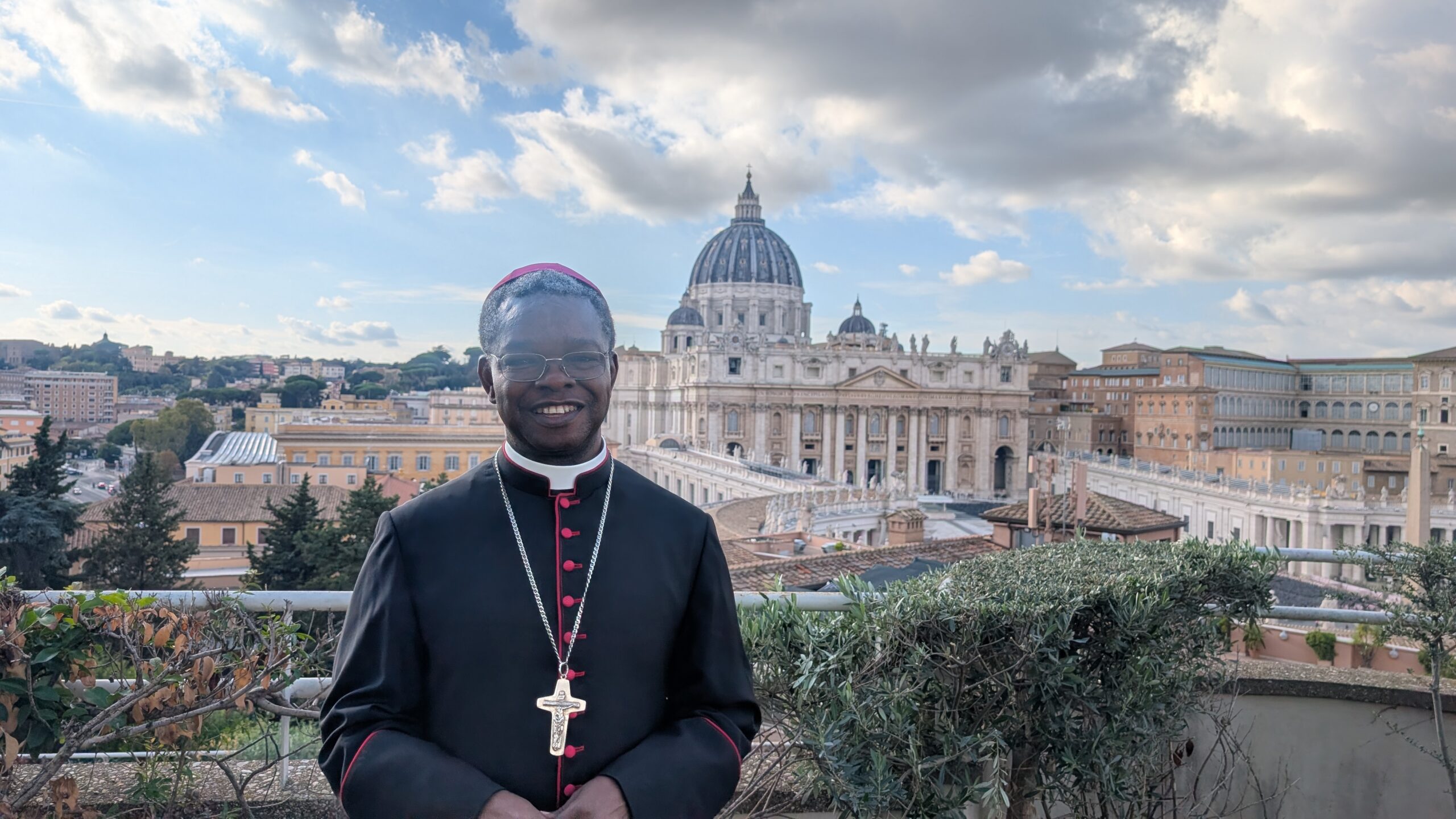
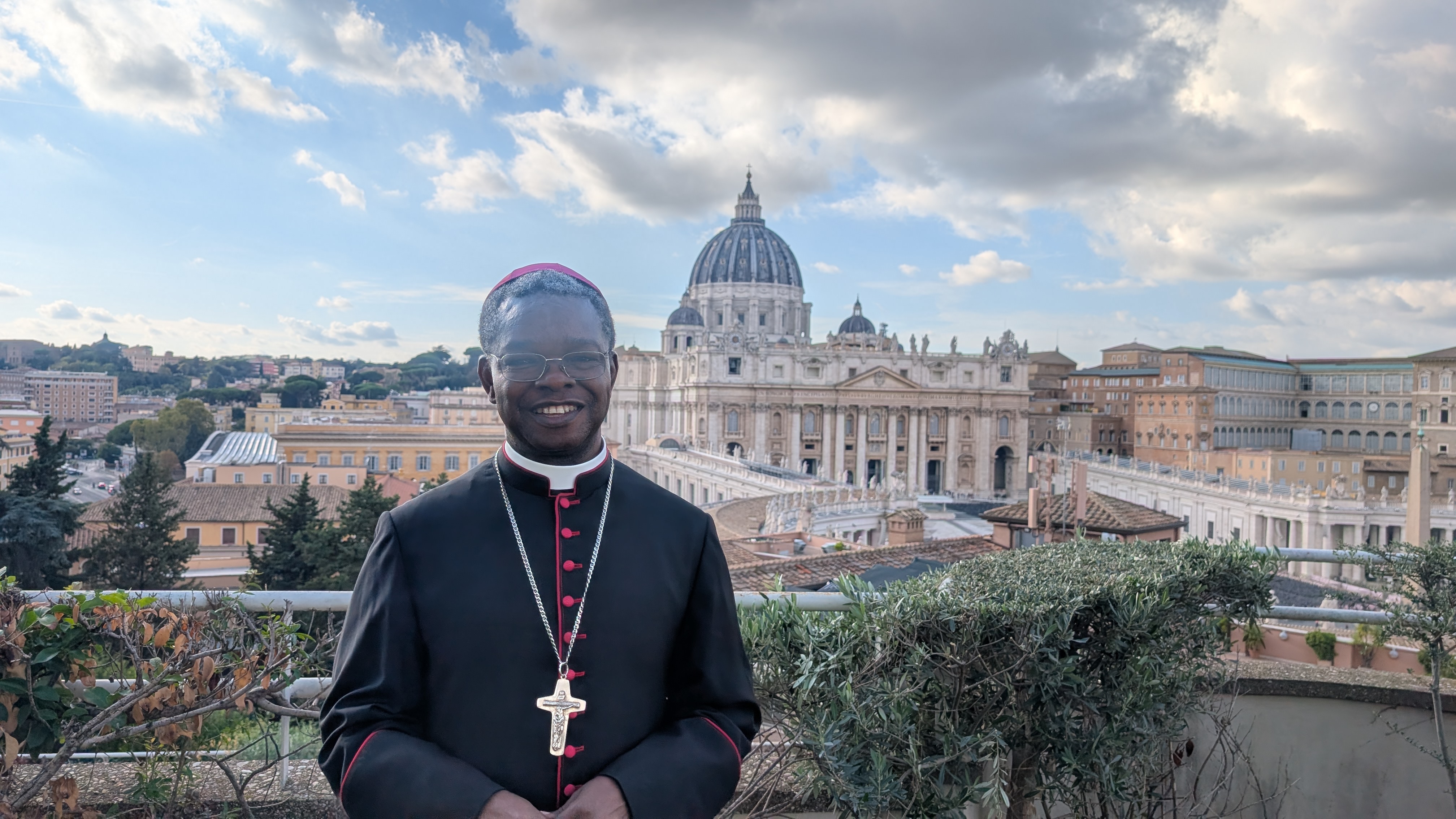
Archbishop Fortunatus Nwachukwu, who serves as a secretary at the Dicastery for Evangelization, urged a focus on the Word of God.
“I am always a bit wary about monetizing mission,” Nwachukwu said to EWTN News. “So, I do not want to begin with money; I want to begin with the Word, because mission is all about bringing the Word of the Lord to the ends of the earth.”
Archbishop Fortunatus Nwachukwu, secretary of the Section of First Evangelization at the Dicastery for Evangelization, participated in an international rosary at the Pontifical Urban University in Rome on Oct. 17, 2026, to mark the 100th anniversary of World Mission Sunday. | Credit: Ishmael Adibuah/EWTN News
At the same time, Nwachukwu indicated that supporting missionaries also means providing “the means to bring the Gospel to various places.” That support, he said, involves money.
“[Today] is also an occasion to tell people: please, be generous to missionaries,” Nwachukwu said.
Msgr. Thomas George Schluep, who also serves at the Dicastery for Evangelization, cited Pope Leo XIV’s message for World Mission Sunday as a reminder that unity in Christ precedes material support
“Pope Leo, in his message for this 100th Anniversary of World Mission Sunday, reminds us that we first must be one in Christ,” Schluep told EWTN News. “Our baptism calls us to be missionaries: to share that love with our families, our friends, our coworkers.”
Memories of missionaries, Pope Leo’s return from the hospital
Participants also shared personal anecdotes about missionaries and their impact on their faith journey.
Schluep shared his memory of Father Gerard Hammond, an American Maryknoll missionary priest known for his decades of humanitarian work in North and South Korea.
“I met him in Korea, where he had been serving since 1960 when he was ordained and sent on mission. He was celebrated by thousands of people in South Korea for bringing the faith to them over the course of 65 years,” Schluep said.
“In North Korea he could not speak of Christ, but his “apostolate of presence” and love for those suffering from tuberculosis was itself evangelization. He taught me a lot about the importance of being present to people, exactly where they are at in their lives, no matter the personal cost.”
Around the time the rosary was taking place, Pope Leo XIV returned to the Vatican after being hospitalized for surgery Oct. 13 at Rome’s Gemelli Hospital. Nwachukwu expressed happiness at his return and hoped that “the Lord will keep him quite long among us”.
“We are all praying for him. We love the Pope, and we love what he is doing.”
The contributions of Americans
Schluep, an American from Pittsburgh, Pennsylvania, also noted the significant contributions of Americans, such as Blessed Fulton Sheen, to missionary work through the Pontifical Mission Societies.
“The American contribution to the missions historically has been enormous,” Schluep noted.
“It was a great joy to see Fulton Sheen beatified, who did so much to evangelize the United States, but also who traveled personally to so many missions around the world and did so much to raise funds for those missions.”
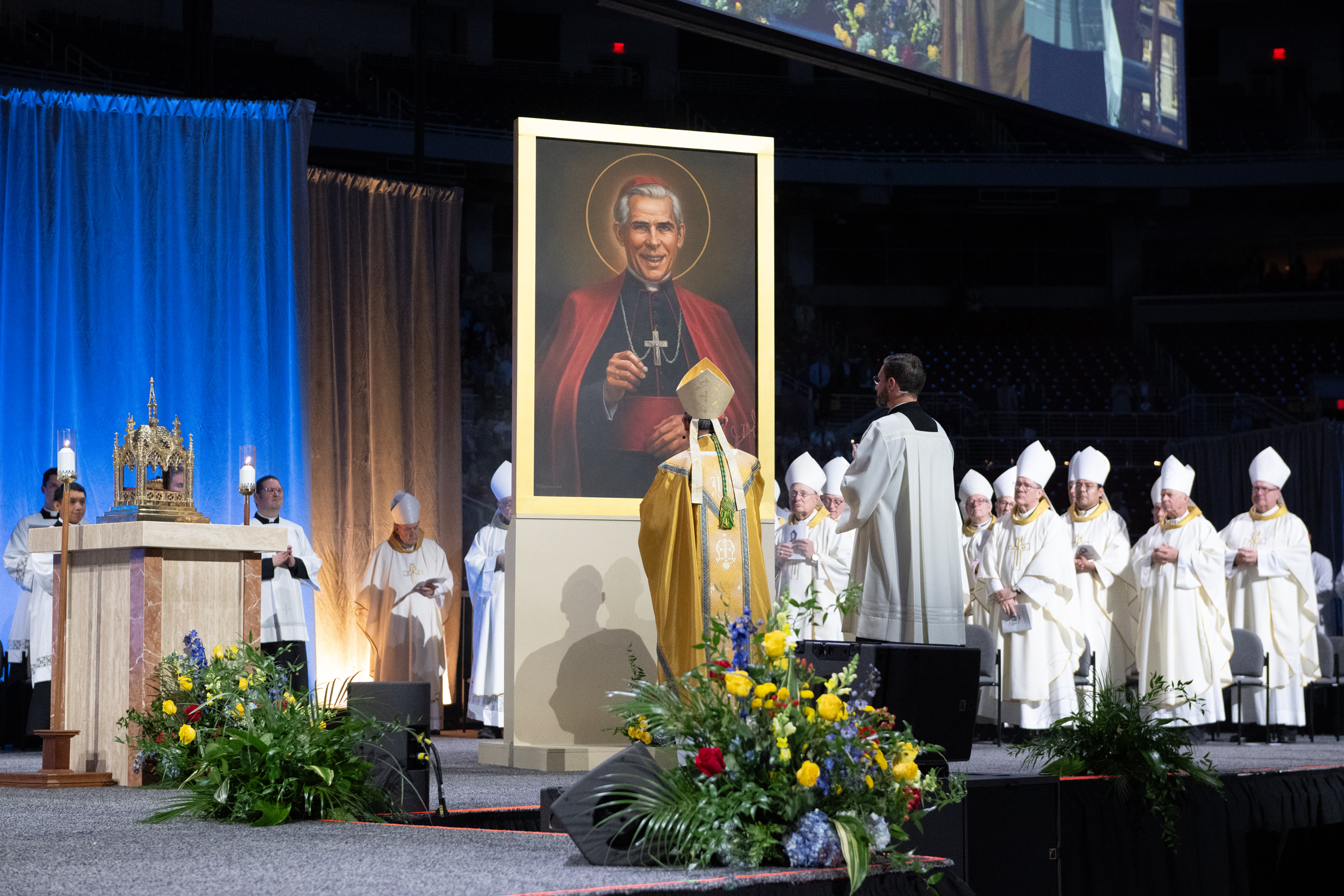
Cardinal Tagle stands before the image of Blessed Fulton Sheen during the beatification Mass in St. Louis on Sept. 24, 2026. | Credit: Jeffrey Bruno
Schluep said he hoped the example of Pope Leo XIV, the first U.S.-born pope, would encourage renewed American support.
“The fact that the Holy Father understands American culture and missionary life in Peru can help him in his particular guidance for us, but now he is the Pope of the entire world, and he calls us to think also of the entire world and not just our country, our families, and especially ourselves,” Schluep said.
The 71-year-old pope had been admitted last Tuesday and underwent surgery just hours later to remove the lower lobe of his right lung. The procedure, which lasted about an hour and a half, was performed using a video-assisted technique, while an intraoperative histological examination confirmed a diagnosis of pulmonary adenocarcinoma.
Pope Leo XIV concludes his stay at the Gemelli Hospital on Oct. 17, 2026. | Credit Vatican Media
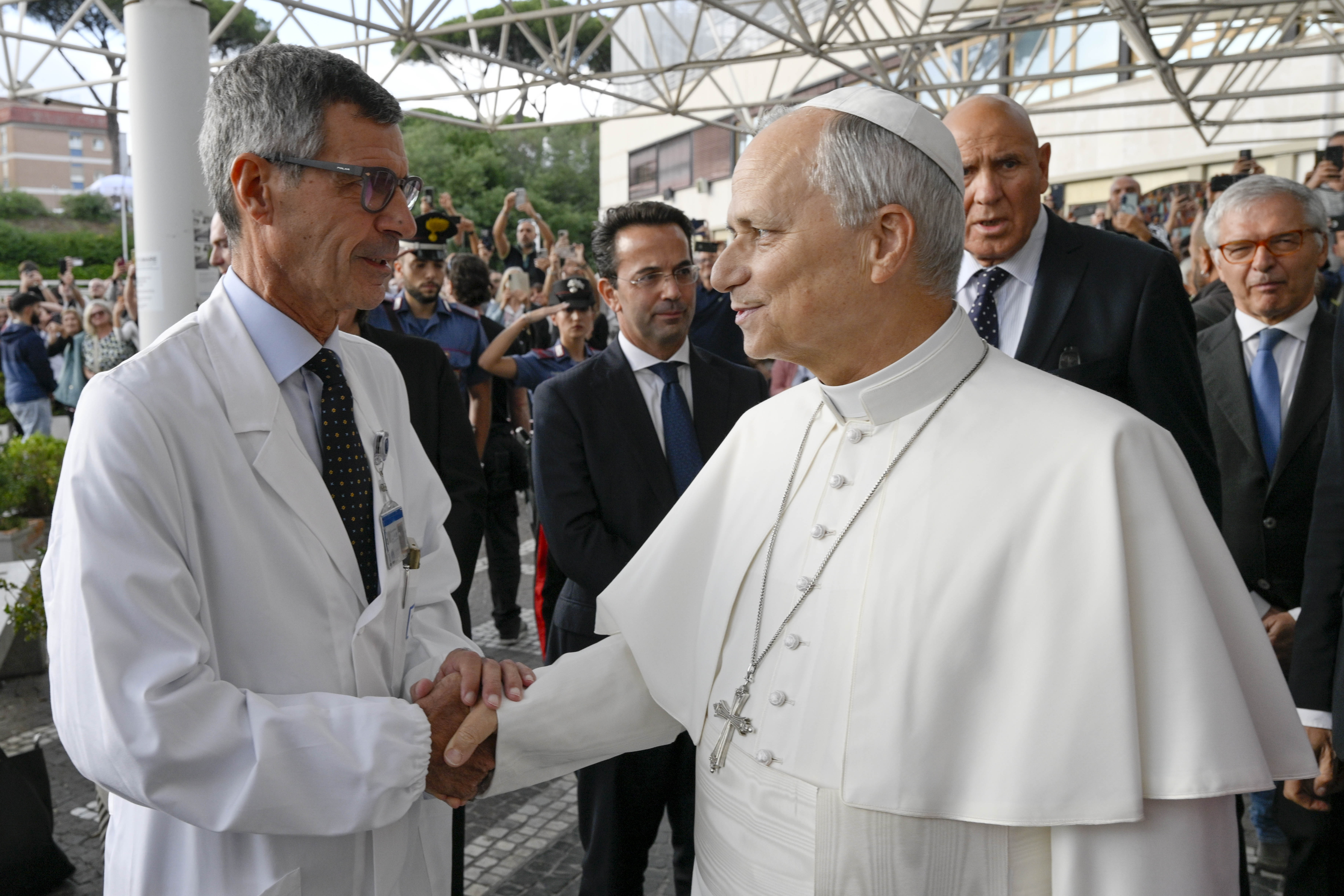
His discharge from the hospital was announced by the pontiff’s attending physician, Dr. Luigi Carbone, and the surgeon who performed the operation, Professor Stefano Margaritora.
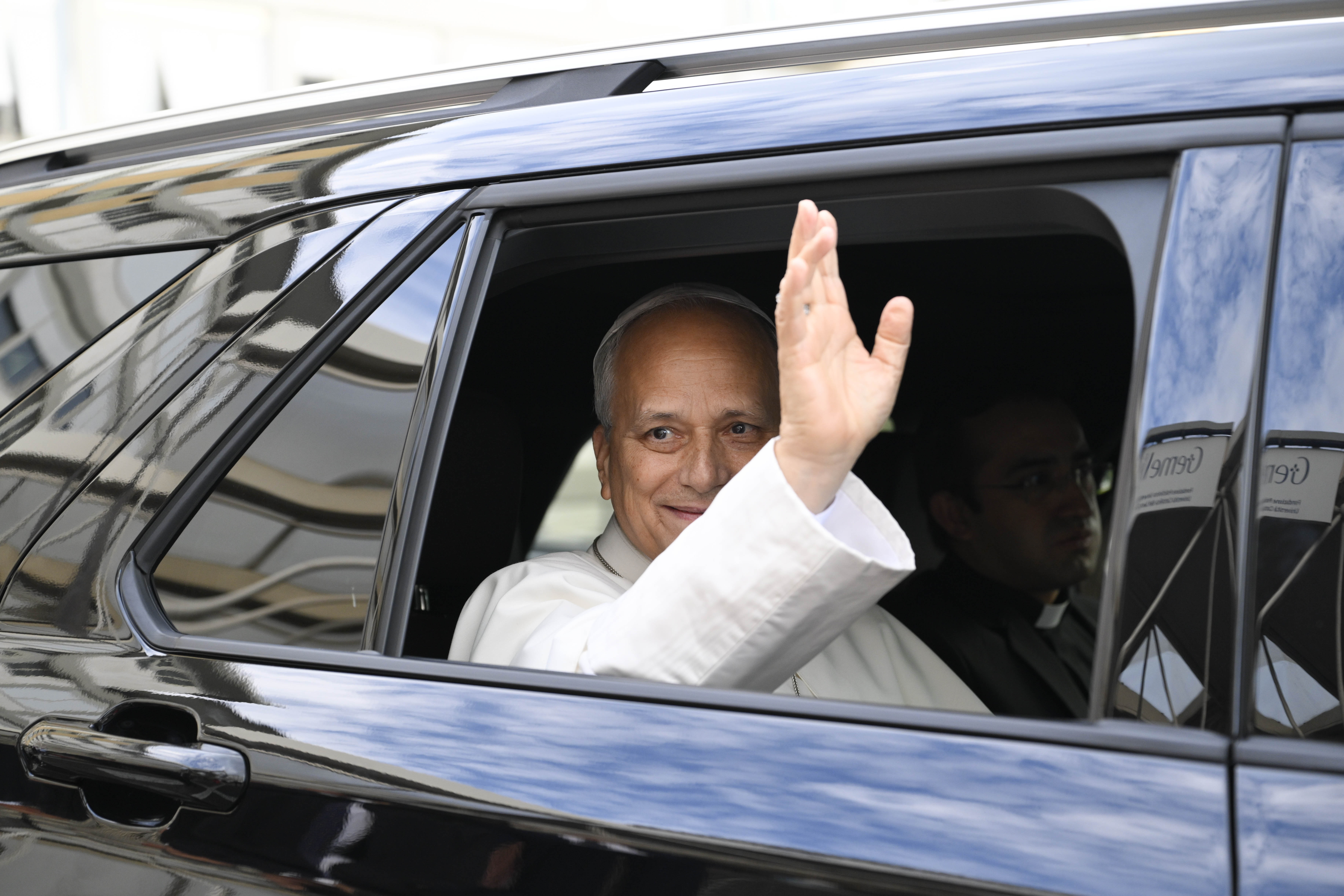
As he left, the pope greeted the faithful gathered along the barriers. Daniele Franco, chairman of the board of the Gemelli University Hospital Foundation, was also there to welcome the pontiff upon his exit.
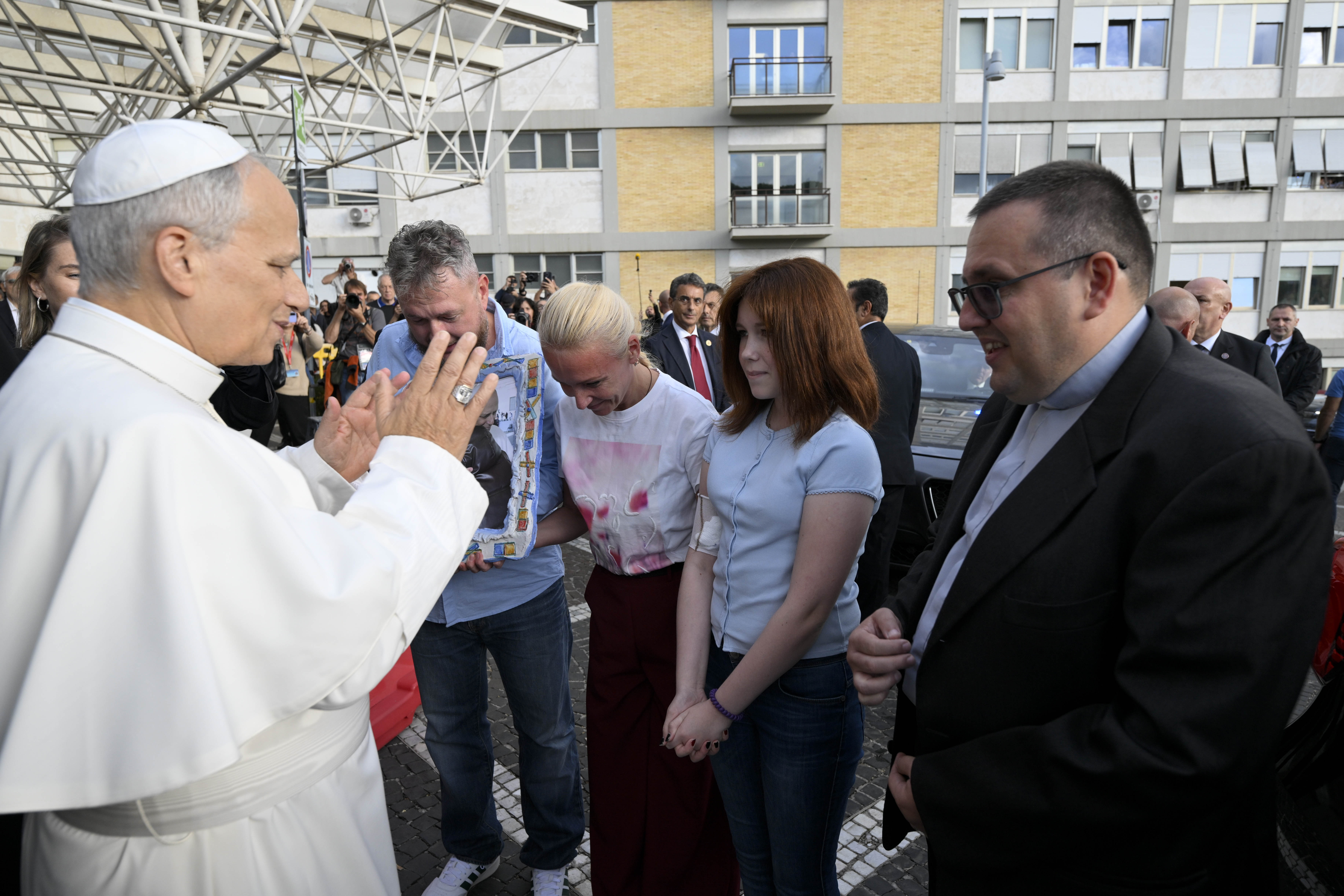
Before getting into the car, Leo greeted several members of the faithful who presented him with gifts. The pope did not stay in the papal suite on the hospitalʼs 10th floor, as it was undergoing renovation, but rather in adjacent rooms on the same floor.
Pope Leo XIV is seen here blessing a group outside Gemelli Hospital on Oct. 17, 2026. | Credit: Vatican Media
Yesterday, the first postoperative images of the pope were released, showing Leo XIV presiding over Mass in a room at the Policlinico hospital that had been specially set up for the celebration. Beside the pope was his personal secretary, Monsignor Edgard Iván Rimaycuna Inga.
Around noon on Saturday, Oct. 17, the pope also celebrated Mass before leaving the Roman hospital, the Holy See Press Office reported.
In the days following the surgery, Leo XIV has resumed his work, meeting at the hospital on various occasions with Archbishop Paolo Rudelli, substitute for general affairs of the Secretariat of State; Cardinal Luis Antonio Tagle, dean of the College of Cardinals; and Cardinal Baldassare Reina, vicar general of His Holiness for the Diocese of Rome.
On Friday, the press office also reported on a telephone conversation between the pope and Russian President Vladimir Putin.
Pope Leo XIV appears in good spirits as he departs Gemelli Hospital on Oct. 17, 2026. | Credit: Vatican Media
Sunday morning at noon, the pope will appear at the window of his study in the Apostolic Palace for the customary recitation of the Angelus. It was only last Sunday that Leo XIV himself, at the conclusion of the Angelus prayer, announced the news of his imminent hospitalization and the associated surgery.
This story was first published by ACI Stampa, the Italian-language sister service of EWTN News. It has been translated and adapted by EWTN News English.
Pope Leo XIV and Russian President Vladimir Putin spoke by telephone Oct. 16 while the pope remains hospitalized.
According to a Holy See statement, the pope expressed concern about Oleshky in the Kherson region, a city in the Russian-occupied portion of Ukraine where a severe humanitarian crisis is underway and where, according to the United Nations, 1,700 people are trapped in what have become ghost towns because of ongoing attacks. The pope sought a truce to enable the arrival of food and medical aid and the voluntary and safe evacuation of the population, and he reaffirmed the Holy Seeʼs commitment to dialogue and peace.
The conversation with the Russian president is the pope’s first reported direct communication with a head of state since undergoing lung cancer surgery Oct. 13. The statement issued by the Holy See Press Office was brief. It said: "Today, His Holiness Pope Leo XIV spoke by telephone with His Excellency Mr Vladimir Putin, President of the Russian Federation.”
Besides calling for a ceasefire, the statement concluded by reaffirming “the Holy See’s commitment to promoting dialogue and peace.”
A Kremlin statement was more detailed. It said that, while expressing his sincere wishes for the popeʼs health and speedy recovery following his recent surgery, Putin emphasized “the importance of Russian-Vatican cooperation in promoting shared spiritual and moral values and protecting Christians and Christian holy sites in various regions of the world.” Both sides reaffirmed their interest in continuing dialogue between the Russian Orthodox Church and the Roman Catholic Church.
The Kremlin also said that, during an exchange of views on Ukraine, “Vladimir Putin thanked the pope for his willingness to contribute to resolving the conflict and for his ongoing humanitarian efforts.”
In addition, the Kremlin stated that, in response to the popeʼs concern for civilians in the Russian-held city of Oleshky in the Kherson region, Putin provided what it described as a detailed explanation of the responsibility of the Kyiv government for the areaʼs humanitarian situation. It added that Putin supported the Vaticanʼs intention to help create the conditions necessary to ensure public safety and organize the delivery of essential supplies. According to the Kremlin, cooperation toward that goal was agreed upon.
The Kremlin described the conversation as “constructive and conducted in a spirit of mutual respect.”
Pope initiated call, Parolin says
Cardinal Pietro Parolin, the Vatican secretary of state, told reporters it was Pope Leo who initiated the Oct. 16 phone call with Putin, according to the SIR news agency of the Italian bishops' conference. Parolin said he hopes that, in response to the popeʼs request, Putin will agree to implement the humanitarian measures. He added that Putinʼs willingness to take the call could be a positive sign.
The call followed visits in August to Russia by Archbishop Paul Richard Gallagher and later by Cardinal Matteo Zuppi, the popeʼs envoy for humanitarian affairs.
A source familiar with the organization of the Oct. 16 meeting said the conversation had been planned during Zuppiʼs trip to Russia at the end of September. This date coincided with the popeʼs hospital stay.
Leo XIV had previously spoken with Putin by telephone on June 4, 2025. According to Vatican News, that conversation focused on matters of mutual interest, with particular attention given to the war in Ukraine and prospects for peace. During the call, the pope urged Russia to make “a gesture fostering peace” and stressed “the importance of dialogue in establishing positive contacts between the parties and seeking solutions to the conflict.”
Putin visited the Apostolic Palace in the Vatican three times for meetings with Pope Francis.
This story was first published by ACI Stampa, the Italian-language sister service of EWTN News. It has been translated and adapted by EWTN News English.
This story was updated at 4:10 p.m. ET on Oct. 16, 2026, to include comments from the Vatican secretary of state.
Vatican Secretary of State Cardinal Pietro Parolin said on Thursday that Pope Leo XIV, still hospitalized after surgery, may have to “adjust his pontificate” to his doctors’ advice, including his November trip to Latin America, if necessary.
Parolin, as reported by Ansa.it, spoke on the sidelines of the launch of the Iraqi Embassy to the Holy See in Rome, marking 60 years of diplomatic relations between the two sovereign states.
The pontiff was admitted to Rome’s Gemelli Hospital on Tuesday for surgery to remove a lung nodule. Since his surgery, his doctors and the Vatican have confirmed that his postoperative recovery “is progressing normally.”
Parolin, who praised the pope for his “great serenity” on Monday, told reporters on Thursday that he imagined Leo’s Latin America trip would proceed but that it now depends on his doctors.
“[The trip] will depend on how things go,” Parolin said. “Let us wait until he leaves the hospital and, based on what the doctors tell us, see whether he will be able to travel. We must wait.”
Parolin also said that while predictions for the future of Leo’s pontificate were premature, his condition upon returning may require him to adjust his papacy.
“Based on all these elements, the pope will also adjust his pontificate if it becomes necessary to do so,” Parolin said.
“We need to see when he returns, in what condition he returns, and what the doctors will say.”
The pope’s postoperative recovery is expected to last one week, allowing him to resume audiences on Oct. 20.
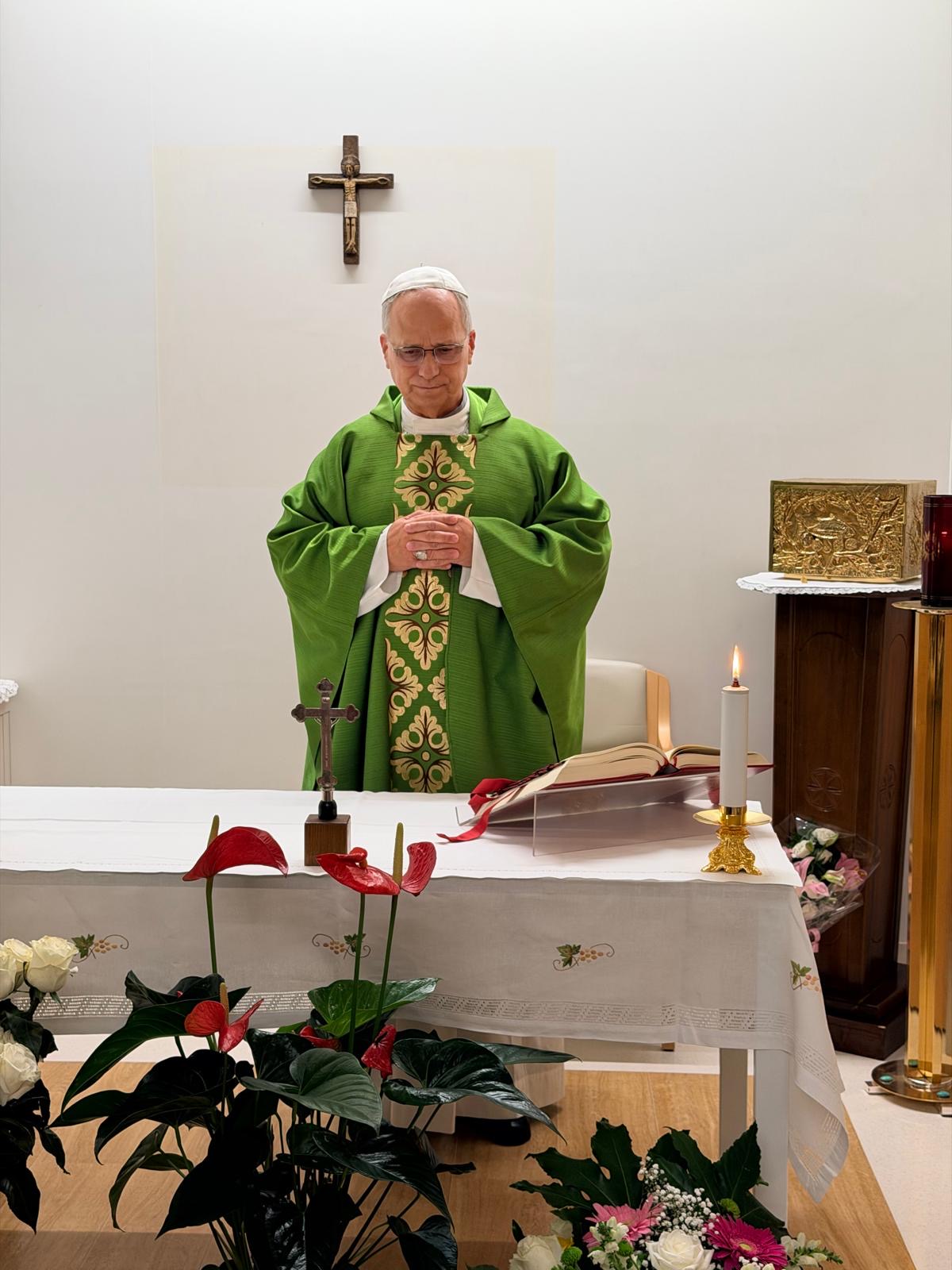
Pope Leo XIV celebrated Mass at Gemelli Hospital on Friday after undergoing surgery Oct. 13 for a cancerous tumor in his right lung.
In two photographs released by the Vatican, the first since his hospitalization, the Holy Father can be seen standing and wearing the green liturgical vestments used during this period of the liturgical year.
In one image, he appears with his hands joined in prayer; the other was taken during the consecration and shows the popeʼs secretary at his right side.
Vatican sources said that the pope distributed Communion during the Eucharistic celebration. In previous days, the Vatican had specified that the pontiff had only concelebrated Mass with his collaborators.
Members of the hospital’s medical and nursing staff, and gendarmes responsible for the pope’s security, were also present at the pope’s Mass on Friday.
“In his homily, the pope thanked all healthcare personnel — doctors, nurses and nursing assistants — for the work they carry out every day caring for the sick and for those in fragile conditions, and in particular for everything they have done and continue to do for him,” the statement released by the Holy See Press Office said.
In the medical bulletin released Friday, Oct. 16, the Vatican also confirmed that the pontiffʼs clinical condition continues to improve.
The statement published by the Holy See and prepared by the popeʼs personal physician, Luigi Carbone, and the surgeon who performed the operation, Stefano Margaritora, notes that the Holy Father “underwent blood tests and a chest X-ray, the results of which confirmed the steady improvement in his overall condition.”
Pope Leo XIV celebrates Mass at Gemelli Hospital on Oct. 16, 2026, where he was admitted four days prior for surgery to remove a tumor from his right lung. | Credit: Vatican Media
Respiratory physiotherapy sessions also continued. The doctors further specified that his “favorable postoperative recovery allows him to carry out his normal daily activities with complete autonomy.”
Vatican sources also indicated that the pope will publicly lead the Angelus on Sunday, although it has not yet been determined whether it will be from the hospital or the Vatican.
All appointments on Leo XIV’s schedule through Oct. 20 have been canceled, though the Vatican has not ruled out the possibility that he could be discharged before then. For now, doctors have not changed the timeline for his release from the hospital, which is expected to be next Tuesday.
Letters from children hospitalized at Gemelli
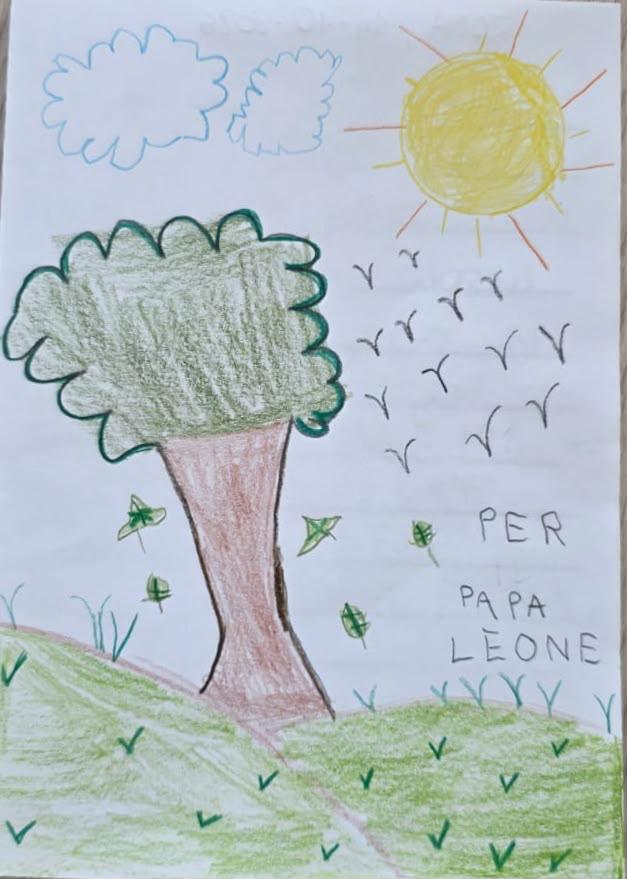
Children hospitalized in the oncology department of Gemelli Hospital send drawings and letters to Pope Leo XIV as he recovers from surgery to remove lung cancer on Oct. 16, 2026. | Credit: Gemelli Polyclinic Hospital
On Friday, the pope also received several letters in his hospital room from young patients receiving treatment in the pediatric oncology department of the same hospital. In them, the children share their personal experiences and assure him of their prayers.
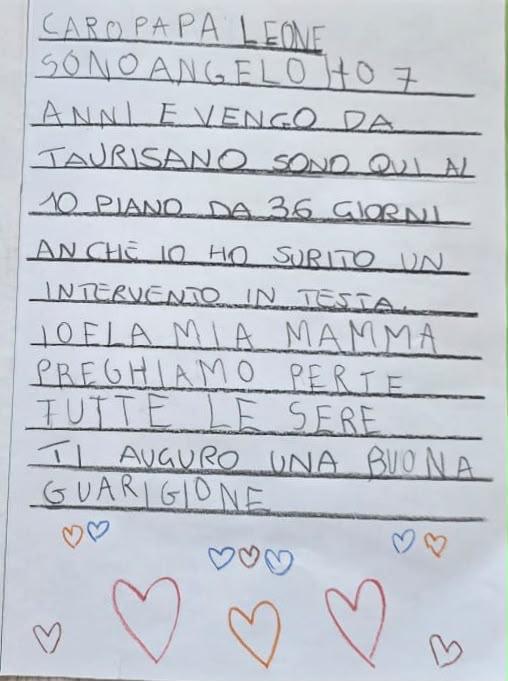
Among the letter writers was Angelo, a 7-year-old boy who has been hospitalized for 36 days and who found in writing a way to reach out to the pontiff.
The child, from Taurisano in the Italian province of Lecce, explained in his letter that he is also hospitalized on the 10th floor and has undergone head surgery. “My mom and I pray for you every night,” he wrote, before wishing him “a speedy recovery.” He included a drawing featuring a large yellow sun and several birds flying over a meadow.
‘Faith moves mountains’
Maria Graziela, the mother of Eleonora, also wanted to send a message of hope. Her daughter, who was treated in the hospitalʼs neurosurgery and oncology units, has now recovered.
“Faith moves mountains,” her mother wrote, expressing her conviction that “God has heard our prayers.” In her letter she added: “Pope Leo, our prayers are for you. May God, the Blessed Virgin Mary, and the guardian angels always protect you.”
One of the letters sent to Pope Leo XIV by children hospitalized in the oncology department of Gemelli Hospital on Oct. 16, 2026. | Credit: Gemelli Hospital
‘It is difficult to depend on others’
The letter from Giorgia, an 18-year-old young woman, explained how illness transformed her way of understanding life. Passionate about travel and accustomed to relying on herself, she acknowledged that “it has been difficult to go from depending solely on my own strength to having to depend on others.”
However, the experience had also allowed her to discover the value of the care she has received, the love of her family and friends, and a new vocation. “If there is one thing I want to do in life, it is save other peopleʼs lives. I want to be like the doctors who are saving mine,” she said.
She concluded her letter by promising that “I pray to God that we may both be healed, and I ask you to pray with me,” and expressing her confidence that “better days will come.” The young woman ended by assuring Pope Leo that “we are united in prayer, for ourselves and for all those who are going through the same situation.”
This story was first published by EWTN News Español, the Spanish-language sister service of EWTN News. It has been translated and adapted by EWTN News English.
Pope Leo XIV on Friday called world hunger a “terrible offense” against human dignity and emphasized that adequate food is a basic human right.
“It is a terrible offense against human dignity to prevent bread from reaching any person or to destroy the means by which it is produced,” the pontiff wrote in a message published for World Food Day.
Still recovering from surgery at Rome’s Gemelli Hospital, Leo addressed his message to Qu Dongyu, director general of the Food and Agriculture Organization of the United Nations (FAO). World Food Day, celebrated every year on Oct. 16 to highlight world hunger, also marks the organization’s founding in 1945.
‘World hunger remains due to lack of charity’
In his message, Leo lamented the challenge of world hunger and questioned how some can speak of technological innovation while food shortages persist.
“Hunger cannot be considered a statistical anomaly, for it is caused mainly by a lack of political will and collective charity,” Leo said.
“Today, people speak of innovation with great confidence,” Leo said. “However, this term is often used only in reference to the development of devices and algorithms, or the optimization of performance merely for the sake of financial gain.”
A new global food order
According to FAO’s annual report for 2025, an estimated 645 million people worldwide experienced hunger, mainly distributed across Africa, Asia, Latin America, and the Caribbean. According to the same report, 35.5 million children were severely malnourished, and war remained the “primary driver of acute food insecurity and malnutrition.”
Leo also said that food shortages should never be “used as a weapon of war” and encouraged the United Nations to work toward a “new global food order” in which technology ensures food for all.
“Regular access to safe, adequate and sufficient food, in keeping with the dignity of every person, is a basic human right,” the pope wrote.
“A new global food order is essential — one in which technological innovation is unconditionally subordinated to respect for God-given human dignity and the universal common good.”
The pope’s remarks on world hunger follow his June visit to the headquarters of the World Food Programme in Rome, where he emphasized the need to focus on humanity to combat hunger worldwide.
Father Ignatius Ding Zuyao was consecrated on Thursday, Oct. 15, as bishop of Haimen in eastern China, a diocese that had lacked a bishop for more than three years.
Zuyao is the ninth Chinese bishop consecrated under Pope Leo XIV following procedures established by the provisional agreement between China and the Holy See governing bishop appointments. The pontiff appointed Zuyao bishop of Haimen on Aug. 24, having approved his candidacy under the agreement.
Zuyao’s consecration, announced by the Vatican on Thursday, also highlights a pattern in which the Vatican does not announce episcopal consecrations in China until the day they occur. He is also the 19th bishop to be selected under the Vatican-China deal.
However, some of the Chinese bishops Leo appointed were not immediately recognized by the Chinese government. Two of the bishops had already been consecrated and were part of the so-called underground Church — the Catholic community not officially recognized by Chinese authorities. The communist government later recognized both, thereby regularizing their ecclesiastical and civil status.
A decade of pastoral work
Zuyao was born in August 1986 in Qidong, Jiangsu Province, and was ordained to the priesthood on Oct. 27, 2011.
From 2001-2004, he studied at the Jiangsu Section of the Sheshan Seminary in Shanghai. He later attended Beijing Theological Seminary to study theology and philosophy and earned a bachelor’s degree.
After Zuyao’s ordination in 2011, he served as pastor in Haimenzhen, Linjiang, and Caojiazhen, all in the Diocese of Haimen. From 2023, he served as pastor of Qingnian Donglu Parish in Nantong until his appointment as a bishop.