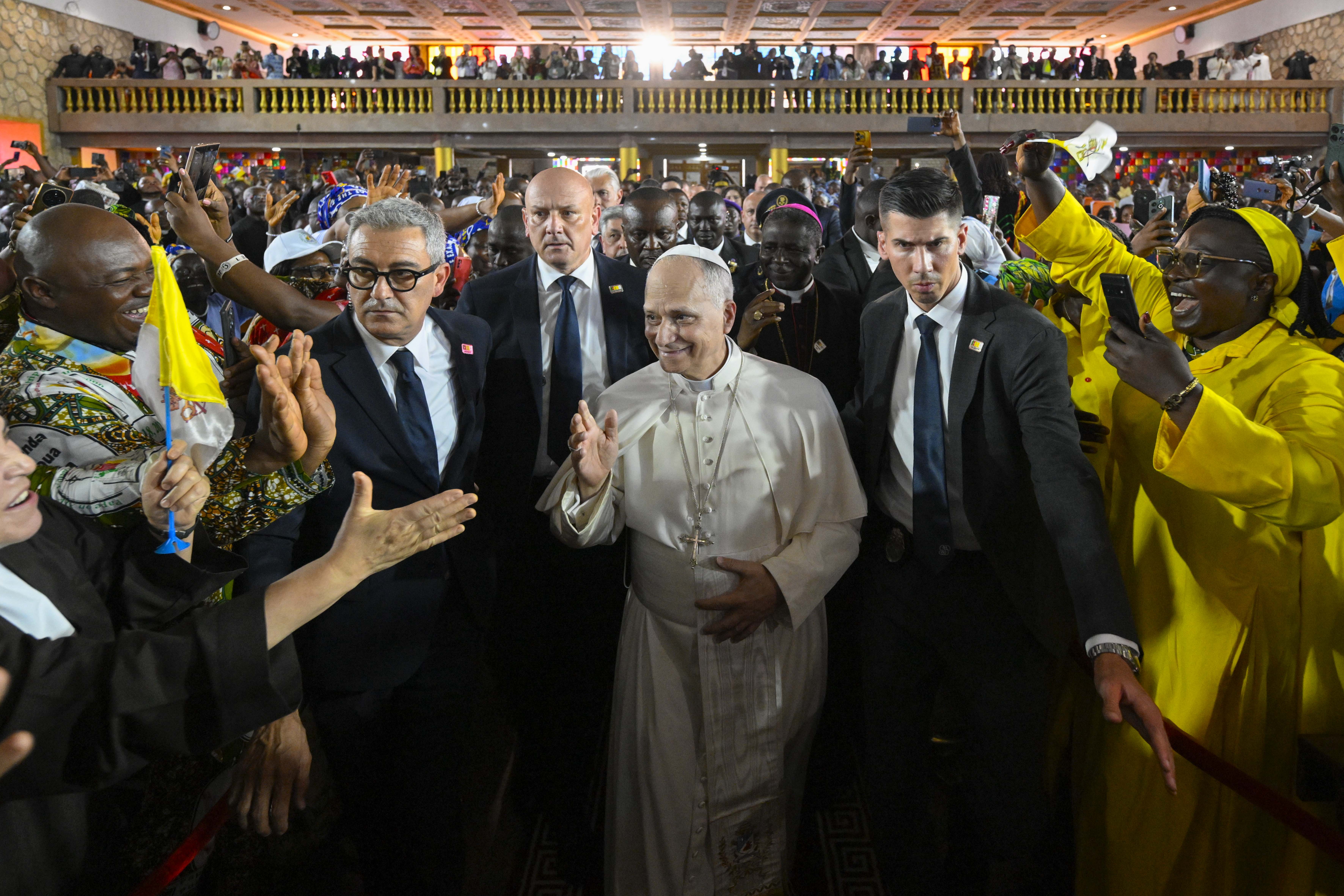
Archbishop Paul Coakley is celebrating the appointment of Archbishop Gabriele Giordano Caccia as papal nuncio to the U.S.
“It is with joy that I welcome the news that our Holy Father, Pope Leo XIV, has appointed as his personal representative and nuncio to the United States, Archbishop Caccia,” he said in a March 7 statement. “On behalf of my brother bishops, I wish to extend our warmest welcome and our prayerful support to him as he carries out his responsibilities across the United States, and we look forward to working with him.”
Caccia has served as the Holy See’s permanent observer at the United Nations in New York since 2019. The Italian diplomat previously served as nuncio, the pope’s diplomatic representative, to Lebanon and the Philippines.
Caccia was born in Milan, Italy, in February 1958 and ordained a priest in 1983. He joined the Diplomatic Service of the Holy See in 1991 and served his first post at the apostolic nunciature in Tanzania.
He was appointed apostolic nuncio to Lebanon and titular archbishop of Sepino in 2009 and later as apostolic nuncio to the Philippines by Pope Francis in 2017.
Coakley also expressed his “sincere and prayerful appreciation” to Caccia’s predecessor, Cardinal Christophe Pierre, who retired after turning 80 in January.
“I have had many opportunities to work with Cardinal Pierre over the years, particularly over the last four months through the U.S. Conference of Catholic Bishops,” he said. “Thank you, Your Eminence, for your tireless service to the Church in the United States, and on behalf of my brother bishops, I offer our heartfelt prayers and best wishes in your retirement.”
The French-born Pierre served as apostolic nuncio to the U.S. for nearly 10 years — spanning three U.S. presidential terms and two pontificates. Pierre’s retirement marks the end of an ecclesiastical diplomatic career that began in 1977 with his first role in New Zealand and included stints in Mozambique, Zimbabwe, Cuba, Brazil, and the United Nations in Geneva.
The CEO of Ford Motor Co. gifted Pope Leo XIV a custom-made 2026 Ford Explorer Platinum hybrid embellished with small tributes to both Chicago and the Vatican.
“Pope Leo XIV has deep roots on Chicago’s South Side — just like Ford,” Jim Farley, CEO of Ford, said in a statement shared with EWTN News. “And we thought it would be especially fitting for him to drive an Explorer built at our Chicago Assembly Plant, which has been in continuous operation for more than a century.”
After Farley and his wife, Lia, decided to launch the project for the Chicago-born pope, Ford, one of the largest American car companies, reached out to the Vatican before putting together a team to create the one-of-a-kind vehicle for the first American pontiff.
“Lia and I made the donation personally, but it only became possible because a group of Ford employees helped bring this special vehicle to life,” he said.
The car features many nods to both Chicago and the Vatican. The scuff plates feature engravings of the Chicago skyline and St. Peter’s Basilica to represent Pope Leo’s journey to the Vatican.
The seat tags are also designed as Chicago flags, and the car’s license plates read “DA POPE” and “LEO XIV.”
Center console of the custom Ford Explorer built for Pope Leo XIV embroidered with the Chicago skyline. | Credit: Photo courtesy of Ford
Employees were told they were building a vehicle for “a VIP,” but because of confidentiality, they didn’t originally know it was for the pope. Many only learned recently they helped build a car that is being driven on Vatican grounds.
“As soon as I could, I told my family,” Jennifer Barilovich, lead electrical systems integration engineer for the project, said in a statement shared with EWTN News. “I come from a huge Catholic family, so everyone was thrilled and just thought it was the coolest project.”
Adolphus Harper, a pre-delivery specialist for Ford, said: “I graduated from St. Rita in 1986, so knowing that the pope who once taught me is now driving something I helped assemble — it’s unbelievable.”
“Knowing a vehicle built herein Chicago is going to the pope, it’s hard not to feel proud. As someone with deep faith, it feels like an even greater honor,” said Danny Golubovic, a pre-delivery specialist.
Engravings of Chicago’s skyline and St. Peter’s Basilica appear on the scuff plates of the custom Ford Explorer built for Pope Leo XIV. | Credit: Photo courtesy of Ford
“After 30 years at Chicago Assembly, the pride never fades,” said Valerie Hernandez, a pre-delivery specialist for Ford. “Knowing that something we built is out there being enjoyed by the pope makes me incredibly proud. It’s a privilege to be part of something bigger than yourself.”
From the Chicago Assembly Plant to the Chicago-born pope
The car was gifted to Pope Leo in person by Farley and his wife on Feb. 28 during a private audience at the Vatican.
“He noticed and appreciated all the personal touches,” Farley said. “We even took a quick drive, and I can confirm the Holy Father enjoys driving a sporty ride.”
“But more than anything, what stays with me is the feeling of gratitude and joy we experienced meeting him and sharing this small gesture,” he said.
Letter from Jennifer Barilovich delivered to Pope Leo XIV. |Credit: Photo courtesy of Ford
The team also gave Pope Leo some other personal gifts including a picture of the Chicago Assembly Plant team, handwritten letters from employees, and a pizza box from Chicago’s Aurelio’s Pizza restaurant.
“I wrote a letter to the pope to tell him how much it meant to me,” Barilovich said. “I hope my letter gave the pope a sense of how proud I am. This is the highlight of my professional life so far.”
Pope Leo XIV has expressed his sorrow over the death of a priest in southern Lebanon, a victim of an Israeli bombing on Monday, March 9.
“Pope Leo XIV expresses his profound sorrow for all the victims of the bombings in the Middle East these past few days, for the many innocent people, including numerous children, and for those who were helping them, such as Father Pierre El-Rahi, a Maronite priest killed this afternoon in Qlayaa,” reads a statement released by the Holy See Press Office.
The pope, the Vatican message added, “is following the events with concern and prays for a swift end to all hostilities.”
El Raii, a Maronite parish priest in southern Lebanon, was killed in a bombing while going to the aid of a parishioner wounded in a earlier attack, according to Father Toufic Bou Merhi, a Franciscan of the Custody of the Holy Land, who spoke with Vatican media.
The pontifical foundation Aid to the Church in Need (ACN) confirmed the tragic news.
“Deeply disturbing reports indicate that a parish priest in southern Lebanon was killed in an Israeli attack. Father Pierre Al Rahi was ministering to his grieving parishioners in the village of Qlayaa when it was attacked,” the organization said in a statement.
The French Catholic organization L’Œuvre d’Orient (The Work of the Orient) strongly condemned the attack and warned of the growing risk to the civilian population.
“L’Œuvre d’Orient condemns in the strongest terms these acts of war, which aim to destabilize all of Lebanon and kill innocent civilians. The death of a priest who refused to abandon his parish is a further escalation of senseless violence,” it said.
The attack occurred around 2 p.m. local Beirut time, exactly one week after the start of the intensification of Israeli bombing in the south of the country.
“There was an initial attack that hit a house near his parish, wounding one of the parishioners. Father Pierre rushed to his aid with dozens of young people. It was then that another bombing occurred at the same house. The priest was wounded,” recounted Bou Merhi, parish priest of the Latin communities of Tiro and Deirmimas.
The priest was taken to a local hospital but died shortly afterward.
El Raii was 50 years old and considered a leading figure for the Christians in the area. According to the Lebanese National News Agency (NNA), armed militants had entered the Qlayaa-Marjayoun area, as well as the nearby villages of Rmeish, Debel, and Ain Ebel, endangering previously safe communities.
Grief and fear in Christian community
The priest’s death has deeply affected the local Catholic community, which was already living under increasing pressure from the conflict.
“They are weeping over the tragedy and, at the same time, are very afraid. Until now, people didn’t want to leave their homes in Christian villages, but in this situation, everything has changed,” Bou Merhi said.
The priest explained that for many, leaving their homes practically means “living on the street or trying to rent a house, but people can’t afford it.”
Humanitarian crisis: Thousands of displaced persons
The conflict has also caused a serious humanitarian crisis. Bou Merhi reported that the Franciscan convent in Tyre is currently sheltering some 200 displaced people, all of them Muslims.
“We are taking them in. Where else can those in need find refuge in this situation?” he asked.
He explained that in Beirut alone there are nearly 500,000 displaced people, while almost 300,000 have fled the south of the country and thousands more have left the Bekaa Valley.
“People know what they are leaving behind: their homes, their belongings, their history. But they don’t know where to go. Many are sleeping in their cars or on the streets. We were not prepared to take in almost a quarter of the population,” he said.
Despite the circumstances, the Franciscan friar affirmed that the Christian communities are striving to maintain hope. “We say, and we repeat, that the last thing that must not die within us is hope in the Lord, who always gives us the strength to continue,” he stated.
“As the pope has said, weapons do not bring peace; they bring massacres and hatred. All we ask is to live with a little dignity,” he concluded.
Walter Sánchez Silva and Victoria Cardiel contributed to this report.
This story was first published by ACI Prensa, the Spanish-language sister service of EWTN News. It has been translated and adapted by EWTN News English.
A March NBC poll found that U.S. voters hold Pope Leo XIV in highest esteem among other public personalities.
The NBC News Survey by Hart Research Associates/Public Opinion Strategies surveyed 1,000 registered voters about public figures and various topics, including the first U.S. pope.
When asked how they felt about Leo, 42% of respondents were “very positive” or “somewhat positive,” while 8% felt “somewhat negative” or “very negative.”
With a favorability rating that outpaced unfavorability by 34 points, Leo ranked ahead of other U.S. figures including comedian Stephen Colbert, Secretary of State Marco Rubio, Vice President JD Vance, Rep. Alexandria Ocasio-Cortez of New York, President Donald Trump, former Vice President Kamala Harris, and California Gov. Gavin Newsom (listed in order of their net rating).
Leo’s total positive score beat out Trump’s by 1 percentage point and JD Vance’s by 4 percentage points. The American pope’s total negative score was markedly lower than that of other U.S. public figures as the only one in the single digits. Colbert was the only other public figure who had a net-positive rating.
The margin of sampling error for the full sample of 1,000 respondents is plus or minus 3.10 percentage points.
Comparison with previous popes
In comparison with previous popes in similar polls, Leo’s total positive rating is somewhere in between. Pope Francis peaked at a 57% approval rating in December 2013, according to NBC. Pope Benedict XVI had a 30% positive rating in February 2013, while Pope John Paul II’s favorability in January 1998 hit 65%.
Born on the South Side of Chicago, Leo is the first pope to hold U.S. citizenship as well as the first to hold Peruvian citizenship and the first Augustinian pope. Following Pope Francis, he is the second pope from the Americas.
In the context of International Women’s Day, celebrated March 8, Pope Leo XIV responded to a letter from a reader of Piazza San Pietro magazine who asked what can be done about femicides, and the pope shared that violence against women causes him “great suffering.”
Femicide is defined as a man killing a girl or a woman for the very reason that she is female.
Pope Leo replied to a woman named Giovanna, who said she is “fortunate” to be married to a man who loves and respects her. The letter appeared in the latest issue of the publication, which this March is dedicated to women.
In her letter, the woman confessed to having “tears in her eyes” because of the “death trap” that married life becomes when a man kills a woman due to a “culture of possession.”
Giovanna then proposed an alliance between the Catholic Church and schools to educate young people in love and respect. “Who else, if not schools and the Church, can help new generations by spreading a culture of respect, love, and above all, freedom?” she asked.
Pope Leo XIV’s response to violence against women
“You raise a major issue that for me is always a source of great suffering: violence in relationships, and in particular violence against women,” the Holy Father responded to Giovanna.
“In a world often dominated by violent thinking, we must further support the feminine genius, as St. John Paul II said, the ‘genius of women,’ protagonists and creators of a culture of care and fraternity indispensable for giving a future and dignity to all humanity,” he emphasized.
Leo XIV added that “perhaps this is also why women are beaten and murdered, because they are a sign of contradiction in this confused, uncertain, and violent society, because they point to values of faith, freedom, equality, generativity, hope, solidarity, and justice.”
“These are great values, which are nevertheless attacked by a dangerous mentality that infests relationships and only produces selfishness, prejudice, discrimination, and a will to dominate,” he added.
After recalling that he had already denounced the violence of femicides in June 2025, the pope stressed that “violence, any violence, is the boundary that separates civilization from barbarism.”
Leo XIV then advised that “we must never underestimate an act of violence and we must not be afraid to denounce violence, including that climate of justification or that downplays or denies responsibility.”
“Walking together in mutual respect for our humanity is not a dream, but the only possible reality for building a world of light for all.”
A task for the Church
The pope thanked Giovanna for her suggestions for an “ever stronger educational alliance” and stated that “the Church, together with families, schools, parishes, movements and associations, religious congregations, and public institutions, can share the urgency of carrying out specific projects to prevent and stop violence against women.”
The pope also recalled that on Nov. 25, 2025, the International Day for the Elimination of Violence Against Women, he emphasized that “to stop violence, we must begin with the education of young people.”
“We must begin by opening everyone’s hearts to the fact that every person is a human being who deserves respect, that dignity for men and women, for everyone.”
This story was first published by ACI Prensa, the Spanish-language sister service of EWTN News. It has been translated and adapted by EWTN News English.
LAHORE, Pakistan — White bedsheets for Muslim worshippers were laid on the grassy lawn outside the Dominican Peace Center in Punjab an hour before the annual interfaith iftar — the fast-breaking meal during Ramadan.
The aroma of crispy pakoras (fritters), dried dates, rose-flavored Rooh Afza, and dahi bhallay (lentil dumplings in yogurt) drew guests to the dining tables after they finished reciting their iftar prayers in Lahore, the provincial capital.
Dominican Father James Channan, director of the center, has hosted such interfaith gatherings for 25 years in a country where religious tensions have periodically turned violent.
Dominican Father James Channan speaks at a combined International Women’s Day and interfaith iftar program at the Dominican Peace Center in Lahore, Pakistan, on March 8, 2026. | Credit: Kamran Chaudhry
“Table friendships are very important in our context. People attending such forums highlight them on social media, reaching millions,” he told EWTN News at the sidelines of the program, timed with International Women’s Day on March 8.
“The combined meals and prayer services have helped curb trends of church attacks that followed U.S. wars in Muslim countries.”
Pakistani Christians have faced multiple terrorist attacks since October 2001, after the United States — seen by many Pakistani Muslims as a Christian nation — launched its military campaign in Afghanistan.
“It’s a bitter past. Churches and Christian settlements were considered soft targets. The ongoing conflicts are not crusades; they are wars of interest,” Channan said.
Interfaith meals continue despite unrest
Interfaith gatherings continued this year even as protests against U.S. and Israeli strikes on Iran left 26 dead in Pakistan.
Church leaders joined clerics in prayers for peace and shared meals at mosques, church premises, and hotels across six dioceses and one apostolic vicariate, as Middle East air travel disruption and rising fuel prices added regional tension.
Many Pakistanis view the United States and Western Europe as Christian nations, and some militant groups target local Christians as linked to these “Christian countries.”
Communal tensions have also erupted locally. In May 2024, a mob attacked 74-year-old Christian Nazir Masih over alleged blasphemy in Sargodha. He later died of his injuries. In August 2023, violence in Jaranwala destroyed 26 churches and 80 Christian homes following allegations of Quran desecration.
In a Feb. 17 message, Archbishop Joseph Arshad of Rawalpindi-Islamabad invited Christians and Muslims to offer special prayers for peace as Lent and Ramadan coincided this year. He encouraged people of both faiths “to visit one another, exchange greetings with respect, and unite in serving vulnerable segments of society.”
Joint events across Pakistan
In Multan, over 82 participants attended a Feb. 28 iftar jointly organized by the Catholic Commission for Inter-Religious Dialogue and Ecumenism; Saiban-e-Pakistan, a state peace initiative; and the Centre of Excellence on Countering Violent Extremism.
A day earlier in Lahore, Channan and four Catholic priests attended the fast-breaking event at the Badshahi Mosque, the country’s second-largest mosque. He presented a framed photo of Abdul Khabeer Azad, the mosque’s “khateeb” (prayer leader), who met Pope Leo XIV in October 2025 at the “Christian-Muslim Dialogue and Daring Peace” conference in Rome organized by the Community of Sant’Egidio.
Guests share the interfaith iftar meal at the Dominican Peace Center in Lahore on March 8, 2026. | Credit: Kamran Chaudhry
Among 120 guests at the Dominican iftar was Muslim speaker Shehzad Qaiser. The event, held in collaboration with groups including the Seventh-day Adventist Church, highlighted ongoing social challenges.
The head of external affairs at Sundas Foundation, which supports patients with blood disorders, agreed that Christians face discrimination in some offices and some Muslims refuse the food prepared by Christians.
“It is very important to share our common practices, joys, and sorrows. Religious leaders have the duty to raise awareness. Sadly some mistake local Christians as ‘kafir’ (infidels),” Qaiser said.
“During Ramadan, people distribute free meals to everyone without asking their religion. Blood donors don’t discriminate either. This is the real spirit of Ramadan and Lent.”
“The Chosen” and “House of David” were among the many winners at the 33rd annual Movieguide Awards, which aired March 5.
The annual Movieguide Awards celebrates TV shows and movies that, according to its website, “reflect Christian values, biblical truth, and messages of redemption, hope, and faith” and “stories that uplift families, strengthen believers, and point hearts toward Christ.”
“House of David” and the star of the show, Michael Iskander, took two awards home. The new hit series won the Faith and Freedom Award for Television — which honors programs that “celebrate independence, faith in midst of oppression, individual dignity, and freedom” — for its Season 2 episode titled “The Truth Revealed.”
Jon Erwin, creator, writer, and producer of the series, said in his acceptance speech that being at the awards show reminded him of Psalm 34: “Magnify the Lord with me, and let us exalt his name together.”
“This really does feel like something that we’re all doing together and have been doing it for a long time,” he said to the faith-based creators in attendance. “I do feel like there’s something in the air in L.A.”
He explained that the show uses an old sound stage in Culver City, California, that was first used for Cecil B. DeMille’s — the filmmaker best known for “The Ten Commandments” — 1927 movie “King of Kings.”
“So, I feel like there’s a bit of a reclaiming of ground going on in our industry and I think we’re back in a big way,” Erwin said.
Iskander, who portrays King David in the series, won the Grace Award for Television for an actor, which is given to an actor whose performance is exceptional and “best contribute to the world’s understanding of God’s love.”
Michael Iskander, the actor who portrays King David in “House of David,” gives his acceptance speech for winning the Grace Award for Television for an actor at the 33rd annual Movieguide Awards on March 5, 2026. | Credit: Movieguide®/Chris Schmitt
In his acceptance speech, Iskander thanked his family, especially his mother, “for sticking by my side … but most importantly I want to thank God, who’s been my anchor and my sail and my light in the darkness. He’s been everything to me and I owe it all to him. He’s brought me out of so much and wherever he takes me, I want to go.”
He added: “I’ve been thinking a lot about why David is being highlighted so much in today’s culture. David is a guide for us and he shows us that no matter how far away we may stray from Christ, he is going around and looking for us and he’s calling us by name and all we have to do is just say ‘yes.’ All we have to do is just listen to his voice and say, ‘Yes Lord, I will follow you.’ So, I want you to know that God doesn’t see how weak or small you may look or how grand or strong you may look; he sees into your heart.”
“The Chosen: Last Supper — Part 2” was awarded the Epiphany Award for Inspiring Movies, which recognizes a movie that is “both inspirational and redemptive and can lead us to a closer and personal relationship with a kind, loving, and forgiving God.” Despite being a TV show, “The Chosen: Last Supper — Part 2” was released in theaters as a cinematic event.
Other winners included “Light of the World,” which won for Best Movie for Children; “BAU: Artist at War,” which tells the true story of an artist who survives a World War II concentration camp, won the Faith and Freedom Award for Movies; and “Sarah’s Oil” took home the award for Best Movie for Mature Audiences, among several others.
CHATTOGRAM, Bangladesh — In Bangladesh’s bustling port city of Chattogram, where thousands of internal and international migrants struggle daily for survival, a 67-year-old Catholic sister has become their strongest defender.
Sister Zita Rema of the Salesian Sisters of Mary Immaculate is known across the city as the “Mother of Migrants,” a title she has earned through decades of tireless service to the poor, the displaced, and the forgotten.
Born in the Diocese of Mymensingh, Sister Zita now leads the Migrant Desk of the Archdiocese of Chattogram. The local Catholic community includes about 3,000 faithful, among them migrant workers and expatriates from India, Sri Lanka, the Philippines, Nigeria, Uganda, and South Korea. Alongside them live more than 5,000 internal Christian migrants working in garment factories, shipbreaking yards, bicycle workshops, oxygen plants, beauty parlors, and other sectors. Many face discrimination, unsafe labor conditions, financial insecurity, and emotional isolation. To all of them, Sister Zita offers a compassionate presence.
“Migrants carry heavy burdens,” she said. “I walk with them so that no one feels abandoned.”
Her ministry is a daily journey through crowded streets, workers’ quarters, and factory neighborhoods. She visits homes after long work shifts, prays with families, counsels the distressed, and advocates for those facing harassment or injustice. Many call her “Ma” — a sign of deep affection.
Sister Zita Rema (pictured on the right) and two other sisters travel by boat to conduct pastoral work in Chattogram. | Credit: Photo courtesy of Sister Zita Rema
Sister Zita is often among the first to respond when tragedy strikes. On March 4, 2023, an explosion at the Seema Oxygen Plant in Sitakunda killed seven workers, including two Catholics, and injured 25 others.
“I went to the hospital immediately,” she recalled. She spent days helping secure treatment, comforting families, and negotiating compensation. Her advocacy resulted in more than 1 million taka (about $8,300) paid by the factory owner and the government. “Without Sister Zita, we would not have received justice,” said Mickey Nokrek, whose son died in the blast.
The hardships of migrants extend beyond accidents. Many families cannot afford the cost of transporting a deceased relative’s body back home. “It can cost 10,000 to 30,000 taka,” Sister Zita said. She mobilizes parish committees to raise the necessary funds so that families can bury their loved ones with dignity.
Sister Zita is also deeply involved in preventing human trafficking. She helped rescue seven Christian children taken to a madrasa in Dhaka under false promises of education and pressured to convert. She has intervened for young women in beauty parlors who were facing abuse, helping them seek legal remedies. “Every person deserves safety and dignity,” she said.
Health care is another cornerstone of Sister Zita’s mission. Many migrant women, especially those who are pregnant, seek her guidance. The Migrant Desk works with two part-time doctors who offer free consultations. She also connects patients to affordable diagnostic centers and has introduced a small insurance pool: Each member contributes 100 taka, and the fund supports anyone hospitalized.
Economic instability has made life worse for many workers. The Russia-Ukraine war has slowed operations in shipbreaking yards, reducing daily wages to 300 taka only — and only when work is available. Sister Zita regularly counsels workers and provides school materials for their children. “Without support, they lose hope,” she said.
Sister Zita Rema teaches catechism to children. | Credit: Photo courtesy of Sister Zita Rema
One migrant who found refuge in her mission is Papia Nokrek, a beautician who suddenly lost her housing due to rising rent. “Sister gave me shelter when I had nowhere to go,” she said. “She truly is a mother to migrants like me.”
Despite working in a Muslim-majority nation, Sister Zita said she has never faced hostility. Her cross silently communicates her Catholic identity. “My witness is through love,” she said.
Bus staff greet her respectfully as “Ma,” and she continues to teach catechism and prepare Catholics for the sacraments of reconciliation, the Eucharist, and confirmation each year.
As International Women’s Day is marked globally on March 8 with the theme “Rights. Justice. Action. For ALL Women and Girls,” Sister Zita said the struggle for safety remains urgent. “Women and children still fear leaving their homes alone,” she said. “My hope is for a Bangladesh where every woman can walk freely, without fear.” Each year, she organizes a program for migrant women to give them a platform to share their struggles and strengthen their unity.
Sister Zita’s concerns reflect the harsh realities women face in Bangladesh. According to the human rights group Ain o Salish Kendra, 749 rapes were reported from January to December 2025, including 569 single rapes and 180 gang rapes. In addition, 193 women were victims of sexual harassment. For Sister Zita, these numbers underscore the urgency of protecting women’s rights and dignity.
Looking back on her decades of service, she said she feels fulfilled. “For 20 years, I have walked with migrant workers, listened to their stories, cried with them, and prayed with them,” she said. “Their love has blessed my life. I thank God for choosing me for this mission.”
Ireland group calls for inquiry into deaths of 108 babies born alive after abortion
An advocacy group in Ireland is calling for an inquiry into the deaths of 108 babies who were born alive after attempted abortions in Ireland
In a story published March 1 and authored by Ireland’s Life Institute and others, the institute cited figures released by Ireland’s Health Service Executive (HSE) from 2019 to 2023.
"Were these babies simply left to die and were they denied the life-saving interventions that might have saved them?” asked Life Institute spokesperson Sandra Parda.
“We need answers, we need transparency,” Parda said. “Looking at the evidence, clearly these babies are then simply being left to die, yet everything is shrouded in silence and secrecy.”
Deputy Mattie McGrath, who obtained the numbers after requesting them from the HSE, said he was "gravely concerned about any approach that reduces transparency around perinatal outcomes.”
Woman forced to induce labor while in prison sues Illinois
A former inmate from Illinois filed a lawsuit against the state prison because they allegedly forced her to give birth via induction rather than spontaneous labor.
At about seven months pregnant, Amy Hicks was convicted of an illegal drug offense. Two weeks before her due date, in early 2024, she underwent induction due to prison requirements.
Labor is usually induced only if there is a health concern for the mother or baby. Women will often elect to avoid induction because it can increase pain and lead to higher intervention rates such as C-sections, among other concerns.
The lawsuit, argued by the American Civil Liberties Union of Illinois, alleges that the prison’s requirements violate the state’s Reproductive Health Act, an amendment that created a right to abortion in the state law. The federal lawsuit names Gov. JB Pritzker’s Illinois Department of Corrections, the prison’s medical provider, and Wexford Health Sources, among others.
Wyoming Senate passes heartbeat act
The Wyoming Senate passed a Heartbeat bill to protect unborn children from abortion when their heartbeats are detectable.
The act prohibits “procedures that terminate the life of a child with a detectable heartbeat” with some exceptions.
The bill now moves to the governor’s desk; If signed, the act would immediately take effect.
Indiana court blocks protections for unborn children on religious freedom claims
An Indiana court blocked a law protecting unborn children under religious freedom claims on March 6.
The American Civil Liberties Union, on behalf of the advocacy group Hoosier Jews For Choice and anonymous women, claimed the law violated religious freedom by preventing women from aborting their children.
Lawsuit alleges Virginia abortion rights ballot initiative is invalid
A lawsuit dated March 6 alleges that a Virginia ballot initiative to create a right to abortion is invalid.
District 3 Supervisor for the Bedford County Board of Supervisors Charla Bansley claimed in the lawsuit that the House of Delegates missed mandated procedural steps, making the ballot initiative invalid.
The 35-page lawsuit claims that Virginia’s House of Delegates failed to send it to all circuit court clerks so they could post it for public inspection three months prior to the 2025 House of Delegates elections.
North Dakota trains physicians to understand new protections for unborn children
A training for doctors required by a North Dakota law recently became available, part of a recent law passed to enforce laws surrounding abortion.
The online training is required after the legislature passed a bill requiring training for physicians on how to apply the state’s laws protecting unborn children in various scenarios.
Susan B. Anthony Pro-Life America to campaign in Ohio
Susan B. Anthony Pro-Life America and Women Speak Out PAC launched a seven figure campaign in Ohio to elect pro-life legislators.
The organizations announced on March 2 that they are dedicating $3.25 million to campaign in support of US Senator Jon Husted, who is running against former US Senator Sherrod Brown and plan to canvas 500,000 houses.
The Ohio campaign is part of SBAʼs $80 million investment for the 2026 midterm cycle across the nation.
Pope Leo XIV on Sunday appealed for peace as violence and fear continue to spread in Iran and across the Middle East, praying in particular for Lebanon and warning that the conflict could widen.
Speaking after the Angelus on March 8, the pope said “deeply disturbing news continues to arrive from Iran and the entire Middle East.”
“In addition to the episodes of violence and devastation as well as the widespread climate of hatred and fear, there is also the concern that the conflict will spread and that other countries in the region, including beloved Lebanon, may again sink back into instability,” he said.
“We lift up our humble prayer to the Lord, so that the thunderous sound of bombs may cease, weapons may fall silent, and a space for dialogue may open up in which the voice of the people can be heard,” the pope said. He added that he was entrusting that intention to the Virgin Mary, “that she may intercede for those who suffer because of war and lead hearts along the paths of reconciliation and hope.”
Before the Marian prayer in St. Peter’s Square, Leo reflected on the day’s Gospel and said that “since the first centuries of the Church’s history, the dialogue between Jesus and the Samaritan woman, the healing of the man born blind and the resurrection of Lazarus illuminate the path of those who, at Easter, will receive Baptism and begin a new life.”
“These great Gospel passages, which we read beginning this Sunday, are intended for the catechumens to help them on their journey to become Christians,” he said. “At the same time, these passages are heard once again by the entire community of believers to help them to be more authentic and joyful Christians.”
Referring to Jesus’ encounter with the Samaritan woman, the pope said: “Indeed, Jesus is the response to our thirst. As he suggested to the Samaritan woman, the encounter with him stirs in the depths of each person ‘a spring of water gushing up to eternal life.’”
“How many people in the entire world are searching even today for this spiritual spring!” he said.
Quoting the diary of Etty Hillesum, a Dutch Jewish writer who died in Auschwitz during World War II, Leo said: “‘Sometimes I am there too. But more often stones and grit block the well, and God is buried beneath. Then he must be dug out again.’”
“Dear friends, there is no energy better spent than that dedicated to freeing our heart,” the pope said. “For this reason, Lent is a gift: we are starting the third week and now we are able to intensify the journey!”
He went on to reflect on the disciples’ reaction in the Gospel: “His disciples came [and] they were astonished that he was speaking with a woman.” The Master, he said, had to prompt them: “‘Do you not say, “Four months more, then comes the harvest”? But I tell you, look around you, and see how the fields are ripe for harvesting.’”
“The Lord still says to his Church: ‘Lift up your eyes and recognize God’s surprises!’” Leo said. “In the fields, four months prior to the harvest, one sees practically nothing. But there, where we see nothing, grace is already at work and its fruits are ready to be gathered.”
“The harvest is great: perhaps the workers are few because they are distracted by other activities,” he continued. “Jesus, on the other hand, is attentive. According to custom, he ought to have simply ignored that Samaritan woman; instead, Jesus speaks with her, listens to her, and shows her respect — without a hidden agenda and without disdain.”
“How many people seek in the Church this same sensitivity, this availability!” the pope said.
“And how beautiful it is when we lose track of time in order to give attention to the person we are encountering, as we see in this passage,” he added. “Jesus was so spiritually nourished by God’s desire to reach people on the deepest levels that he even forgot to eat.”
Leo said that “the Samaritan woman becomes the first of many female evangelizers.” Because of her testimony, “many from her village of despised and rejected people came to meet Jesus, and also in them faith bubbled forth like pure water.”
The pope also marked International Women’s Day, observed March 8, saying: “We renew our commitment, which for us Christians is based on the Gospel, to recognize the equal dignity of man and woman.”
“Unfortunately many women, from childhood onwards, are still discriminated against and suffer various forms of violence,” he said. “In a special way, I offer to them my solidarity and my prayers.”
This article was originally published by ACI Stampa, CNA’s Italian-language news partner, and has been translated and adapted by EWTN News.