Pope Leo XIV on May 30 emphasized to Catholic lay leaders that, in a world increasingly divided by war and polarization, shared humanity can help unify it.
During a private audience at the Vatican with the members of the Centesimus Annus Pro Pontifice Foundation, Leo in his remarks referenced his recent encyclical Magnifica Humanitas, explaining that current challenges prompt fundamental questions about life.
"Indeed, it is precisely when faced with adverse circumstances that the human person is called to reconsider the fundamental questions that have gently prodded the heart of countless generations to more serious reflection: 'Where are we going? Toward what goal do we wish to orient ourselves? What direction should we choose as a people and as a human community?'" Leo said.
These questions, the pope said, clearly indicate humanityʼs common pursuit of truth.
“Such questions are a clear manifestation of humanity’s search for truth, and give rise to a desire for something more, a thirst for God and lasting meaning,” Leo said in his remarks.
“They also bear witness to the essential aspects of our humanity: the God-given gifts of reason and freedom by which we may come to know the truth and adhere to what is good.”
Also referencing his predecessor, St. John Paul II, who founded the Centesimus Annus Pro Pontifice Foundation in 1993 to promote Catholic social teaching, Leo explained that while the modern concept of freedom “is often understood as the capacity to do what one wants,” true freedom is lived “as a “gift of self and openness to others.”
He also referred to Saint Augustine in his address, using Augustineʼs concept of the two cities.
“The City of Man, built on pride and love of oneself, is marked by selfish individualism,” Leo said. “The City of God, built on love of God unto selflessness, and the cultivation of relationships, is what makes it truly possible to build a civilization of love.”
He also reminded those present not to despair at the current state of the world, but engage in “small and steadfast acts of fidelity that serve as a bulwark against dehumanization”.
“The problems not only are very, very present, but worsening,” Schneck told EWTN News. “I think the situation for religious freedom in the world today is worse than it was when I came on the commission, and certainly worse than it was a decade ago.”
In its 2026 report, the commission recommended 18 countries to be labeled as "countries of particular concern" (CPCs) — "the label that we give to the governments in the world who are the worst abusers of religious freedom,” Schneck said.
The list includes 12 countries the U.S. Department of State designated as CPCs in December 2023, including Burma, China, Cuba, Eritrea, Iran, Nicaragua, North Korea, Pakistan, Russia, Saudi Arabia, Tajikistan, and Turkmenistan.
It also includes Nigeria, which President Donald Trump designated in 2025, and five additional recommendations: Afghanistan, India, Libya, Syria, and Vietnam.
India “is among the worst countries in the global community in regards to religious freedom from the analysis that has been done by the commission over the last decade or so,” Schneck said.
“Since 2020, maybe 2019, the commission has been calling on the United States government to designate India as a CPC."
The religious freedom status in India is “particularly tragic” because it “is a country that is famous for its democratic traditions and … where many religions have actually emerged historically,” he said.
“The principal driver” of the current problems “is a really powerful religious nationalism,” he said. “Particularly itʼs Hindu nationalism that is being promoted largely for political reasons by the political party, the Bharatiya Janata Party (BJP), of the current prime minister, Narendra Modi.”
“Since the separation from Great Britain and its independence after the Second World War, there have been a number of episodes of communal violence,” he said.
There is “mob violence against minority religious believers increasingly being allowed, and frankly sometimes being promoted, or at least given legal impunity, under the governmentʼs control by the BJP.”
“The State Department never really explains fully … why they decline to go along with our designation,“ Schneck said. It could be due to “geopolitical reasons of international politics and U.S. foreign policy.”
“India is a particularly important country, for a variety of reasons,” including being “an important country set against China in the geopolitical politics of our day, and itʼs an important country for trade purposes for the United States.”
“Unfortunately, now through several administrations … we have not seen the United States governments actually support our commissionʼs recommended designation.”
The commission also continues to recommend China as a CPC, which the State Department has listened to. It has continued to list China since it was first categorized a CPC in 1999.
Despite its designation, Schneck noted that the commission is “very concerned about the situation in China.”
As Trump recently traveled to China and discussed political prisoners with Chinese President Xi Jinping, Schneck noted the commission has “called for Jimmy Laiʼs release and [has] made not only his case, but the case of millions of others within China.”
The situation “gets worse and worse” and “itʼs not just limited to individuals,” Schneck said. “Weʼre talking about whole populations here — the Uyghur Muslims, the Tibetan Buddhists, Christians.”
“Even our own Catholic Church is under the watchful eye of China … The repression of religion by China is a real deal and something that we should all be concerned about,” he said.
Catholics should be ‘on the front lines’ of defending religious freedom
May marked the end of seven commissioners' terms, including Schneckʼs. He said: “Iʼm very concerned about leaving this work at this particular moment … that I see religious freedom really under a great deal of stress around the world.”
Schneck was appointed to the commission in June 2022 by President Joe Biden. He was later reappointed to the commission and served as its chair for the 2024-2025 term.
Schneck joined the commission after having worked as a political philosopher, a professor, department chair, and dean at The Catholic University of America for more than 30 years. There, he founded and directed the Institute for Policy Research and Catholic Studies.
Schneck served as a national co-chair of Catholics for Biden, part of Biden’s presidential campaign. The group worked to rally Catholics to vote for Biden, despite the then-nominee’s support for legislation and policies that did not align with Church teaching. Prior to that, Schneck was appointed by President Obama to the White House Advisory Council for Faith-Based and Neighborhood Partnerships.
Prior to that, he was appointed by President Barack Obama to the White House Advisory Council for Faith-Based and Neighborhood Partnerships.
Schneck was also the executive director of Franciscan Action Network, a national organization promoting environmental, economic, and social justice for the Franciscan communities of the United States.
Following his multiple positions, Schneck said serving on USCIRF was the “capstone” of his career.
The work “is so meaningful,” he said. “But sometimes itʼs incredibly hard. You talk to people whose relatives have been killed. You talk to people … who have just come out of prison. You go to refugee camps and you see how refugees are living in absolutely dire situations.”
“So, emotionally it can be tremendously hard,” he said. “But at the same time…you really do feel that bearing witness to what has happened to these people is important work and makes a difference.”
“It was a privilege … to be a representative of my own faith on the commission,” Schneck said. “I do feel that my own faith really was strengthened as a result of my participation on the commission."
“The famous document from the end of Vatican II, Dignitatis Humanae, really laid down for our Church what religious freedom should be about, how we as Catholics should be on the front lines in trying to defend religious freedom around the world.”
“I feel like I was called in a way by that teaching of our Church to do this work. I mean, truly, even though itʼs only four years, it did feel like a vocation,” he said.
While Schneck is no longer a USCIRF commissioner, he said he plans to continue his advocacy work through other organizations.
Schneck serves on the governing board of Catholic Climate Covenant, a U.S. organization that advocates for care for creation and climate action. He also is on the board of the Catholic Mobilizing Network, an organization working to end the death penalty.
“Both of these two organizations … spun out of the U.S. Conference of Catholic Bishops,” he said.
“Iʼm pleased to continue my work for the Church with both of these fine organizations, by working on behalf of care for creation … and working on the Churchʼs pro-life mission in working against the death penalty here in the United States,” he said.
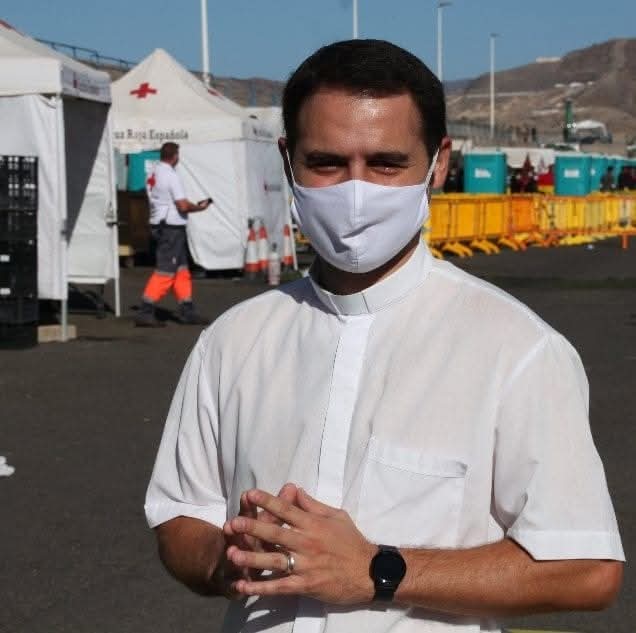
The port of Arguineguín with its pier located on the southern end of the Spanish island of Gran Canaria, where Pope Leo XIV is scheduled to visit on June 11, is at first glance just another port in a fishing town. But itʼs a seemingly nondescript place that in 2020 became the setting for one of the most dramatic episodes of Europe’s migration crisis.
A port transformed into a symbol
For four months, more than 2,600 people — six times the capacity of the pier, which spans a mere 656 ft. — remained crowded together there in inhumane conditions. There were as many people jammed together on the concrete as there were inhabitants in the town that hosted them.
“It was already a very turbulent time, on many levels. Locally, we were right in the middle of the [Covid 19] pandemic, and due to a lack of resources, the food bank had just closed,” recalled Father Adrián Sosa Nuez, who arrived in September 2020 at Our Lady of Sorrows and St. Agatha Parish. Located just a few feet from the port, the parish was where he began to witness the mass arrival of hundreds of “cayucos” — the narrow flat bottom boats that migrants use.
Sosa on the pier at the port of Arguineguín in 2020. | Credit: Photo courtesy of Father Sosa
That year, 23,000 migrants and refugees arrived in the Canary Islands, mostly hailing from the Maghreb and sub-Saharan Africa. Fleeing poverty, war, and drought in search of hope, the desperate people of the worldʼs poorest continent cast off into the Atlantic for an extremely perilous voyage.
The island of Gran Canaria lies approximately 95 miles off the northwest coast of Morocco, a distance that in the unseaworthy, open-topped wooden vessels the migrants use, can stretch into voyages lasting up to a week.
The collapse nobody knew how to handle
Although the 2020 figure is lower than the historic record of 46,843 arrivals recorded in 2024, the surge six years ago caught institutions off guard. There were no adequate facilities to receive them, no beds, and no defined strategy to address a situation that, though foreseeable, spiraled into a humanitarian crisis.
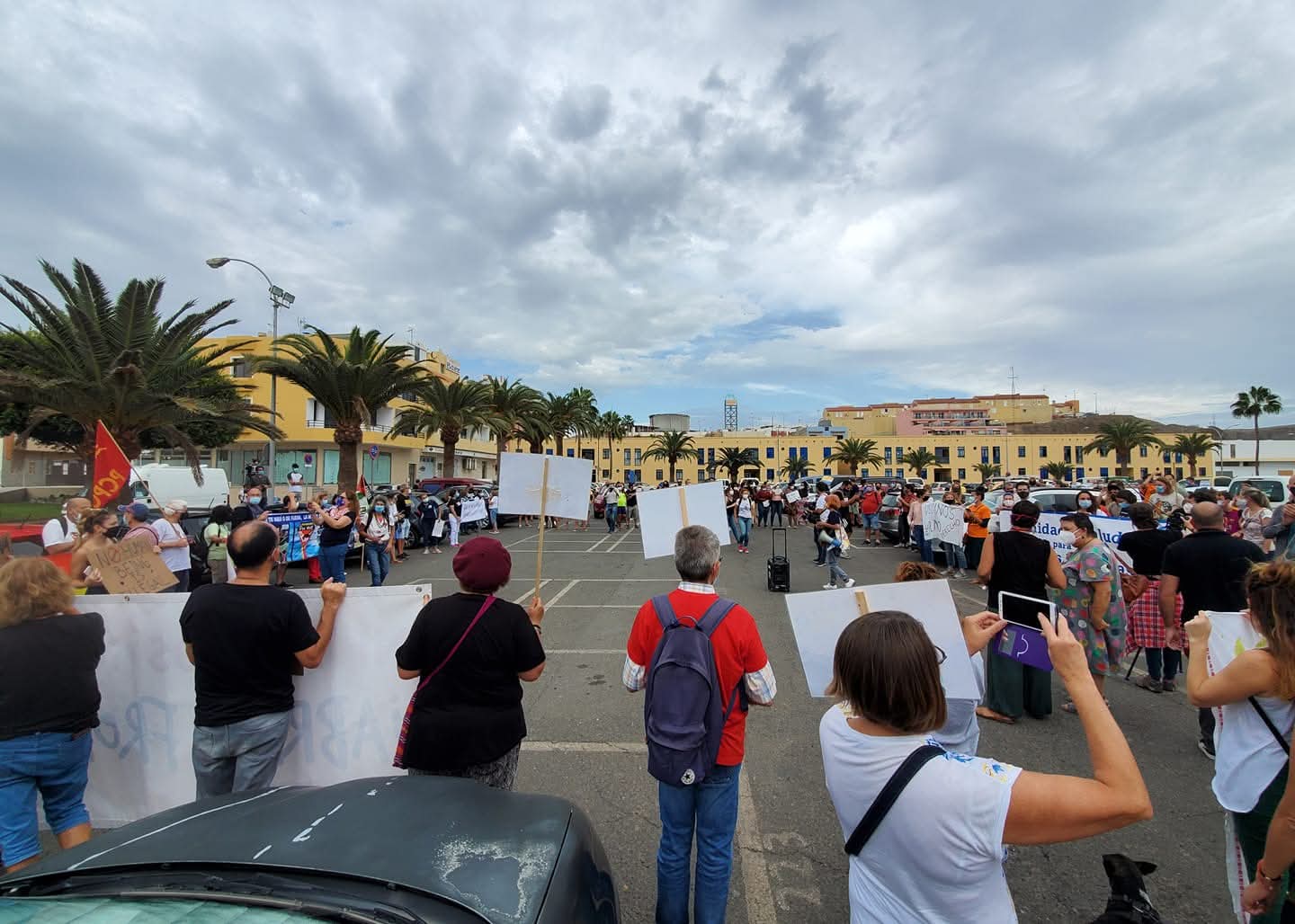
A protest over the living conditions of migrants in Arguineguín in 2020, in which Sosa participated. | Credit: Photo courtesy of Father Sosa
“The impact came as a shock to us not only as a parish, but as the Canarian people. We were unaccustomed to witnessing scenes of this kind, and it caught all the authorities off guard. No one knew how to handle it,” Sosa told ACI Prensa, the Spanish-language sister service of EWTN News.
He is currently a judge on a diocesan tribunal, a professor of canon law, and the parochial vicar in the Siete Palmas neighborhood of Las Palmas, where the pope will celebrate Mass in Gran Canaria Stadium.
Trying to survive in overcrowded conditions
The migrants themselves improvised makeshift shelters using tarps and cardboard. The pier became a place where people slept, ate, and prayed. In real terms, each person had little more than one square yard of space.
Arguineguín thus came to symbolize a triple failure: that of the migrant reception system, that of respect for human rights, and, ultimately, that of human dignity. Added to this were restrictions imposed because of the pandemic.
“We were unable to be at the pier due to Covid protocols, so we could only provide help at a later stage,” explained the priest. Around twenty hotels on the island then opened their doors to accommodate the migrants. “That was when we began to put a human face to their suffering and to accompany them,” he said.
The response of the Church and society
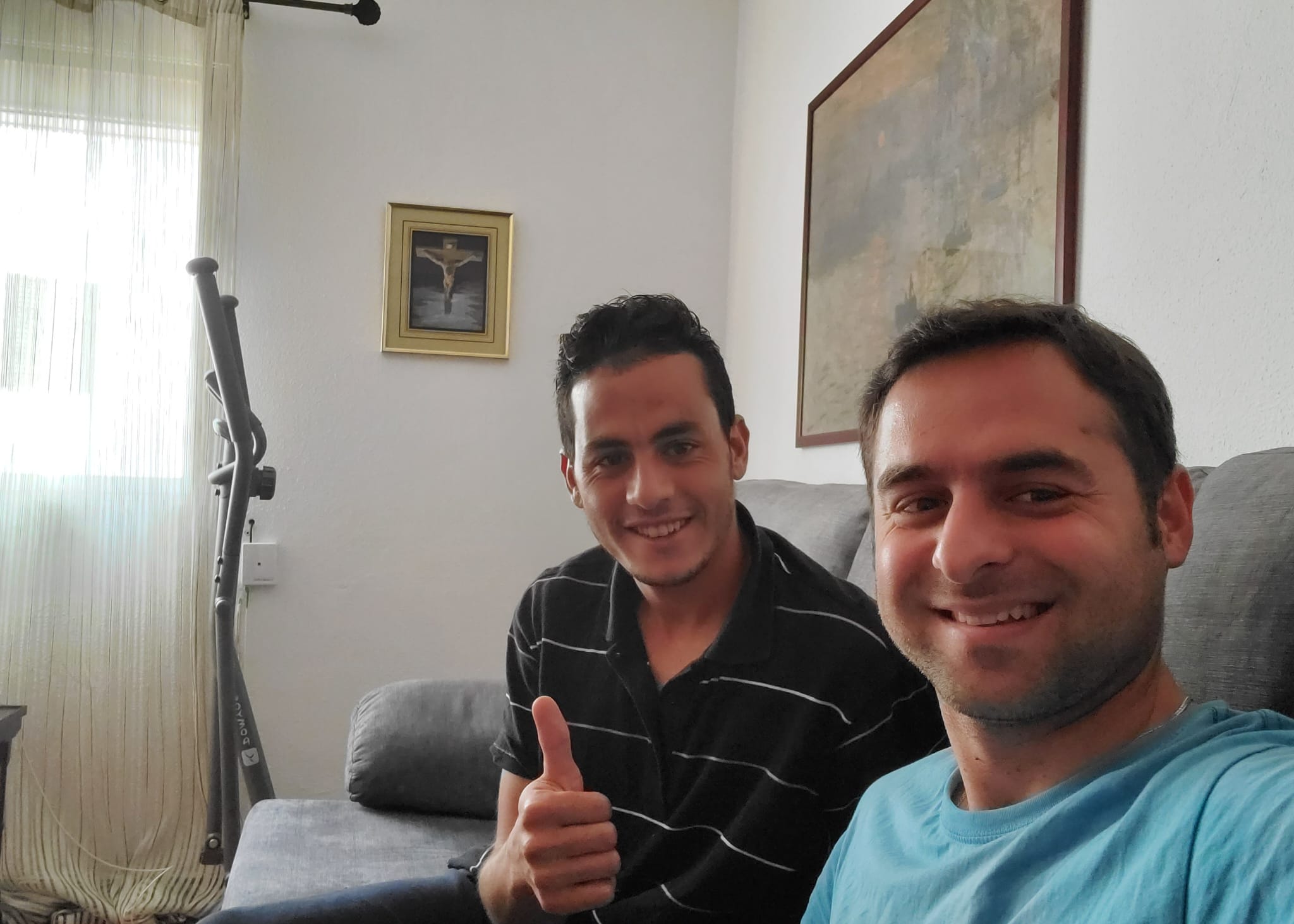
Volunteers from the parish and from Caritas mobilized to offer Spanish classes. Some even welcomed migrants into their own homes. Sosa himself gave shelter to a young man in the rectory after the young man was left out of the reception system.
Sosa (right) with the young man he took in. | Credit: Photo courtesy of Father Sosa
“Pope Francis had recently published Fratelli Tutti, and it was truly providential. It helped us greatly in raising awareness across all social strata that, as Christians, not everything is negotiable and that we had a duty to help these people,” he explained.
The crisis also fostered collaboration among various ecclesial organizations. Among others, Sosa received calls from Father Ángel, founder and president of the NGO Messengers of Peace, inquiring about their needs, as well as from the evangelical church Misión Moderna.
“Despite the difficulties, it was a time of great joy, a time of feeling in communion with the entire Church,” he recalled.
Along the edges of the pier in those days, family members also gathered in search of news regarding their loved ones. They arrived bearing photographs, asking survivors if they had seen them. “Many arrived traumatized. If someone fell ill during the crossing, in many cases they were thrown into the sea,” Sosa recounted.
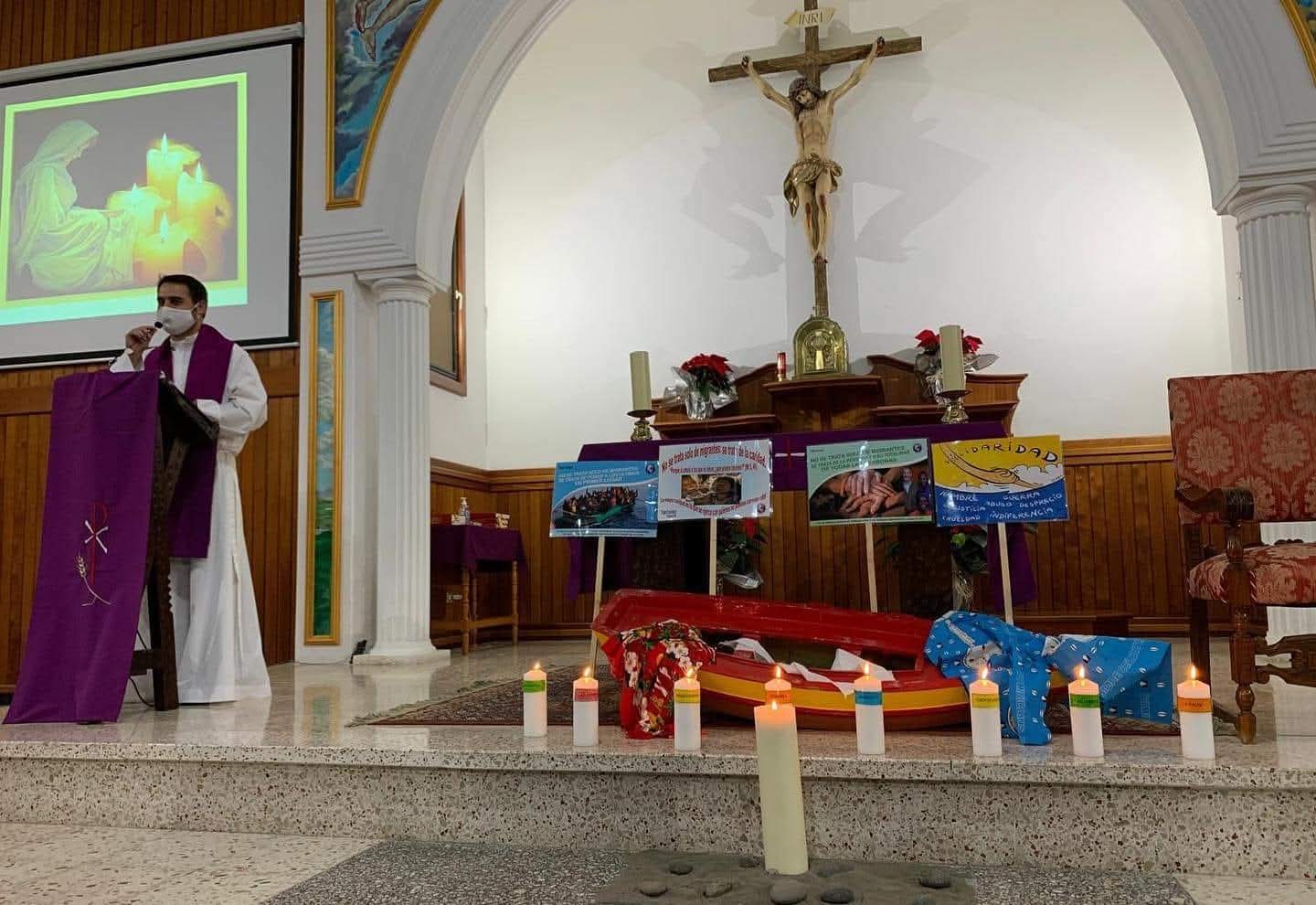
Mass for those who have lost their lives in the Atlantic Ocean. | Credit: Photo courtesy of Father Sosa
In the words of the priest, it was “a major traumatic experience." Since 2020, more than 19,000 people have died attempting to reach the Canary Islands, victims of the cold, the currents, and a journey spanning hundreds of miles, depending on the point of departure.
In 2025 alone, of the more than 3,000 people who perished on maritime routes, 1,906 lost their lives on the Atlantic route to Europe as documented in the 2025 Monitoring the Right to Life report by the NGO Caminando Fronteras (Walking the Borders).
Pope coming to the ‘pier of shame’
Six years later, the pope will visit this site, now known as the “pier of shame.” Nearly 2,000 people will await him there, the very place where many first set foot in European territory under extreme conditions. Moreover, this visit fulfills a wish that his predecessor, Pope Francis, was unable to realize.
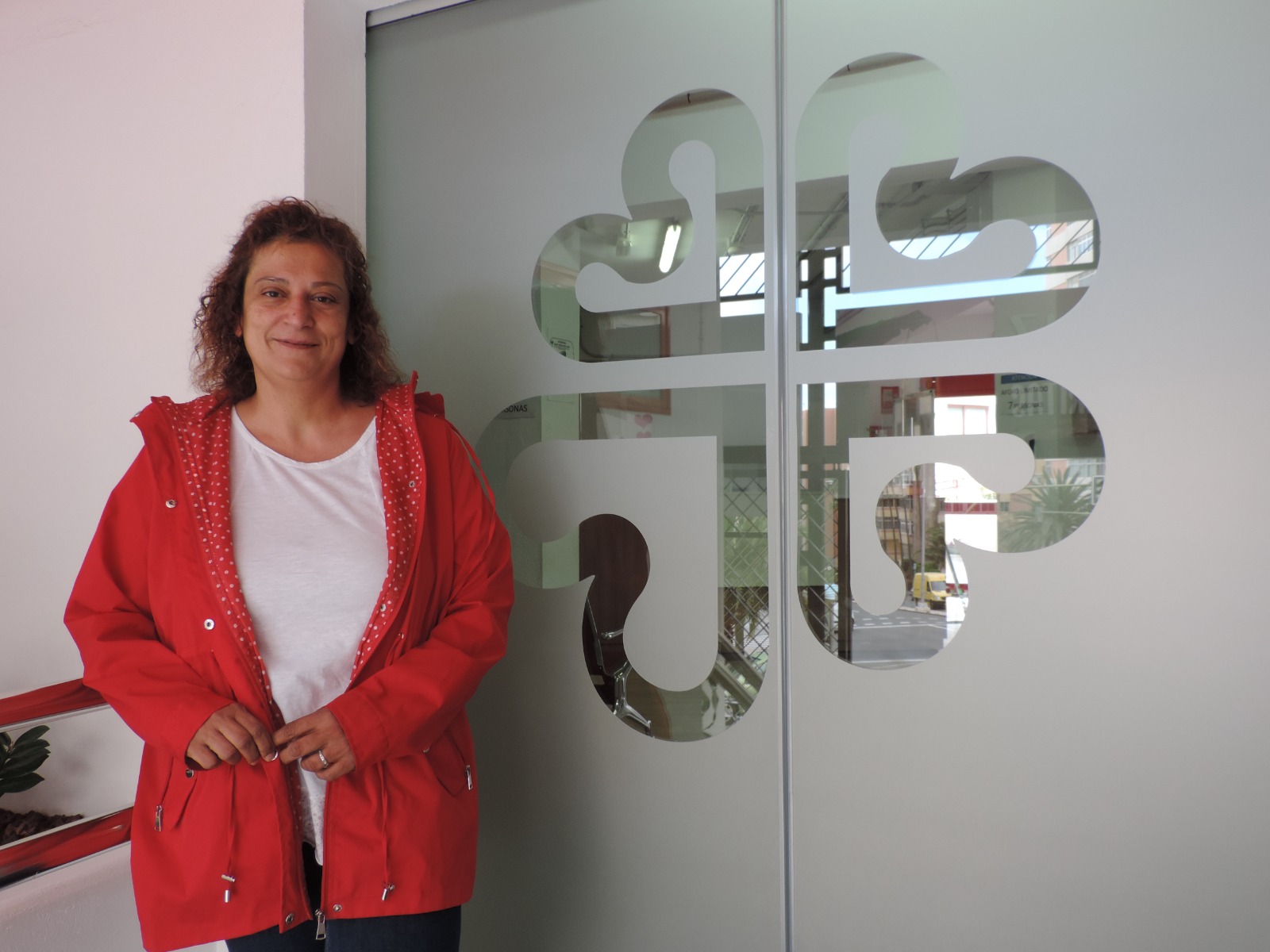
“Many of those who will be with the pope have experienced the grueling Atlantic route. A great many have left friends or acquaintances behind at the bottom of the sea,” explained Caya Suárez, a social worker, secretary general of Caritas in the Diocese of the Canary Islands, and coordinator of the event.
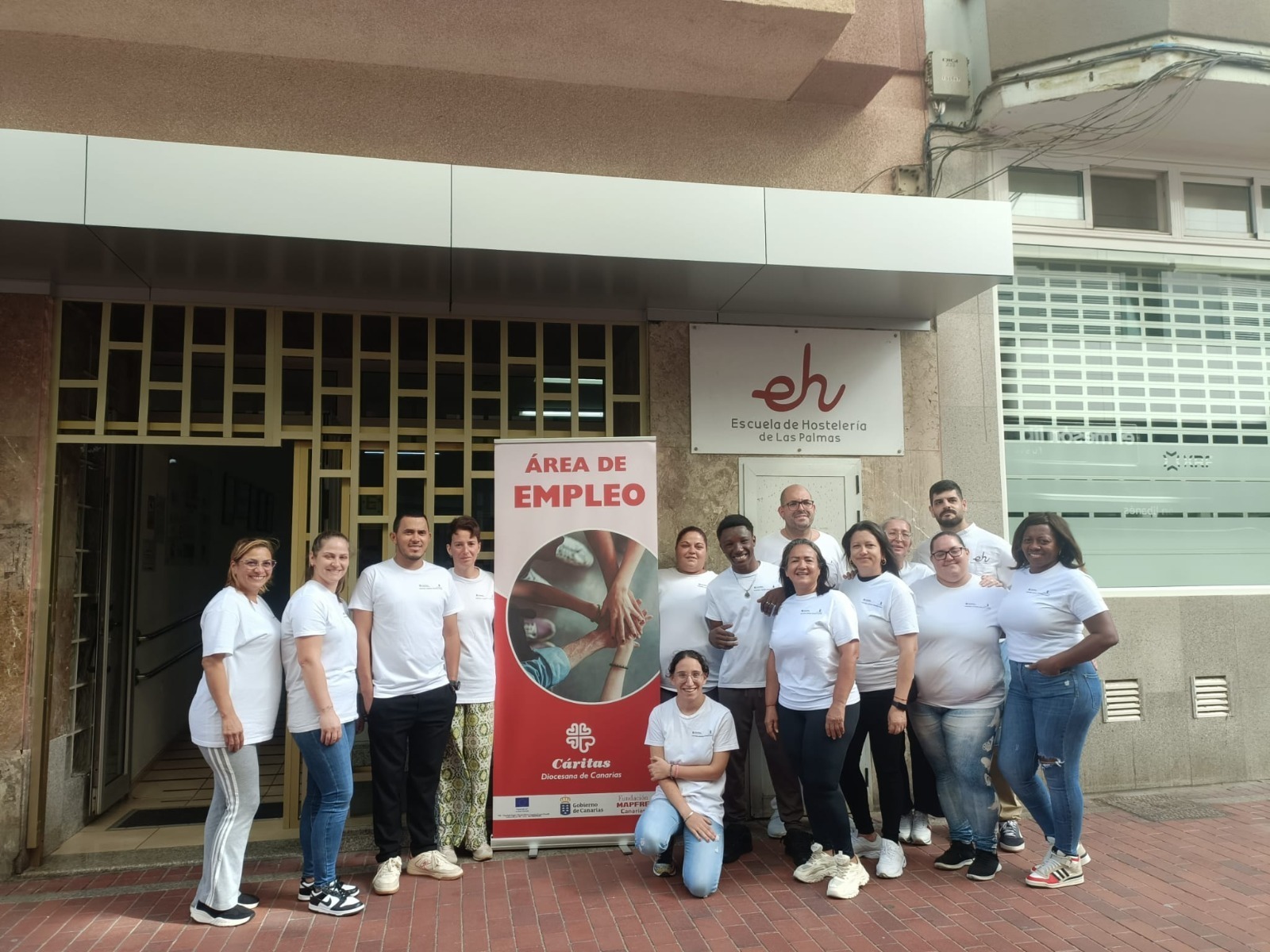
Caritas offers employment and training opportunities. | Credit: Caritas Canarias
One of the most moving moments will be the casting of a floral wreath into the sea in memory of the victims, echoing the gesture performed by Pope Francis in the Sicilian island of Lampedusa. Alongside Pope Leo, a human chain will be formed by people who “wish to remember those they have seen die.”
The pope will listen to the testimonies of four migrants, who will recount not only the hardships of their journey and the stigmatization they endured, but also how Caritas and other ecclesial organizations have become a new family to them.
In Las Palmas province alone, Caritas has assisted more than 22,000 migrants of African and Latin American origin since 2020. Since 2024, the Caritas Española confederated network has launched 47 diocesan projects dedicated to welcoming and supporting undocumented individuals.
“Caritas steps in when people, regrettably, find themselves outside the system, when government assistance fails to reach them,” Suárez explained.
Caya Suárez, president of Caritas Canarias, was one of the organizers of the pope’s visit. | Credit: Photo courtesy of Caritas Canarias
A cross made from cayuco wood
Another significant moment will be the blessing of an image of Our Lady of Mt. Carmel, the patroness of sailors. A small altar dedicated to her image, which is deeply rooted in local fishing traditions, is kept on the pier. On numerous occasions, sailors have been the first to go out to rescue incoming vessels.
Alongside this altar will be a cross crafted from the wood of a migrant boat, a cross that has already become a symbol of the local Church. At the conclusion of the ceremony, the pope will bless both the cross and the image of the Virgin, which will remain on the pier.
This story was first published by ACI Prensa, the Spanish-language sister service of EWTN News. It has been translated and adapted by EWTN News English.
The Washington Nationals have fired a spokesman after video surfaced in which he appeared to admit that the team discriminates against one of its outspoken Catholic pitchers.
EWTN News confirmed on May 29 that the Nationals had dismissed its former community relations director Sean Hudson amid media coverage and criticism from religious groups over the video.
Hudson was at the center of controversy earlier in the week when footage posted to X by “guerrilla journalist” James OʼKeefe apparently showed him claiming that the baseball team “[doesnʼt] use” Williams in certain team activities due to his having criticized an LGBT group that mocks Catholic religious imagery.
Williams had spoken out in 2023 against the Los Angeles Dodgers' decision to honor the “Sisters of Perpetual Indulgence” with a “Community Hero Award.” Members of the group of drag performers dress up in attire resembling Catholic nuns and engage in sexualized performances.
The group also uses imagery of Jesus and the Blessed Mother in its performances. The U.S. Conference of Catholic Bishops has referred to the displays as "blasphemy."
A source confirmed to EWTN News that Hudson had been dismissed following the video controversy. An email to Hudsonʼs Nationals address earlier in the day had been returned with the notification that the address was “no longer a system account,” while Hudsonʼs LinkedIn account had been taken down at some point prior to May 29.
Prior to a May 29 game against the San Diego Padres, team business president Jason Sinnarajah said in an interview on the Nationals broadcast channel that the team is “not anti-Catholic” and does “not hide players from social media.”
“We were horrified by the comments that were made on the video,“ he said. ”The comments don’t reflect us as an organization, our values and who we are. We took action right away, and that individual is no longer employed by the team.”
The recent OʼKeefe video, posted to X on May 26, features a man identified as Hudson describing Williams as a “super Catholic” and referencing his criticism of the drag group.
“Because of that, [the team doesnʼt] use him on social [media],” Hudson claims in the video.
Williams told “EWTN News in Depth” in 2023 that his criticism of the Dodgers “had to be said.”
“We cannot stand idly by while Our Lord gets mocked," he said at the time.
The Swiss Bishops' Conference has endorsed a national legal ban on so-called conversion measures aimed at people who identify as LGBT while insisting that legitimate pastoral care, counseling, and psychotherapy be expressly shielded from any prohibition.
In a statement issued May 26, the bishops said they reject conversion measures in all their forms. “Practices aimed at changing or suppressing sexual orientation, gender identity, or gender expression contradict the dignity of the person as the image of God and can cause considerable harm,” the conference said (translated from German).
The bishops defined conversion measures as targeted influence intended to make a person change or suppress his or her sexual orientation or “gender identity,” exercised through means such as pressure, blame, threats, isolation, devaluation, or religious fear.
Open-ended, respectful conversation and accompaniment, in which a person reflects on his or her situation and decides in freedom, does not fall under that definition, they said.
The conference reserved its sharpest language for religious settings. “In a religious context, such practices can become spiritual abuse when people are shamed, threatened, or manipulated in the name of God,” the bishops said. Church pastoral care must never exert pressure or shame people, they added, and conversion measures are incompatible with Catholic pastoral care.
Pastoral care is legitimate, the bishops said, “when it preserves the dignity and freedom of the person, protects personal integrity, and exercises no undue influence.”
The statement backs the aim of Motion 22.3889, now before the Swiss Parliament, which would prohibit and penalize the offering, facilitating, and advertising of conversion measures, the bishops said, “especially to protect minors and vulnerable persons.”
They set three conditions for any law: a clear definition that captures targeted “conversion” practices; a precise delineation so that open-ended pastoral care, counseling, and professional psychotherapy are not criminalized; and ready access for those affected to support, counseling, and channels for filing complaints.
A long-running Swiss debate
A federal ban has been debated in Switzerland for years. The National Council, the larger chamber of Parliament, adopted Motion 22.3889 on Dec. 12, 2022, instructing the government to create a criminal provision against conversion practices.
The Federal Council recommended rejection, with then-Justice Minister Karin Keller-Sutter arguing that a ban at the federal level was not feasible and that some acts could already be punishable under existing law.
The motion remains in committee in the Council of States, which has awaited a federal report on the scope of the practices. Several cantons have already enacted their own bans.
The bishops were not alone in weighing in. The Protestant Church in Switzerland, the countryʼs main Reformed body, issued its own statement the same day, also backing a legal ban.
The debate extends beyond Switzerland: In late April the European Parliament voted in favor of an EU-wide ban, and on May 13 the European Commission said it would recommend, without binding force, that member states outlaw such practices. Switzerland is not a member of the European Union.
Bishops say position is grounded in Catholic teaching
The bishops argued that they were grounding their position in the teaching of Pope Leo XIV, citing his inauguration homily of May 18, 2025, in which he said the Church is called “to offer Godʼs love to everyone, in order to achieve that unity which does not cancel out differences but values the personal history of each person.”
That pastoral emphasis sits within the wider framework of Catholic moral teaching. The Catechism of the Catholic Church holds that homosexual acts are “intrinsically disordered” and that “under no circumstances can they be approved” (No. 2357), while teaching that persons with homosexual inclinations are called to chastity and, through prayer and sacramental grace, “can and should gradually and resolutely approach Christian perfection” (No. 2359).
In its 1986 “Letter to the Bishops of the Catholic Church on the Pastoral Care of Homosexual Persons,” what was then the Congregation for the Doctrine of the Faith — now the Dicastery for the Doctrine of the Faith — then led by Cardinal Joseph Ratzinger (the future Benedict XVI), wrote that pastors “should have the confidence that they are faithfully following the will of the Lord by encouraging the homosexual person to lead a chaste life and by affirming that personʼs God-given dignity and worth.”
The same letter taught that those who experience the inclination should not be led to believe that “the living out of this orientation in homosexual activity is a morally acceptable option,” adding: “It is not.”
A caution over religious freedom
The Swiss bishops' insistence on protecting pastoral care echoes a concern raised by their Austrian counterparts.
As CNA Deutsch, EWTN News‘ German-language news partner, has reported, the Institute for Marriage and the Family of the Austrian Bishops’ Conference warned in 2023, when Austria considered a similar ban, that an overly broad prohibition could sweep in serious counseling for people experiencing conflicted sexuality and could restrict religious freedom where it touched pastoral accompaniment by confessors, pastoral workers, or laypeople.
Vice President JD Vance told graduates of the U.S. Air Force Academy on May 28 that regarding modern warfare and artificial intelligence (AI), he agrees with Pope Leo XIV’s recent admonition “not to outsource the most important decisions to digital technology.”
During the commencement address in Colorado Springs, Colorado, Vance told over 900 graduating cadets that “the thing I worry about most with AI is how it will change warfare.”
Vance said that “decisions over life and death must be made by humans and not machines.” He warmed the graduates to fiercely guard their roles “as the decision-makers in warfare” rather than outsource to AI.
“You are the masters of warfare and both your minds but also your hearts are the opposite of artificial,” he said. “Use technology to make you better, but never submit to it.”
Vance echoed Pope Leo’s recently released encyclical Magnifica Humanitas, in which the pope said human beings must not allow AI to make decisions in war because those systems do not “have a moral conscience, since they do not judge good and evil, grasp the ultimate meaning of situations, or bear responsibility for consequences.”
Leo called for a “moral and social discernment that safeguards the primacy of the human person, in order to ensure that it will always be human intelligence, with its conscience and freedom, that guides technical innovations and responsibly determines their use and limits.”
In the encyclical, the pope said that AI’s power “remains entirely tied to data processing. So-called artificial intelligences do not undergo experiences, do not possess a body, do not feel joy or pain, do not mature through relationships and do not know from within what love, work, friendship or responsibility mean.”
A total of 931 graduates received their diplomas during the graduation ceremony and will enter the Air Force or Space Force, where they will serve for a minimum of five years.
Though Vance told the graduates his main worry with AI is how it will affect war, he also acknowledged other concerns, namely “how it will affect the labor market, how it will distribute resources, and how it has fundamentally changed how we interact with one another, our social lives.”
Leo also addressed these concerns in the encyclical, writing that while AI systems “often surpass human intelligence in speed and computational capacity, offering tangible benefits across many fields,” society must not forget “the primacy of human labor over any mindset focused solely on finance or productivity — with the consequent attention to the people and families most susceptible to exploitation.”
AI systems “may imitate language, behavior and analytical skills, or even simulate empathy and understanding,” the pope wrote, “but they do not understand what they produce, for they lack the affective, relational and spiritual perspective through which human beings grow in wisdom.”
Just War theory ‘outdated’
The vice president told the cadets that what “makes Americans unique … is that we wage war justly,” admonishing them they must do the same when they become “the ones who lead on the battlefield.”
Waging just wars "is an incredible burden to put on your shoulders. But it is one that we entrust to you with full confidence,” Vance said. “And if the warfare of the future is to live up to the moral values of our ancestors, decisions over life and death must be made by humans and not machines.”
“Youʼre the ones who ensure that our lethality in war, which is amazing and necessary … also coexists with our heart and with our conscience”, he said.
In his encyclical, however, Leo suggested the Church must update its “just war theory” in light of modern technological and political developments.
“Today, more than ever, without prejudice to the right to self defense in the strictest sense, it is important to reaffirm that the ‘just war’ theory, which has all too often been used to justify any kind of war, is now outdated," the pope said.
While acknowledging nations' continued right to legitimate self defense, the pope wrote that resorting to “force, violence and weapons reflects a relational poverty that always has disastrous consequences for civilian populations.”
“Humanity possesses far more effective and capable tools for promoting human life and resolving conflicts, such as dialogue, diplomacy and forgiveness,” he said.
Vance’s address to the Air Force cadets comes after Pope Leo’s recent comments implying the U.S. is not engaged in a just war in Iran, remarks that were followed by a verbal attack from U.S. President Donald Trump.
Vance weighed in on the matter several weeks ago, saying the pope should take more care when he speaks on theological issues such as just war.
“In the same way that it’s important for the vice president of the United States to be careful when I talk about matters of public policy, I think it’s very, very important for the pope to be careful when he talks about matters of theology," he said.
Pope Leo XIV’s first encyclical, Magnifica Humanitas, is a paeanto peace that warns of the danger of “a world in a permanent state of belligerence" even more threatening than the Cold War era.
In that era, the pope writes, despite the existence of grave conflicts, “the awareness persisted that a new global conflict had to be avoided at all costs.”
Following the Second World War, “peace was made the focus of the international order, as attested in particular by the United Nations Charter” but now, war has been “revived as an instrument of international politics, while the very ethical principles that had previously limited its use are being eroded,” writes the pope.
The Holy Father makes no reference to any specific conflict, but rather offers an assessment of a world shaken by violence.
“Today, more than ever, without prejudice to the right to self-defense in the strictest sense, it is important to reaffirm that the ‘just war’ theory, which has all too often been used to justify any kind of war, is now outdated,” the pope indicates in the encyclical.
The right to self-defense
This is not a radical shift, but rather a predictable trajectory that Leo XIV himself outlined from the first day of his pontificate, when, following his election on May 8, 2025, he spoke from the balcony of the Apostolic Palace of a peace that was “unarmed and disarming.”
Recently, during one of his customary encounters with the press upon leaving Castel Gandolfo, where he spends most Tuesdays, he responded to a question from EWTN journalist Javier Romero concerning self-defense.
Self-defense, he said, has always been accepted by the Church. However, he qualified the application of the concept of a just war in the current context: “To talk about just war today, itʼs a very complex problem. You have to analyze it on many levels, but ever since the entrance into the nuclear age, the whole concept of war has to be reevaluated.”
“I always believe that itʼs much better to enter into dialogue than to look for arms and to support the arms industry, which gains billions and billions of dollars each year, instead of sitting down at the table solving our problems and using money to solve humanitarian issues, hunger in the world, et cetera,” he added.
In an interview with EWTN News, Cardinal Michael Czerny, prefect of the Dicastery for Promoting Integral Human Development, emphasized that, although the pope reaffirms “the right to self-defense" in the encyclical, it remains “impossible to justify a war.”
The cardinal said the new encyclical is “a very, very strong call. And it has to do with responsible use. And the Holy Father gives the example of military power. We have achieved a certain level of control. And we must do the same with artificial intelligence in warfare as soon as possible.”
Teaching on just war subject to historical circumstances
The Church’s teaching on “just war” is, by definition as noted by the Second Vatican Council, dynamic and subject to historical circumstances. Popes have progressively raised the bar for accepting the legitimacy of armed conflict.
Thus, in 2003, the Iraq War drew outright condemnation from Pope St. John Paul II in response to the United States’ planned offensive: “No to war! War is not always inevitable. It is always a defeat for humanity,” the Polish pontiff declared on Jan. 13, 2003, before more than 170 ambassadors accredited to the Vatican.
About four weeks later, on March 19, 2003, the United States began its preemptive war against Iraq.
The first major point of reference for contemporary doctrine on war is the Second Vatican Council itself. Its pastoral constitution, Gaudium et Spes (Joy and Hope), established a provisional criterion in 1965: “As long as the danger of war remains and there is no competent and sufficiently powerful authority at the international level, governments cannot be denied the right to legitimate defense once every means of peaceful settlement has been exhausted."
It continued: "State authorities and others who share public responsibility have the duty to conduct such grave matters soberly and to protect the welfare of the people entrusted to their care. But it is one thing to undertake military action for the just defense of the people, and something else again to seek the subjugation of other nations. Nor, by the same token, does the mere fact that war has unhappily begun mean that all is fair between the warring parties,” reads a section of paragraph 79 of this document.
A quarter of a century later, in 1992, the Catechism of the Catholic Church (CCC) addressed at length the notions of “legitimate defense” and “safeguarding peace,” within a more complex international context.
After acknowledging the approval of certain Church leaders of “cruel practices” such as torture in times past, the text affirms that “Because of the evils and injustices that accompany all war, the Church insistently urges everyone to prayer and to action so that the divine Goodness may free us from the ancient bondage of war.”
According to the CCC, “The strict conditions for legitimate defense by military force require rigorous consideration.” It also states that “the evaluation of these conditions for moral legitimacy belongs to the prudential judgment of those who have responsibility for the common good.”
These conditions include “lasting, grave, and certain” damage; the exhaustion of “all other means of putting an end to” a conflict; the existence of “serious prospects of success”; and the assurance that “the use of arms must not produce evils and disorders graver than the evil to be eliminated.”
Referring modern weaponry such as nuclear arms, the CCC also underscores that “The power of modern means of destruction weighs very heavily in evaluating this condition.”
The Church has previously expressed its concern regarding so-called killer robots, or autonomous weapons, whose level of technological sophistication has increased notably in recent years.
Pope Francis called upon G7 leaders gathered in Italy in 2024 to ban the use of autonomous weapons capable of operating without human mediation in armed conflicts.
However, Magnifica Humanitas marks the first time that this appeal has been incorporated into an encyclical.
“Any technology that facilitates attacks without seeing the face of human beings lowers the moral threshold of conflict. Target selection and the use of force must not confuse combatants and non-combatants, nor ignore the impact on defenseless populations,” the pope emphasizes.
This story was first published by ACI Prensa, the Spanish-language sister service of EWTN News. It has been translated and adapted by EWTN News English.
The Catholic University of America (CUA) and Faithful Citizenship Institute (FCI) are launching a partnership to prepare Catholics for a life in public service rooted in Catholic social teaching.
“This brings together the practical training offered by FCI and the rigorous professional training of the MPP program. That creates a pathway for policy professionals to gain the skills necessary to put Catholic social teaching into practice,” Richard Gallenstein, founding director of the master of public policy program, said in a press release.
The two organizations also will collaborate on events and programming. In addition to receiving course credits, all MPP students will have access to FCI’s upcoming formation and networking platform, Fratelli.
The collaboration comes at a time when “current political culture is marked by deep division that extends beyond Capitol Hill – even to our church pews,” said Jennifer Daniels, FCI president and co-founder.
“By forming public policy professionals in the principles of Catholic social teaching, they will reflect the light of the Gospel in civic life to serve the common good,” she said.
Benedictine College moves closer to launching its osteopathic medical school
Benedictine College has filed the application for candidate status with the Commission on Osteopathic College Accreditation after acquiring the necessary funds for submission. This pushed the institution one step closer to opening its proposed School of Osteopathic Medicine.
The institution may receive notification of status as early as September 2026, allowing for progression to the next steps. The expected status keeps the school on track to welcome its first class in 2028.
“This is the big moment that many people have been waiting for,” Benedictine College President Stephen D. Minnis said in a press release. “Our next task is to finish this proposed medical school that will imitate Christ the teacher and the healer."
The proposed Benedictine College School of Osteopathic Medicine plans to train 180 medical students per year, who will then serve in Catholic hospitals around the country, bringing medical care to those in need.
“This is a great moment when Benedictine College sees the need for rural health care and is stepping forward to educate physicians to fill the gap in delivering faithfully Catholic, high-quality medical care,” said Mike Kuckelman, chair of the board of Benedictine College.
Families open school in Sacramento following closure of Catholic school
Families in the Diocese of Sacramento established Alphonse Gallegos Academy (AGA) after the diocese announced the consolidation of three Catholic schools, leading to the closure of two campuses this summer.
The new school refers to itself as "a modern alternative to traditional private school" and “an independent, faith-based learning co-op."
It plans to serve Sacramento families through a full-day, teacher-guided academic environment rooted in faith, community, and strong educational foundations.
Families are actively enrolling for the 2026–2027 school year as the school prepares for its founding classes.
The schoolʼs launch began after the Diocese of Sacramento announced the merger of St. Charles Borromeo School, St. Patrick Academy, and St. Robert School, which will take effect in June 2026.
AGA will include faith-based education “inspired by Catholic tradition,” according to its website, but is not a diocesan school.
AGA is named in honor of Blessed Alphonse Gallegos, who “devoted his ministry to serving others, especially children, families, and those often overlooked by society.”
His “example of joyful service and compassionate leadership continues to inspire the mission and values of AGA,” the school reported.
CUA honored for demonstrating ‘significant contributions’ in space or aerospace research
CUA was granted membership on May 18 from USRA, a nonprofit corporation to advance space-related science, technology, and engineering. It operates scientific institutes and facilities other research and educational programs under federal funding.
To receive a USRA membership, institutions must have demonstrated “significant contributions in space or aerospace research by faculty,” and “a substantial commitment to a course of studies and dissertation research leading to a doctorate in one or more related fields.”
"We look forward to the contributions of The Catholic University of America in ongoing space science investigations, and collaborations with faculty and peers on space-related projects, and USRA programs that bridge academic research with real-world space exploration challenges,” Dr. Elsayed Talaat, president and CEO of USRA, said in a press release.
CUA’s designation marks the 124th USRA institution. The designation also follows the universityʼs achievement in 2025 of the R1 designation, granted to institutes with the highest levels of research activity.
CUA’s “academic prominence and background in physics, engineering, computer science” and its “passion for space science made it an ideal candidate for membership with USRA,” USRA reported.
Spainʼs president congratulates Pope Leo XIV on Magnifica Humanitas
Spanish President Pedro Sánchez offered his praise for Pope Leo XIV’s first encyclical, Magnifica Humanitas, on Wednesday.
“No technology is neutral, AI isnʼt either. And even less so those who use it and the purposes for which they use it,” Sánchez wrote in a social media post on X. “Ihave congratulated Pope Leo XIV for centering his first encyclical on this topic. Only multilateralism and international governance can ensure that technology serves humanity, and not the other way around,” he said.
Catholic and Coptic dialogue resumes after tensions over same-sex blessings
After nearly two years of tension, the Catholic Church and the Coptic Orthodox Church are moving back toward theological dialogue, ACI MENA, EWTN News’ Arabic language service, reported.
Following renewed contact between Pope Leo XIV and Pope Tawadros II, the Coptic Orthodox Holy Synod announced that dialogue with the Catholic Church would resume. The move comes after the Coptic Orthodox Church strongly rejected Vatican guidance on blessings for people in same-sex relationships.
The continuation of dialogue protects a decades-long ecumenical relationship at a time when Christians in the Middle East face severe, shared pressures.
Catholic agency in South Sudan issues Ebola alert
The Catholic Organization for Development and Peace (CODEP) of the Catholic Diocese of Tombura-Yambio (CDTY) in South Sudan has issued an alert and advisory notice urging heightened preparedness against Ebola following reports of the outbreak in neighboring Democratic Republic of Congo (DRC), ACI Africa, a sister EWTN News service, reported Thursday.
In the May 26 advisory addressed to staff of the Wholeness and Wellness Health Service Department, St. Theresa Mission Hospital, health workers, community leaders, and the public, CODEP Director, Father Charles Mbikoyo warned that “the risk of cross-border transmission remains serious due to frequent population movement within the region.”
Mbikoyo said that “although no confirmed case has yet been reported in our area, the risk of cross-border transmission remains serious due to frequent population movement within the region. We therefore cannot remain passive or unprepared.”
Aleppo Catholics bid farewell to beloved archbishop
The Melkite Catholic Church in Aleppo celebrated the funeral of Archbishop Emeritus Jean Jeanbart, whose name became closely linked with rebuilding, education, and pastoral resilience in the city.
At his funeral on Tuesday, church leaders remembered him as a bishop who invested in schools, housing, youth formation, and the future of Christians in Aleppo, even during years of war, ACI MENA reported. His legacy was presented not only as a record of service, but as a practical answer to fear and displacement.
Belarusian Noble laureate meets Pope Leo XIV
Ales Bialiatski, a Catholic and Nobel laureate, met Pope Leo XIV on and delivered a letter to the pontiff raising concerns over human rights issues facing believers in Belarus.
“There are around a thousand political prisoners in prisons, including Catholic, Orthodox, and Protestant priests. That is why I asked him to pray for the release of political prisoners in Belarus, to pray for the Church and for the priests who are imprisoned, as well as for democratic change in Belarus," Bialiatski said in a social media post on Wednesday.
Bialiatski has been detained multiple times, including in 2021 amid government crackdowns on nationwide protests following President Alexander Lukashenko’s contested election. He has previously said, “if I get to meet the pope, I’ll inform him of our Church’s needs.”
Chaldean patriarch meets Iraq’s new Prime Minister ahead of installation
Chaldean Patriarch-elect Paul III Nona received Iraq’s new prime minister in Baghdad just days before his installation, ACI MENA reported Tuesday.
The meeting between the newly elected leaders touched on Iraq’s diversity, the place of Christians in public life, and the need to face the country’s challenges through cooperation rather than division. The patriarch, Paul III Nona, was installed on Friday at St. Joseph Cathedral in central Baghdad.
Christians in northern India arrested on mass conversion charges
Authorities in Uttar Pradesh arrested three Christians on Thursday, alleging that the individuals organized “mass conversion events,” according to a UCA report on Friday.
The three men, Pastor Vivek Kumar, Mohit Chaudhary, and a man identified in the report as “Amit” were arrested after hardline Hindu activists stopped their vehicle while they were traveling with a group of about 30 people to the state capital of Lucknow for a prayer gathering.
The activists said in the First Information Report (FIR) that the men were “conducting religious conversion activities and were found carrying Bibles and other Christian literature,” according to UCA.
Lebanese choir brings Zahle’s sacred music to Rome
Lebanon’s WATAR Choir brought the sound of Zahle to Rome in a recital that blended prayer, memory, and Lebanese musical heritage, ACI MENA reported Thursday.
Performing in several languages, the choir offered a program rooted in church tradition while also carrying the emotional weight of Lebanon’s story abroad. The evening drew clergy, diplomats, and members of the Lebanese community, turning the concert into a moment of faith, culture, and belonging far from home.
During a panel discussion on Friday, Nicaragua Freedom Coalition President Rosalia Gutierrez-Huete Miller said Catholic persecution in her home country is being met with “silence” despite continued government pressure.
Miller, whose citizenship was revoked by the Nicaraguan government in 2023, said that while Catholics in Nicaragua continue to face “the lack of freedom to worship” amid continued pressure from the dictatorship of President Daniel Ortega and his wife and “co-president” Rosario Murilo, other denominations have chosen to “work with the government to avoid that persecution.”
The May 29 panel discussion took place at the Center for Strategic and International Studies (CSIS) in Washington, D.C. The discussion comes after the release of GHREN’s March 2026 report detailing systematic repression and human rights violations against the Nicaraguan people.
“Everything has to be vetted by the government, especially what priests are going to preach on Sunday,” she said, noting the presence of spies for Maduro regime in churches, who she said, “are not taking notes only, but recording what the priest is saying in case that homily was changed or there is variation.”
“Those who are not with [the government] are quiet,” Miller said. “I have permission to mention that in my meeting with [Monsignor Silvio José Báez, auxiliary bishop of Managua], when I asked him, what is the status of the Catholic Church in Nicaragua, he said ‘silence.’”
“I think that Rosario Murillo, she’s afraid of the power of the Nicaraguan faith,” Miller said. “It’s values that shape their beliefs and commitments. She, as we know, needs to control and repress communities of faith in order to prevent the social process, and protests, because that immediately gives them cause for concern.”
Miller lamented the cancellation of traditional Holy Week processions across her home country. “I remember back to my childhood what that meant for a child, what it meant for the whole population — it was a joyous occasion. And now, they cannot do that.”
“But guess what?” she said, “If you look at the videos, and I see them, they’re being held inside the churches. And that gives me so much encouragement, so much pride, because they cannot just wipe us out […] Faith is being practiced regardless.”
Other participants in the panel included Christopher Hernandez-Roy, acting director and senior fellow of the Americas Program, Jan-Michael Simon, chair of the United Nations Group of Human Rights Experts on Nicaragua (GHREN), and Juan Holmann Chamorro, the manager and publisher of the Nicaraguan newspaper, La Prensa.