Catholic doctors say both Eastern and Western spirituality are required to heal the whole person
PHOENIX — For the first time in its nearly 100-year history, the Catholic Medical Association is focusing on how the Eastern Catholic Church’s emphasis on mystery, united with the Western Church’s emphasis on reason, can give a more comprehensive view of human identity and help Western medicine promote human flourishing.
The group’s 95th annual educational conference, held in Phoenix Sept. 10–12, emphasized the early Church Fathers, whose influence was strongest in the East, in order to “promote a more comprehensive view and more respect for the mysteries of human health and disease,” said conference chair Dr. Mary Keen-Kirchoff.
“We’re embodied spirits, not just physical bodies,” she said at the opening. Healing, she added, “is a return to humanity’s original creation in the image and likeness of God.”
The conference theme was “Mysteries and Miracles: Restoring the Practice of Medicine to Heal the Whole Person.” Setting the tone, Father Andriy Chirovsky, a theologian and priest of the Ukrainian Greco-Catholic Church, an Eastern Catholic Church in full communion with Rome, and psychiatrist Dr. Donna C. Dobrowolsky shared the first plenary.
They moved between theology and clinical practice, saying they hoped to help medical professionals recover a holistic understanding of “the whole person, because thatʼs who all of us care about.” Theology without clinical reality stays abstract, they said; clinical work without a complete Christian anthropology becomes fragmented.
“If the human person is misunderstood, then healing will also be misunderstood and therefore less effective,” Chirovsky said. “Healing requires a true anthropology.”
He quoted Pope Leo XIV’s encyclical Magnifica Humanitas, in which the pontiff wrote: “We Christians lift our eyes to the Incarnate God, knowing that it is ‘only the mystery of the Word made flesh that the mystery of humanity truly becomes clear.’”
Why the East, and why now?
Chirovsky cited St. John Paul II’s 1995 encyclical Ut Unum Sint (That They May Be One), in which the pope, referring to the Eastern and Western Catholic churches, wrote that “the Church must breathe with her two lungs!”
Dobrowolsky noted that what the West calls sacraments, the East calls mysteries: rites “not fully comprehensible by human reason, but revealed by God.”
Chirovsky said Eastern spirituality and practice “preserve certain habits of thought that are especially needed at this moment in history.”
He was not arguing against the West, he said. Any strength can become distorted when it loses its complement. The East offers “a needed medicine for some of the pathologies of modern culture,” especially the idea that a person is the center of the universe, “self-defining,” and “the ground of truth.”
“We require revelation to understand our own selves,” he said.
“If the person is not self-explaining,” Dobrowolsky said, medicine has to be careful because lab values and symptom clusters aren’t enough to explain a person. They’re important, but they don’t tell us everything about who a human person is.”
The Catholic Church needs both the East and the West in the same way a healthy person must think with both hemispheres of the brain, the priest said, quoting neuroscientist Iain McGilchrist’s book “The Master and His Emissary: The Divided Brain and the Making of the Western World.”
In his book, McGilchrist notes that the left side of the brain is analytical and narrow, while the right side focuses more on the big picture, and pathology results when the two sides don’t work together and one side dominates.
Chirovsky compared modern medicine’s laser focus on the analytical and quantifiable, using hyperspecialization in the medical field as an example, to a pathology with too much dependence on the left brain.
“The analytic mode is powerful, but when it dominates unchecked, the person becomes legible as data but less visible as mystery and as a person,” he said.
“Any practice of medicine that loses sight of the whole person as revealed in the incarnate Son of God is going to run into lots of trouble,” he added. “Modern medicine is doing exactly that.”
Dobrowolsky agreed, adding that “in medicine, that imbalance isn’t theoretical, we see it every day.”
Seeing the human being as mystery does not mean the person is unintelligible, she said. “We’re saying this human person is not exhausted by reductionist accounts. And that the deepest truth of the human person is disclosed in relation to Christ.”
“If a person is reduced to a collection of functions, risks, and measurable outputs, their care becomes reduced as well,” she continued, saying that while practitioners may “retain technical brilliance … the patient may begin to disappear beneath the technique.”
Indeed, the conference’s breakout sessions touched upon the necessity for a Christian anthropology informed by a Church “breathing with both lungs," with talks titled “Healing Is Not the Same as Curing: Patristic Anthropology and the Limits of Modern Medicine,” “The Neglected Soul: Ancient Monastic Teachings on Depression in the Modern World,” and “Psychedelics, AI, Spirituality, and More: Ancient Wisdom for Reenchanting Medicine.”
“My prayer before the conference was that all attendees receive abundant graces of understanding and hope for the future,” Keen-Kirchoff told EWTN News. “I am so grateful that the Holy Spirit was so present … and trust that attendees are more in tune with who we are in Christ and who we are to become in Christ.”
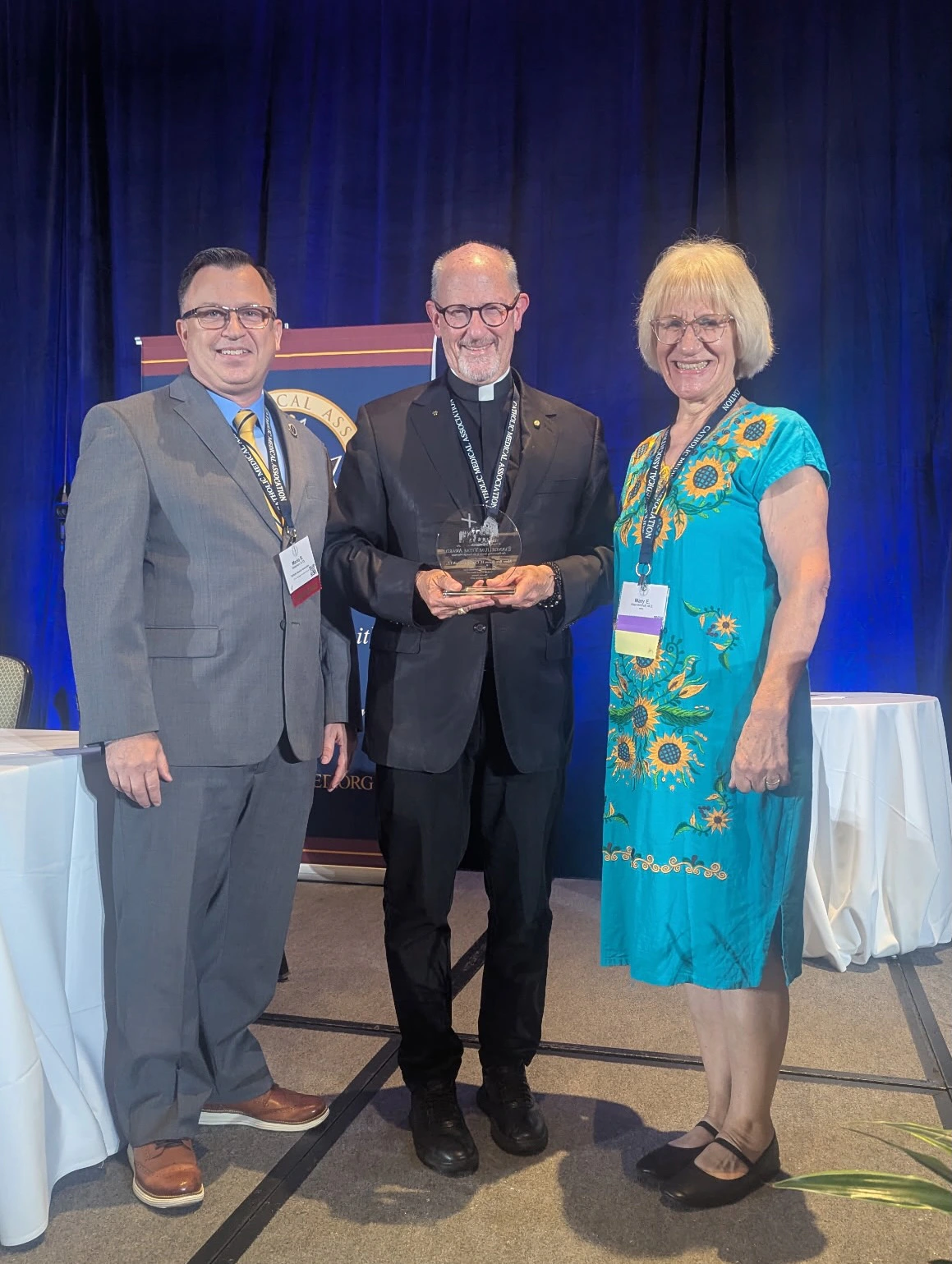
Bishop James D. Conley of the Diocese of Lincoln, Nebraska, won the CMA’s annual Evangelium Vitae award for his pastoral efforts surrounding mental health.
In May 2024, Conley published a pastoral letter titled “A Future with Hope,” concerning the Catholic response to mental health struggles. The honor sits close to the conference’s theme: care that views the person as a whole, in the mystery of body and spirit.
Saint of the Day – rosary.team