Pope Leo XIV said the principal threat facing both religion and science today is the denial of the existence of objective truth. He made this statement on May 11 during an audience granted to members of the Vatican Observatory Foundation, which supports the work of the observatory located in Castel Gandolfo.
“Today, however, science and religion face a different, and perhaps more insidious, threat: those who deny the very existence of objective truth,” the pontiff said.
During his address, he recalled that his predecessor Pope Leo XIII refounded the Vatican Observatory in 1891 in a context where science was beginning to emerge as a rival source of truth to religion. Because of this, he said, the Church felt the “urgent need to counter the growing perception that faith and science were enemies.”
Exploitation of natural resources
“Too many in our world refuse to acknowledge what both science and the Church clearly teach: that we bear a solemn responsibility for the care of our planet and for the well-being of those who inhabit it, especially the most vulnerable, whose lives are threatened by the irresponsible exploitation of both people and the natural world,” Leo said.
He underscored that the Church’s commitment to “rigorous and honest science remains not only valuable but essential.”
The pope also highlighted the unique role of astronomy within this context. “It occupies a particular place in this mission,” he affirmed while emphasizing its capacity to evoke wonder and a sense of proportion in human beings: “It awakens in us both admiration and a healthy sense of proportion.”
“Contemplating the heavens invites us to view our fears and failures in the light of God’s immensity,” he noted.
However, he lamented, “this gift is today threatened” by light pollution.
“To paraphrase Pope Benedict [XVI], we have filled our skies with artificial light that blinds us to the lights God has placed in them — an eloquent image,” he suggested, “of sin itself,” citing a 2012 homily by the German pontiff.
Gratitude for scientific work
The pope expressed his gratitude to the scientists and benefactors associated with the foundation, whose work sustains the activities of the Vatican Observatory.
“Your generosity makes it possible for the Vatican Observatory to share the wonder of astronomy with students around the world and to offer workshops and summer courses to those working in Catholic schools and parishes," he said.
"Ultimately, it is your dedication that keeps the observatory’s telescopes and laboratories faithful to their original purpose: to be places where the glory of God’s creation is encountered with reverence, depth, and joy,” he added.
Finally, the pontiff exhorted them to “never lose sight of the theological vision that animates all of this."
“It’s not surprising that people of deep faith feel called to explore the origins and workings of the universe," he said. "The desire to better understand creation is but a reflection of that restless yearning for God that dwells in the heart of every human being."
This story was first published by ACI Prensa, the Spanish-language sister service of EWTN News. It has been translated and adapted by EWTN News English.
Pope Leo XIV called on Christians and Muslims to resist the growing danger of apathy in modern society, warning May 11 that the constant stream of images of human suffering can “dull our hearts rather than stir them” and urging believers to “transform indifference into solidarity.”
The pope made the appeal during an audience with participants in the eighth colloquium between the Dicastery for Interreligious Dialogue and the Royal Institute for Inter-Faith Studies, held under the theme “Human Compassion and Empathy in Modern Times.”
In his address in the Clementine Hall of the Apostolic Palace, the Holy Father said compassion and empathy are essential for “what it means to live a truly human life.”
The pope noted that the Muslim tradition associates compassion with mercy, “as a gift bestowed by God in the hearts of believers,” and that compassion “always has its origin in God himself.”
Likewise, he said, the Christian tradition’s sacred Scripture “reveals a God who does not remain indifferent to suffering.”
“In Jesus Christ, this divine compassion becomes visible and tangible,” he said. “God goes beyond seeing and hearing by taking on our human nature in order to become the living embodiment of compassion.”
Following Jesus’ example, Leo said, Christian compassion “becomes a sharing in or ‘suffering with’ others, particularly the most disadvantaged.”
“For our traditions, human compassion and empathy are not something additional or optional but are a call from God to reflect his goodness in our daily lives,” the pope said.
Addressing Jordan’s Prince Hasan bin Talal, who was present at the audience, the Holy Father expressed appreciation “for the generous efforts of the Hashemite Kingdom of Jordan in welcoming refugees and assisting those in need in difficult circumstances.”
Leo lamented that “compassion and empathy are sadly in danger of disappearing today” in a society marked by technological advances that, in his view, “have made us more connected than ever before, but they can also lead to indifference.”
“The constant flow of images and videos of the hardships of others can dull our hearts rather than stir them,” he warned.
In the face of this reality, Leo said Christians and Muslims are called to a common mission: “to revive humanity where it has grown cold, to give voice to those who suffer and to transform indifference into solidarity.”
“Compassion and empathy can be our instruments as they have the power to restore the dignity of the other,” the pope added.
This story was first published by ACI Prensa, EWTN News’ Spanish-language sister service. It has been translated and adapted by EWTN News English.
Pope Leo XIV on Monday appointed Bishop Steven J. Lopes, bishop of the Personal Ordinariate of the Chair of Saint Peter, to also lead the Anglican ordinariate in Australia, effective immediately.
There are three personal ordinariates erected for former Anglicans who convert to Catholicism: the Chair of Saint Peter for the United States and Canada, Our Lady of Walsingham for the United Kingdom, and Our Lady of the Southern Cross for Australia.
The Vatican also announced on May 11 that Archbishop Anthony Randazzo — who was named prefect of the Dicastery for Legislative Texts in March — has concluded his role as apostolic administrator of the Personal Ordinariate of Our Lady of the Southern Cross, which began on July 1, 2023.
Each of the three Anglican ordinariates is a personal (non-territorial) jurisdiction, similar to a diocese but defined by people (those with an Anglican background who have entered full communion with the Catholic Church) rather than by strict geographical boundaries. Any Catholic may belong to or attend an ordinariate parish.
“As I conclude my time as apostolic administrator, I give thanks for the grace-filled growth of the Ordinariate [of Our Lady of the Southern Cross] and the faithful witness of its clergy and people,” Randazzo wrote on his Facebook page on May 11.
“It has been a privilege to serve the Ordinariate during this period of renewal and hope,” he said. “I am encouraged by the strong foundations laid and the emerging signs of vitality, and I remain confident that its mission will bear fruit well into the future.”
The Ordinariate of Our Lady of the Southern Cross is based out of a suburb of Sydney. Randazzo was also the bishop of Broken Bay, Australia, from 2019 to 2026.
Lopes, who was ordained a bishop for the Personal Ordinariate of the Chair of Saint Peter in 2016, wrote to members in an email on May 11 that he has been privileged to come to know the Ordinariate of Our Lady of the Southern Cross over the years and to now “be its custodian for a while.”
Lopes has been appointed apostolic administrator “sede vacante et ad nutum Sanctae Sedis,” which means “the see being vacant and at the disposition of the Holy See.”
Lopes, who is originally from California, has a doctorate in sacred theology from the Pontifical Gregorian University in Rome. Ordained a priest in 2001, he served as an official at the then-Congregation for the Doctrine of the Faith from 2005 until his appointment as bishop of the Personal Ordinariate of the Chair of Saint Peter, of which the mother church and cathedral is in Houston.
The Vatican reaffirmed its support for the Anglican ordinariates in a document issued by the Dicastery for the Doctrine of the Faith in March.
VATICAN CITY — Pope Leo XIV on Sunday prayed for victims of growing violence in the Sahel, thanked the people of the Canary Islands for welcoming a cruise ship carrying people sick with hantavirus, and offered a special blessing for mothers during his Regina Caeli address in St. Peter’s Square.
Speaking after the Marian prayer May 10, the pope said he had learned “with deep concern of the reports regarding the growing violence in the Sahel region, particularly in Chad and Mali,” which have recently suffered terrorist attacks.
“I offer the assurance of my heartfelt prayers for the victims and my spiritual closeness to all those who are suffering as a result of the tragic events,” he said. “I fervently hope that every form of violence may cease, and I encourage all efforts aimed at fostering peace and development in that beloved land.”
The pope also marked the annual “Day of Coptic-Catholic Friendship,” extending “fraternal greetings” to Pope Tawadros II and assuring “the entire beloved Coptic Church” of his “remembrance in prayer.”
“It is my hope that our journey of friendship will lead us to perfect unity in Christ, who has called us ‘friends,’” he said.
In Spanish, Pope Leo XIV thanked the people of the Canary Islands who, “with the hospitality characteristic of them,” welcomed the Hondius cruise ship and the passengers infected with hantavirus.
“I look forward to seeing all of you next month during my visit to the Islands,” he said.
The pope also offered a Mother’s Day greeting, asking Mary, “the Mother of Jesus and our own Mother,” to intercede for all mothers.
“Let us pray with love and gratitude for every mother, particularly those living in very difficult circumstances,” he said. “Thank you! May God bless you!”
Before the Regina Caeli, Pope Leo reflected on the Gospel for the Sixth Sunday of Easter, in which Jesus tells his disciples: “If you love me, you will keep my commandments.”
The pope said the words of Jesus free Christians from the misconception “that we are loved because we keep the commandments, as if our righteousness were a prerequisite for God’s love.”
“On the contrary, God’s love is the basis for our righteousness,” he said.
Jesus’ words, he said, are “an invitation to enter into a relationship, not a blackmail or a suspicious ultimatum.”
The Lord commands his followers to love one another as he has loved them, Pope Leo said, because “it is Jesus’ love that begets love within us.”
Christ, he said, is “the standard, the measure of true love: the love that is faithful forever, pure and unconditional,” the love that knows no “buts” or “maybes.”
“Because God loved us first, we too can love, and when we truly love God, we truly love one another,” he said.
The pope said the Lord’s commandments are “a way of life that heal us from false loves” and “a spiritual lifestyle that is a path towards salvation.”
Because God loves his people, the pope continued, he “does not leave us alone in life’s trials” but promises the Paraclete, the Advocate, the “Spirit of truth.”
The Holy Spirit, he said, is a gift that “the world cannot receive” as long as it persists in evil, “oppressing the poor, excluding the weak and killing the innocent.” But those who respond to Jesus’ love for all “will find in the Holy Spirit an ally who will never fail.”
Pope Leo said Christians can always bear witness to “God, who is love,” adding that love is “not an idea of the human mind, but the reality of divine life, through which all things were created out of nothing and redeemed from death.”
Jesus, he said, shares with believers his identity as the beloved Son: “I am in my Father, and you in me, and I in you.”
This “all-encompassing communion of life,” the pope said, refutes the Accuser, the adversary of the Paraclete, who seeks to set humanity against God and people against one another. Jesus does the opposite, he said, “saving us from evil and uniting us as a people of brothers and sisters in the Church.”
This story was first published by ACI Stampa, the Italian-language sister service of EWTN News. It has been translated and adapted by EWTN News English.
The Holy See emphasized the need to place human dignity at the center of migration policies during its May 6 address to the Second International Migration Review Forum being held at United Nations headquarters in New York.
In a statement, Monsignor Robert D. Murphy, interim chargé dʼaffaires of the Holy See’s Permanent Observer Mission to the U.N., explained that the Holy See’s approach “is rooted in the Gospel and developed in Catholic social teaching, with the God-given dignity of every human person at its core."
He articulated several priorities, among them the protection of the lives of migrants, family unity, and the impact of technology on migration processes.
Regarding the protection of life, Murphy expressed his concern about the vulnerability of migrants on dangerous routes, pointing out that “protecting migrants’ lives is an obligation under international law, based on the fundamental right to life.”
He also emphasized the importance of strengthening cooperation in search and rescue operations and of ensuring that the right to life “is never subordinated to any other interests.”
With regard to family reunification, Murphy noted that regular pathways for this purpose remain limited and called for greater efforts to promote family unity, including its integration into labor mobility schemes and ensuring access to education and healthcare, with particular attention to minors.
The Vatican representative also addressed the role of technological innovation, recognizing its potential to improve migration systems and make them “more predictable, accessible, and efficient,” as seen with advancements made in telemedicine, digital recruitment tools, and online consular services.
However, he warned of the risks associated with the use of surveillance technologies at borders, which, he said, “has raised concerns” within the Holy See “regarding potential human rights violations.”
In this context, he drew attention to the need to establish “adequate safeguards, robust oversight, and full respect for migrants’ right to privacy.”
Online recruitment systems
The priest also denounced the phenomenon of so-called “cyber-slavery,” a growing threat driven by criminal networks that exploit globalization and technology, which he characterized as “particularly disturbing,” noting that in these cases, victims are coerced into participating in criminal activities such as online fraud or drug trafficking.
These forms of violence, he noted, “are not isolated incidents, but symptoms of a culture that has forgotten how to love as Christ loves.”
In his conclusion, Murphy quoted Pope Leo XIV to underscore the human dimension of migration: “Every migrant is a person and, as such, has inalienable rights that must be respected in every situation. Not all migrants move by choice, but many are forced to flee because of violence, persecution, conflict, and even the effects of climate change.”
Based on this situation, the Holy See warned that the debate on migration governance must not be reduced to a technical exercise.
“Behind each objective of the GCM and policy effort stands the God-given dignity of migrants, demanding not only better governance but also solidarity, collective responsibility, and sustained efforts to ensure their protection and inclusion,” he pointed out.
This story was first published by ACI Prensa, the Spanish-language sister service of EWTN News. It has been translated and adapted by EWTN News English.
Alix Didier Fils-Aimé, prime minister of Haiti, a country which continues to suffer from a wave of violence and insecurity, was received by Pope Leo on Saturday.
Following the meeting, the Holy See Press Office reported that the discussions between the two men focused on “the good relations between the Holy See and Haiti” and “the valuable contribution that the Church offers to the country at this particular time.”
The meeting’s readout indicated that various current issues facing Haiti were also addressed during the meeting, including “the socio-political situation and challenges in the humanitarian matters, migration, and security” as well as “the necessary contribution of the international community in addressing the present difficulties.”
Following his meeting with the Holy Father, the prime minister was received by Cardinal Pietro Parolin, the Vatican Secretary of State, and Archbishop Paul Richard Gallagher, Secretary for Relations with States and International Organizations.
Haiti’s ongoing turmoil
Haiti continues to experience a complex situation of violence and insecurity, particularly in the country’s capital of Port-au-Prince, where armed gangs operate freely, controlling a large portion of the region.
In the midst of this backdrop, which also affects the Catholic Church, general elections are slated to be held on August 30, 2026, to elect the new president, members of the Senate and the Chamber of Deputies, as well as mayors.
The last elections in Haiti took place in 2016 and were marked by controversy. Following that process, Jovenel Moïse assumed the presidency. Moïse was assassinated in 2021 and since then Haiti has spiraled into further political chaos and violence.
Given the situation, in February of this year Bishop Pierre-André Dumas of Anse-à-Veau-Miragoâne, the current vice president of the country’s bishops’ conference, anticipated that this year’s elections will neither be “transparent” nor “democratic.”
In recognizing the work of the Italian Association for Amyotrophic Lateral Sclerosis (AISLA, by its Italian acronym), Pope Leo affirmed that “in the various situations of life — especially the difficult ones — no one should be left alone.”
His words were delivered during an audience with members of the association, which took place Saturday at the Apostolic Palace in the Vatican.
The Holy Father stated that the work of AISLA “unites people experiencing an illness—along with their family members and caregivers—in a therapeutic alliance of great closeness and proximity that faithfully reflects the manner in which Jesus himself approached those who suffer.”
ALS, also known as Lou Gehrig’s disease, affects nerve cells in the brain, brainstem, and spinal cord that control the movement of voluntary muscles. The disease causes motor nerve cells to deteriorate or die, rendering them unable to send messages to the muscles.
Over time, this leads to muscle weakness, spasms, and an inability to move the arms, legs, and body. The condition continues to worsen, and when the muscles in the chest area cease to function, breathing becomes difficult or impossible.
The Pope expressed that patients — with commitment, faith, and courage — “bear witness that the goodness and value of life are greater than illness,” and that the challenges it presents “can be faced together, transforming them into special and privileged opportunities to give and receive love.”
“Thank you for this! As prophets, you teach everyone the true value of life — and our world desperately needs this message!” Pope Leo said.
He strongly emphasized the closeness of the association’s members to the sick — something he considers “very important,” as healthcare requires presence “for the well-being of the person in their various dimensions: biological, psychological, and spiritual.”
“The Church deeply senses the value of this ‘closeness’: standing alongside people — wherever they are, in their homes — to offer support, not only in terms of care but also in terms of spirituality, paying special attention to the questions regarding the meaning of suffering — questions that cannot be left unanswered,” he underscored.
“In the various situations of life — especially the difficult ones — no one should be left alone; and volunteering, which unites people through generosity, powerfully embodies this value by fostering solidarity and respect, and by responding with gestures of care to the culture of waste and death,” he added.
Finally, he invited them to reflect upon the Passion of Jesus, who chose to experience it “as a time of trial, of physical pain and spiritual suffering,” standing in solidarity with humanity to the very end and demonstrating to them “that pain and suffering cannot halt love nor nullify the power of God.”
Augustiner Brewery delivers beer
On May 9, Pope Leo also received pilgrims from the Edith Haberland-Wagner Foundation and the Augustiner Brewery, who presented him with beer as a gift. This gesture allowed the Pontiff to offer two points for reflection.
Pope Leo XIV with pilgrims from the Edith Haberland-Wagner Foundation and the Augustiner Brewery, who presented him with beer as a gift. | Credit: Vatican Media
First, he highlighted the pilgrims' connection to the Augustinian Order, to which he himself belongs. In this regard, he recalled the impact of Saint Augustine on his own life — a figure who “reminds us that we all possess gifts and talents bestowed upon us by God, and that our purpose, fulfillment, and joy derive from offering them in loving service to God and to our neighbor.”
The Augustiner Brewery is the oldest brewery in Munich and the last to remain privately owned. Its history dates back to 1328.
“I hope, therefore, that your pilgrimage not only strengthens you in faith but also inspires you to continue serving your brothers and sisters, especially those most in need,” he affirmed.
Then, recalling Pope Francis’s encyclical Laudato Si’, the Holy Father stated that man is called not only to care for creation, but also to “ensure that its resources are always used with wisdom and with a view to justice — an indispensable prerequisite for peace.”
“Therefore, upon returning home, I encourage you to continue contributing to the promotion of a just and effective approach to the care of creation, both in the professional and personal spheres, for the common good,” he concluded, imparting his blessing upon all present.
POMPEI, Italy — Pope Leo XIV placed his pontificate under the protection of Mary during a visit to two cities in southern Italy on Friday — the first anniversary of his election to the papacy on May 8, 2025.
Leo celebrated Mass for an estimated 20,000 people outside the Shrine of Our Lady of the Rosary of Pompei, whose feast day is May 8, during the day trip to Pompei and Naples.
“Exactly one year ago,” the pope said in his homily, amid thunderous applause from the assembled faithful, “when the ministry of successor of Peter was entrusted to me, it was precisely the day of the Supplication to the Virgin, this beautiful day of the Supplication to the Virgin of the Holy Rosary of Pompei! I therefore had to come here, to place my service under the protection of the Holy Virgin.”
“Having then chosen the name Leo places me in the footsteps of Leo XIII, who, among his many merits, also developed a rich magisterium on the holy rosary. Added to all of this is the recent canonization of St. Bartolo Longo, apostle of the rosary,” Leo added.
Before Mass, the pope — who flew about 150 miles from Rome to Pompei by helicopter early on May 8 — visited the Shrine of Our Lady of Pompei. Despite forecasts of rain, thousands of people filled Bartolo Longo Square from the first light of dawn.
At the shrine, the Holy Father met the “Temple of Charity,” an organization that welcomes and assists people coming from situations of hardship.
Pope Leo XIV meets the “Temple of Charity,” an organization that welcomes and assists people coming from situations of hardship, during a pastoral visit to Pompei, Italy, on May 8, 2026. | Credit: Vatican Media
“Good morning, Pompei! Our Mother Mary — our mom — is always with us,” the pope said, informally greeting the faithful who were waiting for Mass. Before the Eucharistic celebration, Leo also greeted the sick and people with disabilities inside the shrine.
The pope’s homily at the outdoor Mass focused on the power of the rosary.
“The Hail Mary repeated in the holy rosary is an act of love,” he said. “Generations of believers have been shaped and safeguarded by this prayer — simple and popular, yet at the same time capable of mystical heights and a treasure chest of the most essential Christian theology.”
He also called the Hail Mary prayer “an invitation to joy.”
“It tells Mary, and in her all of us, that upon the ruins of our humanity, tried by sin and therefore always inclined to abuses, oppression, and war, the caress of God has come — the caress of mercy, which in Jesus takes on a human face. Mary thus becomes the mother of mercy.”
“When St. John Paul II proclaimed the Year of the Rosary [2002–2003], he wished to place it in a special way under the gaze of the Virgin of Pompei,” Leo XIV continued. “Times have not improved since then. The wars still being fought in so many regions of the world call for renewed commitment, not only economic and political, but also spiritual and religious.”
“Peace is born within the heart,” he added. “We cannot resign ourselves to the images of death that the news presents to us every day. St. Bartolo Longo, reflecting on Mary’s faith, called her ‘omnipotent by grace.’ Through her intercession, may an abundant outpouring of mercy come from the God of peace — touching hearts, calming resentments and fratricidal hatred, and enlightening those who bear special responsibilities of governance. No earthly power will save the world, but only the divine power of love.”
At the conclusion of Mass, Pope Leo prayed together with the faithful the traditional Supplication to Our Lady of Pompei.
The Supplication to the Queen of the Holy Rosary of Pompei was written in 1883 by St. Bartolo Longo. It is solemnly recited twice a year, at noon on May 8 and on the first Sunday of October. The supplication was composed in response to the invitation that Pope Leo XIII addressed to Catholics in his first encyclical on the rosary, Supremi Apostolatus Officio, calling for a spiritual commitment to confront the evils of society.
Pope Leo XIV prays at the Cathedral of the Assumption of Mary in Naples, Italy, on Friday, May 8, 2026. | Credit: Vatican Media
Visit to Naples
After lunch in private, Pope Leo took a helicopter about 16 miles northwest to Naples, the capital city of the Campania region of Italy, where he met with priests and religious brothers and sisters in the Naples cathedral.
During his visit to the cathedral, Leo stopped in the Chapel of the Treasure of St. Januarius, where the miracle of the liquefaction of the blood of St. Januarius had taken place on May 3. The pope kissed the relic and with it blessed those in the packed cathedral.
After some time in adoration of the Blessed Sacrament, the pope addressed the Catholic community: “What I therefore ask of you is this: Listen to one another, walk together, create a symphony of charisms and ministries, and in this way find ways to move from a pastoral ministry of maintenance to a missionary pastoral ministry, capable of engaging with the concrete lives of people.”
“In a city marked by inequality, youth unemployment, school dropout rates, and fragile family situations, the proclamation of the Gospel cannot be separated from a concrete and supportive presence that involves everyone — priests, religious, and laypeople alike,” he added.
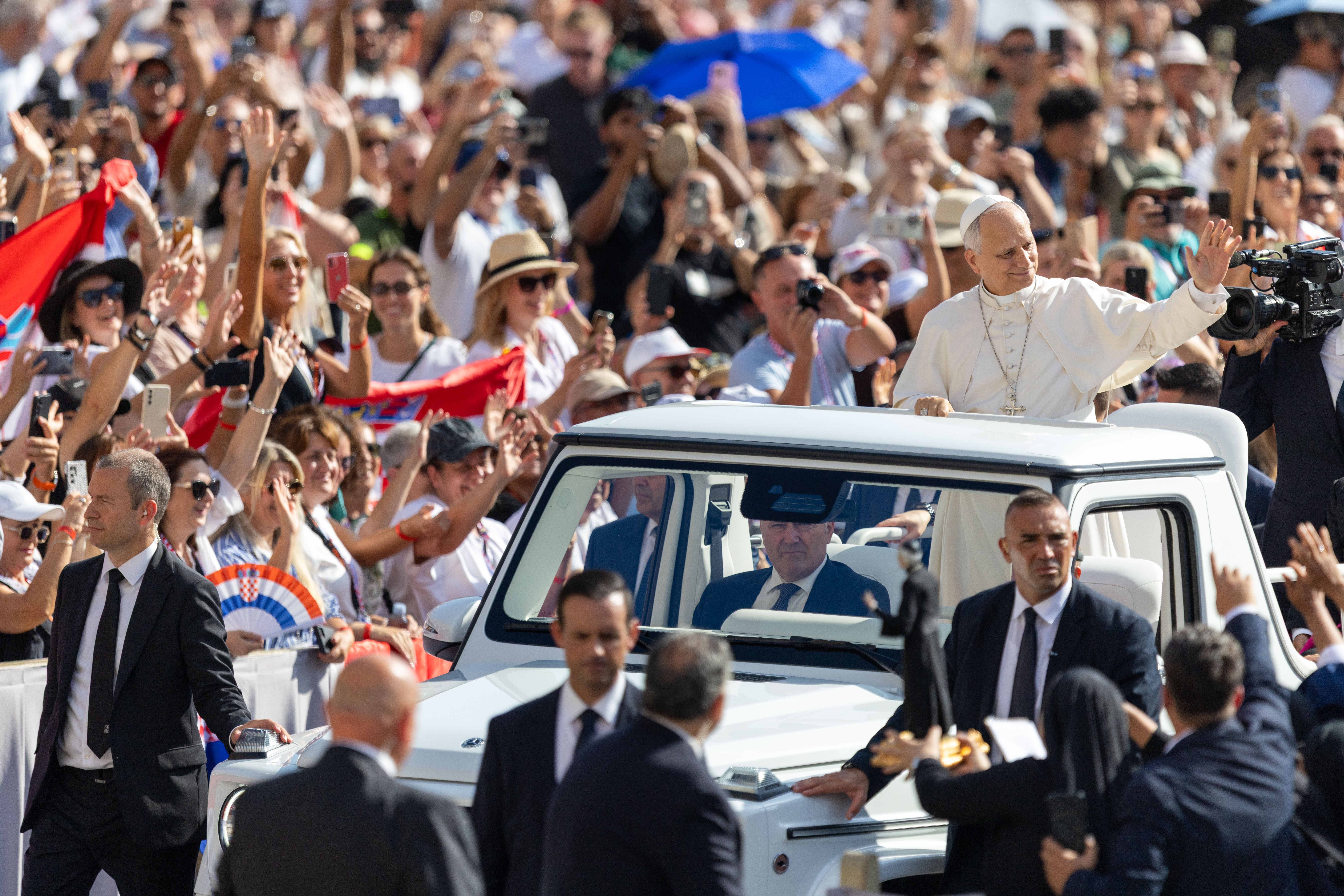
Pope Leo XIV then arrived in the popemobile to Piazza del Plebiscito, the main square of Naples, where authorities estimate about 50,000 people were present.
The pope’s address focused on peace and justice: a peace that “begins in the human heart, passes through relationships, takes root in neighborhoods and on the outskirts, and expands to embrace the entire city and the world.” A peace that needs justice “to be authentic” and that “can never be separated from charity.”
Leo also spoke about the “Neapolitan paradox:” on the one hand, the significant increase in tourism, which however struggles to correspond to “economic dynamism capable of truly involving the entire social community.” He described a city “marked by a social divide that no longer separates the center from the outskirts but is even evident within every area, with existential peripheries nested even in the heart of the historic center.” Faced with these disparities, Pope Leo XIV recalled the presence of the state as “more necessary than ever, to provide security and confidence to citizens and to take space away from organized crime.”
He then encouraged moving forward with the projects of hope taking shape in the city: “Gather your strength, work together, walk united — institutions, Church, and civil society — to connect the city, protect your children from the snares of hardship and evil, and restore to Naples its vocation to be a capital of humanity and hope.”
This story was first published in multipleparts by ACI Stampa, the Italian-language sister service of EWTN News. It has been translated and adapted by EWTN News English.
Pope Leo XIV on May 8 visited the historic Italian cities of Pompei and Naples, meeting with local citizens and clergy and celebrating Mass on the first anniversary of his election to the papacy.
The Holy Father visited the Pontifical Shrine of the Blessed Virgin of the Rosary of Pompei and met with the public before concelebrating the Eucharist in the Piazza Bartolo Longo.
Later, in Naples, he met with clergy and visited the Cathedral of the Assumption of Mary.
Here is a look in photos of Pope Leo XIVʼs activities in Pompei and Naples as he marked one year as pope:
A banner greets Pope Leo XIV as he arrives in the Italian city of Pompei on Friday, May 8, 2026. | Credit: Daniel Ibáñez/EWTN NewsPope Leo XIV deboards the papal helicopter as he arrives in the Italian city of Pompei on Friday, May 8, 2026. | Credit: Daniel Ibáñez/EWTN NewsPope Leo XIV greets crowds in Pompei, Italy, on Friday, May 8, 2026. | Credit: Vatican MediaPope Leo XIV greets crowds at the Pontifical Shrine of the Blessed Virgin of the Rosary of Pompei, Italy, on Friday, May 8, 2026. | Credit: Vatican MediaPope Leo XIV kisses a cross at the Pontifical Shrine of the Blessed Virgin of the Rosary of Pompei, Italy, on Friday, May 8, 2026. | Credit: Vatican MediaPope Leo XIV greets crowds at the Pontifical Shrine of the Blessed Virgin of the Rosary of Pompei, Italy, on Friday, May 8, 2026. | Credit: Vatican MediaPope Leo XIV greets a child at the Pontifical Shrine of the Blessed Virgin of the Rosary of Pompei, Italy, on Friday, May 8, 2026. | Credit: Vatican MediaPope Leo XIV concelebrates Mass in Piazza Bartolo Longo in the Italian city of Pompei, Italy, on Friday, May 8, 2026. | Credit: Daniel Ibáñez/EWTN NewsPope Leo XIV concelebrates Mass in Piazza Bartolo Longo in the Italian city of Pompei on Friday, May 8, 2026. | Credit: Daniel Ibáñez/EWTN NewsPope Leo XIV prays at the Cathedral of the Assumption of Mary in Naples, Italy, on Friday, May 8, 2026. | Credit: Vatican MediaPope Leo XIV speaks to Catholics at the Cathedral of the Assumption of Mary in Naples, Italy, on Friday, May 8, 2026. | Credit: Vatican MediaPope Leo XIV greets crowds at the Cathedral of the Assumption of Mary in Naples, Italy, on Friday, May 8, 2026. | Credit: Vatican MediaPope Leo XIV waves to crowds in Naples, Italy, on Friday, May 8, 2026. | Credit: Vatican MediaPope Leo XIV waves to crowds in the Piazza del Plebiscito in Naples, Italy, on Friday, May 8, 2026. | Credit: Vatican MediaPope Leo XIV greets crowds in the Piazza del Plebiscito in Naples, Italy, on Friday, May 8, 2026. | Credit: Vatican MediaPope Leo XIV greets crowds in the Piazza del Plebiscito in Naples, Italy, on Friday, May 8, 2026. | Credit: Vatican MediaPope Leo XIV smiles while visiting the Piazza del Plebiscito in Naples, Italy, on Friday, May 8, 2026. | Credit: Vatican Media
On May 8, 2025, white smoke billowed from the chimney on the roof of the Sistine Chapel, signaling that a new pope had been chosen. On that day, the world was introduced to Pope Leo XIV, known just hours before as Cardinal Robert Prevost, prefect of the Vatican’s Dicastery for Bishops.
One year later, Pope Leo has captured the hearts of the faithful through his papal trips, events like canonizations and special liturgies, as well as through his spoken and printed words, including an apostolic letter, and much more.
Here are 10 of the most significant events and moments of Leo XIV’s first year as pope:
The new pontiffʼs inaugural Mass
On May 18, 2025, Pope Leo XIV inaugurated his pontificate with a Mass in St. Peter’s Square calling for a united Church. Addressing approximately 150,000 attendees, he emphasized fraternal communion, servant leadership, and reconciliation, marking the official start of his ministry as the 266th successor of St. Peter.
At the Mass, concelebrated with the members of the College of Cardinals, Leo expressed his intention to “come to you as a brother, who desires to be the servant of your faith and your joy, walking with you on the path of God’s love, for he wants us all to be united in one family.”
Less than 48 hours after his election, Pope Leo made his first visit outside of the Vatican visiting the Shrine of the Mother of Good Counsel in Genazzano, located about an hour east of Rome and run by the religious of the Order of St. Augustine.
On his way back to the Vatican, the new pontiff stopped at the Basilica of St. Mary Major where he prayed before the tomb of Pope Francis and the icon of the Blessed Virgin Mary there, “Salus Populi Romani.”
Pope Leo left a white rose, which is said to have been Pope Francis’ favorite flower.
Impactful addresses to youth
Throughout his first year as pope, the Holy Father has had powerful experiences with young people. Two in particular that stand out are his addresses to roughly 1 million young adults during the Jubilee of Youth and his live talk with young people gathered at the National Catholic Youth Conference (NCYC).
During the Jubilee of Youth, which took place July 28–Aug. 3 and was part of the yearlong Jubilee of Hope, young adults from around the world filled the streets of Rome. Each day was filled with different opportunities and events for the young people to experience the richness of the Catholic faith.
On Aug. 2, Pope Leo was greeted by the largest crowd he had addressed during his pontificate so far for the evening vigil at Tor Vergata, an outdoor venue 10 miles east of Rome. An estimated 1 million people were in attendance. The Holy Father arrived by helicopter and then drove through the grounds on the popemobile, waving to the cheering young people before the prayer service began.
The Jubilee of Youth concluded on Aug. 3 with a Mass celebrated by Pope Leo on the 237-acre grounds of Tor Vergata, where more than a million young pilgrims had spent the night following a prayer vigil and Eucharistic adoration.
In his homily, Pope Leo invited the pilgrims to open their hearts to God and venture with him “towards eternity.”
Pope Leo XIV approaches Tor Vergata in Rome by helicopter on Saturday, Aug. 2, 2025. | Credit: Vatican Media
NCYC took place in Indianapolis at Lucas Oil Stadium from Nov. 20–22. On Nov. 21, Pope Leo held a historic digital encounter with American teenagers.
During this live conversation, five teenagers asked the pope questions regarding using technology, recovering from mistakes, giving worries to Jesus, avoiding distractions, and preparing for the future of the Church. The pope gave guidance to the young crowd with words applicable to both teenagers and the universal Church.
Pope Leo XIV speaks to teenagers during a digital encounter at Lucas Oil Stadium in Indianapolis during the 2025 National Catholic Youth Conference (NCYC) on Nov. 21, 2025. | Credit: Tessa Gervasini/CNA
Canonizations of Pier Giorgio Frassati and Carlo Acutis
On Sept. 7, 2025, Pope Leo canonized Pier Giorgio Frassati and Carlo Acutis in his first canonization ceremony before an estimated 70,000 people in St. Peter’s Square.
“Today we look to St. Pier Giorgio Frassati and St. Carlo Acutis: a young man from the early 20th century and a teenager from our own day, both in love with Jesus and ready to give everything for him,” he said during his homily.
He added: “Dear friends, Sts. Pier Giorgio Frassati and Carlo Acutis are an invitation to all of us, especially young people, not to squander our lives but to direct them upwards and make them masterpieces.”
Pope Leo XIV released his first apostolic letter, Dilexi Te, on Oct. 9, 2025. The document emphasizes the idea that the poor are not simply objects of charity but also evangelists who can prompt us to conversion through their example of weakness and reliance on God.
“The poor can act as silent teachers for us, making us conscious of our presumption and instilling within us a rightful spirit of humility,” Leo writes in Dilexi Te (“I Have Loved You”). “The elderly, for example, by their physical frailty, remind us of our own fragility, even as we attempt to conceal it behind our apparent prosperity and outward appearance. The poor … remind us how uncertain and empty our seemingly safe and secure lives may be.”
The pontiff quotes his predecessor throughout the document, which was first drafted during Pope Francis' pontificate and draws heavily on the late popeʼs first apostolic exhortation, Evangelii Gaudium, on the joy of the Gospel.
First major international trip: Turkey and Lebanon
Pope Leo made his first international papal trip to Turkey and Lebanon Nov. 27–Dec. 2, 2025. The wide-ranging international visit included historic ecumenical encounters, deeply symbolic gestures of prayer, and pastoral visits to Christian communities under pressure. Pope Leo highlighted the importance of unity, peace, and fraternity, and brought encouragement to a region marked by ancient faith and present suffering.
One highlight from his time in Turkey included the commemoration of the 1,700th anniversary of the Council of Nicaea alongside Ecumenical Patriarch Bartholomew I of Constantinople in the Turkish city of Iznik, the site of the Council of Nicaea, historically known as the birthplace of the Nicene Creed.
In Lebanon, Pope Leo became the first pope in history to visit the tomb of St. Charbel Makhlouf when he arrived at the Monastery of St. Maron in Annaya.
Pope Leo XIV reflects on the enduring message of St. Charbel Makhlouf at the hermit’s tomb at the Monastery of St. Maron, in Annaya, Lebanon, on Dec. 1, 2025. | Credit: Vatican Media
An extraordinary consistory
In his opening address at an extraordinary consistory — which convened from Jan. 7–8 — Pope Leo assured the cardinals from around the world gathered at the Vatican that “I am here to listen.”
This extraordinary consistory — different from the ordinary ones, which are more limited and frequent — was scheduled to take place immediately after the Jubilee of Hope to “offer support and advice to the Holy Father in the exercise of his high and arduous responsibility of governing the Church,” according to a statement from the Holy See.
The consistory was a closed-door meeting to which no media were admitted, and cardinals were asked to keep the proceedings confidential. However, the cardinals were expected to offer the new pontiff their views on two specific topics: the Synod and synodality, and the mission of evangelization and the missionary character of the Church.
First Holy Week and Easter celebrations as pope
During Holy Week and Easter 2026, Pope Leo presided over the Church’s most solemn liturgies in Rome, beginning with Palm Sunday and continuing through the chrism Mass on Holy Thursday, the Mass of the Lord’s Supper, the Good Friday Passion celebration, the Stations of the Cross at the Colosseum, the Easter Vigil at St. Peter’s Basilica, and finally Easter Sunday Mass with the “urbi et orbi” blessing from St. Peter’s Square.
This was the first time in several years that a pope participated in all the liturgies of Holy Week and Easter. Due to Pope Francis’ declining health toward the end of his papacy, he had to scale back his participation in many of these events.
Pope Leo was also the first pope since John Paul II in 1994 to carry the wooden cross to all 14 stations during the Stations of the Cross at the Colosseum on Good Friday.
Pope Leo XIV carries the cross during the Via Crucis at the Colosseum in Rome, Friday, April 3, 2026. | Credit: Daniel Ibáñez/EWTN News
Historic 11-day trip to Africa
Pope Leo spent 11 days in Africa — from April 13–23 — and visited four countries: Algeria, Cameroon, Angola, and Equatorial Guinea. During this trip, he traveled more than 11,000 miles on 18 separate flights. With stops in 11 cities across those countries, the Holy Father met with the youth, political leaders, prisoners, families, and many more to share the Gospel message.
Throughout his journey, he emphasized themes of peace, reconciliation, and economic justice, meeting with local leaders, clergy, and lay faithful. Large crowds gathered for outdoor Masses, reflecting the vibrancy and rapid growth of Catholicism in many African communities.
One of the highlights of the trip was Pope Leo’s visit to Annaba — ancient Hippo — in what for the Augustinian pontiff amounted to a return to the roots of his faith and vocation. Despite pouring rain, the pope walked through the ruins and, at the end of the route, laid a wreath of flowers and stopped for a moment of prayer, visibly moved.
The pope also paid a visit to the Bata penitentiary in Equatorial Guinea and told inmates that “no one is excluded from God’s love” and urged them to see that even behind bars, there remains the possibility of change, reconciliation, and hope. This prison is one of the country’s harshest, known for its difficult conditions.
Pope Leo XIV displays a crucifix while speaking to prisoners at Bata Prison, Equatorial Guinea, Wednesday, April 22, 2026. | Credit: Vatican Media
Strong messaging on war and peace
The Holy Father has made peace a defining theme of his pontificate from the very beginning, opening his first public remarks with the words “Peace be with you.” That simple greeting set the tone for a broader vision — one rooted in the Gospel but directed squarely at a world marked by conflict and division.
In homilies and international addresses, he has consistently framed peace not as the absence of war but as an active, daily commitment grounded in justice, reconciliation, and respect for human dignity.
The pope has urged world leaders to reject cycles of violence and instead foster what he has called a “culture of peace.” Speaking in the context of ongoing global tensions, he has warned against the normalization of war as a tool of policy, insisting that lasting solutions can only come through dialogue and mutual understanding.
The pope has also addressed the dangers of modern warfare, including the threat of nuclear escalation. He has called for renewed international efforts toward disarmament and de-escalation, emphasizing that the destructive power of nuclear weapons demands a moral as well as political response.
Reiterating the Church’s long-standing teaching, Pope Leo has encouraged nations to pursue diplomacy over aggression, presenting dialogue not as weakness but as the strongest and most enduring path to peace.