Pope Leo XIV met with the archbishop of Canterbury, Sarah Mullally, at the Vatican on Monday. Mullallyʼs first official visit to Rome as the spiritual leader of the Church of England comes amid strained ecumenical relations and division among Anglicans.
Mullally’s delegation for her April 25–28 visit included representatives from the Anglican Communion and the recently appointed Catholic archbishop of Westminster, Richard Moth.
A more difficult path to full communion
In his address to Mullally and her delegation on April 27, Leo said ecumenical dialogue between the Catholic Church and the Anglican Communion has recently become more challenging.
“While much progress has been made on some historically divisive issues, new problems have arisen in recent decades, rendering the pathway to full communion more difficult to discern,” Leo said. “I know that the Anglican Communion is also facing many of these same questions at this time. Nevertheless, we must not allow these continuing challenges to prevent us from using every possible opportunity to proclaim Christ to the world together.”
The pope added that it would be “a scandal if we did not continue to work towards overcoming our differences, no matter how intractable they may appear.”
Beyond Catholic-Anglican dialogue, Mullallyʼs election has further caused significant theological and ecumenical divides within the Anglican Communion, particularly regarding the ordination of women and sexuality.
Pope Leo has affirmed the Catholic Church’s teaching on a male-only priesthood. In the Anglican Communion, notable splits have arisen over the ordination of Mullally as a female bishop, particularly among the Global Anglican Fellowship of Confessing Anglicans (GAFCON) and other conservative branches of Anglicanism. In March, GAFCON announced its break with the See of Canterbury.
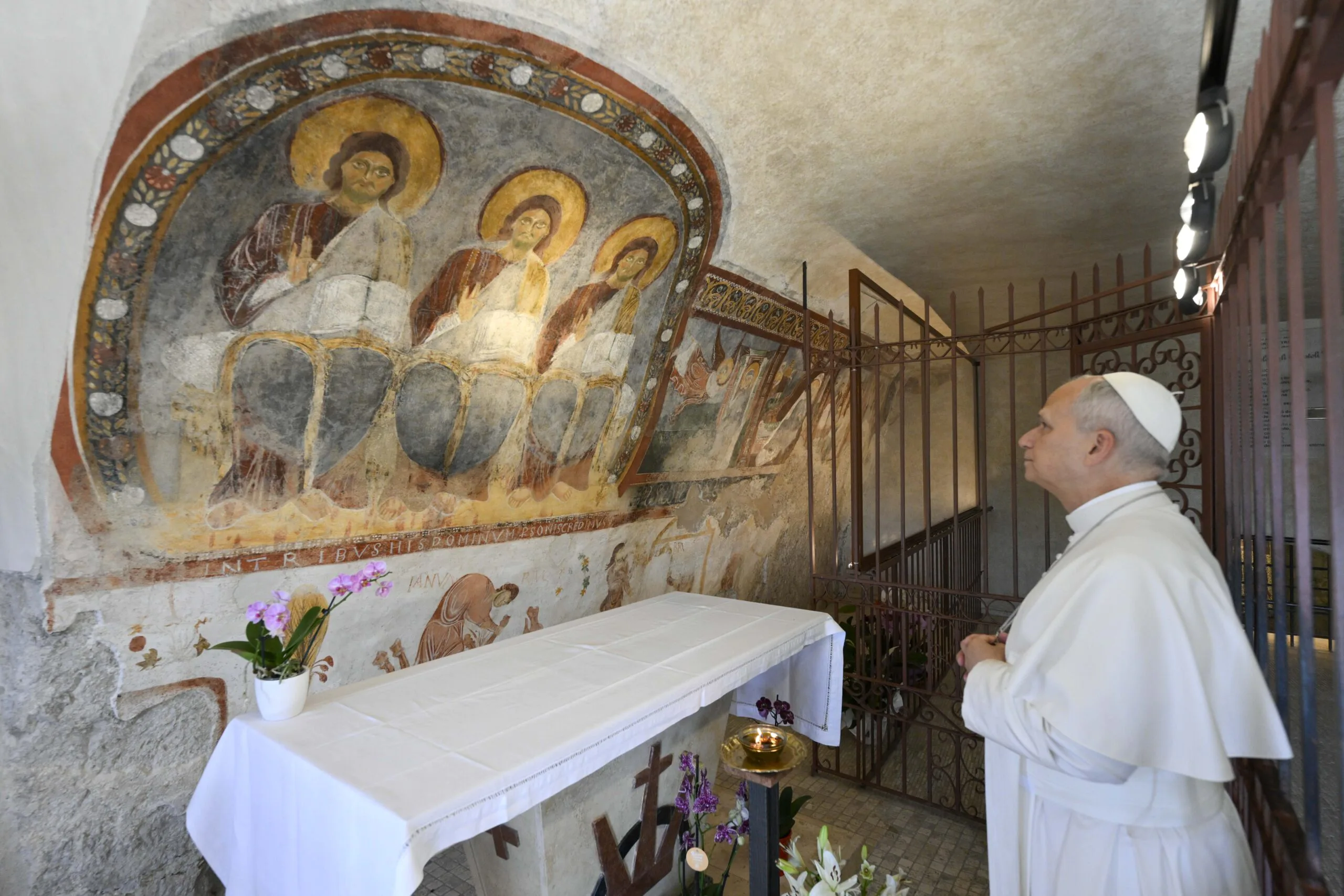
Pope Leo XIV and Archbishop of Canterbury Sarah Mullally pray the Liturgy of the Hours together in the Urban VIII Chapel of the Apostolic Palace on April 27, 2026. | Credit: Vatican Media
After their meeting, the pope and the archbishop recited daytime prayer, part of the Liturgy of the Hours, together in the Chapel of Urban VIII in the Apostolic Palace.
In her address to the pontiff, Mullally thanked him for the opportunity to pray together and encouraged mutual hospitality despite differences.
“In our ecumenical journey, I believe the Holy Spirit is inviting us into a deeper practice of hospitality, not simply as welcome, but as a form of ministry,” Mullally said. “As I begin this ministry, I hope to be a shepherd who loves and cares for the Church, who encourages hospitality despite our differences, who speaks prophetically into our present reality, and who proclaims Christian hope with the confidence that the Gospel of Jesus Christ remains good news for our world today.”
Over the weekend, Mullally also visited the Basilica of St. Paul Outside the Walls and St. Peter’s Basilica. On Monday evening, she will preside over choral evensong at the Church of St. Ignatius of Loyola, during which she will commission Bishop Anthony Ball as the archbishop of Canterbury’s official representative to the Holy See.
VATICAN CITY, April 26, 2026 — Pope Leo XIV ordained 10 new priests in St. Peter’s Basilica on Sunday, urging them to keep the doors of the Church open and to remember that their mission is to welcome, not to exclude.
“Today more than ever, especially when statistics seem to indicate a divide between people and the Church, keep the door open! Let people in, and be prepared to go out,” the pope said in his homily for the Mass on the Fourth Sunday of Easter, also known as Good Shepherd Sunday.
“This is another secret for your life: you are a channel, not a filter,” he told the ordinands.
Eight of the new priests were ordained for the Diocese of Rome, of which the pope is bishop: Guglielmo Lapenna, Giorgio Larosa, Jos Emanuele Nleme Sabate, Giovanni Emanuele Nunziante Salazar, Antonino Ordine, Yordan Camilo Ramos Medina, Daniele Riscica, and Cristian Sguazzino.
The pope also ordained Armando Roa Núñez, born in Mexico and incardinated in the Diocese of Miao in India, and Selwyn Pinto Loyce, born in Saudi Arabia and incardinated in the Institute of Christ the Redeemer, Idente Missionaries.
Reflecting on the Gospel in which Jesus says, “I am the gate,” Leo told the new priests to see themselves as servants of a suffering humanity that awaits abundant life.
“Never hide this holy door. Do not block it; do not be an obstacle to those who wish to enter,” he said. Quoting Jesus’ rebuke in Luke’s Gospel, he added: “You did not enter yourselves, and you hindered those who were entering.”
The pope said priestly ministry should be marked by communion and openness. “You belong to everyone and are for everyone!” he said. “Let this be the fundamental purpose of your mission: to keep the threshold open and direct others to it, without using too many words.”
Leo also urged the ordinands not to reduce Christian life to parish structures or ecclesial groups.
“The Church’s doors are open, but not to cut us off from life: life does not end in a parish, in an association, in a movement, in a group,” he said. “Whoever is saved can ‘go out and find pasture.’”
“Dear brothers, go out and discover culture, people and life!” the pope continued. “Marvel at the things that God makes grow without our having sown them.”
The pope also spoke about celibacy, comparing it to the love of spouses.
“Certainly, like the love of spouses, the love that inspires celibacy for the Kingdom of God must also be guarded and constantly renewed, for every true affection matures and becomes fruitful over time,” he said.
He told the new priests that the deeper their bond with Christ, “the more radical” their belonging to humanity becomes, adding that they are called to be “not only good priests but also honest, helpful citizens, builders of peace and social friendship.”
The pope warned against fear and the search for scapegoats, saying that the need for security today can make people aggressive and cause communities to close in on themselves.
“May your security not lie in the role you hold, but in the life, death and resurrection of Jesus as well as in your participation, along with your people, in the story of salvation,” he said.
The communities to which the priests will be sent, he said, are already places where the risen Christ is present.
“These communities will also help you to become saints!” Leo said. “For your part, help them to walk together, following Jesus, the Good Shepherd, so that they may become places — gardens — of life that rise anew and share themselves with others.”
He added: “Facilitating encounters, helping to bring together those who would otherwise never meet, and conciliating division is one and the same as celebrating the Eucharist and Reconciliation. Coming together always means planting the Church anew.”
Later on Sunday, before leading the Regina Caeli from the window of the Apostolic Palace, Pope Leo returned to the image of Jesus as the Good Shepherd and the gate of the sheepfold.
“Jesus does not come as a thief to take away our life and our freedom, but to lead us along the paths of righteousness,” he said. “He does not come to ensnare or deceive our conscience, but to illuminate it with the light of his wisdom. He does not come to taint our earthly joys, but to open them to a fuller and more lasting happiness.”
“Those who entrust themselves to him have nothing to fear,” the pope said, “for he does not deprive us of life, but comes to give it to us in abundance.”
Leo urged the faithful to be vigilant about who or what enters “the gate” of their hearts.
“‘Thieves’ can take many forms,” he said, citing those who “suppress our freedom or fail to respect our dignity,” as well as “beliefs and biases,” “mistaken ideas,” and “superficial and consumeristic lifestyles” that leave people empty inside.
He also pointed to those who harm humanity by “pillaging the earth’s resources, waging blood-thirsty wars, or fueling evil in any form,” saying they “do nothing but rob each of us of the possibility of a future marked by peace and serenity.”
The pope invited the faithful to examine their consciences: “Who do we want to guide us in life? Which ‘thieves’ have tried to break into our fold? Have they succeeded, or have we managed to ward them off?”
After the Regina Caeli, Leo recalled the 40th anniversary of the Chernobyl nuclear disaster, calling it a warning about the risks of powerful technologies.
“Let us entrust those who died and all who still suffer from the aftermath of the disaster to God’s mercy,” he said. “I hope that discernment and responsibility will always prevail at every level of decision-making so that all use of atomic energy may be placed at the service of life and peace.”
The pope also offered a special greeting to the relatives and friends of the new priests of the Diocese of Rome.
“Please continue to accompany these young ministers of the Gospel with your prayers,” he said.
This story was first published in two parts by ACI Prensa, EWTN News’ Spanish-language news partner. It has been translated and adapted by EWTN News English.
Pope Leo XIV recently completed an 11-day trip visiting the faithful in Algeria, Cameroon, Angola, and Equatorial Guinea. With stops in 11 cities across those countries, the Holy Father met with the youth, political leaders, prisoners, families, and many more to share the Gospel message.
Here are seven powerful moments from Pope Leo’s trip to Africa:
1. Moving visit to the land of St. Augustine
Pope Leo XIV traveled from Algiers to Annaba — ancient Hippo — in what for the Augustinian pontiff amounted to a return to the roots of his faith and vocation.
After a flight of about an hour, the pope arrived in the city most closely associated with St. Augustine, who served as bishop of Hippo from 396 to 430.
Despite pouring rain, the pope walked through the ruins and, at the end of the route, laid a wreath of flowers and stopped for a moment of prayer, visibly moved.
While in Algeria, the pope visited the Great Mosque of Algiers (Djamaa el Djazaïr), often referred to as the “Mosque of Algeria.” Featuring the world’s tallest minaret — rising approximately 265 meters (about 870 feet) — and ranking as the third-largest mosque after those in Mecca and Medina, the monumental complex can accommodate up to 120,000 worshippers.
The tradition of popes visiting mosques began with Pope John Paul II, who in 2001 became the first pope in history known to have entered a mosque when he visited the Great Mosque of Damascus in the capital of Syria.
Pope Leo addressed criticism directed toward him on April 15 on board the papal plane after leaving Algiers bound for Cameroon.
“I think the visit to the mosque was significant [and showed] that although we have different beliefs, we have different ways of worshipping, we have different ways of living, we can [still] live together in peace,” the Holy Father said.
“I think that to promote that kind of image is something which the world needs to hear today,” he said, arguing that such visits show that “together we can continue to offer in our witness as we continue on this apostolic voyage.”
3. Joy-filled children welcome Pope Leo in Cameroon
Pope Leo XIV was welcomed by the songs and dances of children at the Ngul Zamba Orphanage in Yaoundé, Cameroon.
“Dear children, I know that many of you have endured difficult trials. Some of you have known the pain of loss through the death of parents or loved ones. Others have experienced fear, rejection, abandonment, deprivation, and uncertainty. Yet, you are called to a future that is greater than your wounds. You are bearers of a promise," the pope said.
Run for 40 years by the religious congregation the Daughters of Mary, the Ngul Zamba Orphanage — whose name means “Strength of God” — provides food, lodging, and education to poor or abandoned children.
In another heartfelt moment, at the end of the afternoon Mass in Bamenda, Cameroon, as the pope was preparing to leave the airport and get into his car, a little girl ran up to hug him. This spontaneous gesture, amid the joy and emotion of the 20,000 present, captured the hearts of millions around the world.
While in Angola, Pope Leo took part in a rosary gathering at the Marian shrine of Mama Muxima.
The shrine, whose name means “Mother of the Heart” in Kimbundu, is one of Angola’s best-known Marian sanctuaries. Built by the Portuguese in the 17th century on a hill overlooking the Kwanza River, it has long been a place of pilgrimage and prayer for Angolan Catholics.
The crowd in attendance erupted into applause when the Holy Father spoke in Kimbundu, a Bantu language spoken in Angola.
He said: “Mama Muxima, tueza kokué, Mama Muxima, tutambululé,” which means: “Mother of the heart, we come to you; Mother of the heart, receive us.”
The Holy Father visited the Jean-Pierre Olié Psychiatric Hospital in Equatorial Guinea. With its six pavilions, it represents a major development in the treatment of mental illness in Equatorial Guinea, where psychiatric disorders were historically neglected. Founded in 2014, it is the country’s first modern center of its kind and has become a symbol of the national commitment to integrating patients into society.
The event included songs, dancing, and testimonies from both the hospital’s director and a patient, Pedro Celestino Nzerem Koose. A moving poem by a former patient was also recited.
“Whenever I visit a hospital, I have mixed feelings: on the one hand, I feel sorrow for the patients and their families. On the other, I admire and am comforted by all that is done there each day to serve human life,” the pope said in an address delivered in Spanish. “I feel the same way here, but today, I find — and I hope the same is true for you — that joy prevails. It is the joy of meeting in the name of the Lord and of caring for those who are in frail health.”
The pope paid a visit to the Bata penitentiary in Equatorial Guinea and told inmates that “no one is excluded from God’s love” and urged them to see that even behind bars, there remains the possibility of change, reconciliation, and hope.
This local prison is one of the country’s harshest and long known for difficult detention conditions.
One of the more than 600 inmates thanked the pope for his visit and support.
“We wish to thank you for your visit and your support,” the prisoner said. “Your presence reminds us of the importance of faith and redemption. We ask for your blessing to keep moving forward and to come out of this as better people. We are grateful for your compassion and for your message of hope.”
Pope Leo XIV celebrated the final Mass of his Africa trip at Malabo’s stadium, urging the Church in Equatorial Guinea to continue proclaiming the Gospel “with passion” and to bear witness through lives shaped by faith, service, and solidarity.
The Mass in the stadium, where about 30,000 faithful were expected, marked the pope’s last major public event in Equatorial Guinea, the fourth and final African nation on his 11-day journey.
After riding through the crowd in the popemobile, Leo began Mass amid flags, songs, and colorful hats, with music and dance accompanying the liturgy.
The Holy Father also prayed before an image of Our Lady of Bisila, mother and patroness of Equatorial Guinea.
Clothed in white and blue, carrying the child Jesus on her back in the traditional African way, the Virgin of Bisila shows a mother who walks with her people in every struggle and hope. According to local tradition, she appeared to a humble Bubi woman on Bioko Island in the early 20th century (exact year is not clearly attested), and love of her grew until she became the beloved icon of the nation’s Marian devotion.
The Diocese of Rome shared the testimonies of eight seminarians who, on April 26, Good Shepherd Sunday, will be ordained priests by Pope Leo XIV. Among them is Christian Sguazzino, who as a child was once kicked out of Mass by a priest because he was causing "chaos.”
Sguazzino, together with Deacon Danilo Defant and Sister Ester Maddalena Iapenna, will share their testimonies on Friday, April 24, at St. John Lateran Basilica, the cathedral church of Rome, during the prayer vigil for vocations.
Sguazzino discovered his vocation at St. John of the Cross Parish. “When I was a child — after having made my first Communion — I would go play soccer and then attend Mass every day, always bringing a friend along,” the future priest recounted.
“At that time, there wasn’t even a proper church building; instead, services were held in tents. My friends and I, naturally, caused a bit of chaos. So, one day the assistant pastor kicked us out and told us we would be excommunicated!” he shared with a smile.
Recalling that time of mischief, Sguazzino said that “even then — despite everything — I felt the joy of being in church; I loved looking at the altar and the tabernacle.” Along his journey, he emphasized, it was crucial to meet “so many priests who were happy to be priests. Their witness was fundamental.”
An uncle who was a priest always supported him
Yordan Camilo Medina is Colombian and has an uncle who is a priest. As a child, he recounted, “I used to accompany him to take Communion to the mountain communities, and the joy of the faithful upon receiving the body of Christ was incredible.”
“Now he, too, is in Rome, and I have followed him here on my path of priestly formation. He has always supported me,” he added.
He dreamed of becoming a friar
Giovanni Emanuele Nunziante is 32 years old. He was born in Rome but spent part of his childhood in England. “If I had to tell you how my vocation began, my earliest memory dates back to when I was a child,“ he said. ”I didn’t yet fully understand what it meant to be a priest, but I dreamed of being close to the Lord and toyed with the idea of becoming a friar. Then, it all faded into oblivion!”
The call returned with force in 2016, during the Fourth Sunday of Easter. “Upon hearing the Gospel of the Good Shepherd, that desire to be close to the Lord in a special way returned … I realized that my deepest desire was to offer my life just as Jesus did — the Good Shepherd,” he said.
The influence of the Neocatechumenal Way
Antonino Ordine, 27, related that his vocation was born within the faith formation program known as the Neocatechumenal Way: “I was born and raised in a very practicing family, and this led me to appreciate the beauty of the work the Church carries out on a daily basis. I was fortunate enough to meet priests and missionary families especially during a mission in Sweden who were fundamental to my discernment.”
He had wanted to become a doctor and after having served on missions in Latin America, the Middle East, and India, he realized that God was calling him to give himself completely out of love for him.
He was born in Africa into a non-Catholic family
Jos Emanuel Nleme Sabate was born in Cameroon. “My father was Protestant and we often prayed at home,” he said. “When I was 11 years old, I entered the minor seminary of my home diocese because it had a reputation as an excellent school. It was there that I learned about Catholicism.”
“I was baptized at the age of 12 and I believe it was during that rite, which was unfamiliar to me at the time, that I decided to become a priest,” he shared. He is now studying sign language and helping people with disabilities.
He was a pianist of international stature
“I come from a Catholic family,” Daniele Riscica related, “and I have always participated in parish activities; however, I studied at the Frosinone Conservatory and completed my piano studies in classical music. From there, I continued my career as a concert pianist.”
Regarded as a rising star of the international piano scene by the age of 24, he said, “I had already achieved many goals in life, yet I was not satisfied. I felt that God was calling me to something more. So I tried entering the seminary — almost as a test … and there I felt happy.”
He is grateful for his parents' faith
Giorgio Larosa is 30 years old and said that his “vocation was born out of attending the parish, thanks to the faith my parents instilled in me.”
His parents' example, as well as “the example of other Christians, laypeople and priests, was also very powerful. In their stories, I saw the power of the Gospel,” he recounted.
He left his job and entered the seminary
Guglielmo Lapenna is 35 years old and worked in a liquor factory before beginning his formation for the priesthood.
“During World Youth Day 2016 in Kraków, I decided to leave my job and enter the seminary,” he shared, adding: “And the Lord has reaffirmed my vocation every day.”
This story was first published by ACI Prensa, the Spanish-language sister service of EWTN News. It has been translated and adapted by EWTN News English.
ABOARD THE PAPAL FLIGHT — Pope Leo XIV spoke bluntly about war, migration, same-sex blessings, and the Holy See’s relations with authoritarian governments during a roughly 20-minute in-flight press conference with journalists traveling with him from Malabo, Equatorial Guinea, to Rome after his apostolic journey to Africa.
Before taking questions, the pope stressed that the primary purpose of a papal trip is pastoral rather than political.
“When I make a trip — speaking for myself, but today as pope, bishop of Rome — especially an apostolic, pastoral trip, it is to find, accompany, and come to know the people of God,” he said.
He added that such journeys should be understood above all as “an expression of wanting to announce the Gospel, proclaim the message of Jesus Christ,” and as a way “to draw close to the people in their happiness, in the depth of their faith, but also in their suffering.”
Asked about the chaotic state of negotiations aimed at ending the conflict involving Iran, Israel, and the United States, the pope called for a new mindset rooted in peace rather than violence.
“Certainly, I would like to begin by saying that we need to promote a new attitude, a culture of peace,” he said. “Many times when we evaluate certain situations, the immediate response is that we must enter with violence, with war, by attacking, and we have seen that many innocent people have died.”
Leo said the key question was not simply whether a regime should change but how to defend important values without more innocent victims.
“Regime change or no regime change, the question is how to promote the values in which we believe without the death of so many innocent people,” he said.
Describing the situation as “very complex,” the pope said the back-and-forth of negotiations had created “this chaotic and critical situation for the world economy,” while innocent people in Iran were suffering because of the war.
“Rather, I would encourage the continuation of dialogue for peace,” he said. “As Church, I say again, and as a pastor, I cannot be in favor of war, and I would like to encourage everyone to make every effort to seek responses that come from a culture of peace and not of hatred.”
Later in the exchange, responding to a question about reported executions by the Iranian regime, the pope issued an unequivocal condemnation.
“I condemn all actions that are unjust, I condemn the taking of people’s lives. I condemn capital punishment,” Leo said. “I believe that human life is to be respected, and that all people from conception to natural birth, their lives should be respected and protected. So when a regime, when a country, takes decisions which takes away the lives of other people unjustly, then obviously that is something that should be condemned.”
On migration, a major topic ahead of his next international apostolic journey to Spain, the pope said governments have the right to regulate their borders but insisted that wealthier nations must also address the deeper causes driving people to leave poorer countries.
“Evidently, the issue of migration is very complex and affects many countries, not only Spain, not only Europe, but also the United States; it is a global phenomenon,” he said.
Leo continued: “I personally believe that a state has the right to establish rules at its borders. I do not like the idea that everyone enters as if there were no order, and at times creating even more unjust situations than those they had left behind.”
At the same time, he challenged richer countries and multinational corporations to do more for developing nations, especially in Africa.
“But having said that, I ask: What are we doing in richer countries to change the situation in poorer countries?” he said. Referring to Africa, he added that for many people it is seen as “a place where one can go to take minerals, to take its riches, to enrich others in other countries.”
The pope insisted that migrants must always be treated with dignity.
“When people arrive, they are human beings and they deserve the respect that every human being deserves because of human dignity,” he said. “We need to treat human beings in a humane way and not treat them worse than household pets, animals, etc.”
A French journalist asked Leo how he avoids lending moral legitimacy to authoritarian rulers when he meets them during papal trips. The pope said such encounters can be interpreted in different ways, but he returned to the pastoral purpose of travel and the diplomatic mission of the Holy See.
“Certainly, the presence of a pope with any head of state can be interpreted in different ways,” he said. “I would go back to something I said in my initial remarks about the importance of understanding the primary purpose of the travel that I do, that the pope does to visit the people.”
He also defended the Vatican’s continued diplomatic engagement even with difficult governments.
“We don’t always make great proclamations, criticizing, judging, or condemning,” he said. “But there’s an awful lot of work that goes on behind the scenes to promote justice, to promote humanitarian causes.”
That work, he said, can include efforts to free political prisoners and respond to hunger and sickness. “So the Holy See, by maintaining if you will, a neutrality, and looking for ways to continue our positive diplomatic relationship with so many different countries, we’re actually trying to find a way to apply the Gospel to concrete situations, so that the lives of people can be improved.”
Questioned about the blessing of same-sex couples after a decision by German Cardinal Reinhard Marx in Munich and Freising, Leo said Church unity should not be reduced to sexual ethics.
“First of all, I think it’s very important to understand that the unity or division of the Church should not revolve around sexual matters,” he said. “We tend to think that when the Church is talking about morality, that the only issue of morality is sexual, and in reality, I believe there are much greater and more important issues, such as justice, the equality, freedom of men and women, freedom of religion, that would all take priority before that particular issue.”
Leo said the Holy See had already made clear to the German bishops that it does not agree with the “formalized blessing of couples,” including homosexual couples or couples in irregular situations, beyond what Pope Francis had permitted.
Invoking Francis’ well-known statement of “Tutti, tutti, tutti,” Leo said: “All are welcome, all are invited. All are invited to follow Jesus, and all are invited to look for conversion in their lives.”
“To go beyond that today, I think that the topic can cause more disunity than unity,” he added, “and that we should look for ways to build our unity upon Jesus Christ and what Jesus Christ teaches.”
This story was first published by ACI Stampa, the Italian-language sister service of EWTN News. It has been translated and adapted by EWTN News English.
Pope Leo XIV departed Africa and returned to Rome on April 23, concluding an 11-day visit to several countries that marked his first visit as pope to the continent.
The Holy Father departed Equatorial Guinea after saying Mass at the coastal nationʼs Malabo Stadium. He had earlier visited Algeria, Cameroon, and Angola throughout mid-April.
Hereʼs a look at Leo XIVʼs departure from Africa and return home:
Pope Leo XIV waves from the popemobile at Malabo Stadium in Equatorial Guinea, Thursday, April 23, 2026. | Credit: Vatican MediaCatholics smile during Mass with Pope Leo XIV at Malabo Stadium in Equatorial Guinea, Thursday, April 23, 2026. | Credit: Vatican MediaPope Leo XIV greets the faithful during Mass at Malabo Stadium in Equatorial Guinea, Thursday, April 23, 2026. | Credit: Vatican MediaPope Leo XIV greets a family during Mass at Malabo Stadium in Equatorial Guinea, Thursday, April 23, 2026. | Credit: Vatican MediaPope Leo XIV holds the chalice aloft during Mass at Malabo Stadium in Equatorial Guinea, Thursday, April 23, 2026. | Credit: Vatican MediaPope Leo XIV presides over Mass at Malabo Stadium in Equatorial Guinea, Thursday, April 23, 2026. | Credit: Vatican MediaCrowds pray the Mass with Pope Leo XIV at Malabo Stadium in Equatorial Guinea, Thursday, April 23, 2026. | Credit: Vatican MediaPope Leo XIV stands beneath a towering crucifix during Mass at Malabo Stadium in Equatorial Guinea, Thursday, April 23, 2026. | Credit: Vatican MediaPope Leo XIV views a statue of the Virgin Mother and Christ Child at Malabo Stadium in Equatorial Guinea, Thursday, April 23, 2026. | Credit: Vatican MediaPope Leo XIV participates in a farewell ceremony at the Malabo International Airport in Equatorial Guinea before leaving the country to fly back to Rome at the conclusion of his 11-day Africa trip on April 23, 2026. | Credit: Vatican MediaPope Leo XIV speaks aboard the papal plane from Malabo, Equatorial Guinea, to Rome, following an 11-day trip in Africa, April 23, 2026. | Credit: Patrick Leonard/EWTN NewsPope Leo XIV speaks to journalists aboard the papal plane to Rome, Thursday, April 23, 2026. | Credit: Vatican Media
MALABO, Equatorial Guinea — Pope Leo XIV celebrated the final Mass of his Africa trip on Thursday, urging the Church in Equatorial Guinea to continue proclaiming the Gospel “with passion” and to bear witness through lives shaped by faith, service, and solidarity.
The Mass at Malabo’s stadium, where about 30,000 faithful were expected, marked the pope’s last major public event in Equatorial Guinea, the fourth and final African nation on his 11-day journey.
After riding through the crowd in the popemobile, Leo began Mass amid flags, songs, and colorful hats, with music and dance accompanying the liturgy.
Before delivering his homily, the pope greeted the Archdiocese of Malabo and offered condolences for the recent death of its vicar general, Father Fortunato Nsue Esono, who died unexpectedly April 17 at age 39.
“We remember him in this Eucharist,” Leo said. “I invite you to live this moment of sorrow with a spirit of faith, and I trust that full light will be shed on the circumstances of his death.”
In his homily, preached in Spanish, the pope reflected on the day’s Scripture readings, especially the account in the Acts of the Apostles of the deacon Philip and the Ethiopian eunuch.
“When the deacon Philip approached a traveler who was returning from Jerusalem to Africa, he asked, ‘Do you understand what you are reading?’” the pope said. “The pilgrim, a eunuch of the Queen of Ethiopia, replied immediately with humble wisdom: ‘How can I, unless someone guides me?’ His question is not only a search for truth, but also an expression of openness and desire.”
Leo said the figure of the eunuch reveals both human suffering and the liberating power of the Gospel.
“Yet, as he returns to his homeland of Africa, which for him has become a place of servitude, the proclamation of the Gospel sets him free,” the pope said. “Through his encounter with Philip, a witness of the crucified and risen Christ, the eunuch is transformed from a mere reader — a spectator — of Scripture into a protagonist in the very story that captivates him, because it now concerns him personally.”
“This African man thus enters into Scripture, which welcomes every reader who seeks to understand God’s word,” Leo continued. “He steps into salvation history, which embraces every man and woman, especially the oppressed, the marginalized and the least among us.”
The pope said Christians today, like the Ethiopian eunuch, read Scripture not in isolation but within the life of the Church.
“Together we read Scripture as the shared heritage of the Church, guided by the Holy Spirit, who inspired its composition, and by Apostolic Tradition, which has preserved and transmitted it throughout the world,” he said. “Like the eunuch, we too can come to understand the Word of God with the help of a guide who accompanies us on our journey of faith.”
Turning to the Gospel of John and Jesus’ teaching on the bread of life, Leo said Christ fulfills God’s saving work in history and leads every people out of slavery.
“Through Jesus’ Passover, the definitive exodus, every people is set free from the slavery of evil,” he said.
The pope also stressed that Christian faith does not erase suffering but illuminates it with hope.
“Our problems do not disappear in the Lord’s presence, but they are illuminated,” he said. “Just as every cross finds redemption in Jesus, so too the story of our lives finds its meaning in the Gospel.”
Quoting Pope Francis’ Evangelii Gaudium, Leo warned against spiritual self-absorption and called the faithful to keep making room for the poor, for God’s voice, and for the quiet joy of his love. He said it is precisely the Lord’s love that sustains Christians in the service of justice and solidarity.
He concluded by encouraging the local Church to continue its evangelical mission with joy.
“For this reason, I encourage all of you, as the living Church in Equatorial Guinea, to carry on the mission of Jesus’ first disciples with joy,” Leo said. “As you read the Gospel together, proclaim it with passion, just as the deacon Philip did. And as you celebrate the Eucharist together, bear witness through your lives to the faith that saves, so that God’s word may become good leaven for all.”
This story was first published by ACI Stampa, the Italian-language sister service of EWTN News. It has been translated and adapted by EWTN News English.
MONGOMO, Equatorial Guinea — Pope Leo XIV on Wednesday urged Catholics in this Central African country to help shape the nation’s future, saying there is “a need for Christians to take the destiny of Equatorial Guinea into their own hands.”
The second day of the pope’s apostolic journey in the country opened with the celebration of Mass at the Basilica of the Immaculate Conception in Mongomo. The Immaculate Virgin is patroness of Equatorial Guinea.
The basilica is the largest religious building in central Africa and the second-largest basilica on the continent, after the Basilica of Our Lady of Peace in Yamoussoukro, Ivory Coast.
Pope Leo XIV processes into Mass at the Basilica of the Immaculate Conception in Mengomeyén, Equatorial Guinea, on Wednesday, April 22, 2026. | Credit: Vatican Media
Emotion and affection for the pope were palpable before the Mass.
“I feel great joy at the arrival of the Holy Father in our country,” said Emmanuel, a young man from Mongomo who came to attend the Mass.
“I am here with my fellow citizens, waiting for the pope’s arrival. And I am very moved,” added Pedro Ngema outside the basilica.
Before celebrating Mass, Leo greeted a group of children, and together they released balloons tied in the shape of a rosary into the sky. He then blessed the foundation stone for the future cathedral of Ciudad de la Paz. In brief spontaneous remarks, he thanked those present and said it was “wonderful” to be united in praising the Lord. He said he wanted to ask God’s blessing on those gathered, on their families, and on the foundation stone that would mark the beginning of the future cathedral.
Pope Leo XIV along with children releases balloons in the shape of a rosary into the sky outside the Basilica of the Immaculate Conception in Mengomeyén, Equatorial Guinea, on Wednesday, April 22, 2026. | Credit: Vatican Media
“We want to renew our faith,” the pope said. “We want to renew our commitment to follow Jesus Christ faithfully in his Church, in the Catholic Church.”
In his homily, the pope began by reflecting on the Eucharist.
“The Eucharist truly contains every spiritual good of the Church: It is Christ, our Passover, who gives himself to us, he is the living Bread that nourishes us,” Leo said. “His presence in the Eucharist reveals God’s infinite love for the entire human family and the way he encounters every woman and every man even today.”
The pope said he was pleased to celebrate with the faithful and “give thanks to the Lord for these 170 years of evangelization in Equatorial Guinea.”
“It is a fitting occasion to recall all the good that the Lord has done,” he said, “and at the same time, I wish to express my gratitude to the many missionaries, diocesan priests, catechists, and lay faithful who have devoted their lives in service to the Gospel.”
Pope Leo XIV celebrates Mass at the Basilica of the Immaculate Conception in Mengomeyén, Equatorial Guinea, on Wednesday, April 22, 2026. | Credit: Vatican Media
He praised those missionaries for their witness, saying: “Through the example of their lives, they have played their part in bringing about the kingdom of God, unafraid of suffering for their fidelity to Christ.”
“It is a history that you must never forget,” the pope continued. “On the one hand, it links you to the universal and apostolic Church that came before you. On the other, it has made you protagonists in proclaiming the Gospel and bearing witness to the faith.”
Leo said Catholics in the country are now called to continue along that path.
“Each and every one of you is invited to make a personal commitment that encompasses your entire life, so that the faith — celebrated so joyfully in your communities and in your liturgies — may also nourish your charitable works and the sense of responsibility toward your neighbor, for building up the common good,” he said.
Pope Leo XIV incenses the altar during Mass at the Basilica of the Immaculate Conception in Mengomeyén, Equatorial Guinea, Wednesday, April 22, 2026. | Credit: Vatican Media
“Such a commitment requires perseverance; it demands effort and, at times, sacrifice. Yet it is the sign that we are truly the Church of Christ,” he added.
The pope acknowledged that personal, family, and social circumstances are not always favorable but urged the faithful to remain steadfast.
“Even when faced with personal, family, and social situations that are not always favorable, we can trust that the Lord is at work, making the good seed of his kingdom grow in ways unknown to us, including when everything around us seems barren, and even in moments of darkness,” he said.
“With such confidence, rooted in the power of his love rather than in our own merits, we are called to remain faithful to the Gospel, to proclaim it, to live it fully and to bear witness to it with joy.”
Pope Leo XIV greets Catholics during Mass at the Basilica of the Immaculate Conception in Mengomeyén, Equatorial Guinea, on Wednesday, April 22, 2026. | Credit: Vatican Media
Recalling the motto of his apostolic journey — “Christ, Light of Equatorial Guinea, Towards a Future of Hope” — Leo said the country’s deepest hunger today is “for a future imbued with hope that is capable of engendering a new sense of justice and producing fruits of peace and fraternity.”
“This is not an unknown future that we must passively await but rather one that we ourselves are called to build with God’s grace,” he said. “The future of Equatorial Guinea depends upon your choices; it is entrusted to your sense of responsibility and to your shared commitment to safeguarding the life and dignity of every person.”
The pope then called all the baptized to active participation in the Church’s mission and in the country’s development.
“It is therefore necessary for all the baptized to feel that they are part of the work of evangelization, and so become apostles of charity and witnesses to a new humanity,” he said.
Pope Leo XIV speaks during Holy Mass at the Basilica of the Immaculate Conception in Mengomeyén, Equatorial Guinea, Wednesday, April 22, 2026. | Credit: Vatican Media
“The Creator has endowed you with great natural wealth: I urge you to work together so that it may be a blessing for all,” he continued.
Leo concluded with an appeal for a more just society, one in which all work “to serve the common good rather than private interests, bridging the gap between the privileged and the disadvantaged.”
“May there be greater room for freedom, and may the dignity of the human person always be safeguarded,” he said. “My thoughts go to the poorest, to families experiencing difficulty and to prisoners who are often forced to live in troubling hygienic and sanitary conditions.”
Then came the line at the heart of the homily: “Brothers and sisters, there is a need for Christians to take the destiny of Equatorial Guinea into their own hands.”
Pope Leo XIV gives his homily during Mass at the Basilica of the Immaculate Conception in Mengomeyén, Equatorial Guinea, on Wednesday, April 22, 2026. | Credit: Vatican Media
“For this reason, I would like to encourage you: Do not be afraid to proclaim the Gospel and bear witness to it with your lives!” the pope said. “Be builders of a future of hope, peace, and reconciliation, carrying on the work begun by the missionaries 170 years ago.”
Among those reflecting on the pope’s visit was Ndende Njoya Soulemanou, founder and director of the Francophone Institute of Bata, who said Leo’s repeated emphasis on peace during his African journey had especially struck him.
“One word struck me above all during his passage through Cameroon, Angola, and here in Equatorial Guinea,” Soulemanou said. “That word is peace — peace in capital letters. Hearing that word went straight to my heart.”
After Mass, the pope walked to the nearby Pope Francis Technical School for a brief visit to the training center named after his immediate predecessor. In the afternoon, his schedule was set to continue in Bata.
This story was first published by ACI Stampa, the Italian-language sister service of EWTN News. It has been translated and adapted by EWTN News English.
A new automation system for the telescope at the Holy See’s astronomical observatory in Arizona will allow students from Jesuit universities to use it remotely for scientific research.
Mount Graham in Arizona is home to the Vatican Advanced Technology Telescope (VATT), one of the most important observatories managed by the Vatican Observatory (Specola Vaticana).
According to a statement issued by the Governorate of Vatican City State, the robotization and automation of the telescope were recently completed successfully thanks to donations from the Thomas Lord Charitable Trust philanthropic foundation.
The automation was also made possible thanks to donations from Kim Bepler, who specifically supports various Jesuit initiatives and serves on the board of trustees of Fordham University.
Astronomers will now be able to operate the telescope remotely, without the need to be physically present on the mountain. In fact, astronomers from the Vatican observatory at Castel Gandolfo in Italy are already making use of this new feature.
The new automation system is named “Don” in memory of Donald Alstadt, a renowned figure in the field of philanthropy dedicated to supporting scientific research, particularly through the Thomas Lord Charitable Trust.
The idea to automate the telescope emerged following a meeting held last January between Bepler; the director of the Vatican Observatory, Father Richard D’Souza; and the president of the Vatican Observatory Foundation, Brother Guy Consolmagno.
Their objective was to develop a program to connect the VATT with Castel Gandolfo and enable its use at Jesuit universities worldwide, particularly those that normally lack access to an advanced research telescope.
To launch the project, Bepler offered “a generous contribution in honor of Father Joseph M. McShane, president emeritus of Fordham University and a member of the development committee of the Vatican Observatory Foundation.”
This story was first published by ACI Prensa, the Spanish-language sister service of EWTN News. It has been translated and adapted by EWTN News English.
Rome remembered Pope Francis' legacy one year after his death with a Mass on Tuesday at the Basilica of St. Mary Major, where the late pontiff is buried.
The same day, while en route to Equatorial Guinea to wrap up his trip to Africa, Pope Leo XIV remembered Pope Francis on the first anniversary of his death, highlighting his predecessorʼs “solidarity with the poorest, the most vulnerable, the sick, children, and the elderly.”
Cardinal Rolandas Makrickas, archpriest of the Basilica of St. Mary Major, sprinkles holy water on the tomb of Pope Francis at the aforementioned basilica in Rome on April 21, 2026. | Credit: Daniel Ibanez/EWTN News
Cardinal Giovanni Battista Re, dean of the College of Cardinals, celebrated the Mass with other cardinals and clergy resident in Rome. He read Leoʼs message at the Mass, in which the pope recalled Francis' missionary zeal.
“He was also a missionary, proclaiming the Gospel of mercy ‘to everyone, everyone, everyone,’” Leo wrote. “In harmony with his predecessors, he took up the legacy of the Second Vatican Council and urged the Church to be open to mission, a guardian of the world’s hope, passionate about proclaiming that Gospel which is capable of giving every life fulfillment and happiness.”
Cardinal Giovanni Battista Re, dean of the College of Cardinals, preaches at Mass for the first anniversary of the death of Pope Francis at the Basilica of St. Mary Major in Rome on April 21, 2026. | Credit: Daniel Ibanez/EWTN News
Re described Leoʼs message as an invitation to preserve the legacy of Pope Francis, rooted in his “exhortation to build bridges and not walls.”
“The heart of this message seems to me a vibrant invitation to preserve the spiritual legacy of the late Pope Francis. A legacy summarized, as we have heard, through several of his key phrases: ‘the joy of the Gospel,’ ‘the mercy of God,’ ‘the smell of the sheep,’” Re said.
A special plaque commemorating the visits of Pope Francis to the Marian icon “Salus Populi Romani” is displayed at the Basilica of St. Mary Major in Rome on April 21, 2026. | Credit: Daniel Ibanez/EWTN News
Before the Mass, a special plaque was blessed and unveiled to commemorate Francis' many visits to the Basilica of St. Mary Major. During his life, Francis frequently visited the basilica to venerate the Marian icon “Salus Populi Romani” and expressed his wish to be buried in the church near the icon.
The Mass was also attended by several ambassadors accredited to the Holy See, including Irish Ambassador Frances Collins and U.S. Ambassador Brian Burch.
After the Mass, all the cardinals processed to Francis' tomb for the final prayer, delivered by Cardinal Rolandas Makrickas, archpriest of the basilica.
Commending the late pontiff to the mercy of God, Makrickas recalled that “hope does not disappoint,” a tribute to the papal bull with which Francis inaugurated the Jubilee Year 2025, which drew over 20 million people to St. Mary Major and his tomb.