Pope Leo XIV assured his prayers “for all parents who suffer the loss of a child, especially a baby,” on the occasion of the upcoming Day for Life, which will be celebrated in England, Wales, Scotland, and Ireland this coming Sunday, June 21.
In a message signed by Vatican Secretary of State Cardinal Pietro Parolin, the pope said he is praying that these parents “find consolation and peace in the knowledge of God’s love for them” and for the child they have lost.
“This divine love gives meaning to the life of every person and, far from ending with death, invites us to a new fullness in eternity,” the pontiff affirmed.
According to a statement from the Irish Bishops’ Conference, Pope Leo XIV also sent his best wishes and prayers to all those participating in this day of prayer, which is centered on “wonder at the full humanity of the child in the mother’s womb” as well as the efforts made to support mothers and fathers who have suffered the loss of a baby.
He also urged parents to find the support they need in the Church community, “especially in a life nourished by prayer and the sacraments.”
‘Wonder at the child in the mother’s womb’
Organized under the title “Wonder at the Child in the Mother’s Womb,” the Day for Life, which always falls on Father’s Day, recalls that every human being is endowed with infinite dignity from the very moment of conception, “simply by existing, by having been wanted, created, and loved by God,” as the pope recalled in his recent encyclical Magnifica Humanitas.
The Bishops’ Conferences of England, Wales, Scotland, and Ireland recalled in their statement that fatherhood “is a vocation full of joys and hopes, but also of sorrows and concerns.”
The bishops wished to specially acknowledge the pain of parents who have lost a child before birth or during infancy and to offer them a message of hope and consolation: that of fullness in eternity.
The Church wants to be especially close to these parents, according to the bishops, who emphasized the need for spiritual and pastoral accompaniment as parents face physical and psychological consequences, as well as the feeling of powerlessness in not knowing how to support their family or how to express their own grief.
The bishops also recalled that “God has created, wanted, and deeply loved from all eternity every child, including those who lose their lives before birth or shortly afterward.”
The prelates emphasized that the word of God “reveals the sacred humanity of the unborn child” and that parents therefore understand how precious and unique the child they have lost is: “They know that no other child will ever be able to replace him,” they affirmed.
From this perspective, the bishops denounced the inconsistency of describing life in the mother’s womb as a mere cluster of cells. “How can that life be someone so loved and valuable to their parents and, at the same time, be considered something worthless and disposable?” they asked.
The prelates insisted that science is clear in stating that life begins at the moment of fertilization. “The more we learn from science, the more we understand the Church’s teaching on the unique value of the unborn child,” they highlighted.
They further recalled that every human being is not only a body “but also an immortal soul, with a unique and eternal relationship with God, our Creator,” which is why the unborn child “deserves full protection under the law.”
They emphasized that the Church “has always rejected voluntary abortion” and committed themselves to “work and pray so that our society values the life of every child,” especially in the earliest stages of human existence.
This story was first published by ACI Prensa, the Spanish-language sister service of EWTN News. It has been translated and adapted by EWTN News English.
Pope Leo XIV dedicated his general audience on June 17 to reflecting on his apostolic journey to Spain the previous week, during which he visited Madrid, Barcelona, and the Canary Islands.
In his remarks, the pope praised Spainʼs "very rich Catholic tradition" and highlighted the countryʼs “joyful expression of their faith" as well as the affection shown to him by the people.
“In the case of Spain, I was able to observe with joy how much people of every age and situation were looking forward to the pope’s visit: Everywhere I found multitudes who welcomed me with great warmth,” Leo remarked, acknowledging that this was not something to be taken for granted.
Safeguarding encounter between Catholic tradition, contemporary culture
Referring to the events in Madrid and Barcelona during his trip to Spain, the pope also described his trip as an “encounter of ancient and modern, Catholic tradition and contemporary culture,” allowing him to experience “the very character of Europe, its inestimable wealth, as a living reality, not a thing of the past.”
Leo also said that Europeʼs cultural heritage must be preserved to address ongoing challenges.
“It is a heritage to be safeguarded with care, so that it may be invested in today’s global world with its momentous challenges: peace, integral ecology, equitable and sustainable development, and respect for human dignity,” Leo said.
Care for migrants
Referring to the final stage of the journey at the Canary Islands, where Leo met a large number of African migrants, the pope acknowledged that the migration phenomenon “is complex and requires organic and coordinated action plans.”
The pontiff noted, however, that this reality also offers an interpretation that “opens up a different, broader perspective,” allowing Catholics to understand how “to reread the Gospel in today’s world, exchanging with each other the gifts of our respective cultures, and in particular the results produced in them by the fruitfulness of Christ’s message.”
Among these results, he highlighted “dialogue between people and between peoples, the encounter in a spirit of fraternity, which enables us to discover and appreciate one another’s values.” He cautioned that this path is not easy and that asking for God’s help is essential to achieving a “civilization of love.”
Praise for U.S.-Iran peace deal
Leo concluded his remarks by expressing his satisfaction with the peace agreement between the United States and Iran, to be signed on June 19, which will bring an end to prolonged hostilities.
He also renewed his appeal for peace in Ukraine, acknowledging with concern the casualties suffered in the Russo-Ukrainian war. He invited all to “ask the Lord to open pathways to dialogue, to extinguish hatred, and to make a just and lasting peace possible.”
This story was first published by ACI Prensa, the Spanish-language sister service of EWTN News. It has been translated and adapted by EWTN News English.
CASTEL GANDOLFO, Italy — Pope Leo XIV cautioned that the planned ordination of Society of St. Pius X (SSPX) bishops could push the group toward schism, urging them again to stop and remain in communion with the Church.
“We have invited them, and I am still considering making another appeal, to say: ‘Do not do this. Let us try to live communion in the Church.’ But it is their choice. They must understand what it means for them and for the Church,” the pope said, responding to journalists’ questions outside Villa Barberini in Castel Gandolfo on June 16.
The Society of St. Pius X said it plans to consecrate four priests as bishops on July 1 without the permission of Pope Leo XIV. The Vatican warned on May 13 that doing so without a papal mandate would constitute “a schismatic act” and carry the penalty of excommunication. The consecrations are set to take place at its seminary in Écône, Switzerland.
“Certainly, division among Christians is always a painful matter,” the pope said. “But they refuse to accept certain fundamental elements of the Church, beginning with various points of the Second Vatican Council. And if they make those choices, I am sorry. But we must move forward.”
The SSPX exclusively celebrates the Traditional Latin Mass and has rejected certain teachings and reforms of the Second Vatican Council, particularly regarding religious freedom and the Church’s approach to other faiths.
The pope also answered questions about G7 diplomacy, his future travel to France and Peru, and about the Christian response to migration that calls for recognizing reasons why people have to leave their countries such as violence and war.
Reflecting on this theme, taken from a verse of the book of the prophet Isaiah, the Holy Father emphasized that “these are words that fill us with comfort and hope.” He recalled the “painful feeling of being forgotten,” something shared by many people, especially the elderly.
God’s love as a response to anonymity
In the face of this sense of abandonment, the Holy Father recalled that God’s love, which “forgets no one,” is also “an act of justice and a response to the anonymity in which human life all too often ends up lost.”
The pontiff turned his attention to elderly people who have been forgotten and who live in homes “where loneliness reigns” or in care facilities “where each person’s uniqueness risks being reduced to a bed number or an illness.”
He proposed the World Day for Grandparents and the Elderly as an opportunity “to rediscover that the Church is called to be a mother to all and that at any age it is always possible to recognize ourselves as sons and daughters of God.”
He also invited this day to be “an inspiration for everyone, especially the young, to revive the beautiful custom of visiting their grandparents, the elderly members of the family, and even those who have no one to visit them.”
Leo said the Church “understands the suffering of her elderly members; she knows full well that they are all too often viewed through the lens of stereotypes and considered a burden.” He noted in particular the weakening of family ties and the abandonment of many elderly people by children forced to migrate or to fight in wars.
Recalling the words of Pope John Paul I, Leo stressed that we are the recipients “of undying love on the part of God. We know: He has always his eyes open on us, even when it seems to be dark. He is our father; even more he is our mother.” He added that even in old age “we do not cease to be sons and daughters; therefore, the invitation to return to the arms of God — whose love is both paternal and maternal — remains worthwhile at any age.”
‘It is never too late to begin turning to him’
He then noted that the final stage of life “can become the right time to begin or resume a spiritual life” and to encounter God anew.
The pope invited the elderly “not to feel embarrassed by the fragility that emerges” and to recognize that “we are always in need of one another and in need of attention and care.” To God, he said, “we can now turn with filial trust in prayer. It is never too late to begin turning to him.”
He also emphasized that advanced age can be a time to reflect on one’s vocation: “Do not be afraid of fragility! It is precisely this weakness that holds within itself a new potential that also illuminates the other stages of life.”
In this sense, he explained that when “we acknowledge our fragility, our hearts become open to supporting one another and to invoking the One who can grant what no human power can ensure: the profound reconciliation of hearts and, with it, true peace.”
A path toward renewal and peace
In conclusion, the pope stressed that it is possible to live old age as Christians, “fragile” yet at the same time “called.” He noted that a person can be “born anew in old age” and choose paths not of power but of reconciliation and peace.
Finally, he urged the elderly to join in prayer “that peace may soon come to the whole world,” so that a better future may be secured for their grandchildren.
This story was first published by ACI Prensa, the Spanish-language sister service of EWTN News. It has been translated and adapted by EWTN News English.
Pope Leo XIV received a delegation from the Syro-Malankara Church on June 15 on the occasion of its first convention for clergy and laity residing in Europe, urging them to preserve and promote their identity, particularly within the context of the diaspora in Europe and the United States.
The origins of this Church lie in the Christian tradition of India, specifically in the state of Kerala, and trace back to the Christians evangelized by the Apostle Thomas in the first century.
After greeting the bishops present and highlighting the spiritual renewal of this Church in preparation for the centenary of its reunion with the Catholic Church in 1930, he said the Syro-Malankara Church as “your Church has always been a beacon of evangelical energy and apostolic charity, bringing social justice, education, and integral human development to those on the margins of society.”
In his address, the pope also noted that this Church began to grow rapidly beyond ethnic or linguistic boundaries, initially in the neighboring state of Tamil Nadu as the fruit of evangelization efforts begun in 1934.
In this vein, he highlighted the need for “an urgent commitment” to preserving and promoting “the inestimable treasures incarnated by all the Eastern Churches,” especially within the growing diaspora.
The pope underscored the presence of these faithful in the United States, just as Benedict XVI and Pope Francis had done.
Along the same lines, he addressed in particular Bishop Kuriakose Mar Osthathios, whom he recently appointed as apostolic visitator for the Syro-Malankara faithful residing in Europe.
His responsibility includes, according to the pontiff, “surveying the current state of pastoral care with a view to making proposals to the local bishops and to the Holy See for the spiritual good of the faithful.”
He also recalled having asked the Dicastery for the Eastern Churches to help him “to evaluate the best ways to establish firm and enduring foundations” so that future generations of Syro-Malankara faithful may continue to deepen their friendship with the Lord Jesus through their own traditions, thereby contributing to the good of the entire Catholic Church.
In this regard, he asked them to promote greater awareness about “the precious identity of the Syro-Malankara Church” and the “experience of its unique heritage.”
Noting that the St. Thomas Christians of India, considered one of the oldest Christian communities in the world, have a “well-deserved reputation for devout families from which arise many vocations to the priesthood and religious life,” Leo XIV prayed that a steadfast faith “may continue to thrive in your homes and your hearts, particularly in those of the young.”
This story was first published by ACI Prensa, the Spanish-language sister service of EWTN News. It has been translated and adapted by EWTN News English.
Pope Leo XIV affirmed on June 15 the shared heritage of Jews and Catholics, emphasizing that they must be united against antisemitism and in serving those in need.
In an address at the Vatican to representatives of the United Jewish Appeal-Federation of New York, the pontiff praised their organization as “an instrument of global Jewish philanthropy, providing essential humanitarian aid and social services to vulnerable populations.” He also drew parallels between their work and the Catholic Churchʼs commitment to human development.
“These efforts reflect a clear recognition of human dignity and fraternity, resonating with the Church’s own commitment to integral human development and the call to love our neighbor,” Leo said in his remarks.
The pope also reflected on the progress of Catholic-Jewish dialogue since the 1965 publication of Nostra Aetate, a declaration from the Second Vatican Council that condemned all forms of antisemitism. Reaffirming the Churchʼs stance against antisemitism, Leo emphasized the need for Catholics and Jews to work together to combat all forms of discrimination.
"[Nostra Aetate] affirmed, among other things, the truth that we belong to one human family,“ Leo said. ”Recognizing the inherent dignity of all men and women, Nostra Aetate took a firm stand against antisemitism and declared that the Church rejects all forms of discrimination or harassment because of race, color, condition of life, or religion. In a world still wounded by division and conflict, it called us to move beyond past misunderstandings toward collaboration for the common good."
VATICAN CITY — Pope Leo XIV said Sunday that when the Gospel is proclaimed and lived out, evil gives way before the power of the risen Christ.
Speaking from the window of the Apostolic Palace for the June 14 Angelus in St. Peter’s Square, the pope reflected on the day’s Gospel from Matthew, saying it “brings us a great gift, for it draws all who hear it into Jesus’ gaze.”
“It is a story that bears witness to the attentiveness of this gaze, as well as telling us what the Lord sees,” Pope Leo said, citing the passage in which Christ, “When he saw the crowds, he had compassion for them, because they were harassed and helpless.”
“Having become our brother, the Son of God looks at the people, he looks at humanity: he sees the oppression that burdens and the violence that causes strength to fade,” the pope said.
Christ, he continued, also sees the wounds of the contemporary world.
“He sees the wounds of war and the emptiness of consumerism. He sees faces reduced to masks, families torn apart by evil, and young people misled by false ideals,” Pope Leo said. “Jesus sees and loves. He loves and suffers for and with us: his compassion expresses not only fraternal closeness, but his desire to redeem.”
Before humanity’s wounds, the pope said, Christ remains near and sends “workers into the field of the world.”
“What is their task?” he asked. “They must offer God’s comfort to those who suffer by bringing charity where there is misery, hope where there is affliction, faith where there is distrust.”
The pope noted that the Gospel names the first 12 “workers,” the disciples made apostles, missionaries, and preachers.
“The Good News that spans the centuries is the same, always young, fresh, and liberating: ‘The Kingdom of Heaven has come near!’” he said. “Yes, it is near because in Jesus Christ, God draws near to every man and woman, to every people and nation.”
Pope Leo added that the Gospel is not merely announced but also lived.
“When this Gospel is proclaimed and lived out, evil crumbles like a disease that passes away, like a night giving way to dawn, like death conquered by the risen One,” he said.
The pope said the Church is called to continue the mission of the apostles, remembering Jesus’ words: “You received without payment; give without payment.”
“Dear friends, the task of evangelization springs from God’s gift, which in Christ becomes forgiveness for the world, service to the least and the poor, and a commitment to justice,” he said.
After the Angelus prayer, Pope Leo recalled his recent apostolic journey to Spain.
“First of all, I express my gratitude to the Lord for the Apostolic Journey he has allowed me to undertake in Spain,” he said. “I also thank the Spanish people who have welcomed me with great enthusiasm and devotion.”
“I am especially grateful to His Majesty the King; I affectionately thank the Bishops, all the communities I visited and the entire Church in Spain,” the pope added. “Que Dios bendiga siempre a España!”
Pope Leo also remembered several newly beatified martyrs: the diocesan priests Václav Drbola and Jan Bula of Moravia, and Jan Šwierc and eight companions, Polish Salesian priests.
“All were beatified as martyrs, as victims of the persecution by totalitarian regimes because of their fidelity to Christ,” he said.
The pope also recalled that Nazareno Lanciotti, “a Roman missionary priest,” had been beatified Saturday in Mato Grosso, Brazil.
“He too was a martyr, for he defended the poorest in the name of the Gospel,” Pope Leo said. “May the example and intercession of these courageous witnesses sustain the mission of priests and of the entire Church.”
The pope concluded by expressing his closeness to the people of the Philippines, “struck a few days ago by a powerful earthquake.”
“I pray for the deceased and their families, for the wounded and for all those suffering because of this disaster,” he said.
This story was first published by ACI Stampa, the Italian-language sister service of EWTN News. It has been translated and adapted by EWTN News English.
SAN CRISTÓBAL DE LA LAGUNA, Spain — For the first time during his apostolic journey to Spain, which concluded Friday, Pope Leo XIV raised his voice with unusual force.
He did so in Tenerife, speaking against human traffickers: those who charge staggering sums to help migrants cross the ocean and those who enslave them mercilessly.
“For every life lost, every family deceived, every body subjugated, every woman threatened, every worker exploited, you will have to appear before divine justice,” the pope said.
“Break those chains and free those you hold in bondage,” he added. “Return what has been taken and make amends as much as you can.”
Then, in a cry reminiscent of Pope Francis’ 2014 appeal to members of the Mafia, Leo declared: “Stop. Repent.”
To those who profit from the suffering of others, he also left open the door of return to God.
“Repent while there is still time,” he said, “for God’s mercy can reach even the most hardened sinner, but it enters only through the narrow gate of truth, justice, and conversion.”
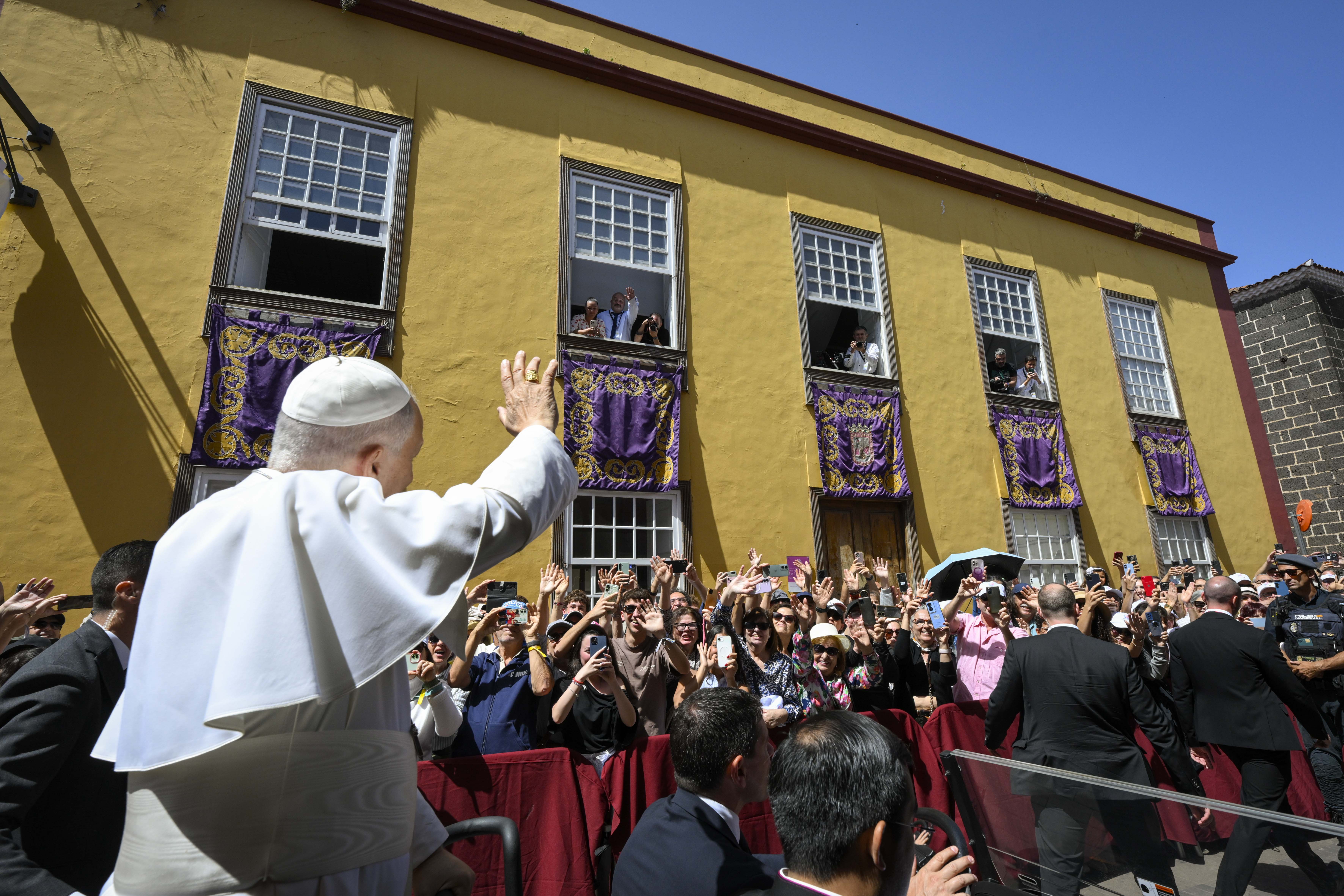
The remarks came during the pope’s meeting with organizations working for the integration of migrants in the Plaza del Cristo de La Laguna, in the capital of Tenerife, before some 4,000 people.
In this final day of his trip, Leo held a second encounter focused on the reality of migration, underscoring the importance he has given the issue throughout his visit.
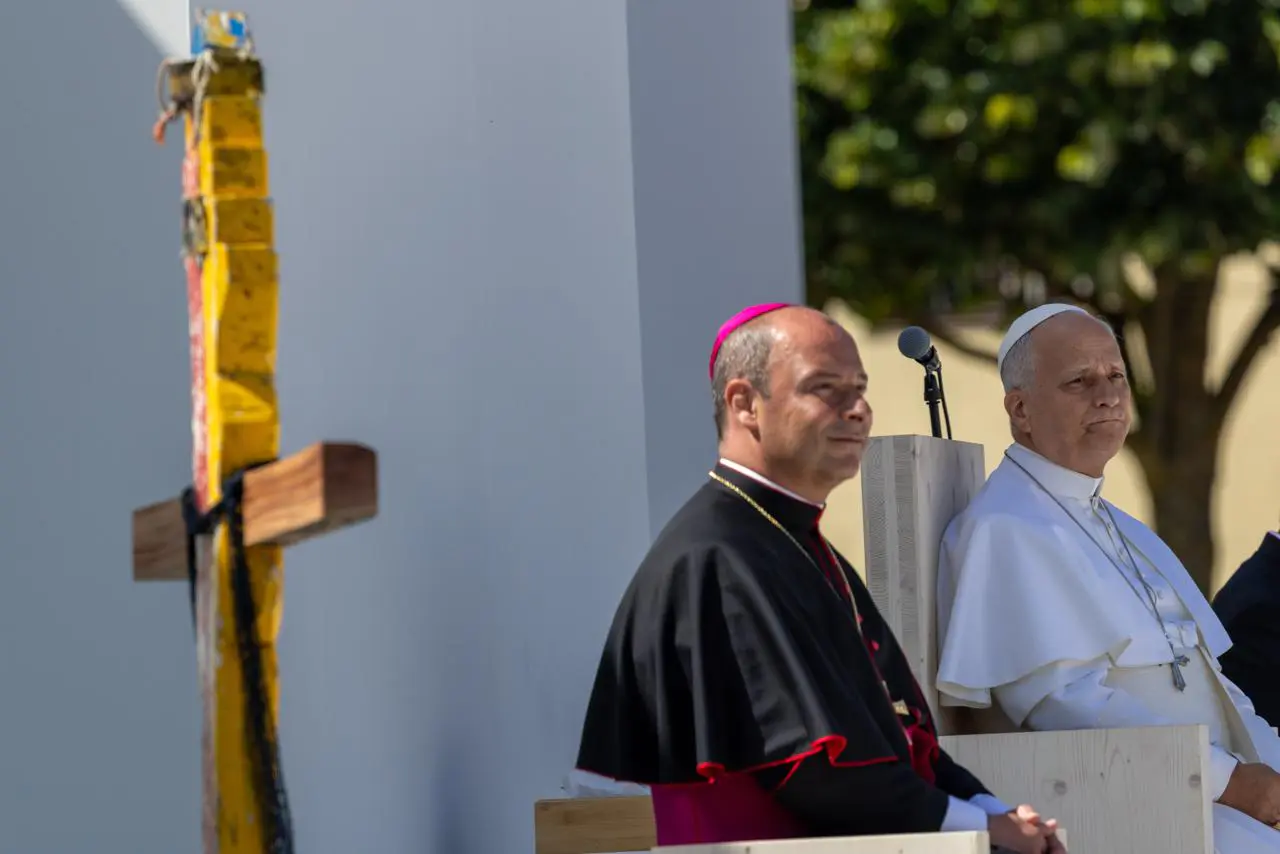
Pope Leo XIV listens during a meeting with organizations working for the integration of migrants in Tenerife, Canary Islands, on June 12, 2026. | Credit: Daniel Ibáñez/EWTN News
The pope offered several keys for migrants so they do “not … remain forever trapped in the role of victims.”
Speaking to “dear migrant brothers and sisters,” Leo said that part of their journey is “to open yourselves with trust to the community that welcomes you, to learn its language, to respect its laws, to get to know its customs, to participate in communal life, and to offer your gifts with gratitude.”
He also addressed Catholics directly, as he had done the previous day in Las Palmas, asking “that integration not be reduced to a social undertaking, however necessary that may be.”
The pope warned of what he called a “silent shipwreck” that can take place after migrants arrive: “Being left alone in a city, without a voice, without ties, work, or a sense of security, and exposed to those who take advantage of vulnerability.”
“Integration means preventing that second shipwreck,” he said.
Leo said integration must take place “without diluting their identity or closing their hearts to the encounter,” adding that “every welcoming society has responsibilities toward those who arrive,” while those who are welcomed also discover that dignity “flourishes when it becomes a duty and a sincere desire to build together with others.”
Before the final Mass that brought his apostolic journey to Spain to a close, the pope asked the faithful not to forget the many migrants from Latin America, the Philippines, and other parts of the world who are already a living part of the community.
“Let yourselves also be evangelized by them,” he said, “for they surely bring with them gifts that Providence has wished to send to you through those who are integrating.”
His predecessor, Pope Francis, summarized the Church’s approach to migration in four verbs: welcome, protect, promote, and integrate. Leo made that vision his own, insisting that integration cannot be reduced to a merely social task.
“Those who come to our parishes need bread, shelter, language assistance, work, and protection,” he said. “They also must find a community capable of offering paths to knowing Jesus Christ through the witness of life and word, while always respecting the conscience and freedom of each person.”
During the encounter, the pope listened to the testimony of Mbacke, a young Senegalese man who arrived as a child, completely alone.
“I have learned alongside my classmates in all the training activities we have: Spanish, cooking, agriculture, masonry, carpentry, repairs, computer skills, sewing, etc., and in my particular case, basic training in Spain,” he said, thanking the Canary Islands’ El Buen Samaritano Foundation, linked to the Parish of Santa María de Añaza in Tenerife, for giving him a family.
“Thank you for receiving young people like me who arrive alone, without family, and who are only looking for an opportunity to start over,” he added.
His testimony put a face on the drama of migrant minors who cross borders without a parent or guardian. For some who have no family, turning 18 can mean “only the street,” once they leave Spain’s child protection system.
Among those waiting for the pope on this final day was Mamadu, 33, originally from Mali. He arrived 15 years ago, still a child. Today he is fully integrated and speaks Spanish perfectly. He told ACI Prensa that he wanted to see the pope and give him a T-shirt he displayed proudly.
Leo also heard from a Venezuelan migrant priest who has served for seven years on El Hierro, the westernmost and southernmost island in the Canary archipelago. The island, the smallest and least populated of the main Canary Islands, has recorded some of the highest migrant arrivals in recent months: Since March 2023, it has received 50,244 immigrants despite having just 11,600 residents.
“There were days and nights when I wanted to stay in the comfort of my house, but I thought: What would Our Lord do?” the priest said. “And I renewed the service being asked of me. And there, amid pain and suffering, there was always some reason for hope, some smile, some grateful face that gave more than enough reason for our commitment.”
The Holy Father also listened to harrowing accounts, including that of Khalid Allad, a 24-year-old Moroccan who, like many others, reached the Canary coast in 2020.
“My journey in a small boat was not easy at all,” he said. “I tried twice. In the first attempt, 20 people died.”
Although his father forbade him from trying again, he set out a year later.
“Although I was afraid, I decided to leave again, this time without his permission,” he said.
Once in Tenerife, he began a new life thanks to the Don Bosco Foundation.
“They offered me a place to live, taught me Spanish, helped me read and write better, and gave me the confidence to move forward,” he said through tears.
Thalia Johana Saldarriaga Diago, a Colombian immigrant who, thanks to Caritas, not only recovered her independence but also became a volunteer helping others in similar situations, also spoke at the meeting.
“In this way,” the pope said, recalling her witness, “yesterday’s stranger can be today’s brother and neighbor.”
The encounter took place as the European Union entered a new and stricter era in migration policy. The Migration and Asylum Pact, the result of years of negotiations among member states, officially entered into force Friday, promising to strengthen control of external borders, speed up asylum procedures, and increase returns of people without the right to remain in EU territory.
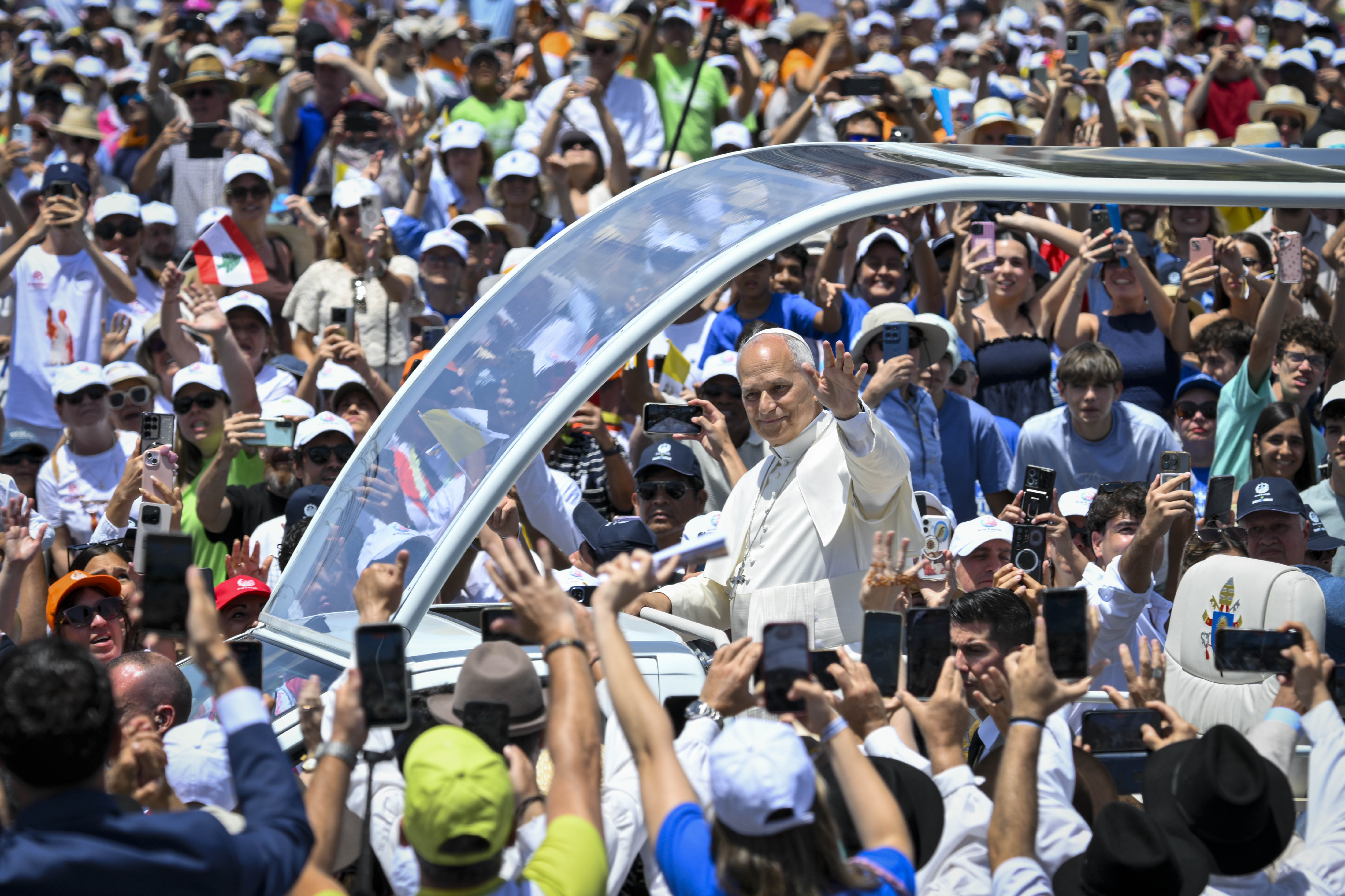
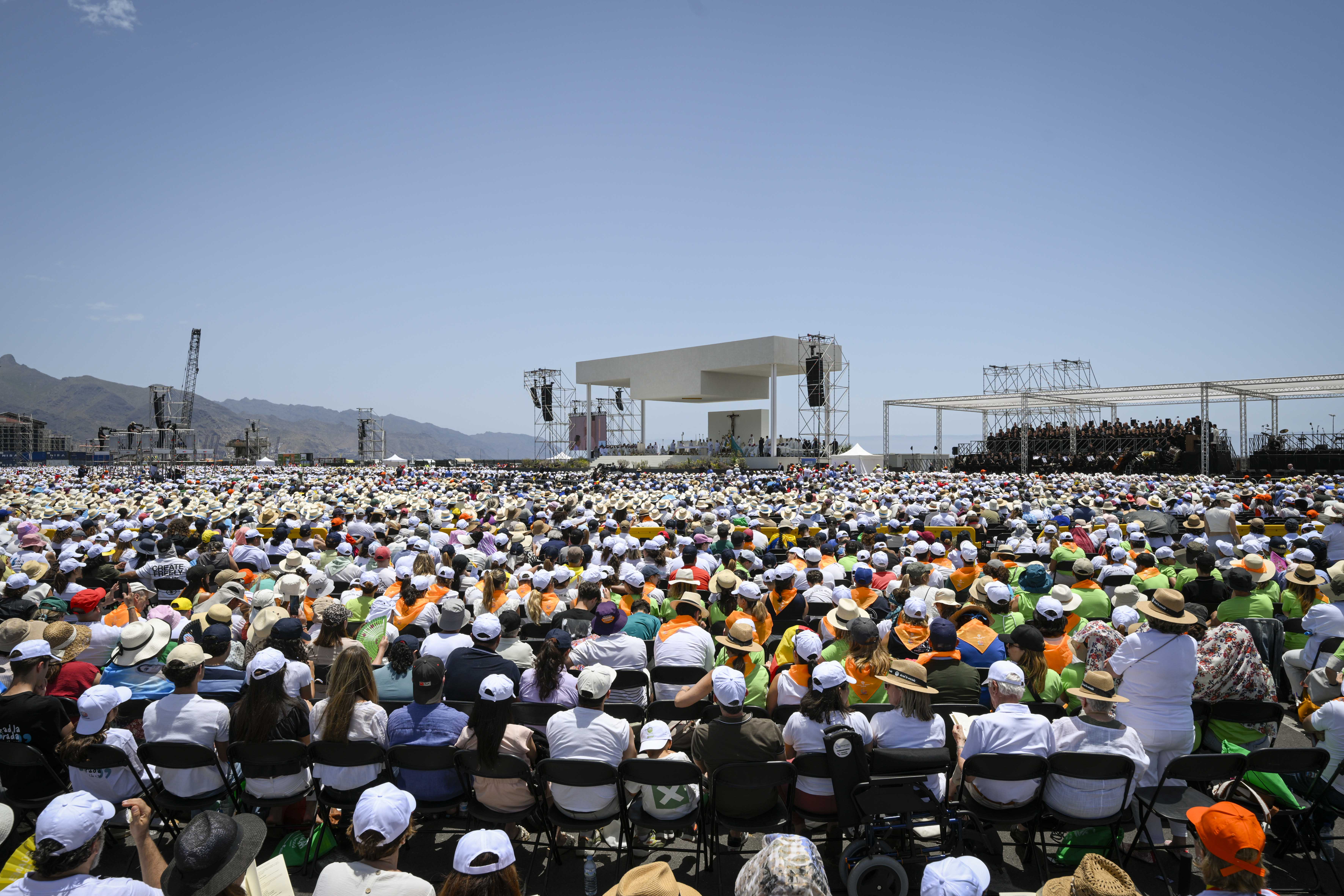
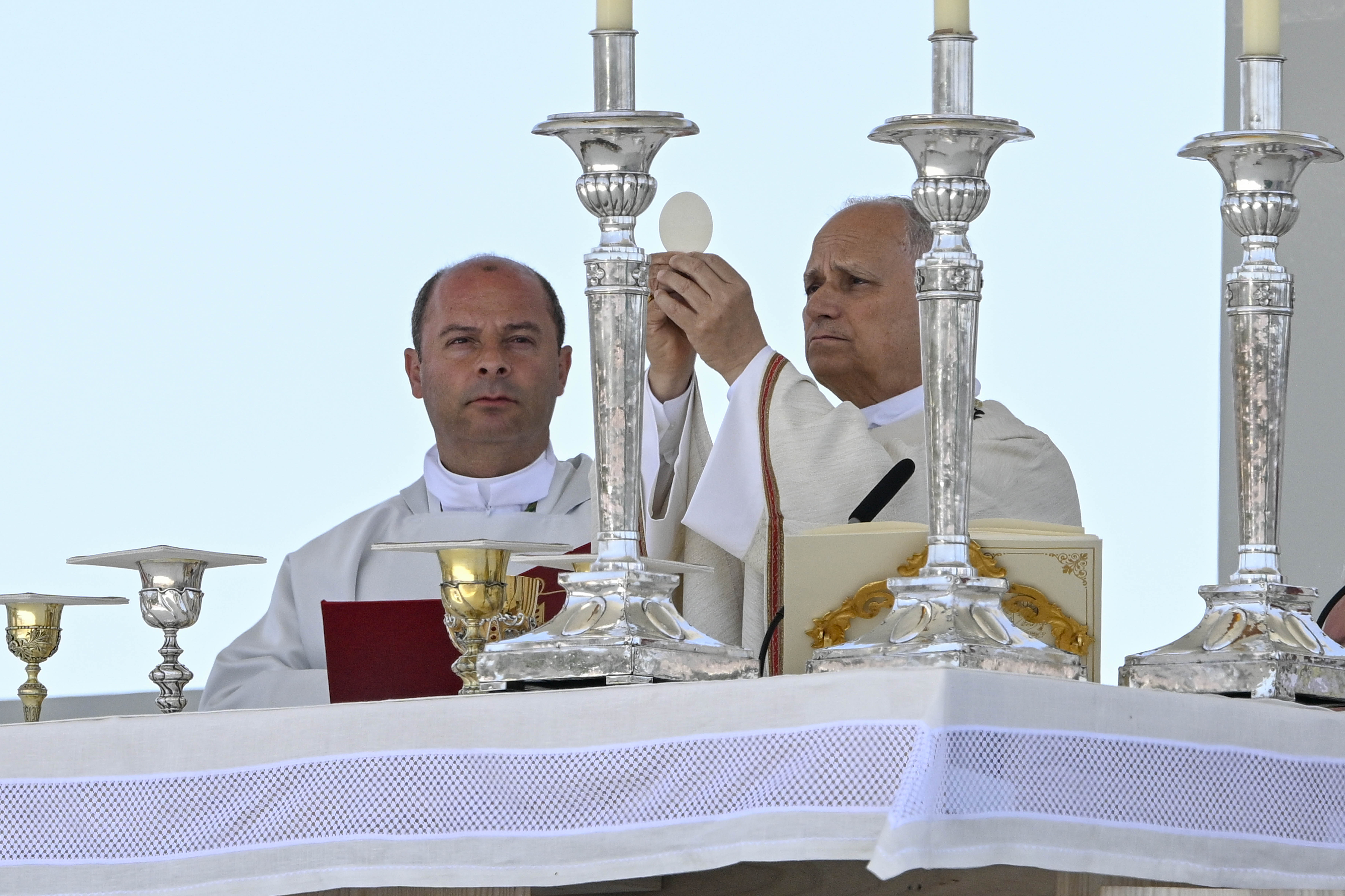
After this effort to put a human face on the drama of migration, and before returning to Rome with an expected delay, the pope celebrated a large outdoor Mass at the port of Santa Cruz de Tenerife.
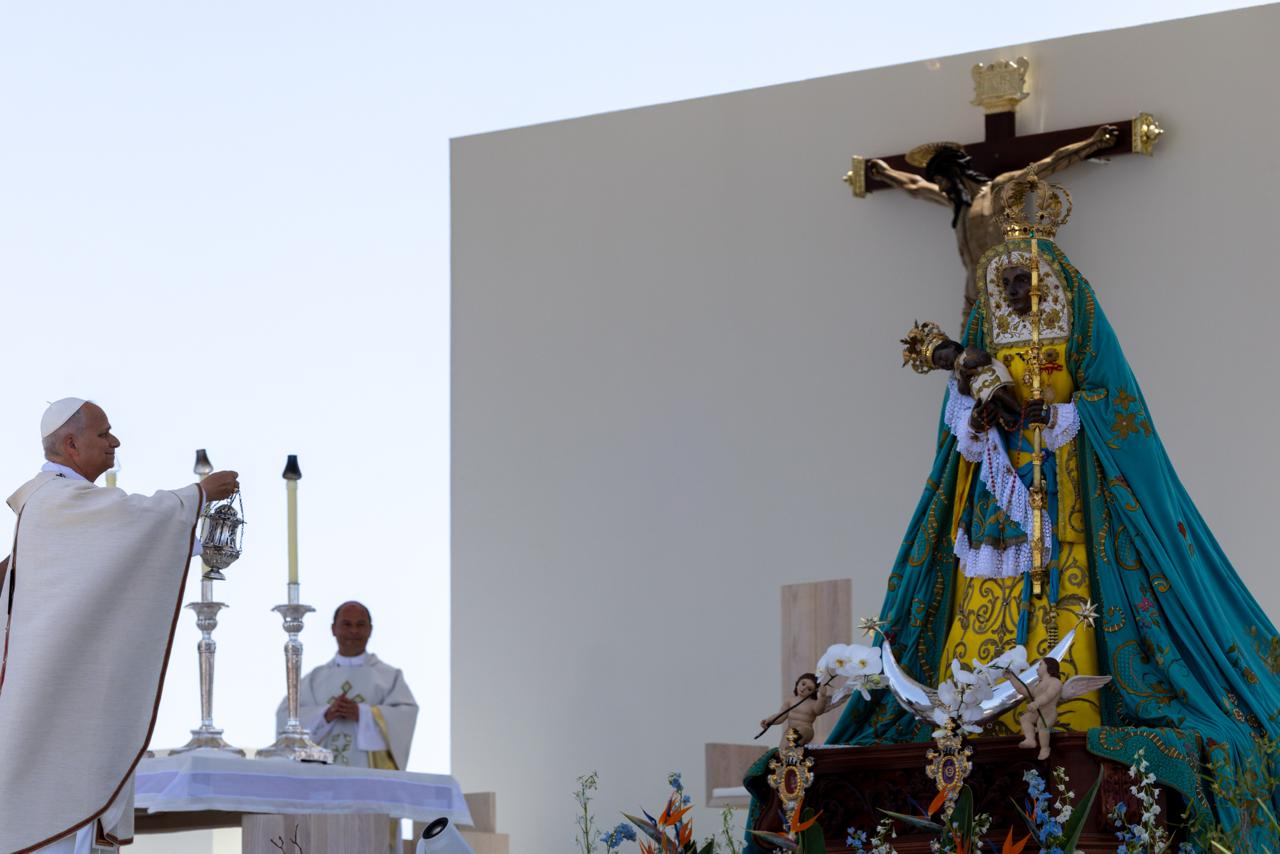
Pope Leo XIV celebrates Mass at the port of Santa Cruz de Tenerife, Canary Islands, on June 12, 2026. | Credit: Daniel Ibáñez/EWTN News
In his homily, Leo cited Pope Francis’ encyclical Laudato Si’ as he reflected on Tenerife’s “tourist vocation” and the island’s contact with visitors from many countries.
“How important it is, especially for those who allow themselves to be guided by the Gospel, not to reduce everything to commerce and profit,” the pope said.
Spain is a global tourism powerhouse, but its success has caused growing tensions in destinations like those the pope visited this week: Madrid, Barcelona, Las Palmas, and Tenerife.
This story was first published by ACI Prensa, the Spanish-language sister service of EWTN News. It has been translated and adapted by EWTN News English.
The journey toward holiness is fulfilled in union with Christ’s perfect heart — a holiness that cannot be lived in isolation, Pope Leo XIV said in a message for the World Day of Prayer for the Sanctification of Priests.
“Cherish your priestly fraternity: Seek one another, listen to one another, and support one another. The priest who isolates himself slowly fades away; the priest who walks alongside his brothers grows,” the pope said in the June 12 message.
The World Day of Prayer for the Sanctification of Priests takes place every year on the solemnity of the Most Sacred Heart of Jesus, which in 2026 is celebrated on June 12.
The Sacred Heart, Leo said, “is the ‘place’ where holiness is manifested as closeness and tenderness. The priest’s holiness, then, is embodied in humble and courageous nearness, in being all things to all people, and in keeping the gate of the sheepfold open so that many can enter and find pasture and rest.”
“For this reason, we are called to a relationship with God that does not distance us from others but brings us closer to everyone — shaping patient and tender hearts, capable of closeness, compassion, and listening,” he added.
Pope Leo said it is “through the union of our imperfect hearts with Jesus’ pierced heart, our journey toward holiness is fulfilled. It is no longer we who live but Christ who lives in us. Such holiness cannot be lived in isolation.”
Reflecting on the mystery of the Lord’s pierced heart, the Holy Father emphasized that holiness is not an abstract ideal but a share in God’s own holiness.
“When he calls us to be holy as he is holy, he indicates that the path we must follow involves being fashioned after his own heart. And for us, dear brothers, this call is particularly radical,” he said, addressing his fellow priests.
The holiness asked of priests, Leo continued, is of a trustful abandonment transformed by the Holy Spirit: “Yet it is precisely here that the great paradox of our priestly life emerges. We are called to share in God’s own holiness, but we carry this treasure in earthen vessels.”
Reflecting on the imperfect, human side of the priesthood, the pontiff noted that “we are limited and imperfect, often weak and weary, and at times wounded. How can such a vulnerable human heart respond to such a high calling? The priest lives this tension. Yet at the same time, he must recognize that he finds peace in the open side of the Lord Jesus.”
“Our humanity is not compartmentalized,” he said. “Prayer, ministry, relationships, weariness, joys, and failures — even time or love that apparently seems wasted — all become privileged places where God reveals himself and his infinite love.”
He urged priests to renew the grace of their ordination through the daily celebration of the Eucharist, prayer, meditation on the word of God, and humble service to others.
“A priestly life that is steady and configured to Jesus’ heart is a credible sign of unity, peace, and mercy. Thus, in an age marked by division and fear, we must be builders of peace and witnesses of the tenderness of the Good Shepherd who knows how to gather the scattered and heal the wounded,” he said.
In his message, Pope Leo invited priests to daily renew their “Here I am” before Christ’s pierced heart and to remember the words of the Curé of Ars, St. John Vianney, who loved to say that “the priesthood is the love of the heart of Jesus.”
“This love is a pledge and a guarantee that, if we surrender and offer ourselves completely, nothing of us will be lost,” the pontiff said.
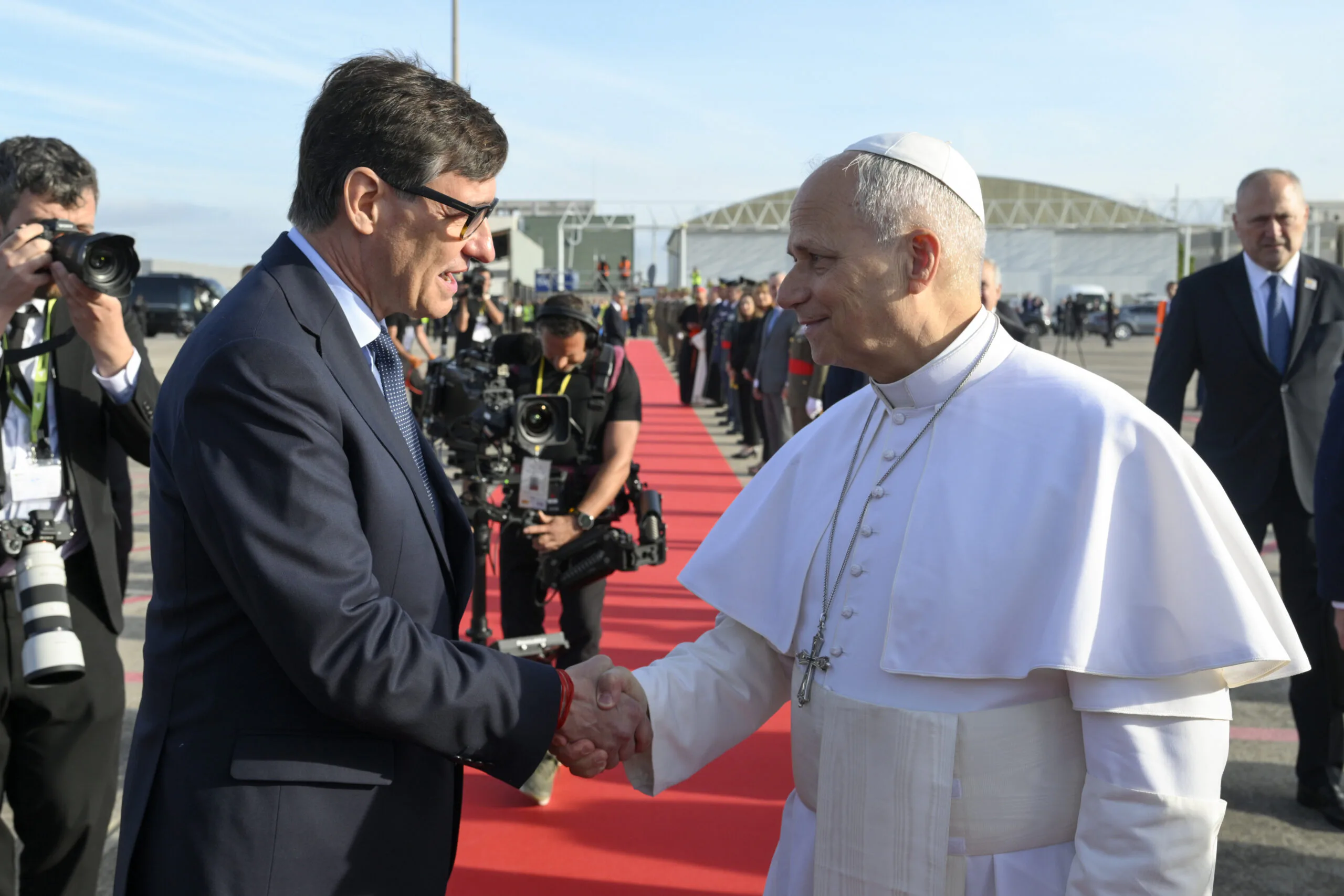
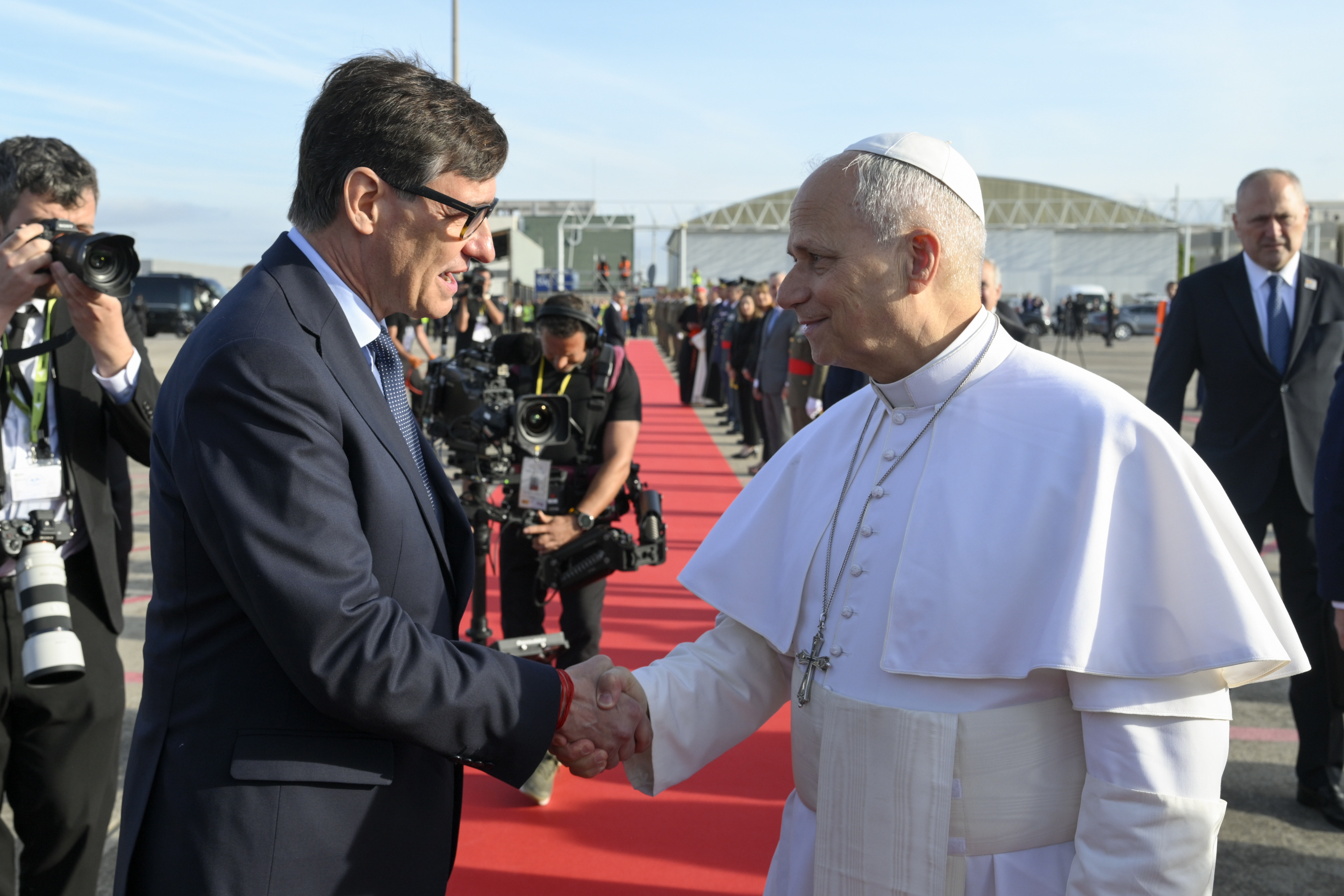
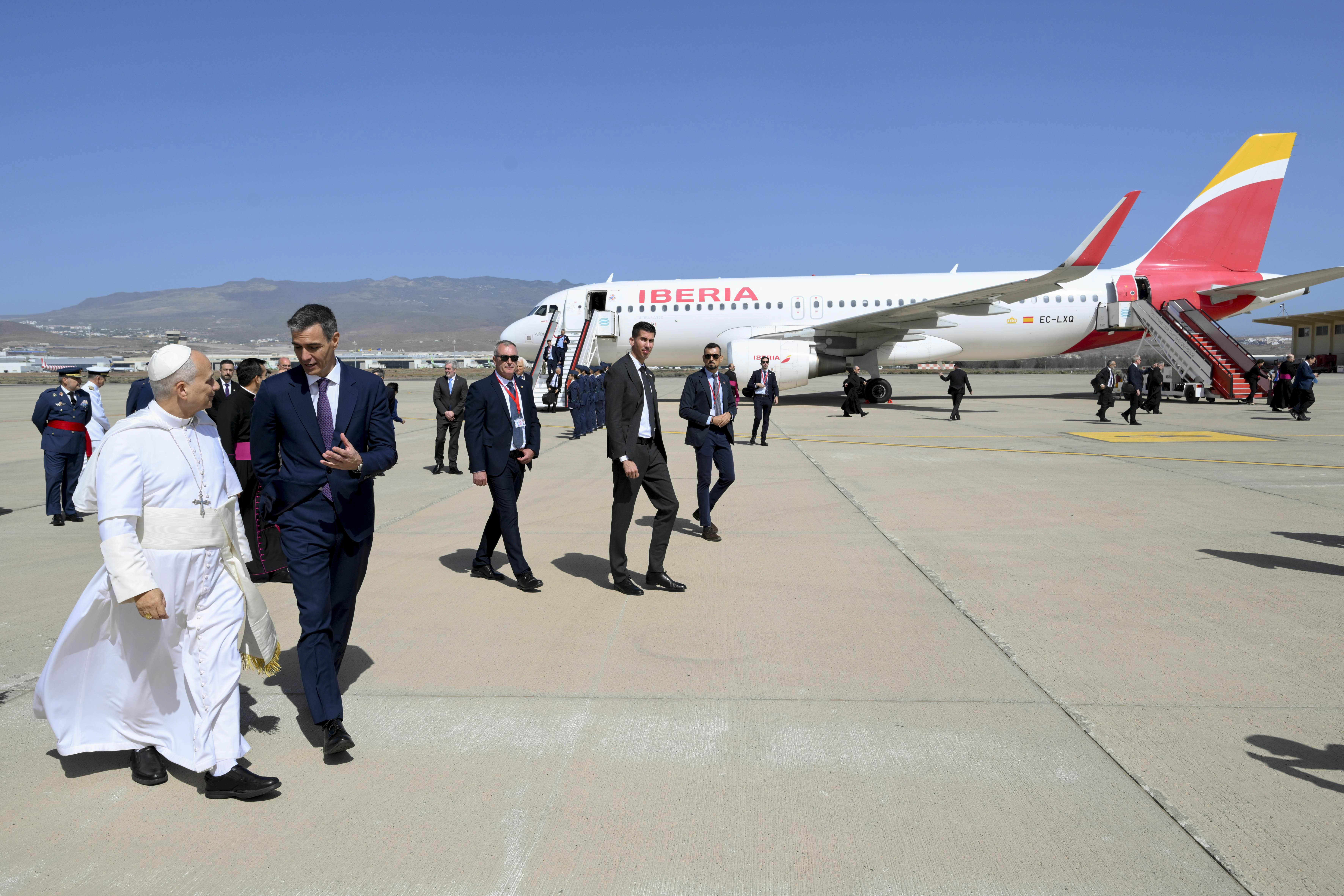
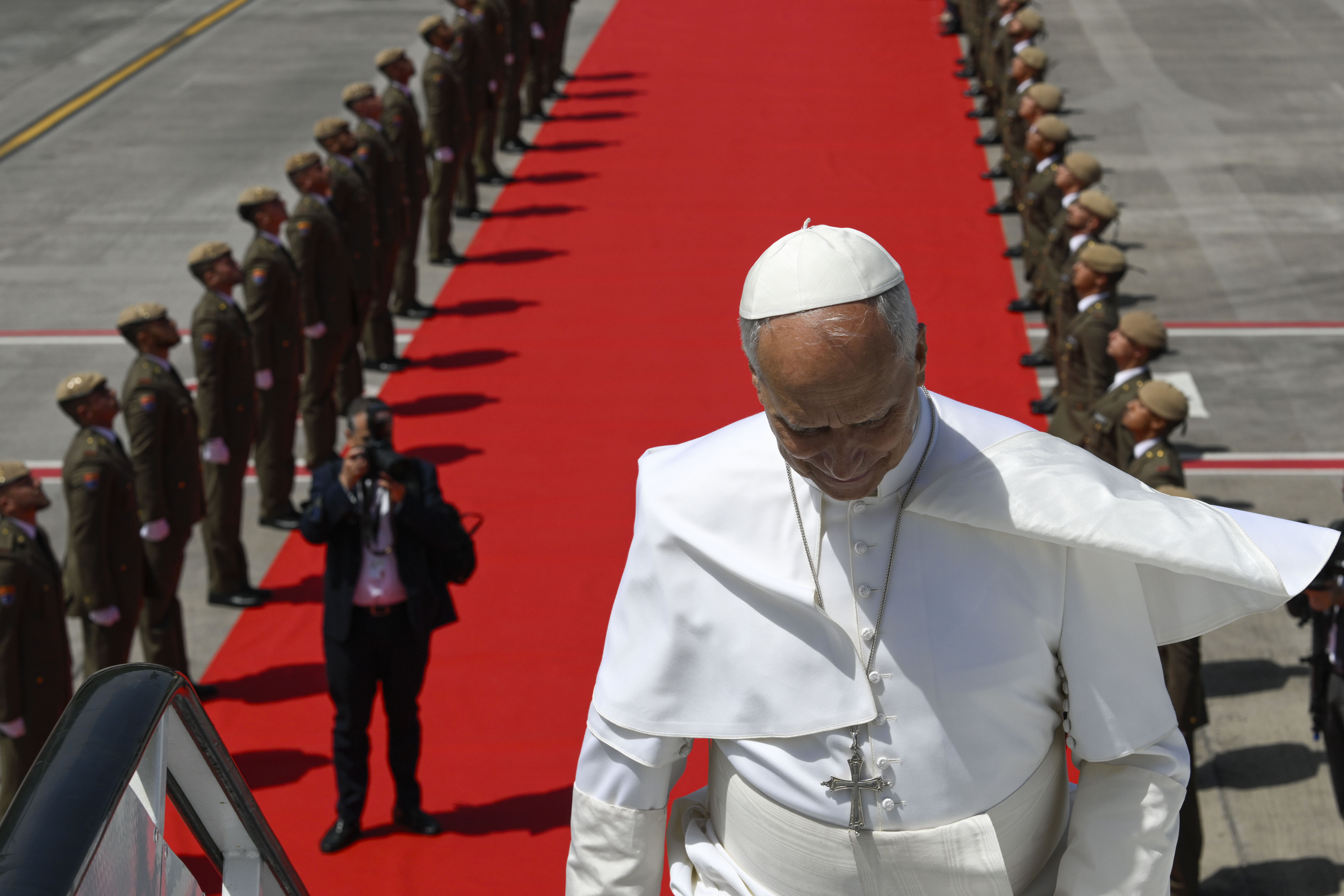
Pope Leo XIV departed Spain for Rome on June 12, finishing a weeklong trip to the European country marked by meetings with national leaders and bishops and a historic Mass at the Basilica of the Sagrada Familia.
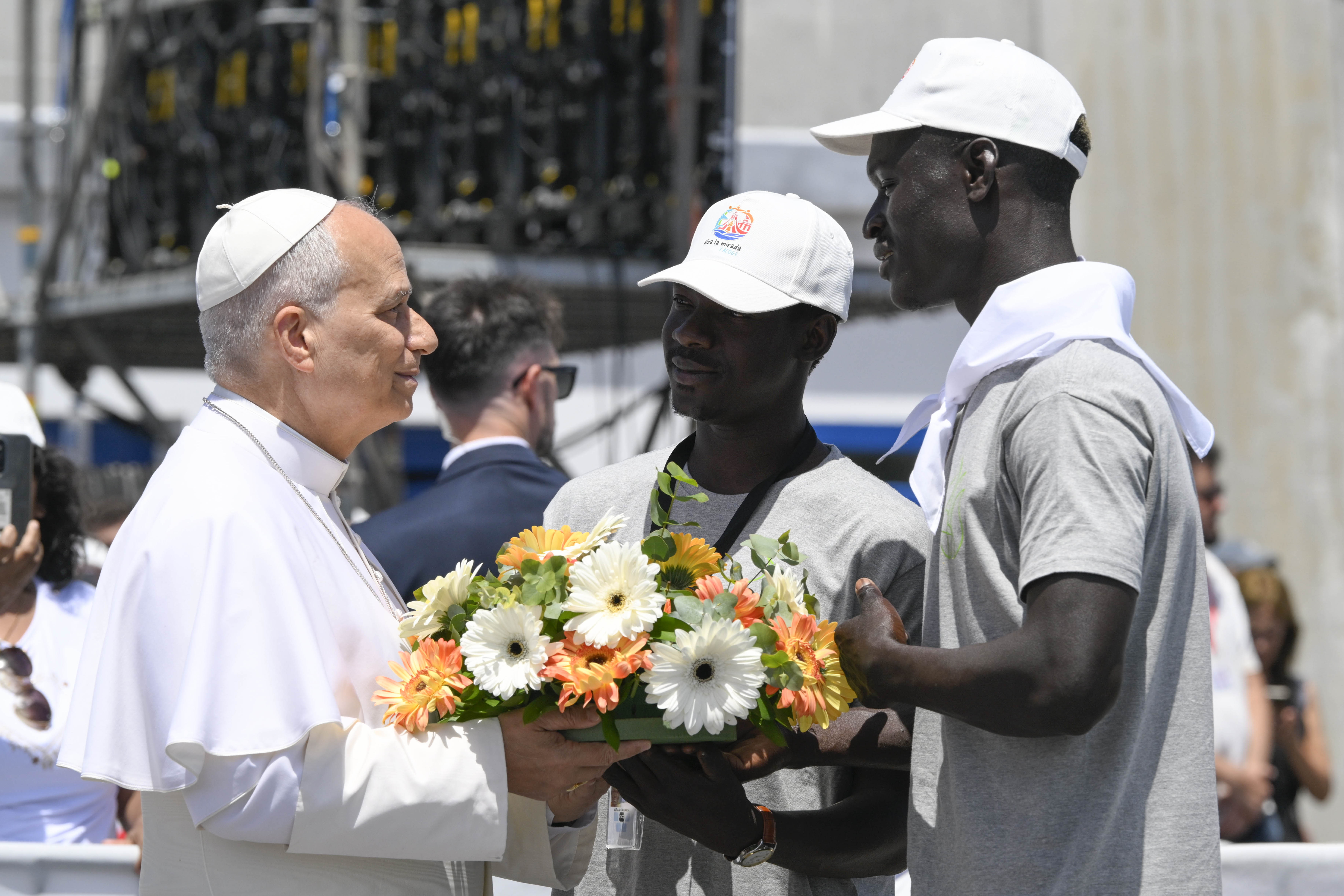
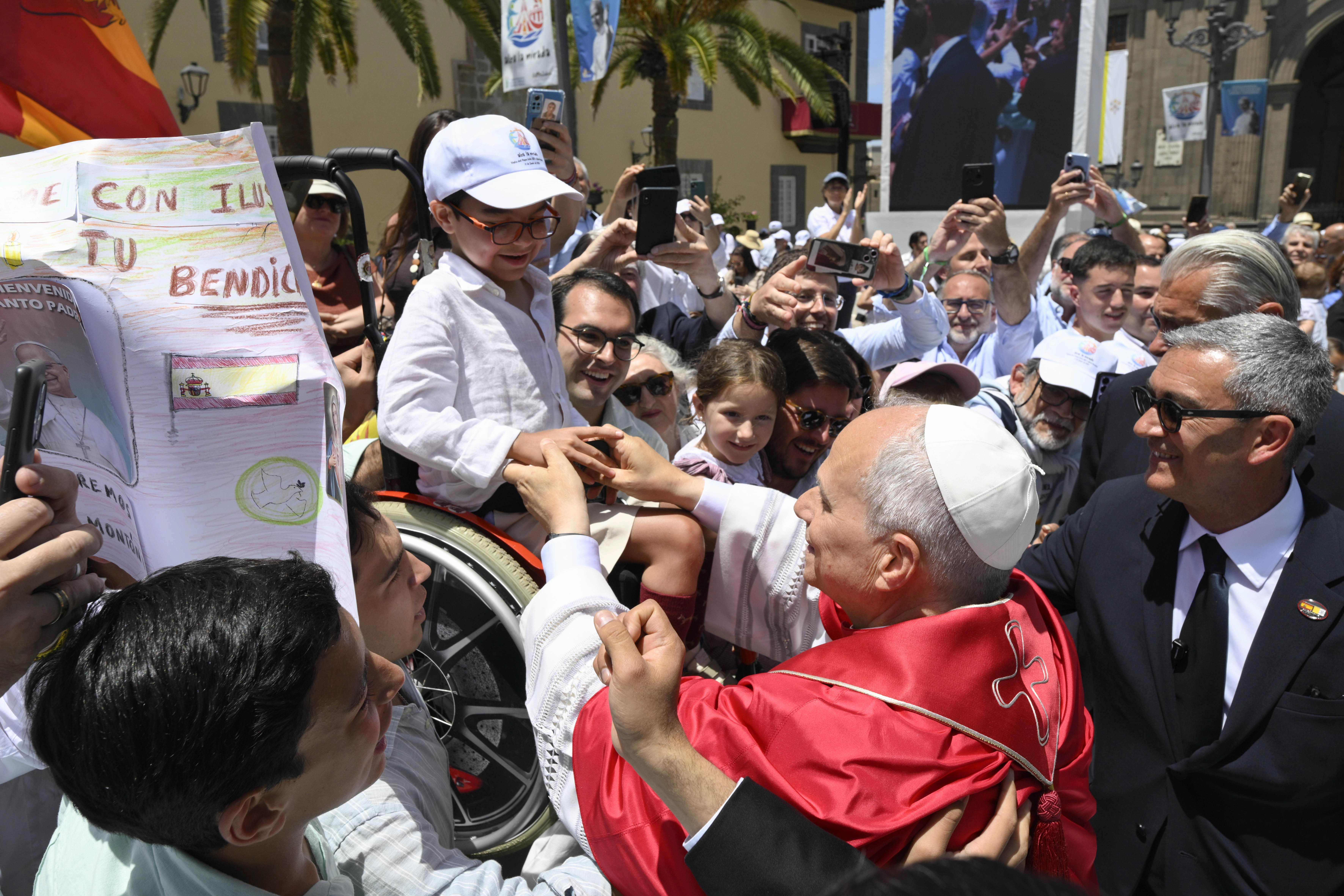
The Holy Father spent time in Madrid and Barcelona before finishing his visit in the Canary Islands off the coast of Europe. Throughout his weekʼs trip he also met with civic groups, including those that minister to migrants, and visited a prison in Barcelona.
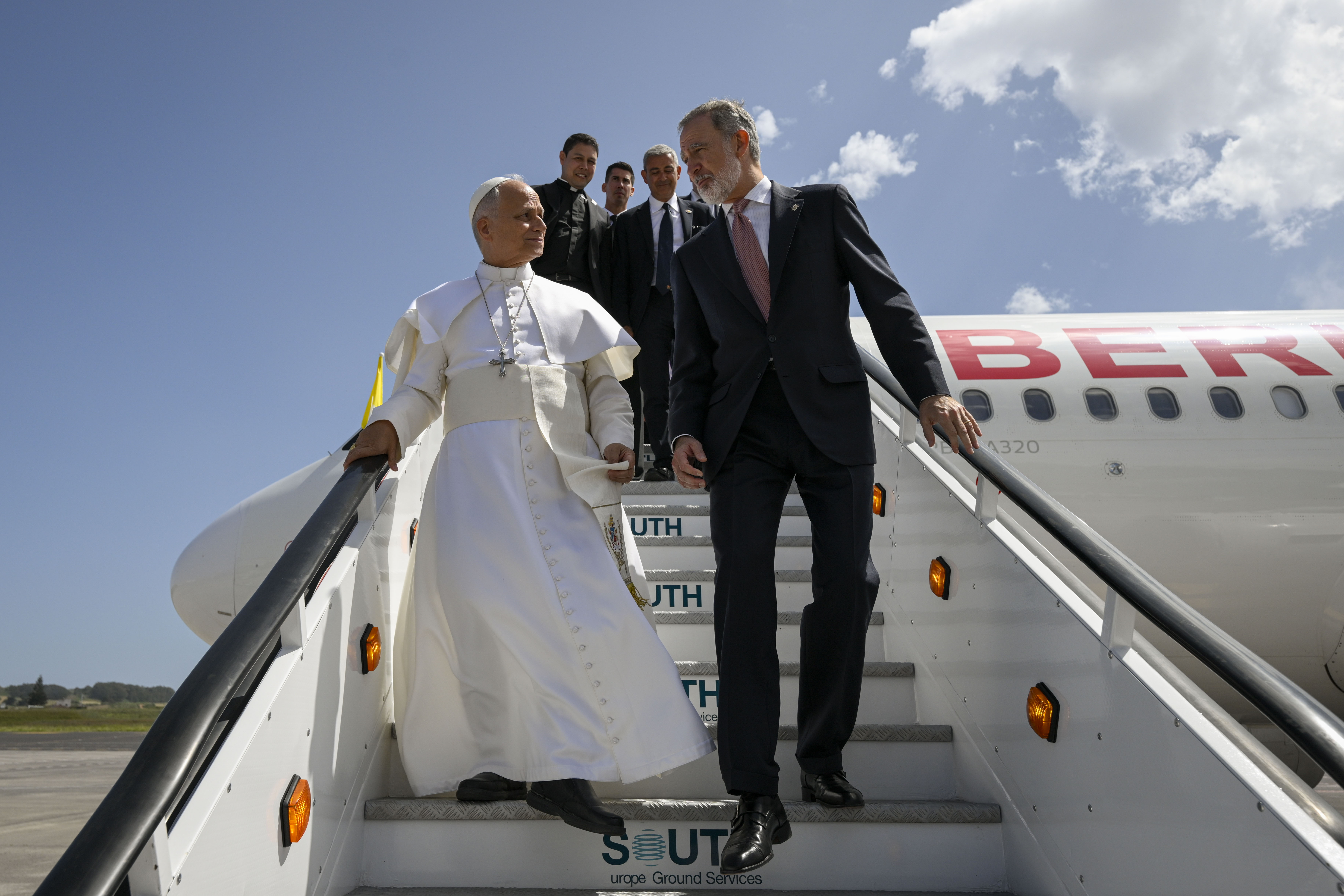
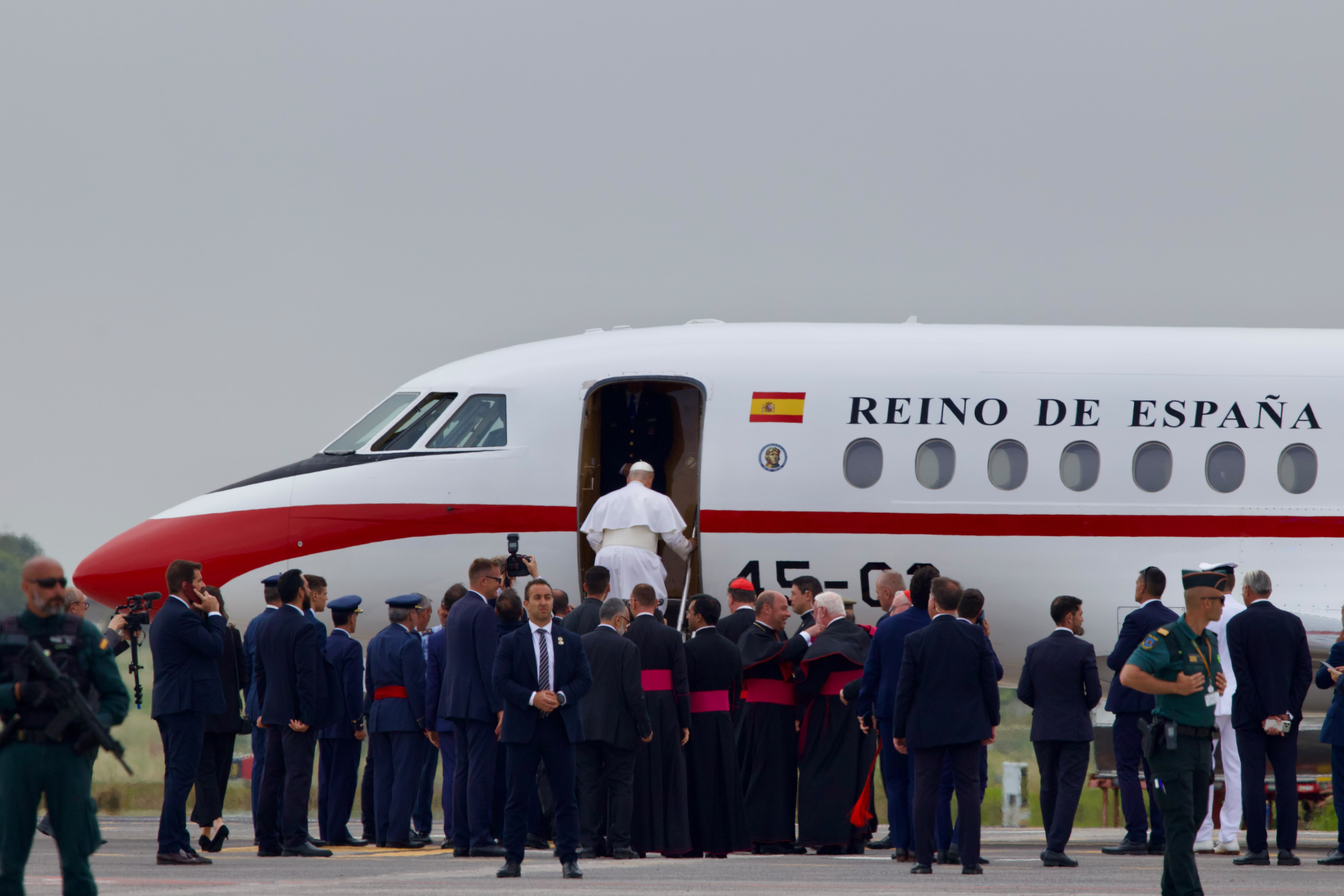
The visit finished with the papal plane suffering a malfunction forcing the pope to deboard before takeoff. He ultimately left for Rome on the king of Spainʼs personal airplane after the king personally offered him the use of the aircraft.
Hereʼs a look at the popeʼs final days in Spain before his return to the Holy See:
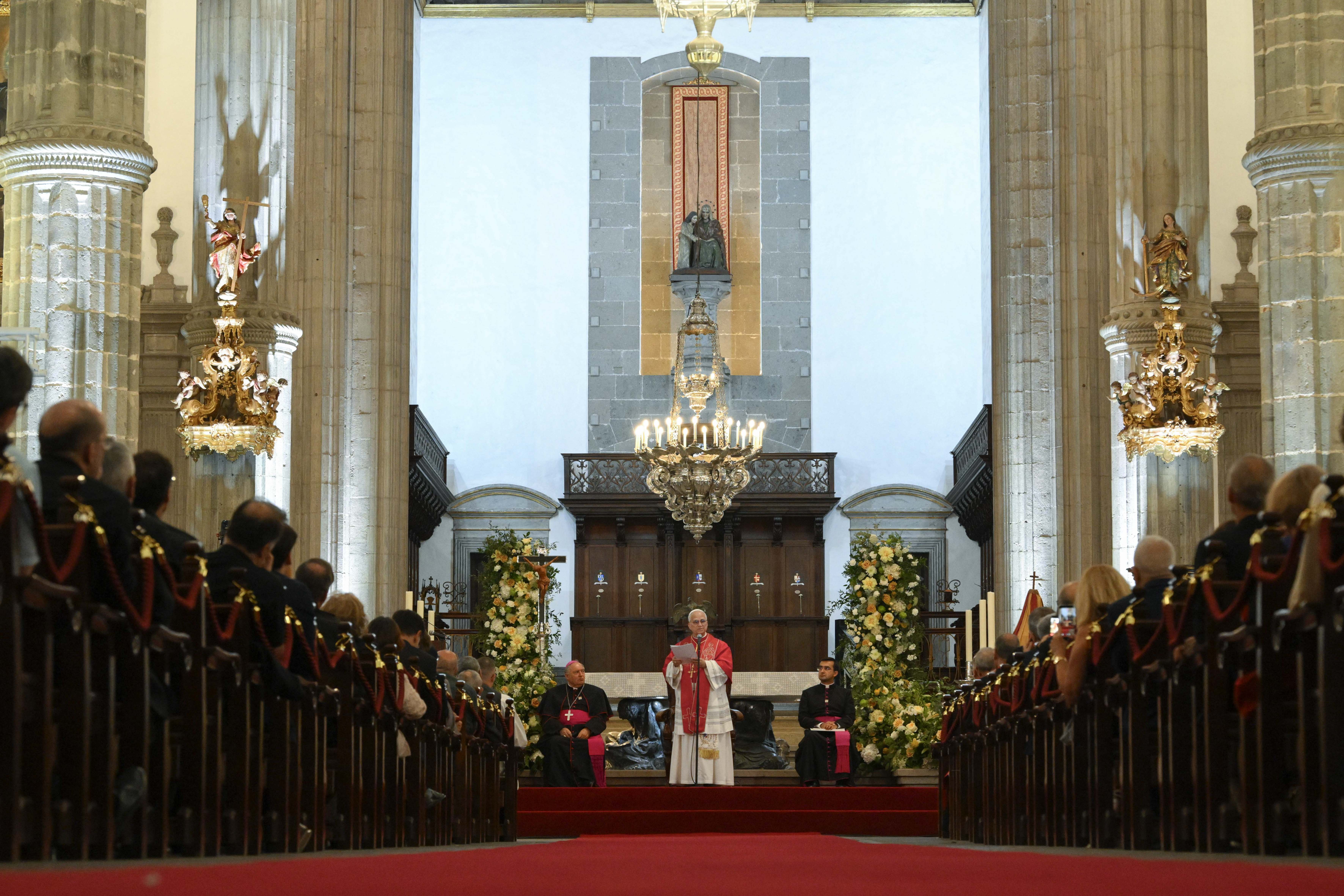
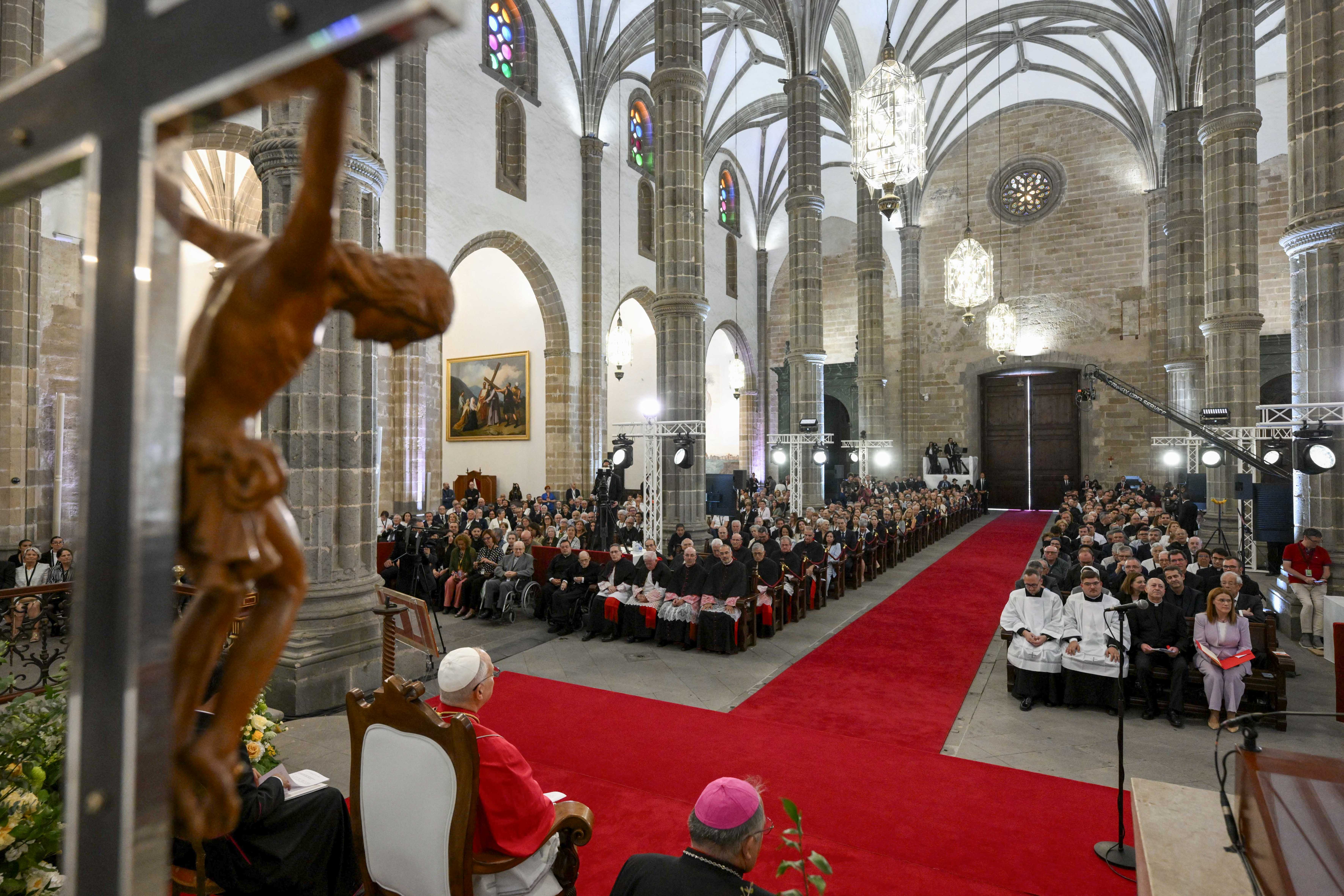
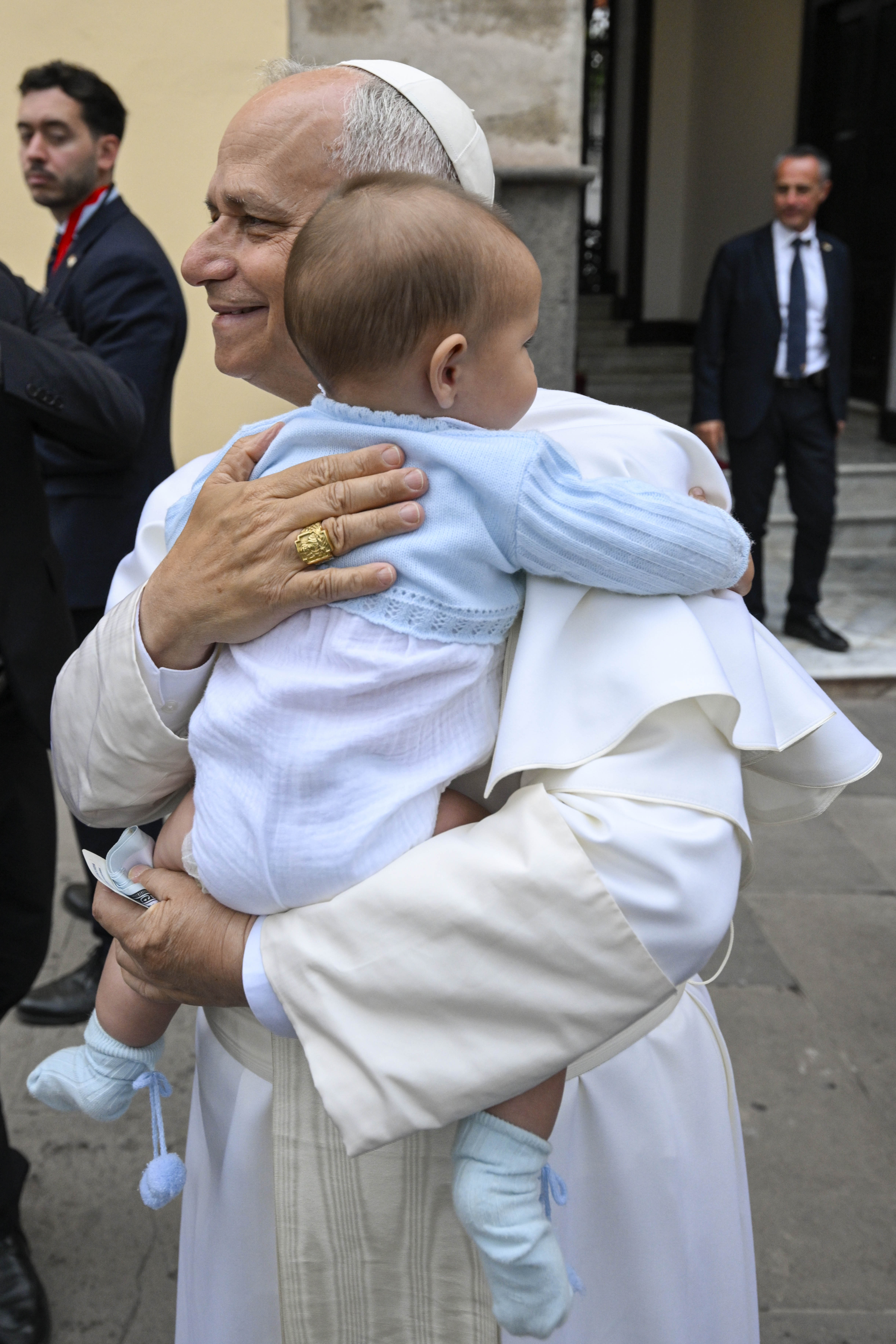
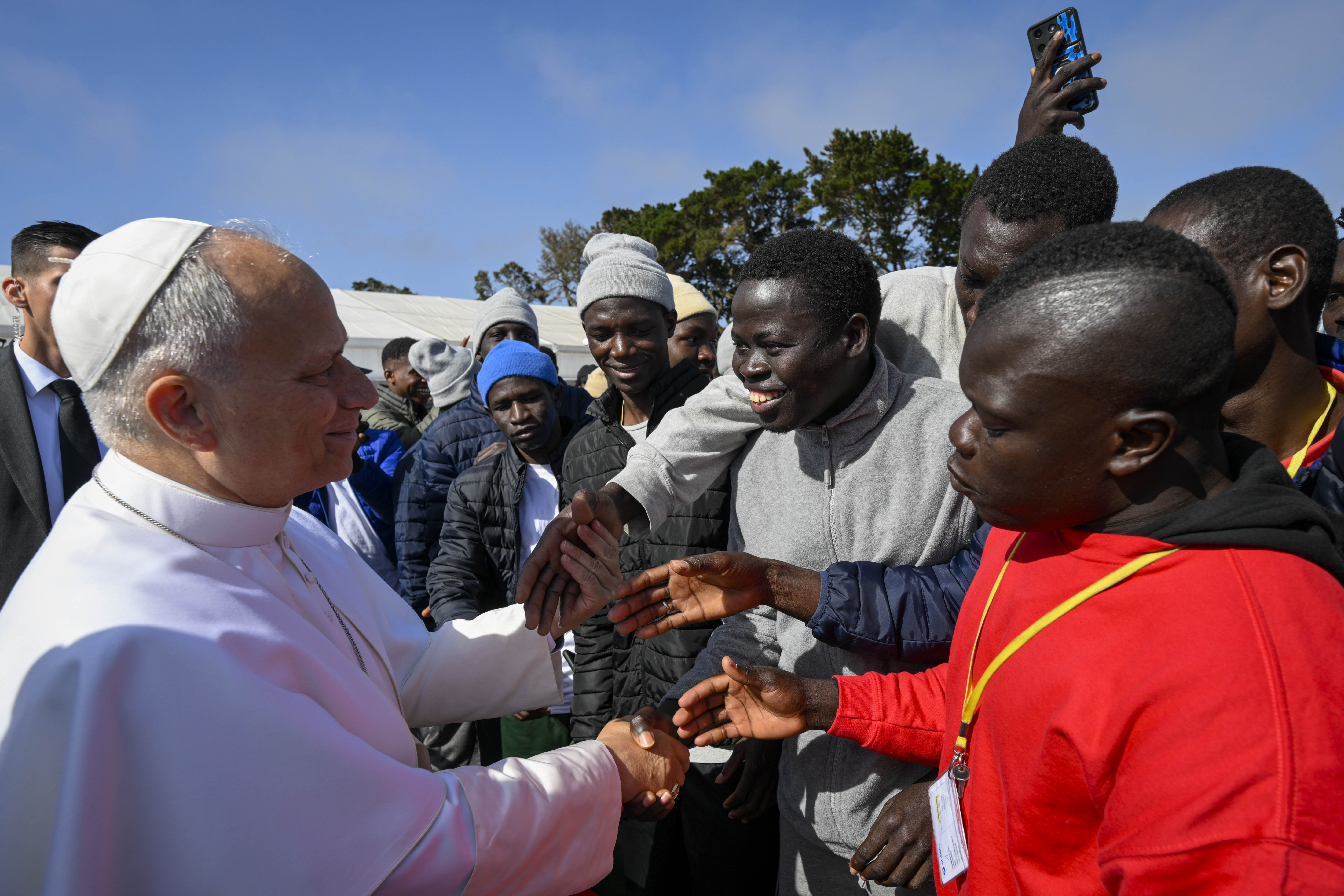
Pope Leo XIV departs Barcelona for the Grand Canary Islands at Josep Tarradellas Barcelona/El Prat International Airport, June 11, 2026. | Credit: Vatican MediaPope Leo XIV arrives in the Grand Canary Islands, June 11, 2026. | Credit: Vatican MediaPope Leo XIV meets with members of humanitarian groups working with migrants in Spain’s Grand Canary Islands, June 11, 2026. | Credit: Vatican MediaPope Leo XIV greets a boy in a wheelchair in Las Palmas, Gran Canaria, Spain, June 11, 2026. | Credit: Vatican MediaPope Leo XIV meets with Catholics and religious leaders at the Cathedral of St. Anne in Las Palmas, Gran Canaria, Spain, June 11, 2026. | Credit: Vatican MediaPope Leo XIV meets with Catholics and religious leaders at the Cathedral of St. Anne in Las Palmas, Gran Canaria, Spain, June 11, 2026. | Credit: Vatican MediaPope Leo XIV holds a baby in Gran Canaria, June 12, 2026. | Credit: Vatican MediaPope Leo XIV meets with migrants in the Plaza del Cristo de La Laguna, Tenerife, June 12, 2026. | Credit: Vatican MediaPope Leo XIV waves at crowds during a meeting with organizations that assist with migrant integration, at the Plaza del Cristo de La Laguna, Tenerife, June 12, 2026. | Credit: Vatican MediaPope Leo XIV waves to crowds before Mass at the Port of Santa Cruz in Tenerife, June 12, 2026. | Credit: Vatican MediaThousands of Catholics gather for a papal Mass with Pope Leo XIV at the Port of Santa Cruz in Tenerife, June 12, 2026. | Credit: Vatican MediaPope Leo XIV elevates the Eucharist during Mass at the Port of Santa Cruz in Tenerife, June 12, 2026. | Credit: Vatican MediaPope Leo XIV boards the papal airplane at Tenerife International Airport, June 12, 2026. | Credit: Vatican MediaPope Leo XIV leaves the plane he was to take back to Rome on June 12, 2026, from Tenerife, Spain. A malfunction on the plane forced the Holy Father to depart the aircraft unexpectedly. | Credit: Vatican MediaPope Leo XIV boards the king of Spain’s airplane on June 12, 2026, in Tenerife, Spain. | Credit: Daniel Ibañez/EWTN News