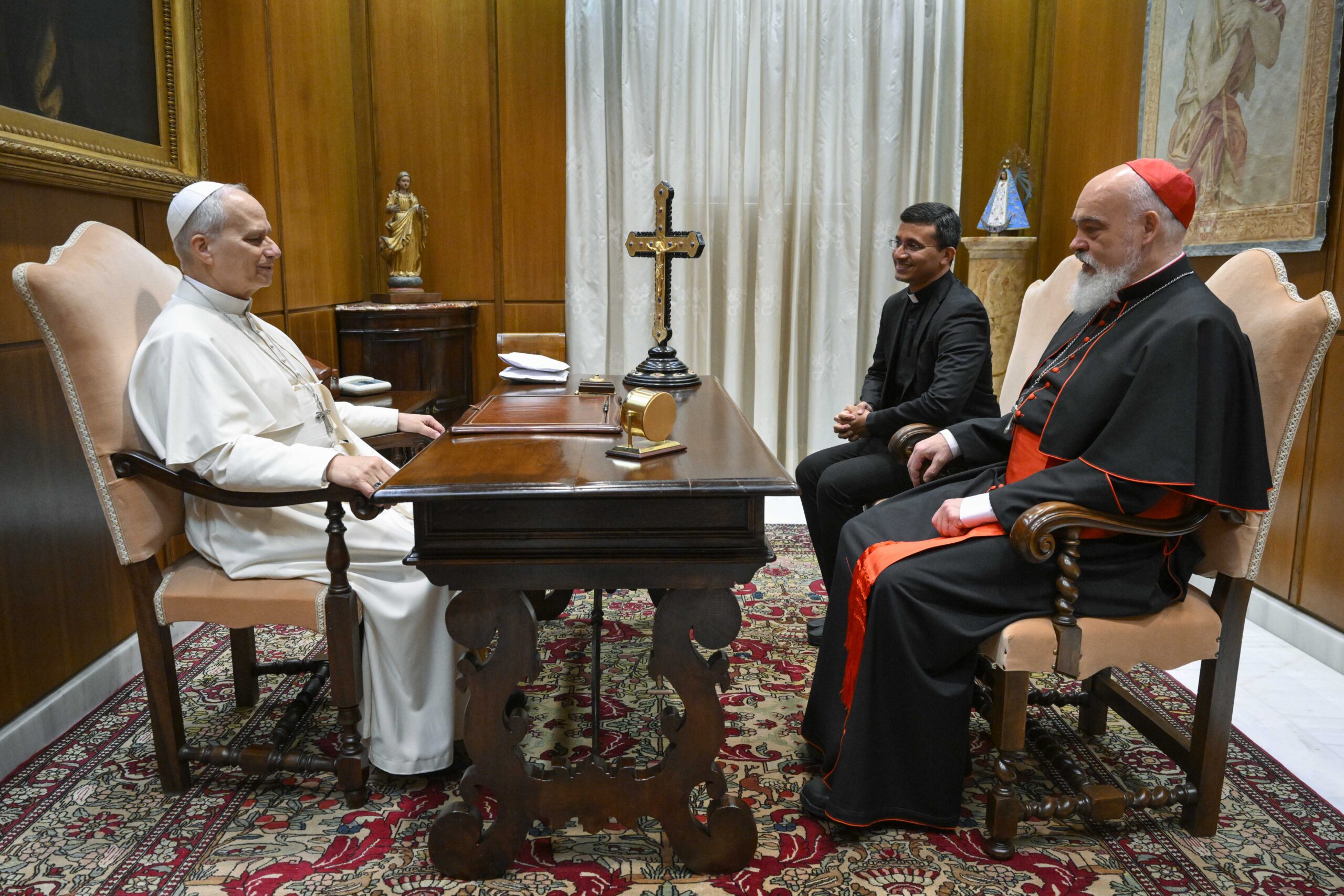
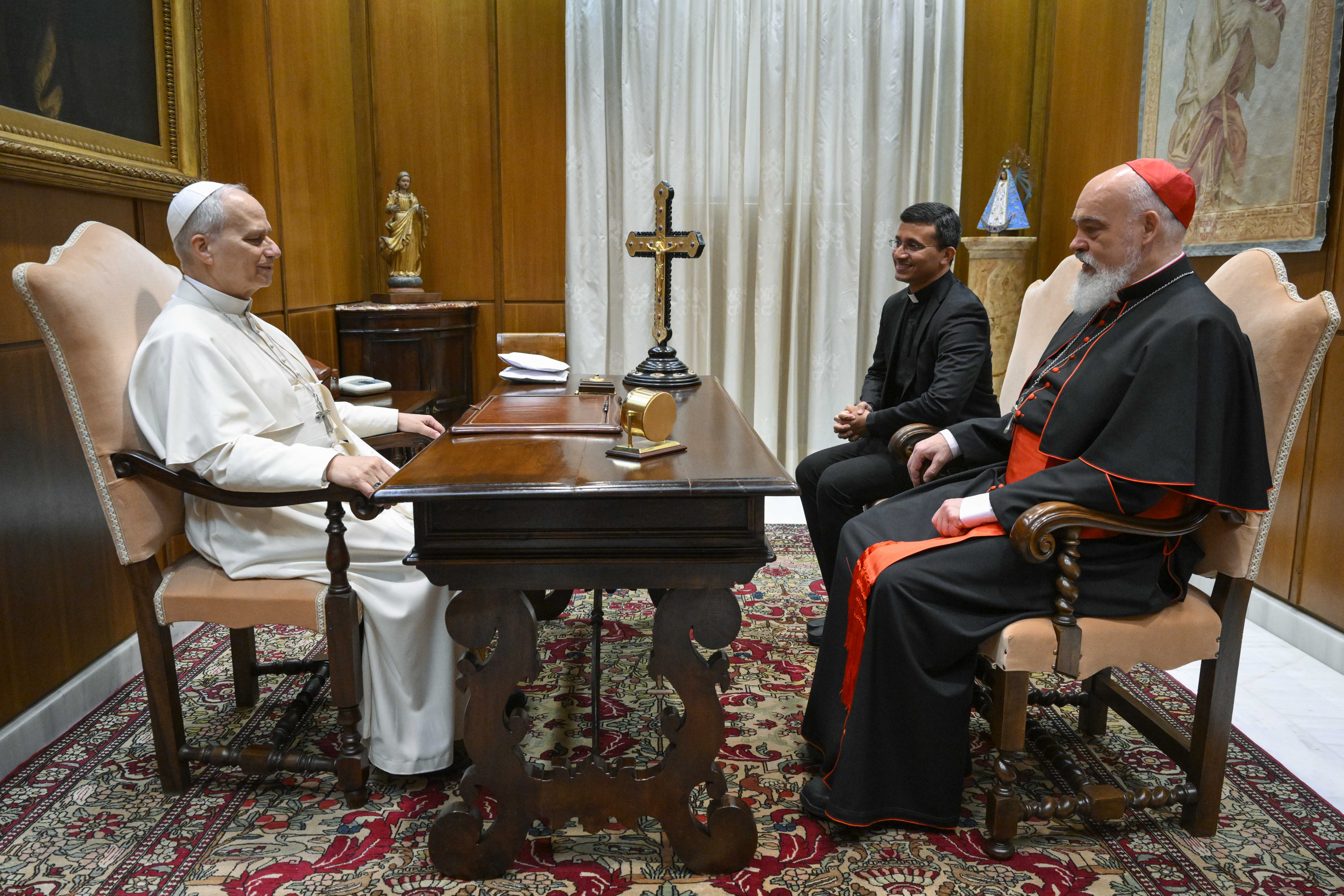
Pope Leo XIV on March 14 took possession of the traditional papal apartment within the Apostolic Palace, moving into the quarters traditionally reserved for his predecessors.
The move was announced on March 14 by the Holy See Press Office, more than 10 months after Leo’s election.
The Holy Father had been staying at an apartment at the Palace of the Holy Office but will now reside in what has long served as the home of the reigning pontiff. The custom was discontinued in March 2013 by Pope Francis, who chose to reside at Casa Santa Marta from the beginning of his pontificate.
Pope Leo XIV has also reinstated the papal tradition of staying at the summer residence of Castel Gandolfo. In the summer of 2025 the pope stayed at Villa Barberini; subsequently, he decided to travel to Castel Gandolfo almost every week, staying from Monday evening until Tuesday evening.
The papal apartment has undergone a lengthy and meticulous restoration, having remained unoccupied since the conclusion of Pope Benedict XVI’s pontificate on Feb. 28, 2013.
The previous renovation dated back to the spring of 2005, following the death of Pope John Paul II and prior to Benedict XVI taking up residence in the quarters.
In addition to the bedrooms, the apartment comprises a private study for the pope — from the window of which he appears every Sunday to recite the Angelus — as well as a dining room and a private chapel, where pontiffs have traditionally celebrated Mass at the start of each day.
Residing alongside Pope Leo XIV in the papal apartment within the Apostolic Palace will likely be his two secretaries, Peruvian Monsignor Edgard Iván Rimaycuna Inga and Italian Father Marco Billeri.
This storywas first publishedby ACI Stampa, the Italian-language sister service of EWTN News. It has been translated and adapted by EWTN News English.
In a message conveyed through Vatican Secretary of State Cardinal Pietro Parolin, Pope Leo XIV on Friday said that mathematicians can become “signs of hope for the world,” particularly in a context marked by rapid technological advancements and challenges facing humanity.
The pope’s message was addressed to the Turkish mathematician and university professor Betül Tanbay, chair of the International Day of Mathematics, which was observed March 13.
Tanbay had informed the pontiff of a webinar dedicated to the theme “Mathematics and Hope.” In response, the pope sent a letter extending his cordial greetings and best wishes to all participants in the initiative.
In the text, Leo XIV invited reflection on the role that mathematics can play in the face of “the multiple challenges confronting the human family,” citing rapid technological development, with all its potential “for both good and evil.”
The pontiff encouraged participants to consider how mathematicians can offer a positive witness to society. “A particularly fruitful area of research is the use of algorithms, especially in the field of artificial intelligence,” he noted.
However, the pope emphasized that work in these fields demands something more than technical competence. As he pointed out, this task requires “not only intellectual effort and ingenuity but also the integral growth of the whole person,” capable of taking into account the moral dimension of emerging technologies.
Recalling his own experience as a mathematics and physics teacher, Leo XIV quoted words he addressed to students during the Jubilee of the World of Education, held on Oct. 30, 2025: “Possessing vast knowledge is not enough if we don’t know who we are or what the meaning of life is.”
Along these lines, the pontiff expressed his hope that participants would be attentive “to the profound spiritual needs of the human heart” and seek ways to humanize the digital realm so that it may become an opportunity for fraternity and creativity.
Likewise, he encouraged mathematicians to be “prophets of hope, truth, and goodness in the world.”
The message concluded with a prayer from the pope for all participants in the International Day of Mathematics, upon whom he invoked “abundant divine blessings of wisdom, joy, and peace.”
Pope Leo XIV’s mathematical background
Robert Francis Prevost, now Pope Leo XIV, graduated in 1977 from Villanova University in Pennsylvania, earning a bachelor of arts degree in mathematics alongside studies in philosophy. This preceded the beginning of his theological studies upon his formal entry into the Augustinian novitiate that same year.
During his time at the Catholic Theological Union in Chicago, Prevost combined his religious formation with teaching: He taught mathematics part time at Mendel Catholic High School in Chicago and worked occasionally as a substitute physics teacher at St. Rita of Cascia High School.
This story was first published by ACI Prensa, the Spanish-language sister service of EWTN News. It has been translated and adapted by EWTN News English.
In Castel Gandolfo, Italy, this week, academics and representatives gathered to launch the Global Alliance, a new initiative by the University of Notre Dame and the Laudato Si’ Centre of Higher Education dedicated to promoting integral ecology through fostering environmental collaboration.
As reported by the official Vatican News outlet, the initiative, which took place March 9–10 at the Borgo Laudato Si’, part of the Pontifical Villa Gardens at Castel Gandolfo established by Pope Leo XIV last year, featured discussions on integral ecology, climate change, and ecological leadership.
Cardinal Fabio Baggio, general director of the Laudato Si’ Center and undersecretary of the Dicastery for Promoting Integral Human Development, spoke of the Global Alliance as a fruit of more universities expressing interest in studying the teachings of Laudato Si’.
“We started by looking around the world at all the universities that have begun deepening their studies on Laudato Si’ — we found more than 400,” Baggio said. “One of the outputs we envisioned from the very beginning was the creation of a Global Alliance. The people here are going to commit to producing more research and disseminating awareness about ecological conversion.”
The Borgo Laudato Si’ complex features a circular greenhouse, centuries-old trees, and agricultural land; it is dedicated to Pope Francis’ teachings on caring for creation in his encyclical Laudato Si’.
Sister Alessandra Smerilli, the secretary of the Dicastery for Promoting Integral Human Development, spoke of event as a source of excitement and a gathering of “people from different corners of the world, different universities, but with one aim, which is that we want to share ideas and good practices to live according to Laudato Si’ principles.”
Former Vatican auditor general Libero Milone revealed details about the work he oversaw with the Vatican finances with the late Cardinal George Pell, including financial irregularities and unaccounted-for sums of money.
“We need to be sure, and I say this as a Catholic and as an accountant, that we are informed correctly about the state of the Vatican finances,” Milone said. “Because if the Vatican finances are sound, it means that our Church will continue. If the Vatican finances are not sound, it’s going to have problems.”
Milone sat down with EWTN News correspondent Colm Flynn for an exclusive interview about his case against the Vatican alleging unfair dismissal, loss of earnings, and reputational damage. The case has been dismissed, and he is filing his final appeal.
For decades, the Vatican has struggled with transparency and accountability in its finances. To address this, Pope Francis appointed Pell to head the Secretariat for the Economy and named Milone as the Vatican’s first auditor general.
Before coming to the Vatican, Milone was a top financial auditor who spent more than 30 years at Deloitte in Italy and in the U.S. as well as a number of other firms.
His job at the Vatican was to examine the Church’s balance sheets and bring order to its financial operations. But after two years Milone suddenly resigned, which he has said he was forced to do after uncovering financial irregularities.
Milone took legal action alleging that Cardinal Angelo Becciu pressured him to quit after he began finding evidence of fraud. The Vatican dismissed his complaint, arguing that even if Becciu did force his resignation, he acted in a personal capacity, not as an official of the Secretariat of State.
The Vatican has said that Milone “failed in the agreement to keep confidential the reasons for his resignation from office.”
“When they delivered the decree of the crimes that I committed, the document said that they had a document …. which proved they had carried out seven months of investigation on me and included all the details of whatever crimes I’d committed,” Milone said.
“This happened in June of 2017. Eight years and some months have gone by, and we have asked for this document many, many times and we’ve never been given it. So I don’t have any element to know what exactly I’m accused of,” he said.
“My impression is, I’ve never seen it because maybe it doesn’t include anything, because had it included something real, I would have been confronted with it,” he said.
Milone appealed, but the decision was upheld. He has launched a final appeal.
The Vatican did not comment upon EWTN News’ request, which Milone says is because “they’re very embarrassed.”
“They’re very embarrassed what two individuals did within the Vatican from an institutional standpoint, and they don’t have the answer,” he said. “So they try to shy away from the issue without commenting on it, which is what happened in the legal case.”
Financial irregularities
Since his dismissal, Milone has spoken with a number of journalists about the matter and irregulatires he uncovered. He spoke with one who was investigating an issue regarding payment systems for the Administration of the Patrimony of the Apostolic See (APSA).
APSA “is the major dicastery of the Vatican, responsible for the management of its assets,” Milone said. “It’s like a treasury, and it’s also sort of a banking institution, although it’s not a direct bank because it operates through banks in other countries to operate its financial activities.”
“When this journalist did his investigation and came up with an analysis … he contacted me and he said he had found out that the payment system in APSA was possibly able to make payments by losing track of the receiver,” Milone said.
The issue was that someone could make a money transfer and then change the direction where the money was going after it had left the account, and it wouldn’t show up on the initial records.
The journalist asked if it was true. “So I told the journalist, ‘What you found out is correct, full stop.’ So I only mentioned it once, saying there was a problem with the swift payment issues. And I confirmed the investigation. How could I not confirm? I couldn’t lie.”
“In my two years in the Vatican, I reported 15 issues to the money laundering authority AIF, and to the promoter [of] justice to investigate. Because my statute said if there are issues which are in conflict of the law, you have to report to these authorities,” he said.
“AIF, 14 times, replied to me that we had misunderstood and one time they didn’t reply. And the promoter of justice never replied to any of them. So what’s the point in highlighting issues which need to be investigated if nobody looks into them?”
Milone has also spoken out about “an odd transfer” of 2.5 million euros sent to a hospital to build a ward. The money was sent, but there is no ward.
“We examined all the documentation, all the transactions, and we found that 2.5 million had been paid over to … the hospital over a period of time in equal transactions, 10 transactions of 250,000, I think. And it had gone into the bank account. The ward had not been built. But the money also left the bank account” of the hospital.
“And that was reported to the promoter of justice in the Vatican,” he said. “I just did my job. My job was to review, report, and then get on with the next thing. My job was not of a judicial nature.”
Next steps with Pope Leo
In an interview with Crux, Pope Leo XIV has said the claims of a financial crisis at the Vatican have been exaggerated, noting that the Holy See actually recorded a surplus of 60 million euros in 2024.
He even said he wasn’t “losing any sleep” over the issue of finances at the Vatican. In response, Milone said: “I was very worried that the pope would not be properly informed of the situation in the Vatican because there were too many, let me use the word, skeletons in cupboards that needed to be preserved. And therefore it would be very difficult to understand the issues at hand.”
“The financial situation may be better than he expected,” Milone said. “I don’t know what’s happened between 2017, when I left, and today, except from reading in the newspapers. But I also know as an experienced accountant that some of the issues there would have been very difficult to remove in a very short period of time.”
“Now, the fact that the consolidated financial statements are not being disclosed, to me, is an indication that there is a problem,” he said.
Milone said he would like to meet with Pope Leo “to give him my understanding of some of the challenges that the Vatican faces in moving forward and becoming sound from an economical standpoint.”
As Milone’s case moves forward, if the next appeal is rejected “that would be technically the end of the line in the Vatican,” he said.
“I’m an optimistic person. I believe that in any case, if there’s a justice system, the justice system has to be properly followed by. And I believe that at the end of the day, if there is truth in the documents and the documents are read properly and understood properly, I will be on the right side of the decision,” Milone said.
On Friday, March 13, Pope Leo XIV issued a direct appeal to Christians who bear responsibility in armed conflicts, urging them to undertake a serious examination of conscience.
“Do those Christians who bear grave responsibility in armed conflicts have the humility and courage to make a serious examination of conscience and to go to confession?” the pontiff asked before priests dedicated to the ministry of confession.
The Holy Father’s statement was made within an international context heightened by the conflict between the United States and Israel with Iran.
The audience took place at the Vatican during a meeting with priests participating in the annual course dedicated to the formation of confessors, organized by the Apostolic Penitentiary. Each year, these courses bring together priests from various parts of the world to deepen their understanding of the pastoral practice of the sacrament of penance.
In his address, the pope underscored the importance of the sacrament of reconciliation, attributing to it the mission of restoring a person’s “inner unity.”
That reconciliation produces, he added, “the inner unity of the individual and unity with the Church,” and for this reason “it also promotes peace and unity within the human family.”
In his address, Leo XIV recalled that the ministry of confession demands closeness, listening, and the capacity to spiritually accompany the faithful — especially in a context marked by tensions and conflicts.
In a world that, as he put it, is experiencing a time of “fragmentation,” the pope emphasized that reconciliation fosters a person’s inner unity — a quest particularly prevalent among young people. The disappointments caused by “unbridled consumerism” or by “a freedom detached from the truth,” he noted, can become “opportunities for evangelization.”
Furthermore, he explained that reconciliation with God also has an ecclesial dimension. “In the celebration of the sacrament of confession, whilst penitents are reconciled with God and with the Church, the Church herself is edified and enriched by the renewed holiness of her repentant and forgiven children,” he remarked.
Many Christians don’t make use of the sacrament of reconciliation
Leo XIV lamented that numerous baptized individuals do not frequently turn to the sacrament of reconciliation, warning that the Church’s “infinite treasure of mercy” runs the risk of notbeing taken advantage of.
During his meeting with priests and candidates for the priesthood participating in the annual course for confessors organized by the Apostolic Penitentiary at the Vatican, the pontiff emphasized that, although the sacrament can be received repeatedly, this does not always translate into actual practice among the faithful.
“It is as though the infinite treasure of the Church’s mercy remained “unused,” he said, due to a widespread distraction among Christians.
As he explained, it is not uncommon for many of the faithful to “remain in a state of sin for a long time rather than approaching the confessional with simplicity of faith and heart to receive the gift of the risen Lord.”
The pope recalled that the practice of confession has a long normative tradition within the Church. Thus, he cited the Fourth Lateran Council, which established in 1215 the obligation to go to confession at least once a year — a norm also upheld by the Catechism of the Catholic Church after the Second Vatican Council: “After having attained the age of discretion, each of the faithful is bound by an obligation faithfully to confess serious sins at least once a year” (Code of Canon Law, 989).”
During his address, Leo XIV also recalled a teaching of St. Augustine of Hippo: “He who confesses his sins, and accuses them, does now work with God. God accuses your sins: and if you also accuse, you are united to God.”
The sacrament of reconciliation: ‘A workshop of unity’
Building upon this idea, the pontiff explained that the sacrament of reconciliation can be understood as a true “workshop of unity.”
“It restores unity with God through the forgiveness of sins and the infusion of sanctifying grace,” he affirmed.
The Holy Father devoted part of his address to explaining how sin operates — specifically, that it “does not break unity, understood as the creature’s ontological dependence on the Creator.”
“Even the sinner remains totally dependent on God the Creator, and this dependence, when recognized, can open the way to conversion,” the pontiff explained in this regard.
Sin: Turning one’s back on God
Pope Leo explained that sin effectively breaks “spiritual unity with God,” for it is akin to “turning one’s back” on him.
“This dramatic possibility is as real as the gift of freedom that God himself has bestowed upon human beings. To deny the possibility that sin truly breaks unity with God is, in reality, a failure to recognize the dignity of man, who is — and remains — free and therefore responsible for his own actions,” he pointed out.
Addressing the young priests and candidates for the priesthood in attendance, Leo XIV emphasized the importance of the ministry of confession. “Always be keenly aware of the most exalted task that Christ himself, through the Church, entrusts to you: to restore people’s unity with God through the celebration of the sacrament of reconciliation.”
The pope emphasized that many priests have attained holiness precisely through this ministry, recalling examples such as Sts. John Mary Vianney, Leopold Mandić, Pio of Pietrelcina, and Blessed Michał Sopoćko.
Finally, Leo XIV noted that reconciliation is also a path toward peace. “Only a reconciled person is capable of living in an unarmed and disarming way! Those who lay down the weapons of pride and allow themselves to be continually renewed by God’s forgiveness become agents of reconciliation in everyday life. In him or her are fulfilled the words attributed to St. Francis of Assisi: ‘Lord, make me an instrument of your peace.’”
Before concluding, the pope exhorted the priests to regularly approach the sacrament themselves: “Never neglect to approach the sacrament of reconciliation yourselves, with faithful constancy, so that you may always be the first to benefit from divine mercy.”
This story was first published by ACI Prensa, the Spanish-language sister service of EWTN News. It has been translated and adapted by EWTN News English.
Pope Leo XIV has appointed Spanish Augustinian Archbishop Luis Marín de San Martín as papal almoner and prefect of the Dicastery for the Service of Charity.
Cardinal Konrad Krajewski, who has led the office since 2022, will return to his native Poland as the new metropolitan archbishop of Łódź.
Marín de San Martín, titular bishop of Suliana, became a more prominent figure in the Vatican during the Synod on Synodality, when Pope Francis named him undersecretary of the Synod of Bishops in 2021.
He and Leo XIV, both Augustinians, have known each other for years. In 2008, when the current pontiff was serving as prior general of the Augustinian order, he asked Marín de San Martín to take charge of the order’s archive in Rome, where he has now served for 18 years.
Born in Madrid in 1961, Marín de San Martín holds degrees in spiritual theology from the Pontifical Comillas University in Madrid and in dogmatic theology from the Pontifical Gregorian University in Rome. He also earned a doctorate in theology from Comillas with a dissertation on the ecclesiology of St. John XXIII and holds a diploma in archival studies.
He served as provincial councilor of the Augustinian Province of Spain from 1999 to 2002 and was pastor of the parish of Santa Ana y la Esperanza in Madrid. Until 2008, he was prior of the Monastery of Santa María de la Vid in Burgos. He has also taught at the San Agustín Theological Center in El Escorial and at the Augustinian Theological Study Center in Valladolid.
With extensive experience in lay pastoral ministry, he has served since 2008 as general archivist of the Order of St. Augustine and since 2013 as assistant general to the prior general of the order, as well as president of the Augustinian Spirituality Institute.
The Apostolic Almonry, formally renamed the Dicastery for the Service of Charity under Pope Francis’ 2022 reform of the Roman Curia, is the Vatican office responsible for carrying out charitable works for the poor in the name of the Holy Father, especially in Rome and in conflict zones.
The papal almoner is also delegated by the pope to grant apostolic blessings through parchment certificates. The office carries the dignity of archbishop and membership in the pontifical family, allowing participation in papal liturgies and official audiences.
Krajewski, born in Łódź in 1963, entered the diocesan seminary there in 1982 and earned a theology degree from the John Paul II Catholic University of Lublin before being ordained a priest on June 11, 1988.
He later earned a licentiate in liturgy from the Pontifical Liturgical Institute of Sant’Anselmo in Rome and a doctorate in theology with a specialization in liturgy from the Pontifical University of St. Thomas Aquinas, also in Rome. He also worked with the Office for the Liturgical Celebrations of the Supreme Pontiff.
Over the years, he served as master of ceremonies to the metropolitan archbishop of Łódź, taught at the diocesan seminary and at Franciscan and Salesian seminaries in the archdiocese, and was a professor at the Warsaw academy.
He also served as pontifical master of ceremonies in the Office for the Liturgical Celebrations of the Supreme Pontiff. In 2013, he was named papal almoner and titular archbishop, receiving episcopal ordination on Sept. 17 of that year.
Pope Francis made him a cardinal in the June 28, 2018, consistory, assigning him the deaconry of Santa Maria Immacolata all’Esquilino. Since 2022, he has served as prefect of the Dicastery for the Service of Charity.
This story was first published by EWTN’s Spanish-language news partner, ACI Prensa. It has been translated and adapted by EWTN News.
The Pontifical Academy for Life launched the initiative Scientists for Peace, an appeal to scientists, researchers, and academics worldwide to promote the concrete pursuit of peace through scientific research and international cooperation.
The project, promoted under the auspices of the Vatican’s Dicastery for Promoting Integral Human Development, was announced amid global tensions and armed conflicts that, according to the organizers, threaten not only the affected populations but also freedom and cooperation in scientific research.
Promotion and defense of human life
In a press release, the Vatican body recalled that its mission is to study, from an interdisciplinary perspective, issues related to the promotion and defense of human life. Within this framework, it poses a central question: “Can scientific research, in its methods and objects of study, contribute to the pursuit of peace?”
According to the document, science — guided by the pursuit of truth and based on rigorous methodologies — develops through the exchange of knowledge and a constant willingness to engage in critical debate.
Although competition and debate are part of academic life, the manifesto’s proponents emphasize that these can be addressed through transparent communication and an effort to overcome individual interests in favor of the common good and the advancement of knowledge beyond national borders.
In this context, the initiative invites the international scientific community to actively advocate for peace and to work toward reconciliation and conflict resolution through the daily practice of research.
The appeal is also inspired by the words of Pope Leo XIV in his message for the 59th World Day of Peace in 2026, where he states: “Peace exists; it wants to dwell within us. It has the gentle power to enlighten and expand our understanding; it resists and overcomes violence.”
The initiative is open to scientists from all disciplines, nationalities, and cultural backgrounds, regardless of their political or religious beliefs.
Researchers with a significant international presence
So far, 80 scientists have already signed it. Among them are several researchers with a significant international presence in academic and media debate.
One signatory is ecologist David Tilman, considered one of the most influential researchers in the fields of biodiversity, climate change, and sustainable agriculture; another is developmental psychologist Michael Lamb, a professor at the University of Cambridge recognized for his studies on child development and family law.
In the field of education, prominent figures include character development expert Thomas Lickona, professor emeritus at the State University of New York at Cortland, and cultural psychologist Barbara Rogoff, a researcher at the University of California Santa Cruz, known for her work on sociocultural learning.
In the field of bioethics, the Dutch expert Henk ten Have, professor at Duquesne University and former head of scientific ethics at UNESCO, signed on, along with philosopher of law Laura Palazzani, professor at LUMSA University, and Spanish jurist Federico de Montalvo Jääskeläinen, professor at the Comillas Pontifical University and former president of the Bioethics Committee of Spain.
The list also includes social theologian Emilce Cuda, responsible for the Pontifical Commission for Latin America; Italian pediatrician Alberto Villani of the Bambino Gesù Pediatric Hospital in Rome, known for his media presence during the pandemic; neonatologist Daniele De Luca, professor at Paris-Saclay University; and agricultural researcher Felix Prinz zu Löwenstein of the FiBL Research Institute for Organic Agriculture, a leading figure in the European debate on organic farming and food sustainability.
This story was first published by ACI Prensa, the Spanish-language sister service of EWTN News. It has been translated and adapted by EWTN News English.
Archbishop of Tehran-Isfahan Cardinal Dominique Mathieu met with the pope March 11 after witnessing the first days of military clashes in the Iranian capital.
Mathieu had been leading the Roman Catholic Church in Iran, which has about 2,000 members, despite the ongoing anti-government protests, U.S. and Israeli threats against the regime, and his own recovery from serious health issues.
Archbishop of Tehran-Isfahan Cardinal Dominique Mathieu meets with Pope Leo XIV March 11, 2026, after witnessing the first days of military clashes in the Iranian capital. | Credit: Vatican Media
Italy closed its embassy in Tehran, and the cardinal’s residence is on the grounds, so the archbishop had to leave with the diplomatic representation. He then took a flight from Azerbaijan to Rome, arriving last weekend.
Mathieu’s whereabouts had been unknown after President Donald Trump and Israeli Prime Minister Benjamin Netanyahu ordered joint strikes on Iran on Feb. 28 that killed Iran’s Supreme Leader Ali Khamenei. In response, Iran launched strikes on U.S. bases and forces, Israel, and the Gulf states.
The 62-year-old Belgian cardinal, a member of the Order of Friars Minor Conventuals, became archbishop of Iran in 2021 and was named a cardinal by Pope Francis in 2024.
The final report of the Synod on Synodality’s study group “Women’s Participation in the Life and Leadership of the Church” raises the possibility of “reformulating” certain competencies and functions of priests, deacons, and bishops to give women greater responsibility in the Church, while noting that the issue of the female diaconate “is not ripe.”
“It is necessary to reflect in particular on the reformulation of the areas of competence of ordained ministry,” states the final report of the group that studied women’s participation in the life and governance of the Church, published by the Vatican on Tuesday in Italian and English.
This is one of the 10 groups established by Pope Francis in 2024 after the first session of the Synod on Synodality.
The work and report of this group were coordinated by the Vatican’s Dicastery for the Doctrine of the Faith. In the document, this team expresses openness to “the possibility of new ministries — including those of community leadership — for lay men and women, and for men and women religious.”
The 86-page report, whose publication was authorized by Pope Leo XIV, notes an “unease” regarding forms of “machismo” and “clericalism” within the Church and therefore proposes a redefinition of governing power that provides new leadership positionsfor women.
In this regard, it emphasizes that “redefining these areas of competence could pave the way for the recognition of new spaces of responsibility for women in the Church.”
Regarding the female diaconate, the report states that the issue “is not yet ripe” and refers to the work carried out by previous commissions — the second of which issued an opinion against it — without reaching a definitive judgment.
The proposals now circulated are also not definitive. They have been submitted to the pope for his consideration.
More than a hierarchical ‘concession’
The text argues that it is necessary to “overcome the conception of women’s active participation in the life and governance of the Church as a ‘concession’ from hierarchical authority.”
According to the document, women’s involvement should not be understood as a mere functional substitution but as a reality linked to baptismal dignity, since women are “holders of a right in this regard, inasmuch as they are baptized and bearers of charisms.”
The document also states that “there is no reason or impediment preventing women from exercising leadership roles in the Church” and emphasizes that “the mere fact of being a woman does not, in itself, prevent women from assuming leadership roles in the Church.”
From an ecclesiological perspective, the study group participants consider it necessary “to overcome the artificial separation between genders and roles, considering the shared dignity of all creatures created in the image and likeness of God.”
In this vein, the group emphasizes that priority must be given “to the order of being with respect to that of doing,” recalling that participation in the mission of the Church is based, above all, on baptism and the gifts of the Holy Spirit present in the people of God.
The report notes that the discernment of these charisms belongs to the bishop, who can recognize them through a mandate, delegating [a function], or the institution of a specific ministry. However, it cautions that this process “is not a solitary decision” but must also involve the ecclesial community.
Role of the laity in the exercise of the bishop’s ministry
From a theological and canonical perspective, the document clarifies that the lay faithful do not participate in holy orders, although they can collaborate in the exercise of the bishop’s ministry.
In this context, the authors emphasize that both Pope Francis and Leo XIV put this guideline into practice by appointing women to positions of authority in the Roman Curia, which constitutes “a model for reflection.”
“The recent appointments of women to positions of responsibility in some dicasteries constitute a prophetic sign of both symbolic and practical significance. They represent a first step towards opening new spaces for participation, recognizing that the capacity for governance and discernment is not the exclusive prerogative of the male gender,” the study group emphasizes.
Warning about clericalism
The document warns, however, that attitudes marked by “clericalism” still persist. In this regard, it points out that “women, even in positions of responsibility, sometimes have difficulty participating and being heard on equal terms with their male colleagues, especially in interactions with ordained ministers.”
At the same time, it notes that the authority proper to the clergy derives mainly from their relationship with the Eucharist and from their mission to safeguard the unity of the community, although this “does not exclude that a power to guide communities may be conferred, at least in some cases, also on lay faithful.”
The report adds that the pope’s primatial authoritycan also be delegated to baptized individuals who have not received holy orders, as established by the apostolic constitution Praedicate Evangelium. Therefore, the document concludes that “there appear to be no obstacles to extending this approach to the local level in dioceses as well.”
Women’s participation is ‘a true sign of the times’
However, the report also observes signs of change. Many women perceive increasing recognition from male leaders who have understood that their participation “is not a concession or an adaptation to passing cultural trends but a true sign of the times.”
This new awareness, the document adds, could become “a prerequisite for lasting structural transformation.”
The synod’s secretary-general, Cardinal Mario Grech, stated in the report’s summary that “courage, accompaniment, and patience will be necessary to introduce gradual changes” in order to preserve ecclesial communion and build communities that fully value the gifts and charisms of men and women.
This story was first published by ACI Prensa, the Spanish-language sister service of EWTN News. It has been translated and adapted by EWTN News English.
VATICAN CITY — Pope Leo XIV on Wednesday remembered Father Pierre El Raii, a Maronite priest who died after being wounded in an Israeli bombing in southern Lebanon, and described him as “a true shepherd” who remained with his people despite the war.
El Raii was killed on March 9 while going to the aid of a parishioner wounded in a earlier attack, according to Father Toufic Bou Merhi, a Franciscan of the Custody of the Holy Land, who spoke with Vatican media.
At the end of his weekly general audience in St. Peter’s Square, Leo commented on the March 11 funeral of El Raii and the war affecting villages in southern Lebanon.
“I am close to all the Lebanese people at this time of grave trial,” he said.
“In Arabic, ‘El Raii’ means ‘the shepherd,’” the pope said. “Father Pierre was a true shepherd who always remained close to his people, with the love and sacrifice of Jesus the Good Shepherd. As soon as he heard that some parishioners had been wounded by a bombing, he rushed to help them without hesitation. May the Lord grant that his blood shed be a seed of peace for beloved Lebanon.”
In his appeal, Leo also called for prayers for peace in Iran and throughout the Middle East, “especially for the many civilian victims, including many innocent children.”
“May our prayer be a comfort to those who suffer and a seed of hope for the future,” he said.
A Church open to others
In his audience catechesis, the Holy Father reflected on the nature of the Church and emphasized that it “can never turn inwards on herself” but must be “open to everyone and … for everyone.”
“In the Church there is, and there must be, a place for everyone, and every Christian is called to proclaim the Gospel and bear witness in every environment in which he or she lives and works,” he explained.
Although believers in Christ belong to the Church, the Second Vatican Council reminds us that “all men are called to belong to the new people of God,” the pope said.
In his talk, Leo continued his reflection on the dogmatic constitution Lumen Gentium, focusing on the document’s second chapter, devoted to the people of God — one of the central parts of ecclesiology.
“The Church is one but includes everyone,” he said to thousands of pilgrims in St. Peter’s Square.
Henri de Lubac and Vatican II
The pope quoted Cardinal Henri de Lubac, SJ, one of the most influential theologians of the 20th century and a key figure of the Second Vatican Council, to describe the Church: “The unique Ark of Salvation must welcome all human diversity into its vast nave.”
For this reason, he noted that the people of God “shows its catholicity, welcoming the wealth and resources of different cultures and, at the same time, offering them the newness of the Gospel to purify them and to raise them up.”
The pope said that the Church is a people in which “women and men of different nationalities, languages, and cultures live together in faith.” For this reason, he presented it as “a sign placed in the very heart of humanity, a reminder and prophecy of that unity and peace to which God the Father calls all his children.”
Every Christian, the pontiff emphasized, is called to proclaim the Gospel and bear witness in the environments in which he or she lives and works.
“Even those who have not yet received the Gospel are therefore, in some way, oriented towards the people of God,” he affirmed.
Christ gathers the new people
During the catechesis, Leo XIV highlighted that the history of the ancient people of Israel constitutes a preparation for the new covenant that God establishes in Jesus Christ. Quoting Lumen Gentium, the pope recalled that “all these things, however, were done by way of preparation and as a figure of that new and perfect covenant, which was to be ratified in Christ.”
He explained that it is Christ who, “in giving his body and his blood, unites this people in himself and in a definitive way.” This people is now composed of men and women from every nation and “is united by faith in him, by adherence to him, by living the same life as him, animated by the Spirit of the Risen One.”
In this way, he continued, the Church is born — understood as the people of God “who draw their existence from the body of Christ and who are themselves the body of Christ.”
“It is not a people like any other,” he emphasized, but a community called together by God and made up of people from all the peoples of the earth.
Its unity “is not a language, a culture, an ethnicity, but faith in Christ.” As the Council says, the Church is “the assembly of all those who in faith look upon Jesus,” he added.
A messianic people
The pontiff also explained that the Church is “a messianic people,” because it has Christ, the Messiah, as its head.
“Above any task or function, what really matters in the Church is to be grafted onto Christ,” he said. This, he explained, is the only “honorary title we should seek as Christians”: to live as children of the Father and as brothers and sisters among ourselves.
Consequently, he affirmed that the fundamental law governing relationships within the Church is “love,” as it is received and experienced in Christ.
Leo concluded his catechesis by highlighting the prophetic value of the Church in today’s world. The Church, he said, “is a great sign of hope — especially in our times, traversed by so many conflicts and wars — to know that the Church is a people in which women and men of different nationalities, languages, and cultures live together in faith.”
This storywas first publishedby ACI Prensa, the Spanish-language sister service of EWTN News. It has been translated and adapted by EWTN News English.