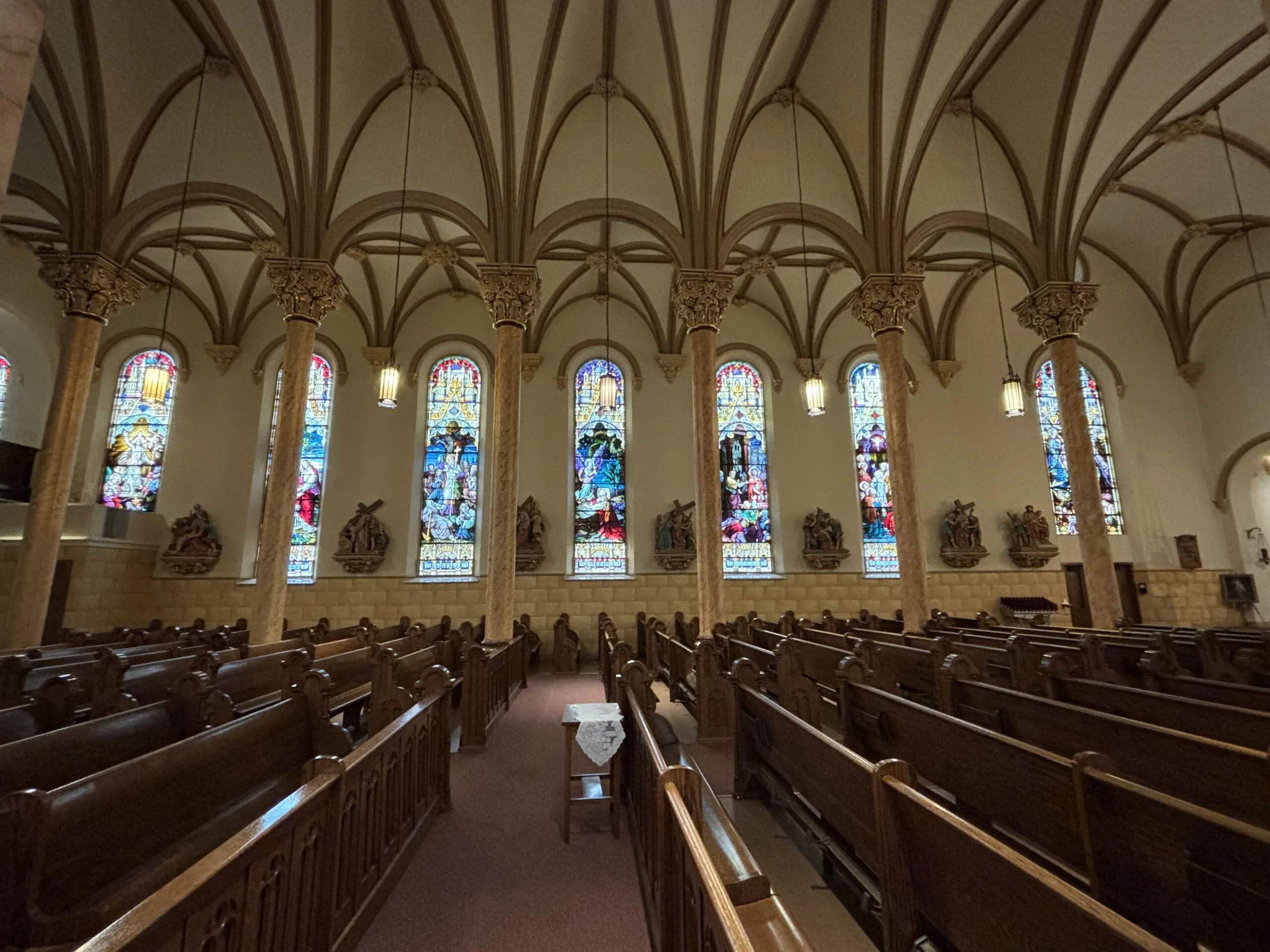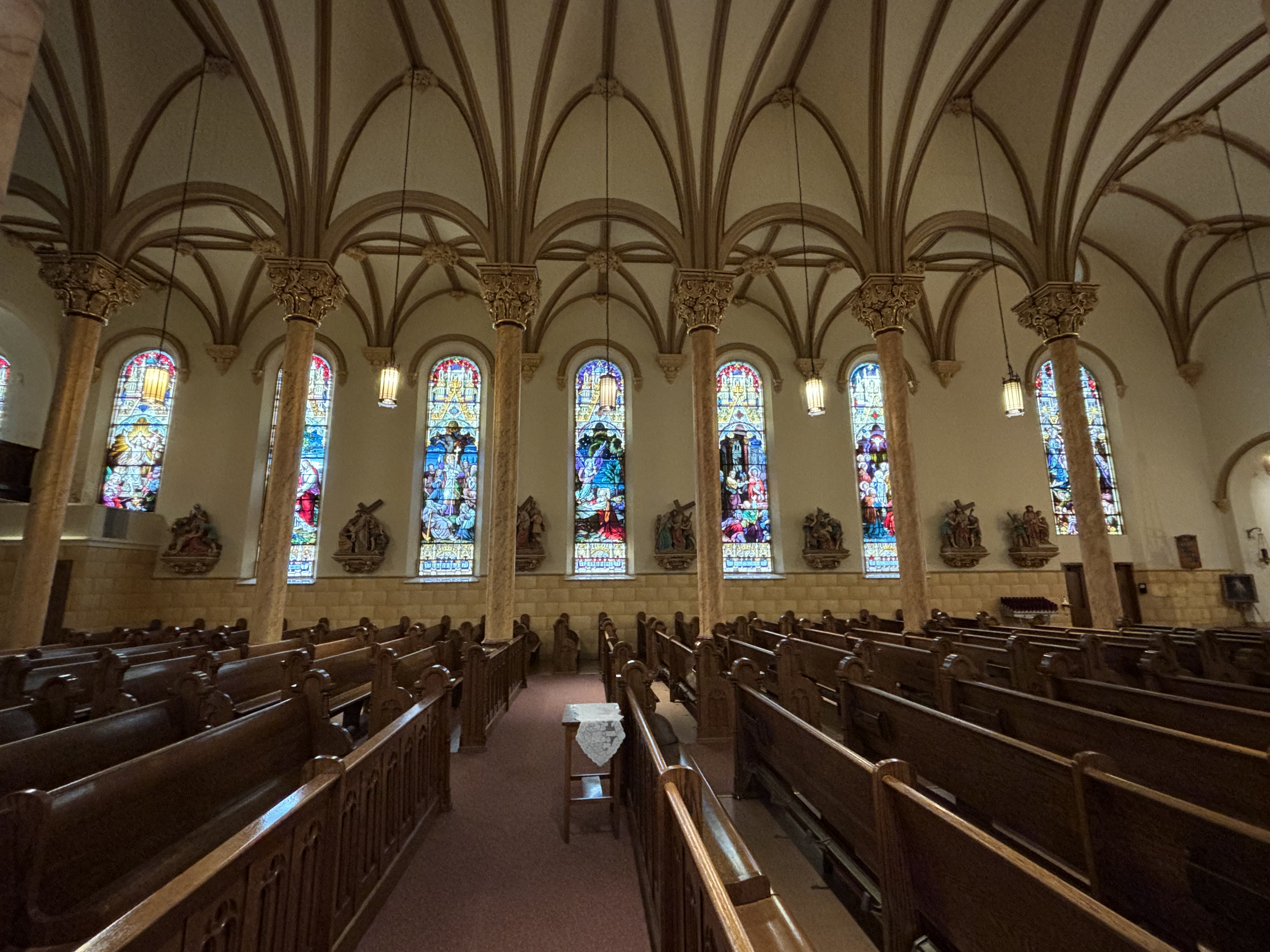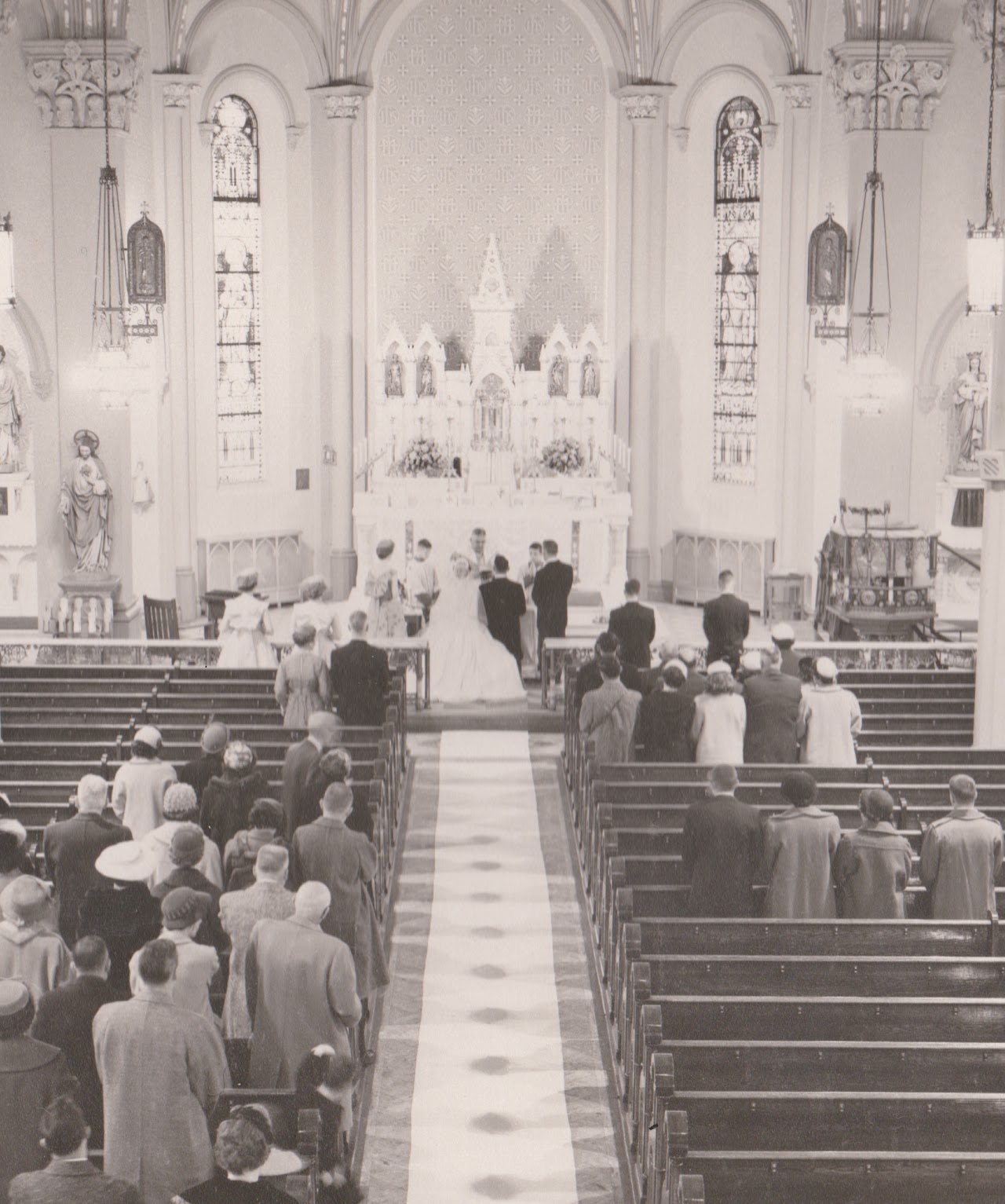
A historic parish in rural Wisconsin suffered major damages amid severe weather in the region on April 14 after strong storms and possibly a tornado destroyed much of the roof of the church building.
St. Joseph Catholic Church in East Bristol lost roughly half of its roof during the weather incident. Photos showed huge portions of the parish roof peeled off, exposing the churchʼs attic and rafters below.
St. Joseph Catholic Church in East Bristol, Wisconsin, is seen with its roof largely destroyed after severe thunderstorms came through the area Tuesday, April 14, 2026. | Credit: Bill Ringelstetter
The region has experienced multiple nights of severe storm outbreaks including severe winds, hail, and isolated tornadoes.
Local news reports said tornadoes had been reported in the East Bristol area just after midnight on April 14. The area was under a tornado warning at the time the parish roof was destroyed, though it wasnʼt clear if a tornado was itself responsible for the destruction.
St. Joseph Catholic Church is seen in East Bristol, Wisconsin, with its roof largely destroyed after severe thunderstorms came through the area Tuesday, April 14, 2026. | Credit: Bill Ringelstetter
The parish did not immediately respond to a request for comment about the damage. On the parishʼs Facebook page, meanwhile, a post claimed that a tornado had hit the church. Images showed destruction inside the church including insulation piled up near the altar and a light fixture in a pew.
Built in the early Gothic Revival manner, the building has seen several additions in the roughly 130 years since it was built, including in 1965 and 2024.
The parish is part of the Diocese of Madison. A press release from the diocese said the diocesan office of buildings, construction, and real estate was responding to the incident, along with the insurer Catholic Mutual Group.
“St. Joseph Church has served generations of Catholics in northeast Dane County, and we are heartbroken by the devastation,” the diocese said. “We ask for your prayers as we assess the damage.”
Rep. Greg Steube, R-Florida, is urging the Department of Veterans Affairs (VA) to add crucifixes to its list of acceptable symbols for veteran headstones at national cemeteries.
“In the pursuit of religious freedom, as guaranteed by the First Amendment to our Constitution, we urge the Department of Veterans Affairs and the National Cemetery Administration to offer the crucifix as an eligible emblem of belief for inscription on headstones at national cemeteries,” Steube said in an April 10 letter addressed to Secretary Douglas Collins of the U.S. Department of Veterans Affairs and Undersecretary for Memorial Affairs Samuel Brown.
“Veterans and their next of kin may select from nearly 100 different emblems representing several different belief systems,” he said, noting sanctioned emblems include symbols for several Christian denominations as well as Jewish, Muslim, and Hindu symbols.
“While even atheists, humanists, and Wiccans have an eligible emblem of belief for inscription, Catholic veterans do not currently have the option to select a crucifix, an emblem of belief that most accurately represents the faith of nearly 20% of all veterans,” he said.
A crucifix is a cross that bears the body of Jesus Christ crucified, which is called the “corpus.” It is a spiritual symbol that recalls the passion and sacrifice of Jesus Christ, calling attention to his love, suffering, and redemption of humanity.
Steubeʼs press release quoted Archbishop Timothy Broglio of the Archdiocese for the Military Services, USA, saying, “I support the bipartisan effort led by Congressman Greg Steube (R-Florida) to support the free exercise of religion of veterans in having the crucifix included on tombstones.”
The archdiocese did not immediately reply to a request for comment.
Archbishop Timothy P. Broglio leads the Archdiocese for the Military Services, USA. | Credit: “EWTN News In Depth”/Screenshot
The VA has the authority to add emblems administratively, or lawmakers could introduce legislation if the agency does not act.
Steubeʼs letter, signed by 45 members of Congress — including 42 Republicans and three Democrats — requested the Department of Veterans Affairs provide its criteria for evaluating and approving emblems of belief for inscription on headstones at national cemeteries and whether any prior request had been made to include crucifixes on its list.
“VA is looking into the lawmakers’ request and will answer their letter directly,” Quinn Slaven, press secretary for the Department of Veterans Affairs, told EWTN News.
Republican Reps. Riley Moore of West Virginia, Mike Carey of Ohio, and John Rutherford of Florida were among the 20 Catholic members of Congress who signed on to the letter. Steube is Protestant, according to Pew Research Center.
Steube’s office did not immediately respond to a request for comment.
Just a few weeks since the death of her husband, Miguel, and amid her grief, Virginia Pérez de Santana, clutching a rosary, recounted with serenity and strength their story of a love that endures, sustained to the very last moment by the certainty that God exists and never abandons us.
Although she grew up in a Catholic family, Virginia said she felt that “something was missing”: a spark, an impulse of faith that would dispel her doubts regarding the existence of God. What she never could have imagined was that this longed-for certainty would come with the illness of her husband, Miguel, a dentist whom she met while volunteering in Cambodia 14 years before.
Although Miguel never doubted, she said, faith did not occupy a central place in their lives. But everything changed one day in July 2024 while they were enjoying a vacation with their three children: Virginia, 5; Miguel, 4; and María, 3.
After suffering severe headaches and a loss of mobility in his left arm, Miguel decided to go to the emergency room.
And that moment marked the beginning of it all.
“While waiting, Miguel was incredibly nervous, because he sensed that something was wrong. He was very agitated the entire time, saying, ‘I want to get out of here, I want to get out of here — I can’t breathe,’” Virginia told ACI Prensa, the Spanish-language sister service of EWTN News. After several tests and a long wait, the doctors confirmed what the couple feared most: Miguel had a brain tumor and required emergency surgery.
Miguel and Virginia with their three children. | Credit: Photo courtesy of Virginia Pérez de Santana
‘I’ve had an experience with God’
Gripped by fear and uncertainty, Virginia left the room to tell her parents what was happening. Upon her return, Miguel was no longer the same: His nervousness had vanished, and his face reflected a surprising peace and serenity. “When I came back, they had already moved him into an emergency bay, and I saw him there, laughing and talking with the other patients,” she recalled.
Then, Miguel took his wife’s hands and said: “Virginia, be at peace; I’ve had an experience with God.”
Miguel told her that, after being left alone in the room once the nurse had gone, he got down on his knees and pleaded: “My God, please, don’t leave me alone.”
A love ‘not of this world’
After praying, Miguel felt as though someone were embracing him, and in that instant, a warmth coursed through his entire body: “From head to toe, he felt a kind of electricity, of love, love, love. A love so pure, a love so profound, that he said it was not of this world.”
She recalled how her husband recounted to her every detail of the embrace he felt in the empty room, where he heard someone say to him: “Be at peace; I am with you, and I bear your cross with you.”
“And in that moment, he began to weep; not out of sorrow, not because of the tumor, but out of happiness. Then, he took my hands once more and said to me: ‘Virginia, you, who have sometimes had doubts — never, never, never doubt again, for God exists. I no longer merely have faith; I am certain that God exists.”
From that moment, Miguel experienced a profound peace and an absolutely radical transformation, “even physically,” recalled Virginia, whose friends and family told her that he looked even “more handsome” than before his illness because of the happiness he radiated.
“You will view the tumor as a blessing.” | Credit: Photo courtesy of Virginia Pérez de Santana
‘He was in love with God’
Although her husband was “a very good person,” Virginia recalled, with a smile, that he complained at times. Nevertheless, he offered up all his suffering and illness. “He would tell me that he was in love with God and that he didn’t want to complain, he wanted to do everything for God.”
“He used to tell me that he felt just like a typical teenager waiting outside school for his girlfriend to come out,” she recalled.
She said that her husband never stopped talking about God and would tell her: “In time, you will come to see this as a blessing, because thanks to the tumor, God has granted me this experience; and thanks to this experience, my eyes have been opened — for before, I was blind.”
Miguel was discharged from the hospital 15 days after the emergency operation. “He was happy,” his wife remembered. During his stay at the hospital, they prayed the rosary daily, and Miguel made a point of visiting some of the patients in nearby rooms, accompanied by the Schoenstatt Pilgrim Virgin statue.
Following the biopsy, they were informed that the tumor was one of the most aggressive types — incurable and fast-progressing. Yet, Miguel accepted the diagnosis with serenity, never questioning why this was happening to him.
“It was a profound acceptance of his illness,” Virginia continued. “And the truth is, we were always side by side, like a team, always believing that we were in God’s hands and that we simply had to accept his will. If a miracle occurred and he was cured, that would be wonderful; and if not — well, then whatever he decides, for we will never understand his ways.”
Friends and parents from their childrenʼs school in Madrid formed a prayer group that grew to nearly 500 people, “almost none of whom we knew,“ Virginia said. ”That gave us a great deal of strength: So many good people who, without even knowing us, cared and prayed for us.”
Miguel and Virginia with their family. | Credit: Photo courtesy of Virginia Pérez de Santana
Embracing illness as a gift
As time went by, although Miguel no longer felt the same powerful impact of the experience he had undergone in the hospital, he still saw God’s love in the everyday “little signs” and gestures of the people praying for him. “It also brought me much closer to God," Virginia said.
In July 2025, the tumor recurred, returning with greater force and in a much more aggressive manner. “He always faced it with great courage, with great strength, and with immense faith. We always used to say: ‘Whatever God wills.’”
“He always faced it with great courage, with great strength, and with immense faith.” | Credit: Photo courtesy of Virginia Pérez de Santana
The tumor progressed rapidly, all treatment options exhausted. In February, Miguel was admitted to palliative care at the Navarra Clinic in Madrid, where he remained until he died on March 10.
“Throughout that entire month Miguel spent in the hospital, he never once complained; even the palliative care doctors themselves told us they were astonished by the sense of peace we radiated,” Virginia said.
Miguel was able to say goodbye to his children. "Watching how he faced his illness and how he faced death has set the bar very high for me,” Virginia recounted.
Miguel with his three children. | Credit: Photo courtesy of Virginia Pérez de Santana
‘It’s true that God exists, that he rose again, and that he is with us’
Drawing upon her experience, Virginia hopes to reach out to those who are going through a similar illness: “God desires that very same love and that very same faith for them, too.”
“Even if they haven’t felt it within their own bodies, let them lean on the testimonies of others,“ she said, ”because he is real; because it is true that God exists, that he rose again, that he is with us; and that even when you call out to him and it feels at times as though God isn’t listening, he is indeed listening to you.”
“That very same strength God has given us, he is also giving to other people … Obviously, I would have preferred for Miguel to remain with me, to grow old alongside him, for our lives to continue on, free of illness and trouble. But I think that had we simply continued on in that same manner, would we have remained so close to God? Well — no; probably not,” she reflected.
“I feel incredibly fortunate to be able to say that my husband is in heaven.” | Credit: Photo courtesy of Virginia Pérez de Santana
‘No ordinary peace’
Virginia shared what she considers the most important thing of all: “I feel incredibly fortunate to be able to say that my husband is in heaven — because I know it; because he had immense faith, he had such deep love for God, and he demonstrated it in so many ways, such as by praying the rosary every day.”
Shortly before her husband died, the chaplain at the Navarra Clinic administered the anointing of the sick.
"I said to Miguel: ‘Do you realize how many people have drawn closer to God because of your illness? I truly believe there is nothing more important you could have done,’” she said.
With tears in her eyes, Virginia said that if one sets aside “human selfishness,” her husband has already achieved his goal: “To be with God — and in such a way.”
“For Miguel, this has been the greatest gift God could have given him. Miguel is with God; he’s happy, and that’s what truly matters,“ she said. ”And if you hold onto that thought, your life changes.”
“The peace we experienced throughout the entire process of his illness and his death was no ordinary peace,“ she said. ”I know it because we were enveloped by so many people’s prayers, and because we were enveloped by God.”
This story was first published by ACI Prensa, the Spanish-language sister service of EWTN News. It has been translated and adapted by EWTN News English.
MANILA, Philippines — Amid growing concerns over mental health, Cardinal Jose Advincula, the archbishop of Manila, Philippines, stressed on April 2 that priests must prioritize their mental health to sustain their missionary work.
Celebrating the chrism Mass on Holy Thursday at the Minor Basilica and Metropolitan Cathedral of the Immaculate Conception, commonly known as Manila Cathedral, Advincula quoted a recent study, saying: “About 18% reported that they are psychologically distressed,” meaning “almost one in every five priests is undergoing a mental difficulty or emotional burden.”
He reminded clergy to acknowledge their human vulnerabilities and weaknesses, calling on the faithful to support clergy through prayer and understanding.
According to data from the Catholic Bishops' Conference of the Philippines (CBCP), as of 2025, there are more than 10,000 priests serving 73.6 million Catholics. The Philippines is Asiaʼs largest Catholic country.
Lay faithful support for the clergy
Advincula urged lay Catholics to stand with priests as they carry out their ministry.
“To be faithful, we need your understanding and your prayers,” he said.
Advincula thanked communities for their continued support, despite what he described as the “obvious limitations” of clergy, which include challenges such as limited resources and the need for more active engagement from the laity.
Cardinal Jose Advincula, archbishop of Manila, delivers his homily during the chrism Mass at Manila Cathedral on April 2, 2026. | Credit: Photo courtesy of Archdiocese of Manila
The cardinal thanked priests and the faithful for their shared responsibility in continuing the Churchʼs life and mission.
He said human connections are essential to restoring hope and sustaining missionary work.
Pope Leo XIVʼs April prayer intention
Advinculaʼs remarks coincided with the Holy Fatherʼs April prayer intention, which is “for priests in crisis.”
“Let us pray for priests going through moments of crisis in their vocation, that they may find the accompaniment they need and that communities may support them with understanding and prayer,” Pope Leo XIV said.
Echoing the popeʼs words, Advincula urged Catholics to pray for priests, especially those facing loneliness, doubt, and exhaustion.
“When a pastor faces some kind of weariness at any time, the Church is not supposed to judge but rather to walk beside him,” he said.
A parish priestʼs struggle with addiction
EWTN News spoke with two priests who have faced mental health challenges and described how they overcame them.
Father Mark (a pseudonym used to protect his identity), a 52-year-old parish priest in the southern Philippines, serves a parish with more than 40,000 Catholics. He has been there for the last five years.
Over the years, Father Mark felt exhausted by pastoral duties. He gradually developed loneliness and distress, which affected his mental well-being. Over time, he began to consume alcohol more frequently and eventually became addicted.
As his health conditions and addictions affected his personal life and pastoral duty, his religious superiors made him take a break from pastoral care and placed him in a Church-run rehabilitation center near Manila for a year.
After a year of medication along with prayer, social connections, and discernment, he is free of addiction and back to pastoral work in a different parish in the central Philippines.
He said he learned a valuable lesson from his imperfections, especially about balancing personal care — physical, spiritual, and emotional.
A rural missionaryʼs ordeal
Father Marcilino, a 47-year-old priest, used to be a rural missionary in the northern part of the country.
He used to minister to 70,000 Catholics across eight chapels and one parish, alongside two younger priests.
“At some point, I got disinterested in my pastoral work and lost zeal for it,” he said.
“I did not have any vices as such. I felt a kind of spiritual dryness in my priestly life,” he said.
When his priest companions noticed his mental distress and lack of participation in community prayers and mealtime presence, they encouraged him to take a few months' break from pastoral responsibility with the knowledge of their superiors.
His superiors sent him for a three-month refresher course on psycho-spiritual enrichment.
After spending three months in the program, he returned to the parish with renewed zeal as a person and pastor.
“I have realized that priests like me face pastoral exhaustion or compassion fatigue caused by many factors,” he said. “It is necessary that we take precautions and efforts to monitor our mental well-being as we are interested in rendering our pastoral service to others with hope and compassion,” he added.
He thanked his superiors and those who continually support him in his missionary endeavors.
“My struggles with mental health issues taught me a valuable lesson that I am not a superhuman being,” he said. “I need to be aware of my limitations, especially worry, anxiety, stress, and depression to some extent.”
“We are all works in progress and rely on Godʼs grace to carry out our pastoral work for the common good,” he said.
Mental health in the Philippines
An estimated 7 million to 12.5 million Filipinos suffer from mental health conditions, according to research published in the Lancet Regional Health.
The National Capital Region Police Office reported on March 25 that suicide cases in Metro Manila more than doubled in the first three months of 2026, with many cases stemming from emotional distress, financial pressure, anxiety, depression, and relationship issues.
Meanwhile, the country does not have adequate mental health professionals, and the government is making efforts to strengthen mental health services, such as increasing funding for mental health programs and training more professionals to meet the growing demand.
Everyone must take care of their mental health amid the many challenges of life and work, Christopher Lim, a professional psychologist, told EWTN News.
Over the years, Lim has counseled several people, including priests and religious sisters, who have faced mental health challenges.
One piece of advice he gives is that anyone can develop mental health concerns at any time, regardless of their current mental well-being.
“Timely professional help is key to mental health,” Lim said.
The Knights of Columbus issued a statement that affirms the Catholic fraternal organization’s solidarity with Pope Leo XIV as President Donald Trump criticized the Holy Father a second time on Truth Social.
“The Knights of Columbus has always stood in solidarity with the Holy Father, recognizing in him a spiritual father who calls the world not to division but to unity, not to conflict but to peace,” Supreme Knight Patrick Kelly said in the statement.
“In this moment, we reaffirm that commitment with clarity and conviction,” he said.
Trump escalated his criticism of the Holy Father late Tuesday evening in a second post on Truth Social, which criticized the pontiff’s staunch opposition to war.
Whether one agrees or disagrees with Leo’s policy views, Kelly said, “the Holy Father’s prophetic voice deserves to be heard with respect and engaged seriously.”
“Pope Leo XIV has consistently called for peace, dialogue, and restraint in a world marked by war and suffering,” he said. “The Holy Father’s words are not political talking points — they are reflections of the Gospel itself.”
Kelly noted that many Catholics and others “have been deeply disappointed by the disparaging comments directed at Pope Leo XIV” by Trump, and that Leo “is not a politician — he is the vicar of Christ, entrusted with proclaiming the Gospel and shepherding souls.”
In his statement, Kelly acknowledged that faithful Catholics can hold differing views on foreign policy and that Catholics should engage in the public square. He said nations can safeguard security “in accordance with the demands of justice and the pursuit of peace.”
“The Church does not ask Catholics to withdraw from civic life but to engage with and elevate it — bringing to our civic dialogue the light of truth, respect for the dignity of every human person, and a steadfast concern for the common good," he said.
Kelly also encouraged prayers for the pope, the president, and other politicians.
“As Knights, we are called to be men of unity, as followers of Christ and patriotic citizens,” he said. “I encourage all Knights of Columbus to pray for the Holy Father, to pray for civic leaders, and to pray for peace and those working to achieve it.”
“And let us recommit ourselves to charity in our public discourse,” he added. “May we be known not for echoing the divisions of our time, but for healing them. In a moment of tension, the path forward is not louder conflict but deeper fidelity — to truth, to charity, and to the Gospel.”
Trump goes after Leo again
Trumpʼs social media post said: “Will someone please tell Pope Leo that Iran has killed at least 42,000 innocent, completely unarmed, protesters in the last two months, and that for Iran to have a nuclear bomb is absolutely unacceptable."
During the protests, Leo did call for peace, saying in January that “ongoing tensions [in Iran and Syria] continue to claim many lives.”
“I hope and pray that dialogue and peace may be patiently nurtured in pursuit of the common good of the whole of society,” he said at the time.
Leo has also strongly opposed nuclear weapons, saying in June 2025: “The further proliferation of nuclear weapons in the Middle East, as well as this escalation of violence, imperils the fragile stability remaining in the region.”
While Trump cited numbers exceeding 40,000 people, estimates about the number of people killed in anti-regime protests and unrest in Iran varies a lot, ranging from several thousand to more than 30,000. Most protesters were unarmed, but Iran’s government claims some were armed and killed about 500 security personnel. Trump said the United States tried to arm the protesters, but those guns did not get to the right people.
Archbishop Alexander Sample of Portland, Oregon, said he is deeply concerned and troubled by Trump’s social media rhetoric, especially during Holy Week and Easter, which he says falls short of the moral standard expected of both the presidency and a professed Christian. The archbishop criticized Trump’s attacks on Pope Leo, saying the pope’s calls for peace and dialogue arise from his pastoral mission, not political ideology.
Sample said the Church’s role is to proclaim peace, human dignity, and the Gospel, citing Jesus’ teaching: “Blessed are the peacemakers.”
The Ancient Order of Hibernians condemned attacks and mockery directed at Pope Leo XIV and the papacy, affirming that respect for the Holy Father is essential to Catholic faith.
Vice President JD Vance, a convert to Catholicism, said at a Turning Point USA event that Pope Leo XIV should “be careful when he talks about matters of theology.”
“One of the issues here is that if youʼre going to opine on matters of theology, youʼve got to be careful,” he said. “Youʼve got to make sure itʼs anchored in the truth.”
Republican U.S. House Speaker Mike Johnson of Louisiana said: “Any religious leader can say anything they want, but obviously, if you wade into political waters, I think you should expect some political response.”
Pope Leo XIV has responded to Trump’s public criticism by saying he has “no fear of the Trump administration” and will continue to speak out boldly with the message of the Gospel.
After concluding the first leg of his African apostolic journey in Algeria, Pope Leo XIV travels to Cameroon from April 15–18. In the Central African nation, the Holy Father is set to visit the capital, Yaoundé, and the metropolitan sees of Bamenda and Douala.
If Algeria represents the Church as a small minority navigating a Muslim-majority society, Cameroon presents a different ecclesial landscape. The Catholic Church there is demographically significant, institutionally entrenched, socially influential, and politically attentive.
Cameroon stands not only as the second stop on the Holy Father’s African itinerary but also as a microcosm of the contemporary African Catholic experience — complex, vibrant, and consequential.
Here are eight things to know about the Church in Cameroon and what is expected of Pope Leoʼs visit:
1. It has a significant and growing Catholic population.
Cameroon’s population is religiously diverse, made up of Christians, Muslims, and practitioners of African traditional religions. Within the Christian bloc, Catholics constitute one of the largest denominations. Current estimates place Catholics at roughly 30% to 35% of the national population, translating into several million Catholics.
This scale gives the Catholic Church measurable public presence. Parishes are numerous, Catholic diocesan structures are well developed, and lay movements are active across urban and rural areas. The Church is not a marginal actor; it is a central stakeholder in national life.
Growth trends remain steady rather than explosive. Unlike some East African contexts where Catholic numbers have surged, Cameroon’s expansion is incremental and closely tied to demographic growth. Nonetheless, vocations to the priesthood and Institutes of Consecrated Life and Societies of Apostolic Life (ICLSAL) continue at levels that sustain ecclesial institutions.
In Cameroon, Pope Leo XIV will encounter a people of God neither defensive nor peripheral but fully embedded in national society.
2. It has a robust ecclesiastical structure and metropolitan sees.
The Catholic Church in Cameroon is organized into five ecclesiastical provinces, each headed by a metropolitan archbishop. These include Yaoundé, Bamenda, Douala, Garoua, and Bertoua.
The Archdiocese of Yaoundé serves the political capital and functions as a strategic center for Church-state engagement. Douala, the country’s economic hub, anchors the Littoral region and reflects the Church’s engagement with commerce, urbanization, and migration.
Bamenda, in the Anglophone Northwest Region, carries particular pastoral and political weight due to ongoing instability in that part of the country. Garoua Archdiocese is in the north of the country, while Bertoua Archdiocese is in the east.
The bishops collectively operate through the National Episcopal Conference of Cameroon, which regularly issues pastoral letters on social, political, and moral issues.
Pope Leo XIV’s decision to visit three metropolitan sees signals a recognition of Cameroon’s regional diversity and ecclesial complexity.
3. The Church in Cameroon has deep historical roots.
Catholic missionary activity in Cameroon dates to the late 19th century, particularly under German colonial administration and later French and British rule. Missionaries established schools, clinics, and parishes that became foundational to local communities.
Over time, ecclesial leadership transitioned from missionary congregations to Indigenous clergy. Today, Cameroonian Catholic bishops and priests lead the Church across the country, and missionary institutes have shifted toward collaboration rather than control.
This historical trajectory — from missionary implantation to local ownership — has shaped a confident Church. Catholic institutions in education and health care are not peripheral supplements; they are pillars of national infrastructure.
The historical memory of missionary sacrifice and local perseverance still informs Catholic identity in Cameroon. Papal visits are therefore received not as external interventions but as moments of communion within an already mature ecclesial body.
4. The Church leads in education and health.
Few institutions in Cameroon rival the Catholic Church in educational reach. Catholic primary and secondary schools are widespread, often regarded for discipline and academic performance. The Church also sponsors tertiary institutions and teacher training colleges.
Health care is similarly significant. Catholic hospitals and clinics serve urban centers and remote areas alike. In regions where public health systems are strained, Catholic Church-run facilities frequently fill service gaps.
This social footprint gives the Catholic Church influence but also responsibility. It must negotiate regulatory frameworks, maintain quality standards, and manage financial sustainability.
This also means that papal messaging on social justice, youth formation, and health care ethics resonates concretely rather than abstractly.
In Cameroon, the Church’s credibility is measured as much by service delivery as by liturgical vitality.
5. Catholic leaders play a role in political and social realities.
Cameroon’s Catholic bishops have consistently engaged in public discourse on governance, elections, corruption, and national unity. Pastoral letters issued around electoral cycles often emphasize transparency, accountability, and peaceful participation.
This engagement places the Church in a delicate position. While she does not function as a political party, she operates as a moral voice. Her statements can attract both public support and governmental scrutiny.
The Anglophone crisis in the northwest and southwest regions — marked by tension between separatist groups and state forces — has intensified the Church’s mediating role. Bishops in affected regions, particularly in Bamenda, have appealed for dialogue and protection of civilians.
Pope Leo XIV’s visit to Bamenda is therefore not merely ceremonial. It unfolds against a backdrop of social fragility and political complexity. Any public remarks in that region will be closely analyzed for diplomatic nuance.
6. The Cameroon Church sees many religious vocations.
Cameroon is considered one of the more fruitful Churches in central Africa in terms of religious vocations. Major seminaries in the country train diocesan clergy, and religious congregations attract local candidates.
The presence of Indigenous clergy has allowed the Church to contextualize liturgy, catechesis, and pastoral strategy. Inculturation — integrating elements of local culture within Catholic worship and life — has developed within the framework permitted by universal Church norms.
However, vocations also present governance challenges: ensuring adequate formation, preventing clericalism, and addressing global concerns about safeguarding and accountability. As elsewhere, the Cameroonian Church must navigate expectations of transparency and ethical leadership.
A papal visit often includes meetings with clergy and religious. In Cameroon, such encounters are likely to reinforce standards of pastoral responsibility and ecclesial communion.
7. The Church here enjoys linguistic, cultural, and religious pluralism.
Cameroon is frequently described as “Africa in miniature” due to its linguistic and cultural diversity. The country officially operates in both French and English, with numerous Indigenous languages in daily use.
This diversity shapes ecclesial life. The Church must minister across Francophone and Anglophone regions, urban and rural contexts, and varied ethnic identities. Liturgies may incorporate local languages and music while maintaining doctrinal unity.
Religiously, Cameroon is pluralistic. Alongside Catholics are Protestants, Pentecostals, Muslims, and adherents of traditional religions. Inter-Christian competition — particularly with rapidly growing Pentecostal movements — poses pastoral challenges. The Catholic Church must articulate its identity in an environment where charismatic worship and prosperity preaching attract large followings.
Interreligious coexistence with Muslim communities, particularly in northern regions, remains a factor in national stability. The Church has often collaborated with Muslim leaders to promote peace and counter extremism.
For Pope Leo XIV, this pluralistic setting requires calibrated messaging — affirming Catholic identity without undermining interreligious harmony.
8. Cameroon hosted a previous papal visit.
In 2009, Pope Benedict XVI visited Cameroon, marking a major ecclesial event that included the promulgation of the Instrumentum Laboris for the Second Synod for Africa. That visit reinforced Cameroon’s role within the continental Church.
Pope Leo XIV’s 2026 journey will inevitably be compared with past papal engagements. Expectations will be shaped by memory: large public liturgies, strong doctrinal messages, and calls for ethical governance.
This story was first published on March 12, 2026, by ACI Africa, the sister service of EWTN News in Africa, and has been updated.
Christians in Algeria say they are hoping Pope Leo XIV’s visit will be what “leads to change” as they have recently faced a massive spike in church closures and Christian arrests.
Pope Leo is visiting Algeria April 13–15 for the first part of his African papal trip. The popeʼs presence has been “widely viewed by the Christian community as a success,” Kelsey Zorzi said in an April 14 interview with “EWTN News Nightly.”
Zorzi, director of global advocacy at Alliance Defending Freedom, discussed religious freedom in Algeria and the governmentʼs move to stop the spread of Christianity.
“Algeria is 99% Muslim; less than 1% of the population is Christian," she said. "So for many years, Christians and Muslims have been living side by side. Muslims have been hearing the Gospel and steadily converting to Christianity."
“As of 2017, there were 50 thriving Protestant evangelical churches operating across the country, and these churches were growing, and the government took note of this,” she said.
“To combat what it perceived as an increasing threat,” the government “started enforcing an old 2006 ordinance that required the association of Protestant churches to be licensed,” she said. “These associations tried numerous times to apply for a license, but the government has refused to this day to acknowledge these applications or to grant the licenses.”
“So they have shut down, over the course of the last nine to 10 years, almost 50 churches across the country,” she said.
The government has claimed the closures were due to problems including safety permits and zoning laws, but Zorzi said “these claims are a mere pretext, and the governmentʼs actual motivation is to stop the spread of Christianity in Algeria.”
In the nation, there has been "a long history of pretextual and manipulative tactics that have been used to keep the churches closed,” she said.
“Weʼve seen the government allege that some of the churches have building code violations, and after these alleged violations are remedied, the government still refuses to reopen the churches,” she said.
The government also has asked “the Evangelical Association to meet to discuss the license, and when the invitation for these meetings arrives, itʼs often for a date that has already passed,” she said.
Pope Leo’s visit to Algeria
The pope met with the president of Algeria on April 13, “and we are hearing he did raise the issue of the Protestant church closures as well as the criminal charges that are being brought against pastors,” she said.
Pope Leo also said Mass where the archbishop of Algiers "pointed out that the Christian community in Algeria is comprised of several denominations" and he "specified that several Protestant church leaders were present at the Mass,” she said.
“The pope visited the eastern portion of the country, which is where St. Augustine lived, and planted an olive tree as a symbol of peace,” she said. “The Protestant communityʼs general sense of the popeʼs visit has been highly positive.”
“Theyʼre very encouraged and theyʼre hoping that this might be the thing that leads to change,” she said.
The Polish Bishops' Conference is working with national authorities to prepare an action plan for potential armed conflict, reflecting growing security concerns in the region.
The initiative follows discussions held during the 404th Plenary Assembly of the Polish Bishops' Conference. On March 17, Poland Deputy Prime Minister and Minister of National Defense Władysław Kosiniak-Kamysz and Minister of the Interior and Administration Marcin Kierwiński met with bishops at the conferenceʼs general secretariat in Warsaw.
In an April 7 interview with the Polish Press Agency, Archbishop Tadeusz Wojda, president of the Polish Bishops' Conference, said the preparations were driven by widespread concern over regional instability.
“There are fears that the war will reach Poland, which is understandable,” Wojda said. “Fortunately, we are not standing idly by, waiting for events to unfold.”
Coordinated Church-state response
At the center of the effort is a newly established working group within the bishops' conference composed of representatives from multiple institutions, including Caritas Poland. The group is collaborating with both the Ministry of National Defense and the Ministry of the Interior to develop coordinated responses to crisis scenarios.
According to Wojda, the plan includes provisions for assisting civilians, supporting refugees, and ensuring access to essential resources such as generators, water, medical supplies, and hygiene products. Government authorities have indicated that such materials would be made available to parishes in the event of a national emergency.
The working group is also developing protocols for the evacuation of cultural and religious heritage sites, the establishment of humanitarian corridors, and the identification of safe locations where civilians could seek shelter.
Role of parishes on the front line
Church leaders expect that parishes will play a critical role in any crisis response. Poland has more than 10,000 Catholic parishes nationwide, making the Church one of the countryʼs most extensive and trusted local networks.
Wojda explained that the Polish government realizes that in a crisis situation, “most Poles will first turn to the Church for help, and only then to municipal institutions and offices.” Therefore, it is important to have access to resources that will allow civilians to survive in a crisis.
To prepare for this responsibility, the conference is developing practical guidelines for clergy. Training sessions and workshops are already underway in some dioceses, often in collaboration with Caritas Poland, which has extensive experience in humanitarian aid.
Wojda stressed that priests are aware of the potential challenges. “They understand the problem they may have to face,” he said, adding that bishops are being kept regularly informed of the preparations.
Broader regional context
The initiative reflects heightened awareness in Poland of security risks linked to the ongoing war in neighboring Ukraine and broader geopolitical tensions in Eastern Europe.
While Poland has not been directly involved in armed conflict, its proximity to the front lines and its role as a key NATO member and logistical hub for Ukraine have heightened concerns about potential spillover effects.
Church and state officials have framed the preparations as a precautionary measure aimed at safeguarding civilians and maintaining social stability. Observers have largely viewed the development positively, noting that the Catholic Churchʼs extensive parish network and centralized structure position it as a uniquely effective partner in crisis response.
This evolving role raises broader questions about the place of religious institutions in modern European societies: whether the Church can serve not only as a moral authority but also as a stabilizing force in times of crisis, and how such cooperation between ecclesial and state structures may shape future responses to conflict and humanitarian emergencies.
The Spanish-language editor of the Italian writer and apologist Vittorio Messori, who passed away this past Good Friday, revealed the keys to the Italian writerʼs literary success and the secret behind a heroic life lived out of love for the Church.
The relationship between editor Álex del Rosal and Messori, one of the most successful Catholic writers of the last half-century, began in 1993, when the publishing house Planeta embraced del Rosalʼs idea to launch “Planeta Testimonio.”
The idea was to collect Catholic books that offered “engaging themes and authors that would consistently appeal to everyone from the student to the shopkeeper to the taxi driver,” del Rosal said in an interview with ACI Prensa, the Spanish-language sister service of EWTN News.
With this goal in mind, del Rosal contacted Messori and proposed compiling his articles from the “Vivaio” column in the newspaper Avvenire into a book. In that column, Messori often defended the Catholic Church. The result was the bestseller “Black Legends of the Church.”
Other titles followed, and in 1984, when Cardinal Joseph Ratzinger was still prefect of the Congregation for the Doctrine of the Faith, Messori conducted a lengthy and candid interview with the future Pope Benedict XVI. Published in 1985 as “The Ratzinger Report,” the book became an international bestseller. The two men remained friends over the years.
Messori achieved another historic milestone in 1994 with “Crossing the Threshold of Hope,” a book-length interview with St. John Paul II. He was the only journalist ever commissioned to prepare questions for such a project with the pontiff. John Paul II personally wrote detailed written responses to Messori’s questions, and the resulting volume became one of the most successful papal bestsellers in history.
Del Rosal, who described Messori as “extraordinary and deeply human,” maintained a friendship with the Italian writer that spanned more than three decades and lasted till his death on April 3.
The Spanish editor shared in an interview with ACI Prensa some key insights into Messoriʼs work and life.
The secret behind his heroic life
Beyond Messoriʼs public image as a friend of popes and a world-renowned author, del Rosal revealed a little-known aspect of the writerʼs life that, in many ways, defined him even more profoundly as a son of the Church. “It was the great cross that Vittorio bore in profound silence,” the editor remarked.
While he was still an agnostic, Messori entered into a canonical marriage with a young woman. Shortly thereafter, they separated, and he initiated the process to have the marriage declared null — a process that lasted two decades.
In that time, the writer met the woman who would remain his wife until his death: Rosanna Brichetti. The two met within the circles of Pro Civitate Christiana, a group founded in Assisi in 1939 by Father Giovanni Rossi, characterized by a great openness toward the secular world.
Messori disclosed his canonical situation to Brichetti with complete candor. "For 20 years," del Rosal said, "he lived with Rosanna in chastity — together, like brother and sister — in a truly heroic manner, precisely because he was so serious about living out his faith.”
The annulment process lasted from 1975 to 1995. The first ruling, which affirmed the validity of the marriage, came in Turin; the second, in Milan. It was only after his appeal to Rome that he finally received the response he had been hoping for from the Church: His first marriage was declared null.
During one of his visits to Messori, del Rosal discussed this matter with the writer: “He would say to me with great pain: ‘I am convinced. First, my conscience tells me that that first marriage is null and void. Second, I am almost certain that my success has slowed down this proceeding and made things more difficult for me.’”
“Thirdly — I, who am friends with Cardinal Ratzinger, the prefect of the Congregation for the Doctrine of the Faith who oversees these matters, and with the pope [St. John Paul II], who is ultimately the one who can also make the decision — nevertheless, I do not wish to use my friendship for a matter of this nature,” the editor recalled.
“Vittorio’s greatest attribute is not his literary success, nor his apologetic work, nor even how formidable he was in his defense of the Church; rather, it is the immense heroism he displayed in loving the Church despite — one might say — having been mistreated,” del Rosal said.
‘A writer’s master is his readers’
Messori was one of the most successful Catholic authors in recent decades, selling "somewhere between 30 and 40 million copies of his various works worldwide,” del Rosal noted.
Part of this success was based on a maxim he upheld not merely in theory, but through great personal effort: “He was the writer who most earnestly lived out his own words: ‘A writer’s master is his readers. Therefore, one must always answer them,’” del Rosal recalled.
With the help of his wife, Rosanna, Messori replied to every one of the more than 100 letters that arrived in his mailbox each week, until the use of email became widespread.
Speak to the seeker, not the convinced
Another of Messori’s strengths was that he addressed himself “not to the convinced Catholic, but to the seeker, to the one asking questions, even if they were at the opposite ends of ideological or doctrinal positions.” Messori himself was raised in a communist and deeply anticlerical family. It is not without reason that his mother, upon learning of his conversion, “wanted to send him to a psychiatrist,” the editor added.
This approach was evident in the publication of his first book, “Hypothesis About Jesus," for which he asked prominent Italian Communist Party member Lucio Lombardo Radice, an agnostic, to write the prologue.
“He didn’t write or speak for a closed circle within the Catholic Church; rather, he sought to address every type of audience,” del Rosal emphasized.
Every morning in the small Italian town on the shores of Lake Garda, Desenzano del Garda, Messoriʼs work routine involved visiting what he called the “center of the town’s opinion,“ a bar where ”the television was on and people chatted about this and that. While having breakfast and reading the newspaper, he would listen to the people’s conversations. This gave him a great deal of inspiration for taking the pulse of public opinion,” del Rosal said.
The balance between reason and the Holy Spirit
Messori’s manner of expression “maintained a balance between the two lungs of the Church: the Spirit and reason,” according to the editor.
Messori really disliked “the terminology of the Vaticanologist” and rejected that label, despite having interviewed two pontiffs. To him, the Vaticanologist “is incapable of moving beyond merely gazing at the exterior of the vessel containing the deposit of faith” and concerns himself solely “with superficial or flashy matters.”
“He always approached apologetics from the standpoint of reasoned faith, not morality. He argued that when morality is proclaimed without first having presented the faith, the result is not acceptance, but rejection,” del Rosal explained.
This story was first published by ACI Prensa, the Spanish-language sister service of EWTN News. It has been translated and adapted by EWTN News English.
THRISSUR, India — People from all walks of life paid tribute to Father Francis Alappatt, the priest-physician who galvanized public support for medical service to the poor, at a memorial gathering in Thrissur in the southern Indian state of Kerala on April 13.
“It was Father Francis who recommended that all the charitable and welfare programs of the archdiocese be named under ‘Sathwanam’ (Compassion). His aim was to provide the best treatment with the least expense, and he worked hard for that,” said Archbishop Andrews Thazhath of Thrissur, inaugurating the memorial at the Jubilee Mission Medical College (JMMC) that Alappatt established at the archdiocesan hospital in the heart of Thrissur.
Alappatt, who died of complications from diabetes at the age of 72 on April 8, was a singular figure in the Catholic Church in India: He was ordained in 1995 at the age of 41 after joining the seminary to fulfill a childhood dream, having already earned a medical degree from Kozhikode Medical College.
‘Half priest’
“Even when he was a medical student, he was called ‘padi achan’ (half priest) for his lifestyle, and I was also touched by him,” recounted Dr. Susheela Jacob, who was a professor at Kozhikode Medical College when Alappatt was a medical student in the 1980s, during the memorial.
“Scenes of trade in blood around the hospital prompted him to launch a blood donation campaign with batchmates [classmates], and he founded the Kerala Blood Donors Forum as a medical student,” Jacob recalled.
“I was regularly in touch with him, and when he started the medical college, he invited me, and I gladly joined in 2005,” said Jacob, a pathologist who is presently lab director at the JMMC Hospital. She spoke to EWTN News on April 14.
After his ordination, Alappatt transformed even remote parishes into centers of blood donation awareness and paved the way for the Kerala state government to record the blood group of each student in school certificates.
Francis Alappatt examines a patient at the Jubilee Mission Medical College Hospital in Thrissur, India. | Credit: JMMC
As director of Jubilee Mission Hospital, he expanded it into a medical college — approved by the central government — in 2004 and doubled the hospitalʼs beds to more than 1,500, making it one of the largest hospitals in Kerala. The facility is known for subsidized treatment for the poor and free medicines for snakebite victims.
Interreligious tributes
“Father Alappatt had a special doctorate in human relations. He knew how to move people,” said K. Rajan, a Hindu and minister in the Kerala state government, at the memorial. “Whenever he invited me for a program, I could not decline.”
“Father Francis was my classmate in school and surprised me [in the late] 1990s coming back to me as a priest. Then he turned my guru (teacher) in life,” said T.S. Pattabhiraman, a leading Hindu businessman of Thrissur.
“He became a family friend and had a unique marketing strategy [to get financial support]. Whenever I went to invite him for a family marriage or other functions, he would seek support for his free dialysis, treatment for snakebite victims. Whenever he needed help, he would call me. I could never say ‘no’ to him,” recalled Pattabhiraman, who is one of the trustees of the interreligious forum Alappatt founded to promote religious harmony.
Popular for his pioneering blood donation movement in Kerala — as well as his interreligious and health awareness programs, in addition to his role as founding director of the Catholic medical college — Alappatt was named chairman of the Indian Red Cross Society.
“In honor of Father Alappattʼs compassion for those affected by kidney disease, I am happy to announce today that Jubilee Mission has decided to set up a renal transplant center, and it will be called the Father Francis Alappatt Memorial Renal Transplant Centre,” announced Auxiliary Bishop Tony Neelankavil at the memorial, evoking thunderous applause.
Free dialysis and parish support
“Father Alappatt introduced and motivated parishes and families to support free dialysis as part of parish feasts and family celebrations like marriage or baptism. We got support for more than 12,000 free dialysis [treatments] in 2025,” Father Reny Mundankurian, the JMMC Hospital director, told EWTN News.
After leaving Jubilee Hospital in 2010, Alappatt served as vicar general of the Archdiocese of Thrissur and also helped improve smaller diocesan hospitals and health care initiatives in the archdiocese.
A prolific writer, he authored 50 books on health, social harmony, the environment, and human relations. A dozen of these were written after he became seriously ill, restricting his movement.
‘He showed God to the world’
“Father Alappatt showed God to the world through his loving service,” said Major Archbishop Raphael Thattil, head of the Syro-Malabar Catholic Church, in his homily during the April 10 funeral service at the Basilica of Our Lady of Dolours parish in the heart of Thrissur.
“He never worked in mission centers, but he showed with his life how life can be turned into missionary work,” said Thattil about his fellow parishioner, as both of them hail from the Dolours Basilica parish, which is celebrating its centenary year.
True to his commitment to health care, Alappatt donated his eyes, and after the funeral service — attended by half a dozen bishops — his body was not taken to the cemetery but placed in the JMMC mobile ambulance to be transported to the hospitalʼs anatomy department.