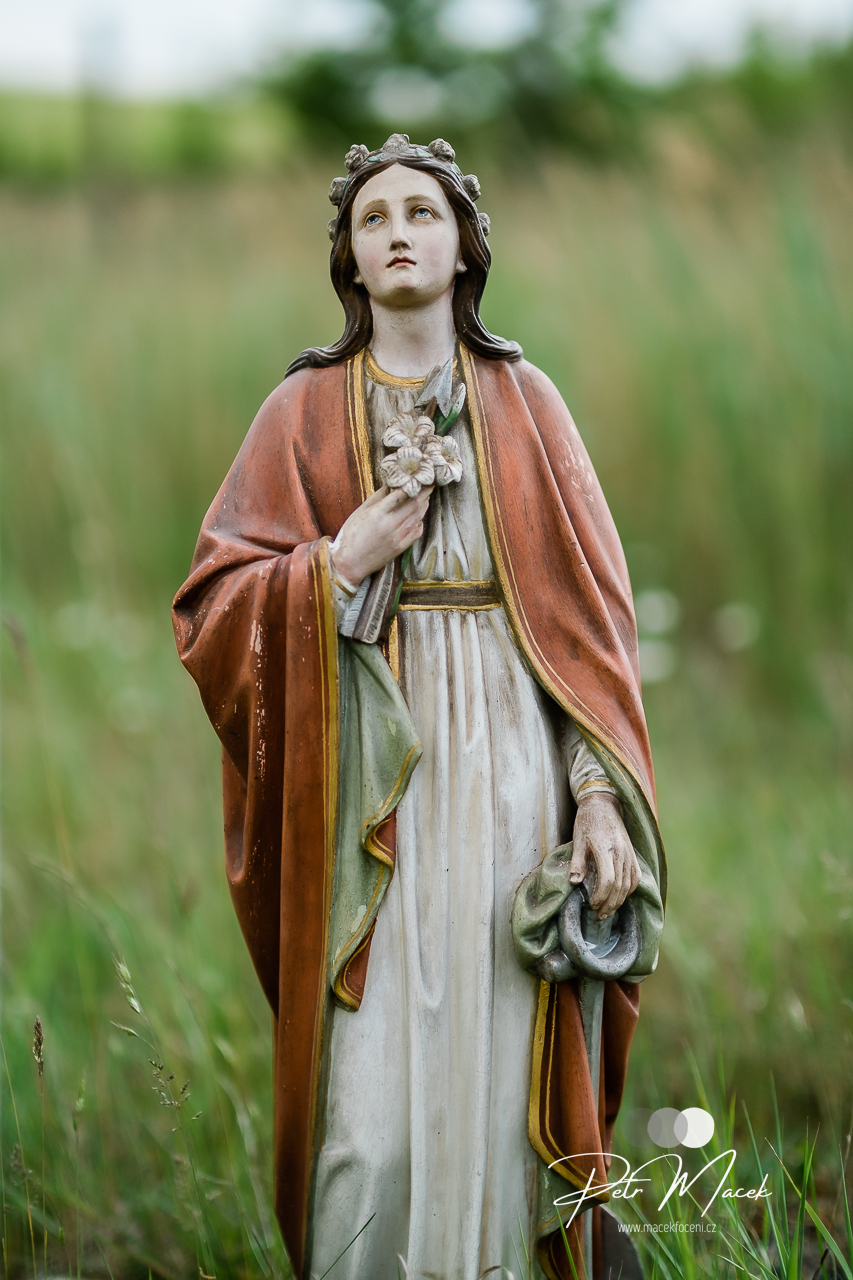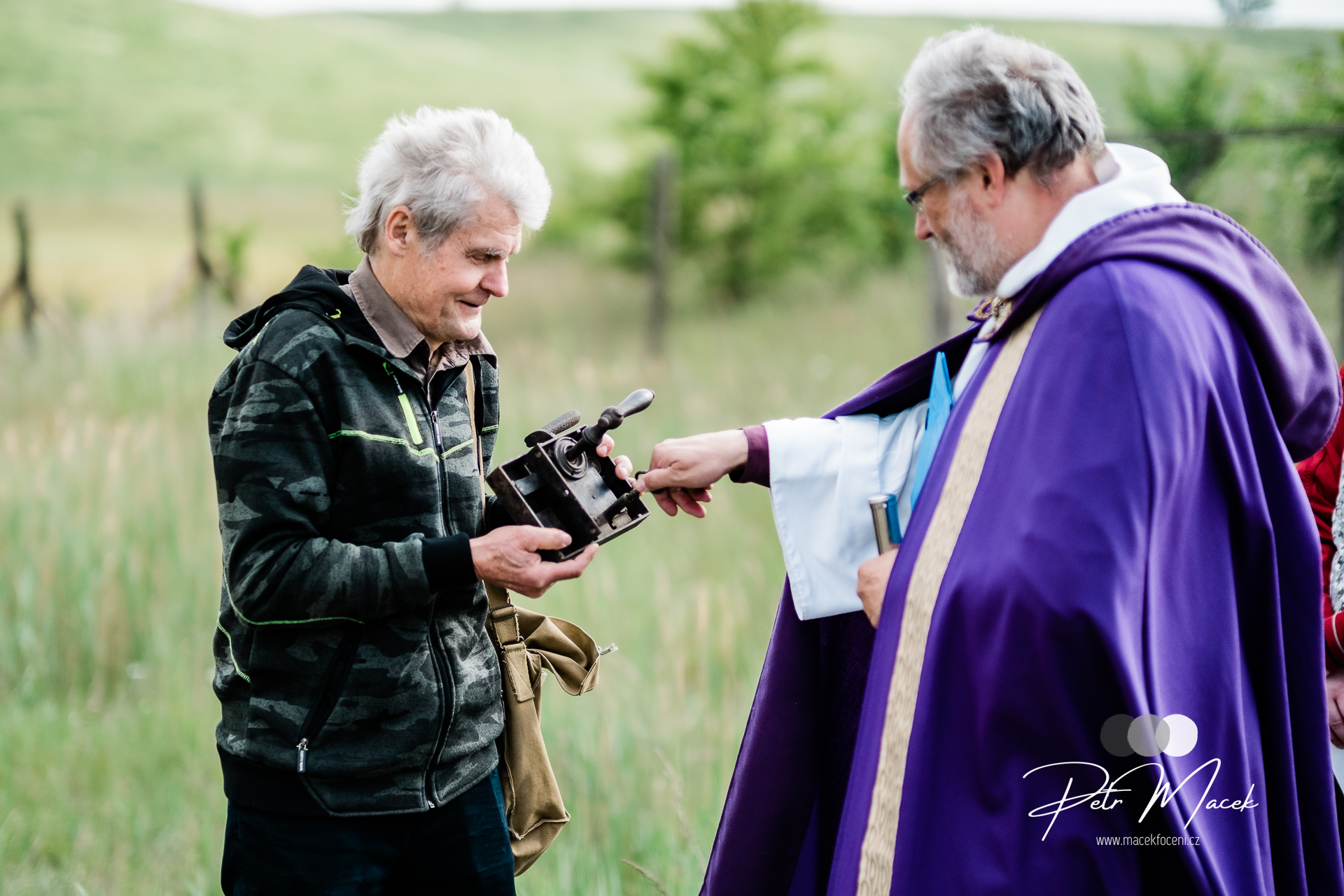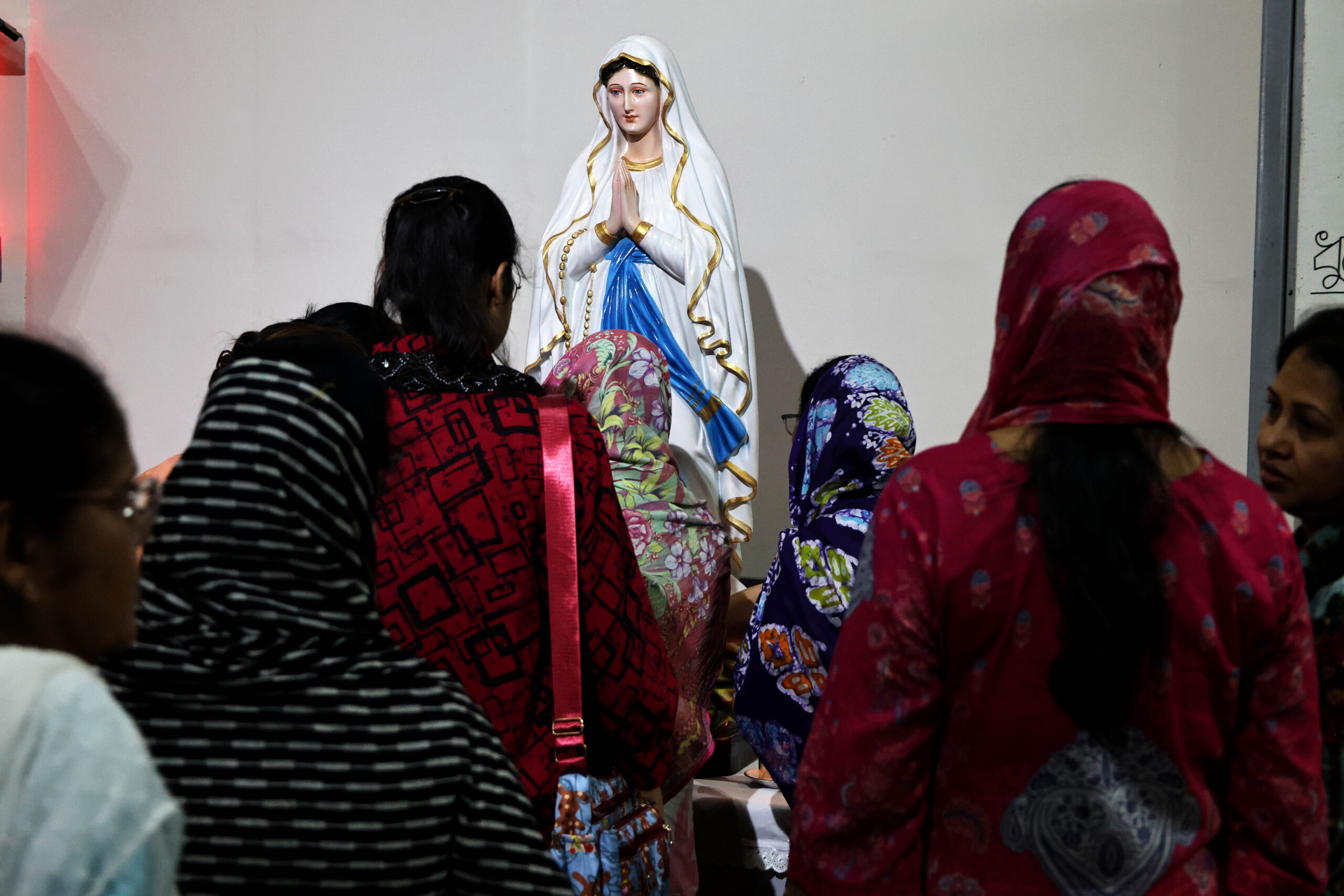
Israel Defense Forces (IDF) helped a Catholic village in southern Lebanon replace a crucifix that one of its soldiers destroyed with a sledgehammer and punished two soldiers who took part in the desecration.
“In full coordination with the local community of Debel in southern Lebanon, the damaged statue was replaced by IDF troops,” the Israeli military announced in an April 21 post on X.
“The Northern Command worked to coordinate the replacement of the statue from the moment it received the report of the incident,” they said. “The IDF expresses deep regret over the incident and is working to ensure that it does not happen again in the future.”
The response comes after a photo circulated on social media that showed an Israeli soldier striking the face of Christ on a damaged crucifix with a sledgehammer. Cardinal Pierbattista Pizzaballa, the Latin patriarch of Jerusalem, called the act “a grave affront to the Christian faith.”
In a separate post, the IDF confirmed that the soldier depicted with the sledgehammer and the soldier who took the photo will receive 30 days of military detention and will be removed from combat duty.
Six other members of the IDF were present and did not act or report the incident, according to the IDF. Those soldiers were summoned for "clarification discussions” and further actions might be taken.
The IDF’s inquiry determined that the conduct of the soldiers involved “completely deviated from IDF orders and values.”
According to the IDF: “Procedures regarding conduct with religious institutions and symbols were reinforced to the troops prior to their entry into the relevant areas and will be reinforced again for all troops in the area following the incident.”
The post stated that the chief of general staff “condemned the incident and stated that it constitutes unacceptable conduct and a moral failure, far exceeding any acceptable standard and contradicting IDF values and the expected conduct of its troops.”
In a statement through the Assembly of Catholic Ordinaries of the Holy Land on April 20, Pizzaballa said even amid the destruction of the statue, “the cross remains unassailable in its meaning.”
“As St. Paul the Apostle declares, ‘Far be it from me to glory except in the cross of Our Lord Jesus Christ’ (Gal 6:14),” his statement read. “For believers, the cross endures as a source of dignity, hope, and redemption, and as a summons to overcome violence through sacrificial love.”
Thousands of people gathered in Poland’s capital on April 19 for the National March for Life, a large public demonstration organized under the slogan “Faith and Fidelity 1966–2026,” commemorating the 1,060th anniversary of the Christianization of Poland.
The event combined religious observance, civic participation, and pro-life advocacy, drawing families, clergy, activists, and public figures to central Warsaw. The day began with Mass celebrated in two of the cityʼs major churches.
Mass is celebrated at the Archcathedral Basilica of the Martyrdom of St. John the Baptist in Warsaw, Poland, on April 19, 2026. | Credit: Tomasz Daniluk/Ordo Iuris
In the Archcathedral Basilica of St. John the Baptist, Bishop Piotr Jarecki presided over the liturgy, while Bishop Tomasz Sztajerwald celebrated Mass at the Cathedral of St. Michael the Archangel and St. Florian in Warsaw-Praga.
Participants later gathered at Castle Square, where the march officially began. Organizers described the event as a public expression of support for life and family, rooted in Poland’s Christian tradition. Metropolitan Archbishop Adrian Galbas of Warsaw encouraged participation ahead of the event, framing it as a testimony to human dignity. “We want to testify that we are lovers of life. Bring your family along! Life triumphs over every death,” he declared.
Church leaders join Poland’s President Karol Nawrocki and other dignitaries at the March for Life in Warsaw on April 19, 2026. | Credit: Tomasz Daniluk/Ordo lures
March through Warsaw highlights pro-life message
The procession moved through central Warsaw streets under the historic slogan marking Poland’s Christian heritage. As participants approached the Presidential Palace, Polish President Karol Nawrocki spoke, linking the march to broader social concerns.
“I support initiatives that serve Poland, and this initiative certainly serves Poland,” he said. “It is also a response to the deep demographic crisis. Today, the answer to many Polish problems lies precisely in Polish families, in our identity, in remembering where we come from and where we are going.”
Organizers said the march was intended not only as a demonstration of pro-life conviction but also as a broader reflection on national identity and social cohesion.
A prominent symbol carried during the march was a copy of the icon of Our Lady of Częstochowa, which has been traveling internationally for 14 years as part of the From Ocean to Ocean pilgrimage in defense of life. The icon has traveled more than 220,000 kilometers (almost 137,000 miles) and visited 32 countries across five continents.
Participants carry an icon of Our Lady of Częstochowa. | Credit: Tomasz Daniluk/Ordo Iuris
Shifting abortion attitudes among younger Poles
The National March for Life is organized by the St. Benedict Foundation alongside dozens of pro-life groups from across Poland and takes place under the honorary patronage of the Polish Episcopal Conference.
Patrycja Michońska-Dynek, director of the Press Center of the Archdiocese of Warsaw, told EWTN News that there are shifting public attitudes toward abortion in Poland, including growing societal acceptance and increased calls for liberalization, attributing these changes to secularization, cultural pressures, and differing interpretations of freedom.
Michońska-Dynek also observed that while pro-life values remain important in Polish society, younger generations often approach the issue with more nuanced perspectives, particularly in complex or exceptional situations. Fostering a “culture of life” must include practical support for families, such as assistance for single mothers and couples in crisis, Michońska-Dynek said.
Lidia, a participant at the National March for Life. | Credit: Tomasz Daniluk/Ordo Iuris
Not a single-issue agenda
Lidia Sankowska-Grabczuk, one of the organizers of the National March for Life, told EWTN News that the pro-life movement in Poland extends beyond a single-issue focus on abortion.
“In a nutshell, the pro-life movement is [often] the anti-abortion movement. In our view… it’s a bit different. We don’t reduce it to a single-issue agenda,” she said, warning that such a narrow framing “strips it of its true meaning.” While protecting unborn life remains central, she described it as part of a broader vision rooted in what she called “the public voice of Polish Christianity.”
She outlined three core pillars underpinning the movement. The first is “respect for life,” encompassing not only the unborn but also solidarity with the elderly, families, and those in need. The second is the family as society’s foundation, grounded in the traditional understanding of marriage and its role in Poland’s social stability. The third pillar is “a state serving the common good,” reflecting a view of politics as service and a call for greater social solidarity.
March for Life in Warsaw commemorates 1,060 years of Christianity in Poland. | Credit: Tomasz Daniluk/Ordo Iuris
Sankowska-Grabczuk also discussed the importance of Poland’s historical and Christian identity in shaping the movement. She noted that recent marches have intentionally marked major national milestones, including the 1,000th anniversary of Poland’s first royal coronation in 2025.
These commemorations, she said, highlight how the movement sees its mission as inseparable from Poland’s historical development, where Christianity has long informed both national identity and social values.
Pro-life voices and public participation
Among international participants was Tonio Borg, president of the European Federation One of Us. He urged participants to remain steadfast in their convictions despite criticism or public pressure.
“Do not be afraid of being slandered and ridiculed because you seek to protect life from the moment of conception,” he said, encouraging continued public engagement and advocacy.
He also called on supporters to make their voices heard in the public sphere, stressing the importance of influencing lawmakers and demonstrating that “the unborn child is one of us.”
Paula, a participant at the National March for Life in Poland. | Credit: Tomasz Daniluk/Ordo Iuris
Marcin Perłowski, director of the Centre for Life and Family, said participants gathered at the march out of a shared conviction that “human life begins at conception” and must be defended. He stated that the National March for Life serves as a public demonstration of that belief, describing it as a stand “against all those who raise a hand against unborn children.”
Pro-life activist Emilia Mędrzecka told EWTN News that her position is grounded in a belief in universal human dignity. “Children in the womb are as human as we are… they are more dependent and need time to grow,” she said while adding that the march reflected a strong presence of families, young people, and older generations united in support of life.
Polish president Karol Nawrocki walks among participants at the National March for Life in Poland. | Credit: Tomasz Daniluk/Ordo Iuris
While official attendance figures have not been released, estimates provided to EWTN News suggested more than 10,000 people participated, with organizers placing peak attendance between 25,000 and 30,000.
Catholic Charities USA (CCUSA) launched an advertising campaign encouraging Catholics to love and serve their neighbors with volunteer work with local CCUSA agencies.
“Often we think of a neighbor as just someone who lives nearby, but itʼs more than simple geography,” a new 30-second video advertisement states.
“Being a neighbor is how you show up in moments of need, when things are unsure, when small acts can be huge, and youʼre a light in someoneʼs darkest moment, showing up again and again to faithfully serve,” the advertisement adds. “Thatʼs a neighbor. Be the hope around the corner in your neighborhood nationwide.”
According to a news release, CCUSA has 169 affiliates in the country and serves more than 16 million people every year.
CCUSA Vice President for Communications Kevin Brennan told EWTN News the organization launched the advertisements because volunteers are “the backbone of the work of the Catholic Charities network across the country.”
“There’s always more need, and so it is a priority for us at [CCUSA] and for agencies across the country to encourage people to volunteer,” he said.
Brennan said specific services vary depending on location to “respond to the specific needs of those most in need in their local communities.” The largest service, he said, is to “feed hungry people” through food pantries or other services such as delivering meals to homebound seniors.
Services also include support for those with developmental disabilities, accompanying pregnant mothers in need, and financial counseling for veterans looking to enter the workforce or change careers, among other things.
He said CCUSA “really serves virtually any category of a person in need that you can think of” and any person “can contact your local Catholic Charities agency and learn how you can get involved.”
Brennan said each agency is united in the core mission to “live out the Gospel call to love your neighbor and serve those most in need.” He said doing volunteer work also “benefits the one doing the service.”
“We know [serving your neighbor is] critical to being a well-rounded person [and] to being a well-rounded Catholic,” he said.
According to the news release, the first round of advertisements will run until the end of May, and another two phases will run in the summer and fall. They will appear on Catholic media, other Christian media, and secular national media outlets. They will also run on podcasts and digital publications.
CCUSA will run advertisements in both English and Spanish media.
“Inspired by the merciful, selfless acts of service undertaken each day by the staff and volunteers of the Catholic Charities network, this campaign calls all of us to find ways, big and small, to offer assistance and accompaniment to those struggling in our midst,” CCUSA President and CEO Kerry Alys Robinson said in a statement.
“By following the Gospel call to love and serve our neighbors, we can strengthen our communities, our world, and ourselves,” she said.
The campaign was launched in conjunction with CCUSA’s launch of the traveling museum People of Hope, which celebrates Christian service with stories of faith-based acts of charity.
The museum’s nationwide tour began in late March. It offers an exhibit with 42 stories from CCUSA staff serving around the country and an interactive data wall on poverty and other challenges.
MANAOAG, Pangasinan — For Salvacion Peralta, devotion to the Blessed Mother has been a constant companion beginning in her childhood in San Carlos City in the Philippines to her new life thousands of miles away in San Diego, California.
A native of Pangasinan, Peralta grew up with a deep love for Our Lady of the Most Holy Rosary of Manaoag, affectionately called by devotees “Apo Baket,” a local term that literally means “Old Lady” but conveys deep reverence for the Blessed Mother as a venerable matriarch.
After marrying her husband, a serviceman in the United States Navy, Peralta relocated to California, where they began raising their family. Despite the distance from her homeland, Peralta said her Marian devotion remained central to her life, especially during moments of suffering.
Her faith was put to the test when doctors diagnosed her with malignant tumors in her thyroid. During that difficult period, she turned constantly to prayer before a replica of Our Lady of the Most Holy Rosary of Manaoag enshrined at her parish church in San Diego.
“There was no single day that I didn’t pray to Our Lady of Manaoag and to Our Lord Jesus, who is really our healer,” Peralta recalled.
After undergoing a series of medical tests, she said her physician was surprised when a subsequent biopsy showed no trace of cancer.
According to Peralta, she initially kept both her diagnosis and her healing private. But her story eventually came to light when a fellow Filipino-American parishioner approached her one day after Mass saying she had dreamt of the Blessed Mother inviting her to visit her shrine in Manaoag.
The parishioner shared that she had purchased a plane ticket to the Philippines for the visit. Peralta, who had also quietly arranged a trip with her husband to give thanks for her healing, was struck by the unexpected confirmation.
News of her recovery quickly spread within the close-knit Filipino Catholic community in San Diego, and she soon found herself sharing her testimony with fellow Marian devotees.
On April 22, Peralta and her husband will be among the millions of pilgrims in Pangasinan marking the centenary of the canonical coronation of the image of Our Lady of the Most Holy Rosary of Manaoag, enshrined at the Minor Basilica of Our Lady of the Rosary of Manaoag.
A canonical coronation is a formal act of the pope typically expressed through a papal decree or bull that bestows the pontifical right to “crown” a specific, highly venerated image of Christ, the Blessed Virgin Mary, or St. Joseph.
Salvacion Peralta and her husband, Julio, in front of the sanctuary of the Minor Basilica of Our Lady of the Holy Rosary of Manaoag in Pangasinan, Philippines. | Credit: Photo courtesy of Salvacion Peralta
A devotion rooted in centuries of faith
The devotion to the Lady of Manaoag traces its origins to a reported apparition in 1605 when a farmer is said to have seen the Blessed Mother holding the Child Jesus atop a tree located on the present-day site of the basilica.
According to long-standing tradition, the farmer heard a voice calling him by name. Following the sound, he saw a radiant cloud resting on a leafy tree. From there, the Blessed Mother identified herself as the Lady of the Rosary and asked that a shrine be built in that place so that the faithful could come to seek her maternal protection.
Word of the apparition spread quickly among neighboring communities, drawing pilgrims to the site. Over time, the area came to be known as “Manaoag,” a term derived from the local expression “Dimad Virgen ya Mantataoag,” meaning “to the place where the Virgin calls.”
Missionary activity in the region was first undertaken by Augustinian missionaries who accompanied Ferdinand Magellanʼs expedition. Later, administration of the mission was entrusted to the Order of Preachers (Dominicans), whose members eventually built the church dedicated to the Blessed Mother.
The centuries-old ivory image of the Virgin Mary housed in the basilica has since become one of the most beloved Marian images in the Philippines. Devotees widely attribute to her powerful intercession countless testimonies of healing, protection, and answered prayers.
The image was solemnly crowned in April 1926 by Archbishop Guglielmo Piani, then the apostolic delegate of Pope Pius XI to the Philippines, in recognition of the deep and enduring devotion of the faithful.
Procession by the devotees of Our Lady of the Rosary of Manaoag–San Diego after the May 24, 2025, Mass honoring Our Lady of Manaoag at St. Mary Parish, National City, California. | Credit: Photo courtesy of Salvacion Peralta
Centennial celebration of faith
The centenary celebration marks a historic milestone for Filipino Catholics and Marian devotees worldwide.
Father Felix Legaspi III, OP, basilica rector, said in a statement that the celebration commemorates a century of faith and grace experienced by pilgrims who continue to entrust their lives to the Blessed Mother.
“This historic celebration marks 100 years of faith, devotion, and grace for countless pilgrims and devotees who frequent the shrine of the Blessed Mother, asking for her unwavering help and intercession,” he said.
A series of novena Masses is being held in preparation for the April 22 commemorative liturgy marking 100 years since the 1926 canonical coronation.
The solemn pontifical Mass will be presided over by Archbishop Charles John Brown, apostolic nuncio to the Philippines, and concelebrated with Lingayen-Dagupan Archbishop Socrates Villegas. Cardinal Jose Advincula, archbishop of Manila, will be the homilist. National and local dignitaries are also expected to attend the celebration.
A devotion shared across oceans
Devotion to the Lady of Manaoag continues to flourish not only in the Philippines but also among Filipino communities abroad.
Peralta is one of many Filipino-American devotees who helped establish associations in the U.S. dedicated to Our Lady of the Most Holy Rosary of Manaoag, including the Devotees of Our Lady of the Rosary of Manaoag-San Diego.
The group gathers annually to celebrate the Blessed Mother’s feast in May at San Rafael Parish in San Diego as well as during October, the month traditionally dedicated to the holy rosary.
This year, many Filipino-American pilgrims have traveled to Manaoag to join people from across the Philippines and around the world to honor “the lady who calls.”
For Peralta, returning to the shrine is more than a pilgrimage — it is an act of gratitude.
Her story, like those of countless others, reflects a faith rooted in trust and sustained by prayer — a devotion that continues to draw generations of believers to the shrine where, according to tradition, the Virgin Mary once called her people to come.
In the wake of a shooting on April 20 at the Teotihuacán archaeological site in Mexico, which resulted in two deaths and 13 injuries, Bishop Guillermo Francisco Escobar Galicia of Teotihuacán expressed his sorrow, called for prayers, and issued an urgent appeal to “reaffirm Christian values within families.”
“We deeply lament that this has occurred as a consequence of the loss of a sense of the meaning of life and the failure to recognize the other as a brother,” the bishop stated in a press release.
According to a statement from the Security Cabinet, the body responsible for the countryʼs security strategy, “a man fired shots at the scene and subsequently took his own life.”
“Regrettably, a Canadian woman lost her life, and as of now there are reports of several individuals who sustained injuries and are currently receiving medical attention. A firearm, a bladed weapon, and unspent ammunition were secured at the scene,” the statement said.
According to the Security Cabinet, the 13 people injured, two of whom are minors aged 6 and 13, are foreign nationals: six from the United States, three from Colombia, one from Canada, one from Russia, one from the Netherlands, and one from Brazil. As of the latest report, “eight remain hospitalized.”
The office of the attorney general of Mexico state identified Julio César Jasso Ramírez, a Mexican national, as the alleged assailant.
Mexican President Claudia Sheinbaum stated April 20 on X that “what occurred today in Teotihuacán pains us deeply. I express my most sincere solidarity with those affected and their families. We are in contact with the Canadian Embassy.”
“I have instructed the Security Cabinet to thoroughly investigate these events and provide all necessary support,” she stated.
The federal attorney generalʼs office stated that it is carrying out “the necessary investigative steps to clarify what occurred, in coordination with the attorney generalʼs office of Mexico state.”
Located approximately 25 miles northeast of Mexico City, the Teotihuacán archaeological site, which includes the Pyramids of the Sun and the Moon, is the second-most-visited site in Mexico after Chichén Itzá in Yucatán state. According to official figures from the Secretariat of Tourism, 1.8 million tourists visited Teotihuacán during 2025.
Look to Jesus Christ
In his statement, Escobar called upon all Catholic faithful “to lift up our prayers for those who have lost their lives, as well as for all those who are going astray, that they may be profoundly reconciled with God and with others.”
“Today, more than ever, we need to look to Jesus Christ, the way, the truth, and the life, to return to Christian values within our families,” he said.
“May Mary Most Holy accompany and soothe the pain of those suffering the loss of a loved one and of those who have gone through this bitter experience,” the prelate prayed.
This story was first published by ACI Prensa, the Spanish-language sister service of EWTN News. It has been translated and adapted by EWTN News English.
Equatorial Guinea is the only country on Pope Leo XIVʼs current African itinerary where he will be able to speak Spanish, due to that countryʼs historical ties to Spain.
Until 1778, Equatorial Guinea was part of Portugal. However, following the Treaties of San Ildefonso and El Pardo, it became part of Spain within the Viceroyalty of Río de la Plata, which had been split off from the former Viceroyalty of Peru in 1776.
The Viceroyalty of Río de la Plata encompassed the African continental territories of Gabon and Equatorial Guinea along with their islands of Bioko (known to the Spanish as Fernando Poo) and Annobón, as well as the territories of Argentina, Uruguay, Paraguay, and Bolivia, and certain areas that today belong to Brazil, Chile, and Peru.
Viceroyalty control began to break down in 1810 amid the process toward independence in Spainʼs overseas territories. Between 1827 and 1843, the British had a significant presence in the territory of Equatorial Guinea. From that point onward, the Spanish became more actively involved in the Spanish territories of the Gulf of Guinea.
The turbulent political processes throughout the 19th century in the Spanish metropolis hindered the territoryʼs further development, despite the existence of a major cocoa industry.
In 1959, Spanish Guinea was recognized as a Spanish territory comprising two provinces. In 1963, it was granted autonomous status, and five years later, its independence was proclaimed.
Alberto Fernández, a contributor to EWTN News and former U.S. ambassador to Equatorial Guinea, explained to “EWTN Noticias,” the Spanish-language broadcast edition of EWTN News, how Spainʼs legacy in the country endures to this day, including the role of Spanish as an official language, along with the Catholic faith.
“Itʼs an overwhelmingly Catholic country. The vast majority of people in Guinea are Catholic,” he said, unlike other countries visited by the pontiff during his African trip, where there is greater diversity of creeds.
Furthermore, in Equatorial Guinea, “one buys Spanish wine, chorizo imported from Spain, and nougat from Spain. There is a strong cultural presence, as well as an Equatorial Guinean enclave in Spain that persists to this day,” the former ambassador noted.
A country rich in oil, with vast social disparities
Fernández described Equatorial Guinea as “one of the smallest countries in Africa, with a population of between 1 and 2 million people, and rich in natural resources, primarily oil and natural gas.”
This energy wealth allows for “major highways, modern airports, and investment in infrastructure,” yet the country is no stranger to “the problem of poverty — the disparity between the rich and the poor” much like other oil-producing nations, such as Venezuela.
“It’s a Spanish-speaking country, very Catholic, very African, but with certain touches of old Spain," Fernández noted.
This story was first published by ACI Prensa, the Spanish-language sister service of EWTN News. It has been translated and adapted by EWTN News English.
The life and conversion of Mayra Rodríguez, from running an abortion clinic to becoming a pro-life leader, as well as her legal battle against Planned Parenthood, form the central theme of a new book being released this month titled “Mayra Rodríguez vs. Planned Parenthood.”
“God’s timing is perfect,” Rodríguez shared in an interview with ACI Prensa, the Spanish-language sister service of EWTN News. Following various setbacks, she will embark on a promotional book tour April 23–26, visiting four Mexican cities: Guadalajara, Mexico City, Puebla, and Xalapa.
On April 25, she will also participate in the March for Life organized by the “Pasos por la Vida” (Steps for Life) platform in Mexico City, drawing tens of thousands to the streets of the Mexican capital.
“The book is about my story. I speak briefly about my childhood in Mexico and how I arrived in the United States,” she said, adding that the book also discusses “the mindset of a Catholic within the reproductive rights movement,” saying it is something “that is profoundly impacting our Hispanic culture.”
Rodríguez clarified: “How many people do we know who call themselves Catholic yet support contraception, abortion, and things like that?”
Rodríguez, who worked for the abortion provider for over 15 years, sued Planned Parenthood Arizona in 2017 for “retaliatory employment termination” after she was fired for reporting to her superiors a series of practices at the facilities that were dangerous to women.
“Throughout the entire trial, we didn’t ask for a single cent,” she emphasized; “we left everything to the jury,” which “decided everything and delivered its verdict. Our sole focus was on proving that I was telling the truth.”
She initially hesitated over the bookʼs title but ultimately settled on “Mayra Rodríguez vs. Planned Parenthood.” She feared it might face a legal challenge, but after consulting with her attorney, they concluded that “that’s the name of the case,” a case that “is a matter of public record; anyone can look it up online. Thanks to that, I am the only person who can afford the luxury of using that name … because they are the defendants.”
Her intention, she emphasized, is to show “who Planned Parenthood is,” because many Mexicans and Hispanics, even within the pro-life movement, are unaware of its impact on politics. She wants people to "see the name and recognize it, and understand that it is synonymous with abortion, synonymous with puberty blockers, synonymous with this entire LGBT movement.”
Welcoming ‘with compassion’ ex-abortion workers
Rodríguez also called upon pro-life advocates not to view those working in the abortion industry “as enemies,” encouraging them instead “to view them with love and compassion, understanding that only in this way will we be able to show them the dignity of the human being.”
She highlighted the abundance of cases involving abortion clinic workers who have become pro-life leaders such as Abby Johnson, Patricia Sandoval, Ramona Treviño, and Dr. Anthony Levatino, among many others.
Within the organization And Then There Were None founded by Johnson to assist those wishing to leave the abortion industry, and of which Rodríguez is a member, “we have over 750 employees who have left the abortion industry, and more continue to join.”
“Our true struggle,” she said, “is to focus on changing hearts. And that is done only by getting the word out, by speaking the truth, by talking to people, and by hoping that they listen and that this succeeds in ensuring that even if abortion remains legal, people come to view it as unthinkable,” she explained.
‘This is just the beginning’
“This is just the beginning. I hope people receive the book well, and … I hope that many people who believe in abortion manage to open their eyes, or at least that that little seed is planted” that leads to their conversion.
“Mayra Rodríguez vs. Planned Parenthood” is published in Mexico by the publishing house Cristo Misionero. The book will be available for purchase during the tour and at the March for Life in Mexico City on April 25.
Rodríguez is also working on translating the book into English.
This story was first published by ACI Prensa, the Spanish-language sister service of EWTN News. It has been translated and adapted by EWTN News English.
On April 21, the Catholic Church honors St. Anselm, the 11th- and 12th-century Benedictine monk and archbishop best known for his writings on the existence of God and Christʼs atonement.
When remembering St. Anselm in a general audience on Sept. 23, 2009, Pope Benedict XVI said he was “a monk with an intense spiritual life, an excellent teacher of the young, a theologian with an extraordinary capacity for speculation, a wise man of governance and an intransigent defender of the Churchʼs freedom.”
St. Anselm, Benedict said, stands out as “one of the eminent figures of the Middle Ages who was able to harmonize all these qualities, thanks to the profound mystical experience that always guided his thought and his action.”
Anselm was born in Aosta, part of the Piedmont region of present-day Italy, around 1033. While his father provided little in the way of moral or religious influence, his mother was a notably devout woman and chose to send Anselm to a school run by the Benedictine order where he received a classical education and reportedly became a great Latinist of his time.
The boy felt a profound religious calling during these years, spurred in part by a dream in which he met and conversed with God. At 15, he wanted to be a monk, but his father forbade it, wishing his son to have a political career. This disappointment was followed by a period of severe illness for Anselm as well as his motherʼs early death.
Unable to join the monks, and tired of mistreatment by his father, Anselm left home and wandered throughout parts of France and Italy for three years. His life regained its direction in Normandy, where he met the Benedictine prior Lanfranc of Pavia and became his disciple.
Lanfranc recognized his pupilʼs intellectual gifts and encouraged his vocation to religious life. Accepted into the order and ordained a priest at age 27, Anselm succeeded his teacher as prior in 1063 when Lanfranc was called to become abbot of another monastery. Anselm became abbot of his own monastery, Bec, in 1079.
Just prior to that, in 1077, Anselm wrote the “Monologian” (“Monologue”),which was both an apologetic and religious treatise attempting to demonstrate the existence of God using reason alone.
With Anselm at the helm, Bec became a center of monastic learning.
By this time, the Normans had conquered England and sought to bring monks from Normandy to influence the Church there. Lanfranc became archbishop of Canterbury and asked Anselm to come and assist him.
The period after Lanfrancʼs death, however, in the late 1080s, was a difficult time for the English Church. King William Rufus, the son of William the Conqueror, refused to allow the appointment of a new archbishop. Anselm went back to his monastery and did not want to return to England, but in 1092, he was persuaded to do so.
The following year, the king changed his mind and allowed Anselm to become archbishop of Canterbury, but the monk was extremely reluctant to accept the charge, which would involve him in further struggles with the English crown in subsequent years.
For a three-year period in the early 12th century, Anselmʼs insistence on the self-government of the Church — against the claims of the state to its administration and property — caused him to be exiled from England. But he was successful in his struggle and returned to his archdiocese in 1106.
Anselm continued to develop theological ideas and teaching. His doctrine of the atonement eventually became part of the theology of the Latin Church, forming the basis of both the Catholic and Protestant understanding of the work of Christ.
In his last years, Anselm worked to reform the Church and continued his theological investigations — following the motto of “faith seeking understanding.” After his death in 1109, his influence on the subsequent course of theology led Pope Clement XI to name him a doctor of the Church in 1720.
This story was first published on April 15, 2012, and has been updated.
American Catholic and Jewish leaders and community members gathered April 16 at the St. John Paul II National Shrine in Washington, D.C., to reflect on Catholic-Jewish relations 40 years after Pope John Paul II’s historic visit to the Great Synagogue of Rome.
On April 13, 1986, Pope John Paul II did what no other pope had ever done when he entered the synagogue and was welcomed by Chief Rabbi Elio Toaff. There, he notably declared that “with Judaism we have a relationship which we do not have with any other religion.”
At the commemorative event co-sponsored by the Coalition of Catholics Against Antisemitism and the St. John Paul II National Shrine, Eric Cohen, president and CEO of the Tikvah Fund, an influential Jewish think tank, extolled Pope John Paul II as “one of the greatest philosophers, religious leaders, and statesmen of the modern era.”
Likewise, Catherine Szkop, director of public affairs at the Embassy of Israel to the United States, recalled her Polish father recounting to her that “in Poland you can say that you donʼt like Jesus and someone will say, ‘Thatʼs your opinion,’ but if you say you donʼt like Pope John Paul II, theyʼll ask in very colorful language, ‘Whatʼs wrong with you?’”
Catherine Szkop speaks at the St. John Paul II National Shrine in Washington, D.C., on April 16, 2026. | Credit: Tessa Gervasini/EWTN News
In addition to being the first pope in nearly 2,000 years to visit a synagogue, Szkop noted that John Paul II was also the first pope to visit the Western Wall in Jerusalem and established diplomatic relations with the State of Israel in 1994.
Cohen described antisemitism as “a perverse inversion of the election of the Jews to have a unique role in history, to be a light unto the nations, and to bring the biblical vision of the good to the world,” adding that “it is the use of the Jewish people as an instrument in a campaign for nihilism and or a campaign for a version of the Almighty that seeks not covenant but radical submission through the sword.”
“I believe Jews and Christians have a summons and a calling to stand together against this revolt against the Bible and to stand for the covenantal renewal of the West,” Cohen said.
“And I believe in that project, America is unique," he added.
America as a uniquely Hebraic and providential nation
Cohen recalled the 1790 letter of the nationʼs first president, George Washington, to congregants of the Jewish synagogue of Savannah, Georgia.
Washington wrote: “May the same wonder-working Deity, who long since delivering the Hebrews from their Egyptian oppressors planted them in the promised land — whose providential agency has lately been conspicuous in establishing these United States as an independent nation — still continue to water them with the dews of heaven and to make the inhabitants of every denomination participate in the temporal and spiritual blessings of that people whose God is Jehovah.”
In addition to defending religious freedom, Cohen pointed out, Washington conspicuously advanced “the idea that you canʼt understand America if you donʼt see it as a providential nation made in the image of the Israelites. That it is the almost chosen nation.”
‘Elder brother’ perspective
Speaking specifically from the perspective of an “elder brother in faith,” Cohen urged both Jews and Christians to remember that “a theology of love, a theology that seeks peace, is not a denial of the reality of evil.”
"Evil is real, and evil has to be opposed sometimes by strength and force, and the Hebrew Bible teaches that,” he said. Referencing Catholic just war theory, Cohen asserted that now more than ever, "we need a reaffirmation and re-explanation of that just war tradition."
He warned both his Catholic and Jewish listeners in attendance, which included diocesan and Dominican clergy as well as members of the American Sephardi Federation, to “not give up on the teachings of the Bible about why force is sometimes necessary.”
Cohen also urged Jews and Catholics to work together “for the religious education of our children.”
Calling it “the great civil rights fight of our age, he said: ”We have to stand together to have a renewal and a renaissance of religious education. That should be the norm in America. And tragically, it is a very, very tiny minority of young Americans who are educated in religious schools.”
Cohen attributed this state of affairs to the country having a system that has until recently been designed against religious schools and “in favor of secularism.”
“We have to stand together in believing that if weʼre going to pass down our faiths, we need an America that welcomes and celebrates religious education,” he emphasized.
On being ‘a blessing to each other’
“The relations between the Catholic Church and the Jewish community have never been more hopeful or positive than they are today,” Szkop said.
George Weigel, a Catholic theologian and author of “Witness to Hope: The Biography of Pope John Paul II,” said both the Catholic and Jewish communities “are providentially entangled, not simply because weʼre living in the same space, trying to straighten out the same country, trying to defend the same good things in the world.”
Papal biographer George Weigel speaks at the St. John Paul II National Shrine in Washington, D.C., on April 16, 2026. | Credit: Ken Oliver/EWTN News
"Weʼre providentially entangled religiously," Weigel continued. "Thatʼs going to take a while for us to wrap our common heads around, but I believe that conversation has started over the past six decades [referring to the 1965 Vatican II document Nostra Aetate] and I think it can only be enriching for both sides."
“The full meaning of that entanglement will only be revealed in the fullness of the kingdom of God, for which both Jews and Christians must hope,” Weigel concluded.
The U.S. Supreme Court will consider an appeal from a Colorado-based coalition of Catholic preschools who allege they were excluded from a “universal” government tuition program for preschoolers.
After granting the appeal on April 20, the court will likely hear the case in the fall.
The Colorado universal preschool program provides tuition assistance to families for a school of their choice, whether public or private, but the state government excluded Catholic preschools that have faith requirements for attendees from the program.
The Catholic preschools ask teachers and families to sign a pledge promising to uphold their religious mission, including teachings on sexuality and gender identity. The Colorado preschool program’s nondiscrimination clause, however, requires schools to uphold provisions on sexual orientation and gender identity.
"Colorado’s highly popular, free Universal Preschool saves families more than $6,000 per year, gives students a strong start, and has skyrocketed Colorado from 27th in preschool enrollment to third,” Polis said in a Sept. 30 statement. “We are building a Colorado for all, where every student is free from discrimination.”
Catholic parents Dan and Lisa Sheley, who have seven children, said in a statement that they hope to be able to participate in the program and choose a Catholic preschool.
Students at St. Mary Catholic Virtue Preschool in Littleton, Colorado. | Credit: Becket
“All we want is the freedom to choose the best preschool for our kids without being punished for our faith,” the couple said. “Colorado promised families a universal preschool program, then cut out families like ours because we chose a Catholic education. We pray the Supreme Court will remind Colorado that universal means everyone.”
A Catholic mother of three said that “Colorado is punishing young religious families.”
“In a state that loudly preaches inclusion, it’s shocking to see Colorado go out of its way to exclude families like mine,” said Erika Navarrete Nagle, whose children attend St. Mary’s. “I hope the Supreme Court will make it clear that no family should be targeted for what they believe.”
A student attends Mass at St. Mary Catholic Virtue Preschool in Littleton, Colorado. | Credit: Becket
Officials in charge of the program recently announced that the preschool program had reached 71.2% participation, leaving about 29% of eligible children not participating. The program’s goal is to reach 77% participation by 2030.
Nicholas Reaves, senior counsel at Becket, the religious liberty nonprofit law firm involved in the case, and attorney for the families and preschools, said he is “confident” the high court will rule in favor of religious freedom.
“The Supreme Court has repeatedly held that states cannot exclude families from government benefits because of their faith,” Reaves said.
“Colorado promised free preschool for all, then slammed the door on families who chose a religious education for their children,” Reaves continued. “After three losses in religious freedom cases at the Supreme Court, Colorado should know better.”
A classroom at St. Mary Catholic Virtue Preschool in Littleton, Colorado. | Credit: Becket
In May 2025, the Supreme Court declined to rule in a contentious case involving what was proposed to be the nation’s first religious charter school, leaving untouched a lower court ruling that forbade the Oklahoma Catholic institution from accessing state funds.