The state of Washington has settled a federal lawsuit brought by a Christian couple, agreeing to a permanent injunction that will again allow religious families to serve as foster parents without having to support beliefs that counter their religious faith and violate their constitutional rights.
Shane and Jennifer DeGross, a Christian couple who served as licensed foster parents in Washington state for nine years, sued the state in 2024 for religious discrimination. The state had declined to renew their foster license in 2022 because of their sincerely held Christian beliefs that God created the human body as either male or female, and that this biological sex is immutable.
The DeGrosses objected to the state’s policy requiring foster parents to affirm a child’s gender identity, including using pronouns that do not align with the child’s sex and supporting social or medical transitioning.
The state decided to settle this week after a key federal court ruling in April denied Washington’s motion to dismiss the case with respect to the DeGrosses’ First Amendment claims to the free exercise of religion and free speech, allowing the lawsuit to proceed.
During the nine years they served as foster parents, the couple cared for multiple children and were described by their licensing agency as exemplary foster parents, according to Alliance Defending Freedom (ADF), the religious freedom law group representing the couple.
As part of the settlement reached on May 20, Washington’s Department of Children, Youth, and Families (DCYF) will change its licensing policies to respect all religious families’ deeply held convictions and won’t “attach any conditions or restrictions to the license solely because of their religious beliefs, including speech and actions pertaining to marriage, gender, or sexual relationships.” State officials also agreed to pay $250,000 in attorneys’ fees.
“When children are sleeping on cots in child-welfare offices for lack of loving homes, states like Washington should be doing everything they can to bring in more qualified foster parents,” said Johannes Widmalm-Delphonse, ADF senior counsel, when the federal court issued its decision in April.
The federal district court cited another ADF case in its April opinion, Bates v. Pakseresht, where ADF had successfully challenged a similar law in Oregon on behalf of a Christian mother, Jessica Bates.
In 2023, Bates challenged the department rule that required those seeking to become adoptive or foster parents must agree to “respect, accept, and support the … sexual orientation, gender identity, [and] gender expression … of a child or young adult” who is placed in the home.
In 2025, the U.S. Court of Appeals for the 9th Circuit ordered that the Oregon Department of Human Services must allow Bates to begin the process of adopting two children without first making her comply with the stateʼs gender identity affirmation policy.
According to a statement from ADF, the appeals court ruled that Oregon’s policy “engaged in viewpoint discrimination and violated Bates’ free speech and free exercise of religion. The Washington district court saw the same issues in how the state’s policy violated the DeGrosses’ constitutional rights.”
The settlement permanently resolves the dispute and requires DCYF to stop imposing viewpoint-based restrictions on religious foster parents.
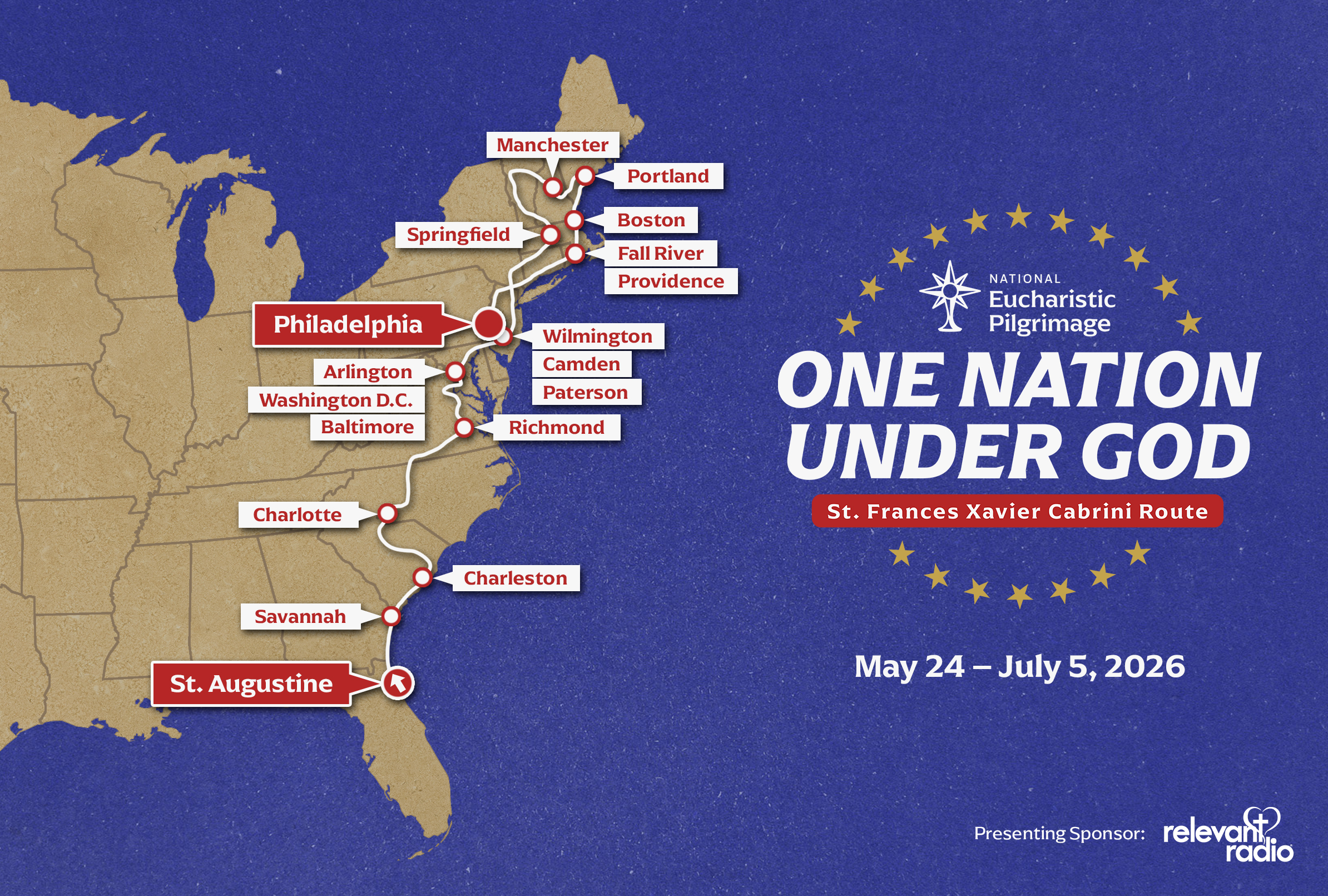
The 2026 National Eucharistic Pilgrimage, “One Nation Under God,” will kick off on May 24 in St. Augustine, Florida.
In honor of the nation’s 250th anniversary, the pilgrimage will begin in Florida, where the first recorded Catholic Mass within the future continental United States was celebrated, highlighting the country’s Catholic roots.
“We have to return to one nation under God, and I think that by beginning this pilgrimage at St. Augustine, weʼre returning to one of the major start points for Catholicism,” Jeffrey Bruno, a photojournalist and contributor to the National Catholic Register, the sister partner of EWTN News, said in an interview with Register Radio.
“If we do return to that as a nation, we really will be a nation filled with hope and with promise,” he said.
The launch of the pilgrimage will include remarks from Jason Shanks, president of the National Eucharistic Congress. He will also be joined by Bishop Erik Pohlmeier of St. Augustine and the nine perpetual pilgrims who will travel the entirety of the pilgrimage, which spans more than 2,000 miles.
Map of the 2026 National Eucharistic Pilgrimage route. | Credit: Courtesy of the National Eucharistic Congress
The 250th anniversary coinciding with the pilgrimage is “perfect,” said Bruno, who has photographed past Eucharistic pilgrimages and the Eucharistic congress. “Hopefully itʼs going to be a new start, a fresh start“ and ”the next 250 will be really happy and holy, I pray.”
The pilgrimage will pass through most of the original 13 colonies. Pilgrims will travel the Eastern Seaboard along the Cabrini Route in honor of St. Frances Xavier Cabrini, the first U.S. citizen to be canonized.
The group will stop in Baltimore, which is the U.S. Catholic Church’s “foundation,” as it houses “the first cathedral” and “was the first diocese" in the nation, Bruno said.
Pilgrims also will travel through Colonial Williamsburg, the immersive restoration of Virginia’s 18th‑century capital, where “American culture … meets Catholic culture,” he said.
“American Catholic culture has had such an incredible impact on this country,” he said. “Catholicism is so interwoven into the fabric of the United States. Mother Cabrini is the perfect example of that too, with all the accomplishments, all the hospitals and institutions that she founded over all the years.”
“Healthcare, education, all these different things, itʼs like they can all find their roots back in … Catholicism” and its “contributions to this country,” he said.
“I just hope [and] I pray that the contributions moving forward will be even more intense," Bruno said.
The pilgrimage will conclude on July 5 in Philadelphia.
Graces of the Blessed Sacrament
As the Eucharist travels from state to state, it will offer needed “grace” to believers and nonbelievers alike, Bruno said.
In his past experience on the pilgrimages, he said “seeing the impact of the Blessed Sacrament” and “passing through the highways and the byways has been the privilege of a lifetime.”
“The grace that comes from these pilgrimages, from these processions, from the processions with the Blessed Sacrament, and the witness of the pilgrims and the people that turn out to join in the local parishes … itʼs breathtaking. Itʼs incredible,” he said.
Bruno said “the efficacy of grace” is just like a quotation attributed to the inspiration of St. Carlo Acutis: “People who put themselves before the sun get a tan; people who place themselves before the Eucharist become saints."
“I think that bringing the Blessed Sacrament” and “crossing all these different towns and places and exposing people — believers, nonbelievers, people that are hurt, people that are broken — to his grace … [has] an efficacy that can’t be understated,” he said.
“Itʼs something that I think the country has missed for a long period of time. And Iʼm super glad that this is happening now,” Bruno said. “You see the hunger is out there.”
“Everybody needs him” and “heʼs present, heʼs available,” Bruno said. “The grace is there.”
A state of Washington lawsuit alleges that Providence, a nonprofit hospital system that operates 51 hospitals across five western states, failed to accommodate pregnant and nursing employees for years.
Washington Attorney General Nick Brown’s office alleged in a complaint that Providence regularly refused accommodations or failed to implement accommodations such as limited lifting or more frequent sitting for pregnant and nursing mothers.
The complaint also alleges that some superiors retaliated against employees after they requested accommodations.
The lawsuit said this violates the state’s Healthy Starts Act and the Washington Law Against Discrimination.
Pennsylvania attorney general appeals lower court ruling
Pennsylvania Attorney General Dave Sunday is looking to overturn a court ruling that struck down a law preventing the state from funding abortion.
Sunday appealed the lower court’s ruling, which struck down the state’s ban on Medicaid coverage for abortion in an ongoing case that began in 2019 when abortion providers brought a suit against the state’s abortion funding ban.
The attorney general said he had a “statutory obligation to defend the commonwealthʼs laws.”
“My responsibility as attorney general is to defend the rule of law and defend statutes without interference of personal opinion or political posturing,” Sunday said in a statement to EWTN News.
Maine senator absent from abortion-related committee meetings, records show
Maine U.S. Sen. Susan Collins, a Republican, has not attended abortion-related Senate Health, Education, Labor, and Pensions Committee meetings since the overturn of Roe v. Wade in 2022, according to committee hearing reports.
Collins confirmed the appointment of Justice Brett Kavanaugh to the Supreme Court in 2018, saying at the time that she thought he wouldn’t be a part of overturning Roe v. Wade.
Her office did not respond to a request for comment from EWTN News.
Maltese Prime Minister Robert Abela called a surprise general election for May 30, announcing the vote nine months before his Labour Partyʼs five-year term was scheduled to end. Citing geopolitical turmoil, particularly the war in Iran and volatile oil prices affecting Maltaʼs energy costs, Abela framed the early election as necessary to provide “stability” at a critical moment.
The timing is politically advantageous. Abelaʼs Labour government holds a comfortable parliamentary majority, and opinion polls hint the party is on track to win a record fourth consecutive term.
Yet the election has forced an uncomfortable conversation about abortion, a topic observers note that Maltese politicians often keep deliberately vague.
A country deeply divided on abortion
Since Maltaʼs constitution explicitly names Catholicism as the state religion, the nationʼs legal framework reflects that foundation by having a near-total prohibition on abortion. In line with Church teaching, treatment for ectopic pregnancies is permitted.
Critics have often labeled the nation as having the most restrictive abortion laws in Europe and regularly called for more abortion rights. As external pressure for liberalization continues to mount, there is also deep internal division between younger, more urban voters who support some abortion access and a significant portion of the electorate that opposes it on moral or religious grounds.
Some note that this tension has made abortion a political minefield. Rather than clearly stating whether they are “pro-life” or “pro-choice,” Maltese politicians allegedly employ careful ambiguity. They frame positions using broader language centered on “womenʼs health,” “medical emergencies,” “human rights,” or “legal clarity.” The use of such technical language allows them to address sensitive cases without explicitly endorsing wider abortion access.
Pro-life advocates demand clarity
Ahead of the May 30 election, one of Maltaʼs largest and most prolific pro-life groups, the Life Network Foundation, issued a direct question to all political parties.
It demanded that each of Maltaʼs six major political parties participating in the elections clearly state whether they will support changes to Maltese law that would introduce abortion and voluntary assisted euthanasia in the next legislature. The foundation asked for a simple yes-or-no answer.
Notably, the Labour government has already broken ranks on one issue. On May 15, it pledged to hold a referendum on voluntary assisted euthanasia if reelected but remained silent on abortion.
As of May 22, four of the six parties had responded to the Life Network Foundationʼs questionnaire. The foundation has pledged to publish all responses or publicly note which parties refused to answer.
By asking for a direct answer on pro-life issues, it gives Maltaʼs political factions no room to avoid stating their values directly to voters on these key issues. It also allows for more accountability and transparency in the political arena ahead of elections.
Pro-abortion encroachment
Given Maltaʼs strong anti-abortion history and stance, there has been increased activity by pro-abortion organizations to slowly increase abortion rights in the country. Most notably, Women on Waves, a Dutch pro-abortion organization, announced in mid-April that it had installed approximately 15 abortion lock safes around Malta.
Each safe contains one mifepristone pill and four misoprostol pills, collectively making up the chemical abortion pill regimen. Women interested in accessing abortion would email the organization, which would provide the location of the abortion safes and the code to unlock the safe.
In response to this, the National Council of Women Malta called for legal action into the placement of these abortion pill safes. “Any initiative which appears to facilitate access to abortion pills in Malta raises serious concerns about respect for the law, public safety, the protection of vulnerable women, and the protection of unborn life,” the council stated, requesting authorities investigate the placement of these safes.
Questions were also raised about the verification aspects of obtaining these abortion pills and what medical safeguards were in place to ensure they did not fall into the wrong hands. In response, Rebecca Gomperts, the founder of Women on Waves, noted that her organization was simply fulfilling an “unmet demand.”
Women on Waves has operated in Malta since 2007. It gained notoriety and visibility in recent years through high-profile campaigns, including at the Malta Maritime Museum, featuring pro-abortion art. The organization has faced backlash in Spain and Poland from citizens and municipalities alike, but its Malta operation is particularly provocative given the countryʼs near-total prohibition on abortion.
While there has been a tendency in the United Sates "to hyper-stress separation of church and state," Bishop Robert Barron said "the roots of our country are deeply religious" and "the basic principles of the country are inescapably religious.”
On May 17, thousands gathered on the National Mall in Washington, D.C., for the White House event celebrating “one nation under God” and "the connection between religion and our American democracy,” Barron said.
In an interview with EWTN News’ Colm Flynn ahead of the event, Barron discussed the “hugely important” phrase "one nation under God.”
“In the written versions of the Gettysburg Address that [Abraham Lincoln] prepared before giving it, the phrase ‘under God’ is not there,” Barron explained.
“But then when he was delivering it he added … ‘under God,’“ Barron said. ”I think it represented a deep intuition that Lincoln had that you canʼt really understand our democracy without it.”
The phrase “under God” is “meant to hold off tyranny,” he said. It is clear that “all kings and all rulers are under God, meaning under the judgment and authority of God. Our founders understood that.”
“And that little phrase is meant to hold off that tendency to deify any political establishment, political party, political ruler. Weʼre a nation, yes indeed, but weʼre under God. Our laws are determined by God,” he said.
“I love the First Amendment to our Constitution, which in its opening lines expresses very eloquently … the right balance,“ he said. ”Namely, ‘Congress shall make no law respecting the establishment of religion.’”
“But then thereʼs a second part, the second clause of that: ‘Congress shall make no law limiting the free exercise of religion,’” he said.
“Thatʼs an eloquent balance. So thereʼs no officially state-sanctioned religion, but that does not mean that religion has no role in public life. On the contrary, because there should be no law restricting the free exercise of religion,” Barron said.
Catholics’ role in public life and public office
Catholics in public office should bring “moral sensibility into their public decisions,” Barron said.
“Weʼre not here to impose Catholicism on anybody,” he said. “But I think to bring a moral and spiritual sensibility into the decisions that you make at these high levels is altogether valid.”
As a member of the White House Religious Liberty Commission, Barron said he met “lots of Catholics in the present administration” and told them to “bring Thomas Aquinas into your public life.”
“By which I mean bring these great moral and spiritual principles that indeed undergird our democracy, but make them a lively presence in the work that you do,” he said.
Barron further spoke about his time on the White House commission, where he received both criticism and praise.
When asked to be a commissioner, “my first reaction was very positive,” Barron said. “I thought … ‘Theyʼre inviting a Catholic bishop to be a voice around the table in the formulation of this policy. Why would I say no?’”
To say no would be “taking a Catholic voice away from that process,” he said.
“I’m not implementing the policy. Iʼm making suggestions regarding the formulation of policy,” Barron explained. “The president could take or leave what we say … So Iʼm not implementing the presidentʼs policies. Iʼm helping to shape public policy.”
“The commission was great. I spoke my mind in every setting. No one censored me,” said Barron, who was present at a White House Holy Week event when Pentecostal pastor Paula Cain White compared the president’s suffering to Jesus Christ’s.
Barron said he was able to address issues within the administration, specifically about Immigration and Customs Enforcement (ICE) “detainees in Chicago having access to sacraments and pastoral care.”
The bishop took the matter to Homeland Security and “no one questioned” him. It was “a religious liberty issue,” because “people have a right to their sacraments and pastoral care,” he said.
Barron also spoke out in regard to the president’s “critical remarks about the pope.”
“I said in an X post that I have deep admiration for the president in regard to religion. Heʼs done wonderful things. But I said I think that was a disrespectful way to talk to the pope,” Barron said.
“In regards to prudential judgment,” a president can “disagree with the pope,” Barron said. “But the pope is not … just an ordinary hack politician that you can sort of talk in that flippant way to.”
Bishop Robert Barron speaks with EWTN News’ Colm Flynn ahead of the May 17, 2026, White House event on “one nation under God” in Washington, D.C. | Credit: EWTN News
“Heʼs the vicar of Christ, successor of Peter. Heʼs our Holy Father. And I just felt that was disrespectful, and I thought it was not a constructive contribution to the conversation,” he said.
“Heʼs the Holy Father, so we have a filial relationship to him. Heʼs a father, weʼre like children … we have a family relationship to the pope. So itʼs different than just our relationship to a political leader.”
“At the level of principle and the moral values that ought to be informing our life … we abide by what the pope is saying, but I think there can be disagreement at the prudential level,” Barron said.
Dividing issues in the nation today
Amid numerous wars right now, Barron said “we should study” the just war tradition.
It offers “very useful criteria, and I think the Churchʼs job is to bring these to consciousness and urge political leaders to apply them,” he said.
“The Catechism of the Catholic Church says that when it comes to the evaluation and application of the criteria, that belongs to the civil authorities. And I think thereʼs great wisdom there too.”
Barron also spoke to the ongoing matters with U.S. immigration enforcement.
“A completely open border invites a lot of moral chaos, and a lot of catastrophe happens because of an open border. So the Church recognizes the legitimacy of that,” Barron said. “At the same time, the Church wants us to welcome the stranger and to be open to those who are in great need and those who are seeking refuge.”
ICE “is a very legitimate expression of the governmentʼs authority, but … I think ICE is way too blunt a tool to use to solve the general issue of people in the country illegally,” Barron said.
“I think a political solution has to be found. I donʼt think ICE is the right instrument to do that,” he said. “Iʼd invite people who are intimately involved in these things to have a good, morally informed conversation about it and come to good prudential judgments.”
“Iʼm not an expert in immigration policy, and Iʼm not an expert in the economics that are prevailing on the ground in various situations,” he said. “I think we have to inform all those who are making those decisions, make sure they have a keen moral sensibility, [and] know what the principles are.”
“But I think people of goodwill can, and obviously do, disagree about how they are applied … concretely,” he said.
U.S. Catholic bishops are calling on Congress to allocate the maximum possible funding for housing programs in the 2027 appropriations bill, citing “an alarming rise in homelessness.”
“Current federal investments in housing programs do not meet the great need we see in our country,” Archbishop Shelton Fabre of Louisville, Kentucky; Catholic Charities USA CEO Kerry Alys Robinson; and National Council of the U.S. Society of St. Vincent de Paul President John Berry said in a May 21 joint letter to Congress. “Ultimately, we urge you to provide the highest level of funding possible for housing and community development programs serving families and individuals who are poor and vulnerable.”
Fabre serves as chair of the bishops' Committee on Domestic Justice and Human Development.
The letter comes amid proposed cuts to federal funding for housing programs from $84.2 billion to $73.5 billion for fiscal 2027.
Citing the most recent data from the U.S. Department of Housing and Urban Development (HUD) in 2024, the letter pointed out that homelessness is at its “highest recorded levels for both individuals and also families with children.”
The letter also cited data from 2025 showing that more families and individuals than ever before are spending more than 30% of their income on housing and that “only 1 out of every 4 income-eligible households receives housing assistance.”
The letter specifically called for “robust funding” for a wide range of programs, including Section 8 housing, housing programs for the elderly, the HOME Investment Partnership Program, homelessness assistance grants through the Continuum of Care Program, and housing counseling centers.
The letter called for protections for faith-based shelters and organizations, “to enable these groups to continue to serve people in need without forcing them to violate their beliefs or compromise the safety of their clients.”
“The Catholic Church, through all its ministries, is one of the largest private providers of housing services for poor and vulnerable people in the country,” the letter said. “We serve as many as we can; however, we lack the resources to assist all our brothers and sisters in need.”
The letter noted that in 2025 despite providing over 196,000 people access to housing and offering homeless-related services to over 719,000 individuals, the Catholic Charities network has 73,000 families on waiting lists for housing.
“Considering such widespread, unmet need, it is clear that the Department of Housing and Urban Development (HUD) needs more resources,” the letter said.
“It was an adventure that will remain etched in my memory for a long time,” said young Frenchman Maël Le Lagadec in describing his feat of carrying a wooden cross to the summit of Aneto Peak in the Pyrenees mountains in Spain after the original one had been knocked down.
The landscape architecture student hiked upward for 14 hours, carrying on his back a 77-pound walnut cross that he had sculpted following the disappearance of the iron cross that had crowned the summit since 1951.
After covering over 17 miles and ascending 6,230 feet with the help of a friend, the 18-year-old managed to reach the highest peak in the Pyrenees, situated at an elevation of 9,840 feet.
Following a report by a group of mountaineers last April, the Spanish Civil Guard confirmed that the original 10-foot cross, weighing 220 pounds, had been toppled and thrown down the slope.
The original cross was installed at the summit of Aneto 75 years ago by a hiking club from Catalonia. Subsequently, the Mountaineers of Aragón also placed an image of the Virgin of the Pillar (the patroness of Spain) and a carving of St. Martial, the patron saint of Benasque, the valley within the Aragonese region where the peak is located inside the Posets-Maladeta Nature Park.
This symbol of faith, situated atop Spainʼs second-highest peak, has been the subject of controversy and various acts of vandalism. In 1999, it was torn from its base by a storm, and more recently, in 2018, it was found painted yellow, a color associated with the Catalan independence movement.
The mayor of the town of Benasque, Manuel Mora, applauded the initiative and stated that the wooden cross would remain until the original is restored. A group called “Movement Towards a Secular State” denounced the installation of the new cross, however, and urged that disciplinary proceedings be opened against Le Lagadec.
For his part, Le Lagadec took to social media to call for an end to the “degradation of this type of heritage,” having documented the entire process from the creation of the cross to its installation atop Aneto.
He also recounted that he had the help of several people who encouraged him throughout the entire ascent, recalling a woman who lent him her hiking stick during the most difficult sections.
“Upon reaching the summit, I still struggled to fully grasp what I had just accomplished,” he wrote in one of his posts, calling his feat “an extraordinary human and athletic adventure, culminating in the installation of the cross at the very summit.”
This story was first published by ACI Prensa, the Spanish-language sister service of EWTN News. It has been translated and adapted by EWTN News English.
Seton Hall University could be forced to release a long‑hidden investigation into clergy sexual abuse at the Catholic institution’s seminary and the university’s handling of it.
The controversy centers on the so-called “Latham report,” a years-old inquiry commissioned by the school itself amid the fallout of bombshell abuse allegations against now-disgraced and deceased former cardinal Theodore McCarrick.
Attorney Gabriel Magee represents several Church abuse victims as part of “approximately 400 cases total” in a consolidated litigation against the Archdiocese of Newark, New Jersey. Seton Hall is a defendant in a handful of the cases, he told EWTN News.
As part of those proceedings, state judge Avion Benjamin had ordered the school in November 2025 to turn over the Latham report to lawyers representing victims of clergy abuse. The school had previously argued that the report was protected by attorney-client privilege.
Seton Hall appealed Benjaminʼs order to surrender the report. Oral arguments were held in the appeals court this month.
The Latham report was commissioned by Seton Hall in 2019. Produced by the law firm Latham & Watkins, it has never been made public. The report is expected to examine whether Monsignor Joseph Reilly, then rector of Seton Hall’s Immaculate Conception Seminary (and now university president), knew about abuse claims and failed to report them. Reilly was appointed president in 2024.
Neither the school nor attorneys representing it responded to requests for comment on the ongoing litigation. Magee, meanwhile, disputed claims that the report is protected by legal shields such as the attorney-client privilege or the “work-product privilege.”
“For either to apply, the primary purpose must either be conveying legal advice or it must have been created in anticipation of litigation,” Magee said.
“But the record here shows instead that the Latham Report was created for self-critical analysis by Seton Hall, primarily to determine how to discipline employees who failed to report the sexual harassment and sexual abuse committed by McCarrick and to advise [the school] on how to create new policies to prevent this from happening again,” he said.
Magee said the appeal to the higher court had been expedited, suggesting the court may issue a ruling “sooner rather than later.”
Newark Archdiocese ordered investigation in 2025
Amid the ongoing controversy, Newark archbishop Cardinal Joseph Tobin in February 2025 ordered an independent review.
The prelate said at the time that the review would examine “how the findings of [the earlier reports] relate to Monsignor Joseph Reilly, including whether they were communicated to any and all appropriate personnel at the archdiocese and Seton Hall University and Monsignor Reilly, and if so, by what means and by whom.”
The archbishop said he had not “place[d] a timetable” on the review, which was being carried out by the law firm Ropes & Gray.
Tobin in 2025 had further said that he had not “restricted the firm from exploring any relevant facts or avenue of investigation.”
"A transparent review of the facts will best serve the interests of all involved and of those who have voiced a call for it,” the cardinal said.
In a statement to EWTN News, the Archdiocese of Newark indicated that the review was still ongoing as of May 20.
“Cardinal Tobin stands by his earlier statement that there should be no restrictions on Ropes & Gray’s efforts to access all relevant information and witnesses,” the archdiocese said.
The cardinal “remains committed to a transparent examination of the facts and is optimistic that the review will be completed as expeditiously as possible,” the statement added.
The Supreme Court on May 21 rejected an attempt by the state of Alabama to execute a convicted murderer whose low IQ may render him intellectually disabled and thus protected from capital punishment by the U.S. Constitution.
The court in an unsigned order dismissed an appeal from Alabama after the 11th Circuit Court of Appeals ruled in favor of Joseph Clifton Smith, with the appeals court holding that Smithʼs low-70s IQ put him close enough to the threshold of an intellectually disability to render his death sentence unconstitutional.
The court heard oral arguments in the case in December 2025. The case had followed a twisting path through the federal court system; the 11th Circuit first ruled in Smithʼs favor in 2023, after which the Supreme Court in 2024 vacated that decision and ordered the appeals court to consider it again.
A second review by the lower court, with another favorable ruling for Smith, again brought the case before the Supreme Court last year; the high courtʼs May 21 ruling brought the case to an end.
The latest ruling represents a potential precedent in how the Supreme Court considers certain cases of capital punishment. The court ruled in the 2002 case Atkins v. Virginia that executing people with intellectual disabilities violated the Constitution’s Eighth Amendment, which prohibits “cruel and unusual punishment."
The justices did not define “intellectual disability” in that case, though it cited expert opinion that “an IQ between 70 and 75 or lower” is “typically considered the cutoff” in some definitions.
Theresa Farnan, philosopher on the Ethics and Public Policy Committee of the National Catholic Partnership on Disability, told EWTN News in April that Smithʼs death sentence was “clearly a borderline case.” Smith was convicted in the brutal 1997 slaying of Durk Van Dam.
“It’s obvious to me he could not grasp the gravity of his crimes,“ Farnan said of Smith. ”In cases like these, the burden on us as a society is even more pronounced to be radically pro-life.”
The Catholic Church in recent decades has come out increasingly against the death penalty, with multiple popes arguing that modern penal systems have rendered capital punishment inadmissible in many if not most cases.
Pope Leo XIV in particular has spoken out several times against the death penalty in just the first year of his pontificate, arguing that “human life is to be respected” and that support for capital punishment is incompatible with a pro-life philosophy.
Bishop John Ricard, who led the National Black Catholic Congress for three decades and served as a bishop in two U.S. dioceses, died on May 20 at 86.
His death was announced by the Archdiocese of Baltimore in the archdiocesan newspaper, Catholic Review. Ricard passed away at St. Josephʼs Seminary in Washington, D.C., according to the archdiocese.
“Bishop John Ricard’s death is a profound loss for our local Church and for the entire Catholic community in the United States,” Baltimore Archbishop William Lori said in the announcement.
Lori said Ricard, a former auxiliary bishop in Baltimore, "served this archdiocese with grace, humility, and a joyful spirit that made him beloved by all who encountered him.”
Born in Baton Rogue, Louisiana, on Feb. 29, 1940, as one of eight children, Ricard attended Epiphany Apostolic College in Newburgh, New York. He completed religious studies at St. Joseph Seminary in Washington, D.C., and received a doctoral degree from The Catholic University of America.
He joined the Society of St. Joseph of the Sacred Heart, or the Josephites, in 1962 and took his final vows on June 1, 1967. He was ordained to the priesthood on May 25, 1968, by Baton Rouge Bishop Emmet Tracy.
He served at several parishes in New Orleans and Washington prior to being appointed as a vicar bishop in the Archdiocese of Baltimore by Pope John Paul II. He was subsequently consecrated as an auxiliary bishop of that archdiocese on July 2, 1984, the first Black bishop to serve there.
In 1997 he was appointed bishop of the Diocese of Pensacola-Tallahassee, Florida, where he served until 2011 when he retired for health reasons.
In addition to his duties as a prelate, Ricard also served as the first president of the National Black Catholic Congress, holding that role from the congress' inception in 1987 until 2017.
After his retirement from Pensacola-Tallahassee, he served as rector of St. Josephʼs Seminary in Washington. He was elected superior general of the Josephites in 2019.
Having grown up amid pervasive racism in the segregated South prior to the Civil Rights era, Ricard at times commented on racial conflict in the United States, including in 2016 amid civil unrest around police shootings, which he described as a “wake-up call for all of us” in an interview with Catholic News Service.
The bishop said he and his friends “lived under constant threat of being arrested” during the 1950s in Louisiana. He said the Catholic Church can “bring [a lot] to the table” of racial healing in the United States.
“Weʼve got a lot of work to do,” he told the news service.
In a statement released after his death, the Josephites said Ricard “faithfully served the Catholic Church for decades through his ministry as a Josephite priest, counselor, educator, pastor, bishop, humanitarian, and leader.”
“He devoted his life to the proclamation of the Gospel, humanitarian efforts worldwide, the mission of the Josephite Society, and the pastoral care of God’s people, especially within Black Catholic communities,” they said.
The Josephites asked for “prayers for the repose of Bishop Ricard’s soul, for the Josephite community, his family, friends, and all who mourn his passing.”