The nation’s capital will serve as the halfway point for the 2026 National Eucharistic Pilgrimage to celebrate the 250th anniversary of the United States.
The Catholic Information Center’s (CIC) Washington, D.C., Eucharistic procession has taken place the past three years, processing through the city’s downtown area near the White House and past the U.S. Capitol.
Father Charles Trullols, CIC director, started the procession in 2023. “I thought it was a great opportunity as we were going through the National Eucharistic Revival to have a Eucharistic procession in the center of our nation’s capital, so that so many people around the country could see that we praise, and we pray, and we worship, together,” Trullols said in an interview with “EWTN News Nightly.”
Ahead of the upcoming 2026 National Eucharistic Pilgrimage, the Archdiocese of Washington reached out to Trullols to inquire if the CIC would partner with the National Eucharistic Pilgrimage in the capital for the 250th anniversary of the country.
“To partner with them at the heart of our nation’s capital … is a great honor,” Trullols said. “And we are looking forward to having many, many, many people joining us.”
“I was so excited and so happy to be able to do that, especially because the National Eucharistic Pilgrimage is going to have such a relevance … this year for so many people to see our faith and to express their belief in the real presence of the Eucharist through the journey that they are going to be doing from Florida, going up north, and finally ending in Philadelphia,” Trullols said.
The 2026 National Eucharistic Pilgrimage’s theme is “One Nation Under God,” to commemorate the anniversary. Pilgrims will journey on the St. Frances Xavier Cabrini Route to honor the first American citizen to be canonized.
The 2026 pilgrimage is set to kick off on May 24 in St. Augustine, Florida, and conclude on July 5 in Philadelphia. The Eucharistic procession will go through 18 dioceses and archdioceses.
Walking with Jesus
Since starting the annual event in D.C., Trullols said “the best part, for me, of the Eucharistic procession is to see Jesus walking with us.”
There are “so many people out there in the streets who do not know what’s going on, and they ask, and they inquire, and they also benefit from all the grace that is coming out from the monstrance, from the Blessed Sacrament, even if they don’t realize that is happening,” he said.
“But many other times people also join, without expecting it, into the procession. And this year, on June 6, when we are going to have our Eucharistic procession with the National Eucharistic Pilgrimage … I hope it will be a great sunny day for us to celebrate, to commemorate, and to walk with Our Lord in the Eucharist,” he said.
Physically walking with the Eucharist in person is “very important because it’s a personal encounter with Jesus Christ,” Trullols said. “Through the screens, we see people, we look at people, but many times we are lacking this personal encounter with Our Lord, which is to physically be with him and honor him and worship him publicly.”
About 1 million people have been displaced over the past 10 days in Lebanon, where the situation continues to deteriorate, according to Marwan Sehnaoui, president of the Sovereign Order of Malta’s Lebanon chapter.
“The situation in Lebanon, in Beirut, and all over Lebanon is a catastrophic situation,” Sehnaoui told “EWTN News Nightly” host Veronica Dudo on March 18. “We are a peaceful country, and here we are with shelling all over.”
Sehnaoui leads the Order of Malta’s Lebanon Association, which, he said, “is all over the Lebanese territory,” with about 600 employees charged with operating more than 60 projects related to health, social, and agricultural humanitarian aid. The Order of Malta also operates 12 mobile medical centers, he said.
“Around 20% of our population had to run away,” he said, noting that “where to put them” has become “a very complicated situation.” He further cited about 1,000 casualties in the region, noting the deaths of 60 people “just today.”
“To see this is very painful, as you can imagine, when there is shelling, destruction, and death,” he said, “but we will survive.”
Sehnaoui emphasized the war’s impact on the Christian community, warning that if the war continues, increased pressure on Christians in the region may force them to leave their homes.
“We don’t want immigration; we want people to stay on their lands,” he said. “And this is why the order has opened a lot of projects on agriculture, so they can be there and cultivate the land and have food.”
“What is important for [the Lebanese Christian community] and others is to have their dignity,” he said. “And the order is a factor in giving back dignity and being an instrument of coexistence … not through weapons but through love and presence at the side of the suffering.”
Sehnaoui expressed gratitude to Pope Leo XIV for visiting Lebanon last year, which he said “was very important for all Lebanese.”
A forum hosted by Senate Democrats spotlighted trauma experienced by children who have been detained or separated from their families during immigration enforcement operations across the country.
According to data shared by Immigrants’ Rights Clinic Director Elora Mukherjee during the March 17 forum, more than 3,800 children, including 20 infants, were detained by immigration authorities from January to October 2025. Mukherjee has represented 68 children and parents detained at the Family Detention Center in Dilley, Texas, where she said her youngest clients “have been babies and toddlers.”
The forum, titled, “The Kids Are Not Alright: How Mass Deportation is Traumatizing Children,” was hosted by Sen. Dick Durbin, D-Illinois.
Despite 20 days being “the general legal limit” for how long a child may accompany his or her parent in federal immigration custody, Mukherjee said more than 900 children have been detained past the 20-day mark and 270 children past 40 days. She cited multiple cases of children who have been detained for longer than 100 days.
“Dilley is a hellhole,” she said. “It’s a prison for babies, toddlers, and children. Children and parents detained at Dilley do not have access to sufficient drinking water. Children and parents detained at Dilley have found live worms, bugs, and mold in their meals.” She said lights are kept on in the facility through the night, making it difficult to sleep.
The Department of Homeland Security has vigorously denied allegations of subprime conditions. EWTN News reached out to the department for comment on the allegations mentioned in the forum but did not receive a response by time of publication.
Mukherjee said the facility is run by CoreCivic, a for-profit prison corporation that receives $180 million annually from Immigration and Customs Enforcement (ICE).
“Children and families should be immediately released from Dilley. Alternatives to detention programs are far more cost effective and humane than detaining children,” she said. “Protecting children from needless cruelty is not an enormous ask. It is what our humanity demands of us.”
Clinical psychologist Lisa Fortuna testified during the forum that children held in detention centers often “present with trauma, hyper vigilance, sleep disturbance, depression, and persistent anxiety about their safety and future.” She also listed school disengagement, learning problems, and disruption in health care” among immigrant children as a result of enforcement operations.
“The psychological burden created by uncertainty, family separation, chronic fear,” she said, “can profoundly shape children’s emotional and development and their sense of safety and stability.”
Maria Heavener, a first-grade teacher at Funston Elementary School in Chicago, told senators about ICE officers’ use of tear gas near school buildings and around children in Chicago during the Trump administration’s Operation Midway Blitz.
Sen. Angus King, an independent from Maine, praised those who testified and cited a Bible verse he said was sent to him by a priest friend earlier in the day: “When an alien resides with you in your land, do not molest him. You shall treat the alien who resides with you no differently than the natives born among you who have the same love for him as for yourself. For you too were once aliens in the land of Egypt” (Leviticus 19:33-34).
“That’s the responsibility that we have and that’s the responsibility that we’re trained to uphold,” he said.
A group of Catholic moral theologians and ethicists have filed an amicus curiae (“friend of the court”) brief in federal court in support of Anthropic, an American artificial intelligence (AI) company that is suing the Department of Defense over the Pentagon’s insistence that it should be free to use Anthropic’s AI products without restriction, including for mass surveillance and autonomous weaponry.
Anthropic, creator of the widely adopted AI assistant Claude, ran afoul of the Pentagon’s leadership late last month when its CEO, Dario Amodei, told Defense Secretary Pete Hegseth that the company refused “in good conscience” to allow Claude to be used specifically for those purposes.
In addition to Anthropic subsequently losing a $200 million contract with the Defense Department, Hegseth announced Anthropic would be designated a “supply chain risk” — a first for an American company. President Donald Trump has directed all government agencies to halt the use of Anthropic’s products within six months. Fearing financial annihilation, Anthropic on March 9 filed two lawsuits against the Department of Defense, challenging the “supply chain risk” designation as an inappropriate retaliation.
The falling out between Anthropic and the Pentagon sparked a major debate on the ethics and morality of AI, with many commentators expressing appreciation for Anthropic’s decision to make a principled stand against the government’s demands.
In the brief filed March 13 in the U.S. District Court for the Northern District of California, San Francisco Division, the group of 14 Catholic scholars — including professors, authors, and at least one priest, Legionary Father Michael Baggot — said the teaching of the Catholic Church supports Anthropic’s decision to reject the Pentagon’s demands on its technology related to mass surveillance and autonomous weapons.
“Anthropic, in the red lines it has drawn for the use of its products on domestic mass surveillance and autonomous weapons systems, sought to uphold minimal standards of ethical conduct for technical progress. In doing so, Anthropic was acting as a responsible and moral corporate citizen, not as a threat to the safety of the American supply chain,” the authors of the brief wrote.
The substance of the brief was written by four scholars: Charles Camosy, an associate professor of moral theology at The Catholic University of America in Washington, D.C.; Joseph Vukov, an associate professor of philosophy and the associate director of the Hank Center for the Catholic Intellectual Heritage at Loyola University Chicago; Brian J.A. Boyd, a moral theologian; and Brian Patrick Green, a lecturer in ethics at the Graduate School of Engineering at Santa Clara University, a Catholic institution in California.
‘A threat for man and for the world’
In the brief, the scholars note that Anthropic has said it is not categorically opposed to the idea of autonomous weaponry or mass surveillance; rather, the company believes its systems are not yet “sufficiently reliable, interpretable, or controllable to be entrusted with decisions that directly take a human life without human oversight, or to conduct population-scale surveillance.”
While the scholars indicated agreement with Anthropic on the criticisms of such systems’ reliability, they stressed that the Catholic tradition has “consistently emphasized that decisions affecting human life, freedom, and dignity must remain the responsibility of human actors and that not every technically feasible or legally permissible use of a tool is therefore appropriate,” and that “when technology is capable of violating life, dignity, and freedom, it is reasonable to draw clear boundaries around its use.”
On the topic of mass surveillance, the scholars note that the Church’s teaching on the right to privacy is rooted in the dignity of every human person. A widespread surveillance regime by the military would undermine the dignity of those being surveilled, the scholars argued.
Such a centralized surveillance system would also tread on the Catholic idea of subsidiarity — the idea that decisions and oversight should be handled by the smallest, most local competent body — by undermining state and local governments, which are not only more likely to understand context better than a distant AI but which must also live with the effects, the scholars continued.
On the topic of lethal autonomous weapons systems, or LAWS (sometimes called “killer robots”), the scholars firmly asserted that the use of weapons capable of making wartime decisions on their own violates the Catholic principle of “just war.” In a just war, human judgment must be employed to ensure, for example, that a violent act is a proportionate use of force, or in the selection or avoidance of targets. Human involvement in such decisions is crucial, the scholars said, because “judgments of proportionality and discrimination are prudential — not mere pattern matching.” This and other reasons are why the Vatican has repeatedly and forcefully expressed opposition to the idea of LAWS, going back as far as 2013.
“[LAWS] circumvent the kind of practical judgment and careful decision-making that should inform all human decisions, and especially those that involve matters of life and death,” the scholars wrote.
The scholars conclude their brief by quoting Pope Benedict XVI’s encyclical Spe Salvi on the topic of technological progress. “If technical progress is not matched by corresponding progress in man’s ethical formation, in man’s inner growth (cf. Ephesians 3:16; 2 Corinthians 4:16), then it is not progress at all but a threat for man and for the world,” the encyclical states.
Green, one of the authors of the amicus brief, previously told the National Catholic Register, the sister partner of EWTN News, that Anthropic’s principled stand, especially coming from a commercial company, is important.
“You can imagine an alternate universe where Dario Amodei just said, ‘OK, we’ll sign it. It’s no big deal.’ They would be doing fine as a business, and the rest of the world would not be talking about AI ethics right now. [But] this universe that we’re living in is one that has been fundamentally changed in a lot of ways because somebody decided to take an ethical stand. I think that’s important,” Green said.
“I think this ethical stand is good, potentially — assuming that the government does not actually destroy Anthropic and reduce their value to zero,” he added.
This story was first published by the National Catholic Register, the sister partner of EWTN News, and has been adapted by EWTN News.
In a statement issued by the chairman of the USCCB Committee on International Justice and Peace and shared with ACI Africa, the sister service of EWTN News in Africa, on March 16, the bishops echoed the position of the Sudan and South Sudan Catholic Bishops’ Conference (SSS-CBC), stating that the killing reflects a disregard for the sanctity of human life.
“I write to express our profound ecclesial solidarity with the Church in South Sudan, as you mourn the killing of approximately 200 innocent civilians in Ayod County in Jonglei state and Abiemnhom County in the Ruweng Administrative area,” Bishop Abdallah Elias Zaidan said.
Zaidan added in reference to the March 2 statement by SSS-CBC: “These acts represent not only a tragic loss of life but a fresh descent into the abyss of human depravity, where the sanctity of life, a sacred gift from God, is trampled upon with alarming impunity.”
He added: “Our committee has long voiced urgent concern over the mass destruction and loss of life caused by civil conflict in South Sudan. We are deeply alarmed by the recent escalation of violence and further intensified humanitarian crisis,” he said.
Zaidan, the local ordinary of the Maronite Eparchy of Our Lady of Lebanon, said that the Catholic bishops in the U.S. share in the conviction that “every massacre is a defeat of our humanity” as highlighted by SSS-CBC.
“We urge the Catholic faithful in the U.S., and all people of goodwill, to pray and work for an end to the cycles of trauma, retaliation, and violence gravely afflicting communities across the country,” he said.
The USCCB solidarity statement comes amid growing concern over renewed violence in parts of South Sudan, where armed clashes and intercommunal attacks reportedly continue to undermine fragile peace efforts.
Reports from Ayod County in Jonglei state indicated that on Feb. 21, government-linked forces allegedly lured villagers in Pankor village with promises of food aid before opening fire on the gathering.
At least 22 people, including women and children, were reportedly killed in the attack.
Witnesses described the incident as a “death trap,” fueling fears that unarmed civilians are increasingly being deliberately targeted in the country’s continuing conflicts involving rival armed factions.
A second and more deadly incident reportedly occurred in Abiemnhom County in the Ruweng Administrative Area between March 1–2.
Local officials have reported that armed youths from neighboring Unity state stormed the county headquarters, attacking government offices and civilian areas. The assault reportedly left at least 169 people dead, including civilians, security personnel, and local government officials such as the county commissioner and executive director.
During the attack, homes and markets were set ablaze before government forces regained control of the town.
Women, children, and elderly residents were among those killed, while more than 1,000 civilians fled to seek refuge at a United Nations peacekeeping base as fighting intensified.
In their statement dated March 10 and addressed to the president of the SSS-CBC Integral Human Development Commission, Bishop Eduardo Hiiboro Kussala of the Diocese of Tombura-Yambio, the Catholic bishops in the U.S. pledged to reach out to the international community for humanitarian assistance.
“We also seek to amplify your call for international assistance in addressing needs for basic humanitarian services, pastoral care, and psychosocial support for the millions currently in distress,” Zaidan said.
He indicated that in the coming days, the faithful in parishes across the U.S. will contribute to the annual Catholic Relief Services (CRS) collection, one of the means through which the U.S. Catholic community can offer tangible support to the people of South Sudan.
The U.S. bishops further applauded the work of organizations like Solidarity with South Sudan, through which Catholic religious congregations help strengthen the people’s capacity to build a more just and peaceful society.
“We pray that the recent cascade of violence may be imminently halted and the most vulnerable protected. Through the intercession of Mary, Queen of Peace, may justice and peace reign throughout South Sudan.”
This story was first published by ACI Africa, the sister service of EWTN News in Africa, and has been adapted by EWTN News.
A years-old copyright lawsuit over Catholic hymns saw jurors in Oregon this week receive a crash course in music reading along with a livestreamed performance of the songs at the center of the dispute.
The suit, originally filed by American Catholic composer Vincent Ambrosetti in May 2020, accuses songwriter Bernadette Farrell and Oregon Catholic Press of copyright infringement against Ambrosetti’s 1980 hymn “Emmanuel.”
The suit alleges that Farrell’s 1993 hymn “Christ Be Our Light” illegally copied elements of “Emmanuel,” with Ambrosetti arguing for a “striking similarity” between the two songs.
Part of Farrell’s work contains “the same notes, the same key, and the same time signature,” the suit alleges.
The suit was dismissed in March 2024, with U.S. District Judge Karin Immergut arguing that Ambrosetti had not shown that the defendants had had “access” to his song prior to writing their own song or that there was a “striking similarity” between the two works.
But the U.S. Court of Appeals for the 9th Circuit reversed that decision in August 2025, reviving the lawsuit and arguing that there were “genuine issues of material fact” regarding the similarity of the songs.
The appeals court noted that in 1985, Oregon Catholic Press then-publisher Owen Alstott allegedly met Ambrosetti at a convention, where Ambrosetti gave Alstott a copy of “Emmanuel.” Alstott would go on to meet and eventually marry Farrell.
The trial began anew on March 16. The Oregonian reported that the panel of eight jurors were instructed on several basic principles of musical comprehension, including how to read music, “how to distinguish between a quarter note and a half note,” and “how many beats each measure holds.”
Lawrence Ferrara, a professor of music at New York University, also performed several musical samples of the disputed works via video during the trial.
Ferrara has participated in court proceedings and copyright disputes for decades, including analysis and professional opinion. In a February preliminary report filed to the court he pointed to similarities in the two songs that he said provide “strong objective musicological evidence of copying.”
Ambrosetti in his 2020 lawsuit said he had sent an infringement notice to the plaintiffs alleging the copyright violation but that they continued to use their song, leading to his filing the suit. The trial is expected to continue through the week.
The Catholic Legal Immigration Network (CLINIC), which works closely with the U.S. bishops, told EWTN News that it “hopes and prays” the U.S. Supreme Court will order President Donald Trump’s administration to keep protections in place for Syrian and Haitian migrants.
On March 16, the Supreme Court agreed to hear a lawsuit that challenges the Department of Homeland Security’s (DHS) decision to revoke temporary protected status (TPS) for migrants from Haiti and Syria.
The court ordered that the protections will remain in place for the time being, until the justices make a final decision. This prevents deportations while the case is litigated. The court will hear oral arguments in the last week of April.
More than 300,000 Haitians and more than 6,000 Syrians are protected from removal based on the TPS status but would lose the ability to live and work in the United States if it is ultimately terminated.
“CLINIC hopes and prays that the Supreme Court recognizes that the administration cannot abuse its executive authority and play with human lives,” Elnora Bassey, a policy attorney for CLINIC, told EWTN News.
Bassey said “this constant back-and-forth” between the administration and the courts has put migrants who rely on those protections “in a state of despair as their future remains unknown.”
“The administration’s lawless attempts to interfere with humanitarian protections for immigrants must come to an end, and they must adhere to the legal process set in place to ensure the integrity of that process remains intact,” Bassey said.
“Immigrants, just like all other human beings, ought to be treated with dignity and respect, and the administration must follow the law of the land and provide humanitarian protections rather than disregard the plain language of the statute to protect vulnerable human beings,” she said.
The lawsuit comes as the Trump administration seeks to revoke TPS status for migrants from nearly a dozen countries, action that has faced legal challenges. These moves are part of Trump’s broader efforts to restrict immigration and enforce mass deportations.
Andrew Arthur, former immigration judge and resident fellow in law and policy at the Center for Immigration Studies (CIS), told EWTN News he is “reasonably sure” the Supreme Court will ultimately side with the Trump administration in the lawsuit.
He said the court’s decision to allow the TPS designation to remain in place until the case is settled “keeps everybody in place until the decision is made.”
“It basically maintains the status quo until the case is completed, to err on the side of caution,” Arthur said.
He said he believes the Trump administration will prevail because law permits TPS designations to be offered in response to a “substantial but temporary disruption of living conditions” that prevents people from returning to their home countries safely. He said it’s “meant for a very short period of time.”
Arthur said conditions in Syria are more stable than amid the 2012 designation during the civil war. Haiti’s issues, he said, are more long-standing and Haiti is “no more dangerous … than it was 10 years ago.”
The U.S. Conference of Catholic Bishops (USCCB) declined to comment on this specific development and referred to previous statements in which the bishops have urged the administration to keep TPS status in place.
Specifically regarding Haiti, USCCB Committee on Migration Chair Bishop Brendan Cahill and Committee on International Justice and Peace Bishop A. Elias Zaidan issued a joint statement in January that said “there is simply no realistic opportunity for the safe and orderly return of people.”
A recent bill introduced in the U.S. House of Representatives would regulate abortion pills due to their potential environmental impact.
The Clean Water for All Life Act would also require a physician to be present for the chemical abortion and a “catch kit” for contaminated blood and aborted tissue. It would also require an in-person exam to prescribe abortion pills.
The bill, introduced by Rep. Mary Miller of Illinois, is designed to address claims that chemical abortion procedures may contribute to environmental contamination. Supporters say the bill would tighten disposal requirements, while critics question the science behind those concerns.
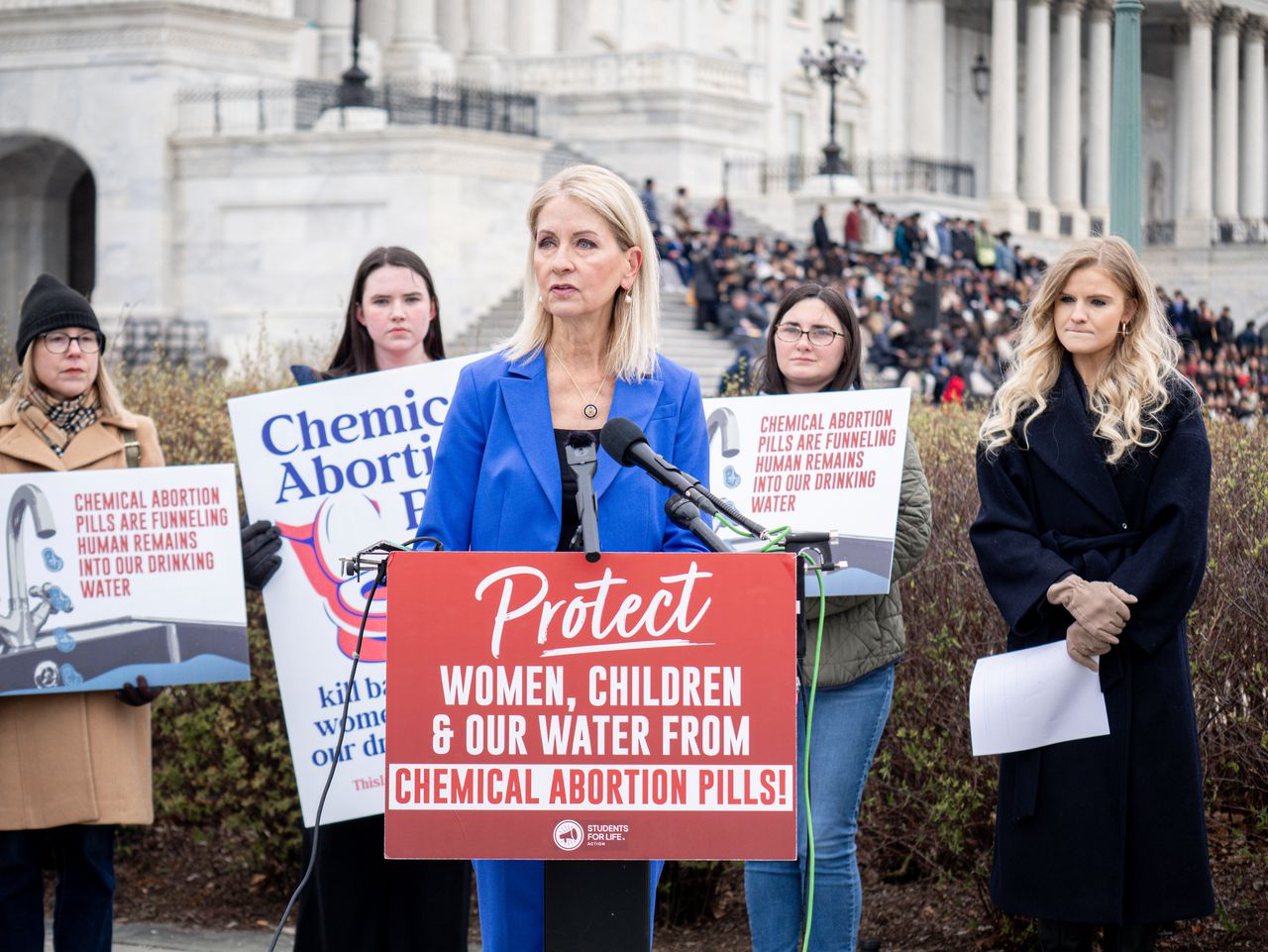
“The murder-for-profit abortion industry is not only ending innocent life but is also polluting our water, endangering women, and operating with virtually no accountability,” Miller said at a press conference in Washington, D.C., on March 18. “Every year, more than 50 tons of chemically contaminated medical waste, including blood, placental tissue, and the remains of preborn children are flushed into America’s water systems as a direct result of chemical abortion pills.”
In 1996, the Food and Drug Administration did an environmental assessment of mifepristone tablets and found “no significant impact.”
The drug was first approved for chemical abortions in 2000, however, and mifepristone-induced abortions now account for more than 60% of abortions in the U.S., not including un-facilitated abortions, such as mail-order abortions in states where chemical abortions are illegal, many of which go unrecorded.
A Students for Life of America report claims that “more than 50 tons of abortion pollution and human remains enter our water system every year,” including endocrine-disrupting chemicals (EDC) that affect hormones.
Students for Life president Kristan Hawkins spoke about the research on “EWTN News Nightly” on March 17.
“What we have found through our own research is that in three metropolitan areas where we tested the water, the three active metabolites that are only found in the chemical abortion drug mifepristone are actually in our drinking water,” Hawkins said.
Mifepristone, a synthetic hormone, blocks the reception of progesterone, a hormone essential for maintaining pregnancy. When mifepristone is taken during pregnancy, it prevents the unborn child from receiving vital nutrients, causing an abortion.
“Chemical abortions are the leading cause of infant death in our country,” Hawkins said. “You’re talking over 700,000 abortions a year are happening this way.”
Miller called the issue “a growing and deeply alarming public health and environmental crisis.”
Rep. Mary Miller, R-Illinois, gives remarks at a March 18, 2026, press conference on the Clean Water for All Life Act in Washington, D.C. | Credit: Students for Life
“Our water systems were never designed to filter these toxic substances,” Miller said. “The fact is, the abortion pill ingredients used to starve a preborn child remain active and unfiltered in our water treatments. That means families across the nation may be unknowingly ingesting abortion-related chemicals in their drinking water, exposing them to potential health risks like infertility and cancer.”
“Innocent life should never be discarded as waste; our environment should not be contaminated; and women deserve full transparency about the dangers of the abortion pill,” Miller said. “When women are fully informed of the harms of chemical abortion pills, I believe they are far more more likely to choose life, sparing not only the life of their unborn child but also preserving the health of our population.”
A supporter of the Clean Water for All Life Act holds a sign about the environmental impact of chemical abortion pills on March 18, 2026. | Credit: Students for Life
“This is more than about policy; it’s about protecting life, defending public health, and holding an industry accountable for its actions that has led to the death of millions,” Miller said.
Pope Leo XIV sent a video message to the participants of the sixth assembly of the Ecclesial Conference of the Amazon (CEAMA, by its Spanish acronym). The region is the largest tropical rainforest on the planet, covering an area of approximately 2.59 million square miles shared by nine South American countries. The pontiff lamented the “growing deterioration” of the natural environment.
“You have made me keenly aware of the sufferings and hopes of the region’s inhabitants, as well as the growing deterioration of their natural environment. To all those suffering from this situation, I wish to express my closeness,” the pope said in the message for the gathering, which is being held in Bogotá from March 17–19 and which marks a new step in the ecclesial journey of the Amazon region.
The gathering brings together pastors, men and women religious, and lay faithful from the Amazonian territories with the aim of laying the foundations to promote synodality within local Churches during the 2026–2030 period, foundations that could serve as an instrument to guide the evangelizing mission in the Amazonian territory.
The pontiff also referenced another key part of the meeting: the election of the presidency of the CEAMA for the 2026–2030 term.
He noted that the new team’s tasks will include continuing to advance the implementation of the Synod for the Amazon and preparing contributions drawn from the Amazonian experience for the ecclesial assembly scheduled to take place in Rome in 2028.
“Know that I accompany you with my prayers in this important step,” assured the pope, who also described the assembly as “a privileged time of listening to the Holy Spirit” to discern the path of Christian communities in the Amazon region.
In this regard, he cited Pope Francis’ apostolic exhortation Querida Amazonía, recalling that the Church’s mission is to proclaim “a God who loves every human being infinitely, a love he has fully manifested in Christ.”
‘Something new is being born’
The participants in CEAMA’s sixth assembly have chosen as their theme a verse from the prophet Isaiah: “I am about to do something new: It is already springing forth, do you not perceive it?” (Is 43:19).
The pope revisited this image to highlight the process currently underway within the Amazonian Church. “It’s true: Something new is being born; it is still fragile, but it is already in process,” he affirmed.
To illustrate this, he drew upon the image of the “shihuahuaco” — known as the “giant of the jungle” — a tree that grows slowly but can live for over a thousand years and become an ecosystem in itself, serving as a sanctuary for numerous species.
Through this metaphor, the pope explained that the Church must “be a sign of unity in diversity and a safe haven that generates and protects life.”
Furthermore, he noted that the current context demands an “adequate response to the numerous social, environmental, cultural, and ecclesial challenges that persist in the Amazon — a region threatened by situations of abuse and exploitation.” In this context, he made reference to the passion flower, “whose distinctive shape makes a striking allusion to the passion of Christ” and which the participants have chosen as the symbol of the assembly.
“It represents the prophetic role of the Church and of all its members — each according to their own mission: to proclaim the ‘kerygma’ [Gospel message] and new life in Christ, to accompany those who suffer, and to safeguard creation and respect for life in all its forms, especially human life,” he stated.
A Church with an Amazonian face
Another objective of the ecclesial conference, which is celebrating its fifth anniversary, is to advance toward the construction of a Church with an “Amazonian face,” one of the great aspirations that emerged during the Synod of Bishops for the Pan-Amazon region.
According to the Holy Father, this process is achieved through the inculturation of the faith, which allows the Church to be enriched by new cultural expressions and to manifest the mystery of Christ with greater fullness.
However, he warned that it is a demanding path. “Inculturation is a difficult, yet necessary, path,” he affirmed, encouraging the participants to “courageously embrace the newness of the Spirit, capable of always creating something new with the inexhaustible treasure of Jesus Christ.”
At the conclusion of his message, Pope Leo XIV encouraged the Amazonian communities to continue strengthening the identity of missionary disciples in the region, recalling the witness of so many men and women who gave their lives for the Gospel in those territories.
“I encourage you to press forward together — pastors and faithful alike — in strengthening the identity of missionary disciples in the Amazon. Continue sowing in the furrow that has been watered even with the blood of so many men and women who have preceded you, and who, united to the passion of Christ, have become the root of a ‘giant tree’ growing in the Amazon,” the pontiff said.
This story was first published by ACI Prensa, the Spanish-language sister service of EWTN News. It has been translated and adapted by EWTN News English.
When Beverly Jacobson first learned that her unborn daughter Verity would be born with the rare genetic condition trisomy 18, she “was filled with fear and anxiety” — but just a few weeks ago the family was able to celebrate Verity’s ninth year of “lots of smiles and giggles and pure joy.”
“Just a happy little girl,” Jacobson told EWTN News in a 2025 interview. “We love her.”
Verity just turned 9 on Feb. 28, less than three weeks ahead of Trisomy 18 Awareness Day, which is celebrated nationally on March 18. Her condition, also called Edwards syndrome, occurs when a person has an extra chromosome 18.
Her name, Jacobson said, derives from the Latin word “veritas,” which means “truth.” She and her husband had considered the name before the diagnosis, but Jacobson said the name choice “was just solidified once we knew that she had this condition” because they wanted her name to “speak truth to the value of all human life.”
“She also is made in the image of God just like every human being, and she’s worthy of life,” Jacobson said.
Some complications often caused by trisomy 18 include growth deficiency, eating difficulties, breathing difficulties, heart defects, facial malformations, skeletal deformities, and intellectual development delays, according to the National Organization for Rare Disorders.
In Verity’s case, she is nonverbal, has developmental delays, cannot feed herself on her own enough to sustain herself, and needs help to move around. Yet, as Jacobson puts it, “she’s really thriving in her own special way.”
Although Verity is nonverbal, Jacobson said this “does not mean noncommunicative” and that it is easy to tell when she is happy or irritated. Like other children, she has her favorite toys, enjoys music, and “has a sense of humor,” Jacobson explained.
“She loves being outside, she loves the wind in her face,” Jacobson said. “It’s so cute.”
Verity also “loves having people in her face — the people she knows,” Jacobson added. She also recounted stories about how children at Verity’s school play with her and “completely accept her,” saying it’s good to know “she is a part of their lives.”
Jacobson noted her relationship with her daughter also helped provide a better understanding of God’s sacrificial love for humanity, noting that Verity is “never going to be able to serve someone else in that physical way and yet we love her so completely.”
“Going from that state of fear … and just depression to where I am today — it’s 100% God’s work in my life through Verity,” Jacobson said. “Verity is his vessel to teach me more about the gift to lay down your life and sacrifice for someone else.”
“I feel by far the joys and the blessings outweigh the difficulties because now we’ve grown and we’re all stronger,” Jacobson said. “We’re used to a new normal.”
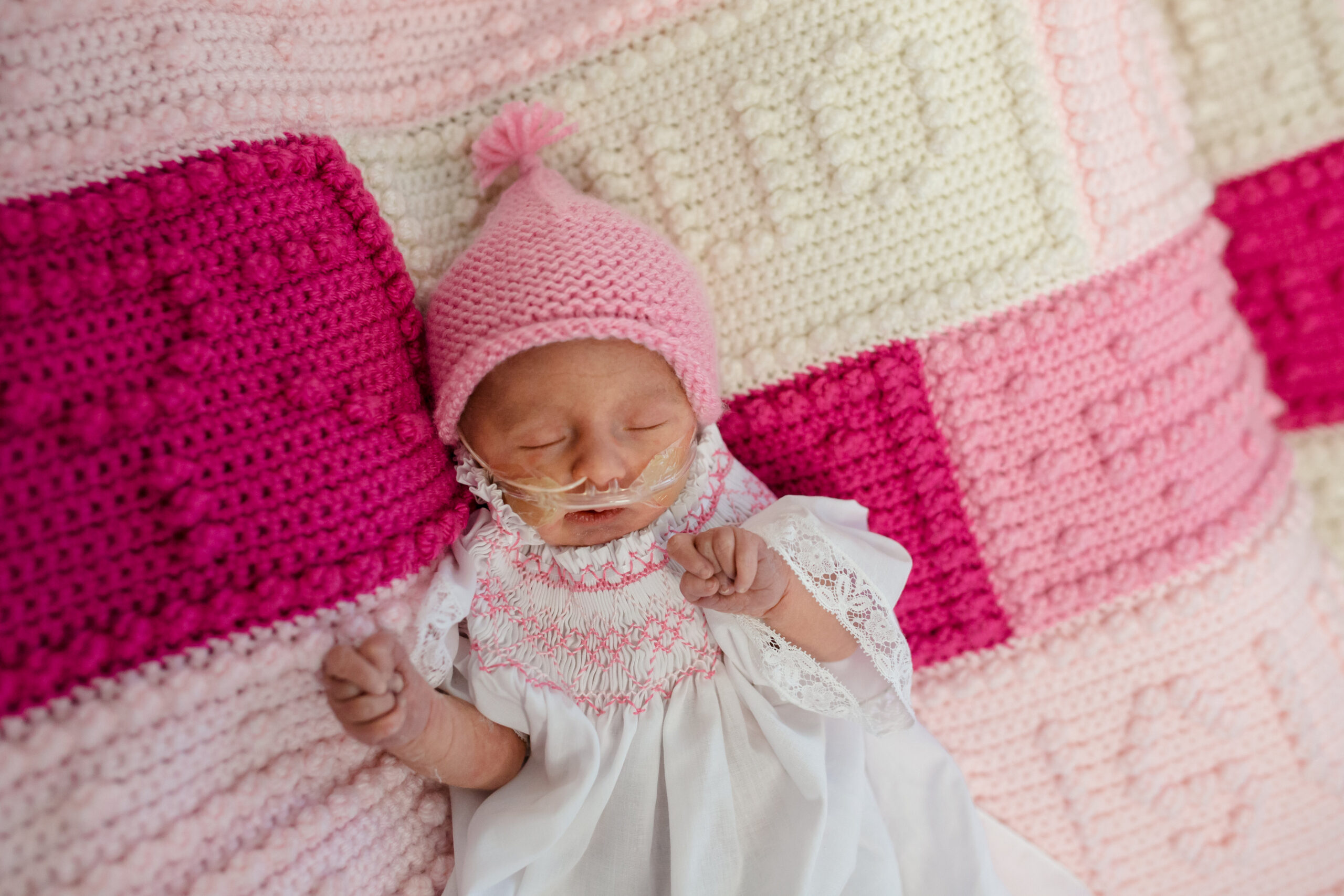
“God seems to send us children with disabilities to help us grow, to remind us that every soul is of greater importance than its frail body, and to teach us how man’s highest calling is found in his God-like possibility of sharing unconditional love,” said National Catholic Bioethics Center senior ethicist Father Tadeusz Pacholczyk of babies like Verity, pictured here as a newborn. | Credit: Melissa Pennington
She said her message to families faced with this type of diagnosis is to let them know “they’re not alone” and that their child “is not a mistake,” and that finding “a community that can help you is so, so important.”
Jacobson also launched the nonprofit Mama Bear Care to provide a community for families whose children are diagnosed with rare genetic disorders. The organization also helps the families connect with doctors and other resources to ensure those children receive necessary care.
“This baby is a gift and not a mistake,” she said. “I really think that Verity’s life has so much value and serves a greater purpose. … I’m selfishly grateful that I get to be her mom.”
Countercultural advocacy for recognition of human dignity
When Jacobson was still pregnant with Verity, a common phrase she heard from doctors was that trisomy 18 was “incompatible with life” and that if she did not die in the womb, they “just indicated she would pass away within five to 15 days,” Jacobson told EWTN News.
“[Verity is] very compatible with life,” Jacobson said, despite the doctors’ warnings. “Living a great life.”
A large percentage of unborn children diagnosed with trisomy 18 die in the womb, and the ones who survive to birth only have about a 5% to 10% survival rate after their first year. Tragically, many of the children who would be born are not given the opportunity to fight for their lives because the post-diagnosis abortion rate is higher than 85%, according to a 2012 study published in the Orphanet Journal of Rare Diseases.
Father Tadeusz Pacholczyk, a senior ethicist at the National Catholic Bioethics Center, told EWTN News that doctors should stop using phrases like “lethal diagnosis” and “incompatible with life,” calling those terms “disparaging” and saying they are “incredibly difficult for the newborn’s parents to hear and process.”
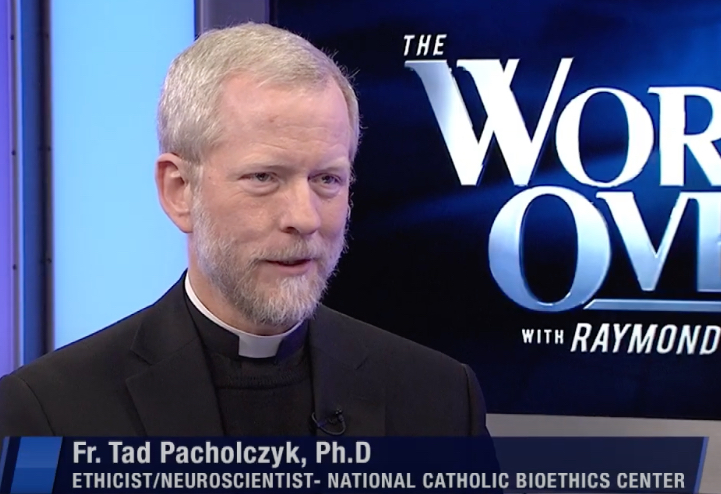
Father Tadeusz Pacholczyk is a senior ethicist at the National Catholic Bioethics Center. | Credit: “The World Over with Raymond Arroyo”/EWTN News screenshot
“Medical professionals should not view such a child as ‘less of a person’ because of his or her disability,” Pacholczyk said. “They need to remain resolute about treating such children with the same dignity and respect as any other child. It’s a travesty when some parents have to contend with a doctor who will not even address their child with a disability by his or her name.”
Jacobson said, like with other genetic conditions, “there’s often a spectrum” for how trisomy 18 will affect a child, adding that doctors “don’t know how this is going to present.”
Despite this, Jacobson said the doctor who provided the diagnosis for Verity “was very clinical” when explaining the condition and “referred to [Verity as] ‘the fetus’ and ‘it,’ instead of ‘the baby’ and ‘she.’” The family then met with a specialty doctor who told Jacobson and her husband that Verity would have a “futile life” and would be a “drain on the family” financially and emotionally.
“It took away from the humanity of my growing daughter who was kicking and very much alive inside of me,” Jacobson said.
Jacobson noted the specialty doctor callously referred to her daughter as “retarded,” which she said “was very hurtful,” adding: “I cried.” Yet, she said the coldness from the doctors motivated her to fight harder for Verity and give her “every opportunity to live.”
“When I heard those words, it was like mama bear woke up and I felt this fierce protectiveness that Verity’s life matters,” she added.
Pacholczyk said that many parents who face these diagnoses “quickly figure out they will have to become vigorous advocates for their children with disabilities.”
“Parents in these situations rejoice when they can link up with an exceptional team of physicians who are hopeful and positive about their disabled child’s life and possibilities,” he said.
Conditions like trisomy 18 have also been used by pro-abortion activists to justify expansions to the procedure in states that have enacted pro-life protections for unborn children, including ones with genetic conditions.
In December 2023, a woman named Kate Cox sued Texas because state law would not allow her to abort her preborn child who was diagnosed with trisomy 18 in the womb. She ultimately left the state to obtain an abortion elsewhere. Much of the media coverage at the time similarly portrayed the diagnosis as “incompatible with life.”
Jacobson said she felt “so much compassion for Cox,” adding: “I’m sure she’s experiencing a lot of emotional trauma and she’s not going to be able to talk about it honestly” because of how pro-abortion activists and the media used her story.
“Many families are experiencing that pressure to abort appointment after appointment,” she added.
Pacholczyk said that “discrimination against those with disabilities should never be allowed to gain a foothold in the medical profession, nor be allowed to guide public policy.”
“The true measure of the greatness of a society will always be in terms of how it treats its weakest members, and the authenticity of our own love will be measured by our compassion and acceptance of the disabled and the powerless,” Pacholczyk said.
“God seems to send us children with disabilities to help us grow, to remind us that every soul is of greater importance than its frail body, and to teach us how man’s highest calling is found in his God-like possibility of sharing unconditional love.”
This story was first published on March 18, 2025, and has been updated.