Pope Leo XIV called for a shift in how the world confronts climate change during a Sept. 24 address to the Pontifical Academy of Sciences.
“We cannot respond to these challenges only after disaster has already struck,” he said. “We need to move from emergency response to prevention, from vulnerability to preparedness, and from short-term measures to a wise and farsighted vision for humanity.”
Speaking at the academy’s plenary session on “The Future of Science in a Changing World,” Leo pointed to increasingly frequent and intense heat waves, droughts, floods, storms, and wildfires. He said their effects “fall most heavily upon the poor” and on communities with the fewest resources to adapt.
“It follows that the climate question is not merely an environmental challenge, it is fundamentally a question of justice, human dignity, and solidarity between peoples and generations,” he said.
The pope called for scientists, engineers, economists, physicians, and social scientists to work alongside local communities and policymakers. He welcomed the climate resilience summits the academy has held over the past two years and encouraged it to continue that work.
Leo also addressed digitalization, artificial intelligence, and robotics. Citing his encyclical Magnifica Humanitas, he said those technologies could bring advances in medicine, food, and energy systems while warning that AI can be used for “surveillance, manipulation, and discrimination.”
He raised concerns about cyber capabilities and autonomous weapons developed or deployed without adequate safeguards and human oversight. Technology, he said, carries responsibilities that extend beyond its technical uses.
“It is my prayer that you will foster a scientific culture that is ambitious yet humble, rigorous yet open to dialogue, innovative yet responsible, globally cooperative yet inclusive of those most at risk and most in need,” he told the academy.
This story was first published by ACI Prensa, the Spanish-language sister service of EWTN News. It has been translated and adapted by EWTN News English.
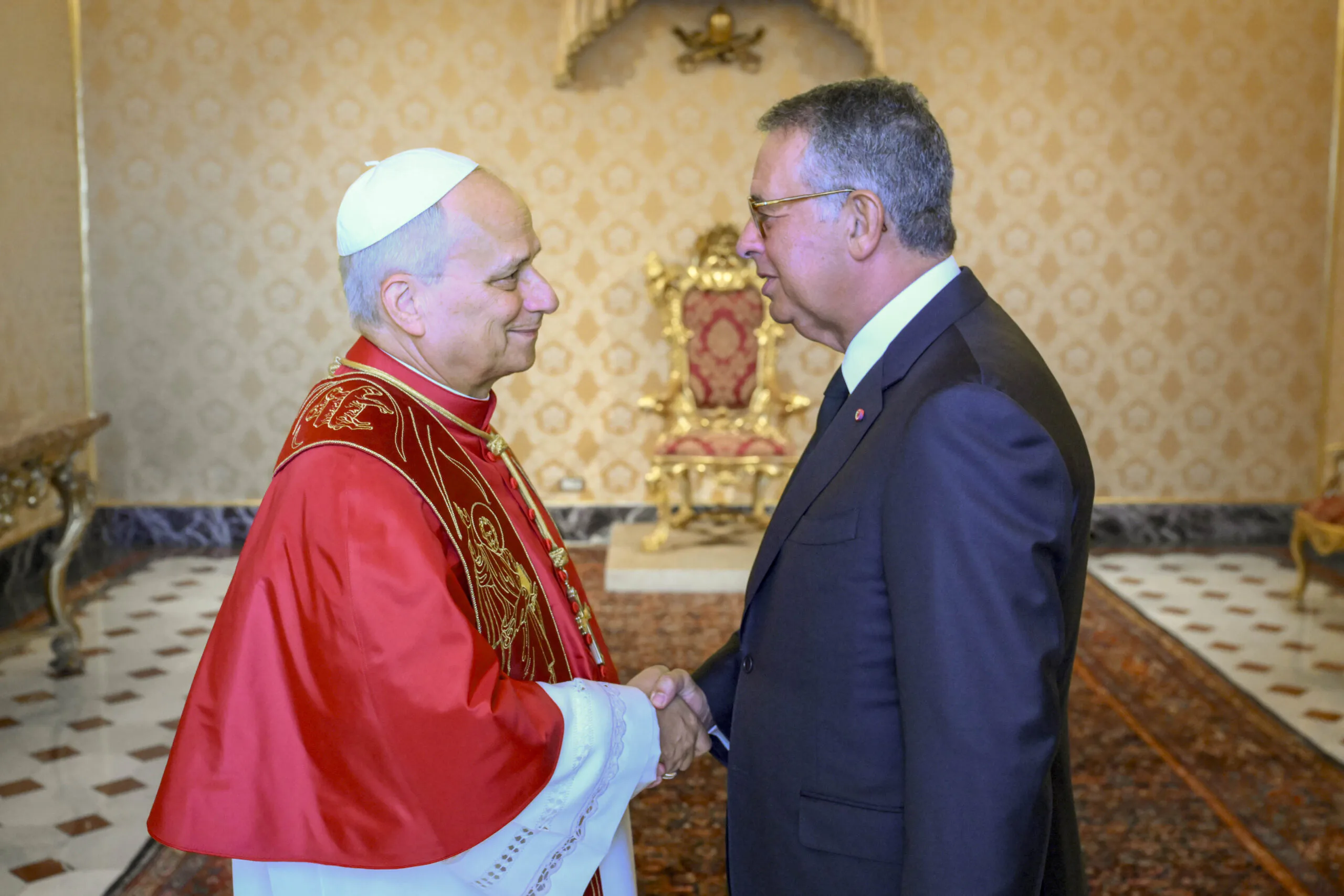
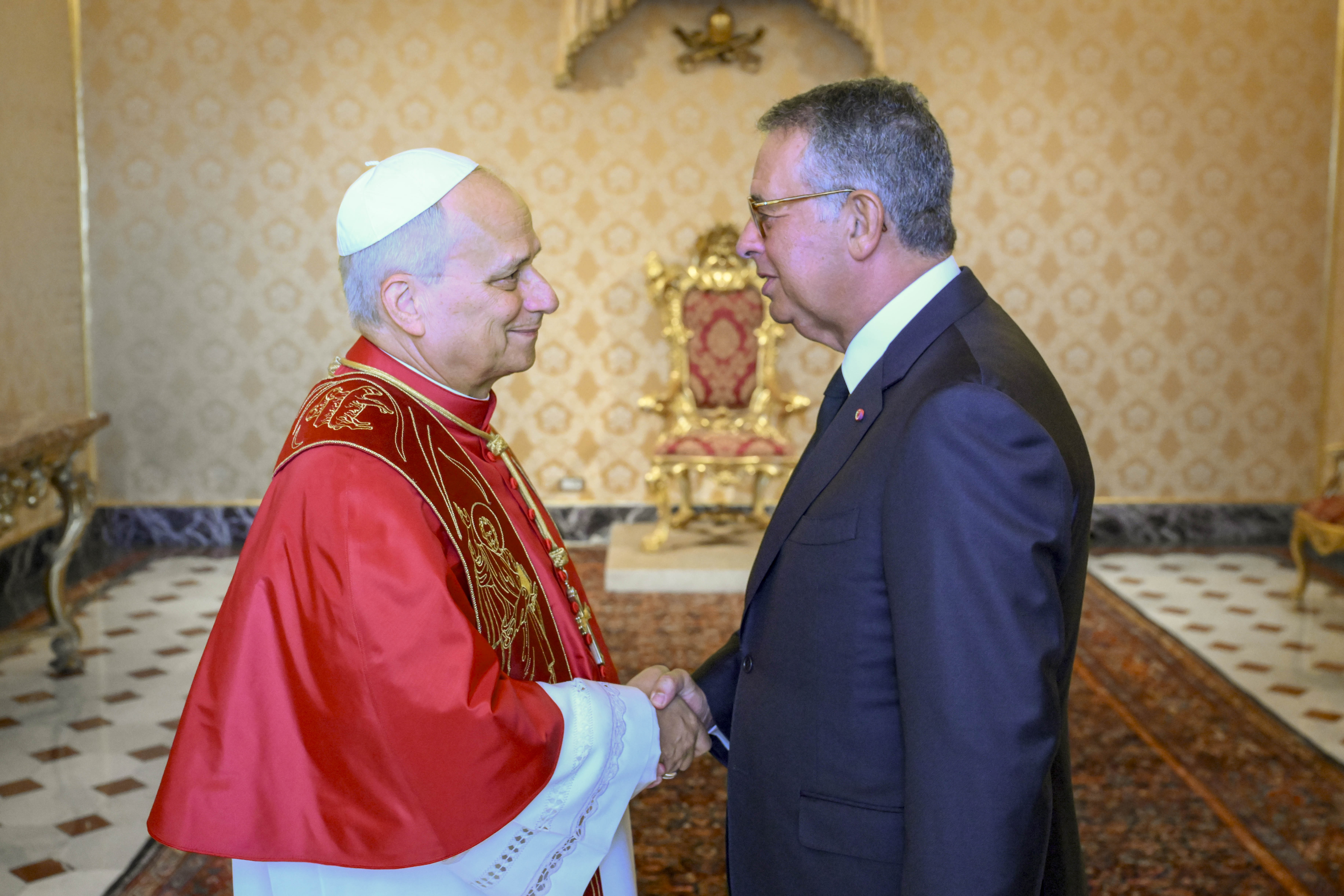
VATICAN CITY — Pope Leo XIV and Hungarian Prime Minister Péter Magyar discussed the wars in Ukraine and the Middle East, the impact of artificial intelligence, and other challenges facing Europe during a private audience at the Vatican on Thursday.
Magyar also formally invited the pope to visit Hungary and presented him with a book of memoirs by Cardinal József Mindszenty, the former archbishop of Esztergom and primate of Hungary who resisted both fascism and communism.
Following the audience, Magyar, who won Hungary’s April 12 parliamentary elections, ending Viktor Orbán’s 16 consecutive years in power, described the meeting on social media as “an honor” and “inspiring.”
Magyar said the two spoke about the situation in Hungary, challenges facing Europe, the growing impact of artificial intelligence on society, and loneliness among young people.
He also explained his approach to politics, which he said is based on “honesty, genuine human connection, and hard work.”
“At the end of our meeting, I asked for a papal blessing for our country and invited the Holy Father to visit Hungary,” Magyar said.
The Vatican said the discussions covered Hungary’s socioeconomic situation as well as education and “the protection of the most vulnerable Christian communities in various regions of the world.”
The two sides also exchanged views on Ukraine and the Middle East and expressed hope for greater international efforts to promote peace and negotiated solutions to ongoing conflicts.
Magyar gave the pope a book of memoirs by Mindszenty, one of the most prominent figures in 20th-century Hungarian Catholicism. The cardinal, who lived from 1892 to 1975, faced imprisonment and persecution for his opposition to both fascism and Hungary’s communist regime.
Portuguese president meets Pope Leo
Pope Leo also received Portuguese President António José Seguro on Thursday in their first official meeting since Seguro became head of state.
Pope Leo XIV with Portuguese President António José Seguro at the Vatican on Sept. 24, 2026. | Credit: Vatican Media
Seguro subsequently met with Archbishop Paul Richard Gallagher, the Vatican’s secretary for relations with states. Cardinal Pietro Parolin, the Vatican secretary of state, was in New York for the United Nations General Assembly.
The Holy See said the talks covered Portugal’s socioeconomic situation, the promotion of the common good, and international affairs.
“Some regional and international issues were addressed, with particular reference to the repercussions of conflicts around the world, migration, the importance of multilateralism and respect for international law, as well as the urgent need for a constant commitment to peace,” the Vatican said.
The private audience lasted about 40 minutes. Seguro presented the pope with a porcelain sculpture of the crucified Christ made by Portuguese manufacturer Vista Alegre and designed by architect Álvaro Siza Vieira.
Seguro had said Wednesday that he planned to convey “the friendship of the Portuguese people” and renew an invitation for Pope Leo to visit Portugal in 2027, when the country will mark the 500th anniversary of the apostolic nunciature.
Pope Francis visited Portugal twice during his pontificate: in 2017 for the centenary of the Marian apparitions at Fátima and in 2023 for World Youth Day in Lisbon.
This story was first published by ACI Prensa, the Spanish-language sister service of EWTN News. It has been translated and adapted by EWTN News English.
Pope Leo XIV will visit three cities in France from Sept. 25–28, making stops in Paris, Lourdes, and Metz to meet with young people, government officials, the sick, and migrants, among others. During the trip, the Holy Father will be discussing issues ranging from artificial intelligence to immigration to the Catholic Church in France today.
Here are 12 things to know about his trip and France’s rich Catholic history:
1. Pope Leo will be the third pope to visit Paris and Lourdes.
Pope Francis made three visits to French cities including Strasbourg, Marseille, and Ajaccio in Corsica but never visited Paris or Lourdes. Pope Leo will now become the third reigning pope, after St. John Paul II and Benedict XVI, to visit both of the iconic Catholic destinations of Paris and Lourdes.
Pope Benedict XVI made the longest visit to Lourdes by a reigning pope, spending four days there in September 2008 for the 150th anniversary of the apparitions.
2. The first papal liturgy at Notre-Dame will be celebrated since the devastating fire.
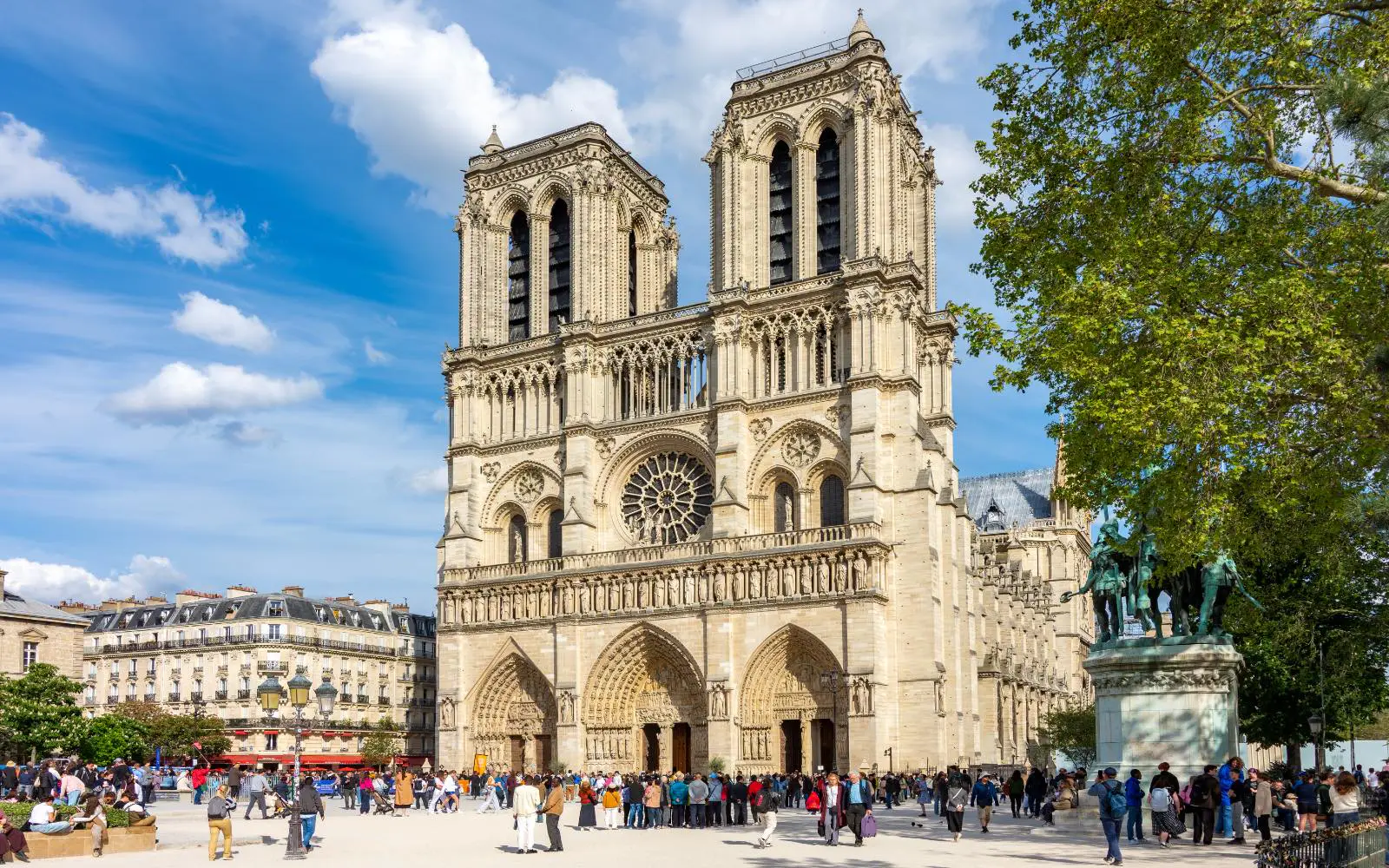
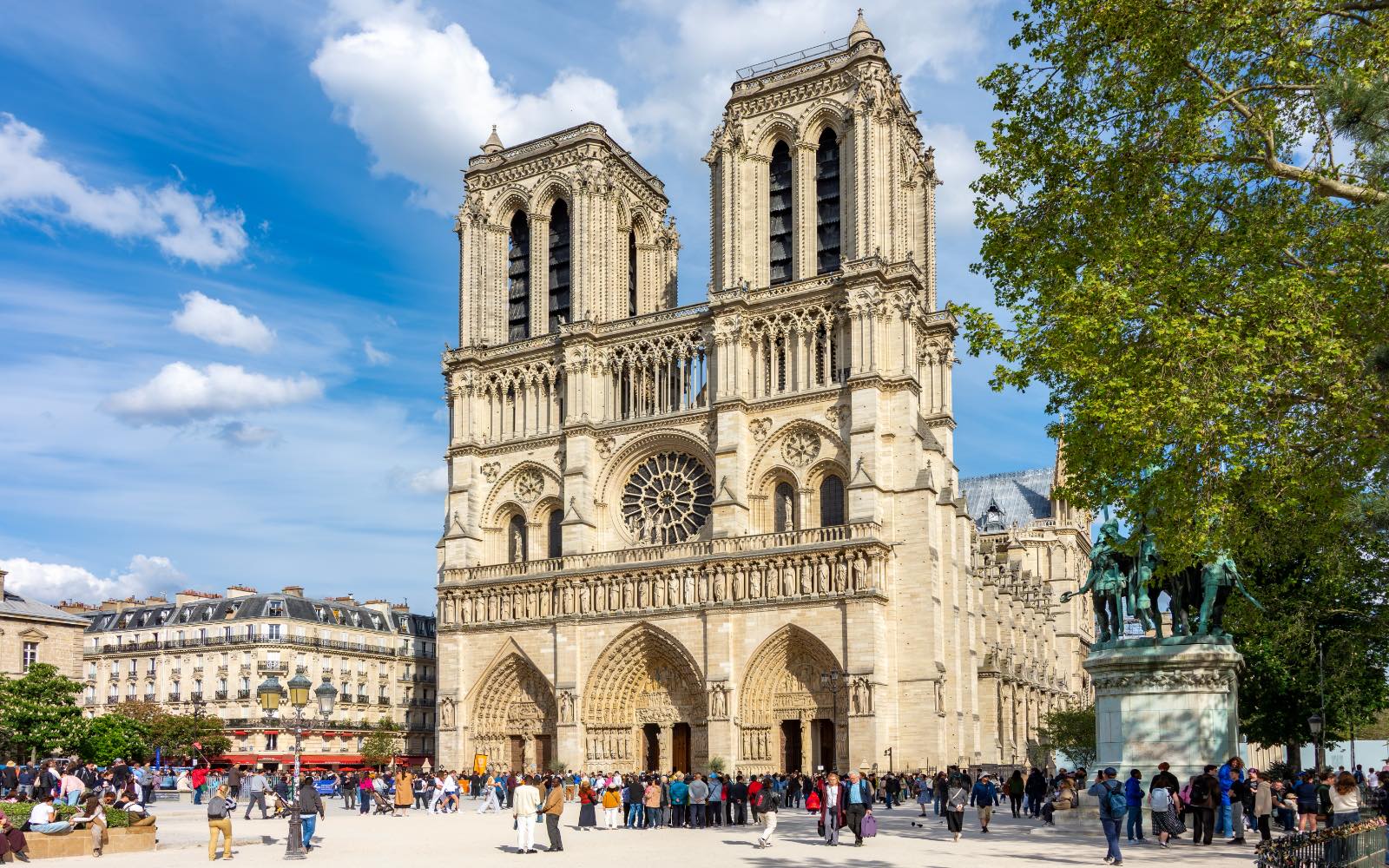
On Sept. 25, Pope Leo will open his apostolic journey to France by presiding over solemn vespers alongside clergy, consecrated religious, and seminarians inside Notre-Dame de Paris.
Seven years after the tragic 2019 fire brought down the cathedral’s spire and roof, this evening prayer marks the very first papal liturgy beneath its restored Gothic vaults.
Notre-Dame Cathedral in Paris. | Credit: Mistervlad/Shutterstock
3. Pope Leo XIV will celebrate Mass at Paris’ Place de la Concorde.
Built as Place Louis XV to honor a king, it became Place de la Révolution during the French Revolution — where Louis XVI, Marie Antoinette, and more than a thousand others were executed. It was renamed Place de la Concorde, “Square of Harmony,” in 1795 as a gesture toward national reconciliation.
Place de la Concorde is the largest public square in Paris, spanning over 20 acres.
4. A relic of Christ’s tunic will be on display for an event during the pope’s trip.
The pope will take part in a youth prayer vigil at the Stade de France in Saint-Denis, north of Paris, on Sept. 25. More than 80,000 French young people have registered for the event.
At the conclusion of the event, a relic of Christ’s tunic will be on display. This will be the first time a pope will witness an exposition of the Holy Tunic, the garment believed to have been worn by Christ during his passion, which is preserved in the Basilica of Saint-Denis.
The special relic is put on display during regular expositions every 50 years, as well as on extraordinary occasions — the most recent being in 2023 — but it has never before been brought before a pope.
The relic will travel under tight security from the basilica to the stadium, which is about 3.7 miles away.
The Stade de France has its own interesting history in that it was built specifically to host the 1998 FIFA World Cup Final — where France famously defeated Brazil 3–0 to claim its first world title. The 80,000-seat stadium is set to trade soccer anthems for sacred hymns as it will now welcome that exact same full-capacity crowd, transforming the historic pitch from the birthplace of French football glory into an altar filled with 80,000 young pilgrims holding candles and praying alongside the pope.
5. Pope Leo will pray at the exact grotto where Our Lady appeared to St. Bernadette.
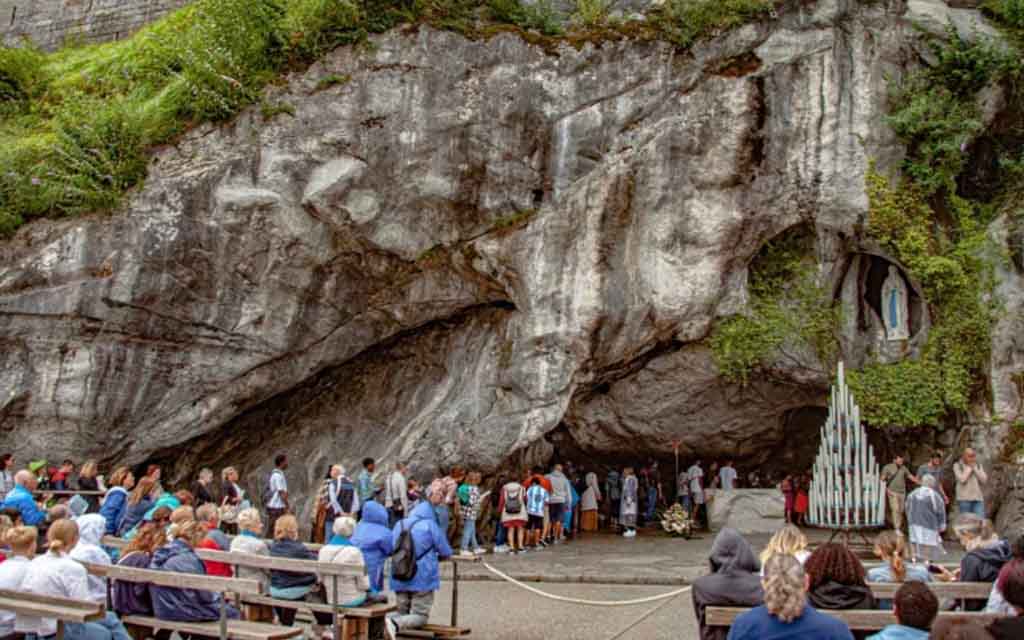
The Holy Father’s first Lourdes event on Sept. 26 is an evening prayer at the Grotto of the Apparitions at Massabielle — one of the most recognizable Marian apparition locations on Earth.
Also while in Lourdes, the pope will lead the rosary and Marian torchlight procession at the Sanctuary of Our Lady of Lourdes on Sept. 27.
Sunday’s Mass will be celebrated by the pope at the shrine’s meadow — the prairie — rather than inside a basilica. The prairie at the Sanctuary of Our Lady of Lourdes is a wide, open grassy meadow located across the Gave River from the main Grotto.
In a deeply Lourdes-specific moment, the Holy Father will visit the staff and sick community of the Accueil Notre-Dame, one of the sanctuary’s hospitality facilities for pilgrims who are ill or disabled.
Since 14-year-old St. Bernadette saw Our Lady in 1858, over 200 million pilgrims have visited the grotto of Massabielle. Out of more than 7,000 claimed medical cures, 72 have been officially recognized by the Church and a rigorous medical bureau as scientifically inexplicable miracles.
6. French pilgrims wonʼt need translations when Pope Leo XIV takes the podium.
The Holy Father speaks French with ease. Drawing on paternal French ancestry, early immersion that saw him tutoring high school classmates in Michigan by age 15, and years delivering addresses across Francophone Africa during his tenure as Augustinian prior general, the Chicago-born pontiff brings a lifelong linguistic fluency and a deep love for French spirituality directly to his encounters in France.
7. France is the birthplace of St. Thérèse of Lisieux.
St. Thérèse of Lisieux is a beloved French Discalced Carmelite nun who is also known as the “Little Flower.” She died at just 24 years old and was proclaimed a doctor of the Church by St. John Paul II in 1997.
Pope Leo will make a private visit to cloistered Carmelite nuns at their monastery in Lourdes during his visit.
8. France holds the title “Eldest Daughter of the Church.”
France earned the title “la fille aînée de lʼÉglise” (“eldest daughter of the Church”) because King Clovis I of the Franks was baptized in Reims around A.D. 496, making the Kingdom of the Franks the first major Western kingdom to adopt orthodox Catholicism rather than paganism or Arianism.
9. The popes lived in France for nearly 70 years.
During the Avignon Papacy (1309–1377), seven successive popes — all French — ruled the universal Catholic Church from the Palais des Papes in southern France rather than Rome, until St. Catherine of Siena helped convince Pope Gregory XI to return to the Eternal City.
10. The Miraculous Medal was revealed in the heart of Paris.
In 1830, the Virgin Mary appeared to novice sister St. Catherine Labouré at the chapel on the Rue du Bac in Paris, giving her the design for the Miraculous Medal. Millions were distributed within years, and the medal remains one of the most widely worn sacramentals in the global Church.
11. Only two French monks know the secret recipe for Chartreuse.
The famous herbal liqueur Chartreuse has been crafted since 1737 by Carthusian monks at the Grande Chartreuse monastery near Grenoble. To this day, only three monks at any given time know the secret recipe of 130 herbs, plants, and flowers.
12. Dom Pérignon champagne was perfected by a Benedictine monk.
Dom Pierre Pérignon, a 17th-century French Benedictine monk and cellarer at the Abbey of Hautvillers, revolutionized winemaking by developing thick-glass bottles, cork stoppers, and blending methods that prevented bottles from exploding — laying the foundation for modern champagne.
Pope Leo XIV appealed on Wednesday to “everyone’s sense of responsibility” to protect migrant and refugee minors, stressing that children and teenagers are the most vulnerable and often endure “unspeakable suffering.”
“Children and teenagers are the most vulnerable,” he said at the end of his weekly general audience, recalling that the World Day of Migrants and Refugees will be celebrated on Sunday, Sept. 27.
Following his catechesis in St. Peter’s Square, the pontiff noted that many minors endure “unspeakable suffering: violence, torture, exploitation, traumatic conditions, and it is not uncommon for them to lose their lives along migration routes.”
In light of this reality, he called for ensuring the protection and support of young migrants.
“I appeal to everyone’s sense of responsibility: Let us all feel a sense of involvement in the lives of these young people, who must always be protected and supported,” Leo XIV urged.
The Church celebrates the World Day of Migrants and Refugees each year to raise awareness about the situation of displaced persons and to promote initiatives of welcome, integration, and accompaniment, with particular attention to those in the most vulnerable circumstances.
In his message for this year’s World Day of Migrants and Refugees, titled “Even Just One of These Children,” Pope Leo XIV insisted that “public and private institutions are obliged to place the protection and dignity of every migrant child and adolescent at the center” of their efforts.
Progress is not opposed to Christian faith
In his catechesis, the pope challenged the “prejudice” that portrays scientific and technological progress as being opposed to the Christian faith and warned of the “tragedy of atheistic humanism” described by French Jesuit Cardinal Henri de Lubac.
“In post-Christian humanisms, the human being and God are mistakenly presented as rivals: In order to assert his knowledge, his freedom, and his progress, man would have to emancipate himself from God. Ultimately, however, by denying the relationship with God, one also loses the possibility of affirming the transcendent value of the human person,” the pontiff said in St. Peter’s Square.
According to Leo, this interpretation “has brought about a change in the way contemporary man views the world, compared with previous ages,” opening the door to a “prejudice” that prevails especially in that part of Western culture that has lost its reference to Christian revelation.
As part of his reflections on the Second Vatican Council’s pastoral constitution Gaudium et Spes, the Holy Father invited the faithful to ask: “What is the value of human activity in the world, and therefore of technical, social, and scientific progress?”
“Created in the image and likeness of God, the human being is the agent of progress. With freedom and intelligence, he increases his knowledge, thereby advancing society as a whole,” he explained.
Pope Leo XIV also said: “Humanity — and with it work, progress, and the autonomy of created realities — is not absorbed or nullified by the encounter with God but rather taken up in its entirety, continuing to be, in Christ, free and active: Indeed, it is in him that it finds full truth and freedom.”
Addressing the pilgrims gathered in the square, the pope said: “Christians, like everyone else, are involved in building the city of man, striving towards the end of all things and the encounter with God, and reminding those with whom they share the adventure of progress, science, and life of this ultimate purpose.”
He added, however, that earthly progress must be clearly distinguished from the development of Christ’s kingdom.
“Finally, let us recall that in order to become authentic human progress — that is, progress for the whole person and for all people — technical and scientific progress must be inspired and guided by charity. Only in this way can it always be placed in the service of human dignity and promote the living conditions of all, especially the most disadvantaged,” the pope concluded.
This story was first published in twoparts by ACI Prensa, the Spanish-language sister service of EWTN News. It has been translated and adapted by EWTN News English.
Archbishop Fulton J. Sheen is set to become the first U.S.-born bishop to be beatified on Sept. 24 in St. Louis. Known for his innovative Catholic media ministry, Sheen spent several years after his ordination studying philosophy and theology in Europe — first in Leuven, Belgium, then in Paris and Rome.
His time in Rome would produce some of the most significant events in Sheen’s life, including the completion of his doctorate, being consecrated a bishop, and attending the Second Vatican Council.
Here are some of Sheen’s most important moments in the Eternal City:
Completing his doctorate at the Angelicum
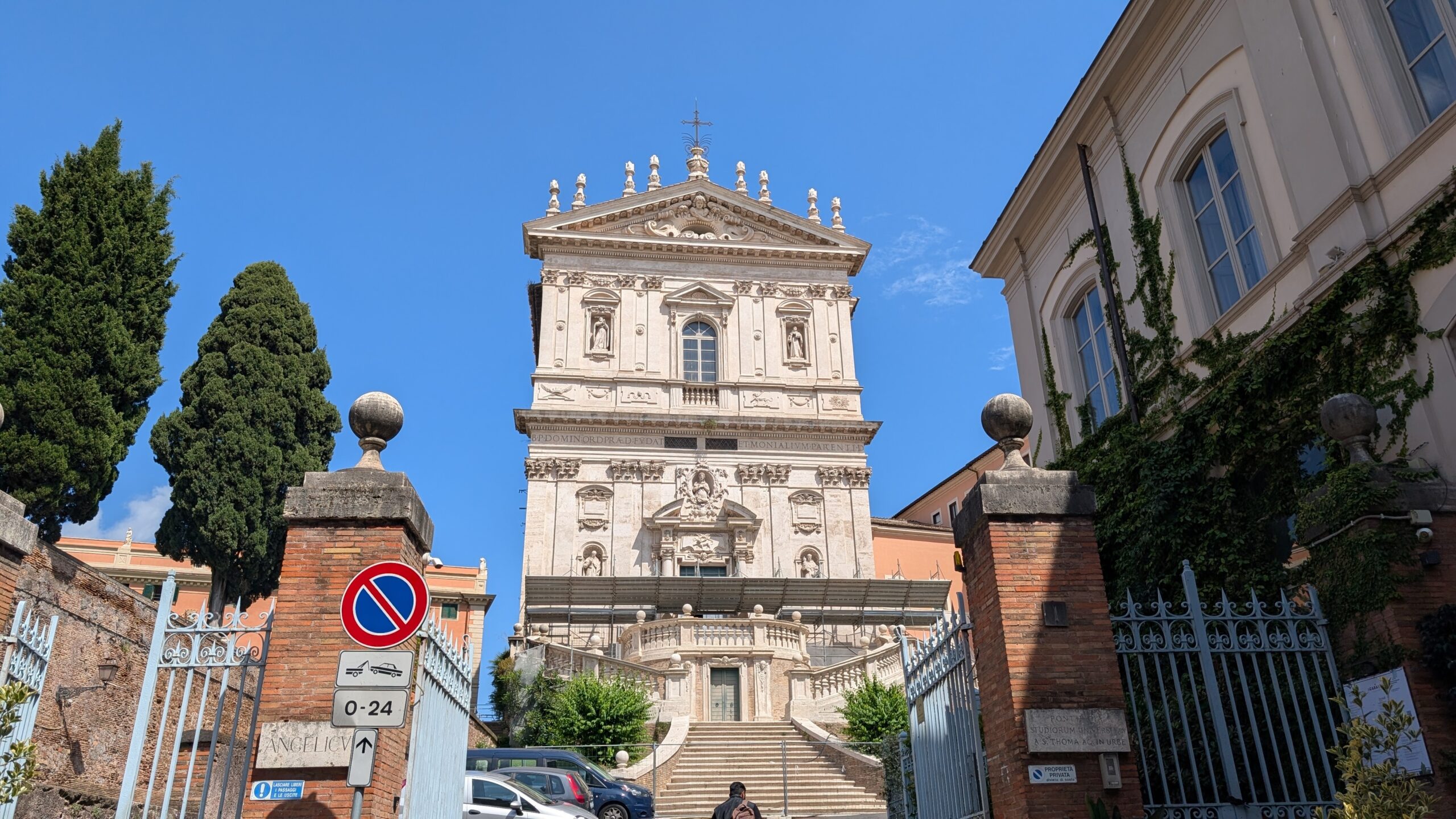
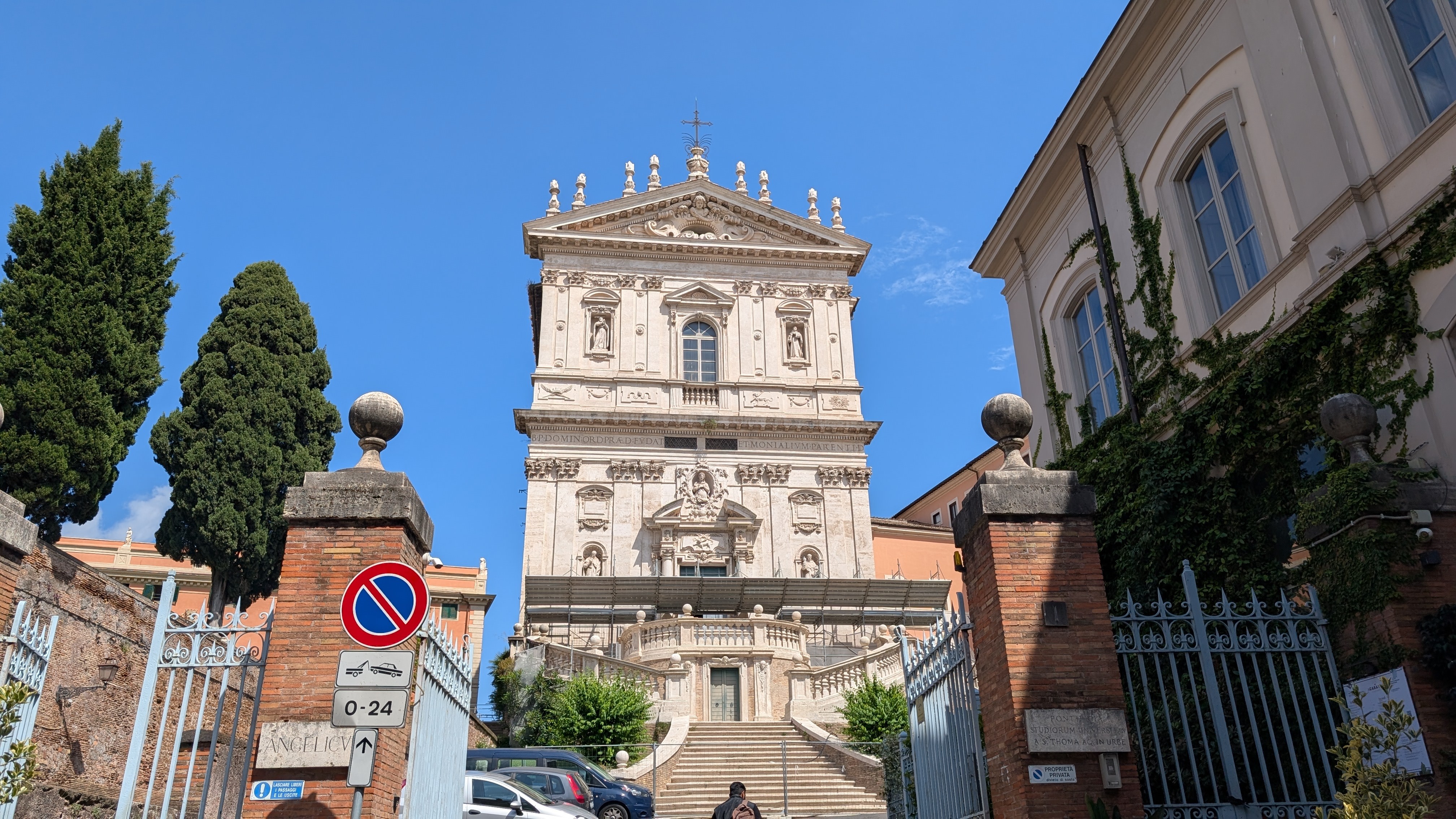
Then-Father Sheen earned a doctorate in theology at the Pontifical University of St. Thomas Aquinas — “the Angelicum,” as it’s known — in Rome after studying there from 1923-1924. That year, the Angelicum was located on the Via San Vitale before moving to its present location at the Church of Sts. Dominic and Sixtus in 1932.
The Pontifical University of St. Thomas Aquinas — “the Angelicum” — in Rome. | Credit: Ishmael Adibuah/EWTN News
In 1923, Pope Pius XI published his encyclical Studiorum Decem, praising the Angelicum’s work in promoting the thought of St. Thomas Aquinas, whose 600th canonization anniversary was also celebrated that year.
Meeting with Pope Pius XI
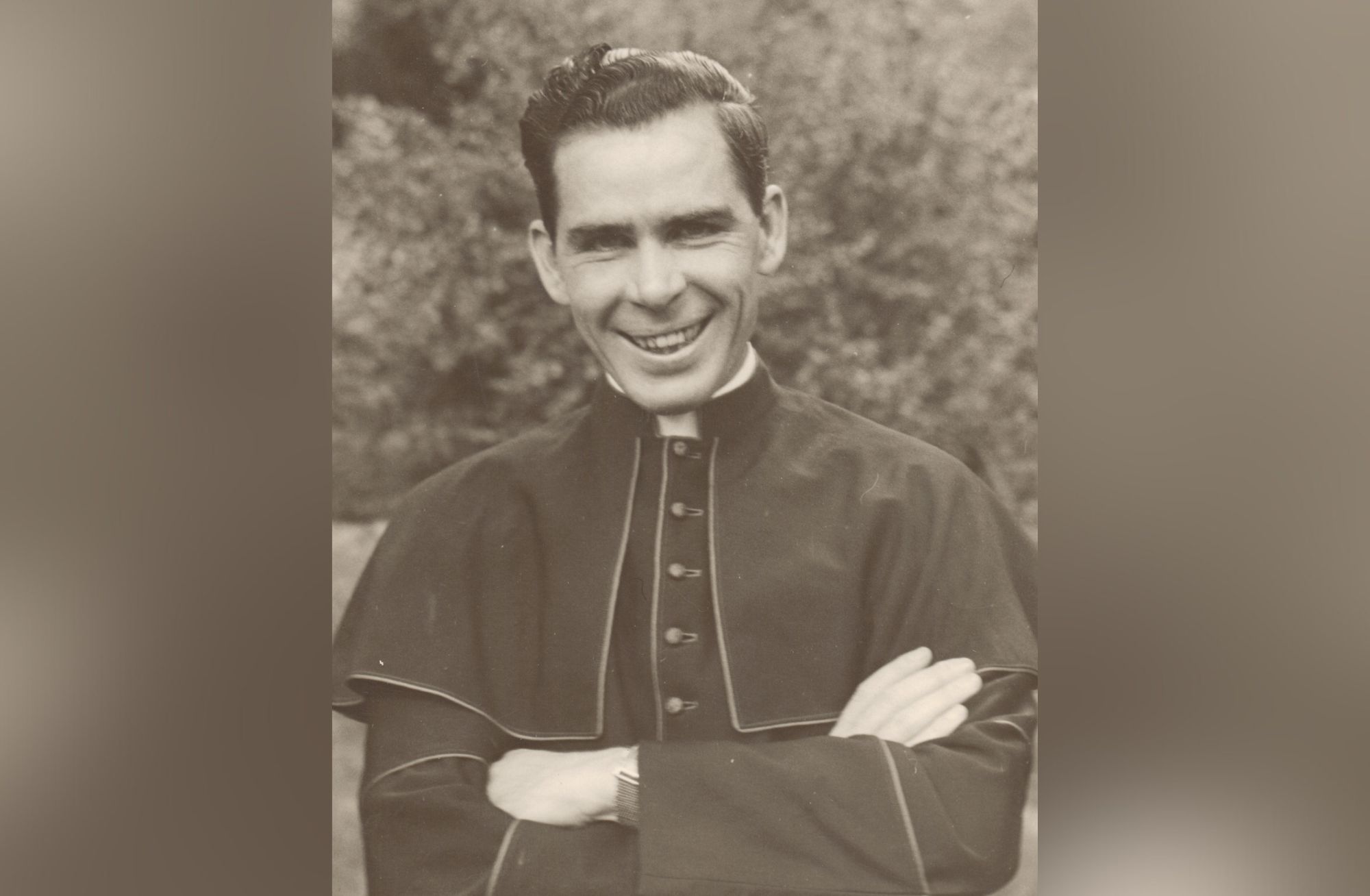
In 1935, Pius XI summoned Sheen to Rome for a private audience at the height of Sheen’s fame from his NBC radio show “The Catholic Hour.” The pope had made him a monsignor the previous year.
A young Fulton Sheen. | Credit: Photo courtesy of The Archbishop Fulton John Sheen Foundation
During their meeting, the pope, alarmed by the rise of Soviet communism, asked Sheen to study the works of Karl Marx and Vladimir Lenin and to use that study to warn Americans of the dangers of communism.
Sheen would respond to the pope’s request by regularly explaining the dangers of communism throughout his public ministry.
Episcopal consecration
On May 28, 1951, Pope Pius XII appointed Sheen auxiliary bishop for the Archdiocese of New York, assisting its archbishop, Cardinal Francis Spellman. He received his episcopal consecration at the Basilica of Sts. John and Paul on June 11, 1951.
Sheen later became the bishop of Rochester, New York, in 1966 and the titular archbishop of Newport, Wales, in 1969.
National director of the Society for the Propagation of the Faith
In 1950, the Vatican nominated Sheen as the national director of the Society for the Propagation of the Faith. He would serve in this position for 16 years.
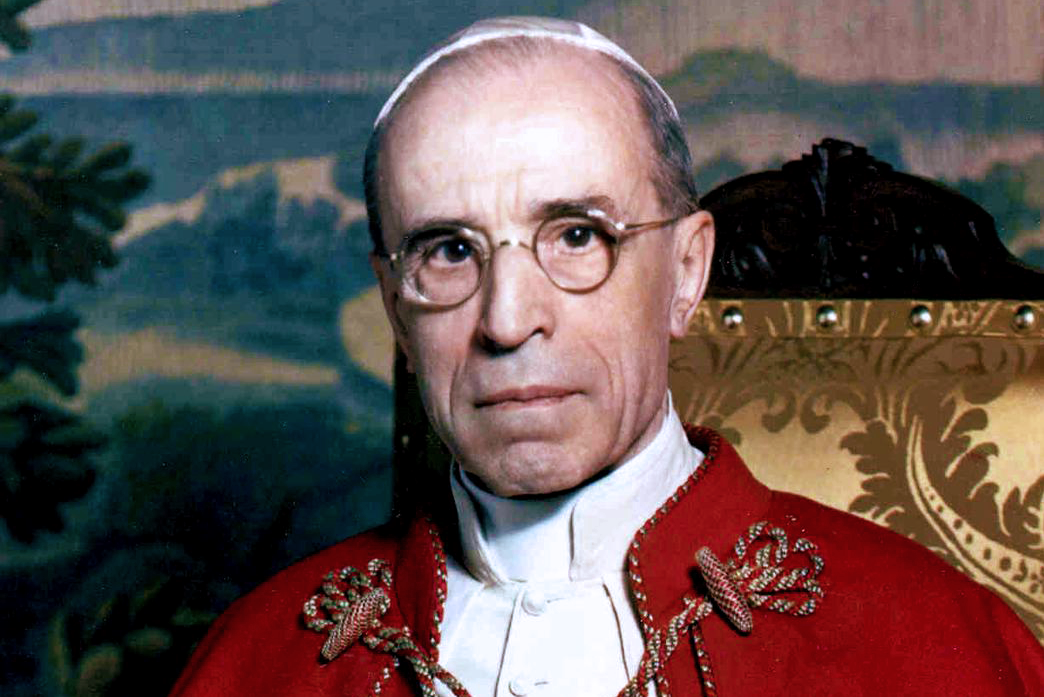
Pope Pius XII. | Credit: Public domain
As national director, he was occasionally required to visit Rome, where he met privately with Popes Pius XII, John XXIII, and Paul VI, as well as other officials in the Roman Curia.
On May 21, 1961, John XXIII invited Sheen, as national director, to consecrate 14 new missionary bishops with him in St. Peter’s Basilica.
Second Vatican Council
Sheen attended all four sessions of the Second Vatican Council, which lasted from 1962–1965.
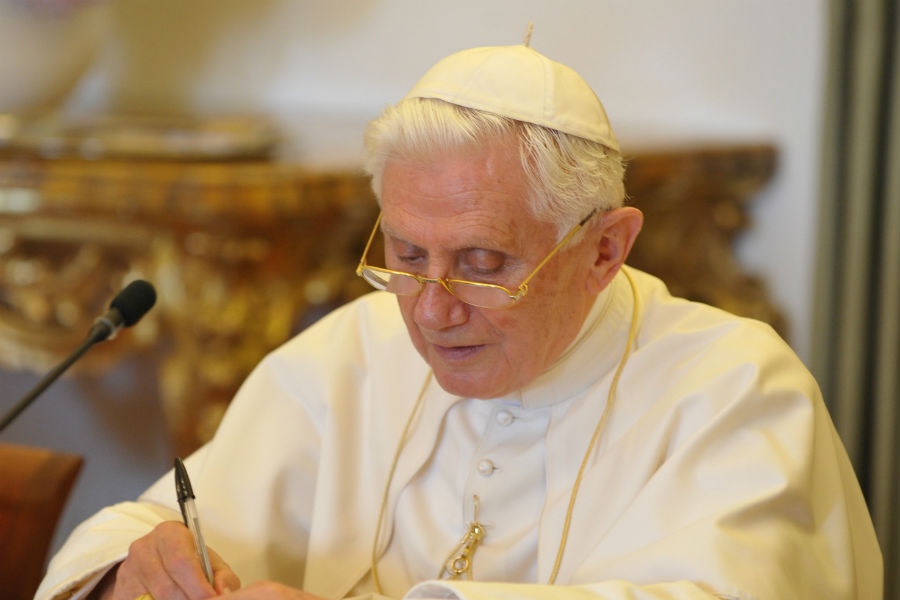
Father Joseph Ratzinger, a theological expert at the council who later became Pope Benedict XVI, met Sheen in 1965. In July 2012, as pope, he fondly recalled the days he spent working with Sheen and others in the Italian countryside, drafting the council’s decree on the Church’s missionary activity, Ad Gentes.
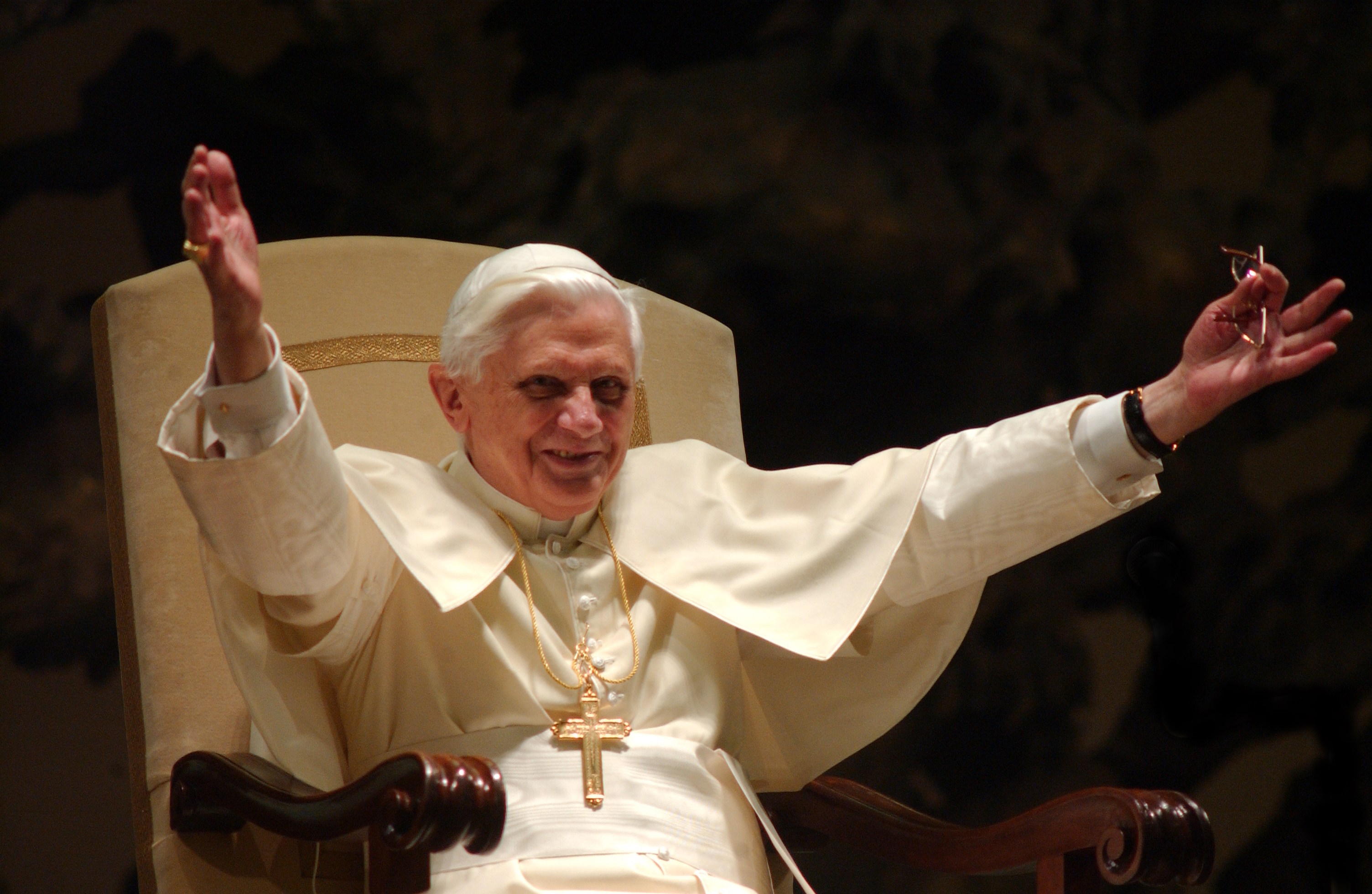
Pope Benedict XVI. | Credit: Vatican Media
“There was Fulton Sheen who would fascinate us in the evenings with his talks,” Benedict said, remembering some of those present during a week that was, for him, “spiritual enrichment, a great gift.”
Shortly before that, Benedict recognized the heroic virtue of Sheen and declared him “venerable” in a decree on June 28, 2012.
Pope Leo XIV’s visit to Lourdes this week will be key to his message of respect for human life in all stages and conditions, which is the theme of his Sept. 25–28 pastoral visit to France. Images of the pontiff meeting ailing pilgrims will complement the trip’s official motto: “That the World May Have Life.”
But the visit to the world-famous shrine will also be the moment where he will most directly address clerical sexual abuse, a crisis that has cast a shadow over the Church in France since a landmark abuse report in 2021.
Lourdes will be the setting Sept. 27 for the pope’s private meeting with sex abuse victims and a speech to the French Catholic bishops, who continue to deal with fallout from the abuse crisis. The shrine itself has been touched by controversy in recent years due to the prominent display there of artwork by a priest accused of sexual and spiritual abuse.
In a survey conducted in France ahead of the Sept. 25–28 visit, the topic of clerical sexual abuse loomed large.
For 15% of respondents, the fight against abuse and its prevention within the Church was the topic they most wanted the pope to address while in France. It was the second-most popular answer after “peace and conflict in the world.”
The Church in France has been grappling with the repercussions of abuse in the wake of the findings of an independent commission that found that likely hundreds of thousands of children had been abused over the past 70 years.
The Independent Commission on Sexual Abuse in the Church (CIASE) published a nearly 2,500-page final report in October 2021, estimating that 216,000 children were abused by priests, deacons, monks, or nuns in France from 1950 to 2020.
It added that when abuse by lay Church workers was also taken into account, “the estimated number of child victims rises to 330,000 for the whole of the period.”
Some of these victims will take part in a private meeting with Pope Leo at the Sanctuary of Our Lady of Lourdes on Sept. 27.
According to the French bishops’ conference, the seven victims represent people abused as minors or adults in different contexts, including churches or Catholic schools.
The seven people issued a joint declaration, published in AFP on Sept. 16, stating: “To engage in dialogue [with Pope Leo] does not mean to endorse. To be received does not mean to renounce our demands.”
Five of the seven revealed their identities. Among them is Bertrand Virieux, a victim of ex-priest Bernard Preynat, who died in 2024 but in 2020 was sentenced to five years in prison for assaults on young scouts in the Archdiocese of Lyon.
According to the victims’ declaration, they met on Sept. 14 to prepare for the papal audience and to “share the fundamental questions” they wish to pose to the pope.
The encounter during the papal trip, which will also include stops in the cities of Paris and Metz, ignited controversy among several abuse support groups in France who criticized the format of the meeting and the choice of whom to include — especially the exclusion of victims’ groups. A spokesman for the Bétharram victims' collective, which represents former student victims from the Notre-Dame de Bétharram school near Lourdes, called the decision to include only individuals in the meeting with Leo an instance of “institutional contempt,” according to InfoVaticana.
Responding to the frustration, the bishops of France have promised to hold other gatherings for victims and to accept their letters after the papal trip.
Earlier on the same day that he meets the victims, Leo will take part in a closed-door meeting with France’s bishops. Given the importance of the abuse issue to the bishops in recent years, it is likely that the pope will address it in his remarks, Cyprien Viet, a Vatican journalist for I.Media, said.
Lourdes and Rupnik mosaics
The Lourdes shrine, one of the most visited Catholic sites in the world, is an evocative backdrop for the meeting with abuse victims, since it is among the first shrines to take definitive action to cover artwork by the accused sexual abuser Father Marko Rupnik, currently on trial at the Vatican.
Bishop Jean-Marc Micas of Tarbes and Lourdes announced in August that mosaics by Rupnik on the façade of the Basilica of the Rosary would be covered ahead of the pope’s visit. In 2025, the mosaics had been partially covered.
“My role is to ensure that the shrine welcomes everyone, especially those who are suffering,” Micas told La Dépêche du Midi. "Among them are victims of sexual abuse and assault, both children and adults.”
Rupnik’s mosaics also grace the chapel of the apostolic nunciature in Paris, where Pope Leo will stay the night of Sept. 25–26, though no public events will take place there.
For the first time in seven centuries, Aquileia, a city in northeastern Italy with a fascinating past, has reunited the three scattered fragments of a sixth-century manuscript that for centuries was venerated as if it were the Gospel written by St. Markʼs own hand.
The author of the Gospel that bears his name was St. Peter’s interpreter and secretary. He followed the apostle to Rome, where he witnessed his preaching in the homes of the first followers of Christ, who dared to defy the Roman Empire’s laws governing worship.
St. Mark carefully recorded every courageous word of that early catechesis, and his notes became a firsthand source for the story of Jesus’ life.
Today, Aquileia, a small town of just over 3,000 inhabitants, treasures St. Mark’s memory as the founder of one of the most flourishing Christian communities of the Middle Ages.
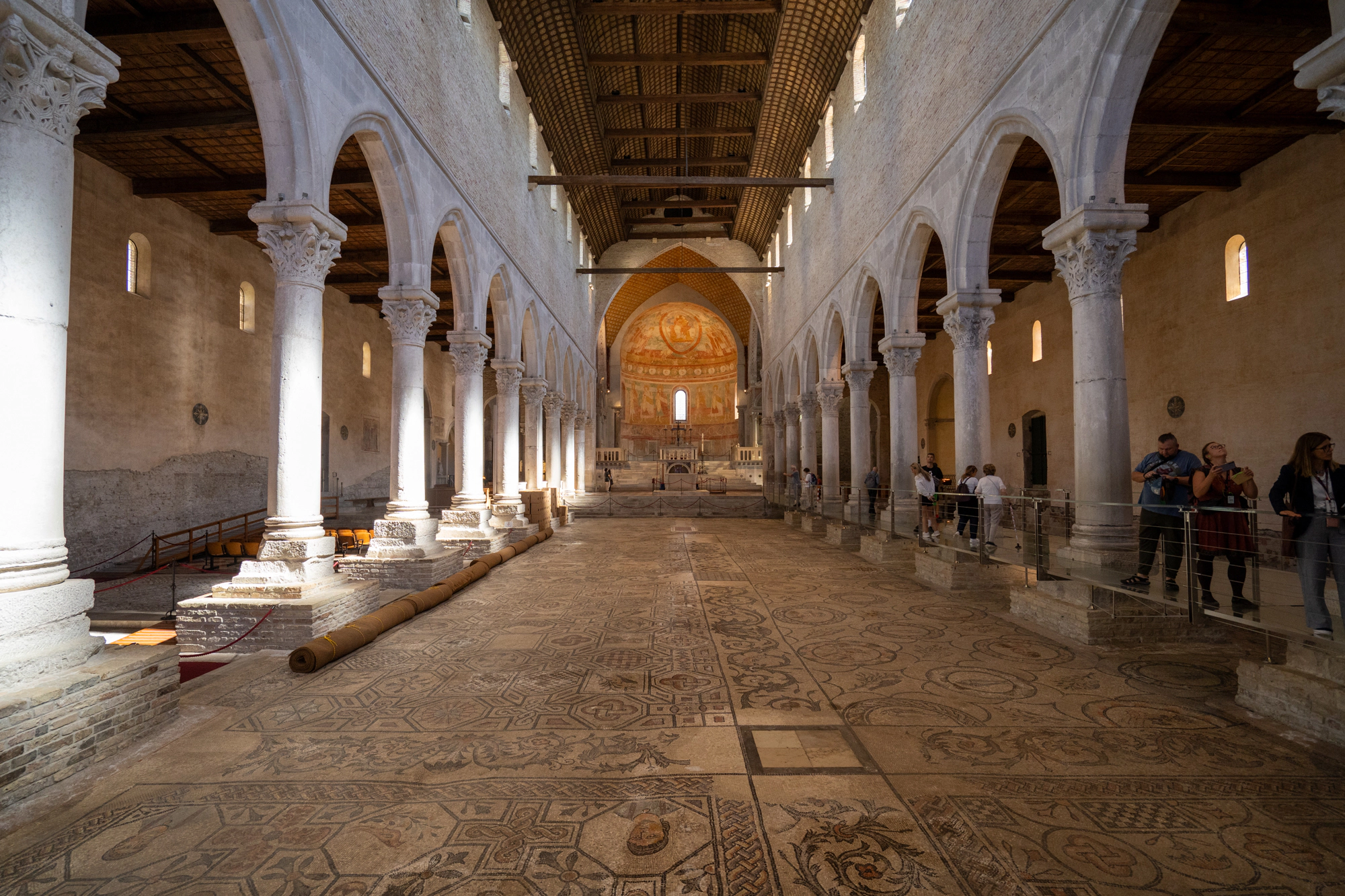
The Basilica of Aquileia, home to the largest and best preserved early Christian mosaic in the Western world. | Credit: Photo courtesy of Tseng Kuang Yi
After the Edict of Milan in A.D. 313, the city, situated at the crossroads of East and West and serving as a bridge between the Mediterranean world and Slavic culture, became a center for the spread of Christianity into Central Europe and the Balkans.
By the fifth century, it had even been honored with the title of apostolic city, and its bishop held the rank of patriarch. That privilege was reserved only for dioceses that traced their origins to the preaching of an apostle.
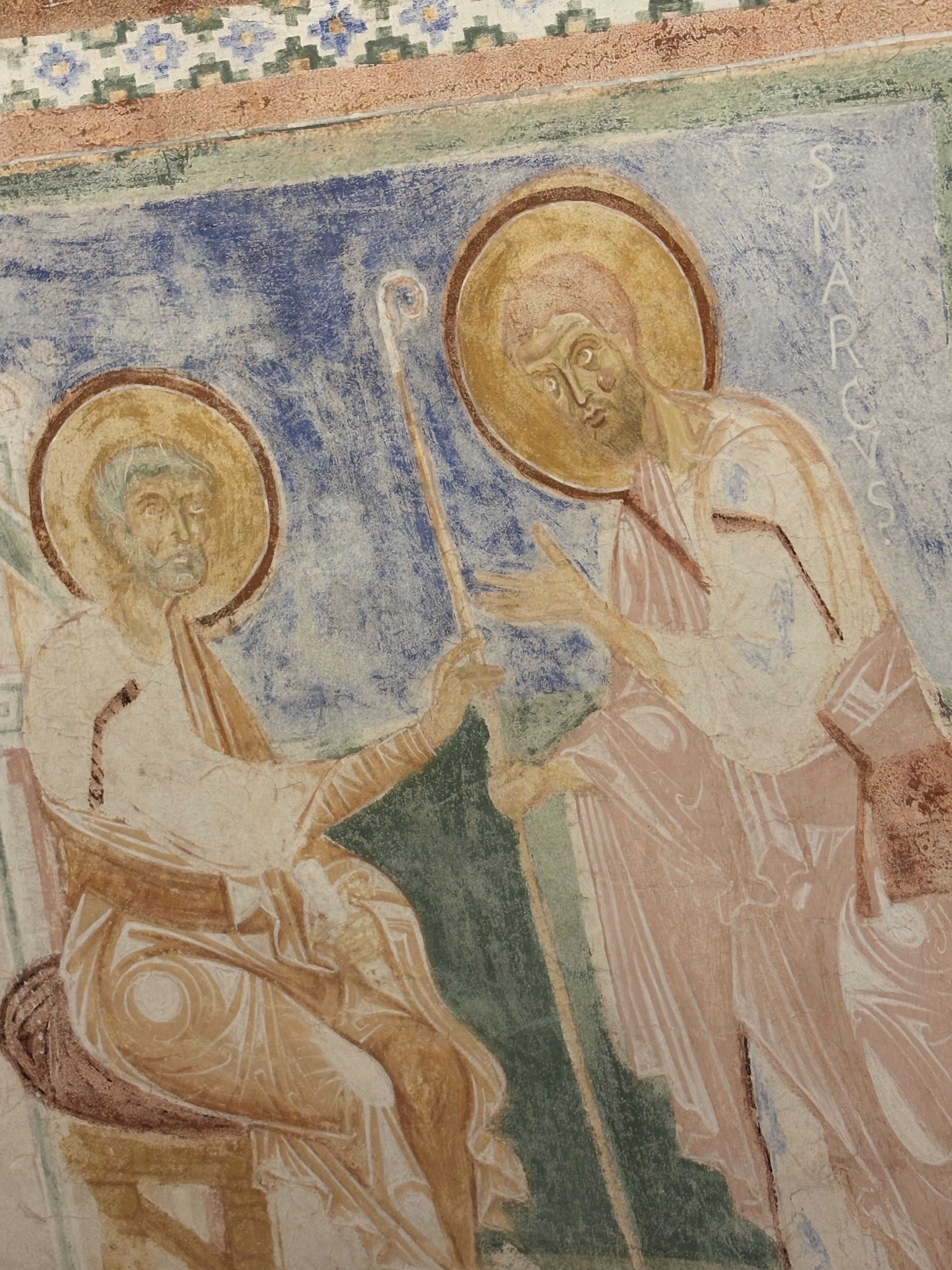
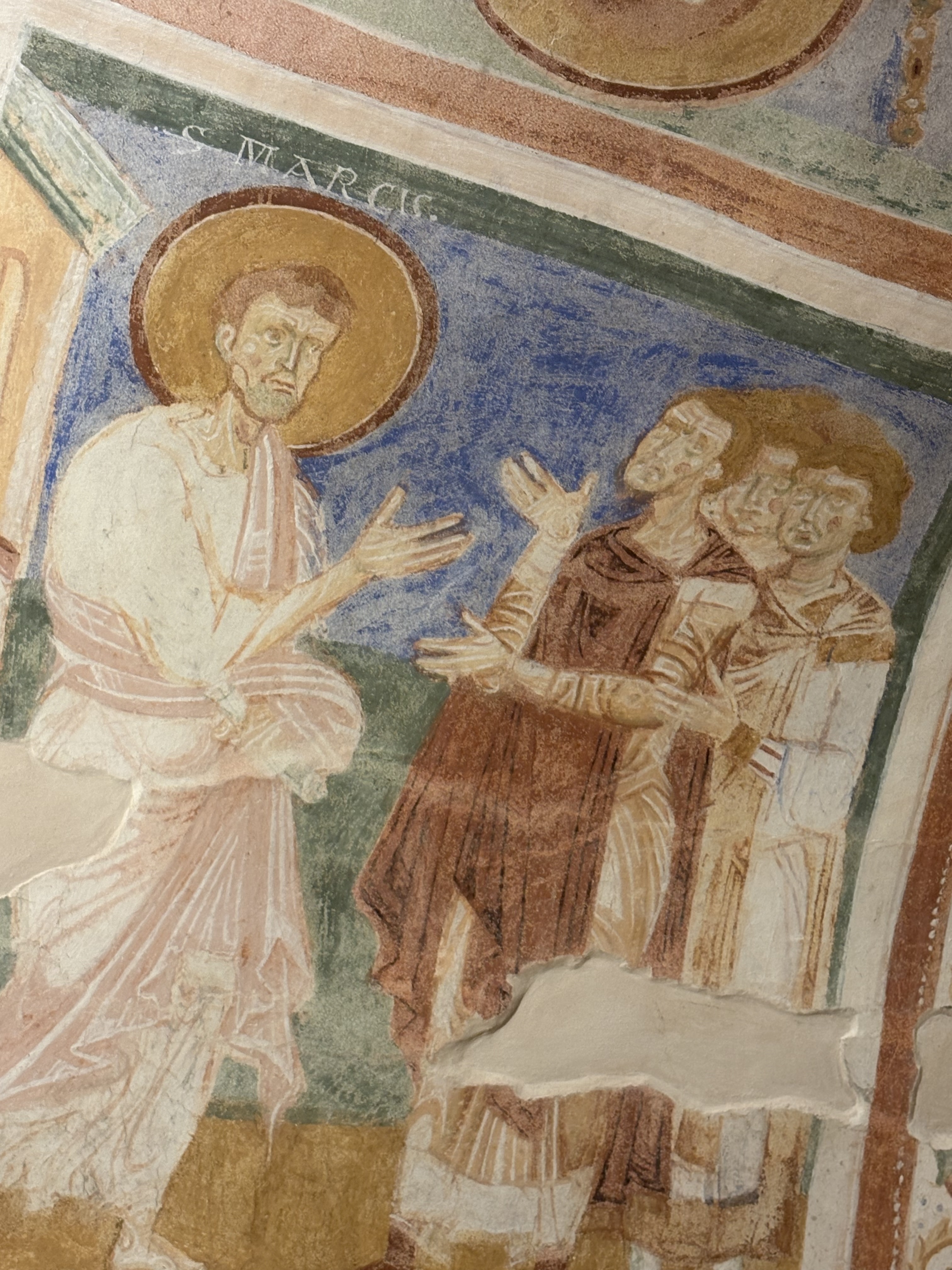
“We preserve extraordinary medieval frescoes in the basilica depicting St. Mark arriving here to found the city’s first Christian community. That is why we believe he truly came to Aquileia,” Aquileia tour guide Anna Sairu told “EWTN Noticias,” the Spanish-language broadcast edition of EWTN News.
The codex that became a relic
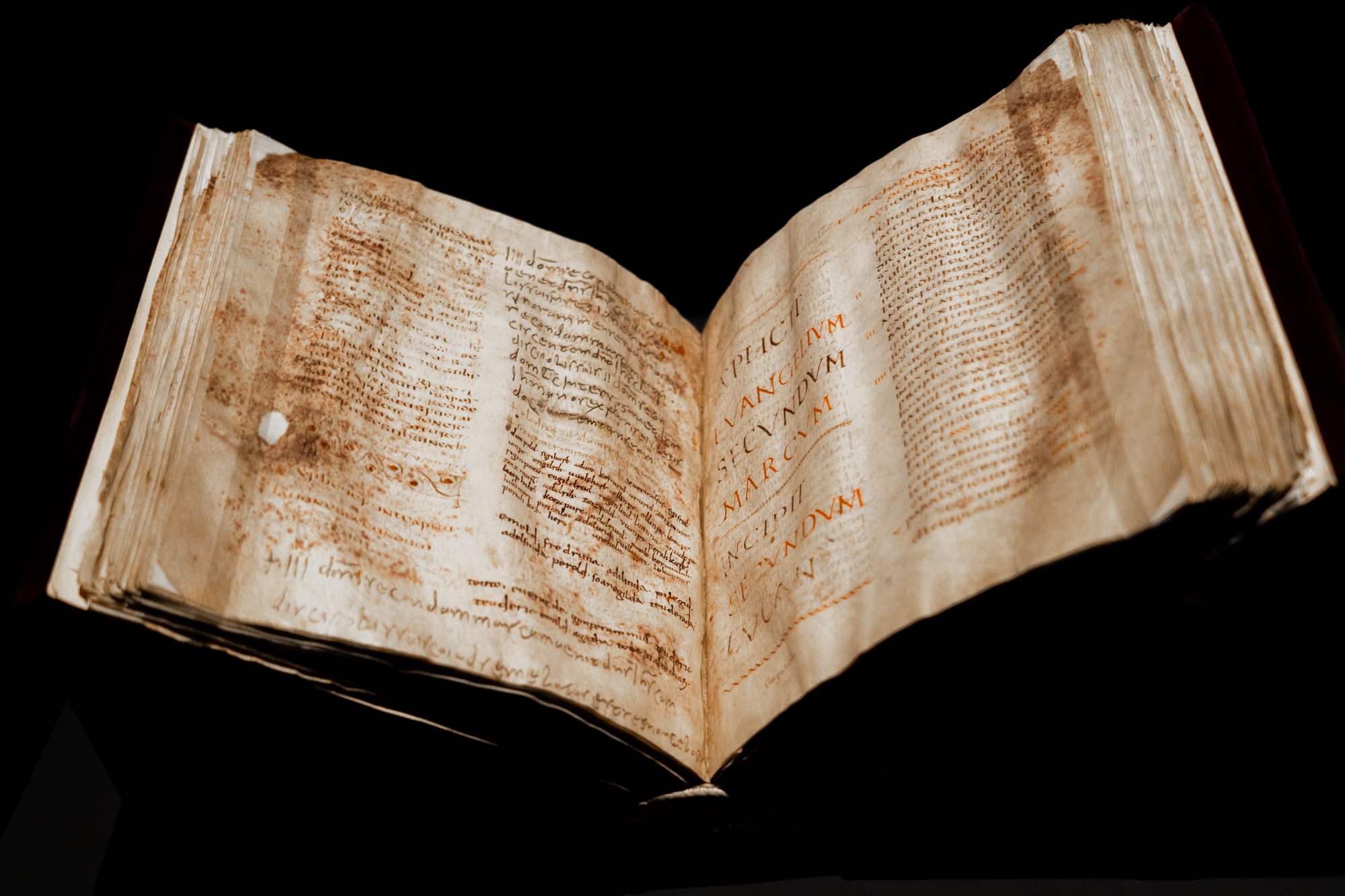
One of the principal witnesses to this tradition is the “Codex Forojuliensis,” also known as the “Cividale Gospel Book.” The sixth-century manuscript, written in uncial script, the calligraphy reserved for sacred texts, originally contained all four Gospels in St. Jerome’s Latin translation.
Scholars believe it was most likely produced in Ravenna, Italy. From there it arrived in Aquileia during the second half of the ninth century, where it was authenticated by the signature of Theodemar, patriarch of Aquileia.
The presence of the codex strengthened the tradition linking St. Mark to the evangelization of the region. Its significance became so great that in 827 the Synod of Mantua recognized Aquileia’s ecclesiastical supremacy over Grado.
Venice looked with suspicion on the growing religious prestige of its neighbor. Just a year later, in 828, Venetian merchants brought the relics attributed to the evangelist from Alexandria to the city on the lagoon. In doing so, “The Most Serene Republic” of Venice gained a patron of apostolic rank and strengthened the religious and political foundations of its power.
Basilica of Aquileia, home to the largest and best preserved early Christian mosaic in the Western world. | Credit: Courtesy of Tseng Kuang Yi
The fragmented Gospel
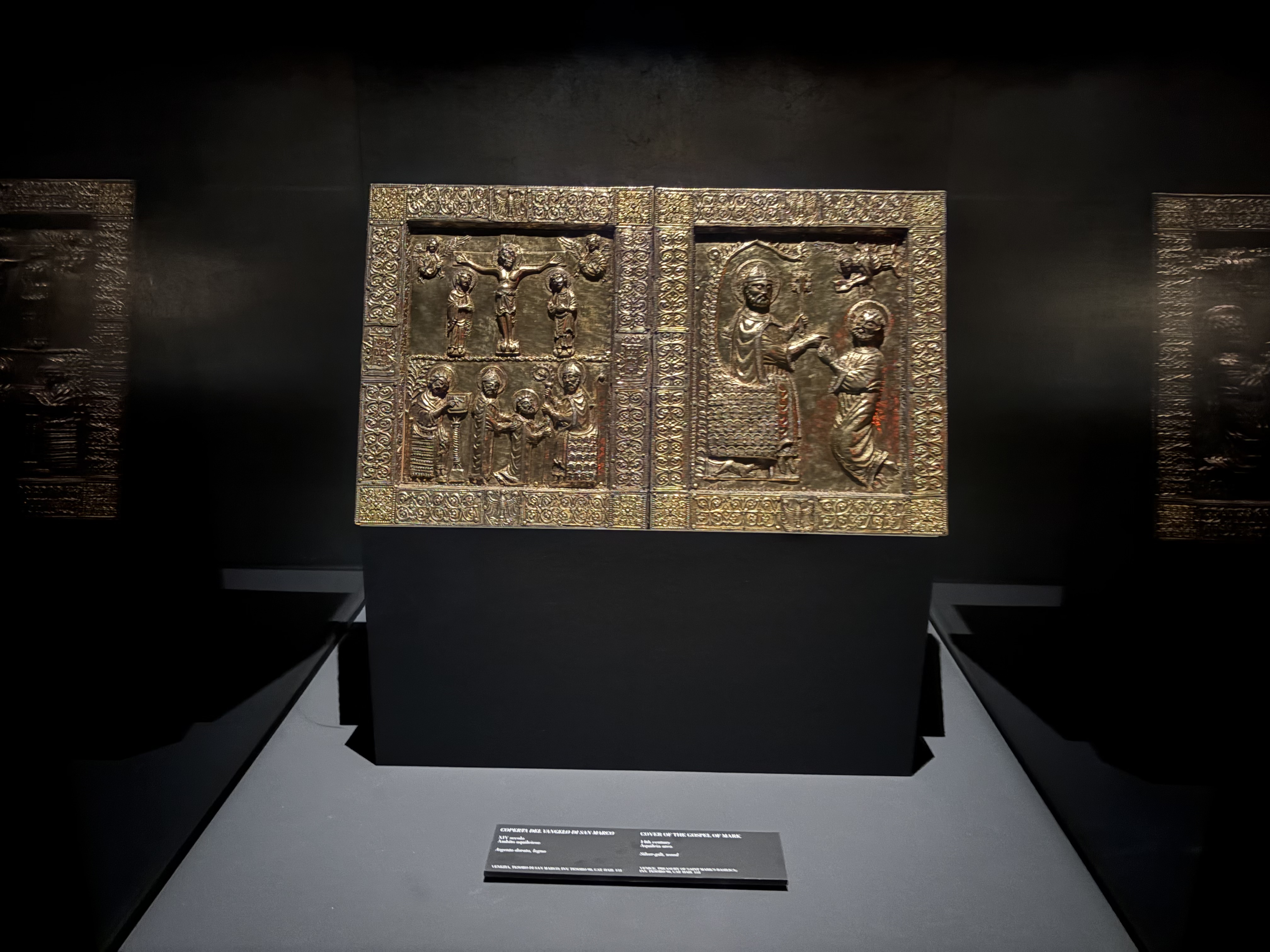
Between the 12th and 13th centuries, the seven quires — folded sheets of paper stitched into booklets — containing the Gospel of Mark were separated from the rest of the codex, rebound independently, and covered with an elaborate gilded silver binding that transformed the book into an object of veneration resembling a reliquary.
From that point on, the manuscript ceased to be viewed as merely an ancient copy and began to be regarded as an autograph written by St. Mark himself. Medieval inventories of the Patriarchal Treasury of Aquileia reflect this belief.
“The Gospel was fragmented when it was removed from the Gospel book containing all four Gospels and began to be regarded as an autograph of the evangelist himself. This is connected to the tradition that St. Mark evangelized this region of Italy, Aquileia, and its surrounding territory. During the 12th and 13th centuries, the Gospel of Mark acquired a life of its own and came to be regarded as an extraordinary relic,” Cristiano Tiussi, director of the Aquileia Foundation and curator of the exhibition, told “EWTN Noticias.”
The emperor who wanted a piece of St. Mark
The fame of the supposed authentic Gospel of St. Mark quickly spread across Europe. In 1354, while traveling to Rome to receive the imperial crown, Charles IV of Luxembourg stopped in Aquileia. At the time, his half-brother, Nicholas of Luxembourg, served as patriarch there.
Gilded silver cover that helped transform the medieval Codex of the Gospel of St. Mark into an object of veneration similar to a reliquary. | Credit: Victoria Cardiel/EWTN News
The emperor requested part of the revered manuscript and received two of the seven quires that comprised the Gospel of Mark. Those pages were taken to Prague, where they were deposited in St. Vitus Cathedral alongside the relics of St. Wenceslaus. Over the centuries, they became the oldest written document preserved in Czech libraries.
The exhibition even displays the original documents recording Charles IV’s request to the patriarch of Aquileia.
“Possessing part of the Gospel of St. Mark meant owning not only a religious relic but also a symbol of prestige, legitimacy, and power,” Tiussi noted.
The conquest of Venice
The remainder of the manuscript remained in Aquileia until May 30, 1420, when Doge Tommaso Mocenigo conquered the city. Venice then claimed the remaining fragments, arguing that they belonged beside the evangelist’s tomb in the Basilica of St. Mark.
Their transfer symbolized Aquileia’s definitive incorporation into the Venetian sphere.
The gesture also carried an unmistakable political significance. If Venice had claimed custody of the evangelist’s body since 828, it now also acquired part of the manuscript believed by tradition to have been written by his hand.
As a result, the Gospel of Mark became permanently divided among the cities of Cividale del Friuli, Venice, and Prague.
For the manuscript itself, however, the consequences proved devastating. Humidity from the Venetian lagoon gradually damaged the pages until they became almost illegible. Today, those remnants are preserved in a reliquary display case within the Treasury of St. Mark.
One of the fragments of the sixth-century manuscript venerated as a relic, attributed to the authorship of the Evangelist St. Mark. | Credit: Courtesy of Tseng Kuang Yi
A medieval Facebook
The exhibition offers visitors a second surprise. Before it was dismantled, the manuscript served as a “Liber Vitae,” or “Book of the Living.” More than 1,500 names were entered into its pages by people who wished to be remembered in the prayers of the monastic community that safeguarded the codex.
“This is one of the features that makes this Gospel book exceptional. In Italy, we know of only two Carolingian-era ‘libri vitae.’ This is one of them. These inscriptions, written in a hand different from the original uncial script, were initially simple liturgical annotations. They are notes written on the Gospel between the seventh and eighth centuries indicating which passages should be read during particular periods of the year or providing other instructions for the book’s liturgical use,” said Luca Villa, another curator of the exhibition.
Beginning in the second half of the ninth century, the names of benefactors, nobles, pilgrims, and distinguished visitors were added.
Among them were figures as notable as Emperor Louis II the Younger and his wife Engelberga, the Moravian prince Svatopluk, and envoys from the newly Christianized Kingdom of Bulgaria.
“There are more than 1,500 important figures who wrote their names in the Gospel, not merely to leave a record of themselves but because they believed that by doing so they would share in the liturgical celebrations every time the book was used in the church where it was kept,” Villa told “EWTN Noticias.”
For historians, these lists provide an extraordinary window into medieval Europe. They reveal a network of contacts, pilgrimages, and cultural exchanges linking distant regions centuries before the emergence of modern nation-states.
A European story
Now, for the first time in roughly 700 years, the three surviving portions of the Gospel have been reunited.
Fresco of St. Mark in the Basilica of Aquileia. | Credit: Victoria Cardiel/EWTN News
The quires preserved in Prague have left the Czech Republic for the first time. The fragments kept in Venice have temporarily departed St. Mark’s Basilica. Together with the pages preserved in Friuli, they reconstruct a story that had remained fragmented since the Middle Ages.
Czech curator Martina Dlabajová said she believes the reunion also symbolizes the very essence of Europe.
“What is beautiful is that, while acknowledging that each fragment has had a different history and followed a different path, by bringing them together we have chosen to embrace that shared history. That is why the exhibition’s title speaks of ‘Seven Centuries, Three Fragments, One European Story,’ because the three fragments never ceased to be part of a common narrative, and that narrative is a European one,” she explained.
“I also like to emphasize that Europe itself should recognize differences, accept that distinct histories exist, and understand that those different histories from various countries enrich our shared history,” she added in comments to “EWTN Noticias.”
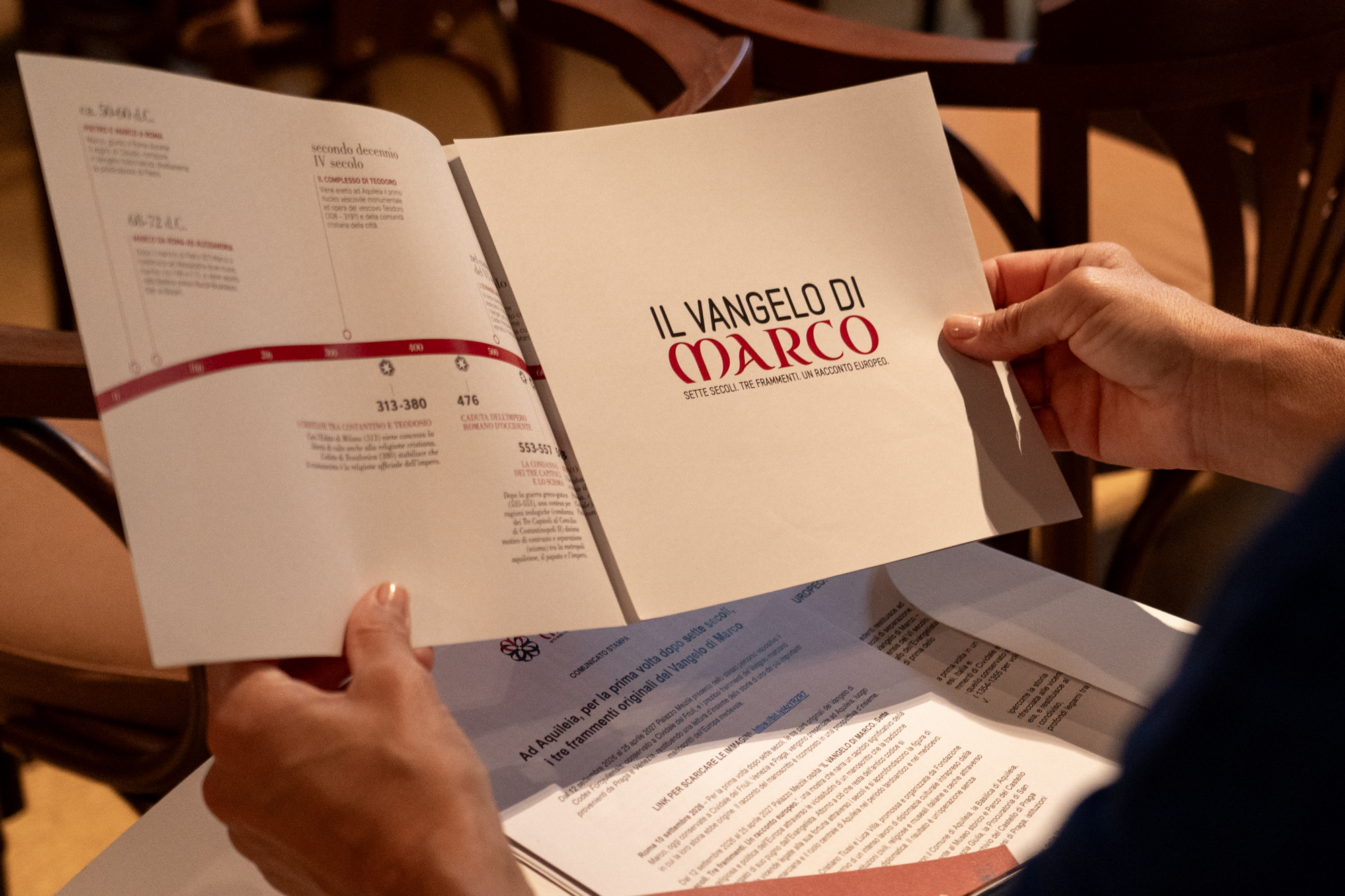
An information booklet for the exhibit “The Gospel of Mark: Seven Centuries. Three Fragments. One European Story,” open to visitors until April 25, 2027. | Credit: Photo courtesy of Tseng Kuang Yi
The exhibition, “The Gospel of Mark: Seven Centuries. Three Fragments. One European Story,” will remain open through April 2027. Due to the fragility of the parchment, however, restrictions are necessary. The original manuscripts will be on display only during the exhibition’s first six weeks. They will then be replaced by high-resolution digital reproductions.
This report was made possible thanks to the support of the Aquileia Foundation.
This story was first published by ACI Prensa, the Spanish-language sister service of EWTN News. It has been translated and adapted by EWTN News English.
Pope Leo XIV flies to France on Friday, where across four days in three cities he will proclaim Catholic teaching to the heart of secular Europe on matters that include end-of-life questions, immigration, and artificial intelligence.
The visit “will truly be a moment in which Leo’s project of making the Church’s social doctrine better known can take shape,” said Father Patrick Valdrini, a former rector of the Institut Catholique de Paris.
France is statistically more secular than it was in 2008, when Pope Benedict XVI made a pastoral visit to the country. The latest data on religious identity in France, in 2019-2020, found that 51% of adults in France say they have no religious affiliation, an 8% increase from a decade before. While 29% of the population identifies as Catholic, the survey found only 8% say they go to Church regularly, according to the Institut National D’Etudes Démographiques.
Yet according to Cyprien Viet, a journalist with the French agency I.Media, the country has become more open to Catholicism in recent years. The reasons for this shift include sympathy for Christianity following attacks on churches and the 2016 killing by Islamist terrorists of Father Jacques Hamel, enhanced appreciation for France’s Christian heritage after the 2019 burning of Notre-Dame Cathedral, and gratitude for the Church’s charitable service during the COVID-19 pandemic.
More recently, “Pope Leo’s encyclical on artificial intelligence [Magnifica Humanitas] has had a fairly strong impact in France, and people recognize that there is a need to explore these issues more deeply. The pope is helping greatly in providing points of reference,” Viet said.
The challenge of laïcité
During his Sept. 25–28 visits to Paris, Lourdes, and Metz, Leo’s approach to sharing the Catholic Church’s teaching on political and social issues will draw wide attention, not least because of France’s tradition of “laïcité,” a strict legal separation of Church and state.
This policy has always involved a certain distrust, even hostility, toward the idea that faith can contribute something good to society, Valdrini said.
“The concept of ‘laïcité’ emerged especially during the French Revolution, rooted in the view that religion hinders freedom and reason, that it is something burdensome rather than liberating,” he said.
Among the most sensitive issues that the pope is expected to address are end-of-life questions. France legalized assisted suicide and euthanasia this summer, becoming the fifth European country to do so after Belgium, the Netherlands, Luxembourg, and Spain. In addition, Switzerland and Austria permit assisted suicide.
Euthanasia is the intentional ending of a person’s life to relieve suffering. It differs from assisted dying, in which the patient takes life-ending drugs himself, under a physician’s guidance. Both practices are prohibited by Catholic teaching.
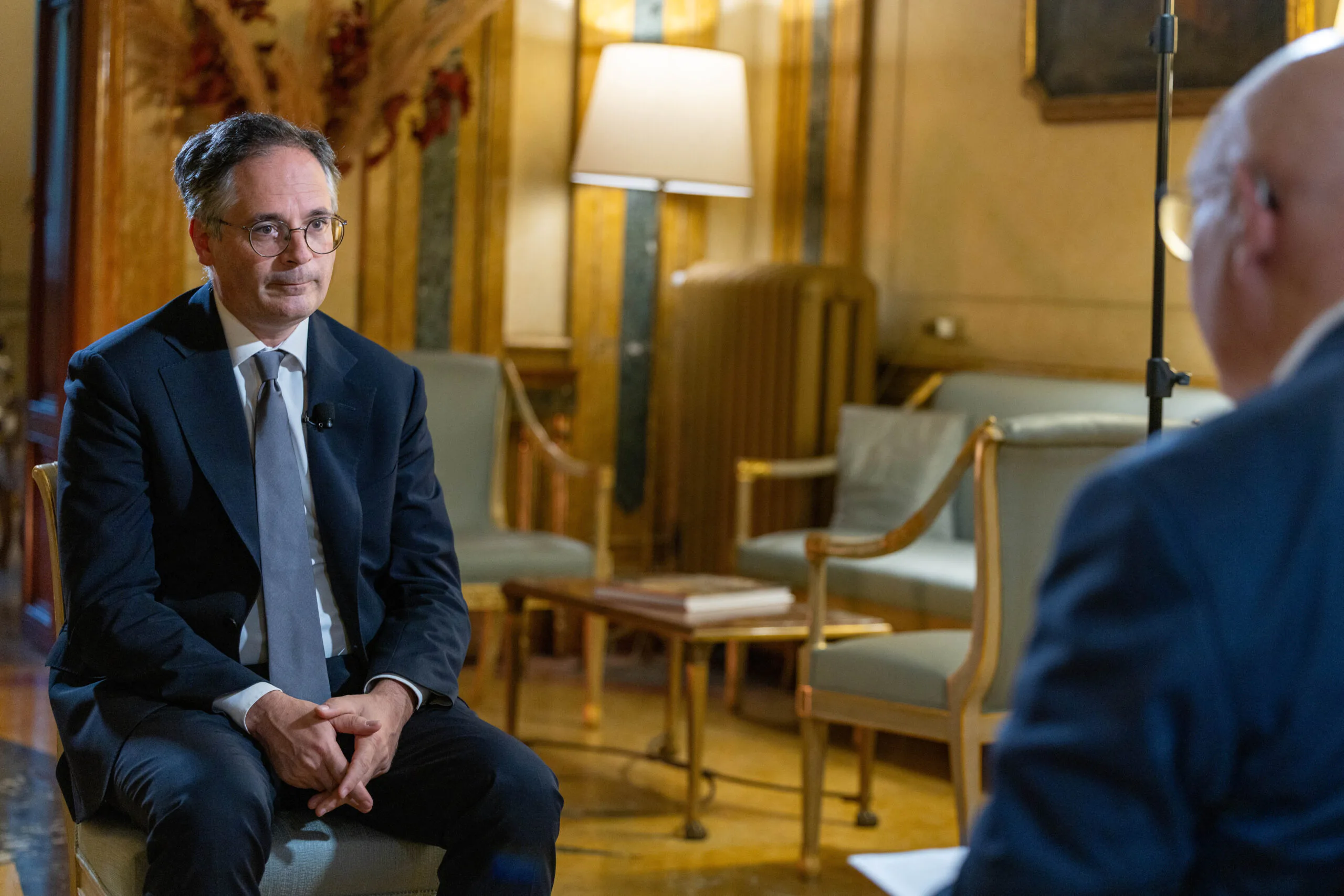
Francis X. Rocca, Vatican editor of EWTN News, interviews Charles Personnaz, French ambassador to the Holy See, at his offices in Rome on Sept. 10, 2026. | Credit: Daniel Ibanez/EWTN News
Charles Personnaz, France’s ambassador to the Holy See, says he expects the pope to speak out on the issue but to leave the political debate to the French bishops, who were already outspoken in their vigorous condemnation of the euthanasia bill before it passed in July.
“I think the pope will certainly repeat what is the Catholic doctrine: the preservation of life from the beginning to … the natural end,” the ambassador said. “But he will also leave to … the French Catholic Church the debate with the political parties in France and the institutions. That is the subsidiarity that is at the heart of Catholic doctrine as well.”
A message about human dignity
On a visit to the Sanctuary of Our Lady of Lourdes, Pope Leo is expected to deliver a message about the inherent dignity of every human person, even when suffering from illness or disability.
Meeting and praying with the sick and vulnerable at one of the most visited Catholic shrines in the world, the Holy Father will give a concrete sign of faith in the value of every human life.
At the shrine he will also meet privately with victims of abuse in the Catholic Church in France and with the country’s bishops.
The Massabielle Grotto in Lourdes, France. | Credit: Christian Pablo Inglize/Shutterstock
Leo is expected to address the global challenges posed by artificial intelligence when he speaks at the headquarters of UNESCO, the United Nations Educational, Scientific, and Cultural Organization, in Paris on Sept. 25. On his last day, he will reflect on interreligious dialogue and the future of Europe at meetings in Metz.
The pope’s visit to a migrant integration center run by the Archdiocese of Paris will touch on one of the most volatile political issues in Europe and beyond, and one closely tied to next year’s presidential election in France, in which the anti-immigration politician Marine Le Pen is the current frontrunner.
Personnaz said he expects the pope’s comments on immigration to be well received, calling the pontiff’s previous statements on the topic “very balanced” with a focus on the responsibility of nations to help people stay in their homeland.
State visit or apostolic journey?
Pope Francis visited France three times during his pontificate, but Leo will be making the first state visit by a pope to France since Benedict XVI’s apostolic journey in 2008.
The French Catholic newspaper La Croix has reported that the Holy See has refused some requests by the government, including a proposal that President Emmanuel Macron accompany the pontiff into Notre-Dame Cathedral for a prayer service on Sept. 25. The Holy See Press Office and the Élysée Palace, the official residence and office of the French president, did not respond to requests for comment on the report.
Notre-Dame Cathedral in Paris. | Credit: Mistervlad/Shutterstock
According to Valdrini, Leo is following in the tradition of St. Paul VI, who sought to emphasize the pastoral character of his travel — the visit to a local Church by the successor of Peter — rather than his role as a head of state.
“It will still be a state visit, and there will be official ceremonies, but it is clear that the pope wanted to emphasize, as previous popes did, this [apostolic] dimension of the journey,” Valdrini said.
Catholicism grows
Despite a lack of religious practice in France, enthusiasm for Pope Leo’s visit is high, as demonstrated by the response to his events with the public in France’s capital.
Adolescents and young adults have snapped up tickets for a prayer vigil in the 81,000-seat Stade de France and an open-air Mass in Place de la Concorde. Paris’ largest public square may draw some of the biggest crowds of his pontificate thus far, with 600,000 people expected to fill the square and a nearly two-mile stretch of avenue connecting to the Arc de Triomphe. This enthusiasm is also reflected in an atypical outpouring of donations to the dioceses to cover organizational costs.
Leo will address France’s Catholics at a critical juncture in their history, as they welcome rising numbers of converts. He is likely to encourage the nation traditionally known as “the eldest daughter of the Church” to rediscover her Catholic roots.
This Easter, France recorded more than 20,000 adult and adolescent baptisms, a 20% increase from the already record-high number in 2025, which saw a 45% increase from 2024 figures.
The phenomenon has prompted the bishops of Île de France, the ecclesiastical region that includes the Archdiocese of Paris, to convene a special council on how to respond to the huge influx of Catholic converts.
“Today people have not inherited their faith … and so they are kind of ignorant about the Catholic heritage,” Personnaz said. “But when they discover it, they have no prejudices about it. And in a world where the youth are searching for a sense to [their] life, the Catholic proposal remains very interesting.”
Francis X. Rocca and Victoria Cardiel contributed to this report.
John Cavadini, a professor of patristic theology at the University of Notre Dame, will receive the 2026 Ratzinger Prize.
The Vatican Foundation Joseph Ratzinger-Benedict XVI announced Cavadini as the winner of the prestigious award at a press briefing in Rome on Sept. 22. The foundation also said Pope Leo XIV will present the award to Cavadini on Dec. 19 at the Apostolic Palace in the Vatican.
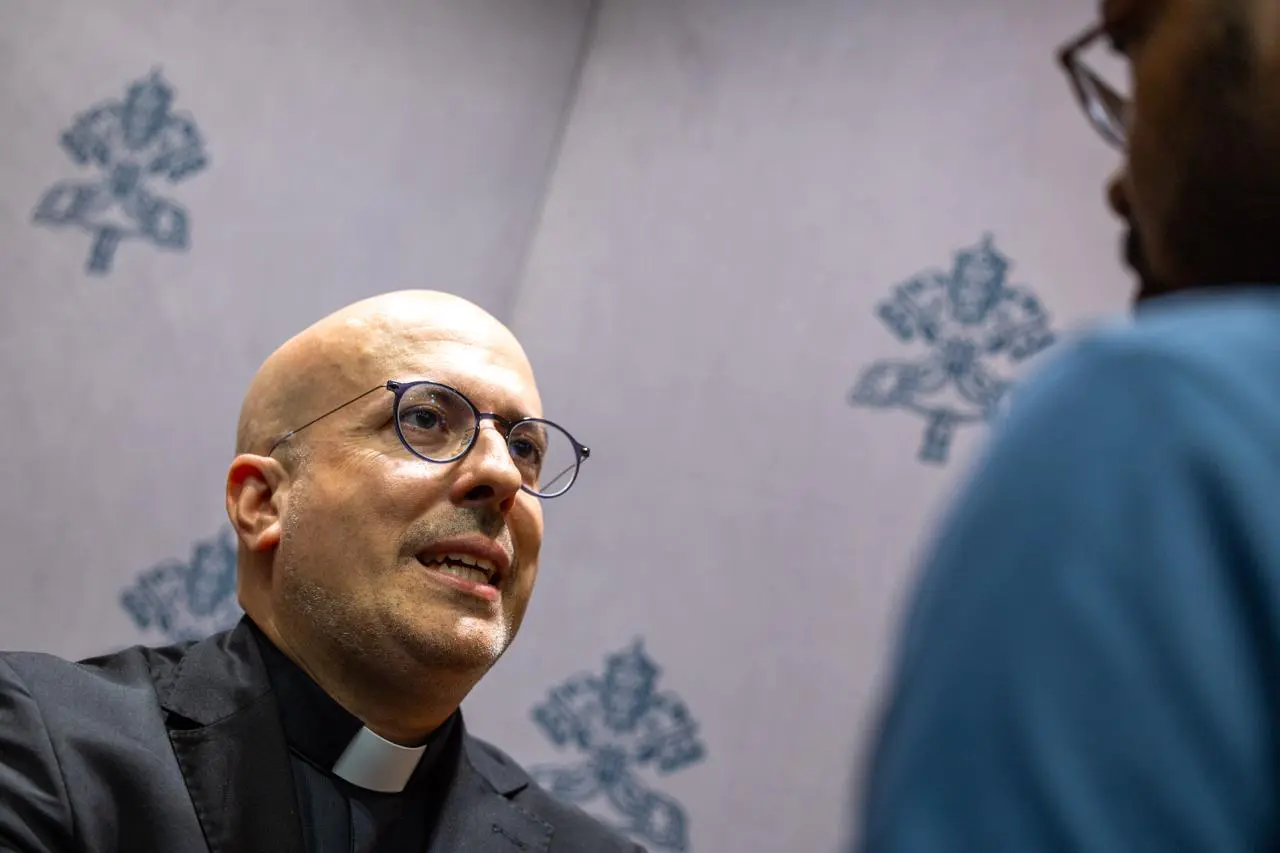
Present to announce the winner on Sept. 22 at the Holy See Press Office were Father Roberto Regoli, president of the Vatican Foundation Joseph Ratzinger-Benedict XVI, and Pierluca Azzaro, secretary of the foundation.
Cavadini will also be the third faculty member from the University of Notre Dame to receive the award, following Cyril O’Regan (2024) and Jesuit Father Brian E. Daley (2012). Since the award was established in 2011, the university has had the most winners of any institution.
In a press release from the foundation, Cavadini expressed gratitude for the award, saying he sought to conduct his theology “as a man of the Church and, at the same time, as a man of academia.”
The unique contributions of American theologians
Cavadini has been affiliated with the University of Notre Dame since joining its faculty of theology in 1990. He also served as the director of the McGrath Institute for Church Life from 2000–2026.
His research and teaching have focused on the theology of St. Augustine, an influential figure of the patristic era.
Regoli praised Cavadini’s work for the “rigor of his theological publications, his commitment and zeal in university teaching.” Speaking to EWTN News on the sidelines of Tuesday’s press conference, he noted the unique contributions of theologians hailing from the United States.
Father Roberto Regoli, president of the Vatican Foundation Joseph Ratzinger-Benedict XVI, speaks to EWTN News at the Holy See Press Office in Rome on Sept. 22, 2026. | Credit: Daniel Ibañez/EWTN News
“Undoubtedly, the cultural debates in the United States of America do not concern only America; they are followed around the rest of the world,” Regoli told EWTN News. “Our cultural traditions have been more influenced by the thought of the United States of America, and for this reason it is important to look toward the Anglo-Saxon world, because in the different fields of science it has taken on a leadership role for several decades.”
The renewed interest in the theology of Joseph Ratzinger
The 2026 Ratzinger Prize is part of numerous initiatives to commemorate the 100th anniversary of the birth of Joseph Ratzinger, who was later elected Pope Benedict XVI, in 2027.
Pope Benedict XVI. | Credit: L’Osservatore Romano
Regoli also noted the renewed academic interest worldwide in Ratzinger’s life and theological legacy ahead of the anniversary year.
“The legacy of Ratzinger speaks for itself,” Regoli told journalists on the sidelines.
“If we look around us at an international level, even in recent years, Ratzinger chairs have been born everywhere: in Europe, in the United States, in Latin America, and in Africa. Many doctoral theses on him, books on him, or his books continue to be edited; they are numerous, and even for the centenary, many more will come out,” Regoli added.
One of the foundation’s focuses during the anniversary year will be Ratzinger’s legacy in Africa, with Azzaro telling EWTN News that, as pope, Ratzinger “strongly believed that Africa had the spiritual reserves necessary for the West to flourish again.”
For the first time, a pope will witness an exposition of the Holy Tunic, the garment worn by Christ during his passion, which is preserved in the Basilica of Saint-Denis in Argenteuil, France.
The special relic is put on display during regular expositions every 50 years, as well as on extraordinary occasions — the most recent being in 2023 — but it has never before been brought before a pope.
Pope Leo XIV will be able to view it on Sept. 25, when it is displayed at the conclusion of the youth vigil at a soccer stadium in a suburb north of Paris, part of the packed schedule for his trip to France.
More than 80,000 French young people have registered for the prayer vigil at the Stade de France, and according to Father Guy-Emmanuel Cariot, former rector of the basilica of Argenteuil, Leo is the first pope to see the tunic since the time of St. Peter.
That may be an exaggeration, but it is true that there has never before been an extraordinary exposition of the relic during a papal journey and in the presence of a pontiff. That will happen during this trip, in part because only 3.7 miles separate the basilica of Argenteuil from the Stade de France.
The tunic will travel those nearly four miles under extremely tight security measures, made even stricter by memories of the theft of the tunic in 1983, when the relic disappeared for a couple of months. For that reason, the route the tunic will take is being kept confidential. It is known, however, that there will be surveillance both on the ground and from above to ensure that the transfer takes place discreetly and under optimal security conditions.
The tunic has been kept in Argenteuil for more than 1,200 years and is one of several relics of Christ’s passion preserved in France. The Crown of Thorns is kept at Notre-Dame Cathedral in Paris, while the Holy Headcloth of Jesus is preserved in Cahors.
As for the Holy Tunic itself, it was mentioned in Gregory of Tours’ sixth-century work “Liber in Gloria Martyrum Beatorum” (“The Glory of the Martyrs and the Blessed”). The book notes that Jesus’ seamless tunic was kept in Galata, in a church dedicated to the holy archangels, about 120 miles from Constantinople. The seventh-century “Chronicle of Fredegar,” however, locates the tunic in Zafad, not far from Jerusalem.
The tunic later came into the possession of the Byzantine Empress Irene, who gave it to Charlemagne in the year 800 on the occasion of his coronation as the first emperor of the Holy Roman Empire. Charlemagne in turn donated it to the monastery of Argenteuil, whose abbess was his daughter Theodrada. The “Charta Hugonis” of 1156 notes that the tunic had long been kept in the basilica of Argenteuil.
Over the centuries, the tunic was hidden to protect it from the Normans and later from the Huguenots. During the French Revolution, in order to save it from anticlerical persecution, Father Ozot, pastor of Argenteuil, had it cut into pieces and hidden. It was eventually reassembled, although some portions were lost.
Other pieces of the tunic are preserved elsewhere. One example is the so-called “Tunic of Trier” in Germany, which has appeared in historical records since 1072 and is believed to be one of the relics brought back from the Holy Land by St. Helena. However, scholars have been unable to determine its origin and age because of its poor state of preservation and the extensive repairs it has undergone over the centuries.
This story was first published by ACI Stampa, the Italian-language sister service of EWTN News. It has been translated and adapted by EWTN News English.