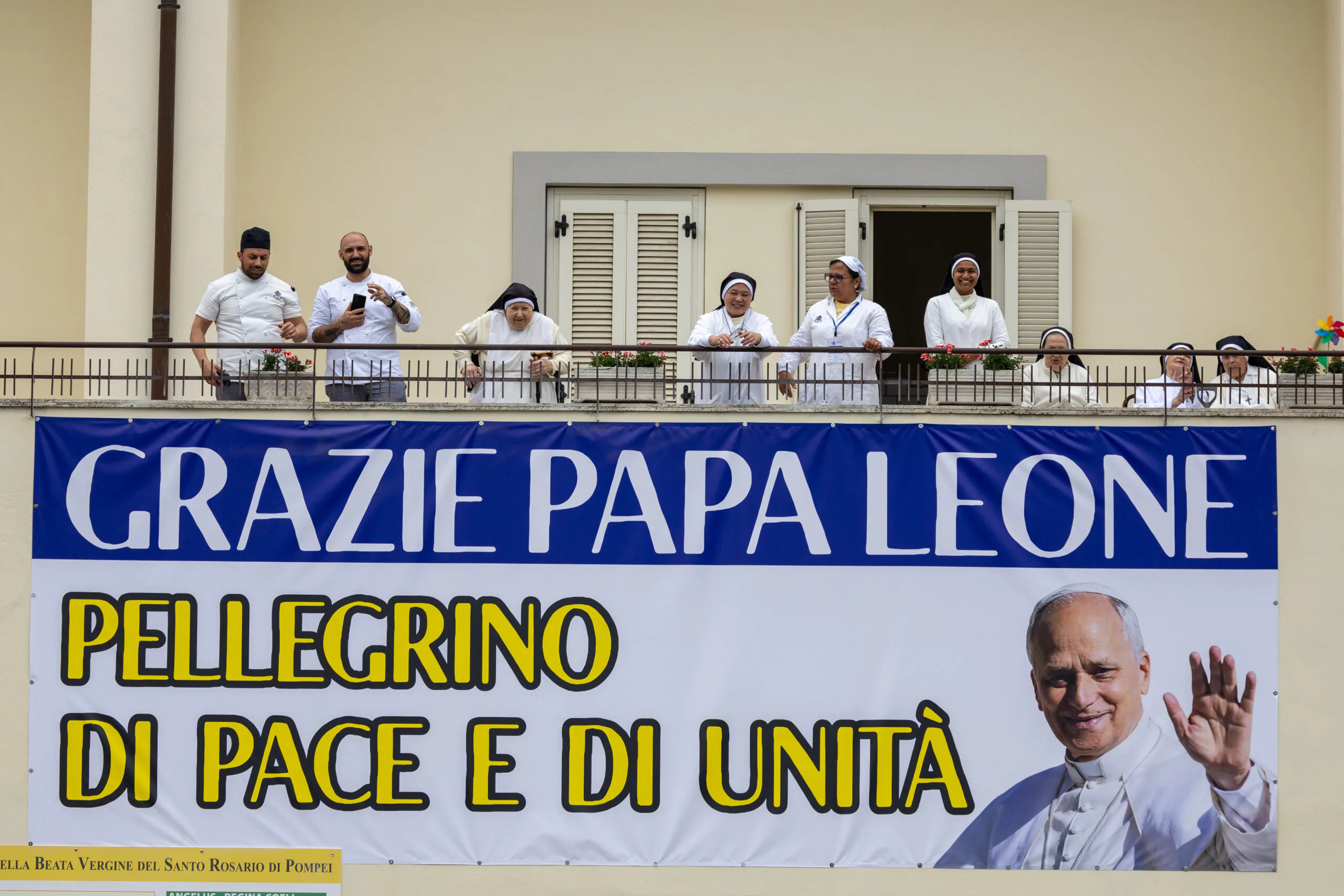
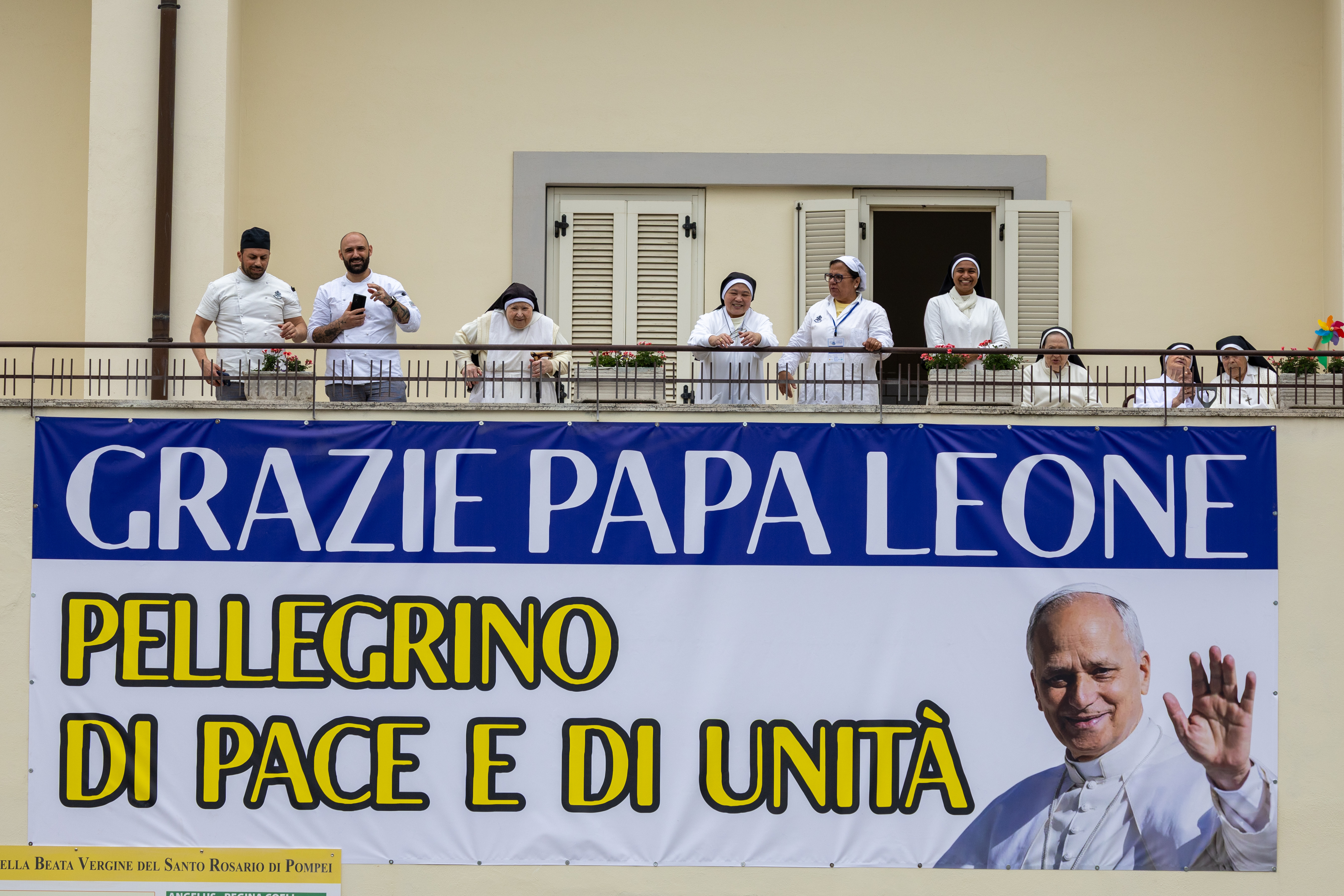
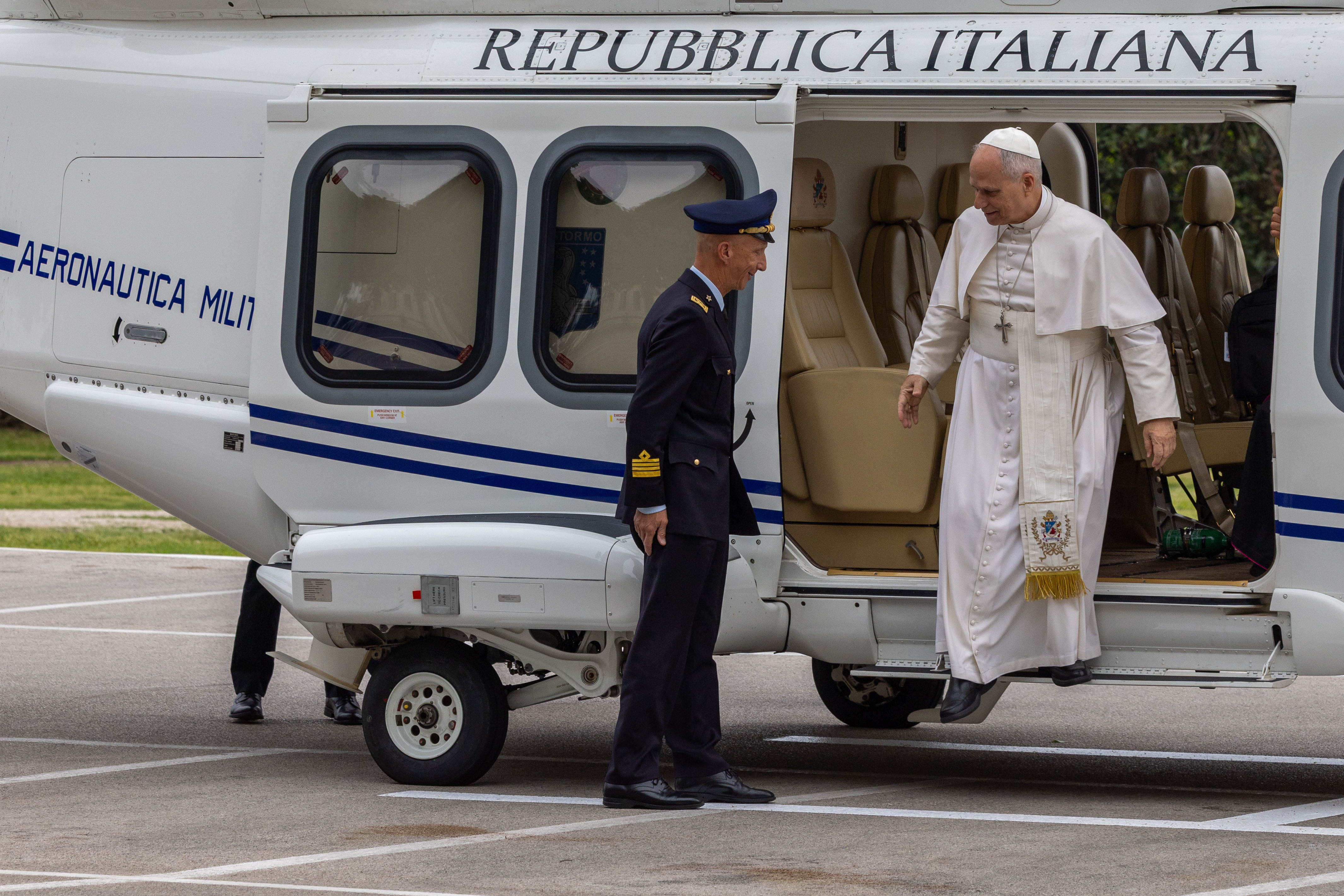
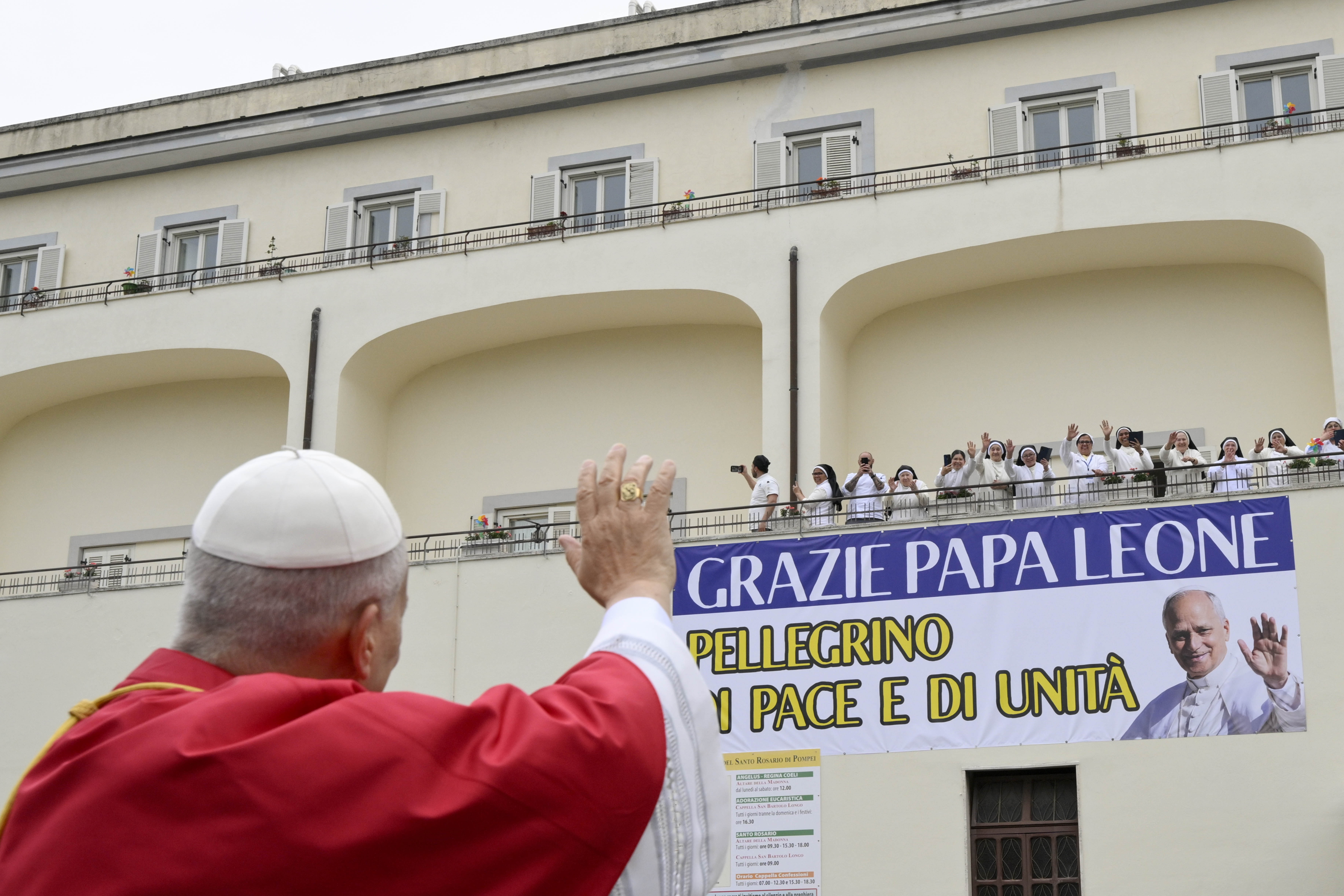
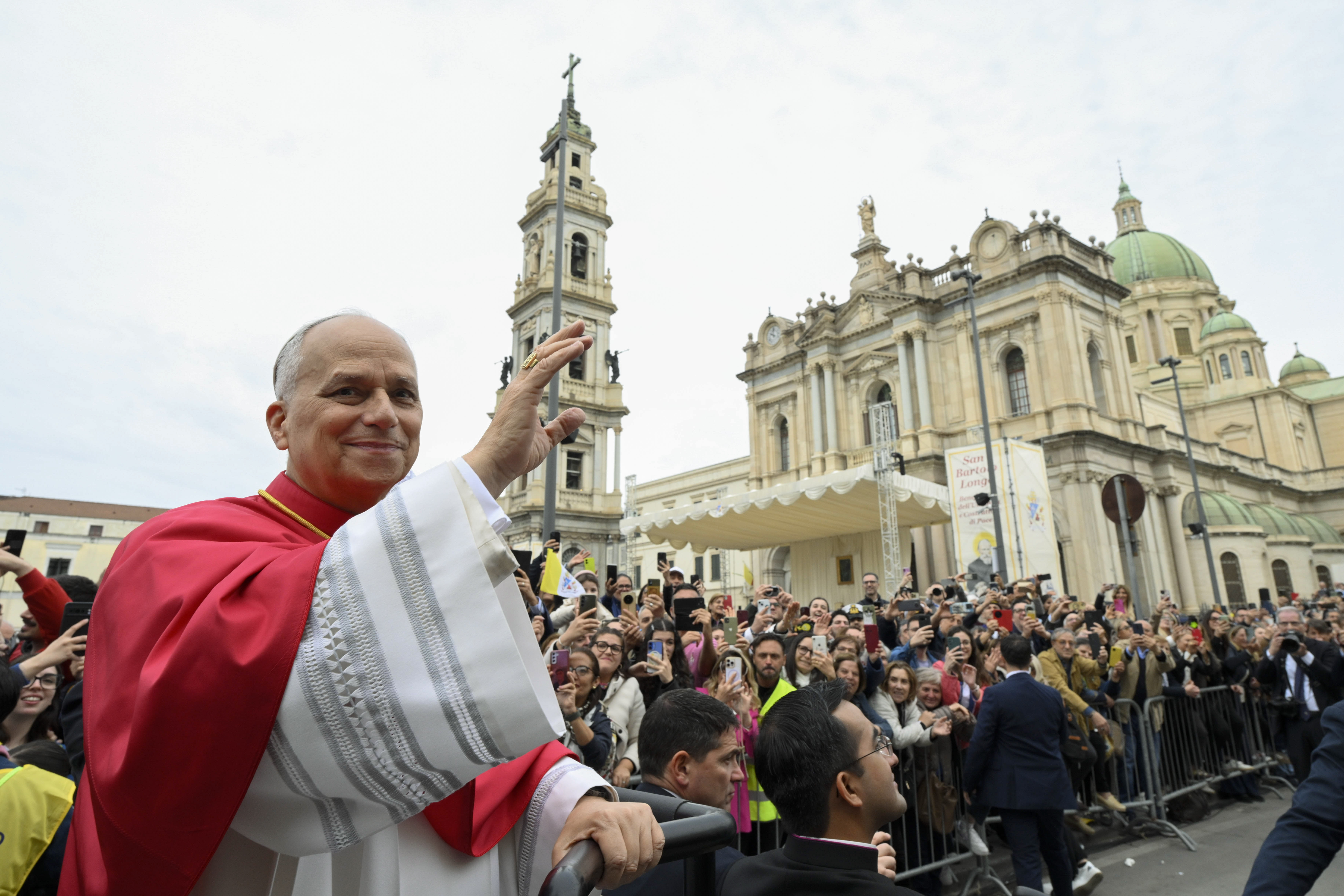
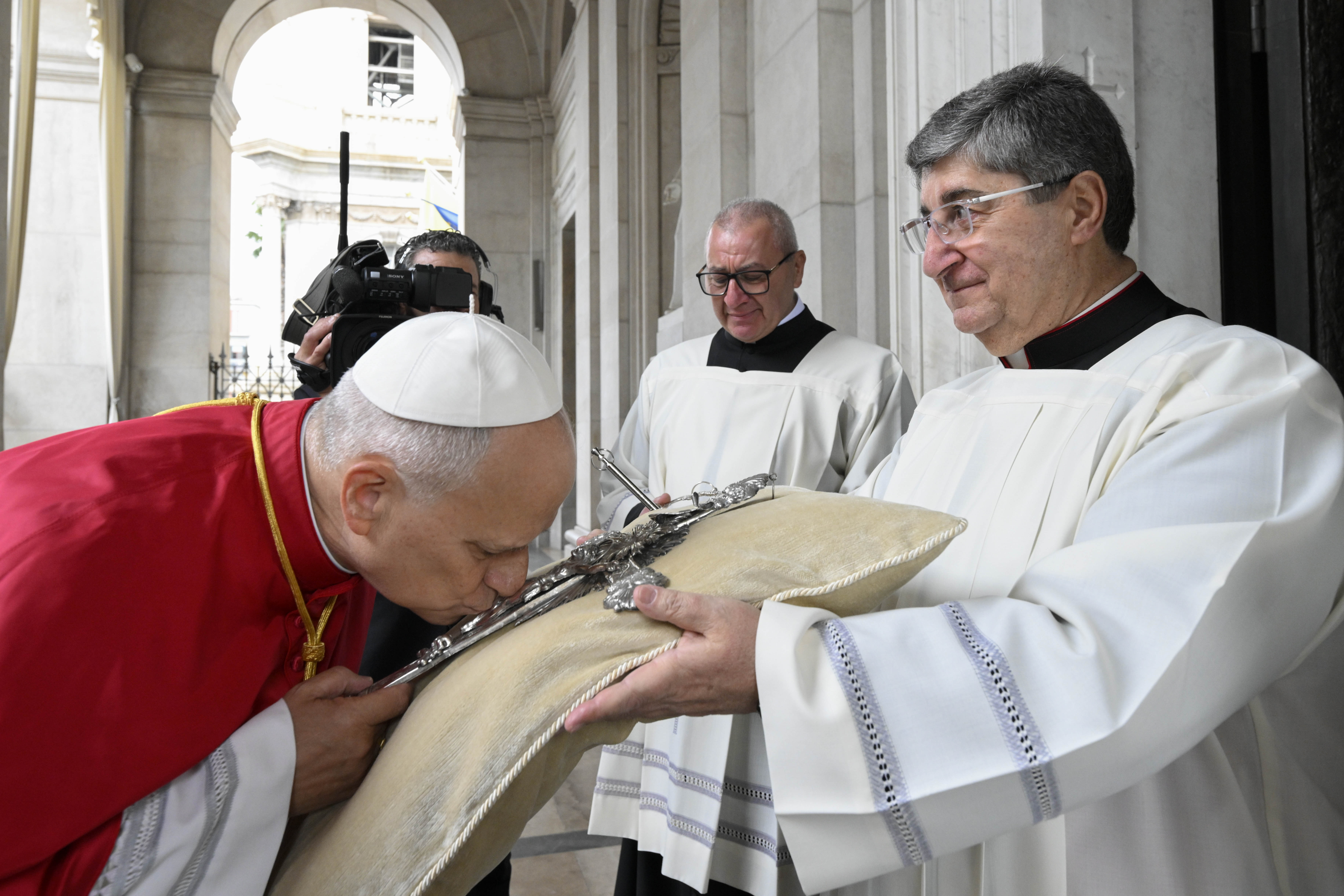
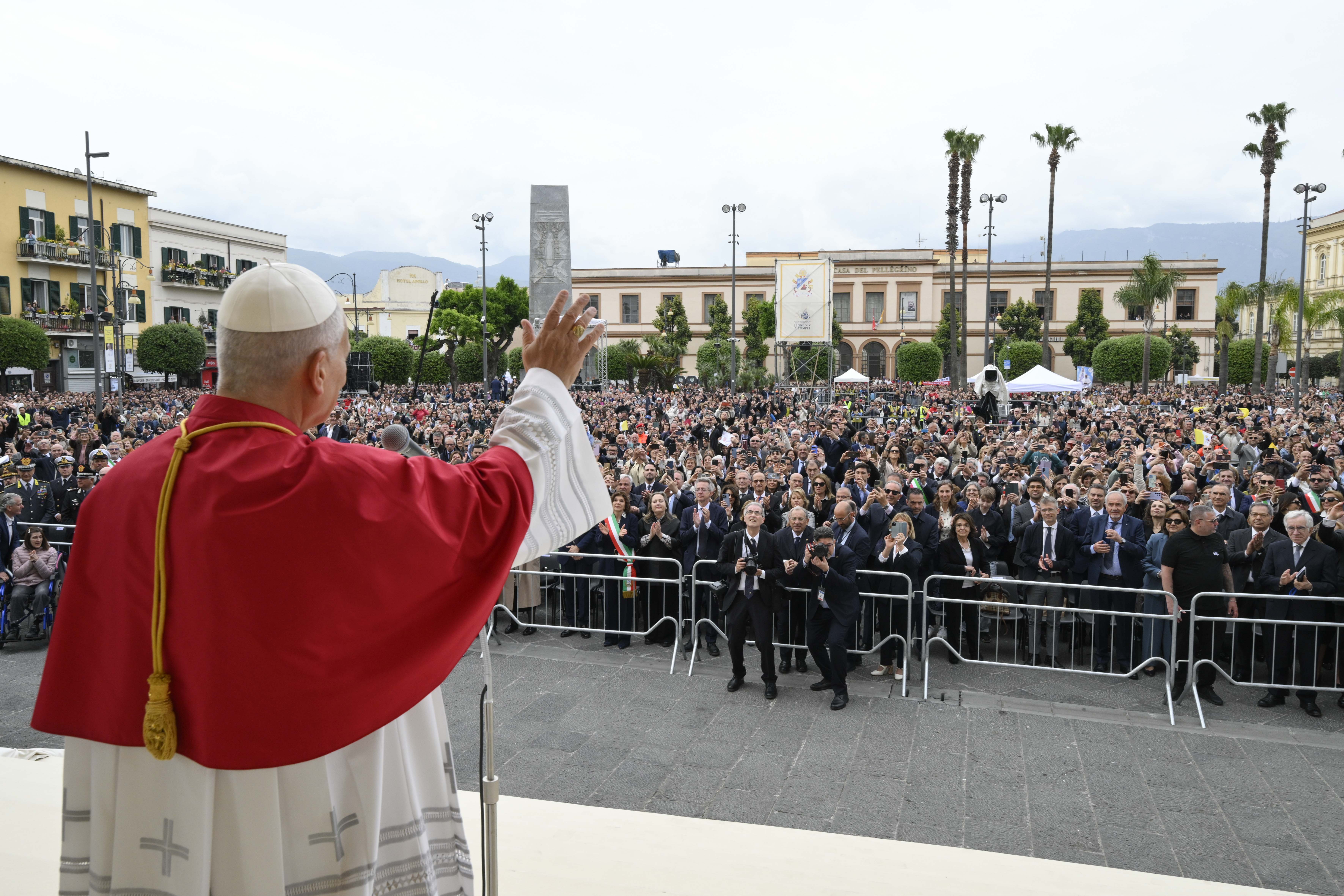
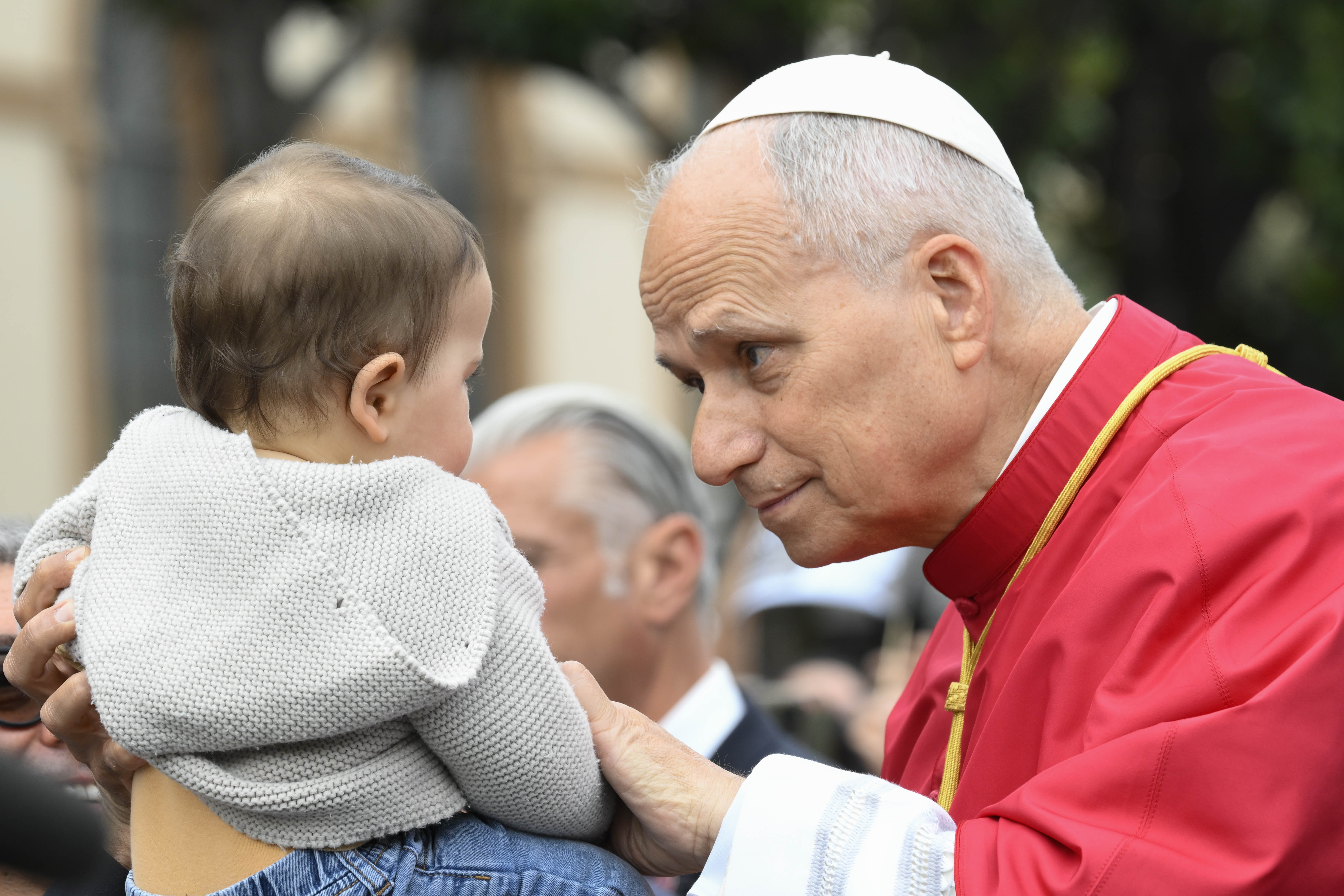
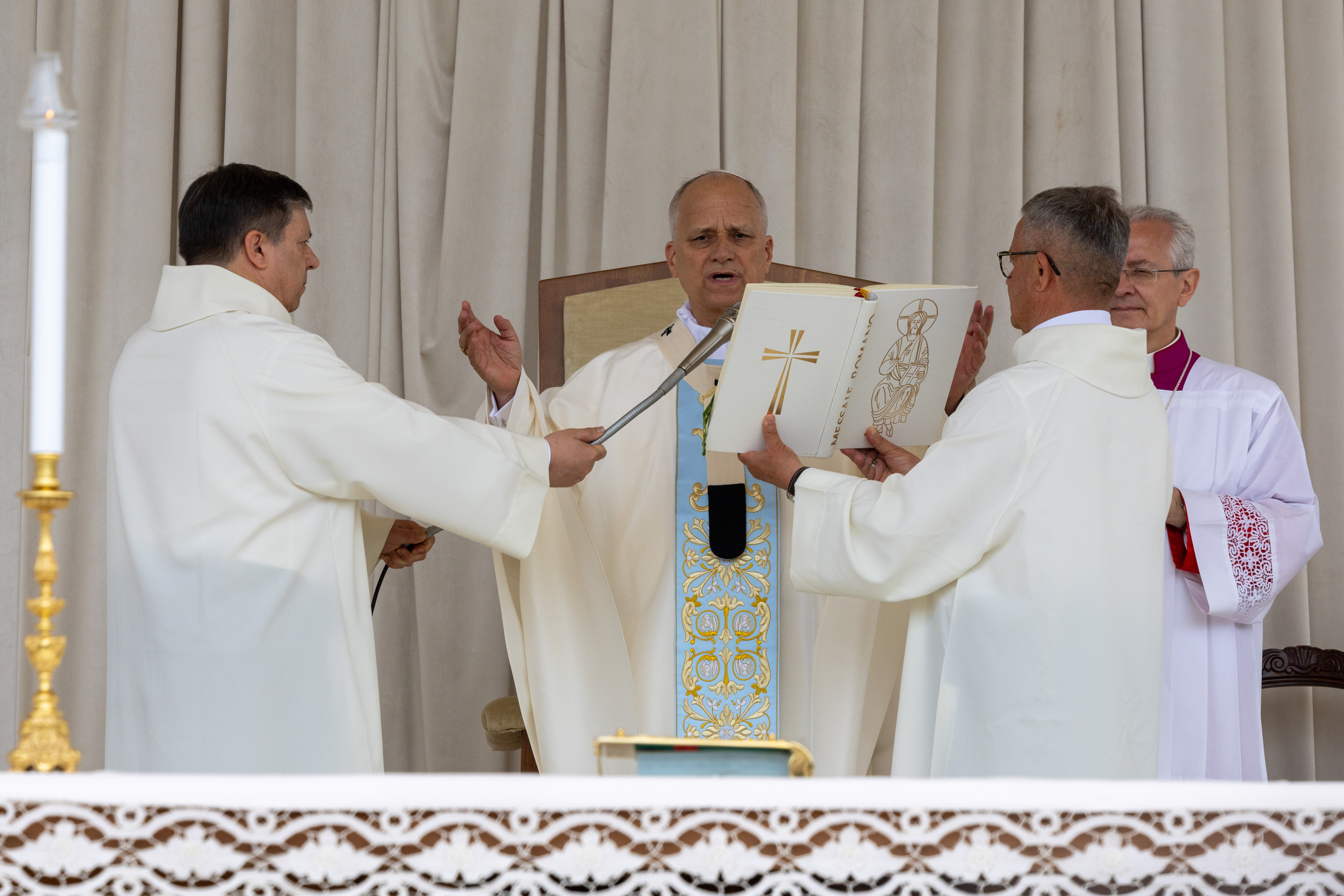
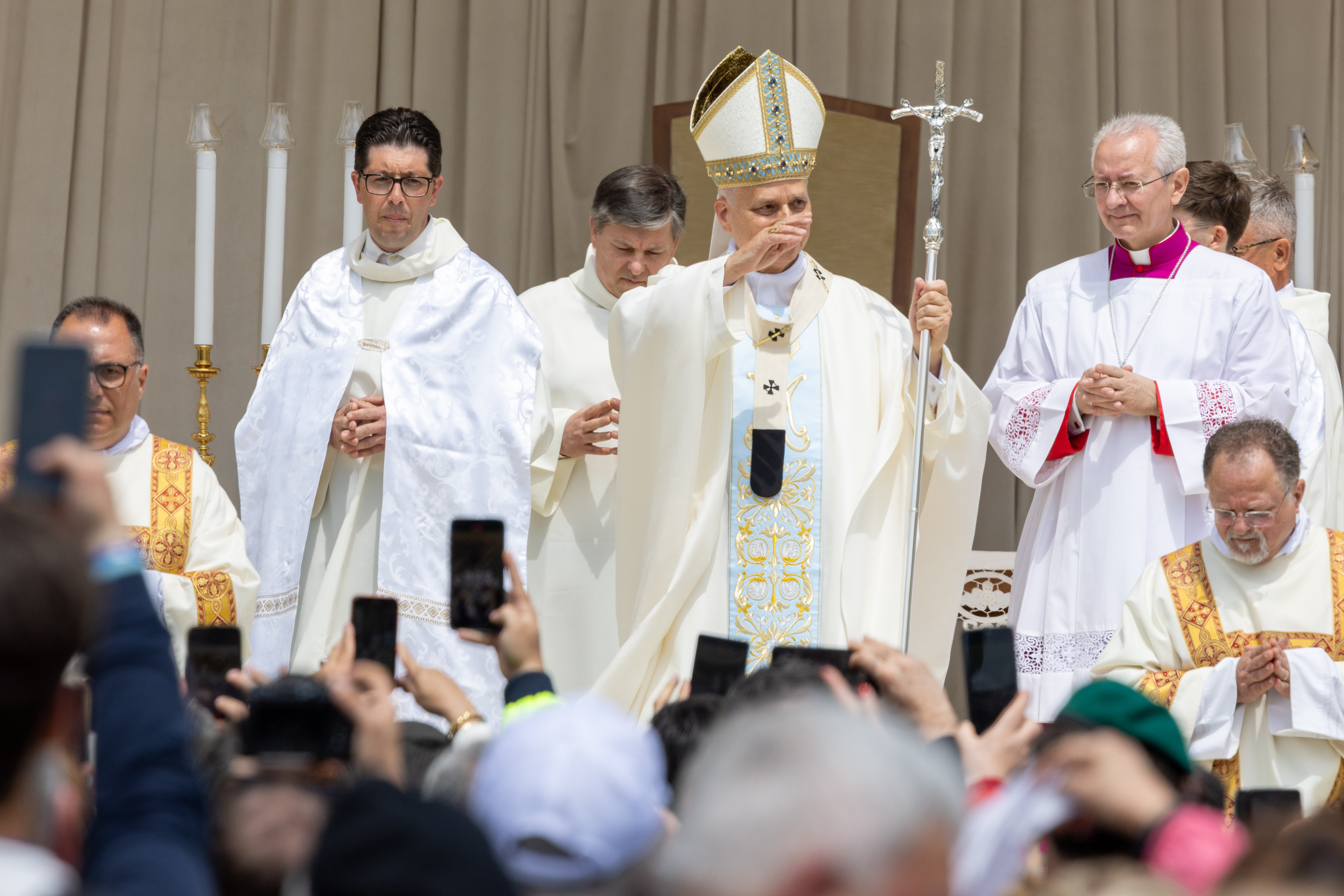
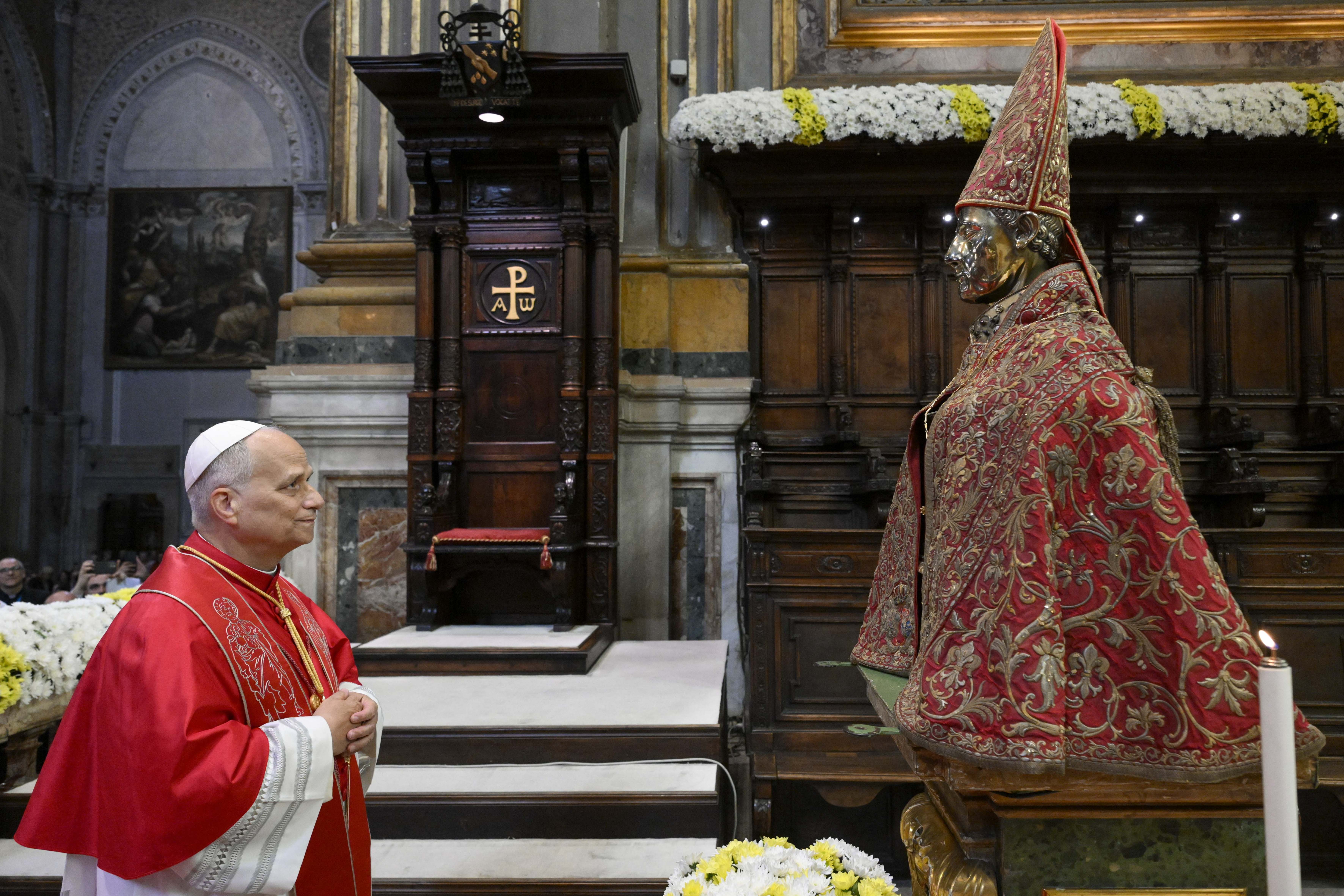
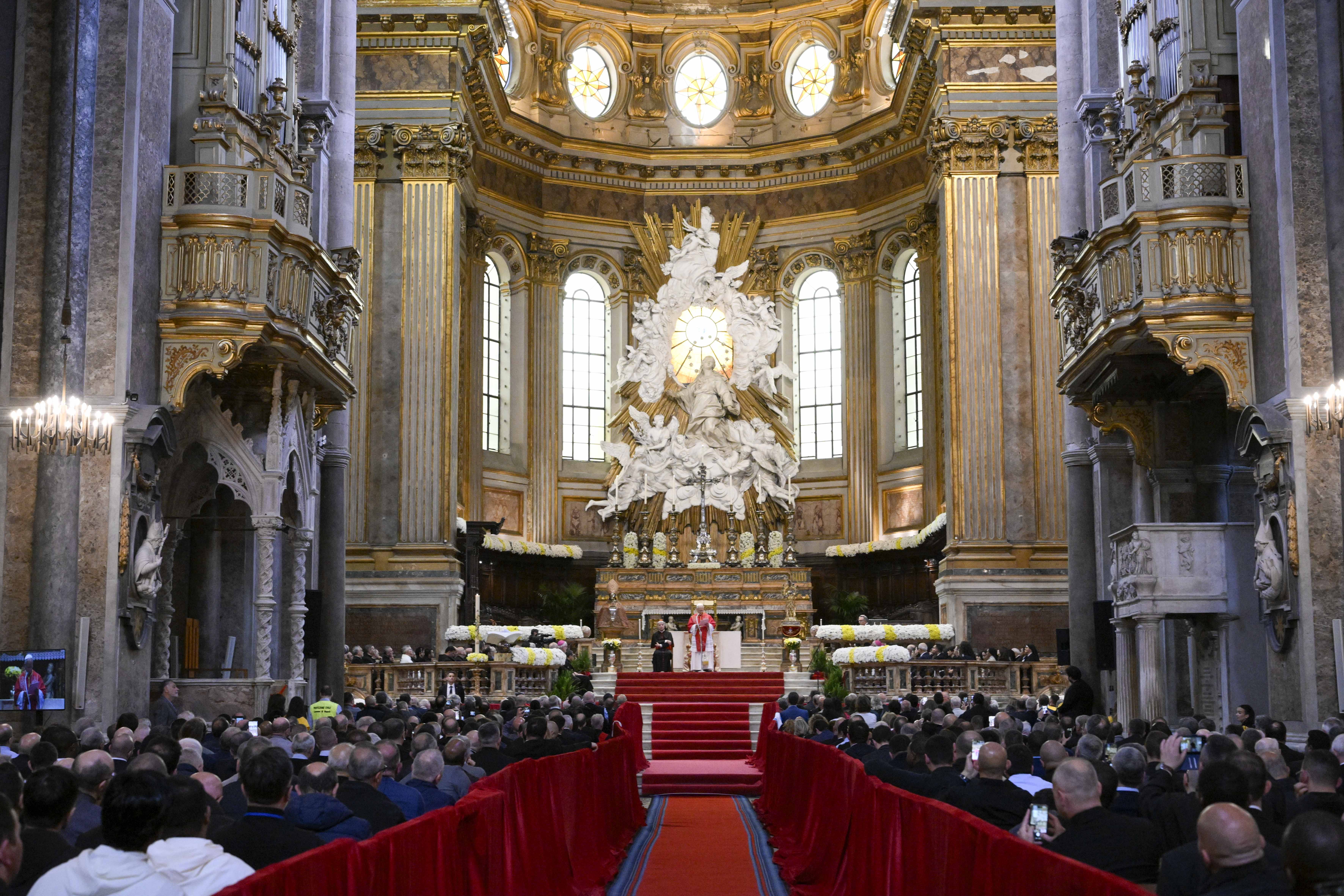
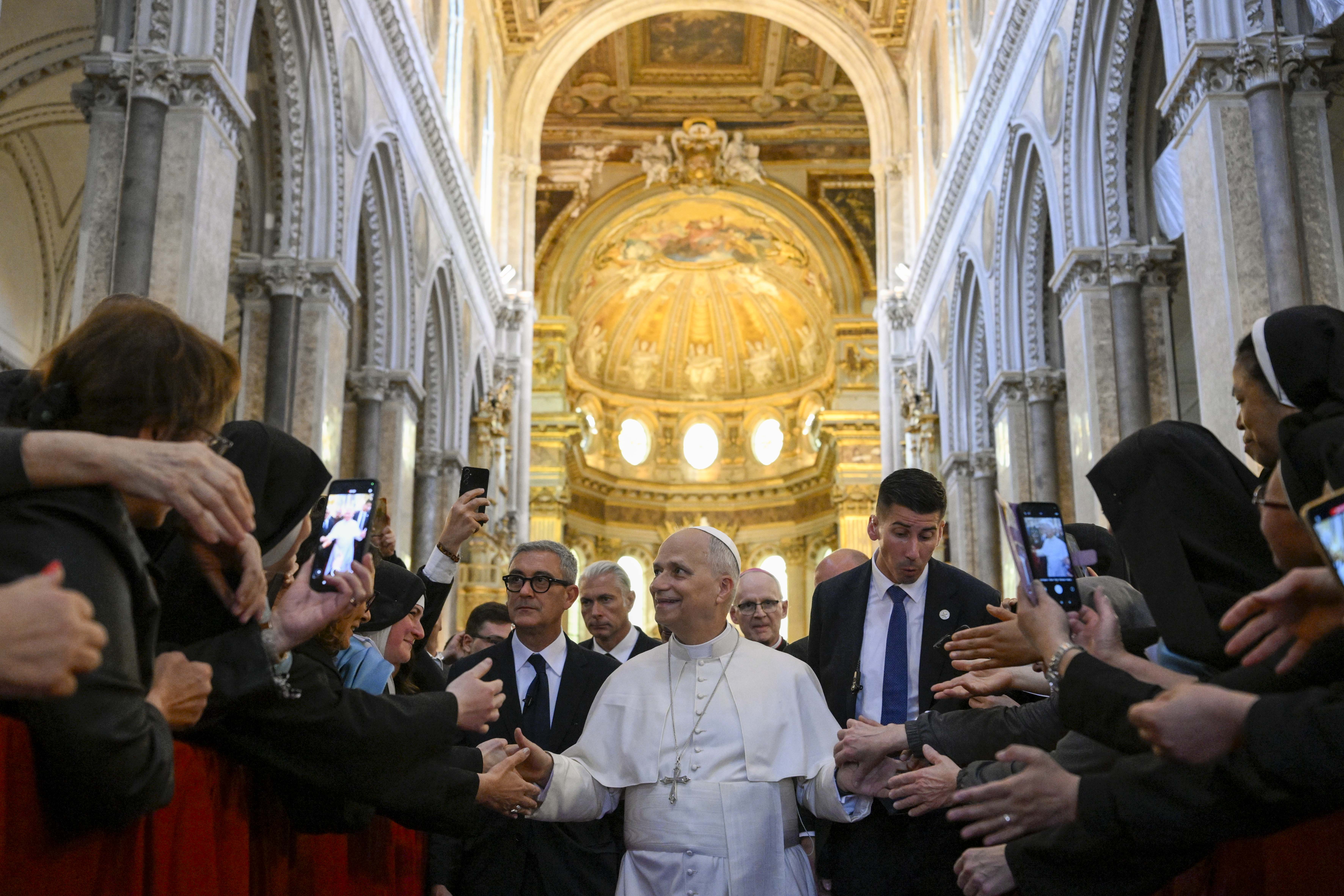
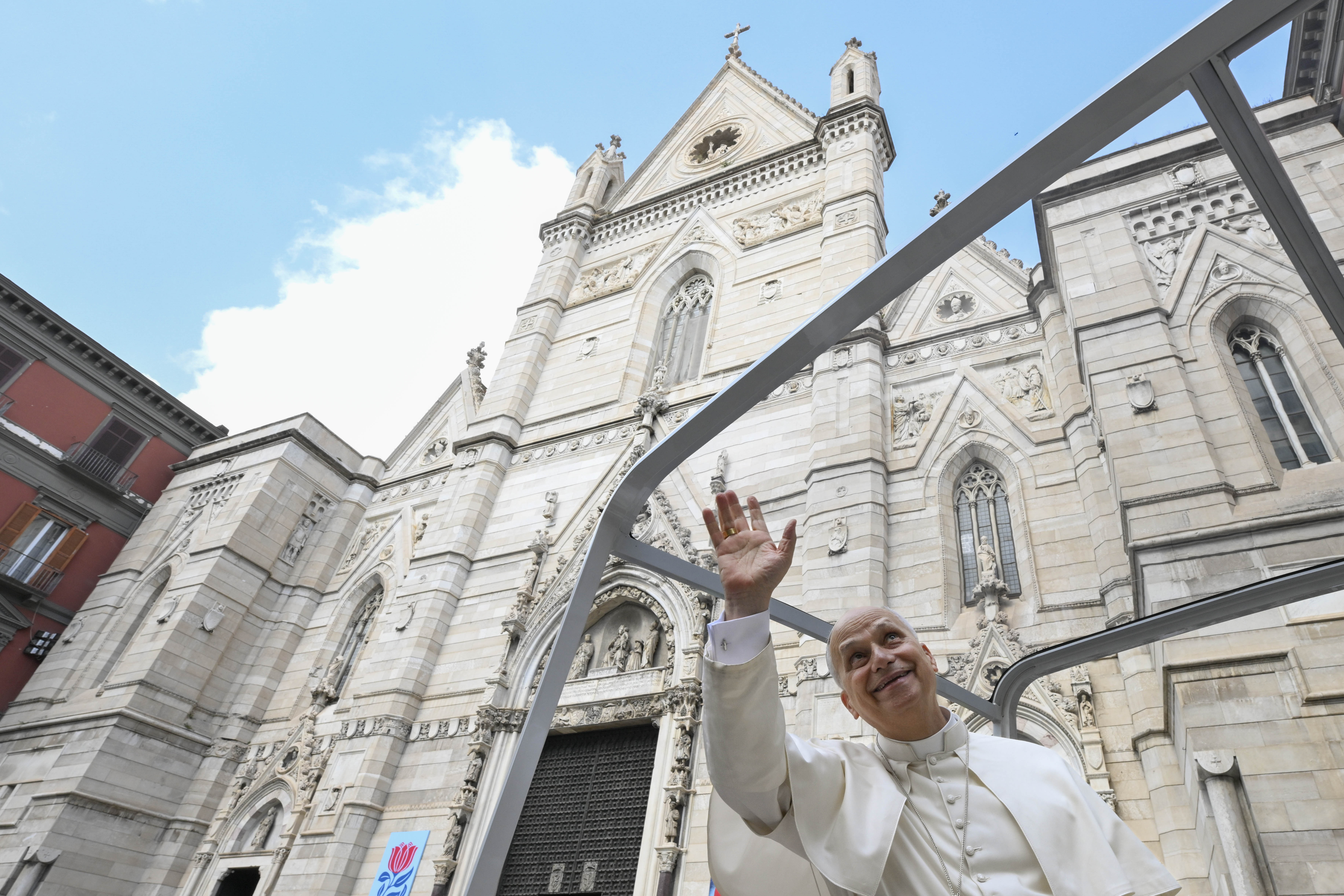
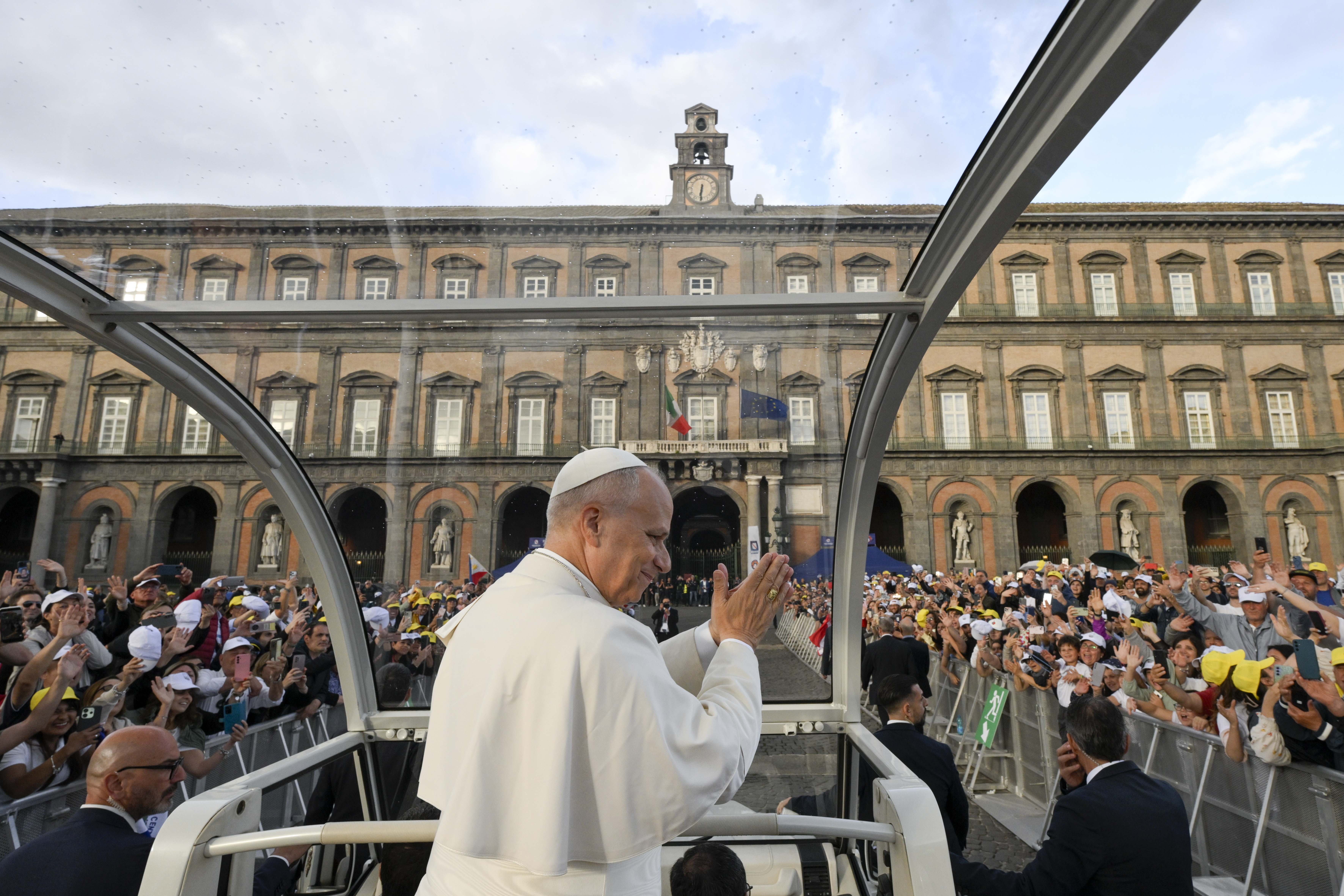
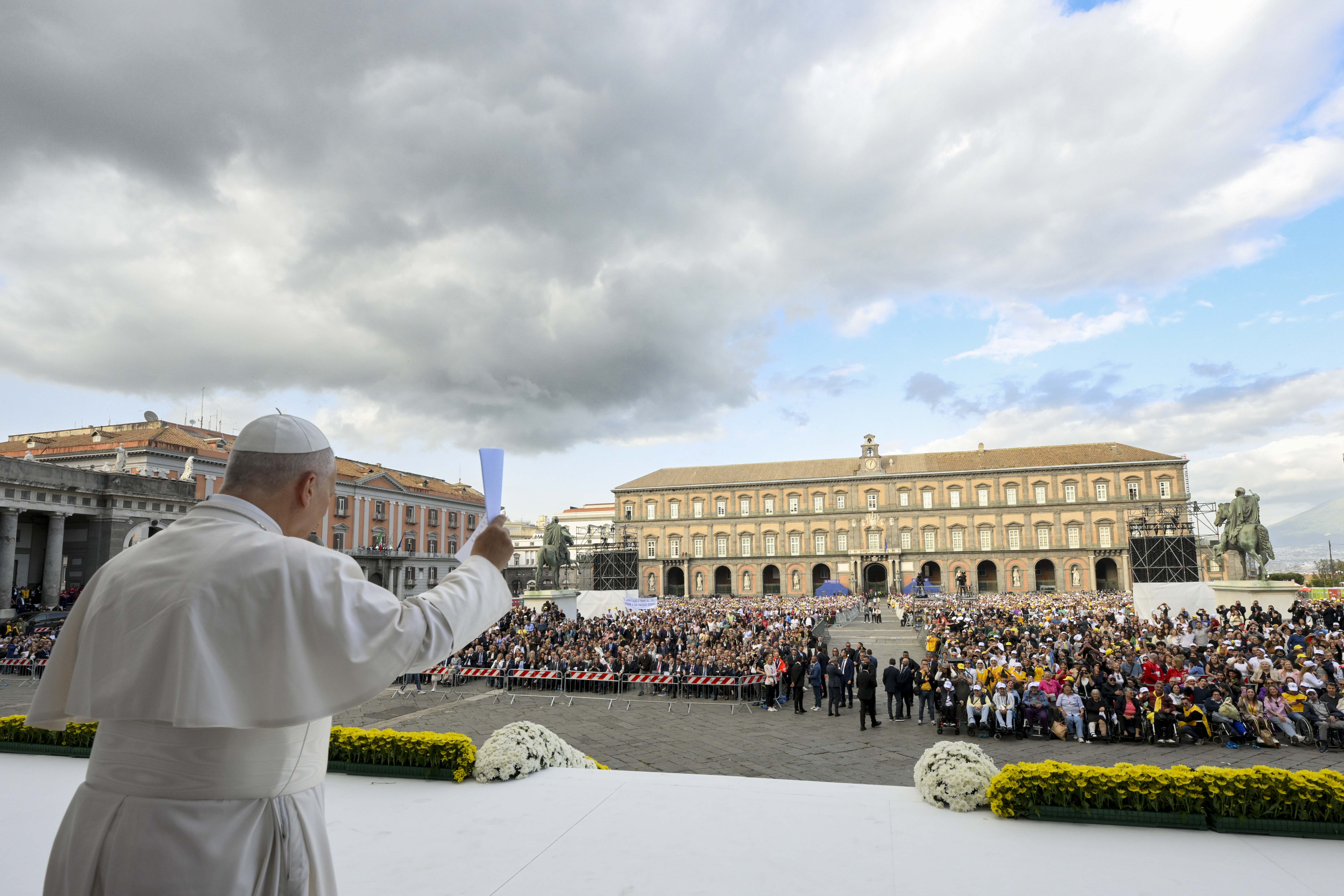
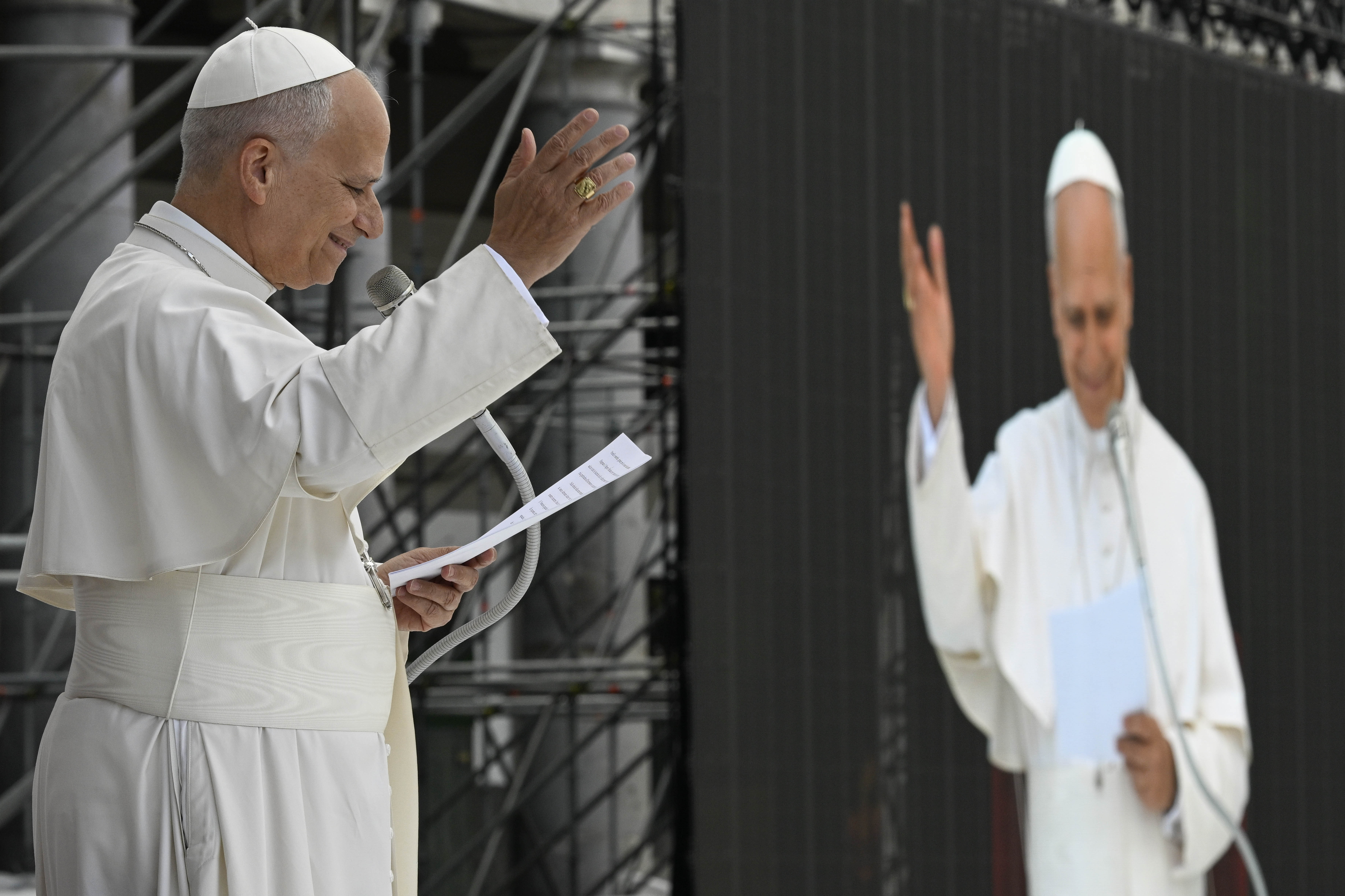
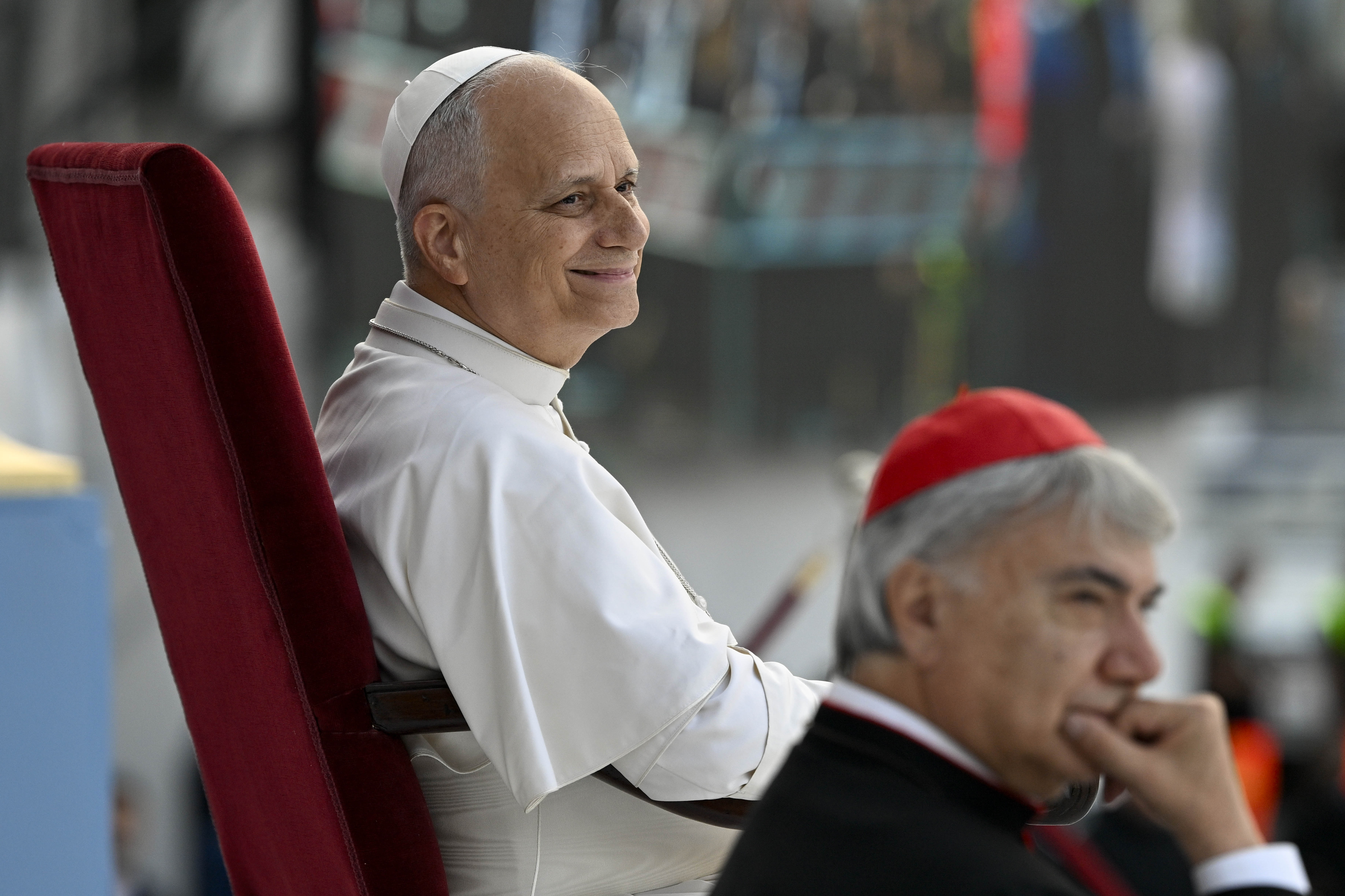
Pope Leo XIV on May 8 visited the historic Italian cities of Pompei and Naples, meeting with local citizens and clergy and celebrating Mass on the first anniversary of his election to the papacy.
The Holy Father visited the Pontifical Shrine of the Blessed Virgin of the Rosary of Pompei and met with the public before concelebrating the Eucharist in the Piazza Bartolo Longo.
Later, in Naples, he met with clergy and visited the Cathedral of the Assumption of Mary.
Here is a look in photos of Pope Leo XIVʼs activities in Pompei and Naples as he marked one year as pope:
A banner greets Pope Leo XIV as he arrives in the Italian city of Pompei on Friday, May 8, 2026. | Credit: Daniel Ibáñez/EWTN NewsPope Leo XIV deboards the papal helicopter as he arrives in the Italian city of Pompei on Friday, May 8, 2026. | Credit: Daniel Ibáñez/EWTN NewsPope Leo XIV greets crowds in Pompei, Italy, on Friday, May 8, 2026. | Credit: Vatican MediaPope Leo XIV greets crowds at the Pontifical Shrine of the Blessed Virgin of the Rosary of Pompei, Italy, on Friday, May 8, 2026. | Credit: Vatican MediaPope Leo XIV kisses a cross at the Pontifical Shrine of the Blessed Virgin of the Rosary of Pompei, Italy, on Friday, May 8, 2026. | Credit: Vatican MediaPope Leo XIV greets crowds at the Pontifical Shrine of the Blessed Virgin of the Rosary of Pompei, Italy, on Friday, May 8, 2026. | Credit: Vatican MediaPope Leo XIV greets a child at the Pontifical Shrine of the Blessed Virgin of the Rosary of Pompei, Italy, on Friday, May 8, 2026. | Credit: Vatican MediaPope Leo XIV concelebrates Mass in Piazza Bartolo Longo in the Italian city of Pompei, Italy, on Friday, May 8, 2026. | Credit: Daniel Ibáñez/EWTN NewsPope Leo XIV concelebrates Mass in Piazza Bartolo Longo in the Italian city of Pompei on Friday, May 8, 2026. | Credit: Daniel Ibáñez/EWTN NewsPope Leo XIV prays at the Cathedral of the Assumption of Mary in Naples, Italy, on Friday, May 8, 2026. | Credit: Vatican MediaPope Leo XIV speaks to Catholics at the Cathedral of the Assumption of Mary in Naples, Italy, on Friday, May 8, 2026. | Credit: Vatican MediaPope Leo XIV greets crowds at the Cathedral of the Assumption of Mary in Naples, Italy, on Friday, May 8, 2026. | Credit: Vatican MediaPope Leo XIV waves to crowds in Naples, Italy, on Friday, May 8, 2026. | Credit: Vatican MediaPope Leo XIV waves to crowds in the Piazza del Plebiscito in Naples, Italy, on Friday, May 8, 2026. | Credit: Vatican MediaPope Leo XIV greets crowds in the Piazza del Plebiscito in Naples, Italy, on Friday, May 8, 2026. | Credit: Vatican MediaPope Leo XIV greets crowds in the Piazza del Plebiscito in Naples, Italy, on Friday, May 8, 2026. | Credit: Vatican MediaPope Leo XIV smiles while visiting the Piazza del Plebiscito in Naples, Italy, on Friday, May 8, 2026. | Credit: Vatican Media
On May 8, 2025, white smoke billowed from the chimney on the roof of the Sistine Chapel, signaling that a new pope had been chosen. On that day, the world was introduced to Pope Leo XIV, known just hours before as Cardinal Robert Prevost, prefect of the Vatican’s Dicastery for Bishops.
One year later, Pope Leo has captured the hearts of the faithful through his papal trips, events like canonizations and special liturgies, as well as through his spoken and printed words, including an apostolic letter, and much more.
Here are 10 of the most significant events and moments of Leo XIV’s first year as pope:
The new pontiffʼs inaugural Mass
On May 18, 2025, Pope Leo XIV inaugurated his pontificate with a Mass in St. Peter’s Square calling for a united Church. Addressing approximately 150,000 attendees, he emphasized fraternal communion, servant leadership, and reconciliation, marking the official start of his ministry as the 266th successor of St. Peter.
At the Mass, concelebrated with the members of the College of Cardinals, Leo expressed his intention to “come to you as a brother, who desires to be the servant of your faith and your joy, walking with you on the path of God’s love, for he wants us all to be united in one family.”
Less than 48 hours after his election, Pope Leo made his first visit outside of the Vatican visiting the Shrine of the Mother of Good Counsel in Genazzano, located about an hour east of Rome and run by the religious of the Order of St. Augustine.
On his way back to the Vatican, the new pontiff stopped at the Basilica of St. Mary Major where he prayed before the tomb of Pope Francis and the icon of the Blessed Virgin Mary there, “Salus Populi Romani.”
Pope Leo left a white rose, which is said to have been Pope Francis’ favorite flower.
Impactful addresses to youth
Throughout his first year as pope, the Holy Father has had powerful experiences with young people. Two in particular that stand out are his addresses to roughly 1 million young adults during the Jubilee of Youth and his live talk with young people gathered at the National Catholic Youth Conference (NCYC).
During the Jubilee of Youth, which took place July 28–Aug. 3 and was part of the yearlong Jubilee of Hope, young adults from around the world filled the streets of Rome. Each day was filled with different opportunities and events for the young people to experience the richness of the Catholic faith.
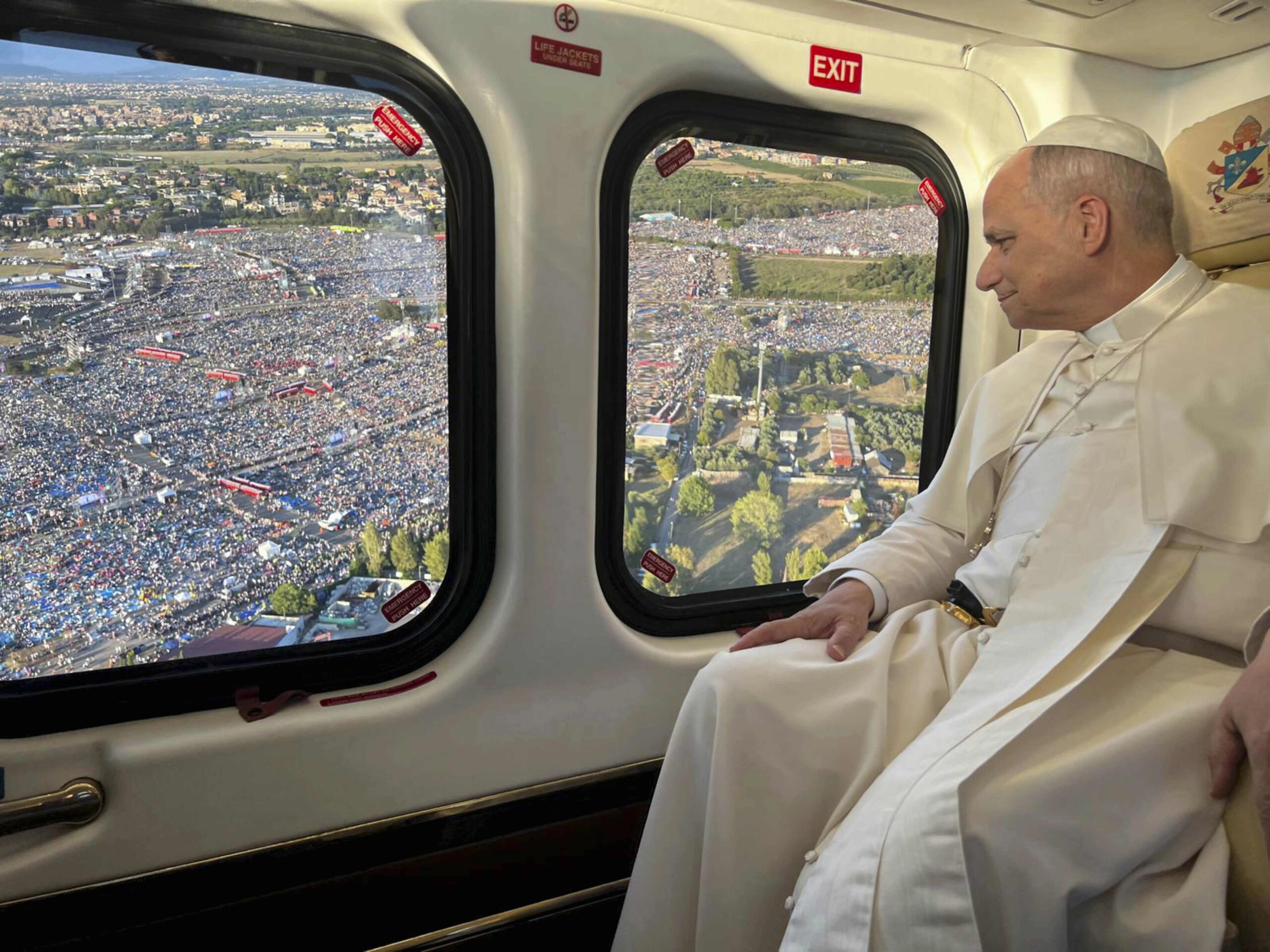
On Aug. 2, Pope Leo was greeted by the largest crowd he had addressed during his pontificate so far for the evening vigil at Tor Vergata, an outdoor venue 10 miles east of Rome. An estimated 1 million people were in attendance. The Holy Father arrived by helicopter and then drove through the grounds on the popemobile, waving to the cheering young people before the prayer service began.
The Jubilee of Youth concluded on Aug. 3 with a Mass celebrated by Pope Leo on the 237-acre grounds of Tor Vergata, where more than a million young pilgrims had spent the night following a prayer vigil and Eucharistic adoration.
In his homily, Pope Leo invited the pilgrims to open their hearts to God and venture with him “towards eternity.”
Pope Leo XIV approaches Tor Vergata in Rome by helicopter on Saturday, Aug. 2, 2025. | Credit: Vatican Media
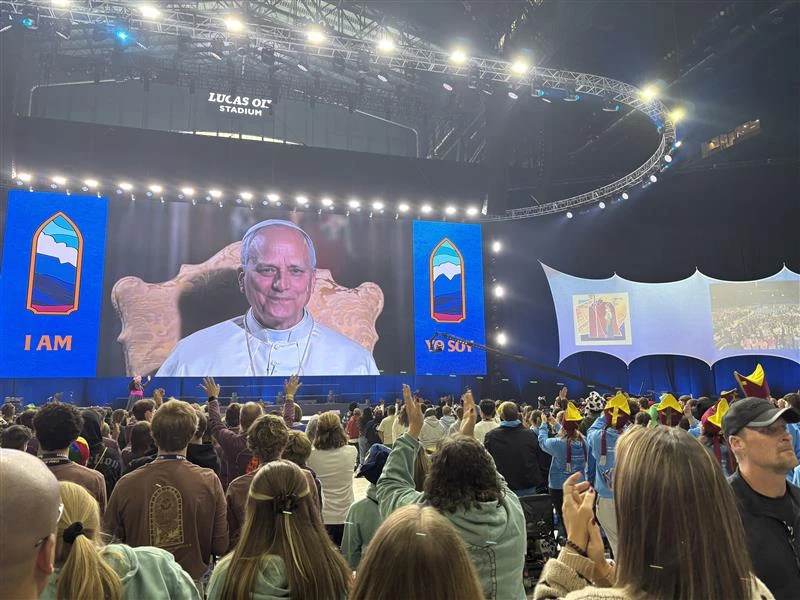
NCYC took place in Indianapolis at Lucas Oil Stadium from Nov. 20–22. On Nov. 21, Pope Leo held a historic digital encounter with American teenagers.
During this live conversation, five teenagers asked the pope questions regarding using technology, recovering from mistakes, giving worries to Jesus, avoiding distractions, and preparing for the future of the Church. The pope gave guidance to the young crowd with words applicable to both teenagers and the universal Church.
Pope Leo XIV speaks to teenagers during a digital encounter at Lucas Oil Stadium in Indianapolis during the 2025 National Catholic Youth Conference (NCYC) on Nov. 21, 2025. | Credit: Tessa Gervasini/CNA
Canonizations of Pier Giorgio Frassati and Carlo Acutis
On Sept. 7, 2025, Pope Leo canonized Pier Giorgio Frassati and Carlo Acutis in his first canonization ceremony before an estimated 70,000 people in St. Peter’s Square.
“Today we look to St. Pier Giorgio Frassati and St. Carlo Acutis: a young man from the early 20th century and a teenager from our own day, both in love with Jesus and ready to give everything for him,” he said during his homily.
He added: “Dear friends, Sts. Pier Giorgio Frassati and Carlo Acutis are an invitation to all of us, especially young people, not to squander our lives but to direct them upwards and make them masterpieces.”
Pope Leo XIV released his first apostolic letter, Dilexi Te, on Oct. 9, 2025. The document emphasizes the idea that the poor are not simply objects of charity but also evangelists who can prompt us to conversion through their example of weakness and reliance on God.
“The poor can act as silent teachers for us, making us conscious of our presumption and instilling within us a rightful spirit of humility,” Leo writes in Dilexi Te (“I Have Loved You”). “The elderly, for example, by their physical frailty, remind us of our own fragility, even as we attempt to conceal it behind our apparent prosperity and outward appearance. The poor … remind us how uncertain and empty our seemingly safe and secure lives may be.”
The pontiff quotes his predecessor throughout the document, which was first drafted during Pope Francis' pontificate and draws heavily on the late popeʼs first apostolic exhortation, Evangelii Gaudium, on the joy of the Gospel.
First major international trip: Turkey and Lebanon
Pope Leo made his first international papal trip to Turkey and Lebanon Nov. 27–Dec. 2, 2025. The wide-ranging international visit included historic ecumenical encounters, deeply symbolic gestures of prayer, and pastoral visits to Christian communities under pressure. Pope Leo highlighted the importance of unity, peace, and fraternity, and brought encouragement to a region marked by ancient faith and present suffering.
One highlight from his time in Turkey included the commemoration of the 1,700th anniversary of the Council of Nicaea alongside Ecumenical Patriarch Bartholomew I of Constantinople in the Turkish city of Iznik, the site of the Council of Nicaea, historically known as the birthplace of the Nicene Creed.
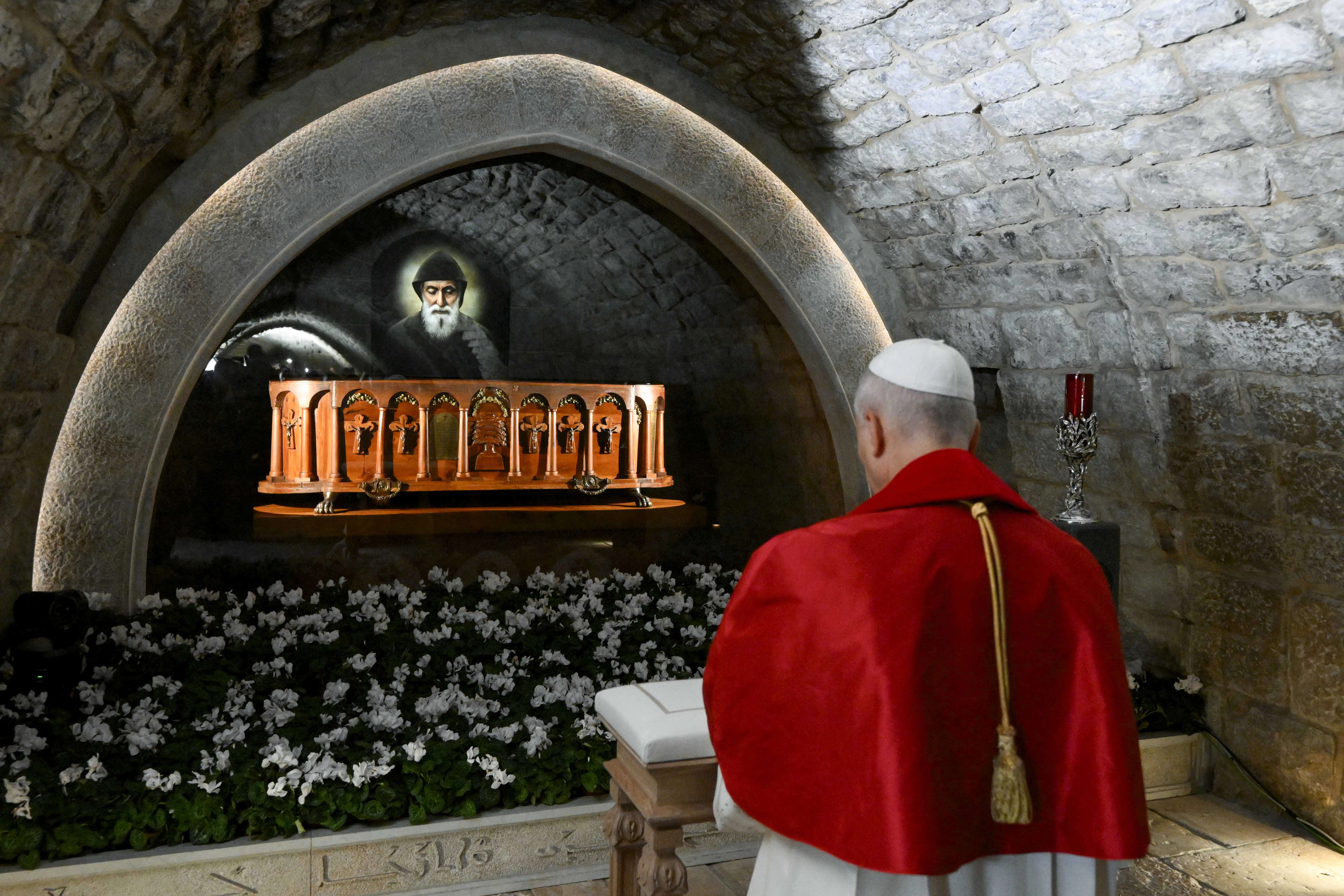
In Lebanon, Pope Leo became the first pope in history to visit the tomb of St. Charbel Makhlouf when he arrived at the Monastery of St. Maron in Annaya.
Pope Leo XIV reflects on the enduring message of St. Charbel Makhlouf at the hermit’s tomb at the Monastery of St. Maron, in Annaya, Lebanon, on Dec. 1, 2025. | Credit: Vatican Media
An extraordinary consistory
In his opening address at an extraordinary consistory — which convened from Jan. 7–8 — Pope Leo assured the cardinals from around the world gathered at the Vatican that “I am here to listen.”
This extraordinary consistory — different from the ordinary ones, which are more limited and frequent — was scheduled to take place immediately after the Jubilee of Hope to “offer support and advice to the Holy Father in the exercise of his high and arduous responsibility of governing the Church,” according to a statement from the Holy See.
The consistory was a closed-door meeting to which no media were admitted, and cardinals were asked to keep the proceedings confidential. However, the cardinals were expected to offer the new pontiff their views on two specific topics: the Synod and synodality, and the mission of evangelization and the missionary character of the Church.
First Holy Week and Easter celebrations as pope
During Holy Week and Easter 2026, Pope Leo presided over the Church’s most solemn liturgies in Rome, beginning with Palm Sunday and continuing through the chrism Mass on Holy Thursday, the Mass of the Lord’s Supper, the Good Friday Passion celebration, the Stations of the Cross at the Colosseum, the Easter Vigil at St. Peter’s Basilica, and finally Easter Sunday Mass with the “urbi et orbi” blessing from St. Peter’s Square.
This was the first time in several years that a pope participated in all the liturgies of Holy Week and Easter. Due to Pope Francis’ declining health toward the end of his papacy, he had to scale back his participation in many of these events.
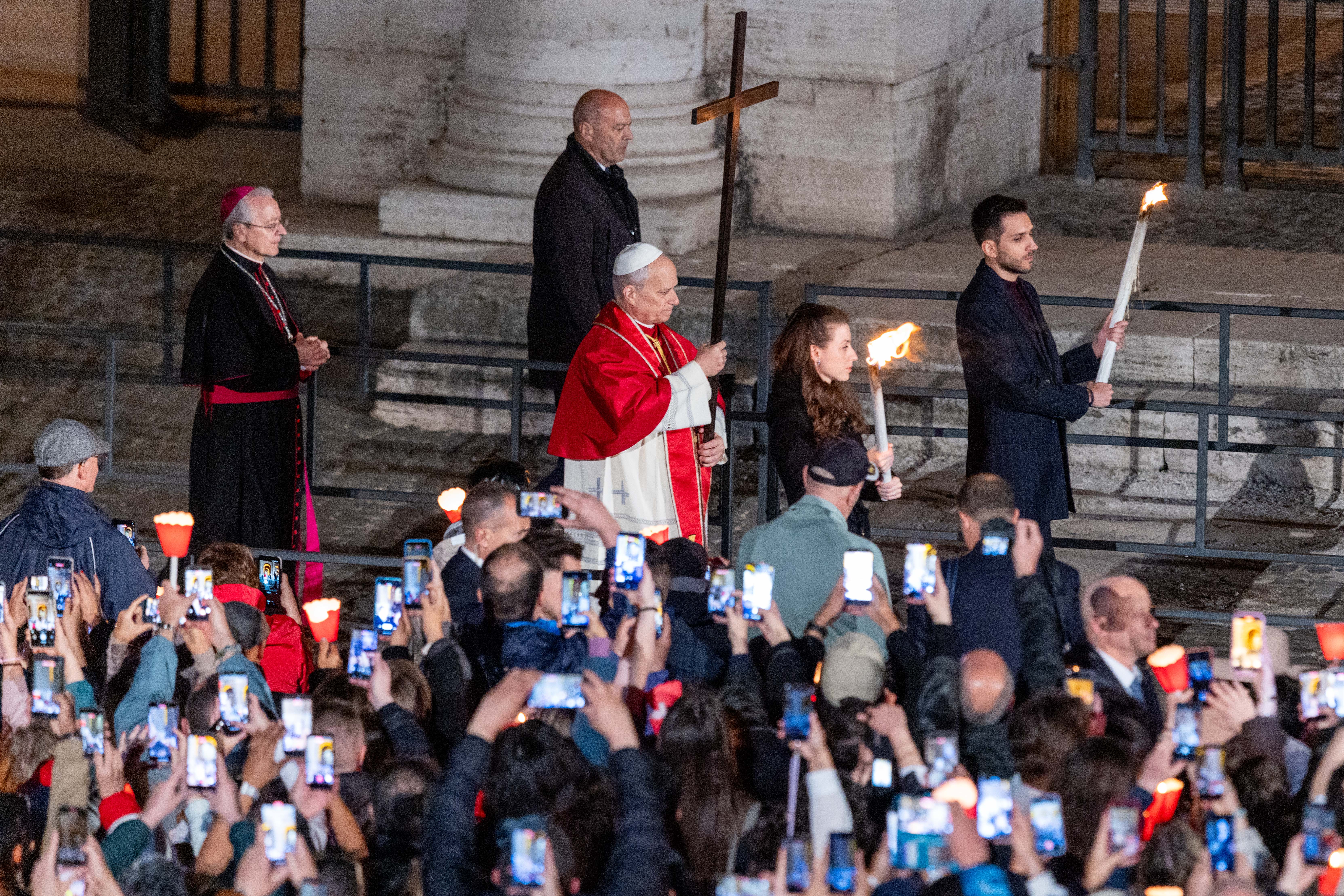
Pope Leo was also the first pope since John Paul II in 1994 to carry the wooden cross to all 14 stations during the Stations of the Cross at the Colosseum on Good Friday.
Pope Leo XIV carries the cross during the Via Crucis at the Colosseum in Rome, Friday, April 3, 2026. | Credit: Daniel Ibáñez/EWTN News
Historic 11-day trip to Africa
Pope Leo spent 11 days in Africa — from April 13–23 — and visited four countries: Algeria, Cameroon, Angola, and Equatorial Guinea. During this trip, he traveled more than 11,000 miles on 18 separate flights. With stops in 11 cities across those countries, the Holy Father met with the youth, political leaders, prisoners, families, and many more to share the Gospel message.
Throughout his journey, he emphasized themes of peace, reconciliation, and economic justice, meeting with local leaders, clergy, and lay faithful. Large crowds gathered for outdoor Masses, reflecting the vibrancy and rapid growth of Catholicism in many African communities.
One of the highlights of the trip was Pope Leo’s visit to Annaba — ancient Hippo — in what for the Augustinian pontiff amounted to a return to the roots of his faith and vocation. Despite pouring rain, the pope walked through the ruins and, at the end of the route, laid a wreath of flowers and stopped for a moment of prayer, visibly moved.
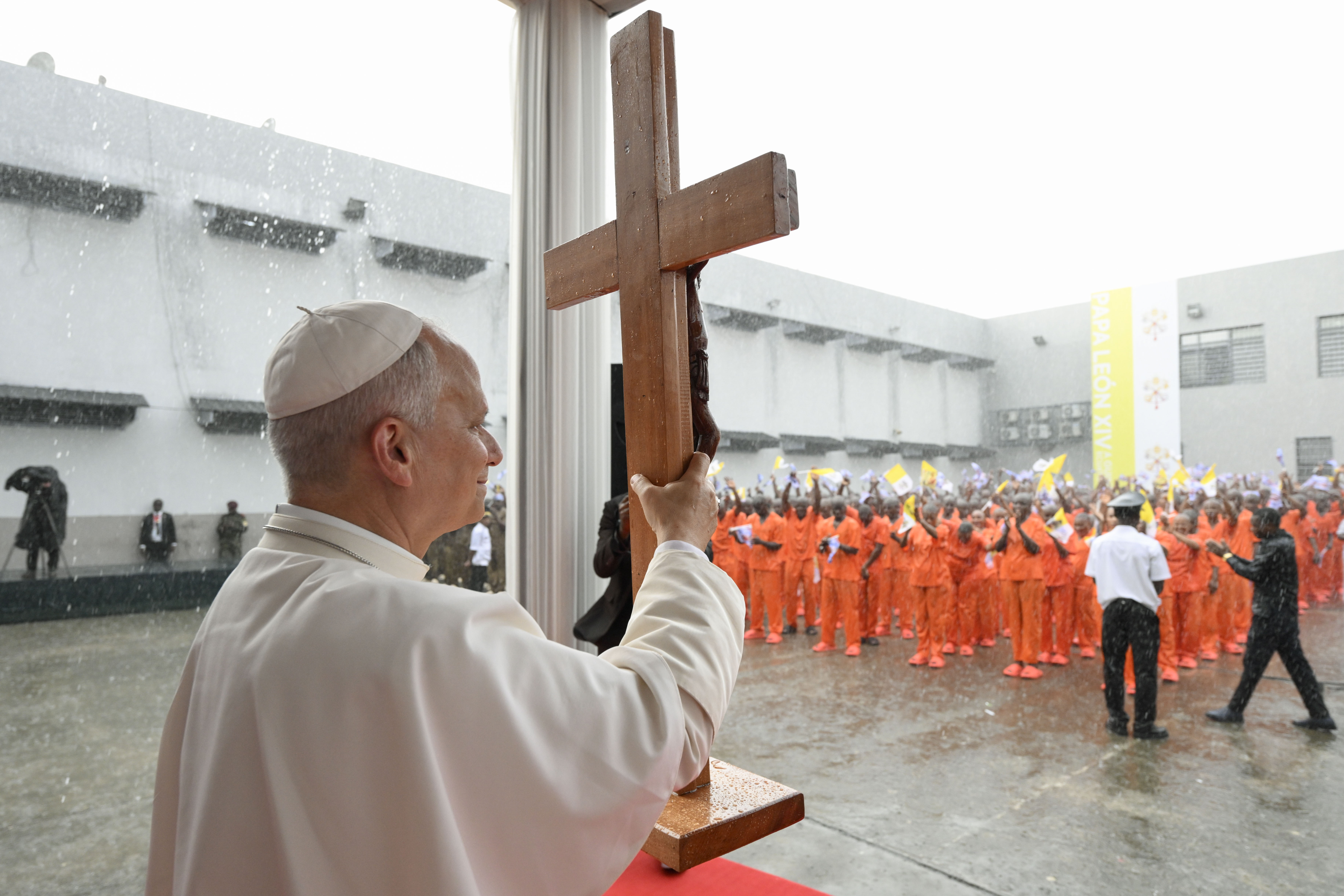
The pope also paid a visit to the Bata penitentiary in Equatorial Guinea and told inmates that “no one is excluded from God’s love” and urged them to see that even behind bars, there remains the possibility of change, reconciliation, and hope. This prison is one of the country’s harshest, known for its difficult conditions.
Pope Leo XIV displays a crucifix while speaking to prisoners at Bata Prison, Equatorial Guinea, Wednesday, April 22, 2026. | Credit: Vatican Media
Strong messaging on war and peace
The Holy Father has made peace a defining theme of his pontificate from the very beginning, opening his first public remarks with the words “Peace be with you.” That simple greeting set the tone for a broader vision — one rooted in the Gospel but directed squarely at a world marked by conflict and division.
In homilies and international addresses, he has consistently framed peace not as the absence of war but as an active, daily commitment grounded in justice, reconciliation, and respect for human dignity.
The pope has urged world leaders to reject cycles of violence and instead foster what he has called a “culture of peace.” Speaking in the context of ongoing global tensions, he has warned against the normalization of war as a tool of policy, insisting that lasting solutions can only come through dialogue and mutual understanding.
The pope has also addressed the dangers of modern warfare, including the threat of nuclear escalation. He has called for renewed international efforts toward disarmament and de-escalation, emphasizing that the destructive power of nuclear weapons demands a moral as well as political response.
Reiterating the Church’s long-standing teaching, Pope Leo has encouraged nations to pursue diplomacy over aggression, presenting dialogue not as weakness but as the strongest and most enduring path to peace.
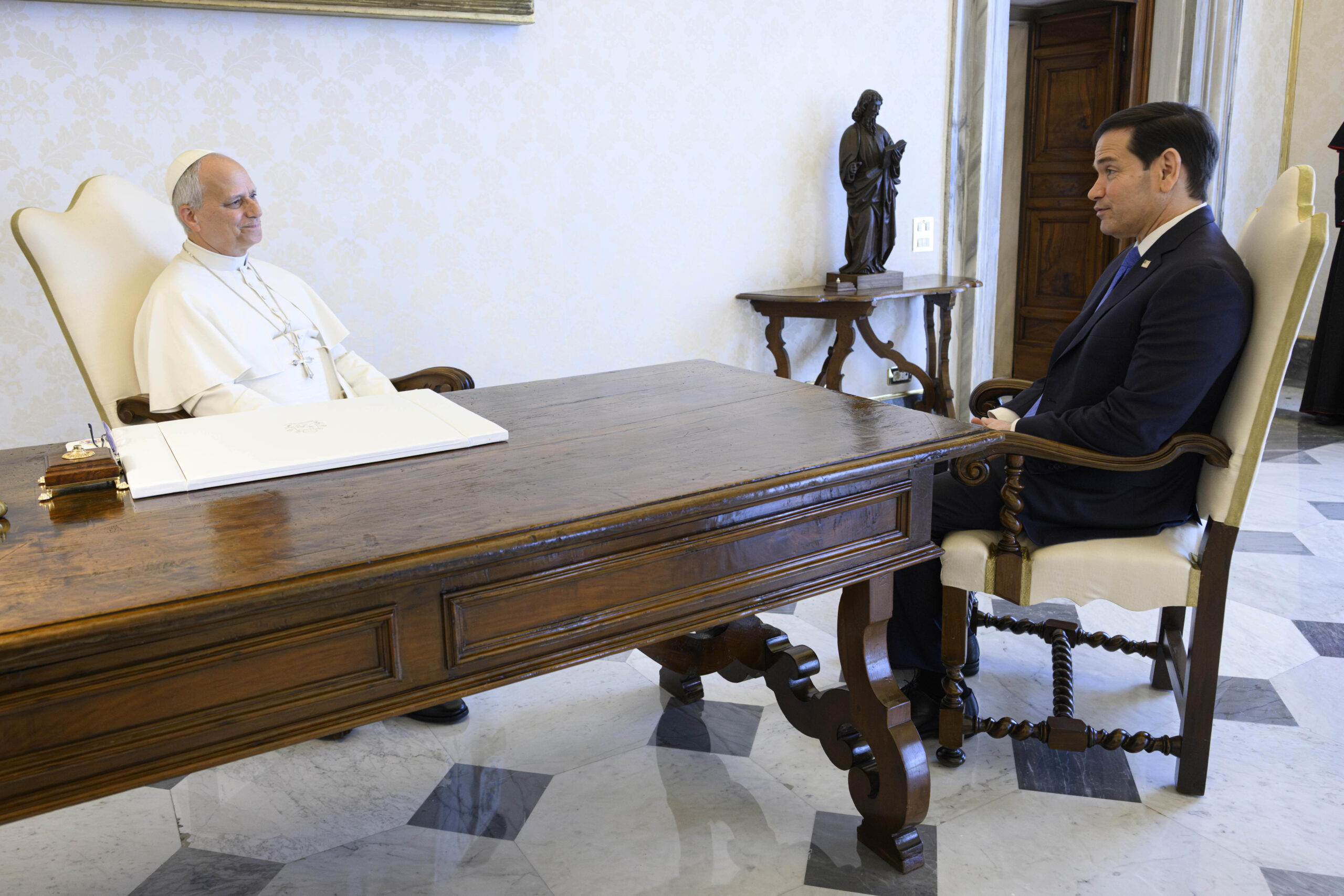
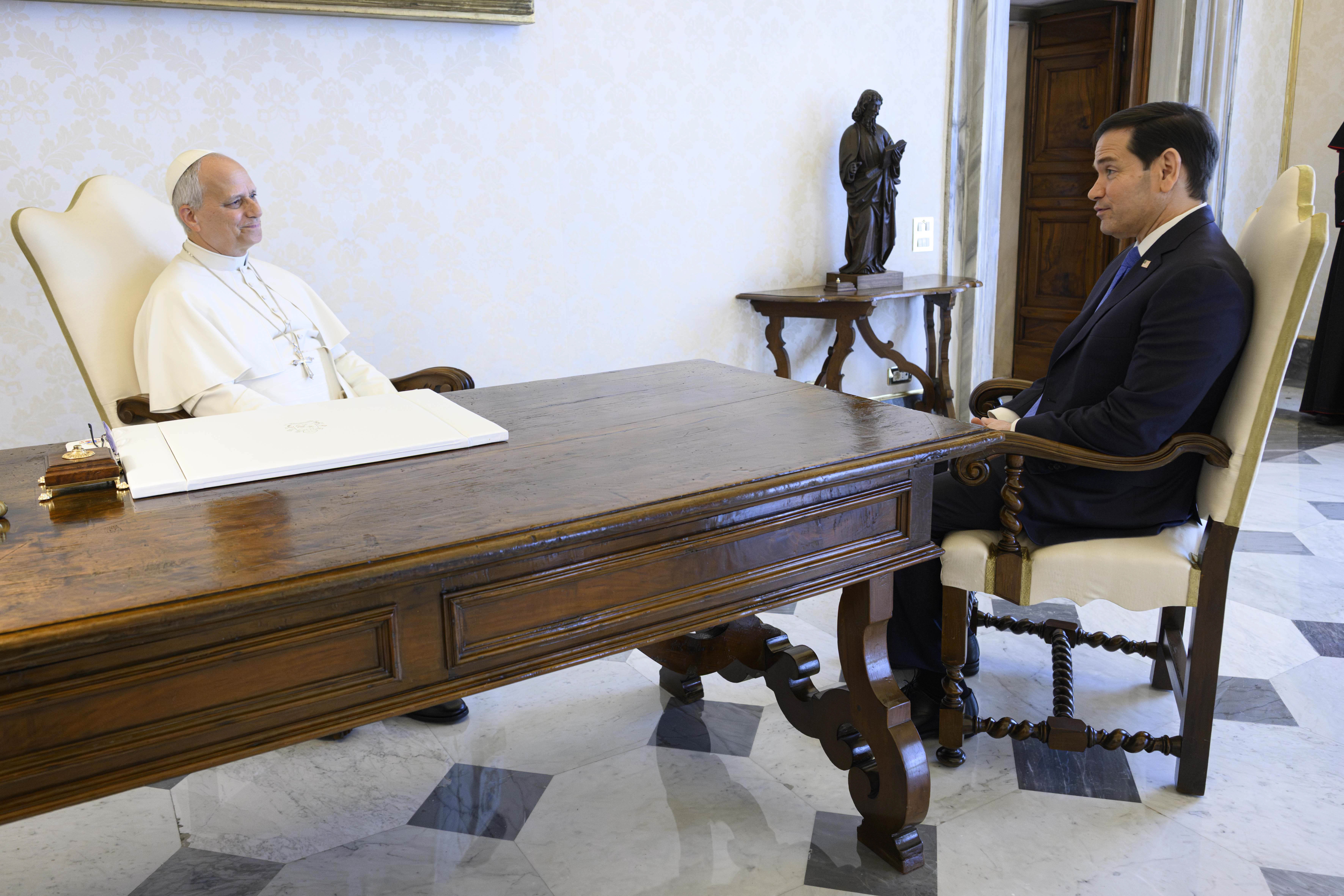
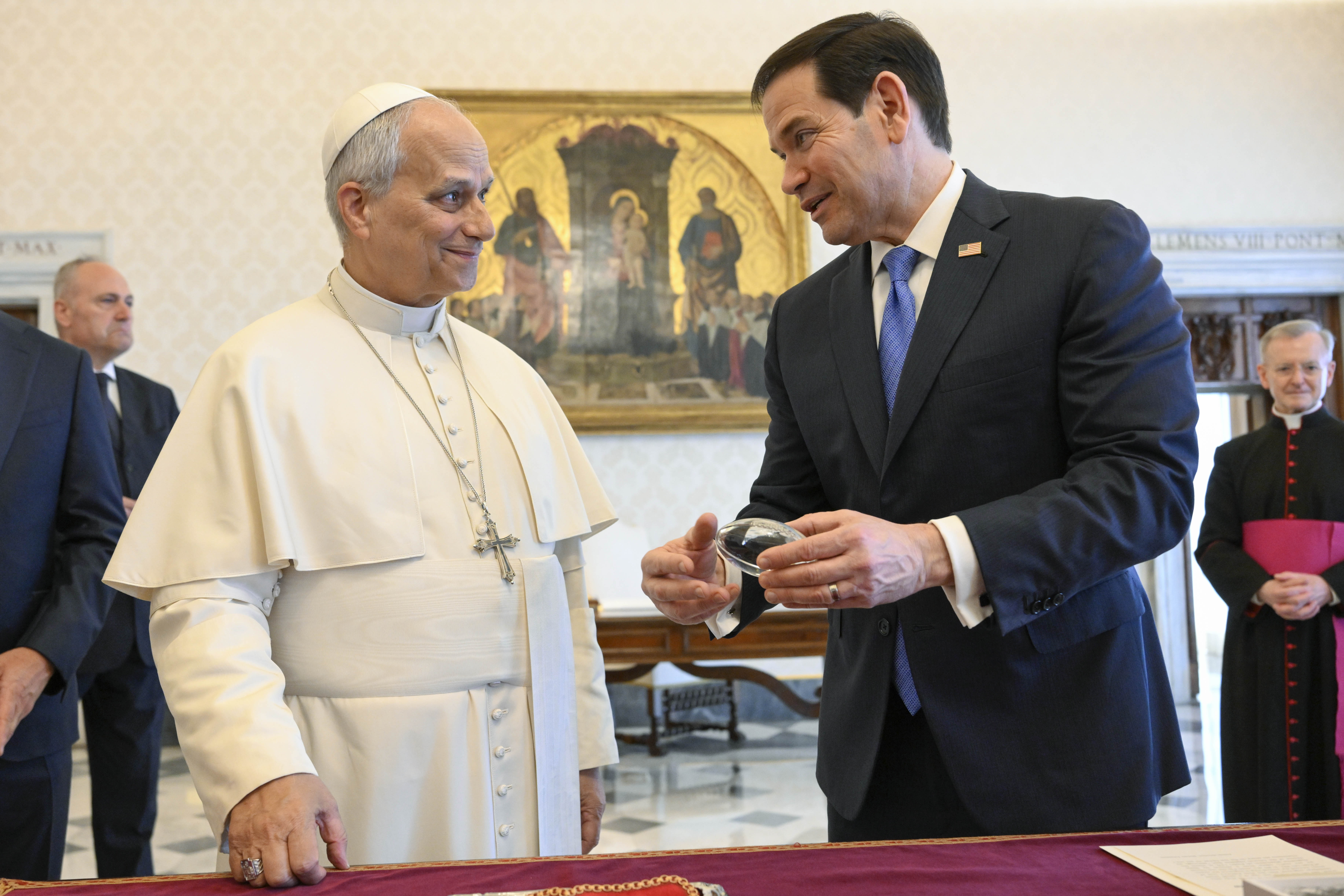
On Thursday Pope Leo XIV met with U.S. Secretary of State Marco Rubio at the Vatican, with the meeting coming amid tensions between the Holy See and U.S. President Donald Trump.
Trump has expressed his disapproval of Leoʼs public statements denouncing the U.S.-led war on Iran. The Holy Father has repeatedly called for peace amid the ongoing conflict.
According to a statement released by the U.S. Department of State, the pontiff and Rubio discussed “the situation in the Middle East and topics of mutual interest in the Western Hemisphere.”
Pope Leo XIV speaks with U.S. Secretary of State Marco Rubio at the Vatican, Thursday, May 7, 2026. | Credit: Vatican Media
It also stated that their meeting “underscored the strong relationship between the United States and the Holy See and their shared commitment to promoting peace and human dignity.”
The Holy See published its own statement of the meeting, which, according to Vatican spokesperson Matteo Bruni, lasted for 45 minutes.
The statement described the meeting as an encounter where “cordial discussions” took place regarding the “fostering of strong bilateral relations between the Holy See and the United States of America.”
Pope Leo XIV speaks with U.S. Secretary of State Marco Rubio at the Vatican, Thursday, May 7, 2026. | Credit: Vatican Media
This week Trump expressed his desire that Rubio tell the pope that "Iran cannot have nuclear weapons.” The president has repeatedly claimed, without evidence, that Leo wants the Middle Eastern country to develop nuclear armaments.
Leo has rejected those allegations. On May 5 at Castel Gandolfo he stated that the Church "has spoken for years against all nuclear weapons." On Wednesday, Vatican Secretary of State Cardinal Pietro Parolin stated that the Holy See "has always worked, and will continue to work, on nuclear disarmament."
Parolin, who also met Rubio on May 7, also described Trumpʼs recent verbal attacks against the pope as "strange."
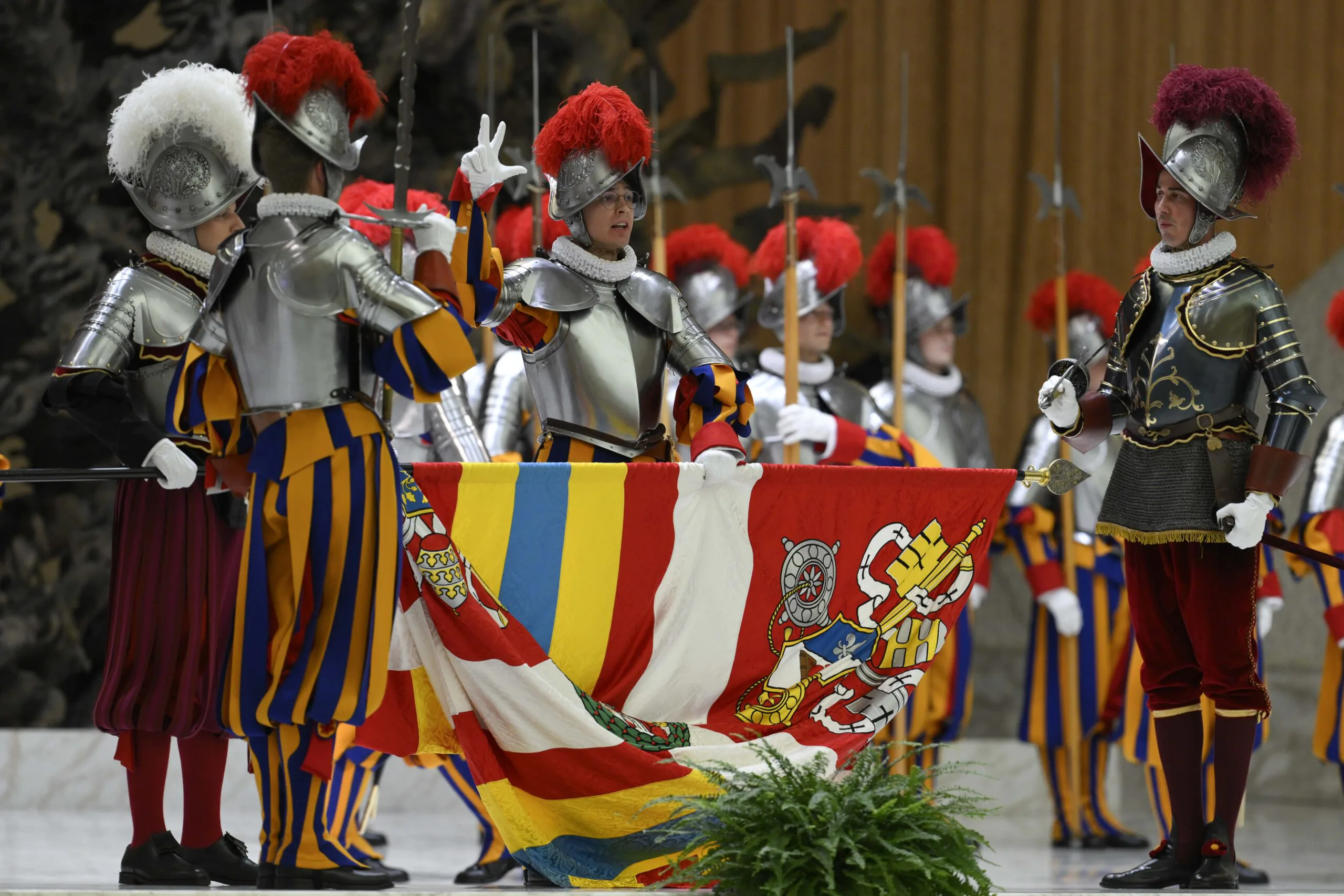
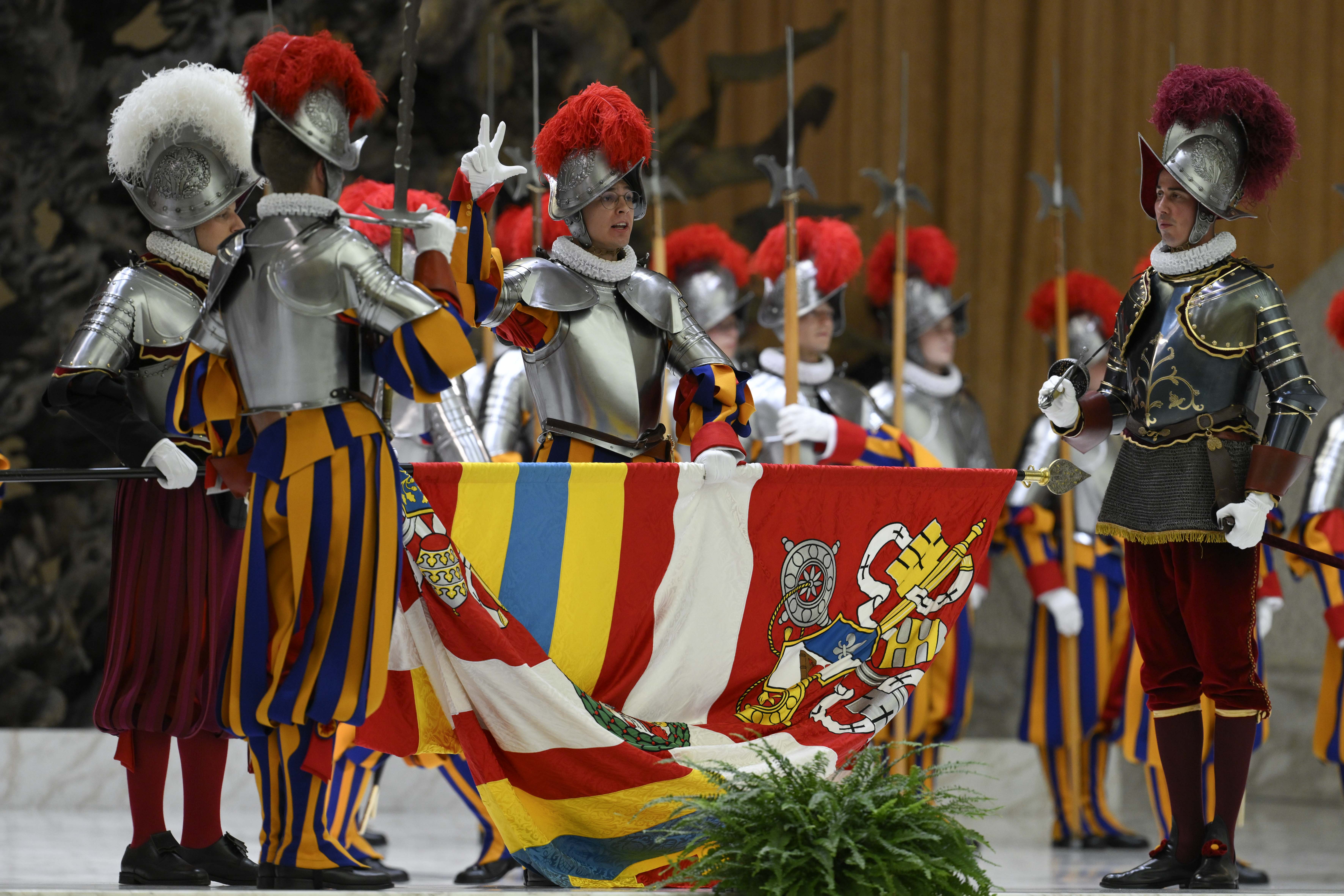
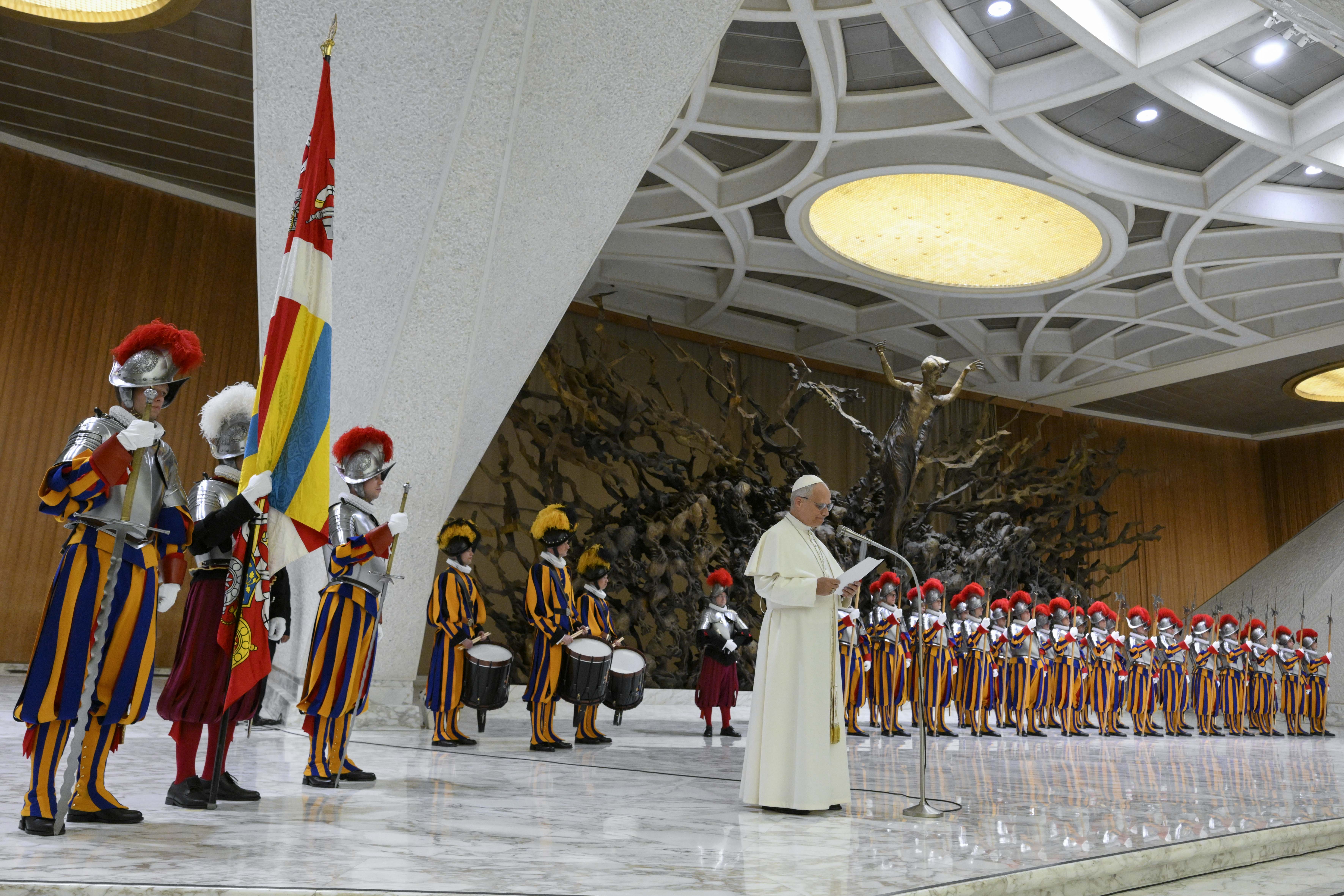
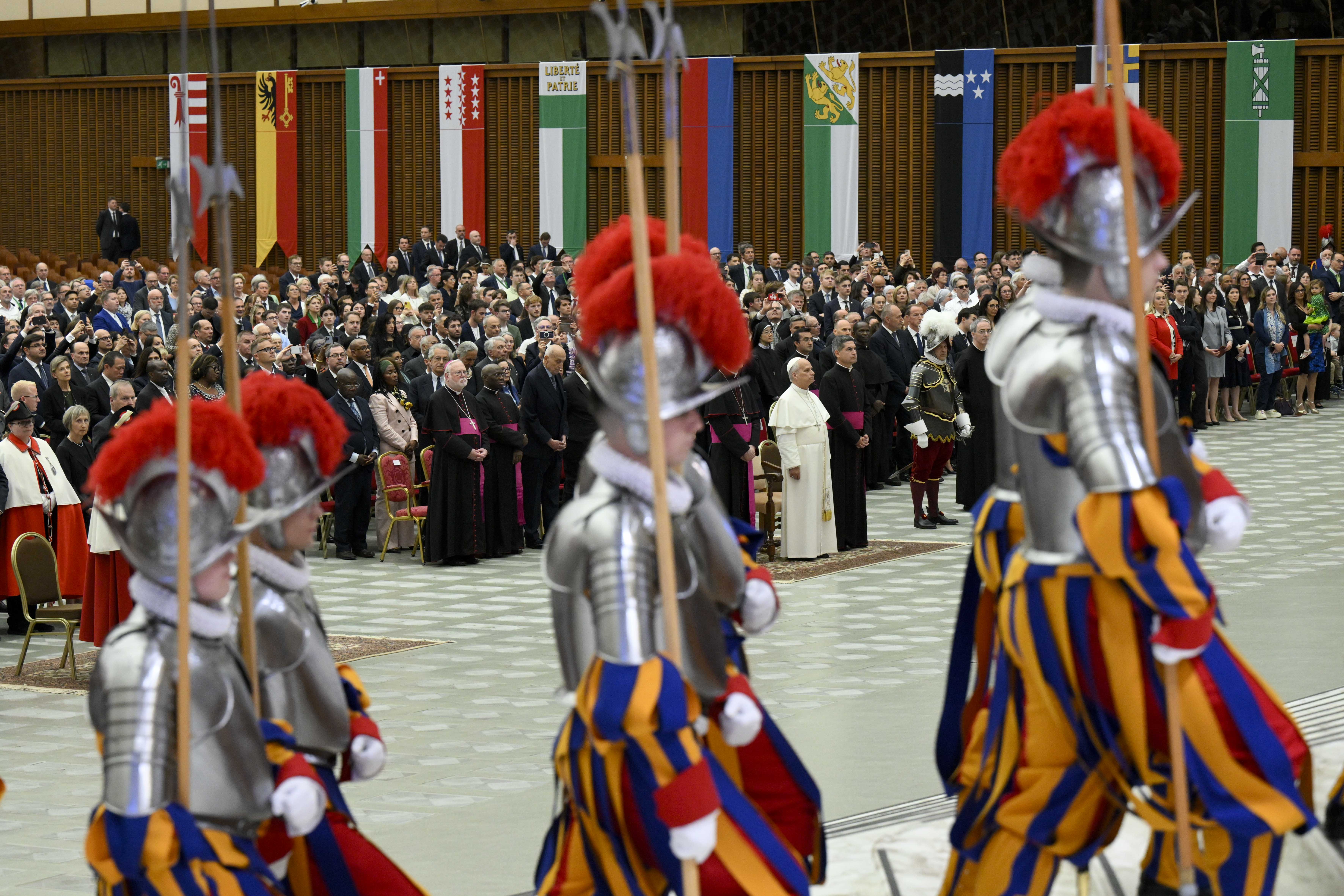
Recruits of the Pontifical Swiss Guard took their oath of allegiance to Pope Leo XIV, solemnly pledging to serve and protect him.
The ceremony took place May 6 in the Paul VI Audience Hall at the Vatican in the presence of the pontiff, members of the Holy See Diplomatic Corps, and the family and friends of the 28 recruits.
At the high point of the ceremony, in a gesture laden with tradition, each recruit held the banner of the Pontifical Swiss Guard with his left hand, raised three fingers with his right, and recited the oath swearing to protect the pope, even at the cost of his life.
Each recruit holds the banner of the Pontifical Swiss Guard with his left hand, raises three fingers with his right, and recites the oath swearing to protect the pope, even at the cost of his life, on May 6, 2026. | Credit: Vatican Media
This gesture, more than just an oath of allegiance, also commemorates the 147 Swiss Guards who died defending Pope Clement VII during the Sack of Rome on May 6, 1527.
In his address after the ceremony, Leo thanked the recruits, describing their future service as a “commitment of fidelity, inspired by youthful enthusiasm and grounded in faith in God and love for the Church.”
On Thursday, the pope held a private audience with the new Swiss Guards and their families. Leo took this occasion to remind them of the beauty of their calling and described them as servants of Christ, called not only to serve the Holy See but also those most in need.
Pope Leo XIV welcomes the Swiss Guard in a ceremony for recruits on May 6, 2026. | Credit: Vatican Media
“More than soldiers, you are servants who, in the image of Christ, go out to meet those who need your help: not only members of the Curia or officials visiting the Vatican but also pilgrims and tourists,” the pope said. “Always remember these words of Jesus: ‘Whatever you did for one of the least of these, my brothers, you did for me’ (Mt 25:40).”
Pope Leo XIV welcomes the Swiss Guard in a ceremony for recruits on May 6, 2026. | Credit: Vatican Media
Pope Leo XIV on Thursday underscored the enduring value of printed books in the digital age, saying reading “nourishes the mind” and offers Christians a valuable opportunity to proclaim Christ.
The pope made the remarks May 7 during an audience at the Vatican with employees of the Vatican Publishing House, or Libreria Editrice Vaticana, which was founded in 1926 and is celebrating its centenary this year.
The Holy Father said the book “is an opportunity to think,” defending the physicality of printed books in an increasingly digital culture because, he said, they remind readers of the importance of “thought, reflection, and study.”
“Reading nourishes the mind; it helps to foster a conscious and well-formed critical sense, guarding us against fundamentalism and ideological shortcuts,” Pope Leo said.
“For this reason, I urge everyone to read books, as an antidote to closed-mindedness, which is reflected in rigid attitudes and reductive views of reality,” he added.
The pope also emphasized that books offer an opportunity for encounter.
“When we hold a book in our hands, we ideally encounter its author,” he said. “But at the same time, we meet those who have read it before us, or who are reading it now or will read it in the future.”
Pope Leo noted that Pope Francis had taught Catholics “to practice the culture of encounter,” adding that “a book is a bridge to others, a source of dialogue that enriches us, a stimulus to expand our own perspective.”
For Christians in particular, the pope said, books can be “an opportunity to proclaim Christ.”
“We know well how reading a saint’s biography or a well-written spiritual reflection can touch the heart,” he said.
He also pointed to the Virgin Mary, who is often depicted in the Annunciation “intent on reading the holy Scriptures,” and to St. Anthony of Padua, who is commonly shown holding “the open Book of the Gospels, upon which the Infant Jesus stands.”
“We often see St. Augustine seated at a desk before a large book and, at times, holding a heart in his hand: truth and charity,” the pope said.
“At the school of Mary and the saints, let us nourish ourselves with the word of God, so that it may shape our way of thinking and acting,” Pope Leo added.
The pope concluded by recalling the words of St. Paul VI, who in 1976 met with employees of the Vatican Publishing House for its 50th anniversary and urged them to “look ahead, to refine ideas and plans for the future.”
“I thank you for your work, which I hope you will carry out with dedication and passion,” Pope Leo said. “And I cordially bless each of you and your loved ones.”
This story was first published by ACI Prensa, the Spanish-language sister service of EWTN News. It has been translated and adapted by EWTN News English.
Cardinal Pietro Parolin, the Vatican secretary of state, said on Wednesday it would be premature to discuss sanctions against the German bishops for blessings of same-sex couples.
Parolin, however, did not rule out an intervention by the Holy See but expressed hope that it would be avoided.
“It is premature now to speak of sanctions. Let us hope we never have to get to sanctions, and that problems can be resolved peacefully, as they should be in the Church,” Parolin told reporters on the sidelines at a book launch at the Patristic Institute in Rome on Wednesday.
Several members of the German Bishops' Conference, citing the Vatican declaration Fiducia Supplicans, have formalized blessings for same-sex couples in their dioceses in Germany. Recently, a 2024 letter was circulated from the Dicastery of the Doctrine of the Faith prohibiting this practice.
Pope Leo XIV has also weighed in on the issue, recently stating that the Holy See does not agree with the German bishops with the “formalized blessing of couples" beyond the allowances of Fiducia Supplicans.
Rubio to meet with Pope Leo
Parolin also weighed in on the May 7 meeting scheduled between Leo and U.S. Secretary of State Marco Rubio, and U.S. President Donald Trumpʼs recent criticisms of the pope. Parolin said the United States remains an interlocutor with the Holy See and described the latest verbal attacks against Leo as “strange.”
“We will listen to [Rubio]. We will listen to him. The initiative came from [the Trump administration]. I imagine we will talk about everything that has happened in recent days; we cannot avoid touching on these issues,” Parolin said.
Leo recently spoke to journalists at Castel Gandolfo and rejected Trumpʼs claim that the Church supports nuclear weapons. Parolin echoed those sentiments on Thursday, stating that the “Holy See has always worked, and continues to work, precisely on nuclear disarmament.”
The Vatican’s General Secretariat of the Synod published Tuesday the testimonies of two men in civil marriages with other men who describe from personal experience the tensions and wounds that have marked their life of faith within the Church.
It is the first time a Vatican text has given voice to this group in such detail. One testimony is from a man in Portugal who said he suffered a deep wound when a spiritual director suggested he could have been married to a woman to “find peace” and “use my gifts,” minimizing the affective dimension of marriage.
The man said the suggestion was painful because “it was a suggestion to harm a woman by robbing her of the chance to be completely loved and desired, all to fulfill a social expectation.” From that point, he said, he began excluding his relationship and affective life from his prayer.
The Synod also published the testimony of a U.S. Catholic man in a civil marriage with another man, an immigrant, and active in parish life. “My sexuality isn’t a perversion, disorder, or cross; it’s a gift from God,” he wrote. “I have a happy, healthy marriage and am flourishing as an openly gay Catholic.”
Both testimonies are written in English and are published on the Synod website as annexes to the final report of Study Group 9, titled “Theological Criteria and Synodal Methodologies for Shared Discernment of Emerging Doctrinal, Pastoral, and Ethical Issues.”
The U.S. testimony recalls the author’s experience with Courage, a Catholic apostolate that supports people with same-sex attraction who seek to live chastely according to Church teaching. Pope Leo XIV received members of Courage at the Vatican on Feb. 6.
The man wrote that he went to the group at the suggestion of a conversion therapist he had met to deal with his “condition.” He added: “I tried in vain to date a Catholic woman, but our relationship failed when my family faced a crisis. The time had come to be honest with myself, God, and others.”
The 32-page report, published first in Italian and presented in English as a working translation, is not a definitive doctrinal proposal. Rather, it outlines a methodological shift and will now be presented to Pope Leo XIV for study.
Drawing from the testimonies, the Synod study group says the first account describes “the devastating effects of reparative therapies aimed at recovering heterosexuality” and “contradictory advice” such as suggestions to marry a woman in order to “find peace.”
The report proposes a new approach based on listening and dialogue for addressing “emerging doctrinal, pastoral, and ethical issues,” including the experience of “people of faith with same-sex attractions.”
The text is rooted in what it calls the “principle of pastorality,” which stresses that Christian proclamation must take account of concrete persons and their lived experience. It proposes a change in approach to some of the most delicate questions in the life of the Church.
The report does not seek to offer total solutions but to open a path of discernment. Instead of speaking of “controversial” issues, as the subject of the report was originally announced, it proposes calling them “emerging” issues, understood as experiences that prompt the Church to rethink how to live and transmit the Gospel in diverse contexts.
The document explicitly recognizes the difficulty of harmonizing doctrine and pastoral practice. It says testimonies received by the study group show “how arduous it is for individuals and Christian communities to reconcile ‘doctrinal firmness’ with ‘pastoral welcome.’” It adds that polarized positions often result in “profound suffering, personal lacerations, and experiences of marginalization or ‘double lives’” for believers with same-sex attraction.
In this context, the report proposes a method based on three steps within what it calls “conversation in the Spirit”: listening to ourselves, paying attention to reality, and summoning various forms of expertise.
The text says this dynamic of listening seeks to foster a synodal Church in which the people of God actively participate in discernment.
The report also stresses the importance of paying attention to those living on existential, social, and cultural “peripheries.” It cites other examples of “emerging issues,” including the rise of adult catechumens in some local Churches, which it says calls for rethinking pastoral structures.
In addition to the testimonies of two homosexual persons, Study Group 9 includes an experience of active nonviolence, as witnessed by a Serbian youth movement that helped bring about the peaceful fall of President Slobodan Milošević on Oct. 5, 2000, drawing inspiration in part from the first Christians.
The Synod also published the final report of another study group, Study Group 7, on criteria for selecting candidates for bishop.
That report says bishops should be evaluated not only for moral integrity, doctrinal orthodoxy, pastoral sensitivity, leadership ability, and capacity to administer Church goods but also for “synodal competencies.” It quotes Pope Leo XIV as saying that a bishop’s duty is “to build communion among its members and with the universal Church by fostering the variety of gifts and ministries given for its own growth and for the spread of the Gospel.”
The report also asks the dicasteries of the Roman Curia to review their procedures in a more synodal spirit and proposes regular independent evaluation of the processes for selecting bishops.
This story was first published by ACI Prensa, the Spanish-language sister service of EWTN News. It has been translated and adapted by EWTN News English.
VATICAN CITY — Pope Leo XIV continued his catechesis on the documents of the Second Vatican Council at his Wednesday general audience, reflecting on the Dogmatic Constitution Lumen Gentium and the Church as “pilgrim in history towards the heavenly homeland.”
Speaking May 6 in St. Peter’s Square, the pope said that “the Church, in fact, journeys through this earthly history always looking towards her final destination, which is the heavenly homeland.”
“This is an essential dimension which, however, we often overlook or downplay, because we are too focused on what is immediately visible and on the more concrete dynamics of the life of the Christian community,” he said.
The pope explained that “the Church lives in history in the service of the coming of the Kingdom of God in the world.”
“She proclaims the words of this promise to all and always; she receives a pledge of it in the celebration of the Sacraments, particularly the Eucharist; she puts its logic into practice and experiences it in relationships of love and service,” he said.
Leo said Lumen Gentium makes an important affirmation about the nature and mission of the Church.
“The Church is the ‘universal sacrament of salvation’ (LG, 48), that is, the sign and instrument of that fullness of life and peace promoted by God,” he said.
“This means that she does not identify perfectly with the Kingdom of God, but is its seed and beginning, for its fulfilment will be granted to humanity and the cosmos only at the end,” the pope continued.
Because of this, he said, Christians journey through history “without being either deluded or despairing,” guided by the promise of the One who will “make all things new.”
The Church, Leo said, carries out her mission between the “already” of the Kingdom’s beginning in Jesus and the “not yet” of its promised fulfillment.
“As the guardian of a hope that enlightens the path, she is also invested with the mission of speaking clearly to reject everything that mortifies life and prevents its development, and to take a position in favour of the poor, the exploited, the victims of violence and war, and all those who suffer in body and in spirit,” he said.
The pope emphasized that the Church must always point beyond herself to Christ.
“As the sign and sacrament of the Kingdom, the Church is the pilgrim people of God on earth who, drawing precisely on the final promise, reads and interprets the dynamics of history through the Gospel, denouncing evil in all its forms and proclaiming, in word and deed, the salvation that Christ wishes to bring about for all humanity and His Kingdom of justice, love and peace,” he said.
“The Church, therefore, does not proclaim herself; on the contrary, everything within her must point to salvation in Christ,” he added.
From this perspective, Leo said, the Church must recognize “humbly the human fragility and transience of her own institutions,” which, while at the service of God’s kingdom, “bear the fleeting image of this world.”
“No ecclesial institution can be treated as absolute; indeed, since they exist within history and time, they are called to continual conversion, to the renewal of forms and the reform of structures, to the continual regeneration of relationships, so that they may truly fulfil their mission,” the pope said.
Leo also reflected on the communion between Christians still carrying out their earthly mission and those who have already completed their earthly lives and are in purification or beatitude.
He said Lumen Gentium affirms that all Christians form “a single Church” and that there is “communion and sharing of spiritual goods” founded on believers’ union with Christ.
By praying for the dead and following the example of those who lived as disciples of Jesus, the pope said, Christians are strengthened on their own journey.
“Marked by the one Spirit and united in the one liturgy, together with those who have gone before us in faith, we praise and give glory to the Most Holy Trinity,” he said.
The pope concluded: “Let us be grateful to the Council Fathers for reminding us of this most important and beautiful aspect of being Christian, and may we strive to cultivate it in our lives.”
This story was first published by ACI Stampa, the Italian-language sister service of EWTN News. It has been translated and adapted by EWTN News English.
Castori has earned several academic degrees, including a bachelor’s degree in classics from Harvard University in 1982, a master of divinity degree from the Jesuit School of Theology at Berkeley in 1998, and a doctorate in Near Eastern religions from the University of California, Berkeley, in 2008.
He also received a licentiate in sacred theology from Fordham University in 2009.
He has held several teaching roles, including as an assistant professor at Santa Clara University and the Ateneo de Manila in the Philippines.
His pastoral experience includes service as chaplain to the Tongan Catholic communities in northern California and to San Quentin State Prison.
Before being appointed to Honolulu, he served as the rector of the Arrupe Jesuit Residence in Seattle.
CASTEL GANDOLFO, Italy — Pope Leo XIV said violence must always be a last resort and rejected U.S. President Donald Trump’s claim that he supports Iran having a nuclear weapon.
The American president has repeatedly said he doesn’t want a pope who thinks Iran should have a nuclear weapon, even though the pope has never endorsed that view and has consistently spoken against nuclear arms.
Pope Leo XIV said May 5: “I have already spoken from the very first moment of being elected, and now we are close to the anniversary. I said, ‘Peace be with you,’ and the Church’s mission is to preach the Gospel, to preach peace. If someone wants to criticize me for proclaiming the Gospel, let them do so truthfully.”
“The Church has spoken for years against all nuclear weapons, so there is no doubt there. And so I simply hope to be listened to for the value of God’s words,” Leo said to the press outside the papal villa of Castel Gandolfo before returning to Rome after a daylong stay there, two days before a scheduled meeting with U.S. Secretary of State Marco Rubio.
Trump said May 4 on the "The Hugh Hewitt Show": “The pope would rather talk about the fact that it’s OK for Iran to have a nuclear weapon. I don’t think that’s very good. I think he’s endangering a lot of Catholics and a lot of people, but I guess if it’s up to the pope, he thinks it’s just fine for Iran to have a nuclear weapon.”
“I donʼt want a pope who thinks itʼs OK for Iran to have a nuclear weapon,” Trump wrote on Truth Social on April 12.
Leo has never said that Iran should have nuclear weapons, and he has spoken specifically against nuclear weapons:
“May the nuclear threat never again dictate the future of humanity," he said in a March 5 video message.
In June 2025, he called for a world free from nuclear threat in appealing for peace between Iran and Israel.
Pope Leo answered an EWTN reporter’s question about whether his statement that “God does not listen to the prayers of those who wage war” applies to all who take up arms, even in self-defense, or only to unjust aggressors.
“Self-defense has traditionally always been allowed by the Church,” Pope Leo XIV said.
“To talk about just war today, itʼs a very complex problem. You have to analyze it on many levels, but ever since the entrance into the nuclear age, the whole concept of war has to be reevaluated with terms today,” Leo said.
“I always believe that itʼs much better to enter into dialogue than to look for arms and to support the arms industry, which gains billions and billions of dollars each year, instead of sitting down at the table solving our problems and using money to solve humanitarian issues, hunger in the world, et cetera,” he said.
For a war to be justified, according to the Catechism of the Catholic Church, it must be waged to fight against a grave evil, the damage caused by waging the war cannot be graver than the evil it is meant to eliminate, there must be a serious prospect of success, and all alternatives to war must have already been tried. The decision to go to war must be made by a lawful authority responsible for the common good. All criteria must be met to qualify as a just war.
Meeting with Rubio
The pope’s meeting with Rubio this week follows a period of tension between the Holy See and the Trump administration. In April, Trump attacked the pontiff on social media, calling him “weak on crime and terrible for foreign policy” in response to the pontiffʼs appeals for peace amid the U.S.-Israel war on Iran. The pope told reporters he “perhaps” may comment on the meeting with Rubio afterward.
Brian Burch, U.S. ambassador to the Holy See, was asked May 5 about the state of the U.S.-Vatican relationship.
“I donʼt accept the idea that somehow thereʼs some deep rift,” Burch said. “I think nations have disagreements and I think one of the ways that you work through those is, as the Holy See says, is through fraternity and authentic dialogue. I think the secretary is coming here in that spirit, to have a frank conversation about U.S. policy, to engage in dialogue, to better understand each other and to work through — if there are differences — certainly to talk through that.”
The meeting will focus on “Middle East policy and our efforts there to bring about a more peaceful world,” Burch said, areas of “deep cooperation, shared interests, and in many ways, I think, shared goals.”
Burch said Rubioʼs visit “speaks to our deep desire to engage in exactly what the Holy See has called for: fraternity and authentic dialogue.”
The Church’s stance toward war is that it must be avoided. The Church has long held concerns about war to be a moral subject, with St. Augustine writing extensively about it in the early fifth century and popes and theologians both commenting on just war doctrine generally and speaking out about specific wars for centuries.
Popes seldom issue blanket rulings but Pope Benedict XV made clear World War I lacked moral legitimacy given its scale, civilian toll, and lack of proportionate ends. Pope John Paul II warned the Gulf War did not meet just war criteria. And the Vatican formally stated in 2003 that the invasion of Iraq failed just‑war standards.
In his Easter Sunday urbi et orbi message, Leo asked people of goodwill to search always for peace and not violence. He again asked people April 7 “to reject war, especially a war which many people have said is an unjust war, which is continuing to escalate and is not resolving anything,” the pope said. “We have a worldwide economic crisis, energy crisis, situation in the Middle East of great instability, which is only provoking more hatred throughout the world.”
Pope Leo XIV in his Easter homily called for peace throughout the world, urging Christians to carry the hope of the Resurrection into a world wounded by war, violence, and injustice.
Javier Romero and Brian Schumacher contributed to this story.