Pope Leo XIV on Aug. 15 called on Catholics to look to Mary, the Mother of God as an example of “true beauty,” with the Holy Father pointing to her youthful appearance in sacred art as a sign of “love that never ends.”
The Holy Father delivered the homily during Mass at the Pontifical Parish of Saint Thomas of Villanova in Castel Gandolfo, directly adjacent to the papal summer residence there. The small chapel was full for the 10 a.m. liturgy of the solemnity of the Assumption of the Blessed Virgin Mary.
In his homily reflecting on Mary’s assumption into heaven, Leo noted that “many works of art depict her as a beautiful young woman physically rising from the earth toward the heavens at the end of her earthly life.”
These depictions of a youthful Mary at the end of her life offer a contrast with “our experience of what the passing of years does to us,” the pope said. He asked rhetorically: “What do we have in common with the beautiful young woman depicted on the altarpieces of our churches?”
Mary’s glorification, the pope said, “teaches us that our true beauty does not lie in hiding the signs of aging, but in revealing the signs of love that never end, and are even impressed on our flesh.”
The pope said this sign of faith invites Catholics to “reexamine many of the aesthetic standards, predominantly hedonistic and consumerist in nature, that the world imposes on us.”
He contrasted those who look aged but who radiate “serenity, kindness and peace” with those who “are perhaps outwardly attractive but hard and cold at heart.”
“It is easy to see where true beauty lies and where, on the other hand, there is still a need for conversion, forgiveness and healing,” he said.
Love “is humanity’s most beautiful adornment,” the pope said. He urged Catholics to “follow the light of the Risen Lord” in part by “looking to Mary, whom God has crowned with glory in body and soul.”
In remarks during his midday Angelus after the Mass, Leo said viewing a depiction of Mary being assumed into heaven “allows us to contemplate our ultimate destiny” as followers of Christ.
He described the Blessed Mother as “a sign of hope and consolation” for the faithful and he invoked her blessing on “those communities that are particularly in need of consolation,” including the faithful in Ukraine and Russia, as well as those suffering from the recent earthquake in Colombia.
The solemnity of the Assumption of the Blessed Virgin Mary on Aug. 15 is an opportune time to deepen our love for the Mother of God by understanding the “place” God has assigned her for our spiritual benefit and eternal salvation.
Mary’s assumption into heaven is a dogma of faith for Catholics.
Church dogmas encompass truths concerning God, Jesus Christ, the Virgin Mary, the Church, the sacraments, and the ultimate destiny of human beings. With regard to Mary, the Church has defined four dogmas.
Below is a review of the dogmas proclaimed regarding Mary, a helpful reminder of the role she plays in God’s plan of salvation for us.
1. The Immaculate Conception
The dogma of the Immaculate Conception states that the Blessed Virgin Mary was preserved by a singular grace of God and in view of the merits of Jesus Christ from all stain of original sin from the very first moment of her conception.
The Catechism of the Catholic Church (CCC) summarizes it thus: The Virgin was “preserved immune from all stain of original sin” such that her “entirely unique holiness” was enriched “from the first instant of her conception,” which God granted her to prepare within her a dwelling place for the Incarnate Word.
This dogma was defined by Pope Pius IX on Dec. 8, 1854, through the papal bull Ineffabilis Deus. Church teaching emphasizes that this grace comes from Jesus Christ, not apart from him: Mary was redeemed in a “prevenient” (or “preceding”) and perfect manner in virtue of her Sonʼs merits.
2. Divine motherhood
Mary’s divine motherhood means that the Virgin is truly the mother of God, because Jesus Christ, her son, is one divine person with two natures, the human and the divine. Therefore, the child born of Mary according to the flesh is the eternal Son of God made man; in this sense, Mary is truly Theotokos, the Mother of God (cf. CCC, 495).
This truth was solemnly proclaimed by the Council of Ephesus in the year 431 under the pontificate of Pope Celestine I. In the 20th century, the Second Vatican Council reaffirmed this doctrine by noting that “from the most ancient times, the Blessed Virgin is honored with the title of Mother of God” (Lumen Gentium, 66).
3. Her perpetual virginity
The dogma of perpetual virginity affirms that Mary was a virgin before, during, and after the birth of Jesus. This truth has been part of the Catholic faith since the early centuries.
It is not merely a matter of noting that Mary remained a virgin up to a certain point but of professing that her virginity was perpetual. St. John Paul II recalled that the Church has consistently regarded this truth as part of the faith received and deepened throughout its history.
Unlike the Immaculate Conception and the Assumption, this dogma was not defined in a single papal bull. Maryʼs perpetual virginity was formally defined through the Second Council of Constantinople (553) and the Lateran Synod (649).
4. The Assumption of the Blessed Virgin Mary
The dogma of the Assumption of the Blessed Virgin Mary states that the Blessed Virgin, having completed the course of her earthly life, was taken up body and soul into heavenly glory. The Church does not define the exact manner in which her earthly life ended, but it does proclaim with certainty that she was fully glorified by God (cf. CCC, 966).
This dogma was solemnly proclaimed by Pope Pius XII on Nov. 1, 1950, through the apostolic constitution Munificentissimus Deus. That document reaffirms that the Immaculate Mother of God was assumed body and soul into heavenly glory.
Important to remember
Marian dogmas do not detract in any way from Jesus Christ; on the contrary, they reveal the greatness of God’s saving work in the Virgin Mary. Therefore, authentic Marian devotion never separates Mary from Jesus Christ but rather contemplates her as the Lord’s first and most perfect disciple.
This story was first published by ACI Prensa, the Spanish-language sister service of EWTN News. It has been translated and adapted by EWTN News English.
Pope Leo XIV has appealed to all people to recognize the suffering of child migrants, noting that they are often the most vulnerable during mass migration.
In a message published by the Vatican on Aug. 14, the pope reflected on the theme for the 112th World Day of Migrants and Refugees, “Even Just One of These Children,” drawn from Matthew 18:5. The initiative is organized by the Vatican’s Dicastery for Promoting Integral Human Development.
Leo highlighted the growing challenges faced by minors forced to migrate from their home countries, including human trafficking, loss of parents, and sexual violence.
“Sadly, migrant children are more easily ignored, because they lack adults capable of protecting and supporting them,” Leo said in his message.
“To this already appalling situation are added further tragedies: deaths along migration routes, trafficking and exploitation, the recruitment of minors for use in armed conflicts, sexual violence, forced marriages, and the atrocities they have suffered or witnessed during their travels.”
He also noted the contributions of families, civil society, and Church communities in helping child migrants.
“We think of the families who open the doors of their homes in order to restore to these children the warmth of a family hearth; the educators who serve in reception centers; the volunteers and aid workers who each day devote themselves to healing the invisible wounds of these little ones along migration routes and in our cities,” Leo said.
The pope then appealed to civil institutions to work to improve protections for migrant children to uphold the dignity of every child.
“Even just one of these children, in the context of civil institutions, calls us to reaffirm the principle of the best interests of the child. Public and private institutions are bound to prioritize the protection and dignity of every single child and adolescent,” he said.
Pope Leo XIV has emphasized the need for priests to remain faithful to the texts and instructions of the Mass and to receive the proper formation to celebrate the sacred liturgy with dignity.
“I have called attention to the respect that all those called to prepare the celebration of the divine mysteries, and priests in particular, must show toward the rites promulgated by Pope Saint Paul VI and Pope Saint John Paul II,” the pontiff wrote in a letter addressed to Cardinal Arthur Roche, prefect of the Vatican’s Dicastery for Divine Worship and the Discipline of the Sacraments, published Aug. 14.
“It is vital that this respect ‘springs from an inner attitude of openness and trust in God, manifesting humility before his greatness and sincere fidelity to ecclesial communion,’" Leo added.
Roche is participating in a conference on liturgical formation organized by his dicastery at the Benedictine Abbey of Mount Angel in Oregon from Aug. 14–19. Other participants include cardinals, bishops, and laypeople with diverse Church experiences.
According to the dicastery, the meeting is intended to be “a joint reflection with the aim of defining shared, concrete, and practical proposals.”
“The choice of a monastic community signifies the intention to engage in dialogue within a prayerful setting,” the press release states. “Rather than a scholarly conference, it will be a time of spiritual discernment on the theme of liturgical formation, to continue along the path charted by Sacrosanctum Concilium.”
In Leo’s letter, he stressed the need for clergy and laity to receive ongoing liturgical formation, citing Pope Francis’ apostolic letter on the liturgy, Desiderio Desideravi.
“In his Apostolic Letter Desiderio Desideravi … Pope Francis emphasized the need for an attentive and ongoing formation of clergy and laity alike in revitalizing the liturgical life of the universal Church,” Leo said. “I would therefore encourage you to explore concrete paths for liturgical formation at every level in the Body of Christ.”
One practical opportunity for liturgical formation, he said, is in the regular gathering for Mass on Sundays.
“These celebrations are anchored in the annual rhythm of the liturgical year, with the Paschal Mystery at its center. For this reason, it is essential that they also be profoundly formative, promoting an ever deeper understanding of the ars celebrandi, expressed not only by the celebrant of the liturgy, but also by the entire assembly,” the pope said. “In this way, through proper education and reverent worship, Catholics will be formed both for the liturgy and by the liturgy.”
As the pontiff also noted in his letter, his remarks follow his recent addresses on the Second Vatican Council’s constitution on the liturgy, Sacrosanctum Concilium, during Wednesday general audiences.
In his Aug. 12 audience, Leo encouraged the faithful to attend Sunday Mass and warned that virtual gatherings cannot replace in-person attendance.
Pope Leo XIV has directed the Office of Papal Charities to send 100,000 euros ($115,345) to the Catholic Church in Colombia to aid those affected by the Aug. 10 earthquake, which struck several cities in the western part of the country.
As reported by Vatican News, the donation was confirmed on the website of the Colombian Bishops’ Conference (CEC, by its Spanish acronym). The aid was made possible through the coordination of the prefect of the Dicastery for the Service of Charity, Archbishop Luis Marín de San Martín, with the apostolic nunciature in the country and the president of the CEC, Archbishop Javier Múnera.
The CEC announced that the funds will be sent to the National Secretariat for Social Pastoral Care-Caritas Colombia, the entity acting “as a coordination center for the collection and distribution of aid, with the aim of helping to address the most urgent needs of the affected communities.”
“The €100,000 in aid constitutes an initial response to address the most urgent emergencies. According to information provided by the Holy See, additional assistance will be made available as new needs are identified and promptly communicated to the Dicastery for the Service of Charity,” the CEC reported.
Given the extent of the damage in various dioceses such as Pereira, Cali, and Quibdó, among others, the CEC said that “in the coming days, work will continue on compiling a report regarding the priority needs of the affected communities, with the aim of directing aid to those who need it most.”
During his Aug. 12 general audience, Pope Leo XIV once again expressed his closeness “to our brothers and sisters in Colombia who have suffered the consequences of the recent earthquake, which has caused many deaths and injuries, as well as extensive material damage.”
“As I pray to the Lord for the eternal rest of the deceased, I assure you of my prayers for their families and all those affected by this tragedy. I express my gratitude to all those working on rescue and relief efforts for the victims,” the pope said.
Meanwhile, the Colombian government declared three days of national mourning “in memory of the people who lost their lives as a result of the 7.4-magnitude earthquake that occurred on Aug. 10.”
The Ministry of the Interior noted in a statement that Mondayʼs earthquake “is the greatest-magnitude quake recorded in Colombia during the 21st century, causing damage in various departments [administrative districts] and giving rise to a profound sense of solidarity throughout the country.”
This story was first published by ACI Prensa, the Spanish-language sister service of EWTN News. It has been translated and adapted by EWTN News English.
Pope Leo XIV is a pope of several firsts: the first American pope, the first to be an Augustinian, and the first in modern times to have done overseas missionary work.
He is also the first pontiff in nearly 50 years to have studied and worked as a canon lawyer, holding a doctorate in canon law from the Pontifical University of St. Thomas Aquinas (the Angelicum) in Rome.
During his papacy, canon law has featured in some of the most important events of his reign. From the excommunication of four bishops consecrated for the SSPX to his recent appointments as Vatican judges, to the Marko Rupnik trial to his curial appointments, canon law has become a key aspect of understanding Leo’s pontificate.
However, for many Catholics, canon law is more than merely a feature of Vatican administration. It is important to Catholics' relationship with the Church, especially in upholding justice — the very purpose of canon law.
Marriages, eligibility to receive the sacraments, and the allocation of Church property are among the most basic, often overlooked, uses of canon law.
Here are some important things to know about canon law and how it applies to Catholics.
What is canon law?
Canon law is the collection of all the laws that regulate the life of the Church. The word canon itself comes from the Greek word “kanōn,” which means to measure. Unlike civil law, however, canon law exists to uphold spiritual discipline, maintain relationships between the laity and the Church hierarchy, and protect rights. Ultimately, as stated in the 1983 code, the purpose of all Church laws is the salvation of souls.
Among the oldest legal systems
The Catholic Church’s canon law system is the oldest continuously functioning legal system in the West. The Church’s earliest laws were issued as decrees, or canons, by ecumenical councils, regulating the Church’s daily life. After Christianity became more established in the Roman Empire, the popes also issued decrees influenced by Roman legal theory and traditions. By the 12th century, it had developed into a fully functioning legal system and has governed the Church ever since.
How does canon law affect Catholics?
Primarily, canon law contains rules about who can receive the sacraments. For example, the requirement to say “I baptize you” instead of “We baptize you” during baptism, the prohibition against using grape juice for holy Communion, and the seal of confession are all regulated by canon law.
Marriage annulments — the determination of whether a marriage is valid — are among its most common applications.
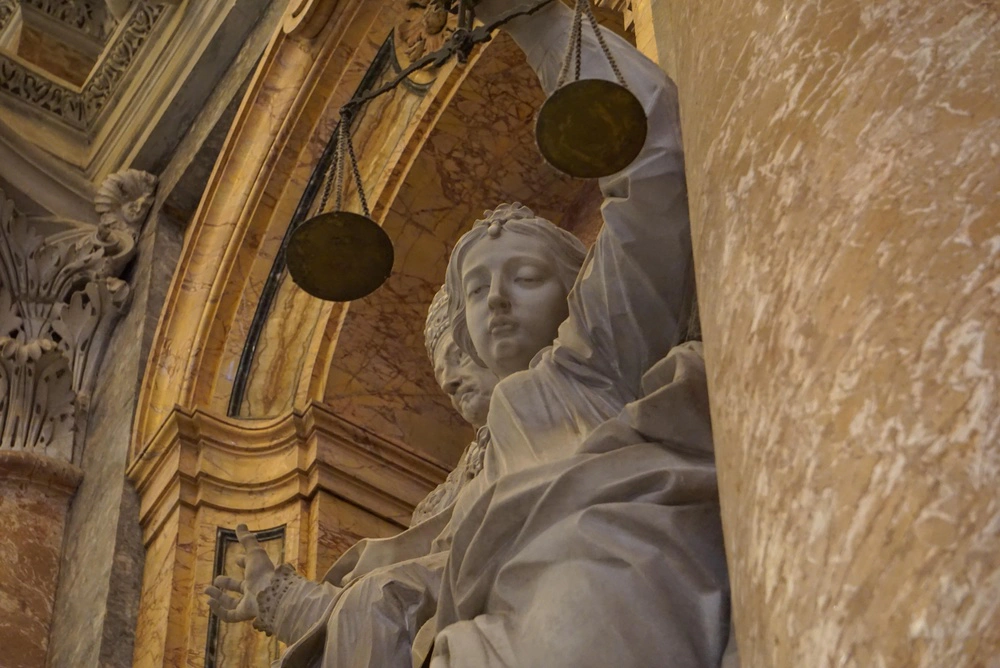
Detailed close-up of a Renaissance marble statue depicting Lady Justice, the ancient Roman goddess Justitia, with scales inside St. Peter’s Basilica at the Vatican. | Credit: Alexander Ruszczynski/Shutterstock
The 1983 code — a Catholic ‘Bill of Rights’
Before the 20th century, the Church did not have a single legal code governing all Catholics. That changed when St. Pius X ordered a compilation of all Church laws into a single code, completed in 1917 by Pope Benedict XV. In 1983, St. John Paul II revised the code to incorporate the teachings of the Second Vatican Council. The 1983 Code of Canon Law — the current code in use — heavily emphasizes the rights and duties of laity and clergy, stating that “there exists among all the Christian faithful a true equality regarding dignity and action.”
‘Civil law punishes; canon law heals’
The quote “Civil law punishes; canon law heals” from 12th-century Byzantine canonist Theodore Balsamon highlights the distinct purposes of civil and canon law. Whereas civil law exists to maintain social order, canon law exists to facilitate salvation.
Officials are elected to uphold society’s rules, while the pope — as the Church’s supreme legislator — appoints bishops to dioceses to not only uphold Church law but also to teach, govern, and sanctify, as stated in paragraph 21 of Lumen Gentium, the dogmatic constitution on the Church.
Moreover, a diocesan bishop, according to canon 391 of the 1983 code, has “legislative, executive, and judicial power” over his diocese, meaning he can establish diocesan laws. Daily judicial matters of the diocese are usually handled by its tribunal, especially cases involving marriage, parish property, and abusive clergy.
The Church sometimes defers to civil law in nonreligious matters, such as contracts, labor laws, and certain criminal cases. For cases of clerical sexual abuse, however, the Church may conduct a separate internal canonical investigation, which could lead to restrictions on ministry or even dismissal from the clerical state.
How to become a canon lawyer
Clergy and laity worldwide study each year to practice canon law in the Church. To become a canon lawyer, usually one must first earn a licentiate of canon law (JCL). Before 1979, canonical studies were largely limited to clergy. Now, with adequate philosophical and theological education, any priest or layperson can be admitted to the licentiate program. Some of the most renowned schools for canon law are The Catholic University of America in Washington, D.C., and the Pontifical Gregorian University and the Pontifical University of the Holy Cross, both in Rome.
The role of the Vatican
The Holy See supervises all Church tribunals primarily through the Apostolic Signatura — the Church’s highest court. Every diocese has a tribunal (court), and the Signatura oversees them on behalf of the pope, who is the Church’s supreme judge. There are two other Vatican courts: the Roman Rota, which mainly handles appeals in marriage cases, and the Apostolic Penitentiary, which deals with indulgences and certain absolutions from sin reserved to the Holy See.
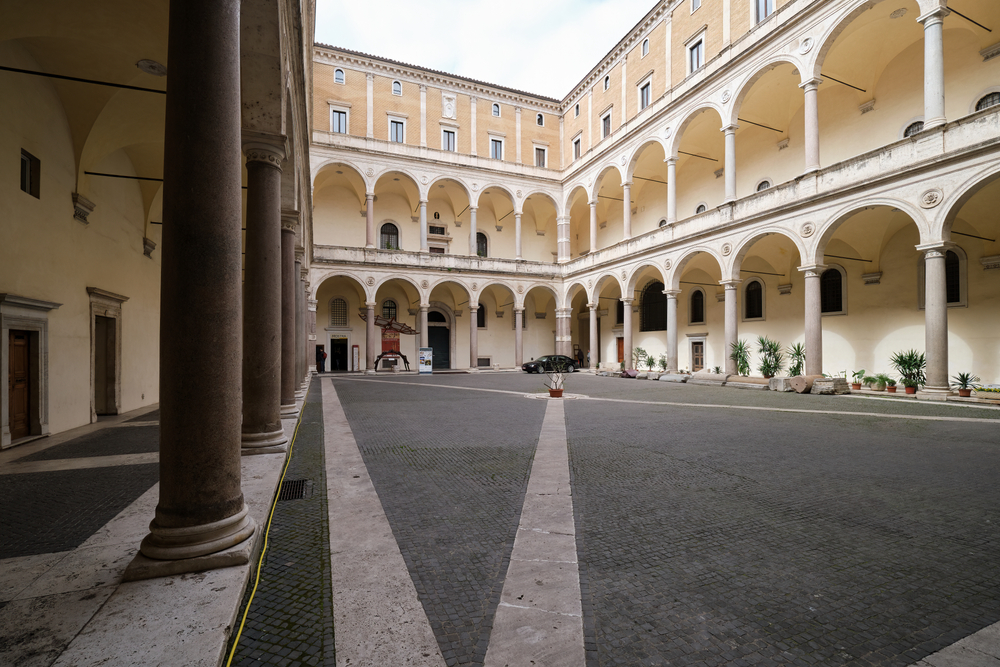
The courtyard of the Palazzo della Cancelleria, a Renaissance palace in Rome, which serves as the headquarters of the Supreme Tribunal of the Apostolic Signatura. | Credit: Alexander Reuter/Shutterstock
The Eastern churches have their own code
A separate code of canon law governs the more than 20 Eastern Churches in communion with Rome, including the Maronite, Ukrainian Greek Catholic, and Chaldean Catholic Churches. The Second Vatican Council affirmed the right of the Eastern churches to preserve their own traditions, including their legal traditions. St. John Paul II issued a code for those churches in 1990, reflecting the diversity of the Church’s legal customs. Its full title is the Code of Canons of the Eastern Churches.
Leo’s experience as a canon lawyer
Before becoming pope, Leo spent more than a decade studying and practicing as a canon lawyer. The then-Father Robert Prevost studied canon law at the Angelicum in Rome, earning a license in 1984 and a doctorate in 1987. During his missionary work in Peru, he taught canon law at the seminary level and served as a judge. His experience would serve him during his leadership of the Augustinians and as the head of the Vatican’s Dicastery for Bishops.
During his papacy so far, Leo has chosen some of his collaborators within the Roman Curia for their legal experience, highlighting the importance of canon law for protecting the rights of the faithful and assisting them toward salvation.
VATICAN CITY — Pope Leo XIV has urged Catholics to prioritize attending Sunday Mass, warning that active participation in the Eucharist cannot be replaced by virtual gatherings.
“I urge everyone to seek the best possible conditions so that even those who are unable to take time off work on Sundays may take part in holy Mass,” Leo said.
In his address during his general audience at the Vatican on Aug. 12, the pontiff continued his catechesis on the Second Vatican Council’s constitution on the liturgy, Sacrosanctum Concilium.
As on Aug. 5, his general audience was held inside St. Peter’s Basilica due to Rome’s high summer temperatures.
The liturgical year according to Pius XII and Prosper Guéranger
Leo explained the importance of the liturgical year, referencing his predecessor Venerable Pope Pius XII as well as Servant of God Abbot Prosper Guéranger, OSB, the first abbot of Solesmes Abbey in France and a key figure in the liturgical movement.
It is “important to note that this way of referring to the cycle of Christian feasts as the ‘liturgical year’ became widespread in ecclesiastical language thanks to the work of the Servant of God Abbot Prosper Guéranger,” Leo said in his remarks.
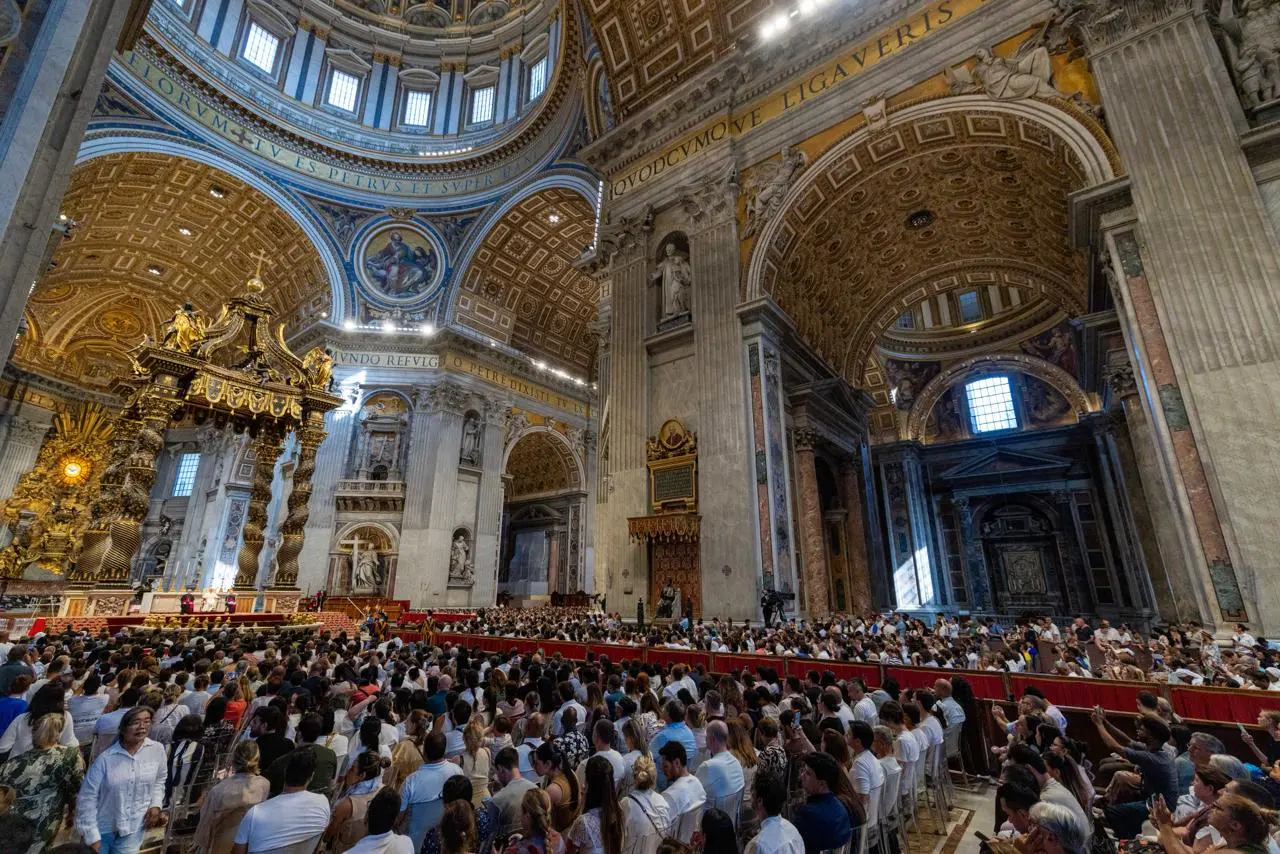
The faithful gathered in St. Peter’s Basilica during Pope Leo XIV’s general audience on Aug. 12, 2026. | Credit: Daniel Ibáñez/EWTN News
The pope also stressed that the liturgical year is not merely a remembrance of past events but, as Pius XII wrote in his encyclical Mediator Dei, “Christ himself, who is ever living in his Church.”
“The liturgical year should thus be understood as a constant renewal of the work of salvation which Christ accomplishes in history,” the pope said. “As she journeys through this temporal cycle, the Church remains in contact with the Lord’s redemptive action, so that all the faithful may be filled with his grace.”
The importance of Sunday Mass
Leo also explained that the Church has always regarded Sunday as a weekly celebration of Christ’s resurrection: the “dies Domini” (“the Lord’s day”).
He urged Catholics to attend Sunday Mass and warned against using virtual gatherings to substitute for in-person attendance.
“To sanctify Sunday, it is essential to celebrate the Eucharist,” Leo said. “This assembly cannot be substituted by a solely virtual presence, nor can it be reduced to a merely passive gathering.”
“The liturgical assembly is in fact fulfilled through the active participation of brothers and sisters,” Leo added.
Leo’s continued closeness to Colombia amid earthquake
The pope again expressed his spiritual closeness to the victims of a 7.4-magnitude earthquake that struck western Colombia on Aug. 10, which has killed at least 250 people, according to reports.
“As I pray to the Lord for the eternal rest of those who have died, I assure their families and those affected by this tragedy of my prayers. I express my gratitude to all those working in rescue and assistance efforts for those affected,” Leo said in Spanish.
The previous day, Aug. 11, the pope sent a telegram through Vatican Secretary of State Cardinal Pietro Parolin expressing his sorrow upon learning of the earthquake.
Pope Leo XIV on Aug. 11 named eight new members, including four laypeople, to the Council for the Economy, the body that oversees the administrative and financial structures and activities of the Roman Curia and institutions connected to the Holy See.
The council also approves the annual budget and the consolidated financial statements of the Holy See and submits them to the pope.
Members are appointed by the pope for a five-year term and, according to the constitution of the Roman Curia, are always divided between eight cardinals or bishops and seven expert laypeople chosen from diverse nationalities.
The new cardinals appointed to the council Aug. 11 are Grzegorz Ryś, archbishop of Krakow, Poland; Ladislav Nemet, SVD, archbishop of Belgrade, Serbia; Jean-Paul Vesco, OP, archbishop of Algiers, Algeria; and Roberto Repole, archbishop of Turin, Italy.
Among the laypeople, Pope Leo appointed HSH Gisela Bergmann, princess of Liechtenstein and the daughter of HSH Prince Michael of Liechtenstein. The 36-year-old holds a degree in engineering and has worked in various positions in investment banking and engineering in England, Canada, Singapore, and Switzerland.
Since 2022, Bergmann has been CEO of Industrie-Und Finanzkontor, a financial company founded by the princely family of Liechtenstein.
Leo also appointed French businessman and philanthropist Denis Duverne, who has been chair of the board of directors of the French multinational insurance corporation AXA since 2016. He has a background in regulatory affairs in France and abroad.
The pope also appointed two Italians to the council. Elena Principato-Wettstein, an Italian currently based in Switzerland, is executive director and head of sales management WM Europe International at UBS, the Swiss multinational investment bank and financial services firm.
Paolo Nusiner, meanwhile, has had a long career managing Catholic institutions in Italy, including holding the top positions at the Catholic newspaper Avvenire and the Catholic University of the Sacred Heart in Milan.
He has been director for general affairs at the Vatican’s Dicastery for Communication since 2015 and president of the Isola Tiberina-Gemelli Isola Hospital in Rome since 2022.
Leo confirmed the following people, originally appointed by Pope Francis, for additional five-year terms: Cardinal Odilo Pedro Scherer, archbishop of São Paulo, Brazil; Cardinal Gérald Cyprien Lacroix, ISPX, archbishop of Québec, Canada, and primate of Canada; Cardinal Joseph William Tobin, CSSR, archbishop of Newark, New Jersey; Leslie Jane Ferrar, trustee of the Archdiocese of Westminster, Great Britain; Alberto Minali, chief executive officer of REVO Insurance; and Father Brian Edwin Ferme, a canon lawyer and secretary of the council.
Cardinal Reinhard Marx, who has led the council since it was established by Pope Francis in 2014, will also continue in his position, as will the council’s vice coordinator, the German legal scholar Charlotte Kreuter-Kirchhof.
According to the constitution of the Roman Curia, Praedicate Evangelium, the council “carries out its functions in the light of the social doctrine of the Church, following the best practices recognized internationally in the field of public administration and striving for an administrative and financial management that is both ethical and efficient.”
Amid the devastation of a 7.4-magnitude earthquake that struck western Colombia on Aug. 10, Pope Leo XIV has sent his condolences to all victims of the disaster and assured them of his closeness.
In a telegram dated Aug. 11 and signed by Secretary of State Cardinal Pietro Parolin, the pope expressed his sorrow upon learning of the earthquake, which, according to an Aug. 11 BBC news report, has killed at least 132 people and injured 570.
It has also severely damaged several buildings, including the Cathedral Basilica of Our Lady of the Rosary, also known as the Manizales Cathedral.
“The Holy Father,” according to the telegram, is “deeply saddened to learn of the sorrowful news of the earthquake that has severely affected several areas of Colombia, causing casualties and numerous injuries, as well as serious material damage, including to many churches.”
The telegram added that the pontiff “offers prayers for the eternal rest of the deceased and raises his prayers to the Lord for the speedy recovery of those affected by this tragedy.”
The message, addressed to the archbishop of Cartagena and president of the bishops’ conference of Colombia, Archbishop Francisco Javier Múnera Correa, ICM, asks him “to convey the heartfelt condolences of His Holiness Leo XIV to the families who, in this hour of profound sorrow, mourn the loss of their loved ones.”
Local and national authorities continue to assess the casualties and damage from the earthquake, concentrated in the municipality of San José del Palmar in the department of Chocó, located on the Pacific coast.
On its social media, the Archdiocese of Manizales shared a video showing cracks in the facade and the partial collapse of one of the side towers of the Manizales Cathedral, which stands 390 feet tall, making it the tallest cathedral in Colombia and the tallest neo-Gothic church in the Americas.
Pope Leo XIV has chosen “Disarming Technology, Serving Peace. Politics as Preventive Responsibility” as the theme of the 2027 World Day of Peace.
The theme will be part of the celebrations for the 60th World Day of Peace, observed on Jan. 1, 2027, the Vatican’s Dicastery for Promoting Integral Human Development announced on Aug. 11.
The announcement referenced Leo’s encyclical Magnifica Humanitas, highlighting his appeal to civil leaders to prioritize humanitarian principles and shared responsibility.
Quoting from Magnifica Humanitas, the Vatican said that Pope Leo, “recalling that ‘no algorithm can make war morally acceptable’ and warning of the risks involved in entrusting military decisions to artificial intelligence … makes a fervent appeal to the international community to foster shared agreements capable of safeguarding human responsibility and humanitarian principles in situations in which human life and peaceful coexistence among peoples are at stake.”
The Aug. 11 statement also explained that the pontiff had chosen this theme to “draw attention to the moral responsibility of those called to serve in the public sphere.”
The World Day of Peace was instituted by St. Paul VI, who proposed it on Dec. 8, 1967, the solemnity of the Immaculate Conception. The Church first celebrated the day on Jan. 1, 1968, the solemnity of Mary, Mother of God.
The observance has often been an occasion for popes to highlight the relevance of Catholic social teaching to global challenges, including war, the right to life, and international diplomacy.