The traditionalist Society of Saint Pius X (SSPX) issued an open letter and a declaration of faith to Pope Leo XIV and the College of Cardinals on June 24.
Ahead of the extraordinary consistory of the cardinals at the Vatican on June 26-27 and the SSPX’s upcoming episcopal consecrations on July 1 without papal approval, the group issued the letter as well as the declaration reaffirming their attachment to Church tradition.
“We are convinced that Tradition contains all the remedies for the deepest ills afflicting the Church and the world, for which solutions are sought in vain outside of it,” the SSPX stated in their open letter.
The accompanying declaration contains 154 statements defending traditional Church teachings, including on the sacraments, divine revelation, the Virgin Mary, the rejection of ecumenism, and fidelity to the Traditional Latin Mass.
These documents from the SSPX mark the latest development in a series of public disagreements with the Holy See over the SSPX’s planned episcopal consecrations without papal approval.
The Vatican stated on May 13 that the consecrations would be a schismatic act, resulting in automatic excommunication for the consecrating bishops and those consecrated.
On June 16, Pope Leo warned the SSPX that their planned episcopal conscrations risk schism.
“We have invited them, and I am still considering making another appeal, to say: ‘Do not do this. Let us try to live in communion in the Church.’ But it is their choice. They must understand what it means for them and for the Church,” the pope said, responding to journalists’ questions outside Villa Barberini in Castel Gandolfo on June 16.
The SSPX exclusively celebrates the Traditional Latin Mass and has rejected certain teachings and reforms of the Second Vatican Council, particularly regarding religious freedom and the Church’s approach to other faiths.
The Holy See Press Office did not respond to a request for comment by the time of publication.
St. John the Baptist, the forerunner of Christ, is one of only three people in history — after Jesus and Mary — whose birthday is celebrated in the Church’s liturgy.
In fact, the Nativity of St. John the Baptist on June 24 is a solemnity, meaning it is the highest form of Catholic feast day. And because it falls exactly six months before the solemnity of the Nativity of Our Lord, it is sometimes known as “Summer Christmas.”
“The Church observes the birth of John as in some way sacred; and you will not find any other of the great men of old whose birth we celebrate officially. We celebrate John’s, as we celebrate Christ’s,” St. Augustine of Hippo said in his sermon 293.
In the Mass for the solemnity, the priest prays to God in the preface that in Christ’s precursor, “St. John the Baptist, we praise your great glory, for you consecrated him for a singular honor among those born of women.”
“His birth brought great rejoicing; even in the womb he leapt for joy at the coming of human salvation. He alone of all the prophets pointed out the Lamb of redemption,” the prayer continues. “And to make holy the flowing waters, he baptized the very author of baptism and was privileged to bear him supreme witness by the shedding of his blood.”
St. Augustine explained that “John, it seems, has been inserted as a kind of boundary between the two Testaments, the Old and the New. That he is somehow or other a boundary is something that the Lord himself indicates when he says, ‘The Law and the prophets were until John.’ So he represents the old and heralds the new. Because he represents the old, he is born of an elderly couple; because he represents the new, he is revealed as a prophet in his mother’s womb.”
John’s connection to Christ
Father Mauro Gagliardi, a theologian and liturgist who teaches in Rome, wrote in a 2009 article on Zenit that it is important to emphasize John the Baptist’s role as “indicator.” John is “a prophet who refers back to Christ.”
The liturgy, Gagliardi said, does the same thing, and thus the June 24 solemnity “reminds us of this: The Christian liturgy is a powerful indicator of Christ to the peoples, like [John] the Baptist.”
John the Baptist’s feast day also has cosmic connections, the theologian pointed out. The fact that June 24 is close to the summer solstice demonstrates the fulfillment of the prophecy in John 3:30 that “he must increase; I must decrease,” since after John’s birthday the days get shorter, or “decrease,” while after Jesus’ birthday on Dec. 25, the days get longer, or “increase.”
“This interweaving between a figure from the history of salvation — John — and the cosmic rhythms (both guided by the same God) has found a fruitful development in the devotion and liturgy of the Church,” Gagliardi said.
Popular customs of ‘summer Christmas’
The Church’s liturgical commemoration of St. John the Baptist dates back to the fourth century.
Acknowledgement of the saint’s importance can also be noted in his shared patronage, together with St. John the Apostle, of Rome’s Archbasilica of St. John Lateran, which is also the seat of the bishop of Rome — that is, the pope.
The night of June 23 is known in some countries, including Italy, as “St. John’s Eve.” Due to the solemnity’s timing, shortly after the summer solstice, some of the practices connected to the feast have a pagan character, including that some refer to it as “the Night of the Witches.”
Modern-day secular festivities may include concerts and theatrical performances, while Catholics usually celebrate Mass and hold religious processions.
One of the most typical customs related to St. John’s Eve, both secular and religious, is the bonfire, called in some countries “St. John’s Fires,” which are lit in honor of the saint who “was not the light, but came to testify to the light (Jn 1:8).” Fireworks or candle-lit processions can also take the place of bonfires.
In an Angelus message on June 25, 2006, Pope Benedict XVI said the feast of St. John the Baptist “reminds us that our life is entirely and always ‘relative’ to Christ and is fulfilled by accepting him, the Word, the Light, and the Bridegroom, whose voices, lamps, and friends we are.”
“‘He must increase, but I must decrease’ (Jn 3:30): The Baptist’s words are a program for every Christian,” Benedict said.
This story was first published on June 24, 2024, and has been updated.
As Pope Leo XIV carries out his global mission, the Vatican is calling on the faithful worldwide to support him through the traditional Peter’s Pence collection this Sunday, June 28, the day before the solemnity of Sts. Peter and Paul.
No contribution is too small; every gift counts: It doesn’t matter whether you can offer a grain of sand or a mountain; what truly matters is participating and giving what is within your means, according to Peter’s Pence Office.
To support this initiative, the Vatican Secretariat for the Economy and the Dicastery for Communication have prepared a series of informational and multimedia materials.
What is Peterʼs Pence?
The Peterʼs Pence website explains that it is an offering “which may be small in amount, but holds great symbolic value,” as it “demonstrates a sense of belonging to the Church and of love and trust in the Holy Father.”
It is also “a concrete sign of communion with him as the successor of Peter, and of concern for the most needy, whom the pope always cares for.”
Peter’s Pence has two purposes. The first is “to support the mission of the Holy Father, which extends to the entire world through the proclamation of the Gospel, the promotion of integral human development, education, peace, and fraternity among peoples.”
A second purpose is “to support numerous charitable works benefiting individuals, families in difficulty, and populations affected by natural disasters and wars, or those in need of assistance or development aid.”
How did Peterʼs Pence originate?
Peterʼs Pence, as a donation to the pope, began to take place on a regular basis in the 7th century with the conversion of the Anglo-Saxons. Over time, more European peoples joined the practice. In the Middle Ages, the term was used to designate the annual contribution made by states to the Holy See, a custom that eventually fell out of use.
In modern times, specifically around 1870, following the end of the Papal States, the practice of making material contributions to the Vatican picked up again across Europe. The pope was able to provide aid to the needy, such as those affected by an earthquake in Croatia in 1881.
How is the money used now?
The website presents reports on the use of the funds raised. In 2024, for example, donations totaled 58.5 million euros ($66.5 million) of which 13.3 million euros ($15.1 million) were used to help those most in need, funding 239 charitable projects across 66 countries.
The remaining funds — the majority of the collection — supported the broader apostolic mission of the Holy Father and the Holy See. Specifically, 61.2 million euros helped cover essential activities carried out by Vatican dicasteries and offices, including evangelization efforts, support for local churches in difficulty, formation of priests and seminarians, diplomatic work through apostolic nunciatures, education, and the promotion of integral human development and peace.
This story was first published by ACI Prensa, the Spanish-language sister service of EWTN News. It has been translated and adapted by EWTN News English.
Pope Leo XIV on June 24 appointed Puerto Rican priest Father Geraldo Ramírez Torres as the new bishop of the Diocese of Ponce in the Caribbean territory.
The pontiff also accepted the resignation of Bishop Rubén Antonio González Medina, C.M.F., who has led the diocese since 2015.
According to a Vatican press release, Ramírez was born in Villalba, Puerto Rico, on Nov. 17, 1967. He was ordained a priest of the Diocese of Ponce on Nov. 19, 1991.
His academic training included a bachelor’s degree in theology at the Pontifical Catholic University of Puerto Rico.
He served as a parish priest and chaplain for several parishes in the Ponce diocese before his appointment as bishop. He served as vicar general of the diocese since 2021 and as parish priest of the dioceseʼs Cathedral of Our Lady of Guadalupesince 2004.
Known as “Father Jerry,” Ramírez told El Visitante de Puerto Rico in 2016 that he owed his priestly vocation to “a devout family and the example and dedication of the Marianist priests and brothers.”
“I accepted the call aware that I wasnʼt the best clay, but with the conviction that he is indeed the greatest and best potter,” the priest told the Catholic newspaper on the occasion of his 25th anniversary of priestly ordination.
The diocese of Ponce is one of six Roman Catholic dioceses in Puerto Rico and is a suffragan diocese of the Archdiocese of San Juan de Puerto Rico, all of which are a part of the Catholic Church in the United States.
Pope Leo XIV this week emphasized the importance of writing, describing it as a human expression of truth that ultimately leads to God.
In an audience with a group of authors on June 24, Leo discussed the enduring value of literature amid rapid digitalization. In his remarks, he urged authors to inspire readers to seek truth through their work.
The encounter between the pope and writers marked the 100th anniversary of the Vatican Publishing House, also known as Libreria Editrice Vaticana, shortened to LEV, in Italian.
“Writing, as you know, is an act of truth, of revelation, for it reveals who we are, what we believe and hope for, the world we strive toward and the future of which we dream,” Leo said. “We are never masters of the truth; if anything, it is the truth that ‘conquers’ us. That is why I hope you will inspire others to be drawn to the truth, because you yourselves are drawn to it.”
Pope Leo XIV poses for a photo during an audience with 28 writers from around the world, including Americans Marilynne Robinson, Elizabeth Strout, Phil Klay, Jonathan Safran Foer, and Paul Elie, at the Vatican on June 24, 2026. | Credit: Vatican Media
Leo also explained that writing, as a human exercise, ultimately leads to God.
“When we delve into the very depths of our humanity, we are not far from God; for there, in the midst of very human stories, God reveals himself,” Leo said.
His speech to writers follows a similar address delivered to the Vatican Publishing House employees on May 7, also held to mark its 100th anniversary.
The Vatican Publishing House was founded in 1926 as the official publisher of all texts by the pope and the Holy See.
Encounter through literature in the age of AI
Several of the authors reflected on the pope’s speech in comments to journalists following their audience.
Jonathan Safran Foer, a critically acclaimed Jewish-American author, described the encounter as revealing the power of writing to foster empathy for others’ suffering.
“Writing is good at opening us up empathically and being aware of the suffering in the world,” Foer told EWTN News. “It is very easy to ignore somebody you don’t see. It’s very hard to ignore somebody who is in front of you. And at its best, art brings the other in front of you. It creates those encounters.”
Paul Elie, an American author and senior fellow at Georgetown University, holds up his New Yorker article on Pope Leo XIV in a sacristy of Saint Peterʼs Basilica in the Vatican on June 24, 2026. | Credit: Ishmael Adibuah/EWTN News
Other authors discussed the challenges faced by writers in the era of artificial intelligence (AI). Paul Elie, an American author and a senior fellow at Georgetown University, praised Pope Leo for highlighting the need for writers in today’s world.
“Artificial intelligence — thereʼs no question itʼs a threat to literature and writing, and the pope addressed that today. ‘We need you,’ he said. One reason the world needs writers is that we still write as a free act, not as something created by an algorithm,” Elie told EWTN News.
Colum McCann, an Irish writer of literary fiction, added: “The Holy Father has been talking about stories and storytelling, language, disarming language, and how AI has penetrated the world of storytelling. If you get to the heart of the human mystery, you get to the heart of proper storytelling and engagement. We would then hope, somehow, to bring [humanity] back together in these divided times.”
Widows have a place of privilege and special care in the Judeo-Christian tradition, according to biblical texts. On International Widows’ Day, annually observed on June 23, the Church has the opportunity to honor these women who, throughout the ages, have meaningfully supported their families and communities after the loss of their spouses.
Widows in Scripture
In St. Lukeʼs Gospel, Jesus’ encounters with widows began in his infancy, when he was presented in the Temple of Jerusalem, and continued into the years of his public ministry as a teacher and healer.
These various meetings recorded in the Gospel highlighted the strength of a widow’s faith and prayer before God, as well as Jesus’ particular compassion for her needs and well-being.
Anna, the 87-year-old widow who “worshipped night and day with fasting and prayer,” recognized the divinity of Jesus when Mary and Joseph brought him into the Temple.
According to Luke, Anna was a prophetess and one of the first women to praise Jesus as the Messiah. She “spoke about the child to all who were awaiting the redemption of Jerusalem.”
When Jesus saw the widow of Naim mourning the death of her only son, accompanied by others, during the funeral procession, the Gospel said Our Lord was “moved with pity” when he saw her tears.
Without being asked to perform a miracle, Jesus approached the widow without hesitation, raised her only son back to life from the dead and “gave him to his mother.”
Before dying on the cross, Jesus entrusted the care of his own widowed mother, Mary, to the "disciple whom he loved.”
“He said to his mother, ‘Woman, behold, your son,’” St. John wrote. “Then he said to the disciple, ‘Behold, your mother.’ And from that hour the disciple took her into his home.”
In the Acts of the Apostles, the evangelist Luke also sheds light on how certain ministries were formed to support widows in the early Church.
The ministry of deacons was established by the Twelve Apostles to resolve the dispute among their Hebrew and Greek disciples regarding the care of widows, as outlined in Acts 6.
St. Luke also mentions how these women supported the various spiritual and material needs of the first Christian communities.
In Acts 9, Peter promptly visited the widows of Joppa who mourned the death of their friend Tabitha, also known as Dorcas, who was “completely occupied with good deeds and almsgiving.”
“When he arrived, they took him to the room upstairs where all the widows came to him weeping and showing him the tunics and cloaks that Dorcas had made while she was with them,” the evangelist wrote.
After kneeling down and praying beside her, Peter “raised her up” and “presented her alive” to her Church community.
St. Augustine’s letter to a Roman widow
According to Augustinian Father Kolawole Chabi, the Church’s concern and reverence for widows continued over the centuries, exemplified in St. Augustine’s letter to Proba written in A.D. 412.
The Roman noblewoman’s supplication to St. Augustine led him to write an ancient treatise on Christian prayer that remains relevant today, the professor at Rome’s Patristic Institute Augustinianum told EWTN News.
“The letter to Proba spoke of continuous praying,” Chabi said in an April 27 interview. “Augustine said that inasmuch as you continue desiring God, you are praying. Your prayer stops when your desire for God stops.”
In the bishop of Hippo’s written response to the Roman noblewoman, he praised the widows mentioned in the Gospel whose ceaseless prayers were heard and heeded by God and encouraged her to continue living a pious life for the benefit of her family and community.
“[Proba] became, also, a leading figure in the Christianization of the Roman aristocracy,” Chabi told EWTN News.
Before becoming a prominent Church leader, Augustine owed his own widowed mother St. Monica for his conversion. Through her persistent prayers and example of holiness, he was baptized by St. Ambrose during the Easter Vigil in A.D. 387 at the age of 32.
St. Monica continues to be a popular Catholic patron for married women, mothers, and widows.
Widows’ ministries in the Church today
From ancient times to the present day, widows continue to have a significant apostolic role and place of care in Catholic archdioceses around the world.
Among several widows’ groups formed within the Church, the Order of Widows (Ordo Viduarum) has seen a recent revival in parts of the U.S.
Carlotta Stricker, assistant servant leader for the Widows of Prayer, spoke to EWTN News about the unique vocation and how women who have lost their husbands are keeping the faith.
“As a Widow of Prayer, we live our lives with God as our focus,” she explained. “Responsibilities include daily Mass, Eucharist, rosary, adoration, Liturgy of the Hours (morning and evening), and Divine Mercy Chaplet. All other forms of prayers and spiritual reading are encouraged.”
“In spite of our promise and vows, we are still mothers, grandmothers, and great-grandmothers and still have an active role in our families lives,” she said.
VATICAN CITY — The Vatican has rejected a request by the German Bishops’ Conference to allow lay faithful, in exceptional circumstances, to preach the homily during the celebration of the Eucharist.
The Dicastery for Divine Worship and the Discipline of the Sacraments communicated the decision in a letter dated June 17 addressed to Bishop Heiner Wilmer, president of the German Bishops’ Conference.
In the letter, the Vatican dicastery said it is “not possible to grant the indult requested” made on March 30 which would have allowed a duly designated layperson to preach in place of the homily.
Although the dicastery — which oversees most matters related to the Catholic Church’s liturgy and the ritual of the sacraments — expressed appreciation for the pastoral motivations behind the request, it emphasized that current norms do not allow for exceptions on this point.
“The reservation of the homily to a priest or deacon is not a merely disciplinary norm, but derives from the very nature of the liturgy,” the dicastery said.
The letter noted that the homily “constitutes an integral part of the Liturgy of the Word,” is “intrinsically linked to the proclamation of the Gospel,” and “represents an exercise of the munus docendi entrusted to ordained ministers through the sacrament of holy orders.”
The dicastery also stressed that the “proclamation of the Word within the liturgical celebration is inseparable from the mission received sacramentally and from the unity that links the Word and the Sacrament in the eucharistic celebration.”
The letter underlined the need to strengthen the formation of clergy, pointing to “the importance of promoting the ongoing formation of ordained ministers, so that the homily may fully express its pastoral and spiritual efficacy.”
Finally, the dicastery recalled that the Church’s current discipline already provides other possibilities for lay faithful to preach.
“There are numerous forms of proclamation of the Word and preaching that can be entrusted to the lay faithful outside the homily and outside the celebration of the Eucharist,” the dicastery said, noting that such preaching must always be carried out in accordance with canon law and the proper nature of those forms of announcing the Gospel.
This story was first published by ACI Prensa, the Spanish-language sister service of EWTN News. It has been translated and adapted by EWTN News English.
After a meeting at the Vatican in October last year, Pope Leo XIV and a network for victims of clergy sexual abuse and continue to build collaboration through conversations with the Vatican’s safeguarding commission.
The pope “is interested in dialogue and in seeing what can be done in his new role. I think the fact that he received us was a sign of trust on his part, because in the past the relationship between survivors’ groups and the Vatican has not been easy, so we took a step forward,” Matthias Katsch, a member of the advocacy organization Ending Clergy Abuse (ECA) told EWTN News in Rome.
Katsch, who is from Germany, is a member of ECA’s board of directors and one of the members most critical of policies adopted to prevent abuse within the Church.
Matthias Katsch, member of the board of directors of Ending Clergy Abuse, speaks to EWTN News in Rome on June 18, 2026. | Crédito: Daniel Ibáñez/EWTN News
On June 15-16, the board of directors of ECA — which is present in 14 countries across five continents — held a meeting with top officials of the Pontifical Commission for the Protection of Minors (PCPM) at Palazzo Maffei, a Vatican-owned property in the center of Rome. The PCPM is responsible for promoting safeguarding policies in the Church.
The pope, though not present, proposed the meeting, which will have a second part later this year.
The private meetings — which included, among others, the commission’s secretary, Bishop Luis Manuel Alí Herrera — were “very positive,” according to Katsch.
The role of the organization Katsch represents, in his words, is “to engage in dialogue with survivors” of abuse and then to press the appropriate Church authorities so that “the changes that are needed can be carried out step by step.”
“We have common ground: on both sides we have the same interest. We want to prevent this from continuing to happen,” said Katsch, who has spoken publicly about the abuse he suffered at a Jesuit school in Berlin.
The meeting coincided with the recent approval of the PCPM’s statutes by Leo, a measure which, according to the body itself, strengthens the Church’s commitment to protecting minors and vulnerable persons worldwide.
For ECA representatives, the meeting with the commission was an opportunity “to learn firsthand what this means for the policy they are going to pursue.”
“There is now more clarity about roles in this process and, from what I understand, the idea is that it is not only the commission or any other body that is responsible for the protection of minors and accountability … but that the entire Church, in particular the entire Curia, is responsible,” Katsch stressed.
In the opening session, the president of the pontifical commission, Archbishop Thibault Verny, insisted that the obligation to listen to victims “must be an active exercise with concrete results in order to be credible.”
During the working sessions, ECA representatives called on the Catholic Church to adopt globally the accountability standards in force in the United States, which provide for permanent removal from ministry when abuse is admitted or proven in a legal process.
“We are calling for zero tolerance; that it become law, and this basically means that a priest who has abused a minor [is removed from ministry] within the Church … that he no longer has a leadership role within the Church. We are not talking about expelling someone from the Church, nor from the priesthood, because that is not within our competence,” he explained.
This is a specific norm for the United States, approved in 2002 after a historic meeting of priests from that country at the Vatican, following the Boston Globe’s January 2002 exposure of the case of Father John Geoghan, who had abused more than 130 children for over 30 years.
After the meeting in the Vatican, all U.S. bishops gathered in Dallas and signed a document titled the “Charter for the Protection of Children and Young People,” which included these measures and was ultimately approved in December 2002.
In June, this document was revised, but it maintained the original text’s central aim of “addressing, with transparency and accountability, allegations of abuse committed by members of the clergy,” as Bishop Barry Knestout of Richmond, Virginia, and chair of the Committee for the Protection of Children and Young People, explained during the session.
“After 25 years, we have seen that it has worked. Hundreds of priests in the United States have been removed from ministry for having abused children. So why cannot that clarity be applied in other parts of the world? That is our question,” Katsch said, noting that PCPM is not the Holy See’s legislative body but is responsible for guiding safeguarding strategies alongside other dicasteries of the Roman Curia.
The Vatican will hold a plenary session in September to evaluate the impact of abuse prevention policies and procedures, with the aim of identifying both the progress made and the system’s shortcomings.
ECA plans to present a proposal for a universal law that includes, among other measures, the creation of an independent agency with investigative authority, the obligation to issue recommendations and public reports, and a guarantee of transparency throughout the process.
The Code of Canon Law establishes that bishops must open a preliminary investigation as soon as they become aware of a possible crime in their dioceses. After completing the proceedings, they must send the acts to the Dicastery for the Doctrine of the Faith, along with their assessment.
However, a lack of resources in this body remains one of the main obstacles. “What is needed for justice to be effectively carried out in individual cases is that the team of those who investigate cases from Rome, cases that arrive in Rome, has a number of people proportionate to the number of cases worldwide. I understand that there are now around 20 prosecutors for the whole world, and that does not work,” Katsch said.
Another request is the obligation to share information with civil authorities. Katsch emphasized the importance of “cooperating with and reporting to the ordinary courts the cases that come to their attention,” while acknowledging the complexity of this issue depending on different legal systems.
“There are countries that do not have the legal standards that allow this, [so] one cannot be certain that the laws are applied fairly,” he explained, without specifying particular cases.
The PCPM confirmed to EWTN News that it agreed to continue dialogue with ECA beyond the first meeting at the group’s request.
This story was first published by ACI Prensa, EWTN News’ Spanish-language sister service. It has been translated and adapted by EWTN News English.
Pope Leo XIV defended the dignity of human life at every stage and warned about the risks of a medicine subordinated to technical or utilitarian criteria at the Vatican on Monday.
“No doctor should ever allow himself, on the basis of laboratory algorithms, to decide on the life of an embryo or of an elderly person,” the pope said June 22 during an audience with members of the Jérôme Lejeune Foundation.
“Medicine must never become a servant of programmed death!” he emphasized.
The foundation began its work in France in 1995, following the death of geneticist Jérôme Lejeune, considered the father of modern genetics for discovering in 1958 the genetic cause of trisomy 21 (Down syndrome).
According to its website, the organization allocates between four and five million euros (approximately $4.5-5.7 million) annually to research, maintains a biobank in Paris with more than 20,000 samples, and operates medical centers in Paris and Nantes, France, in Madrid, Spain, and in Córdoba, Argentina).
“I wish to express my encouragement for your commitment in favor of life and human dignity,” Leo XIV told foundation members.
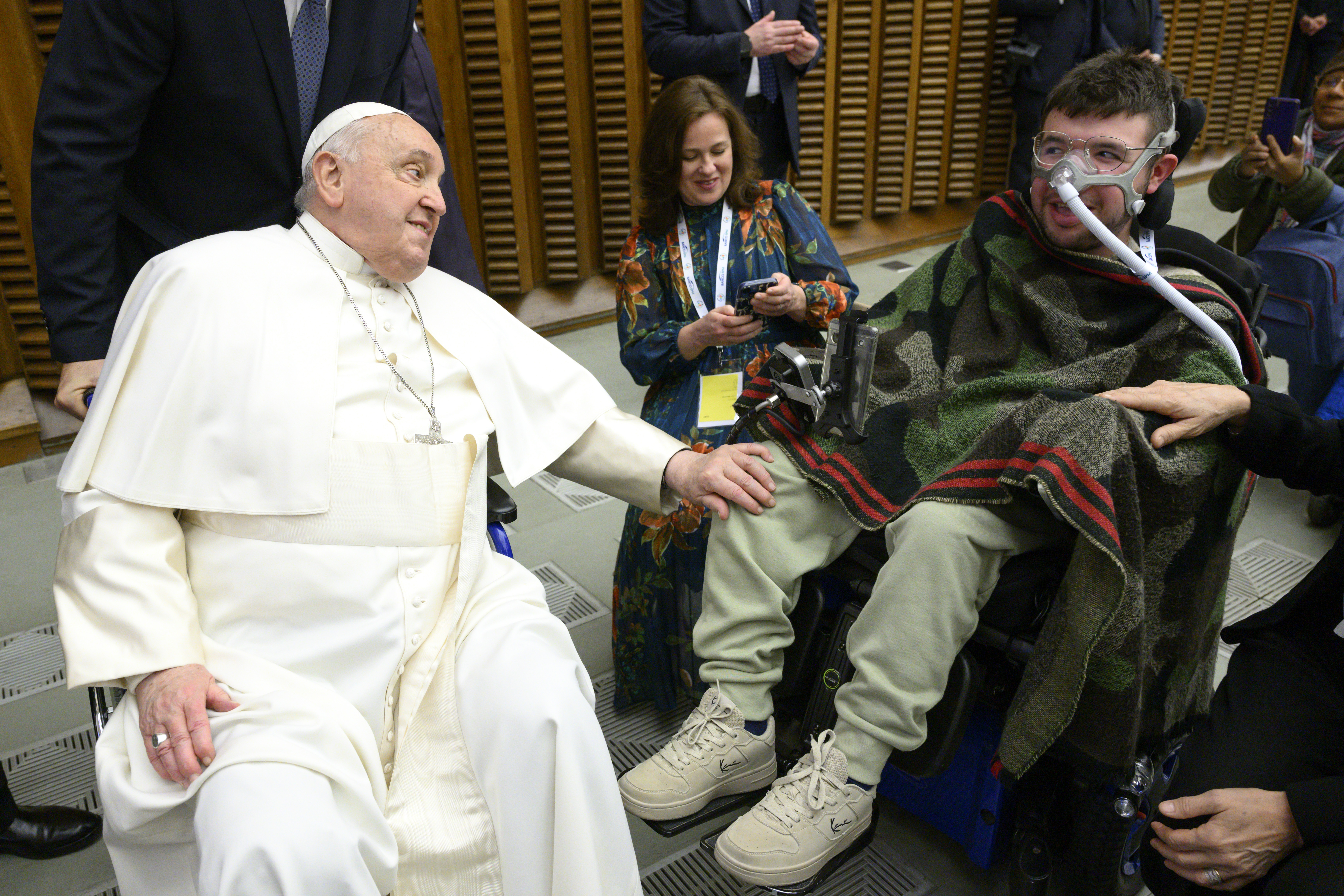
Pope Leo XIV embraces a participant in his audience with members of the Jérôme Lejeune Foundation in the Apostolic Palace at the Vatican on June 22, 2026. | Credit: Vatican Media
In his address, the pontiff also recalled the figure of Lejeune, a French scientist whose cause for beatification advanced when Pope Francis in 2021 signed the decree recognizing his heroic virtues.
Despite the international recognition Lejeune’s discovery brought him, it was later used by the abortion industry to identify unborn children with Down syndrome — something Lejeune firmly rejected.
The French geneticist, declared venerable, publicly defended the lives of the most vulnerable despite the rejection he faced in certain scientific circles.
During the June 22 meeting, held on the occasion of the centenary of Lejeune’s birth, the pope emphasized that the professor dedicated his life to children with disabilities: “Moved by the difficult situation of children with disabilities, Professor Lejeune devoted his life to them as a scientific researcher.”
Leo also recalled that the discovery of the chromosomal anomaly responsible for trisomy 21 made Lejeune a “pioneer of modern genetics.”
‘Medicine is the hatred of disease and the love of the patient’
The Holy Father likewise highlighted Lejeune’s medical vocation and his commitment to patients, whom he called “the poorest of the poor,” and cited one of his best-known expressions: “Medicine is the hatred of disease and the love of the patient.”
The pope also recalled the scientist’s influence in the Church, noting that St. Paul VI appointed him a member of the Pontifical Academy of Sciences and that his closeness to St. John Paul II contributed to the creation of the Pontifical Academy for Life.
In his remarks, Leo XIV warned about the ethically questionable use of scientific advances. “A man of science and wisdom, Jérôme Lejeune quickly understood that his scientific discovery would be used to eradicate people with trisomy 21 before their birth,” he said. The pontiff added that the geneticist denounced this phenomenon as “chromosomal racism.”
“Be, like him, committed witnesses in society, at the service of the constant pursuit of the common good,” he said.
Pope Leo XIV takes a photo with members of the Jérôme Lejeune Foundation in the Apostolic Palace at the Vatican on June 22, 2026. | Credit: Vatican Media
The pope reiterated that technology cannot replace medicine or be separated from an ethical framework: “The value of the human person does not depend on what he or she accomplishes or produces.”
Finally, he expressed gratitude for the work of the Lejeune Foundation, addressing its members, children of Venerable Lejeune present in the audience, and “dear friends with trisomy 21” and their parents.
“I am pleased by the place you occupy on the global level in research on intellectual disabilities of genetic origin,” he said.
The pontiff concluded by encouraging its members to continue promoting a culture of life and the common good, and he imparted his apostolic blessing, extending it to their families and to the patients served by the institution.
This story was first published by ACI Prensa, EWTN News’ Spanish-language sister service. It was translated and adapted by EWTN News English.
Pope Leo XIV called on the United Nations (U.N.) to prioritize people in combating world hunger and said feeding the hungry is an essential part of peacemaking.
The pontiff visited the headquarters of the U.N. Food and Agriculture Organization in Rome on Monday. In his remarks, Leo emphasized the seriousness of world hunger, explaining that it often fuels other social challenges, particularly migration.
“More than merely a humanitarian concern, hunger erodes social cohesion, heightens the risk of conflict, and fuels forced migration,” Leo said. “In effect, conflicts are ‘fed’ more readily than people are nourished. This reality reflects not only operational shortcomings but also a fundamental imbalance in political and moral priorities.”
The pope also stressed the importance of multilateral collaboration, stating that each state shares co-responsibility to “recognize the inherent God-given dignity of every person.” He also encouraged secular governments to be open to collaborating with the Catholic Church to assist the most vulnerable, recognizing their fundamental human right to adequate food.
“Access to adequate food is a fundamental human right grounded in the dignity of every person,” Leo remarked.
“The Catholic Church — through parishes, dioceses, Caritas agencies, and other faith-based initiatives — often reaches vulnerable populations in areas inaccessible to international actors. I therefore encourage the World Food Programme and its partners to continue supporting these efforts.”
The U.N. Food and Agriculture Organization was established in 1945 in response to widespread hunger and food insecurity worldwide following World War II. In his address, Leo XIV praised the progress of the organization’s mission while warning the U.N. about the dangers of a bureaucracy that slows the delivery of food assistance to disadvantaged populations.
“Implementing this appeal [to fight hunger] effectively requires reducing unnecessary bureaucracy so that transparency and accountability serve people rather than impede assistance,” the pope said.