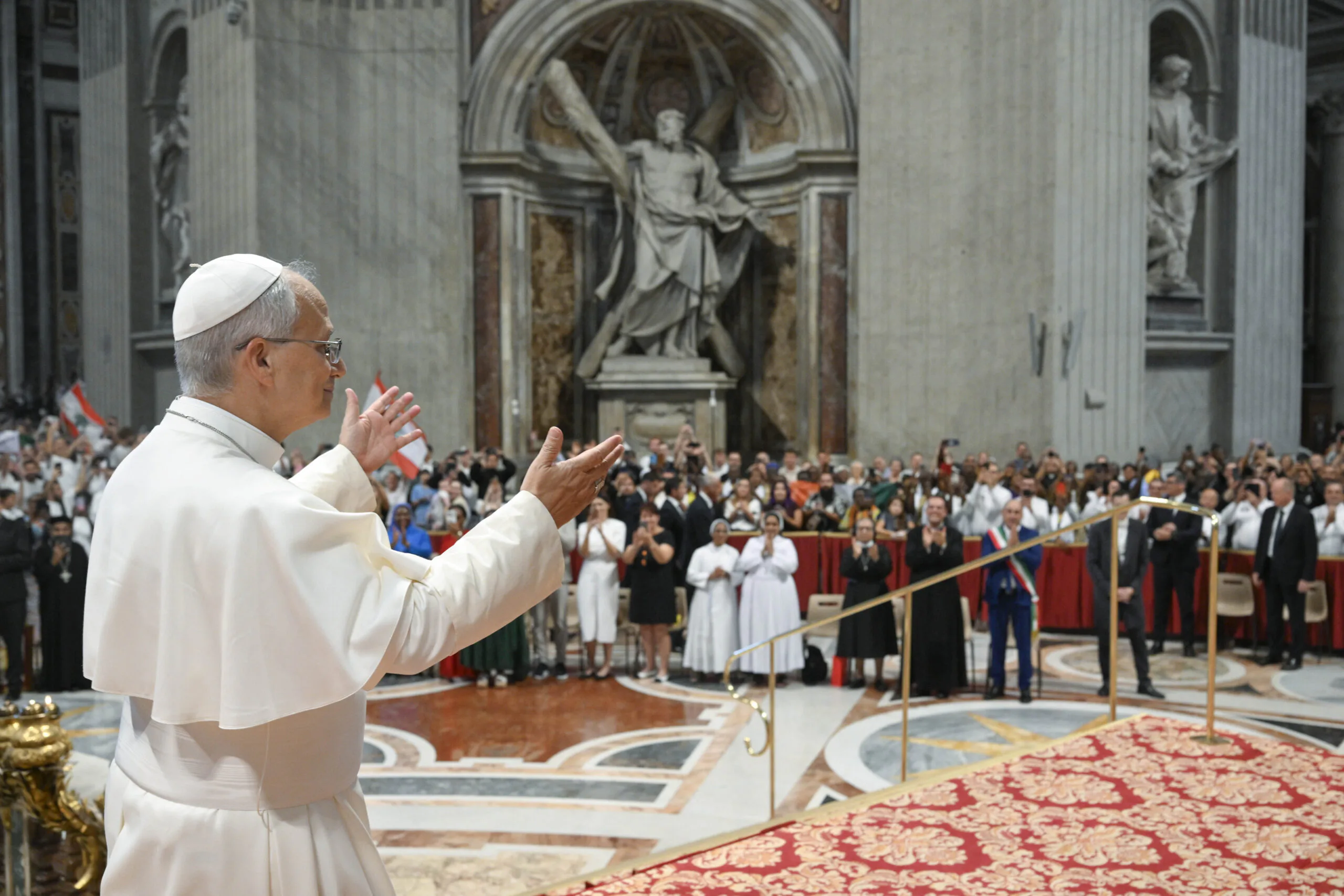
Pope Leo XIV at the Vaticanʼs Easter Vigil on April 4 described the ancient ceremony as “filled with light” and as the “mother of all vigils” where the faithful “relive the memorial of the victory of the Lord of life over death.”
“We do so after having traversed, over the past few days — as if in a single, grand celebration — the mysteries of the Passion of the God who, for our sake, became a man of sorrows: despised and rejected by men, tortured and crucified,” the pope reflected.
Pope Leo XIV presides over the Easter Vigil at St. Peter’s Basilica, Saturday, April 4, 2026. | Credit: Daniel Ibáñez/EWTN News
At the vigil in St. Peter’s Basilica, the pope described the Risen Christ as "the very Creator of the universe who — just as he granted us existence out of nothing at the dawn of history — so too, upon the Cross, in order to demonstrate his boundless love for us, bestowed upon us the gift of life.”
Reflecting on the account of the Resurrection, Leo said: “On Easter morning, the women — overcoming their sorrow and fear — set out on their way. They wanted to go to Jesus’ tomb. They expected to find it sealed, with a large stone at the entrance and soldiers standing guard."
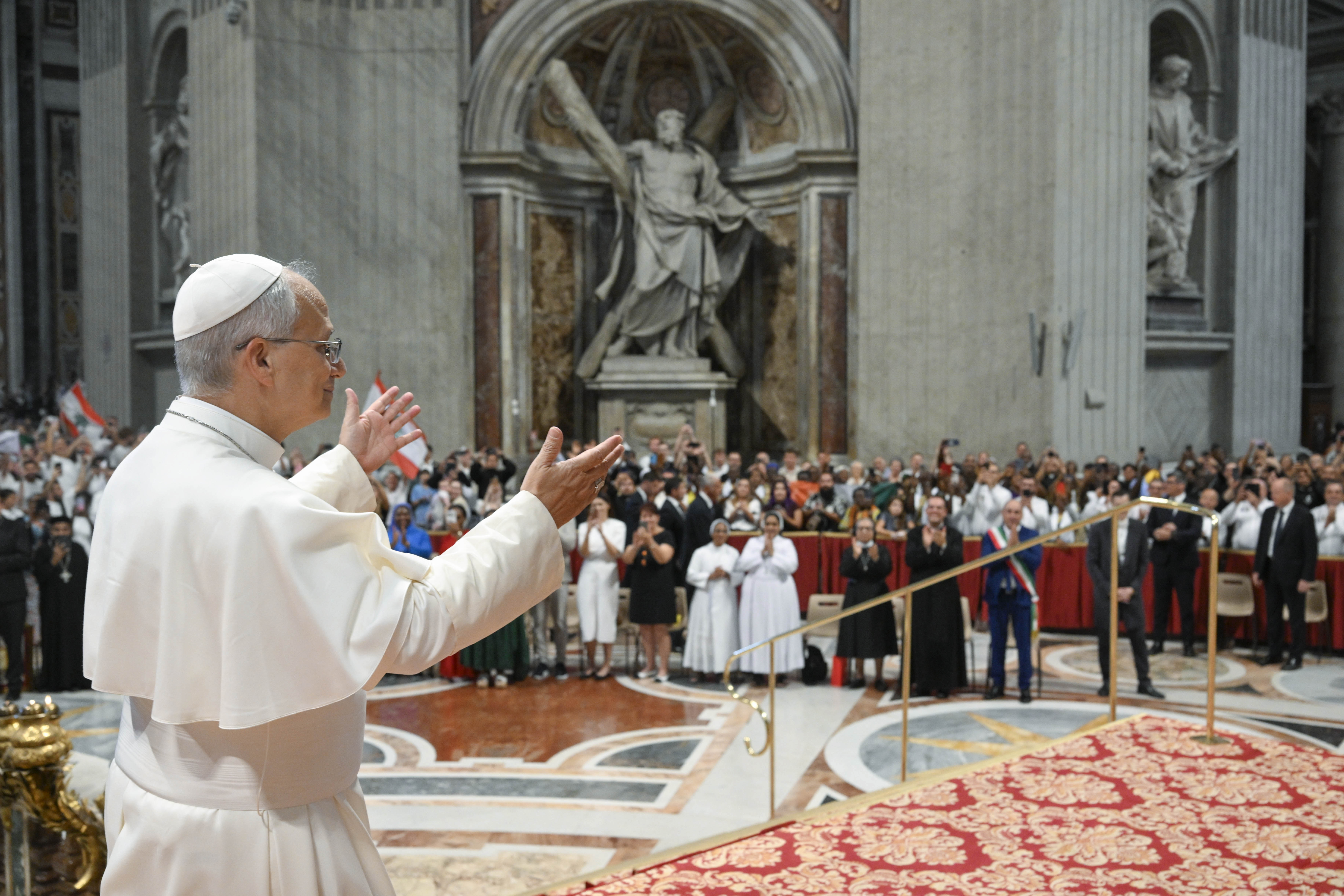
Pope Leo XIV presides over the Easter Vigil at St. Peter’s Basilica, Saturday, April 4, 2026. | Credit: Daniel Ibáñez/EWTN News
He described that stone as representative of sin, “a massive barrier that shuts us in and separates us from God, seeking to stifle his words of hope within us.”
"Mary Magdalene and the other Mary, however, did not let themselves be intimidated," he said. "They went to the tomb and, thanks to their faith and their love, became the first witnesses of the Resurrection.”
The pope said Jesus' message to the women — “Peace be with you” — is “also our message to the world.”
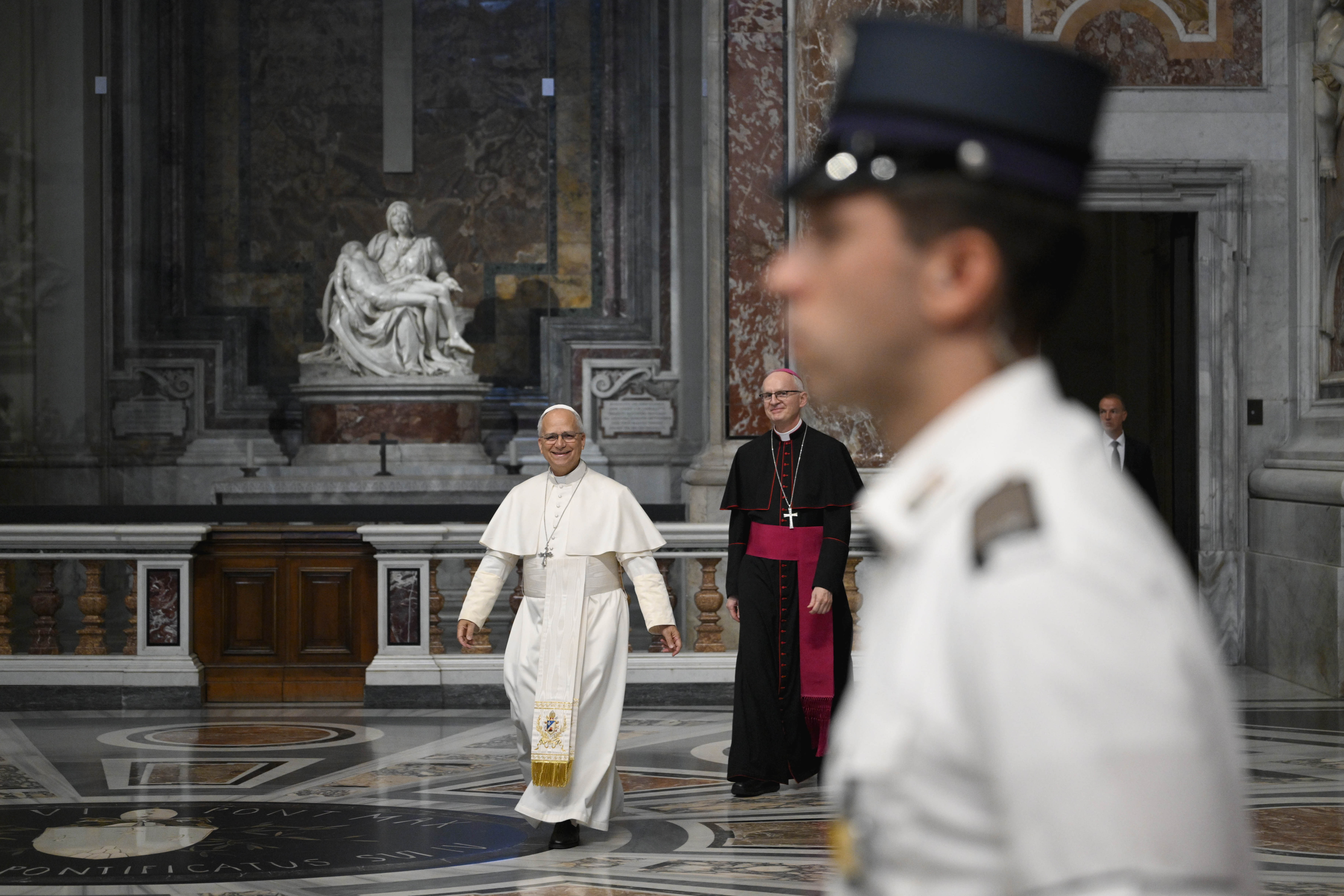
Pope Leo XIV presides over the Easter Vigil at St. Peter’s Basilica, Saturday, April 4, 2026. | Credit: Daniel Ibáñez/EWTN News
"Like the women who ran to bring the news to the brethren, we too wish to set out tonight from this Basilica, to carry to everyone the Good News that Jesus has risen, and that — through his power, having risen with him — we too can give birth to a new world of peace and unity.”
Addressing the catechumens receiving baptism during the vigil, the pope described them as “reborn in Christ to become new creatures.”
“Even in our own day, there is no shortage of tombs that need opening; indeed, the stones sealing them are often so heavy and so heavily guarded that they seem immovable,” he said.
“Some of these stones weigh upon the human heart — such as mistrust, fear, selfishness, and resentment. Others — the consequences of those inner burdens — sever the bonds between us, such as war, injustice, and the closing off of peoples and nations from one another.”
“Let us not allow ourselves to be paralyzed by them!” the pope said.
Pointing to the heroic work of the Christians of the past, the pope urged the faithful to “be moved by their example.”
“And on this Holy Night, let us make their commitment our own, so that everywhere and always — throughout the world — the Easter gifts of harmony and peace may grow and flourish,” he said.
This story was originally published by ACI Stampa, EWTN News' Italian-language partner agency. It has been translated and adapted by EWTN News English.
VATICAN — Pope Leo XIV presided over the Celebration of the Lord’s Passion in St. Peter’s Basilica on Good Friday during which the preacher of the papal household exhorted Christians to “approach the Lord’s cross without fear.”
The liturgy began with the pope lying prostrate before the cross and then unfolded in three parts: the Liturgy of the Word, veneration of the cross, and Holy Communion.
There was no opening antiphon; the solemn liturgy began with silent prayer, the unifying thread through the entire celebration.
After the proclamation of the Gospel of John’s account of Christ’s passion, the papal preacher, Father Roberto Pasolini, OFMCap, delivered a homily.
Pope Leo XIV lies prostrate before the altar in St. Peter’s Basilica during the Liturgy of the Lord’s Passion, Friday, April 3, 2026. | Credit: Daniel Ibáñez/EWTN News
‘The greatest act of love’
“In a time like ours, still torn apart by hatred and violence, when even the name of God is invoked to justify wars and deadly decisions, we Christians are called to approach the Lord’s Cross without fear — indeed, with full trust — knowing that it is a throne upon which one sits and learns to reign with him by placing one’s life at the service of others,” Pasolini said.
“If we can hold fast to the profession of this faith, then our days too will be able to give voice to the songs of both joy and suffering, that mysterious score of the Cross in which the notes of the greatest love can be clearly recognized,” he continued.
The preacher recalled that the day’s liturgy invites Catholics to contemplate the Passion: “Yet the Cross of Christ risks remaining incomprehensible if we look at it only as an isolated fact, as a sudden event. In reality, it is the highest point of a journey, the fulfillment of an entire life in which Jesus learned to listen to and welcome the voice of the Father, allowing himself to be guided day by day all the way to the greatest act of love.”
“Jesus is the man of sorrows who knows suffering well — no violence, no resort to force, no temptation to destroy everything and start over from scratch. We know how difficult it is to embrace such a mission. We are tempted to use aggression and violence, thinking that without them nothing can ever be resolved. But only meekness is the true strength for confronting the darkness of evil,” he continued.
Father Roberto Pasolini preaches during the Liturgy of the Lord’s Passion in St. Peter’s Basilica, Friday, April 3, 2026. | Credit: Daniel Ibáñez/EWTN News
Example of the Servant Songs
In his homily, Pasolini referred to the Servant Songs, four poetic texts found in the Book of the Prophet Isaiah (42, 49, 50, 52–53), which describe a mysterious figure — the “Servant”— who fulfills God’s will through vicarious suffering.
“To understand this journey during the days of Holy Week, the liturgy has had us listen to the so‑called Songs of the Servant of the Lord. These are poetic texts in which the prophet Isaiah sketched the figure of a mysterious servant through whom God would be able to save the world from evil and sin. Christian tradition has recognized in these songs a striking and dramatic foreshadowing,” Pasolini explained.
“In the third song, a new surprise emerges: The servant wants to help, but people respond with anger and violence,” Pasolini said. “Those who live in darkness do not always welcome the light, because the light also exposes what we would prefer to keep hidden — our wounds, our ambiguities.”
“In the fourth song, something deeply unsettling occurs: The violence inflicted on the servant is so intense that it disfigures his face. He has no appearance or beauty, yet the servant has learned not to return the evil he has received,” the preacher said.
The servant "does not resign himself to this logic [of violence]; he absorbs everything without retaliating. For this reason, he bore the sin of many,” the priest explained.
For the papal preacher, the Lord Jesus “did not merely listen to these songs; he lived them intensely, with complete trust in the Father.”
“We see it constantly in wars, in divisions, in wounds: evil keeps circulating because it always finds someone willing to pass it on. Jesus broke this chain by accepting what happened to him. In the Passion, he recognized the score of the songs of love and service that the Father had entrusted to him. In this way, he learned the most difficult obedience — the obedience of loving the other,” Pasolini continued.
“The voice of God no longer guides us — not because it has disappeared, but because it has become just one voice among many, the others promising security and well‑being,” he said.
“What is missing is a word, a song capable of guiding our steps toward a more just world,” he added. “And yet, if we look closely, we can glimpse a silent crowd of people who choose a different voice — a voice that does not shout, that does not impose itself by force, a quiet and persistent song that invites us to love and never return evil for evil. They do not perform extraordinary deeds, but each day they try to make their lives serve not only themselves, but others as well.”
Pope Leo XIV prays in St. Peter’s Basilica during the Liturgy of the Lord’s Passion, Friday, April 3, 2026. | Credit: Daniel Ibáñez/EWTN News
‘Lay down the weapons’
Referencing the act of venerating the cross, Pasolini encouraged those present to use the opportunity to “lay down the weapons” they are holding.
“They may not seem as dangerous as those wielded by the powerful of this world. Yet they, too, are instruments of death, because they are enough to weaken, wound, and drain meaning and love from our daily relationships,” he said.
“Salvation will not drop down from above, nor can it be guaranteed by political, economic, or military decisions. The world is constantly being saved by those who are willing to embrace the Songs of the Servant of the Lord as the shape of their own lives,” the preacher encouraged.
“This is what the Lord Jesus did. He took the Father’s will seriously, accepting it as a score to be carried out to the end, with loud cries and tears.”
“Tonight we too are handed the score of the cross. We can freely accept it if we acknowledge that there is no difficulty that cannot be faced, no guilty party we must point to, no enemy who can prevent us from loving and serving."
"There is only ourselves — who, by choosing not to return evil, by remaining patient in trials, by believing in good even when darkness seems to swallow everything, can become day by day those servants the Lord needs to bring salvation into the world,” he said.
This story was originally published by ACI Stampa, EWTN News' Italian-language partner agency. It has been translated and adapted by EWTN News English.
Pope Leo XIV urged the faithful to “live our lives as a journey” and prayed for the Church to “follow in the footprints” of Christ as he walked the Via Crucis on April 3.
The pope personally carried the cross through every station of the Good Friday Way of the Cross at the Colosseum, the first time in four years the figure of the Supreme Pontiff has been present at the amphitheater.
Due to health concerns, Pope Francis last participated in person at the Colosseum in 2022, appearing via video after that.
Leo told media earlier in the week that the event “will be an important sign, given what the pope represents: a spiritual leader in today’s world — a voice to proclaim that Christ still suffers.”
"And I, too, carry all of this suffering in my prayers,” the pope said.
The Via Crucis meditations for 2026 were written by Father Francesco Patton, the former Custos of the Holy Land. The reflections noted that “every authority must answer before God for the manner in which it exercises the power it has received,” including “the power to initiate a war or to end it” and “the power to trample upon human dignity or to safeguard it.”
“Each one of us, too, is called to answer for the power we exercise in our daily lives,” the meditations said.
At the conclusion of the Way of the Cross, the pope quoted Saint Francis of Assisi in praying that God would “give us miserable ones the grace to do for you alone what we know you want us to do and always to desire what pleases you.”
“Inwardly cleansed, interiorly enlightened and inflamed by the fire of the Holy Spirit, may we be able to follow in the footprints of your beloved Son, our Lord Jesus Christ,” the pope prayed.
This story was originally published by ACI Stampa, EWTN News' Italian-language partner agency. It has been translated and adapted by EWTN News English.
Pope Leo XIV urged the faithful to “live our lives as a journey” and prayed for the Church to “follow in the footprints” of Christ as he walked the Via Crucis on April 3.
A flickering cross towers at the Colosseum in Rome on Good Friday, April 3, 2026. | Credit: Daniel Ibáñez/EWTN NewsPope Leo XIV carries the cross during the Via Crucis at the Colosseum in Rome, Friday, April 3, 2026. | Credit: Daniel Ibáñez/EWTN NewsPope Leo XIV carries the cross during the Via Crucis at the Colosseum in Rome, Friday, April 3, 2026. | Credit: Daniel Ibáñez/EWTN NewsA candle flickers at the Colosseum in Rome on Good Friday, April 3, 2026. | Credit: Daniel Ibáñez/EWTN NewsPope Leo XIV carries the cross during the Via Crucis at the Colosseum in Rome, Friday, April 3, 2026. | Credit: Daniel Ibáñez/EWTN NewsPope Leo XIV carries the cross during the Via Crucis at the Colosseum in Rome, Friday, April 3, 2026. | Credit: Daniel Ibáñez/EWTN News
The Good Friday Reproaches are a series of antiphons, known also as the “Improperia” or “Popule Meus” (“My People”), coming from the opening lines of the Latin text of the recitation.
Dating back to the ninth century, though not gaining a permanent place in the Roman orders until the 14th century, the Good Friday Reproaches have long been an essential part of the Roman liturgy. But they largely disappeared from many parishes following the liturgical reforms of the Second Vatican Council.
The antiphons have, however, retained their prominence at the Vatican — and are normally chanted by the Sistine Chapel Choir during the Good Friday service in St. Peter’s Basilica.
In the moment leading up to the dramatic recitation, the priest chants three times, in an increasing pitch, “Ecce lignum crucis,” or “Behold the wood of the cross,” each time gradually unveiling the cross that hitherto has been covered in a purple veil.
Once the crucifix is placed in a central location at the edge of the sanctuary, cast against a bare altar, the faithful are invited to kneel before — and kiss — it, a powerful remembrance of Christ’s passion but also a recognition of the cross as an instrument of salvation.
During the adoration of the cross, the Good Friday Reproaches are chanted in an alternating manner between a cantor and choir. It opens: “Popule meus, quid feci tibi? Aut in quo contristavi te? Responde mihi” (“My people, what have I done to you? How have I offended you? Answer me”).
This hauntingly sorrowful and beautiful text is followed by the first reproach: “Quia eduxi te de terra Aegypti: parasti crucem Salvatori tuo” (“Because I led thee out of the land of Egypt: thou hast prepared a cross for thy Savior”), showcasing the world’s fatal rejection of Christ despite his love and saving acts.
The following is the full text of the reproaches:
Popule meus, quid feci tibi? Aut in quo contristavi te? Responde mihi. (O my people, what have I done to thee? Or how have I offended you? Answer me.)
Quia eduxi te de terra Aegypti: parasti crucem Salvatori tuo. (Because I led thee out of the land of Egypt: thou hast prepared a cross for thy Savior.)
Hagios o Theos. Sanctus Deus. Hagios Ischyros. Sanctus fortis. Hagios Athanatos, eleison himas. Sanctus immortalis, miserere nobis. (O holy God! O holy God! O holy strong One! O holy strong One! O holy and immortal, have mercy upon us. O holy and immortal, have mercy upon us.)
Quia eduxi te per desertum quadraginta annis: et manna cibavi te, et introduxi te in terram satis bonam: parasti crucem Salvatori tuo. Hagios … (Because I led thee through the desert for 40 years: and fed thee with manna, and brought thee into a land exceeding good: Thou hast prepared a cross for thy Savior. O holy God! …)
Quid ultra debui facere tibi, et non feci? Ego quidem plantavi te vineam meam speciosissimam: et tu facta es mihi nimis amara: aceto namque sitim meam potasti: et lancea perforasti latus Salvatori tuo. Hagios … (What more ought I to have done for thee, that I have not done? I planted thee, indeed, my most beautiful vineyard: and thou hast become exceeding bitter to me: for in my thirst thou gavest me vinegar to drink: and with a spear thou hast pierced the side of thy Savior. O holy God! …)
Ego propter te flagellavi Aegyptum cum primogenitis suis: et tu me flagellatum tradidisti. Popule meus … (For thy sake I scourged the firstborn of Egypt: Thou hast given me up to be scourged. O my people …)
Ego te eduxi de Aegypto, demerso Pharone in mare Rubrum: et tu me tradidisti principibus sacerdotum. Popule meus … (I led thee out of Egypt, having drowned Pharaoh in the Red Sea: and thou hast delivered me to the chief priests. O my people …)
Ego ante te aperui mare: et tu aperuisti lancea latus meum. Popule meus … (I opened the sea before thee: and thou hast opened my side with a spear. O my people …)
Ego ante te praeivi in columna nubis: et tu me duxisti ad praetorium Pilati. Popule meus … (I went before thee in a pillar of cloud: and thou hast led me to the judgment hall of Pilate. O my people …)
Ego te pavi manna in desertum: et tu me cedisti alapis et flagellis. Popule meus . . . (I fed thee with manna in the desert: and thou hast assaulted me with blows and scourges. O my people …)
Ego te potavi aqua salutis de petra: et tu me potasti felle et aceto. Popule meus … (I gave thee the water of salvation from the rock: and thou hast given me gall and vinegar to drink. O my people …)
Ego propter te Chananeorum reges percussi: et tu percussisti arundine caput meum. Popule meus . . . (For thy sake I struck the kings of the Canaanites: and thou hast struck my head with a reed. O my people …)
Ego dedi tibi sceptrum regale: et tu dedisti capiti meo spineam coronam. Popule meus … (I gave thee a royal scepter: and thou hast given a crown of thorns for my head. O my people …)
Ego te exaltavi magna virtute: et tu me suspendisti in patibulo crucis. Popule meus … (I exalted thee with great strength: and thou hast hanged me on the gibbet of the cross. O my people …)
This story was first published on Good Friday 2024 and has been updated.
Pope Leo XIV spoke by phone with Israeli President Isaac Herzog and Ukrainian President Volodymyr Zelenskyy on Good Friday.
The Vatican said the pope spoke separately with both presidents on April 3. They exchanged Easter and Passover greetings. Leo also spoke with the presidents about the ongoing wars in Ukraine and the Middle East and highlighted the need for continued humanitarian aid.
The Middle East and Ukraine continue to be plagued by armed conflicts. The U.S. and Israeli conflict with Iran has entered a new phase with U.S. President Donald Trump this week vowing stronger military action against Iran. The Russia-Ukraine War continues to claim casualties and has entered its fourth year.
A statement from the office of the Israeli president said Herzog discussed the U.S.-Israeli war on Iran with the pope, including “the ongoing threat of missile attacks by the Iranian regime and its terror proxies against people of all faiths in the region.”
The statement also said that Herzog recalled to Leo recent Iranian missile attacks on Jerusalem, and his insistence that Hezbollah continues to be a threat to stability in the Middle East.
The telephone discussions followed Leo’s public plea on March 31 in which he again called for an unconditional ceasefire and expressed hopes that Trump would be “looking for a way to decrease the amount of violence, of bombing.” In that same plea, he also called for an Easter truce for both conflicts.
The discussion between the pope and the Israeli president also followed an incident in Jerusalem on March 29, where the Latin patriarch, Cardinal Pierbattista Pizzaballa, was denied access to the Holy Sepulchre on Palm Sunday by Israeli police.
The Latin Patriarchate of Jerusalem and the Custody of the Holy Land later reached an agreement with Israeli authorities, permitting access for Church representatives to celebrate Masses and religious rites while restrictions on public gatherings remain in force.
Neither the office of the Israeli president nor the Vatican commented on whether the pope and Herzog discussed the incident in Jerusalem.
Pope Leo XIV celebrated a chrism Mass at the Vatican on April 2, his first as pope after being elected as supreme pontiff in May 2025.
The Mass included the traditional blessing of the holy oils that will be used throughout the year in the sacraments of baptism, confirmation, anointing of the sick, and holy orders.
Pope Leo XIV presides over a chrism Mass at the Vatican on Holy Thursday, April 2, 2026. | Credit: Daniel Ibáñez/EWTN NewsPope Leo XIV presides over a chrism Mass at the Vatican on Holy Thursday, April 2, 2026. | Credit: Daniel Ibáñez/EWTN NewsPope Leo XIV breathes over oil during a chrism Mass at the Vatican on Holy Thursday, April 2, 2026. | Credit: Daniel Ibáñez/EWTN NewsPope Leo XIV greets clergy at a chrism Mass at the Vatican on Holy Thursday, April 2, 2026. | Credit: Daniel Ibáñez/EWTN NewsPope Leo XIV greets clergy at a chrism Mass at the Vatican on Holy Thursday, April 2, 2026. | Credit: Daniel Ibáñez/EWTN NewsClergy raise their hands in prayer during a chrism Mass at the Vatican on Holy Thursday, April 2, 2026. | Credit: Daniel Ibáñez/EWTN NewsPope Leo XIV presides over a chrism Mass at the Vatican on Holy Thursday, April 2, 2026. | Credit: Daniel Ibáñez/EWTN NewsChrismaria stand in a line at a chrism Mass at the Vatican on Holy Thursday, April 2, 2026. | Credit: Daniel Ibáñez/EWTN News
Pope Leo XIV on Holy Thursday returned the Mass of the Lord’s Supper to the Basilica of St. John Lateran, reviving a papal practice last observed there in 2012 under Benedict XVI.
Departing from Pope Francis’ custom of celebrating the liturgy in prisons or migrant centers, Leo celebrated the rite in the cathedral of Rome and washed the feet of 12 priests of the Diocese of Rome.
In his homily, the pope framed the liturgy as the solemn entrance into the Easter Triduum and said Christ’s love, shown in both the Eucharist and the washing of the feet, reveals the justice of God in a world wounded by evil.
“This evening’s solemn liturgy marks our entry into the holy Triduum of the Lord’s passion, death, and resurrection,” Leo said. “We cross this threshold not as mere spectators, nor out of habit, but as those personally invited by Jesus himself as guests at the Supper in which bread and wine become for us the sacrament of salvation.”
“His love becomes both gesture and nourishment for all, revealing the justice of God,” the pope said. “In this world, and particularly in those places where evil abounds, Jesus loves definitively — forever, and with his whole being.”
Reflecting on the washing of the feet, Leo said the gesture is not simply a moral lesson but a revelation of God’s own way of loving.
“What the Lord shows us — taking the water, the basin, and the towel — is far more than a moral example,” he said. “He entrusts to us his very way of life. The washing of the feet is a gesture that encapsulates the revelation of God.”
The pope also cited Benedict XVI, recalling that Christians must repeatedly learn that God’s greatness is unlike worldly greatness. “We too must ‘learn repeatedly that God’s greatness is different from our idea of greatness… because we systematically desire a God of success and not of the Passion,’” Leo said.
He warned that human beings are tempted to seek a God who grants success, victory, or usefulness like wealth and power rather than recognizing the divine power revealed in humble service.
“Yet we fail to perceive that God does indeed serve us through the gratuitous and humble gesture of washing feet,” Leo said. “This is the true omnipotence of God.”
The pope said Jesus’ action purifies both humanity’s false image of God and its false image of man.
“For we tend to consider ourselves powerful when we dominate, victorious when we destroy our equals, great when we are feared,” he said. “In contrast, as true God and true man, Christ offers us the example of self-giving, service, and love.”
Leo stressed that Christ gave this example not in a moment of acclaim but “on the night he was betrayed, in the darkness of incomprehension and violence.”
“In this way, it becomes clear that the Lord’s love precedes our own goodness or purity; he loves us first, and in that love, he forgives and restores us,” the pope said.
Quoting St. John’s Gospel, Leo urged Christians to live out mutual service in imitation of Christ: “He does not ask us to repay him but to share his gift among ourselves: ‘You also ought to wash one another’s feet.’”
The pope also referred to Pope Francis’ 2013 Holy Thursday homily, noting that Christian service cannot be reduced to abstraction or empty obligation but must spring from charity.
Allowing oneself to be served by the Lord, Leo said, is a precondition for serving others. “By washing our bodies, Jesus purifies our souls,” he said. “In him, God has given us an example — not of how to dominate, but of how to liberate; not of how to destroy life, but of how to give it.”
In one of the homily’s strongest appeals, the pope turned to the suffering of those crushed by violence and oppression.
“As humanity is brought to its knees by so many acts of brutality, let us too kneel down as brothers and sisters alongside the oppressed,” he said.
Leo said the liturgy of Holy Thursday draws together the institution of the Eucharist and holy orders, revealing “the perfect self-gift of Jesus, the High Priest and living, eternal Eucharist.”
Addressing priests directly, he said: “Beloved brothers in the priesthood, we are called to serve the people of God with our whole lives.”
He concluded by inviting Catholics to spend time in Eucharistic adoration and to ask for the grace to imitate Christ’s love.
“Holy Thursday is therefore a day of fervent gratitude and authentic fraternity,” the pope said. “May this evening’s Eucharistic adoration, in every parish and community, be a time to contemplate Jesus’ gesture, kneeling as he did, and to ask for the strength to imitate his service with the same love.”
This story was first published by ACI Stampa, the Italian-language sister service of EWTN News. It has been translated and adapted by EWTN News English.
Departing from Pope Francis’ custom of celebrating the liturgy in prisons or migrant centers, Leo celebrated the rite in the cathedral of Rome and washed the feet of 12 priests of the Diocese of Rome.
Pope Leo XIV greets the faithful at the Basilica of St. John Lateran during the Mass of the Lord’s Supper, Thursday, April 2, 2026. | Credit: Daniel Ibáñez/EWTN NewsPope Leo XIV celebrates the Mass of the Lord’s Supper at the Basilica of St. John Lateran, Thursday, April 2, 2026. | Credit: Daniel Ibáñez/EWTN NewsPope Leo XIV washes the feet of priests at the Basilica of St. John Lateran during the Mass of the Lord’s Supper, Thursday, April 2, 2026. | Credit: Daniel Ibáñez/EWTN NewsAcolytes process through the Basilica of St. John Lateran during the Mass of the Lord’s Supper, Thursday, April 2, 2026. | Credit: Daniel Ibáñez/EWTN NewsThe Gospel is held aloft at the Basilica of St. John Lateran during the Mass of the Lord’s Supper, Thursday, April 2, 2026. | Credit: Daniel Ibáñez/EWTN NewsPope Leo XIV incenses the altar of the Basilica of St. John Lateran during the Mass of the Lord’s Supper, Thursday, April 2, 2026. | Credit: Daniel Ibáñez/EWTN NewsPope Leo XIV holds a crucifix aloft at the Basilica of St. John Lateran during the Mass of the Lord’s Supper, Thursday, April 2, 2026. | Credit: Daniel Ibáñez/EWTN News
Pope Leo XIV on Holy Thursday proposed Christian mission as an antidote to what he called the “imperialist occupation of the world,” saying it is now a priority to remember that “neither in the pastoral sphere nor in the social and political spheres can good come from abuse of power.”
At the chrism Mass in St. Peter’s Basilica on April 2, the pope reflected on the mission God entrusts to his people and warned that it must never be distorted by “a desire for domination, entirely foreign to the way of Jesus Christ.”
“The cross is part of the mission: The sending becomes more bitter and frightening, but also more freeing and transformative,” Leo said. “The imperialist occupation of the world is thus disrupted from within; the violence that until now has been the law is unmasked.”
The pope did not point to any specific geopolitical situation when he used the phrase.
The chrism Mass, one of the principal liturgies of Holy Thursday, includes the blessing of the holy oils that will be used throughout the year in the sacraments of baptism, confirmation, anointing of the sick, and holy orders. During the Mass, priests also renew the promises they made at ordination.
Presiding over the rite for the first time as bishop of Rome, Leo addressed nearly 1,000 priests in St. Peter’s Basilica and emphasized that the Christian mission is never lived in isolation or in rupture with the Church.
“Each of us takes part in it according to our own vocation in a deeply personal obedience to the voice of the Spirit, yet never without others, never neglecting or breaking communion!” he said.
The pope said the Easter Triduum, which begins later on Holy Thursday, calls Christians not to flee trial but to pass through it with Christ.
“What we are about to relive, in fact, possesses the power to transform what human pride generally tends to harden: our identity and our place in the world,” he said. “Jesus’ freedom changes hearts, heals wounds, refreshes and brightens our faces, reconciles and gathers us together, and forgives and raises us up.”
Leo also stressed that the Church is apostolic because it is sent out, not static, and said bishops and priests are called to remain at the service of a missionary people.
He warned that mission has too often been warped by worldly logic and said authentic Christian love cannot be tied to force or display.
“Love is true only when it is unguarded; it requires little fuss, no ostentation, and gently cherishes weakness and vulnerability,” he said.
The pope also cautioned against approaching the poor with worldly signs of influence.
“There is no ‘good news to the poor’ … if we go to them bearing the signs of power, nor is there authentic liberation unless we free ourselves from attachment,” he said.
Instead, Leo pointed to the witness of the great missionaries, who, he said, embody “quiet, unobtrusive approaches, whose method is the sharing of life, selfless service, the renunciation of any calculated strategy, dialogue, and respect.”
He added that Christian mission requires simplicity and reverence before the mystery present in every people and culture.
“As Christians, we are guests,” he said. “To be hosts, in fact, we must learn to be guests ourselves.”
Even in places marked by secularization, he said, the Church must not think in terms of conquest or reconquest but of listening, accompaniment, and witness. That is possible only when the Church walks together, he said, and when mission is not “a heroic adventure reserved for a few, but the living witness of a body with many members.”
Leo also reflected on the possibility of rejection in Christian mission, recalling Jesus’ expulsion from Nazareth. Yet even that trial, he said, can become the place where the Gospel reveals its deepest power.
“How many ‘resurrections’ are we called to experience when, free from a defensive attitude, we immerse ourselves in service like a seed in the earth!” he said.
During the homily, the pope cited St. Óscar Romero, the archbishop of San Salvador murdered in 1980, as a witness of persevering hope amid danger and suffering.
At the close of his reflection, Leo urged Catholics to renew their commitment to a mission marked by unity and peace.
“In this dark hour of history, it has pleased God to send us to spread the fragrance of Christ where the stench of death reigns,” he said. “Let us renew our ‘yes’ to this mission that calls for unity and brings peace. Yes, we are here! Let us overcome the sense of powerlessness and fear!”
This story was first published by ACI Prensa, the Spanish-language sister service of EWTN News. It has been translated and adapted by EWTN News English.